Bagrati Cathedral in Kutaisi: A Symbol of Georgian Unity

Standing atop Ukimerioni Hill like a stone crown over Kutaisi, Bagrati Cathedral (Georgian: ბაგრატის ტაძარი) has witnessed more than a thousand years of Georgian history. Built in 1003 during the reign of King Bagrat III – the ruler who first united the Georgian kingdoms – this cathedral represents far more than medieval architecture. For Georgians, it embodies national identity itself.
The cathedral offers visitors spectacular panoramic views of Kutaisi, the Rioni River, and on clear days, the distant Caucasus mountain range. Whether you’re drawn by religious significance, architectural beauty, or simply the best sunset viewpoint in the city, Bagrati Cathedral deserves a place on your Kutaisi itinerary.
Quick Facts & Visitor Information
-
Location: Ukimerioni Hill, Kutaisi, Imereti Region
-
Built: 1003 AD (during the reign of King Bagrat III)
-
Architectural Style: Medieval Georgian cross-dome
-
Opening Hours: Daily 10:00 – 20:00
-
Entrance Fee: Free (donations are welcome)
-
Dress Code: Modest dress is required. Women should cover their shoulders and knees; headscarves are usually available at the entrance.
-
Time Needed: 45 minutes – 1.5 hours
-
Best Time to Visit: Late afternoon to capture the golden light and enjoy sunset views over the city.
The History of Bagrati Cathedral: From Unification to Restoration
The Birth of a Unified Georgia (978–1003)
The story of Bagrati Cathedral begins with one of Georgia’s most consequential rulers. In 978, young Bagrat III inherited the title of King of the Abkhazians from his father. Over the following decades, through strategic marriages, alliances, and military campaigns, he accomplished what no Georgian ruler had before: uniting the fragmented Georgian principalities into a single kingdom.
To commemorate this historic achievement, Bagrat III commissioned a cathedral that would stand as a permanent symbol of Georgian unity. Construction began in the late 10th century, with the cathedral completed and consecrated in 1003. The medieval chronicle “Matiane Kartlisai” records that for the consecration ceremony, Bagrat gathered rulers, clergy, and nobles from across his newly united realm, a deliberate statement of national cohesion.
An inscription near the north window, featuring some of the earliest Arabic numerals found in Georgia, provides the exact construction date: “The church was built in 223” (in the Georgian Koronikon calendar, equivalent to 1003 AD).
The Golden Age & Royal Coronations
The cathedral’s significance grew throughout Georgia’s Golden Age. In 1089, one of history’s greatest Georgian kings, David IV, known as David the Builder, was crowned within these walls. David would go on to transform Georgia into the dominant power of the Caucasus, and the cathedral where he received his crown became forever linked with Georgia’s period of greatest prosperity.
For centuries, Bagrati Cathedral served as a center of both religious and political life, hosting ceremonies, councils, and gatherings that shaped the nation’s destiny.
Destruction by the Ottomans (1691)
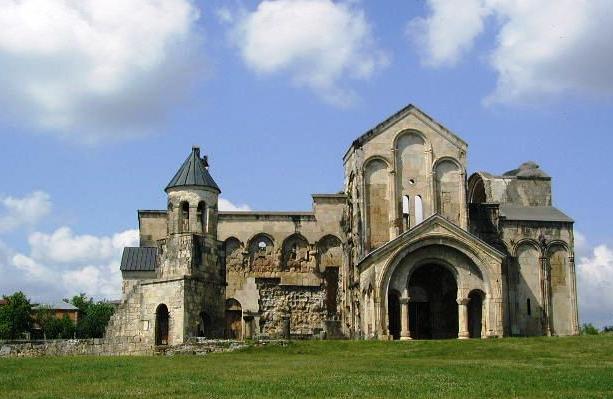
The cathedral’s grandeur came to a dramatic end in 1691. During the Ottoman-Georgian conflicts, Turkish forces besieged the Kutaisi fortress, which surrounded the cathedral. In a desperate attempt to break the Georgian defense, the Ottomans placed gunpowder beneath the cathedral and detonated it. While the thick stone walls survived the explosion, the great dome collapsed, leaving the interior open to the sky.
For over three centuries, Bagrati Cathedral stood as a roofless ruin – its broken silhouette a poignant reminder of both Georgia’s former glory and its subsequent struggles.
Soviet-Era Conservation & Modern Restoration
Systematic archaeological and conservation work began in the 1950s under Georgian architect Vakhtang Tsintsadze. These careful restoration phases continued through 1994, stabilizing the ruins while preserving their historical authenticity.
The cathedral’s fate changed dramatically in the 2000s when President Mikheil Saakashvili championed a full reconstruction. Italian architect Andrea Bruno led the controversial project, which restored the dome and returned the cathedral to its original form by 2012. On September 16, 2012—two weeks before parliamentary elections—the Patriarch of the Georgian Orthodox Church consecrated the rebuilt cathedral in a ceremony attended by thousands.
Architecture: A Masterpiece of Medieval Georgian Design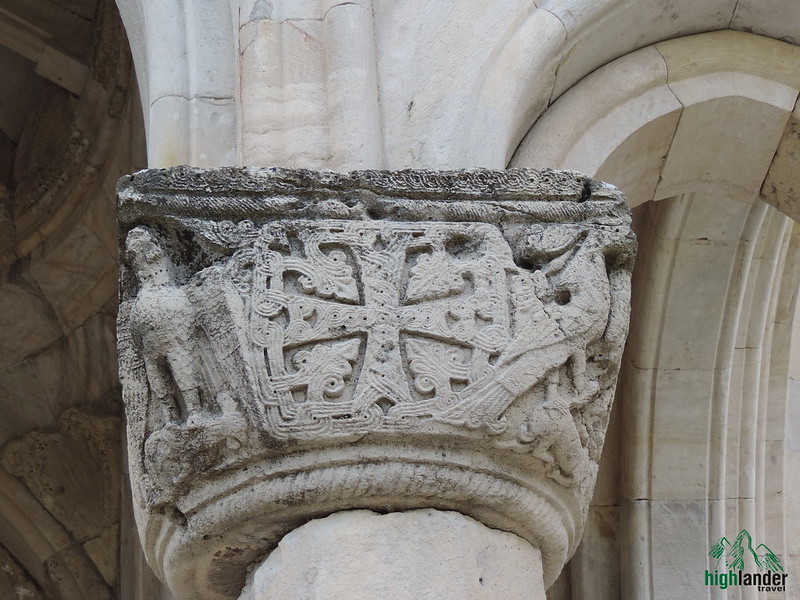
Bagrati Cathedral exemplifies the cross-dome architectural style that reached its peak in medieval Georgia. The design was influenced by the Church of St. John the Baptist in Oshki (modern-day Turkey), though Georgian architects developed their own distinctive approach.
Structural Elements
The cathedral’s layout follows a cruciform plan with four free-standing pillars supporting the central dome. Key architectural features include:
- Central dome – Rising on high drums, creating the dramatic vertical emphasis characteristic of Georgian church architecture
- Cross-shaped arms – The north and south arms project boldly from the building’s mass, clearly expressing the cross plan in the exterior silhouette
- Three-nave western arm – Featuring two-story side galleries with upper choirs
- Twin-story chambers – Flanking the eastern altar, used for liturgical purposes
- Limestone construction – Large hewn stone blocks fitted with remarkable precision
Decorative Features
Medieval Georgian craftsmen embellished the cathedral with intricate ornamental work. Visitors today can still appreciate:
- Elaborate stone carvings on the exterior walls and portals
- Fragments of the original mosaic floor
- Traces of medieval frescoes, including images of the Virgin Mary
- Ornate carved gateways on the western and southern arms were added several decades after initial construction
Archaeological excavations at the site have yielded gold jewelry from medieval graves, testifying to the cathedral’s role as a burial place for Georgian nobility.
The UNESCO Story: From World Heritage to Delisting
Bagrati Cathedral’s relationship with UNESCO represents one of the most controversial heritage debates in recent decades—and understanding this story adds an important layer to any visit.
World Heritage Inscription (1994)
In 1994, UNESCO inscribed Bagrati Cathedral together with the nearby Gelati Monastery as a joint World Heritage Site. The organization recognized both monuments as outstanding examples of medieval Georgian architecture representing “the Golden Age of medieval Georgia.”
The Restoration Controversy (2010–2017)
When the Georgian government announced plans for full reconstruction in the 2000s, UNESCO expressed serious concern. The organization argued that rebuilding a ruined monument with modern materials would compromise its historical authenticity—a principle central to World Heritage designation.
In 2010, UNESCO placed the combined Bagrati-Gelati site on its List of World Heritage in Danger, urging Georgia to halt reconstruction. Despite international criticism, the Georgian government proceeded, viewing the project as a matter of national significance that transcended UNESCO guidelines.
In 2017, UNESCO made the rare decision to remove Bagrati Cathedral from the World Heritage List entirely—only the fourth site ever delisted. The committee stated that reconstruction had been “detrimental to its integrity and authenticity.” Notably, Gelati Monastery retained its World Heritage status and was simultaneously removed from the endangered list.
What This Means for Visitors
The UNESCO decision sparked heated debate. Critics argued that reconstruction destroyed irreplaceable historical fabric. Supporters countered that Georgians had the right to restore a symbol of their national identity to its original glory.
For visitors, this controversy adds depth to the experience. You’ll see a functioning cathedral that looks much as it did in 1003—but you’ll also see modern steel and concrete elements incorporated into the reconstruction. This blend of ancient and modern reflects the ongoing global conversation about how cultures preserve and present their heritage.
Whatever your view on the restoration, Bagrati Cathedral remains profoundly significant to Georgians. It functions as an active place of worship, hosts regular services, and remains one of Kutaisi’s most popular venues for weddings—a living tradition connecting contemporary Georgia to its medieval past.
What to See & Do at Bagrati Cathedral
Inside the Cathedral
The reconstructed interior impresses with its soaring vaulted ceilings and spacious layout. While simpler than Georgia’s most ornate churches, the atmosphere is one of calm reverence. Look for:
- Original stone carvings were incorporated into the reconstruction
- Fragments of medieval frescoes
- The large central dome that collapsed in 1691 and was rebuilt in 2012
- If you’re lucky, witness a Georgian Orthodox service with traditional polyphonic singing
The Panoramic Views
Many visitors consider the views from Ukimerioni Hill the highlight of their visit. From the cathedral grounds, you can see:
- Downtown Kutaisi spread below
- The Rioni River winds through the city
- On clear days, the snow-capped Racha mountain range to the north
Pro tip: Visit in late afternoon when golden light illuminates the cathedral, then stay for sunset when Kutaisi lights up below. This is especially magical in autumn.
Georgian Weddings
Bagrati Cathedral is one of the most popular wedding venues in western Georgia. On weekends, you’ll likely see wedding parties in traditional attire, hear church bells, and witness the joyful celebrations that follow Georgian Orthodox ceremonies. It’s a wonderful glimpse into contemporary Georgian culture.
Photography Opportunities
The cathedral offers excellent photo opportunities:
- Best exterior shots: From the approach path, looking up at the hilltop silhouette
- Best interior light: Morning, when sunlight streams through eastern windows
- Best city views: Late afternoon golden hour through sunset
- Photography is permitted, but be respectful during services
How to Get to Bagrati Cathedral
From Kutaisi City Center
By taxi: The easiest option. A taxi from central Kutaisi costs approximately 5-7 GEL (around €2) and takes about 10 minutes. Use the Bolt or Yandex Go apps for transparent pricing.
On foot: Walking from the city center takes 30-40 minutes via an uphill route. While demanding, the walk rewards you with progressively improving views. Follow signs to “Bagrati” from the White Bridge (Tetri Khidi) area.
From Tbilisi
Kutaisi lies approximately 230 km west of Tbilisi. Options include:
- Marshrutka (minibus): Departs from Tbilisi’s Didube station; journey takes 3.5-4 hours; cost around 20 GEL
- Train: Georgian Railway operates a daily service; the journey takes approximately 5.5 hours
- Rental car: Scenic drive via the Rikoti Pass on the main E60 highway
- Guided tour from Tbilisi: Full-day tours typically combine Bagrati with Gelati Monastery and Prometheus Cave
From Kutaisi International Airport
David the Builder Kutaisi International Airport lies 14 km west of the city. Taxis to Bagrati Cathedral take approximately 25-30 minutes and cost around 25-30 GEL.
Practical Tips for Visiting Bagrati Cathedral
Dress Code
As an active place of worship, modest dress is required:
- Women: Cover shoulders and knees; headscarves are typically available at the entrance but bringing your own is recommended
- Men: Long pants preferred; avoid sleeveless shirts
Best Time to Visit
- Time of day: Late afternoon (4-6 PM) offers the best light for photography and comfortable temperatures in summer
- Season: Spring (April-June) and early autumn (September-October) provide pleasant weather
- Avoid: Midday in summer when the hilltop has no shade and can be very hot
Facilities
- No entrance fee or tickets required
- No restroom facilities at the cathedral—use facilities in the city before visiting
- Small vendors near the entrance sell religious items and local crafts
- Limited parking available near the entrance
Religious Services
Regular Orthodox services are held at the cathedral. While visitors are welcome to observe, please:
- Maintain silence during services
- Ask permission before photographing clergy or worshippers
- Stand in the back of the nave if a service is in progress
Nearby Attractions: Make It a Full Day
Bagrati Cathedral combines perfectly with other Kutaisi-area attractions. Here’s a suggested itinerary for a rewarding day:
Gelati Monastery (11 km)
The crown jewel of Georgian medieval architecture. Unlike Bagrati, Gelati Monastery retains its UNESCO World Heritage status and preserves stunning original frescoes and mosaics from the 12th century. Founded by King David the Builder—who was crowned at Bagrati—Gelati served as Georgia’s premier cultural and educational center. Allow 1-1.5 hours for your visit.
Motsameta Monastery (6 km)
Perched dramatically on a cliff above the Tskaltsitela River canyon, Motsameta offers perhaps the most picturesque setting of any Georgian monastery. The small church commemorates two 8th-century martyrs whose relics remain inside. The scenic drive through forest makes this a perfect stop between Bagrati and Gelati.
Prometheus Cave (42 km)
One of Europe’s largest cave systems, Prometheus Cave features spectacular stalactites and underground rivers illuminated by colored lights. The 1.4 km walking route takes approximately 1 hour, with an optional boat ride on the underground lake. Air-conditioned interior makes this an excellent retreat on hot summer days.
Sataplia Nature Reserve (9 km)
Home to real dinosaur footprints preserved in limestone, Sataplia combines natural caves with a glass-floored viewing platform offering spectacular valley views. The reserve’s museum explains the prehistoric significance of the site.
Suggested Day Itinerary from Kutaisi
- Morning: Visit Prometheus Cave (cooler inside during morning hours)
- Midday: Gelati Monastery and lunch in Kutaisi
- Afternoon: Motsameta Monastery
- Late afternoon/sunset: Bagrati Cathedral for golden hour views
To explore Kutaisi and its surroundings better, we offer a Kutaisi tour with professional guides.
Frequently Asked Questions
Is there an entrance fee for Bagrati Cathedral?
No, entry to Bagrati Cathedral is completely free. Donations are welcomed and appreciated to support the cathedral’s maintenance and the resident monastic community.
What are the opening hours of Bagrati Cathedral?
The cathedral is open daily from 10:00 AM to 8:00 PM. During major Orthodox holidays and religious services, visiting hours may vary. The grounds around the cathedral remain accessible outside these hours for exterior viewing and sunset photography.
Why was Bagrati Cathedral removed from the UNESCO World Heritage List?
In 2017, UNESCO removed Bagrati Cathedral from the World Heritage List due to extensive reconstruction work completed in 2012. The organization determined that the use of modern materials and construction techniques compromised the site’s historical authenticity. This made Bagrati one of only four sites ever removed from the UNESCO list. The nearby Gelati Monastery, originally inscribed together with Bagrati, retained its World Heritage status.
How do I get to Bagrati Cathedral from Kutaisi city center?
The cathedral is located on Ukimerioni Hill, about 10 minutes by taxi from central Kutaisi. A taxi costs approximately 5-7 GEL (around €2). You can also walk uphill in 30-40 minutes—a rewarding approach with progressively better views. Use Bolt or Yandex Go apps for convenient taxi booking.
Do I need to cover my head to enter Bagrati Cathedral?
Women are expected to cover their heads inside the cathedral as a sign of respect. Headscarves are often available at the entrance, but bringing your own is recommended. Both men and women should dress modestly, covering shoulders and knees.
Can I attend a religious service at Bagrati Cathedral?
Yes, visitors are welcome to observe Orthodox services, which feature beautiful traditional Georgian polyphonic singing. Services are held regularly throughout the week, with longer liturgies on Sundays and major holidays. Please maintain respectful silence and avoid flash photography during services.
Is Bagrati Cathedral worth visiting if I’ve already seen Gelati Monastery?
Absolutely. While Gelati impresses with its preserved medieval frescoes, Bagrati offers a different experience: panoramic city views, insight into the UNESCO heritage controversy, and a glimpse into contemporary Georgian religious life through frequent weddings and active worship. The two sites complement each other beautifully and represent different aspects of Georgia’s medieval golden age.
How much time should I spend at Bagrati Cathedral?
Most visitors spend 45 minutes to 1.5 hours at Bagrati Cathedral. This allows time to explore the interior, appreciate the architecture, enjoy the panoramic views, and take photographs. If you arrive for sunset, you may wish to linger longer.
Is Bagrati Cathedral accessible for people with mobility issues?
The hilltop location presents challenges for visitors with limited mobility. While you can drive or take a taxi to the entrance, the approach involves some uneven ground and steps. The interior of the cathedral is on one level once inside.
What’s the best time of year to visit Bagrati Cathedral?
Spring (April-June) and early autumn (September-October) offer the most pleasant weather for visiting. Summer can be hot with no shade on the hilltop. Winter visits are possible but may involve rain or occasional snow. For photography, late afternoon provides the most beautiful light year-round.
Why Visit Bagrati Cathedral
Bagrati Cathedral stands as more than an architectural monument. For over a thousand years—through glory and destruction, ruin and resurrection—it has symbolized Georgian resilience and unity. The UNESCO controversy, rather than diminishing the site, adds a fascinating layer of contemporary relevance to your visit.
Whether you come for the medieval history, the architectural grandeur, the spiritual atmosphere, or simply the best sunset viewpoint in Kutaisi, Bagrati Cathedral rewards visitors with an experience that connects Georgia’s proud past to its living present.
Planning a trip to Kutaisi? Contact Georgia Tours to arrange guided tours, airport transfers, or custom itineraries combining Bagrati Cathedral with Georgia’s other treasures.