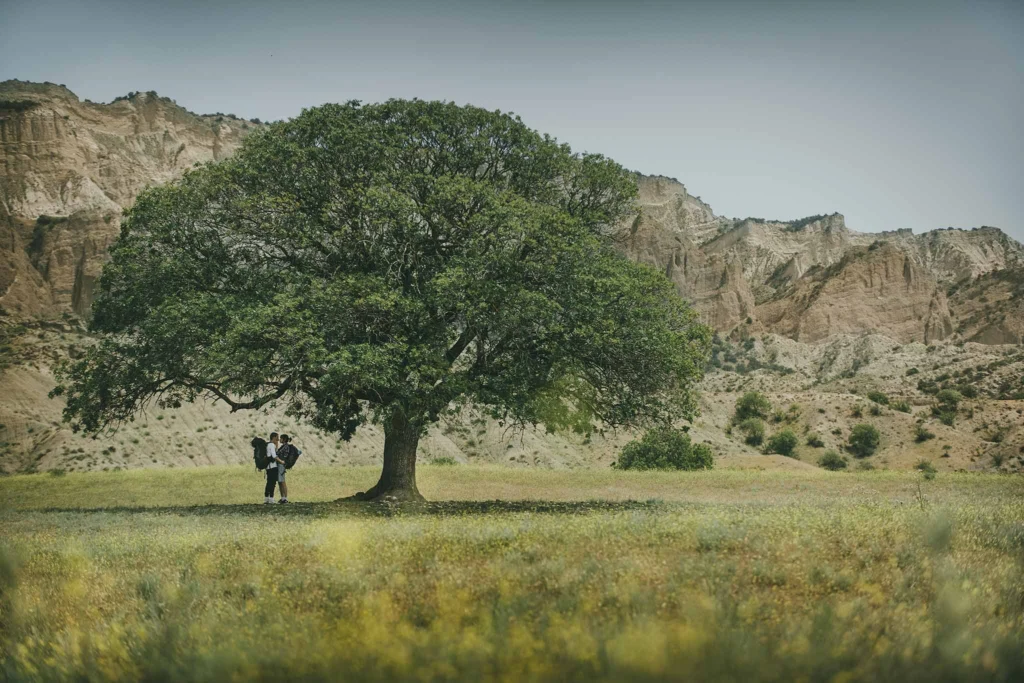
Nothing prepares you for how quickly Georgia stops being green. An hour and a half southeast of Tbilisi the vineyards give out, then the trees, and then you are driving through striped ochre badlands with a horizon that could be Anatolia or Nevada. It is called Gareji — the wilderness — and in the sixth century a monk named David walked out into it deliberately, because that was the point.
He and his followers cut cells straight into the sandstone. The complex grew over centuries into a chain of monasteries strung along the ridge, and the Lavra of St David — the lower one, terraced into the hillside with wooden balconies and a spring — is still a working monastery today. You can walk through the tunnels, look into the cells, and stand at David’s tomb. It is free to enter, it is entirely silent apart from the wind, and the contrast with everything else in Georgia is the whole experience.
One thing you should know before booking. The upper monastery, Udabno, sits on the crest of the ridge, and that crest is the disputed border with Azerbaijan. It has been closed to visitors since June 2019, and border guards turn back anyone who tries the trail. The famous frescoes and the portrait of Queen Tamar are behind that closure. Plenty of tour pages still advertise them. We do not, because the moment we would have to explain it is at the bottom of the path with your day half over.
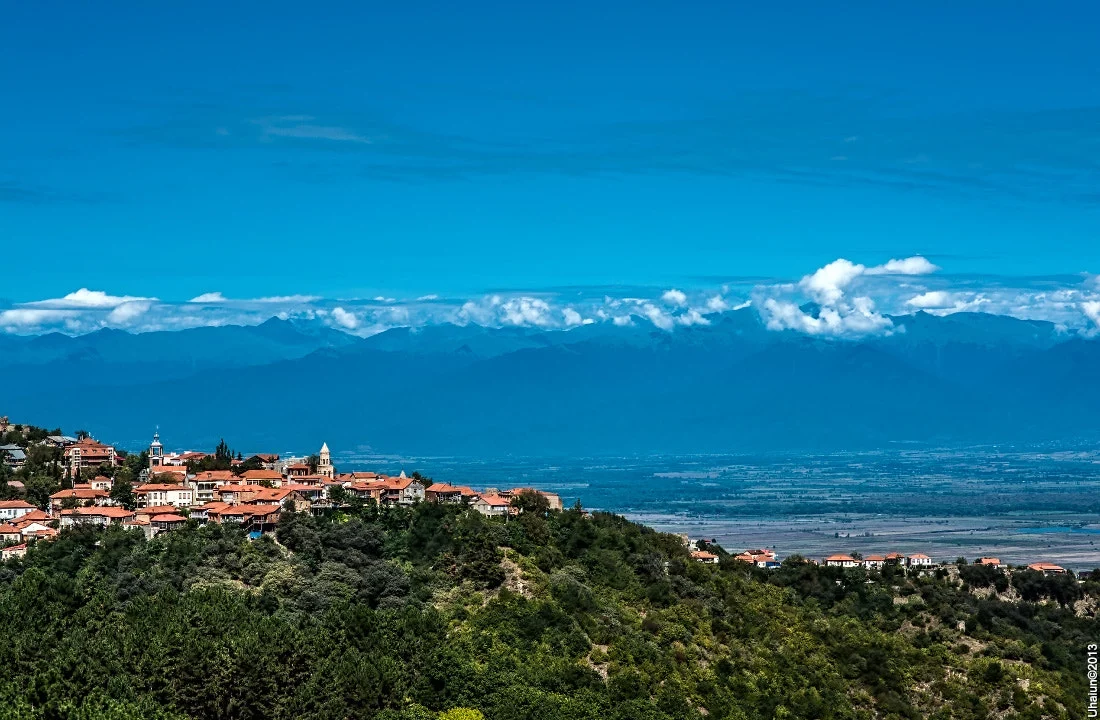
What that leaves is a good ninety minutes at the Lavra rather than a half day of hiking — which is why this tour puts Sighnaghi in the afternoon rather than treating it as a bonus. You drive north out of the desert into Kakheti’s vineyard country, and arrive at a fortified town on a ridge with four and a half kilometres of eighteenth-century wall around it and the whole Alazani valley below, the Greater Caucasus standing along the far side. Lunch, an hour walking the walls, and then Bodbe — the convent two kilometres away where Saint Nino, who converted Georgia, is buried under a cypress alley.
It is a long day, around eleven hours, and roughly five of those are driving. In exchange you get the two landscapes of eastern Georgia that have nothing in common with each other.
What you’ll see
Tour highlights
- The Lavra of St David — a sixth-century monastery terraced into a sandstone hillside, with cells, tunnels, wooden balconies and the founder’s tomb. Still a working community; free to enter.
- The Gareji semi-desert — striped, treeless badlands an hour and a half from the capital. There is no other landscape like it in Georgia and most visitors never see it.
- A border you can see from where you stand — the ridge above the monastery is the frontier with Azerbaijan, and the dispute over it is live. Your guide will explain what is going on and why the upper monastery is shut.
- Sighnaghi’s town wall — four and a half kilometres of it, with twenty-three towers, built in 1762 under Erekle II. You can walk a stretch and climb a tower.
- The Alazani valley from the wall — vineyards to the horizon and the Greater Caucasus standing behind them. This is the view that sells Kakheti.
- Bodbe Monastery — St Nino’s tomb, reached down an alley of cypresses. She is the reason Georgia is Christian, and the site is one of the most visited pilgrimage places in the country.
- Two landscapes in one day — semi-desert in the morning, wine country in the afternoon, about ninety minutes of driving between them.
- Private car and driver-guide — your group only, and no fixed thirty minutes per stop.
Step by step
Tour itinerary
Around eleven hours door to door, roughly 280 kilometres. Five of those hours are driving, split into three legs.
08:00 — Pickup in Tbilisi
Collected from your hotel or apartment. The road runs southeast through Rustavi and then out into open steppe. The last stretch is paved the whole way now, so no 4×4 is needed — a change from a few years ago, when this drive had a reputation.
09:45 — David Gareja, the Lavra of St David
Ninety minutes. You climb a short path from the car park into the monastery, which is built in terraces against the rock: cells, a chapel, tunnels cut through the sandstone, wooden galleries, and a spring that has been the reason anyone could live here for fifteen centuries. David’s tomb is in the lower church.
You can walk another hundred or two hundred metres uphill for a wider view over the complex and out across the border. Past that point is closed, and the guards enforce it. There is a small visitor centre with toilets and a shop.
11:30 — North into Kakheti
About two hours, and the most striking drive of the day: the badlands give way to steppe, then to farmland, then to vineyards, and the mountains come up on the northern horizon.
13:30 — Sighnaghi, and lunch
An hour over lunch in the town. Sighnaghi is small — around fifteen hundred people — and built on a slope, so the streets are cobbled and steep and the balconies lean out over them. It has a reputation as the city of love, which comes from the twenty-four-hour marriage registry rather than anything more romantic, but the town earns the name on the terrace view alone.
14:45 — The wall and the town
An hour on foot. You can climb onto the fortress wall and walk a section of it between the towers, with the whole Alazani valley below and the Caucasus wall on the far side. On a clear day you can pick out individual peaks; in autumn the valley below is being harvested.
16:00 — Bodbe Monastery
Forty-five minutes to an hour, two kilometres out of town. A cypress alley leads to the church where Saint Nino is buried. If the group is up for it, a steep path drops down the hillside to her spring — twenty minutes down, rather more coming back up, and worth it if your legs are still working.
17:00 — Return to Tbilisi
Two hours west, arriving around 19:00.
Starting from
€135
per person
Locally operated since 2011
We reply within 24 hours
What your price covers
What’s included
Included
- Private air-conditioned vehicle for your group only
- English-speaking driver-guide for the full day
- Hotel or apartment pickup and drop-off in central Tbilisi
- Entry to David Gareja and Bodbe — both free, and we will never invent a ticket price
- Fuel, parking and road costs
- Bottled water in the car — more of it than usual, because there is no shade at Gareja
- All taxes and booking fees
Not included
- Lunch in Sighnaghi — around 25–45 GEL per person
- The Sighnaghi Museum, if you want to see its Pirosmani paintings — a small entry fee, paid at the door
- A wine tasting in Sighnaghi, available as an add-on — ask when you book
- Travel insurance
- Tips for your driver-guide
- Personal expenses and souvenirs
Photographs
Gallery
Where you’ll go
Map & route
Lavra of St David
Gareji Semi-Desert / Udabno
Bodbe Monastery
Sighnaghi Walled Town
Practical details
Good to know before you go
What is open at David Gareja, and what is not
The Lavra of St David — the lower monastery — is open, free, and active. That is where the cells, the tunnels, the balconies and the founder’s tomb are, and it is the part most people picture when they think of Gareja.
Udabno, the upper complex on the ridge, has been closed since June 2019. The ridge is the disputed border with Azerbaijan; border guards patrol it and turn walkers back. The frescoes up there, including the well-known portrait of Queen Tamar, are not currently viewable by anyone. The dispute is a live diplomatic matter with no settlement in sight, so we plan the day on the assumption that it stays closed, and we will tell you immediately if that changes.
The desert is not a figure of speech
- There is no shade at all. None. In July and August the site reaches 40°C and the rock radiates it back at you.
- Cover up rather than strip off. Long sleeves, long trousers, a hat and sunscreen do more for you here than shorts. This also satisfies the monastery’s dress code, so it solves two problems.
- Watch where you put your feet. Levantine vipers live in this landscape and are active in warm weather. Stay on the paths, do not reach into rock crevices, and you will very likely never see one.
- Drink more than you want to. We carry extra water for this stop specifically.
Dress code
Both David Gareja and Bodbe are working monasteries. Shoulders and knees covered for everyone; women are asked to wear a skirt and a headscarf. Wraps are usually available at Bodbe; at Gareja, bring your own — it is a small community in a remote place and there is no guarantee.
When to go
| Season | Conditions | Worth knowing |
|---|---|---|
| April – May | The steppe is briefly green and flowering | The best three or four weeks of the year here, and the desert looks least like a desert |
| June | Hot but manageable, everything dry | Start early; be at Gareja before eleven |
| July – August | Up to 40°C with no shade, vipers active | We run it with an early start, but if you dislike heat, choose another month |
| September – October | Warm, clear, harvest under way in Kakheti | The other good window — and Sighnaghi is at its best |
| November – March | Cold, sometimes bleak, occasionally beautiful | Very few visitors. Snow on the badlands is a rare sight worth having |
How much walking
Around two to three kilometres in total. At Gareja it is a short climb on a stone path with some steps and uneven ground; in Sighnaghi it is cobbles and slopes; at Bodbe it is flat unless you take the path down to the spring, which is steep both ways. Nothing here is technical, but the surfaces are uneven throughout, so wear proper shoes.
Children and accessibility
Children from around seven do fine — the tunnels at Gareja are the highlight for most of them — though the driving legs are long, so bring something for the car. For visitors with limited mobility, Sighnaghi and Bodbe are manageable while the climb at Gareja is not; tell us in advance and we will be straight with you about what will work.
Booking
Book at least 24 hours ahead. Free cancellation up to 24 hours before departure. Child seats free on request.
From our travellers
Reviews
Before you book
Frequently asked questions
Is David Gareja open to visitors?
The Lavra of St David, the lower monastery, is open and free to enter. The upper complex, Udabno, has been closed since June 2019 because the ridge it sits on is the disputed border with Azerbaijan, and border guards turn back anyone attempting the trail. That is the current position and we will say so on this page for as long as it holds.
Can I still hike the ridge to see the frescoes?
No. The three-kilometre ridge walk between the two monasteries is closed, and so are the Udabno frescoes and the painting of Queen Tamar. Any operator still advertising that hike is selling something they cannot deliver.
Is it worth going if the upper monastery is shut?
We think so, but you should decide with the facts. The Lavra alone is about ninety minutes: a sixth-century monastery cut into a hillside, tunnels, cells, a founder’s tomb, and a landscape that exists nowhere else in Georgia. Paired with Sighnaghi it makes a full and varied day. If your reason for coming was specifically the frescoes, wait until the border question is resolved.
How long is the tour?
Around eleven hours door to door, covering about 280 kilometres. Roughly five hours of that is driving, split into three legs of one and a half to two hours each.
Is there an entrance fee?
No. David Gareja and Bodbe are both free. The only optional cost is the Sighnaghi Museum if you want to see its Pirosmani paintings.
Do I need a 4×4 to get to David Gareja?
Not any more. The road is paved the whole way to the car park, which was not true a few years ago and is still repeated on older websites. A normal car is fine.
What is the best time of year?
April to May, or September to October. The desert has no shade whatsoever and reaches 40°C in midsummer; in April the steppe is briefly green and flowering, which is the nicest it ever looks.
Are there really snakes?
Levantine vipers live in the area and are active in warm weather. In practice most visitors never see one. Stay on the marked paths, do not put your hands into rock crevices, and wear closed shoes and long trousers — which the monastery dress code requires anyway.
What should I wear?
Long trousers, covered shoulders, closed shoes and a hat. Women need a skirt and a headscarf for the monasteries. Bring your own wrap for David Gareja rather than relying on borrowing one.
Why Sighnaghi as well?
Because the closure at Gareja leaves a half day free, and because the two places have nothing in common — semi-desert in the morning, walled hill town and vineyards in the afternoon. It is the contrast that makes the eleven hours worth it.
Ready when you are
Tell us your dates and how many of you are travelling. We’ll come back within 24 hours with availability, a confirmed price, and your guide’s name.