Georgia has one desert, and it is in the last place you would look for it — the far southeastern corner, past the vineyards, out where the map runs into Azerbaijan and stops.
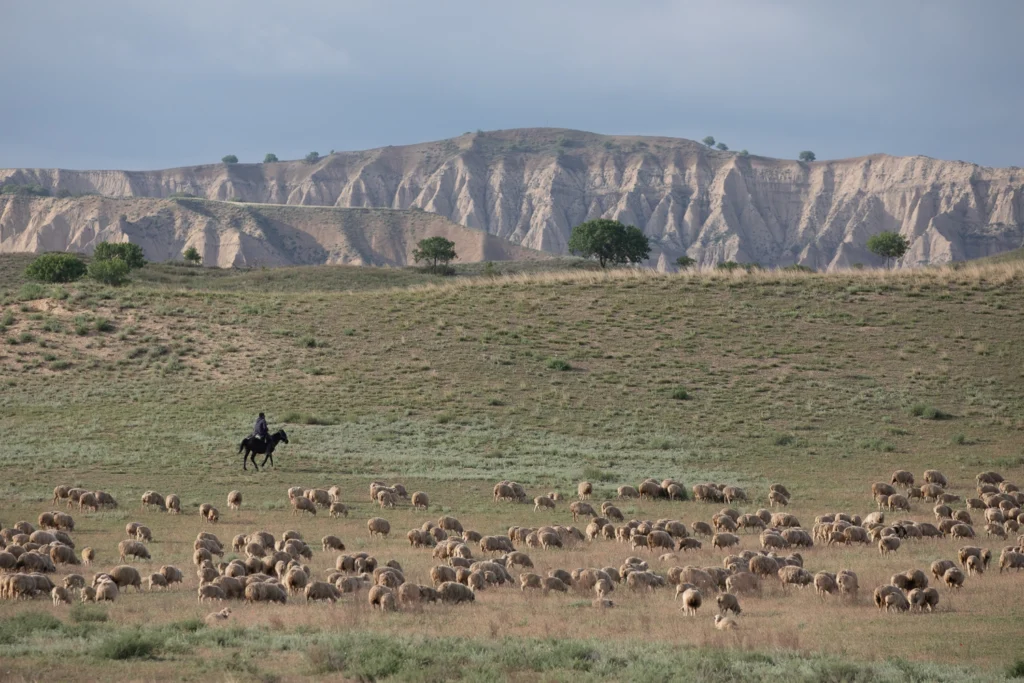
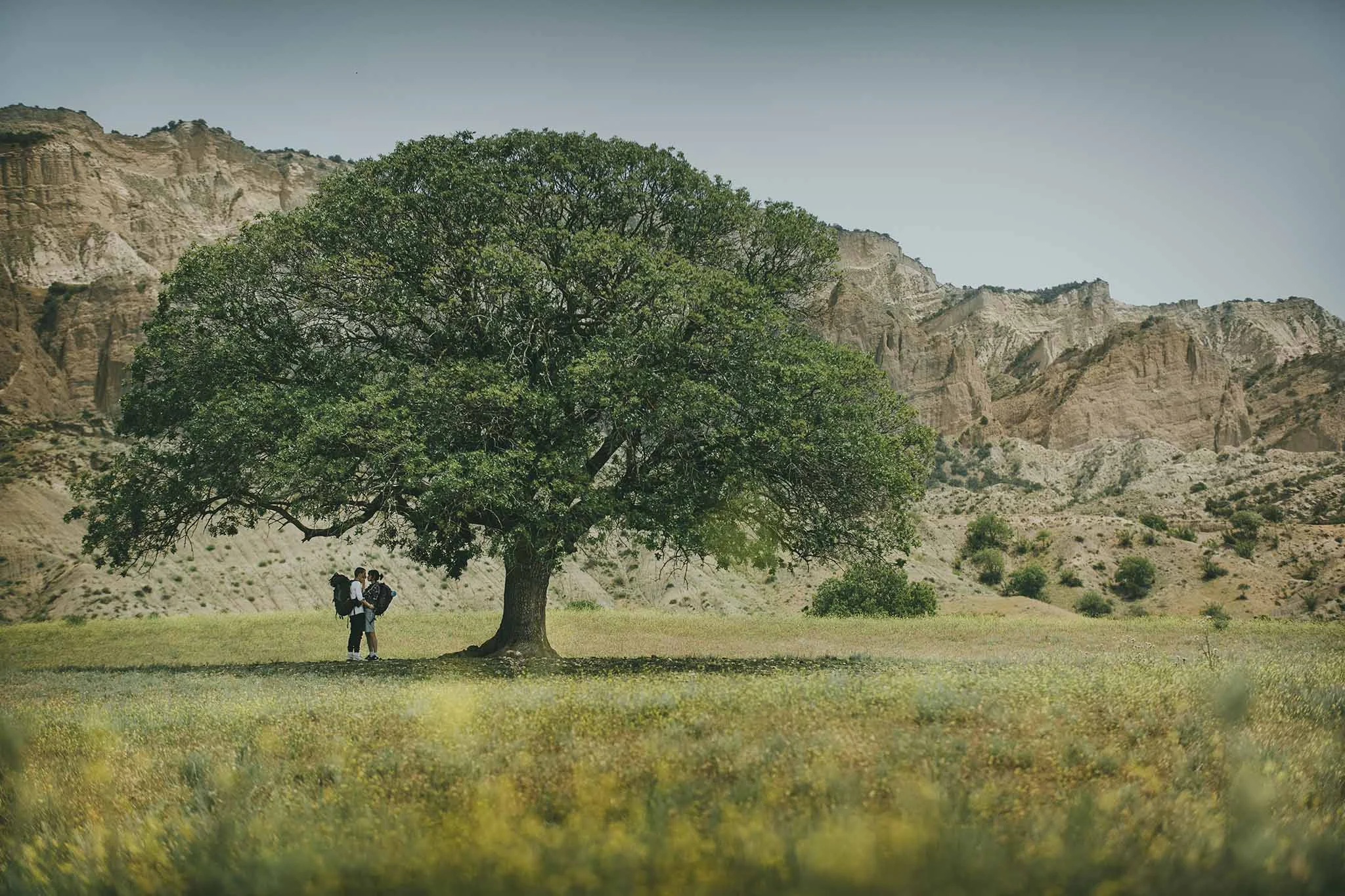
Vashlovani is what happens when soft sedimentary rock meets rare, violent rainfall over a few million years. The mudstones and clays here were laid down under an ancient sea; the water that occasionally falls on them has cut the whole plateau into knife-edge ridges, blind gullies and freestanding pillars. The result looks like Utah and sits ninety minutes from a wine cellar.
At Eagle Canyon the ground simply opens. You stand on the rim and the erosion runs away from you to the horizon in tan, grey and ochre bands, with the Alazani valley in the distance and, on a clear day, the Caucasus behind that. Warm air rises off the canyon walls all afternoon, and raptors ride it — griffon and Egyptian vultures, golden and steppe eagles, long-legged buzzards, kestrels. They circle at eye level and below you, which almost never happens anywhere else. Bring binoculars; we carry spares.
Then, twenty minutes away, Khornabuji: a medieval fortress on top of a rock pinnacle that rises straight out of flat ground like something drawn rather than eroded. Harder rock, softer surroundings, a few million years of weather — and someone in about the fifth century looked at it and thought, that.
The afternoon deliberately changes register. Bodbe, where Saint Nino is buried, and then Sighnaghi on its ridge with the whole Alazani valley below it. After six hours of dry rock and raptors, a walled town full of wine shops lands differently than it would on its own.
Be clear about what this day costs you. It is roughly 450 kilometres and thirteen hours, with about six of those in the vehicle. There is no way around that — Vashlovani is genuinely remote, and that remoteness is precisely why it is empty and why the wildlife is there. If long drives are hard for you, this is not the tour. If the idea of standing on the rim of an empty canyon watching vultures work the thermals is worth six hours of road, nothing else on our list comes close.
What you’ll see
Tour highlights
- Eagle Canyon — a gorge cut through soft sedimentary rock, and the most accessible viewpoint into Vashlovani’s badlands. The rim drops away without warning and the erosional landscape runs to the horizon.
- Raptors at eye level — thermals rise off the sun-heated canyon walls, and vultures, eagles and buzzards use them for hours. You watch them from above and alongside, not as specks overhead. This is the part people remember.
- Khornabuji fortress — a fifth-century citadel on an isolated rock pinnacle standing alone above flat plains. Walls following the summit’s edge, cisterns cut into the rock, and one of the most dramatic settings of any fortress in Georgia.
- Georgia’s only semi-desert — an ecosystem that exists nowhere else in the country, on the tentative list for UNESCO World Heritage status.
- 150+ bird species — Vashlovani is one of Georgia’s serious birding destinations, and autumn brings raptor migration through the same canyon.
- Wildflowers in April and early May — poppies, irises and tulips carpet the badlands for a few weeks and then the heat takes them.
- Bodbe Monastery — the tomb of Saint Nino, who converted Georgia in the fourth century, under an alley of cypresses.
- Sighnaghi — eighteenth-century walls, four kilometres of them with twenty-three towers, above the Alazani valley with the Caucasus behind.
Step by step
Tour itinerary
About thirteen hours door to door and roughly 450 kilometres, of which six hours is driving. An early start is not optional — the light at Eagle Canyon is best before mid-afternoon and the return leg is long.
07:00 — Pickup in Tbilisi
Collected from your hotel or apartment. The road runs southeast into Kakheti and then keeps going, past the vineyards and out into open country. This is the least populated part of Georgia: long horizons, scattered villages, a frontier feeling that builds as the green drains out of the landscape.
10:00 — Dedoplistskaro
A short stop in the small town that serves as the gateway to the protected areas. It has an end-of-the-road character and visible Azerbaijani cultural influence, and the badlands are already showing on the horizon.
10:45 — Eagle Canyon
An hour and a quarter, and the heart of the day. A short walk from the vehicle brings you to the rim. Below and in front of you the plateau is cut into gullies and ridges in layered tan and grey; the Alazani valley sits in the middle distance, and on a clear day the Greater Caucasus closes the horizon.
Then you stop moving and start watching. Thermals come off the canyon walls and the raptors work them — often several species at once, at and below your own eye level. Your guide will identify what is up. Take the binoculars and give it the full hour; the birds do not perform on a schedule and the ten-minute version of this stop is not worth the drive.
12:15 — Khornabuji Fortress
An hour. The fortress sits on an isolated rock pinnacle that rises abruptly from the plain — harder rock that survived while everything around it eroded away. Fifth-century walls follow the irregular summit, with gateway ruins, rock-cut cisterns and the remains of a church.
Nearly everyone views it from below, walking the base and photographing the pinnacle, and that is genuinely the better experience. The route to the summit is a steep scramble on loose rock with exposed sections and real drops. It is not maintained, not signed and not something we encourage. If you are an experienced hiker who is comfortable with exposure, your guide will look at the conditions and give you an honest answer; in wind or wet, the answer is no.
13:30 — Lunch
An hour in Dedoplistskaro or on the road toward Sighnaghi. Facilities out here are limited, so this is the one proper meal of the day.
15:15 — Bodbe Monastery
Forty-five minutes. A cypress alley leads to the church where Saint Nino is buried. She converted King Mirian in the fourth century, which is why Georgia is Christian; she retired here afterwards and stayed. There is a spring below the monastery reached by a long flight of steps — worth it if your legs have survived the morning.
16:30 — Sighnaghi
An hour and a half. Cobbled streets, wooden balconies, and a fortress wall you can climb onto and walk between the towers. The view down over the Alazani valley to the Caucasus is the one that sells Kakheti. Time to walk a stretch of wall and still sit down with a coffee.
Optional wine tasting at a natural wine producer in the town — four or five wines with an explanation of the qvevri method. Ask when you book rather than on the day.
18:00 — Return to Tbilisi
About two hours west. Arrival around 20:00. Most people sleep for part of it.
Starting from
€150
per person
Locally operated since 2011
We reply within 24 hours
What your price covers
What’s included
Included
- Private 4WD vehicle for your group only — the approach roads are unpaved and a normal car will not do it
- English-speaking driver-guide with birding and natural history knowledge, not a general city guide
- Hotel or apartment pickup and drop-off in central Tbilisi
- Binoculars for wildlife and bird watching, on request
- Vashlovani Protected Areas entry
- Fuel, parking and road costs
- Bottled water throughout — more than usual, because there is nowhere to buy it
- Photographs from the day, shared afterwards
- All taxes and booking fees
Not included
- Lunch — around 25–45 GEL per person
- Optional wine tasting in Sighnaghi, roughly $15–20 per person
- The climb to the summit of Khornabuji, which is at your own risk if you attempt it
- Travel insurance — worth having on this one
- Tips for your driver-guide
- Personal expenses and souvenirs
Photographs
Gallery
Where you’ll go
Map & route
Dedoplistskaro
Eagle Canyon
Khornabuji Fortress
Bodbe Monastery
Sighnaghi
Practical details
Good to know before you go
The numbers, plainly
| Duration | About 13 hours, 07:00 to roughly 20:00 |
| Driving | Around 450 km and six hours in the vehicle |
| Activity level | Moderate — uneven ground, no long walks, one optional climb we advise against |
| Group | Private, your party only, maximum six people in one 4WD |
| Season | April to October is the sensible window. Winter departures on request |
| Ages | Twelve and up. It is the driving, not the walking, that rules out younger children |
What Vashlovani actually is
An arid, eroded plateau in the rain shadow of the surrounding hills — the westernmost extension of Central Asian semi-desert habitat, which is why it feels geographically out of place. Rainfall is scarce, temperatures are extreme, and the soft rock does the rest. It is on Georgia’s tentative list for UNESCO World Heritage status.
The wildlife is genuinely notable: bezoar goats on the cliffs, wild boar, jackals audible at dusk, and more than 150 recorded bird species. Camera traps occasionally record Caucasian leopard, of which fewer than ten are thought to remain in the country — we mention them because they matter to the ecosystem’s importance, not because you will see one. You will not.
What to bring — this is a wilderness day, not a city one
- Proper boots. The ground at the canyon rim and around Khornabuji is loose and uneven. Trainers with smooth soles are the wrong choice.
- Full sun protection. Brimmed hat, high-factor sunscreen, sunglasses. There is no shade at any point of the morning.
- Long sleeves and long trousers. Sun, thorns and insects, plus the monastery dress code in the afternoon. One decision solves several problems.
- Binoculars if you have them, though we carry spares.
- Snacks and a water bottle. There is nowhere to buy anything for several hours.
- A scarf or wrap for Bodbe, and cash in lari for lunch and the wine tasting.
- A power bank. Long day, a lot of photographs, patchy signal.
Snakes, honestly
Levantine vipers live here and are active in warm weather. In practice, visitors very rarely see one. Stay on the paths, do not put hands into rock crevices, wear closed shoes, and watch where you step on broken ground. That is the whole of the precaution.
When to come
| Season | Conditions | Worth knowing |
|---|---|---|
| April – May | 18–25°C. Wildflowers across the badlands, spring migration | The best few weeks of the year, and a short window. Book early |
| June – August | 30–40°C with zero shade | We run it with a very early start. If you dislike heat, choose another month |
| September – October | 20–28°C, peak raptor migration | The best month for the birds, and excellent light for photography |
| November – March | 5–15°C, stark and monochrome | On request. Fewer birds, clearer air, complete solitude |
For photographers and birders
This day can be rebuilt around you: golden-hour timing, longer at the productive stops, and a guide who understands that setting up a shot takes more than ninety seconds. Serious birders can have an earlier start, more time on the rim, and an itinerary that flexes with what is flying. Ask us and we will quote it.
Looking after the place
Vashlovani is a protected area and the ground is fragile. Stay on the trails, take everything out with you, leave rocks and plants where they are, watch wildlife from a distance, and keep noise down — it carries a long way out here and it is the reason the birds are working the thermals rather than leaving.
Booking
Book at least 48 hours ahead so we can confirm the vehicle and a guide with the right background. Free cancellation up to seven days before departure.
From our travellers
Reviews
Before you book
Frequently asked questions
Why does this tour cost more than your other day trips?
Distance and vehicle, mostly. Vashlovani is around 450 kilometres round trip on roads that need a 4WD, which is more fuel and more wear than any other day tour we run. The day is thirteen hours rather than eight or nine. And the guide needs natural history knowledge rather than general commentary. The price reflects a genuinely remote trip, not a premium on the same product.
How long are we in the vehicle?
About six hours in total — roughly three each way, plus shorter drives between sites. There is no way to reduce it; the remoteness is the reason the place is empty and the wildlife is there. If long car days are difficult for you, we would rather tell you now than at hour four.
Will we definitely see eagles?
They are wild animals, so nothing is guaranteed. But Eagle Canyon is prime raptor habitat and birds are present year-round; most groups see several species. Spring and autumn migration give the highest diversity. Your guide will spot and identify what is flying.
Will we see a Caucasian leopard?
No. Fewer than ten are thought to remain in Georgia, they are nocturnal and they avoid people; camera traps pick them up occasionally in the deep wilderness and that is essentially the extent of it. We mention them because they matter to why this ecosystem is protected, not to set an expectation.
What makes Vashlovani different from the rest of Georgia?
It is the country’s only semi-desert badlands. Everywhere else you go here is green mountains, forest or vineyard; this is eroded rock, scarce water and desert-adapted species, created by a rain shadow. Standing in it, you would not guess which country you were in.
Can we climb Khornabuji fortress?
It is possible and we advise against it. The route is a steep scramble on loose rock with exposed sections and real drops, unmaintained and unsigned. Around nine in ten visitors view it from below, which gives you the fortress, the pinnacle and the photographs without the risk. Experienced hikers comfortable with exposure can discuss it with the guide on the day; in wind or after rain the answer is no.
Is this suitable for serious birdwatchers?
Yes. More than 150 species have been recorded in the protected areas and Eagle Canyon is one of the better raptor sites in the country. We carry binoculars and the guide can identify what you are looking at. If you want an early start and a flexible itinerary that follows the birds, tell us when you book and we will build the day around that.
What if I am not especially interested in birds or landscape?
Then take a different tour. Khornabuji, Bodbe and Sighnaghi are all worth seeing, but the centre of this day is a canyon rim and the things flying over it. If you came to Georgia for history, wine or mountains, we have better days for you and we would rather point you at one.
When is the best time for wildflowers?
Mid-April to early May, when the badlands briefly turn into a garden — poppies, irises, tulips. By late May the heat has taken them. If the flowers are your reason for coming, book inside that window.
Is the tour private?
Yes. Your own vehicle and guide, maximum six people, and the pace is yours. The per-person price falls as the group grows because the vehicle cost is shared.
Ready when you are
Tell us your dates and how many of you are travelling. We’ll come back within 24 hours with availability, a confirmed price, and your guide’s name.