David Gareja Monastery: Complete Guide to Georgia’s Desert Cave Complex
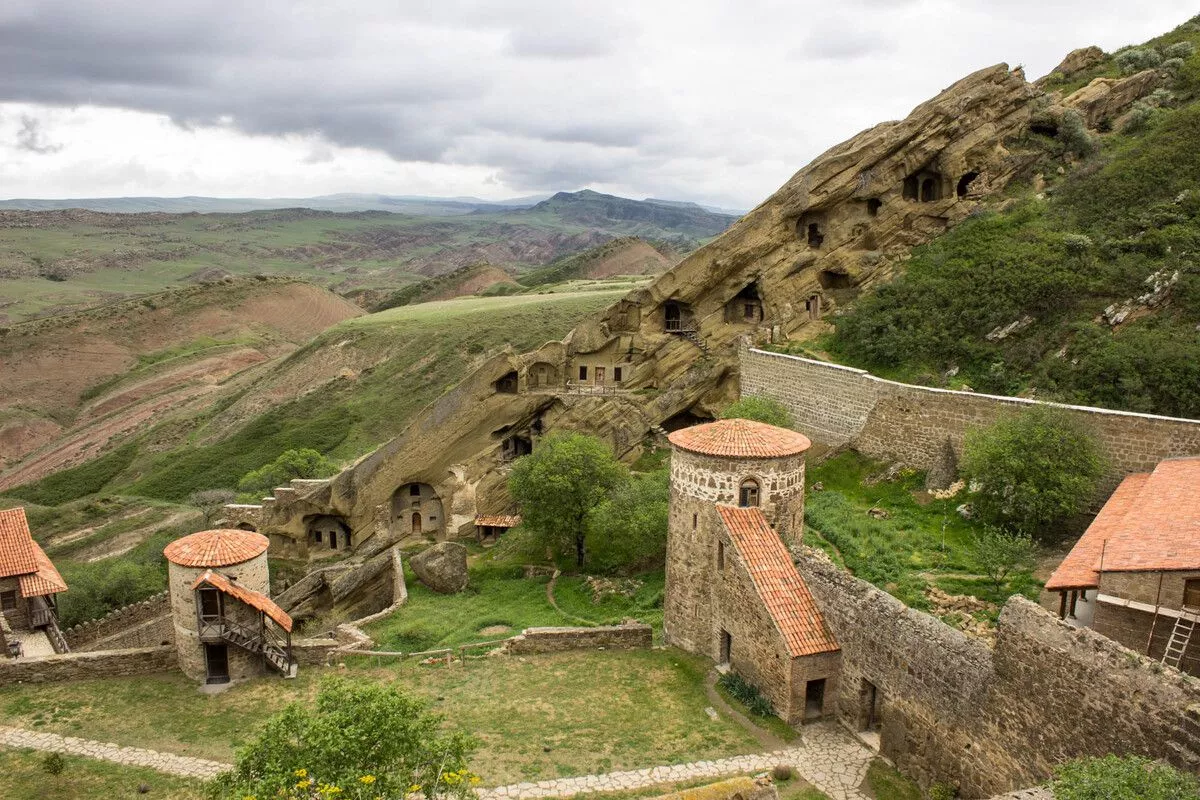
The semi-desert of southeastern Georgia seems like an unlikely place for one of the country’s most important spiritual sites. Yet here, carved into the dry, multicolored hills near the Azerbaijan border, the David Gareja monastery complex has drawn monks and pilgrims for over 1,500 years. The landscape itself feels almost biblical: barren ridges, deep gorges, and in spring, carpets of wildflowers that transform the desert into something surreal.
For travelers, David Gareja offers a combination found nowhere else in Georgia: ancient cave monasteries, remarkable medieval frescoes, a moderate hike with panoramic views, and a landscape that looks more like central Asia than the Caucasus.
Quick Facts
| Detail | Information |
|---|---|
| Location | Southern Kakheti, ~60 km southeast of Tbilisi |
| Drive time from Tbilisi | 1.5 to 2 hours |
| Main sites | Lavra Monastery, Udabno Caves |
| Hike duration | 1.5 to 2 hours round trip |
| Difficulty | Moderate (some steep sections) |
| Best seasons | Spring (April to May), Autumn (September to October) |
| Entry fee | Free |
| Facilities | Very limited; bring water and food |
History of David Gareja
The complex dates to the 6th century, when St. David Garejeli, one of the thirteen Assyrian Fathers who spread Christianity throughout Georgia, chose this remote desert as the site for his hermitage. He arrived with his disciple Lukian, and they settled in a small natural cave. Other monks soon followed, and within St. David’s lifetime, three monasteries had been established: St. David’s Lavra, Dodorka Monastery, and John the Baptist Monastery.
The first church was built while St. David was still alive. A local nobleman named Bubakar converted to Christianity, was baptized by St. David, and constructed a small church dedicated to the Transfiguration on the lower terrace of what is now Lavra. St. David and Lukian were later buried in this church.
The complex reached its peak between the 10th and 13th centuries, when at least twelve active monasteries operated within the area. Monks developed a distinctive school of fresco painting, using pigments made from local clay that gave the artwork its unique color palette. The most famous frescoes, found in Udabno Monastery, include portraits of Georgian monarchs: King David IV the Builder, Demetre I, George III, and Queen Tamar with her son King Giorgi IV Lasha.
In 1616, the Persian Shah Abbas I devastated the complex during his invasion of Georgia. Restoration attempts continued through the following centuries but never fully succeeded. The monasteries operated with declining significance through the 19th century until 1919, when the chaos following the Russian Revolution led to complete abandonment.
Monks returned only in the early 1990s after Georgian independence. Today, a small community of monks lives at Lavra, and the complex functions as both an active monastery and a historical site.
What to See at David Gareja
Lavra Monastery
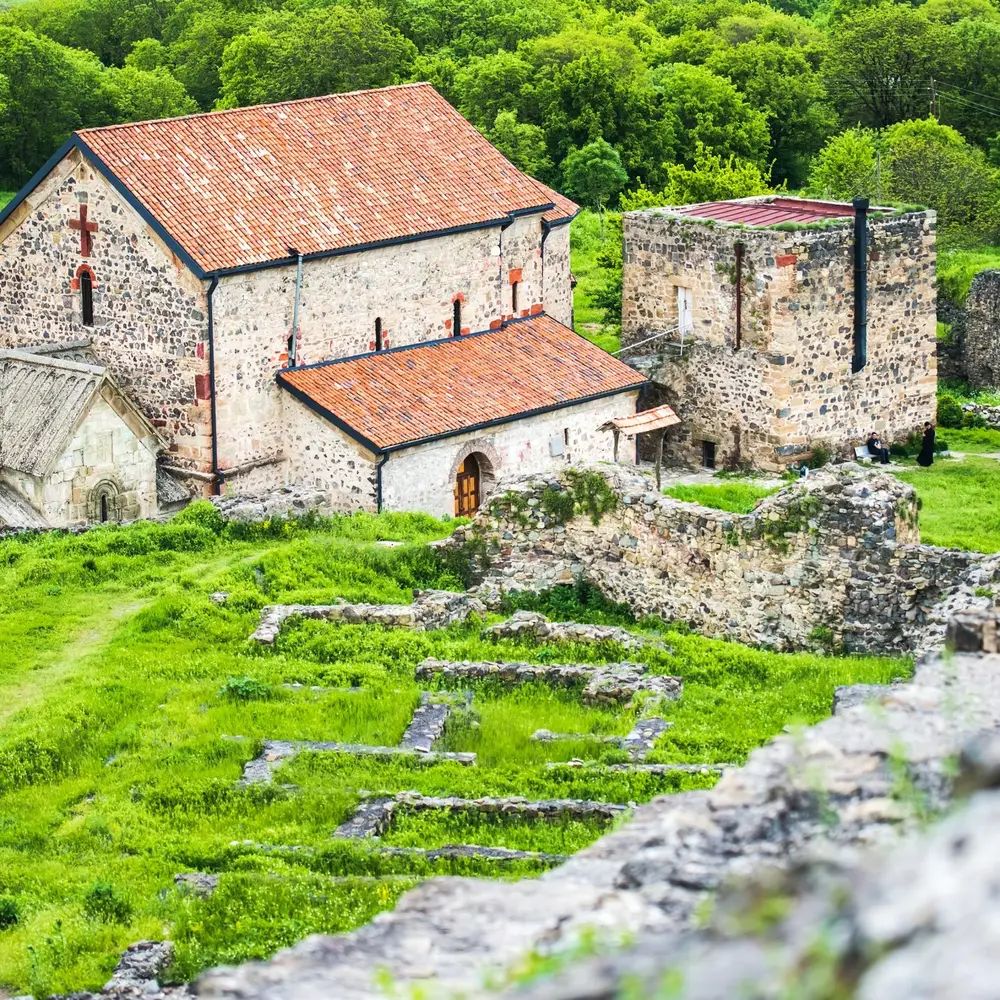
Lavra is the central and most accessible part of the complex, located where the road ends. This is where St. David established his original hermitage in the 6th century. The monastery includes:
The Church of the Transfiguration, rebuilt multiple times over the centuries, with the current structure dating largely to the 19th century. St. David’s tomb is located here.
Cave cells carved into the rock face, where monks lived in various periods. Some retain traces of decorative plasterwork from the 17th and 18th centuries.
King Alexander’s Tower on the upper terrace, which contains partially preserved examples of the distinctive Gareja-style iconostasis made from calcium gypsum and decorated with frescoes.
A defensive tower and walls were added during the medieval period when the monastery required protection from raids.
Lavra remains an active monastery. Visitors are welcome but should dress modestly and behave respectfully.
The Hike to Udabno
From Lavra, a trail climbs over the ridge to Udabno Monastery on the opposite slope. This hike is the highlight for most visitors.
The path ascends steeply at first, gaining the ridge in about 20 to 30 minutes. The effort is rewarded with views in both directions: the semi-desert stretching toward Tbilisi on one side, and the flat plains of Azerbaijan on the other. On clear days, the contrast between the rugged Georgian hills and the level steppe beyond the border is striking.
The descent to Udabno takes another 15 to 20 minutes. The caves are carved into the cliff face overlooking Azerbaijan, arranged along a natural terrace in the rock.
Udabno Caves and Frescoes
Udabno means “desert” in Georgian, and the name fits. The caves here housed monks from the 9th century onward, and the main church contains the most significant frescoes in the complex.
The paintings date primarily to the 10th through 13th centuries and represent the peak of the Gareja fresco school. Unlike frescoes elsewhere in Georgia, these use pigments derived from local colored clays, producing distinctive earth tones.
The most famous images include:
Portraits of Georgian royalty, including King David the Builder (who reigned 1089 to 1125) and Queen Tamar (who reigned 1184 to 1213). These are among the few contemporary depictions of these important figures in Georgian history.
Scenes from the life of St. David Garejeli, painted according to iconographic rules developed specifically at this monastery.
The Last Supper in the refectory, where monks would have taken their meals while contemplating the image.
Religious scenes, including the Crucifixion, Resurrection, and various saints.
The frescoes have suffered significant damage over the centuries from weathering, vandalism, and the 1616 Persian invasion. Soviet-era military exercises in the area caused additional harm. Despite this, enough remains to appreciate the artistry and historical importance.
Other Monasteries
The David Gareja complex technically includes about twenty monasteries spread across the surrounding hills. Most are inaccessible to casual visitors or require significant hiking to reach. The main tourist route covers only Lavra and Udabno.
Dodorka Monastery, founded by St. David’s disciple Dodo, sits on a horn-shaped rock extension and contains a 10th-century domed church. Access requires a separate, longer hike.
John the Baptist Monastery has an early 19th-century bell tower and medieval cave cells. It can be visited with additional time and effort.
For most visitors, Lavra and Udabno provide a complete experience. Those with archaeological or religious interests may want to arrange specialized tours to explore further.
The Border Situation
Part of the David Gareja complex lies in territory disputed between Georgia and Azerbaijan. The border runs along the ridge, meaning some Udabno caves technically sit on the Azerbaijani side.
This situation has practical implications for visitors:
Access to certain caves may be restricted depending on current diplomatic relations and border guard presence.
The situation can change without notice. Caves accessible one month may be closed the next.
Azerbaijani border guards occasionally patrol the area and may prevent access to sections on their side of the line.
There have been periodic tensions, including a 2019 incident when Azerbaijani border guards restricted access to parts of the site.
Before visiting, check current conditions. Your tour operator or guesthouse in Tbilisi should have recent information. The core sites at Lavra and the main Udabno frescoes are within Georgian-controlled territory and normally accessible, but the situation remains fluid.
This is not a dangerous situation for tourists, but awareness helps avoid frustration if certain areas are temporarily off-limits.
How to Get to David Gareja
By Organized Tour
The easiest option. Day tours from Tbilisi typically combine David Gareja with Sighnaghi or other Kakheti destinations. Tours handle transportation over the rough final stretch of road and provide historical context at the site.
By Private Car or Taxi
The drive from Tbilisi takes approximately 1.5 to 2 hours. The route passes through the Kakheti lowlands before entering the semi-desert.
Road conditions: The main road is paved until the final 10 to 15 kilometers, which is unpaved and can be rough. A standard car can make it in dry conditions, but high clearance helps. After rain, the road may become difficult or impassable for regular vehicles.
Navigation: GPS coordinates for Lavra Monastery are approximately 41.4477° N, 45.3764° E. Signage exists but is limited.
By Public Transport
No direct public transport runs to David Gareja. The closest you can get by marshrutka is the town of Sagarejo, which still leaves roughly 40 kilometers of difficult road. This option requires arranging a taxi from Sagarejo, which can be expensive and unreliable.
Public transport is not recommended for this destination.
Best Time to Visit
Spring (April to May)
The optimal season. The semi-desert transforms into green grass and thousands of wildflowers in every color. Temperatures are comfortable for hiking, typically 15 to 25 degrees. April is particularly spectacular when the bloom peaks.
Autumn (September to October)
The second-best option. Summer heat has passed, temperatures are pleasant, and the light is good for photography. The landscape is dry and brown but atmospheric in its own way.
Summer (June to August)
Challenging. Temperatures in the semi-desert regularly exceed 35 degrees, and there is no shade on the hike to Udabno. The heat makes the experience unpleasant and potentially dangerous without adequate water and sun protection. If you must visit in summer, go early morning and bring at least 2 liters of water per person.
Winter (November to March)
Possible but not ideal. The landscape is dormant and brown, and the weather can be unpredictable. Rain turns the access road to mud. However, you will have the site almost entirely to yourself.
Practical Tips for Visiting
What to Bring
Water is essential. There are no facilities at the site, and the hike is exposed. Bring at least 1.5 liters per person, more in warm weather.
Sun protection matters year-round. The semi-desert offers no shade, and the ridge walk is fully exposed. Bring sunscreen, sunglasses, and a hat.
Sturdy footwear is necessary for the hike. The trail includes loose rock and steep sections. Sandals or dress shoes are inadequate.
Snacks or a packed lunch if you plan to spend time at the site. The nearest restaurants are in Sagarejo, about 40 kilometers away.
A headlamp or phone flashlight helps for exploring darker cave interiors.
Modest clothing is required for Lavra, which is an active monastery. Women should cover shoulders and ideally wear skirts below the knee. Head coverings are appreciated. Men should wear long pants.
Photography
Photography is permitted throughout the complex, including the frescoes. Flash is discouraged in the caves as it can damage the ancient paintings over time. The best light for the Udabno frescoes is morning, when the sun illuminates the cliff face.
The ridge offers exceptional panoramic photography opportunities. Sunrise and sunset create dramatic lighting across the desert landscape.
Time Needed
Plan for 3 to 4 hours at the site to explore Lavra, complete the hike, and spend adequate time with the Udabno frescoes. Rushing through in an hour means missing the experience.
A full day from Tbilisi, including driving time, is realistic. Most tours combine David Gareja with other Kakheti stops, making for a 10 to 12 hour day.
Facilities
Toilets exist at Lavra but are basic.
No food or water is sold at the site. The small shop near the parking area may or may not be open.
No ATM or card payment anywhere nearby. Bring cash for any purchases.
Mobile phone coverage is limited but usually functional for calls.
Combining David Gareja with Other Destinations
David Gareja and Sighnaghi
The most popular combination for day tours. After visiting the monastery complex, the route continues to Bodbe Monastery and the picturesque town of Sighnaghi, known for its 18th-century walls and views over the Alazani Valley. This pairing balances the stark desert landscape with Kakheti’s greener wine country.
David Gareja and Wine Tasting
Several family wineries operate in the villages between David Gareja and the main Kakheti wine region. A tour can include monastery exploration in the morning and wine tasting with lunch in the afternoon.
David Gareja and Vashlovani
For those interested in more remote landscapes, Vashlovani National Park lies further southeast. This combination requires at least two days and a 4×4 vehicle but rewards adventurous travelers with some of Georgia’s most unusual scenery.
Frequently Asked Questions
Is David Gareja worth visiting?
Yes, for the right traveler. The combination of ancient history, remarkable frescoes, unique landscape, and the moderate hike makes it one of Georgia’s most distinctive day trips. It appeals particularly to those interested in early Christianity, medieval art, or unusual landscapes. Those seeking only famous postcard views may find other destinations more immediately impressive.
How difficult is the hike?
Moderate. The trail gains significant elevation climbing to the ridge, and some sections are steep with loose footing. Anyone in reasonable physical condition can complete it. The hike is not suitable for those with mobility limitations or serious health concerns. In summer heat, it becomes considerably more challenging.
Can I visit David Gareja independently?
Yes, with a car. The route is straightforward, and no guide is required to explore the main sites. However, the unpaved road and limited facilities mean a tour offers convenience. Having a guide also provides historical context that enhances understanding of what you see.
Is it safe?
Yes. Despite the border situation, tourists face no danger. The disputed area involves diplomatic disagreements, not active conflict. Standard travel precautions apply: bring adequate water, protect yourself from the sun, and watch your footing on the hike.
Are the frescoes well preserved?
Partially. Centuries of weathering, the 1616 Persian destruction, Soviet military activity, and ongoing exposure have damaged many paintings. Enough survives to appreciate their quality and historical importance, but visitors expecting pristine medieval art may be disappointed. The fragmentary nature adds a certain poignancy.
Can I visit in one day from Tbilisi?
Yes, this is the standard approach. The round trip takes 8 to 12 hours, depending on how much time you spend at the site and whether you add other stops like Sighnaghi.
What if the border area is closed?
You can still visit Lavra and the portions of Udabno within Georgian-controlled territory. The most important frescoes are typically accessible. If the ridge crossing is blocked, you will miss the views into Azerbaijan, but can still see the main historical sites.
Experience David Gareja with Highlander Travel
The desert monasteries require some effort to reach, but the journey is part of the experience. The landscape between Tbilisi and David Gareja transitions from green valleys to something alien and stark, preparing you for a site that feels removed from ordinary time.
We offer David Gareja tours that combine the monastery complex with Sighnaghi, Kakheti wineries, or other destinations based on your interests. Our guides know the history, the hiking route, and the current access situation.
Book David Gareja Tour | View All Kakheti Tours
Highlander Travel has been organizing tours in Georgia since 2011. We are based in Tbilisi and know the country intimately, from the main attractions to the hidden corners that make Georgia special.