
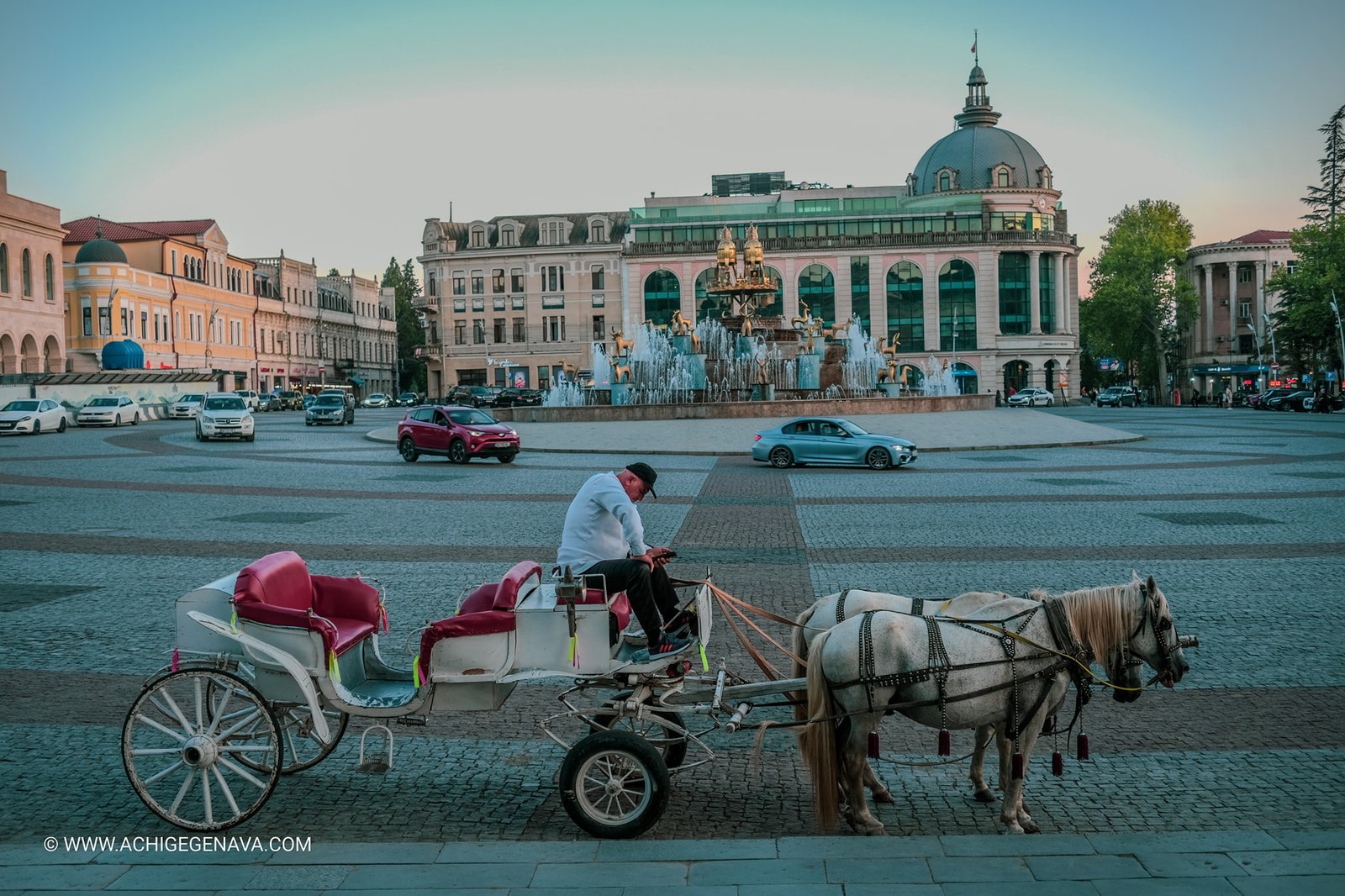
Kutaisi does not rush. The Rioni River winds through the city at its own pace. Old men play backgammon in parks where Soviet monuments stand alongside 11th-century churches. Women sell adjika and churchkhela at the Green Bazaar using the same wooden spoons their grandmothers used. This is Georgia without the tourist polish—authentic, slightly rough around the edges and all the more beautiful for it.
Why Kutaisi Deserves More Than a Quick Airport Stop
Many international visitors land at Kutaisi International Airport, take a marshrutka to Tbilisi and never look back. That is a mistake.
Kutaisi is one of Georgia’s largest cities, but calling it a city sometimes feels wrong. It is more like an oversized village where everyone knows someone who knows everyone. Cafés close when the owner gets tired, and the museum opens when the curator arrives. This is not simply inefficiency—it is a different pace of life.
What makes Kutaisi special: It is one of the world’s oldest continuously inhabited cities. Ancient Greeks knew it as Aia, the legendary capital of Colchis, where Jason came searching for the Golden Fleece. Archaeologists continue to find Colchian gold jewellery, Bronze Age weapons and evidence of settlement stretching back thousands of years.
Kutaisi is not living entirely in the past. The city centre has cafés serving natural wine and modern interpretations of Georgian food. Street art covers Soviet-era buildings, while synagogues and Catholic churches reveal that Georgia has always been more diverse than many outsiders realise.
Getting to Kutaisi: Your Gateway to Western Georgia
Flying into Kutaisi International Airport
Kutaisi International Airport (KUT) is approximately 20 kilometres from the city centre. Wizz Air operates numerous low-cost connections from Budapest, Warsaw, Milan, Vienna and other European cities. It is also a popular entry point for travellers arriving from Israel.
Airport-to-city transportation:
- Official shuttle bus: Services operate throughout the day and drop passengers near the city centre. Purchase tickets at the airport counter.
- Taxi through Bolt: Using an application provides transparent pricing and avoids negotiating with airport taxi drivers.
- Private transfer: A pre-booked transfer is useful when arriving late at night or travelling with substantial luggage.
The airport is small and generally efficient. SIM cards and mobile data packages are available after arrival, which is helpful for using taxi and navigation applications.
Arriving by Train from Tbilisi
The overnight train from Tbilisi to Kutaisi is atmospheric but may not be the most practical option. Another possibility is travelling to Rioni Station, which lies on the main east–west railway line and receives more frequent services. From Rioni, Kutaisi is approximately 20 minutes away by taxi.
Day trains from Tbilisi take approximately five hours. Check current schedules and prices through Georgian Railway before travelling.
Travelling by Marshrutka from Tbilisi
Marshrutkas run frequently between Tbilisi’s Didube Station and Kutaisi. The journey normally takes three to four hours. Minibuses often depart when full, so schedules can be flexible. They are inexpensive and functional, although not particularly luxurious.
Kutaisi City Centre: Where Old Meets Older
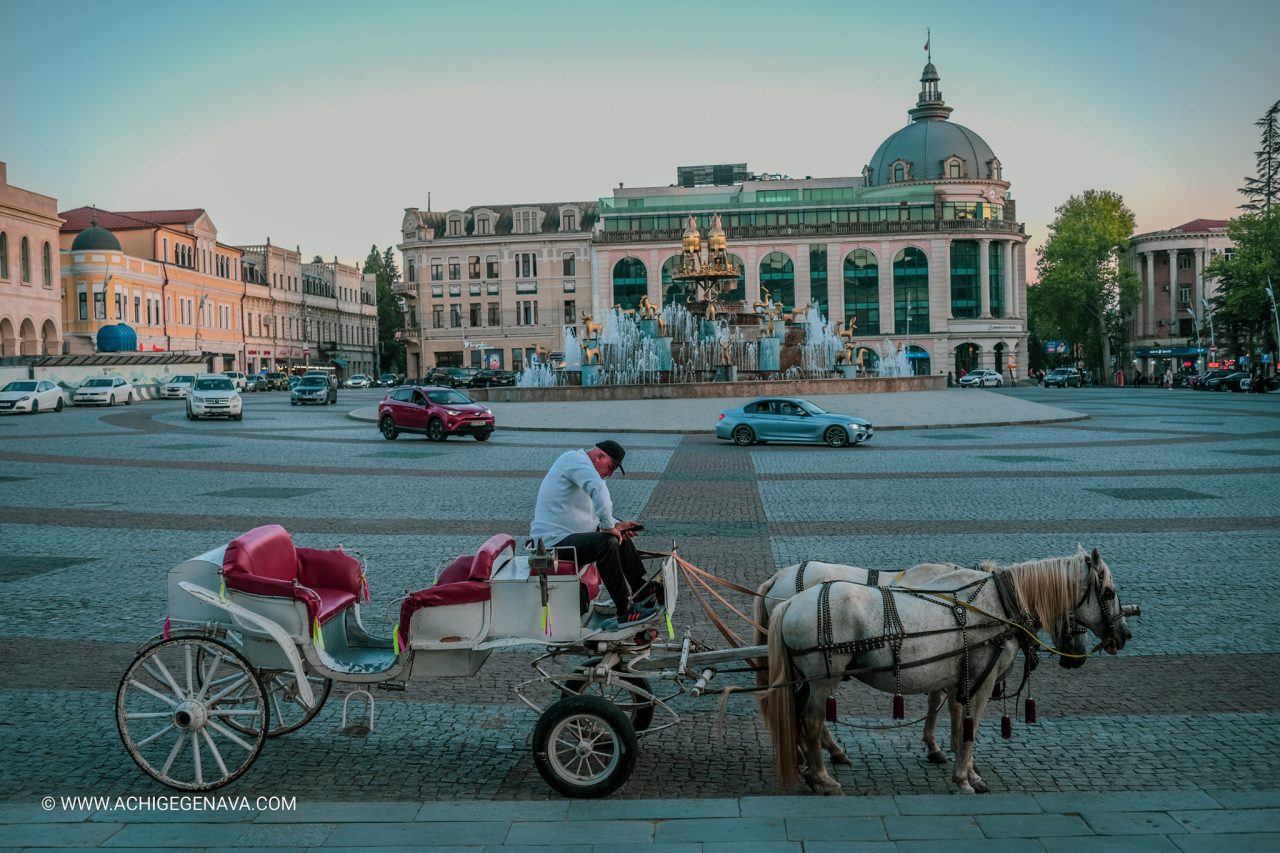
The Colchis Fountain: Gateway to Ancient Legends
The Colchis Fountain dominates Kutaisi’s main square like a golden sun rising from the pavement. Its figures are enlarged replicas of ritual objects discovered in ancient Colchian burial sites across Imereti. The Tamada toastmaster, magnificent stags and twin horses are based on Bronze Age artefacts more than 2,500 years old.
At night, the fountain glows in changing colours while traffic circles the busy roundabout. There is no convenient pedestrian crossing, so wait carefully for a safe gap before crossing.
The fountain serves as a useful starting point for exploring central Kutaisi. Most of the main city-centre attractions are within a 10–15-minute walk.
Walking Through Kutaisi’s Historic Heart
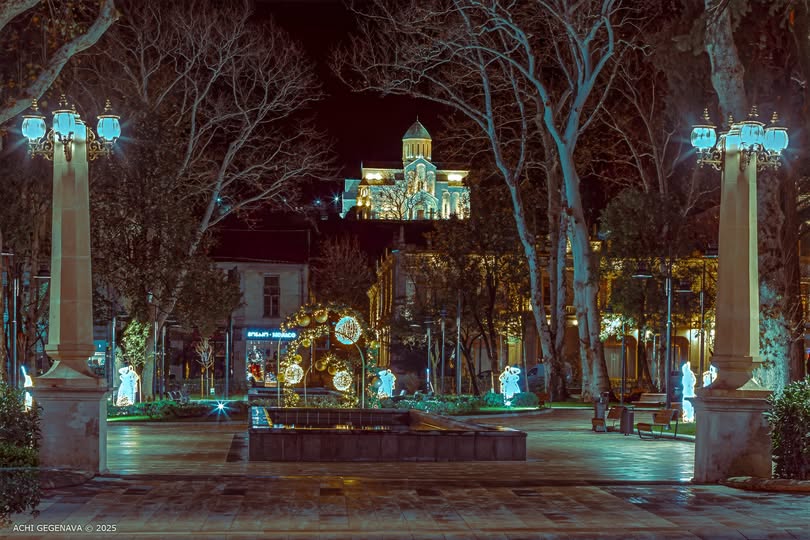
The Boulevard, or Central Park, stretches south from the Colchis Fountain. This tree-lined promenade was once a royal garden. Its colonnaded entrance, fountains and sculptures dedicated to Imeretian artists give it a slightly faded European elegance.
One of the most distinctive monuments honours the Ishkhneli Sisters, a folk quartet from Kutaisi that became famous across the Soviet Union during the 1940s.
The architecture surrounding the park tells Kutaisi’s story in stone. Paliashvili Street contains ornate 19th-century merchant houses, while Kutaisi City Hall on Rustaveli Street represents the heavier architectural style of the Soviet period.
The Andronikashvili Brothers’ House, built around 1880, features elaborate stucco decoration and corner balconies that catch the afternoon light beautifully.
The Meskhishvili Theatre and Cultural Scene
The rounded Meskhishvili Theatre stands behind the Colchis Fountain. Established in 1861, it is one of Georgia’s oldest theatres. Its 830-seat hall feels more intimate than Tbilisi’s Opera House. Performances are generally in Georgian, but attending can still provide an engaging cultural experience.
Nearby, the Kutaisi State Opera Theatre is crowned by ten Greco-Roman statues positioned on its highest pillars. The building replaced the older Kharazov Theatre, which burned down in 1946.
Kutaisi’s Chamomile Crossings
Zebra crossings in central Kutaisi are decorated with white and yellow flowers. These chamomiles are another symbol of the city.
Every May 2, Kutaisi celebrates Kutaisoba, also known as Gviriloba or the Chamomile Festival. It commemorates a 19th-century tradition in which local schoolgirls sold flowers to raise money for a tuberculosis hospital.
The festival fills the streets with flowers, traditional music and public celebrations. If you visit Kutaisi in early May, it is worth experiencing.
The Green Bazaar: Kutaisi’s Real Heart
If you want to understand everyday life in Kutaisi, visit the Green Bazaar. This is a working local market where residents shop, negotiate prices, taste products and exchange neighbourhood news.
The covered market is divided into sections. The main floor contains seasonal produce, including bundles of tarragon and coriander, dried peppers, autumn persimmons and summer cherries. An elevated section contains a photogenic spice shop selling adjika, Svanetian salt and Imeretian tea.
The central hall specialises in cheese and dairy products. Taste the Imeretian cheese used to make traditional khachapuri. It is salty, tangy and very different from the generic products sometimes sold abroad as Georgian cheese.
Outside corridors contain honey vendors. Around Easter, the market also sells supplies for traditional celebrations, including different shades of red dye for colouring eggs.
Kolkhida bas-relief: Do not miss the enormous Soviet-era artwork on the market façade. Artist Bernard Nebieridze spent approximately ten years creating the rust-coloured panel, which depicts Medea, Jason and the Golden Fleece alongside scenes from Kutaisi.
Behind the market on Varlamishvili Street, small shops sell homemade cheese and chacha. A covered flower market operates throughout the year on the opposite side.
Practical tips:
- Visit after 10:00, when most vendors have finished setting up
- Carry cash because cards are not accepted everywhere
- Try Bread and Wine inside the market for fresh khachapuri and lobiani
- Café Richard on the corner is a convenient place to stop for coffee
Near the market, an outdoor book market operates beside the park. Most books are in Georgian or Russian, but patient browsing can occasionally uncover English-language editions.
Kutaisi’s Jewish Quarter: A Story of Coexistence
Georgia’s Jewish community, known as the Gurjim or Kartveli Ebraelebi, traces its history to families who migrated from Babylon in the 6th century BC. Kutaisi once had one of Georgia’s largest Jewish populations. Most emigrated to Israel during the 1960s and 1970s, but their architectural and cultural legacy remains.
The Jewish Quarter extends along Jerusalem Street, Newport Street and Gaponov Street. The monumental Kutaisi Synagogue, completed in 1886, is Georgia’s second-largest synagogue after the Great Synagogue in Tbilisi. Its symmetrical stone façade and richly painted interior reflect the prosperity of Kutaisi’s former Jewish community.
Visiting hours: The synagogue is normally open for a few hours in the morning. Ring the bell if the door is closed. Remember that this remains an active house of worship.
A second, smaller synagogue was added to the complex in 1912. The site also contained a matzah bakery and a school. The Old Synagogue, built in 1852, stands farther down Gaponov Street. It is usually locked, but its exterior remains visible.
The streets between the synagogues contain row houses and old shops, some still marked with the Star of David. The neighbourhood has the quiet, faded atmosphere of a place where much of its community history remains visible even though many residents have left.
For Israeli visitors: Kutaisi’s Jewish heritage provides a fascinating insight into Georgia’s multi-ethnic history. Georgian Jews and Orthodox Georgians generally coexisted peacefully for centuries, and many Israelis with Georgian roots visit Kutaisi to reconnect with this heritage.
A memorial in front of the main synagogue honours Boris Gaponov, who translated Shota Rustaveli’s The Knight in the Panther’s Skin into Hebrew. He created an important cultural bridge between Georgian and Jewish literary traditions.
Visitors interested in Jewish history may also explore the Old Jewish Cemetery in the Sapichkhia district, where Hebrew inscriptions remain visible on weathered headstones.
The Catholic Quarter and Holy Annunciation Temple
Kutaisi’s Catholic Quarter centres on the Holy Annunciation Temple. Capuchin missionaries settled in the area during the 17th century, establishing a Catholic community sometimes associated with Kutaisi’s “French Quarter,” although many families were Georgian Catholics.
The temple’s robust arched façade and interior frescoes are unusual for Georgia. Its “Immaculate Conception” inscription is specifically Catholic terminology. During the Soviet period, the building served as a concert hall. Its subsequent transfer to Orthodox use remains a matter of historical debate.
The surrounding architecture includes ornate corner buildings with shaped windows and the symmetrical former Military Commandant’s Office on Dvalishvili Street.
At the end of the quarter stands St George’s Church, originally an Armenian Apostolic church and now used by the Georgian Orthodox Church. Its grounds provide views over the Rioni River.
Bridges, Rivers and Riverside Life
The Rioni River defines Kutaisi as much as any monument. It is fast-flowing, moody and changes colour with the seasons. It occasionally floods, but it is always central to the city’s character.
White Bridge
The White Bridge connects the old town with residential areas across the Rioni. Built in 1872 by French engineers, it contains transparent floor sections through which visitors can see the river below. Metal panels inscribed with passages from Georgian literature line its sides.
A statue known as Picasso’s Boy stands at the centre. The character comes from Rezo Gabriadze’s film An Unusual Exhibition and refers to an old Kutaisi tradition in which young men jumped from the bridge into the Rioni. The practice is no longer encouraged because the river’s current is dangerous.
White Stones Café at the end of the bridge was once a meeting place for members of the Blue Horns literary movement, including Titsian Tabidze and Paolo Iashvili.
Red Bridge
The Red Bridge, or Tsiteli Khidi, was manufactured in France at the factory associated with Gustave Eiffel. It is a modest but elegant metal structure connecting Kutaisi’s neighbourhoods across the river.
Chain Bridge
The Chain Bridge occupies the site of one of Kutaisi’s oldest river crossings. Support pillars from an 18th-century bridge remain visible. Wooden houses stand on the rocks above the water nearby, creating one of the city’s most distinctive riverside scenes.
Where to Eat in Kutaisi
Georgian food needs little introduction: khinkali, khachapuri, chakapuli and badrijani are known throughout the country. Imeretian cuisine has its own character, with tangier cheese, generous use of walnuts and distinctive spice combinations. Kutaisi is the home of Imeruli khachapuri, the round cheese-filled bread that became one of Georgia’s best-known dishes.
Palaty: Traditional Imeretian Food in a Historic Mansion
Restaurant Palaty occupies a 19th-century mansion in the Sapichkhia district. It has high ceilings, period furniture and garden seating beneath fruit trees.
The menu focuses on traditional Imeretian dishes, including khinkali, ojakhuri cooked in clay pans and vegetable pkhali.
Portions are substantial, so order conservatively.
Lilestan: Imeretian Tasting Board
Lilestan on Tamar Mepe Street serves a generous Imeretian tasting board featuring local cheese, jonjoli, ghomi, several types of pkhali and homemade pickles. It is a convenient choice for visitors who want to sample several regional dishes at once.
Cafés and Wine Bars
Foe-Foe Tea House
Foe-Foe Tea House captures Kutaisi’s artistic and retro character. The café is decorated with antiques, vintage samovars and reproductions of work by Petre Otskheli, a Kutaisi-born artist who was killed during Stalin’s purges.
Gallery Terrace
Gallery Terrace occupies the roof of the green-and-gold former Palace Hotel opposite the Opera House. It offers excellent views over central Kutaisi, especially around sunset.
Sisters Bar
Sisters Bar is located in a pink building beside the park. It offers cocktails, natural wine and a relaxed atmosphere popular with younger Kutaisi residents.
Where to Stay in Kutaisi
Kutaisi’s accommodation options range from inexpensive family guesthouses to contemporary boutique hotels.
Budget accommodation:
- Guesthouses: Family-run properties are common around the Green Bazaar and Sapichkhia
- Hostels: Black Tomato and Bao Hostel provide shared accommodation for budget travellers
Mid-range accommodation:
- Hotel Varla: Comfortable rooms in a central location
- Hotel Bagineti: An old-town property with traditional hospitality
Boutique and luxury accommodation:
- Communal Kutaisi: A boutique hotel with an Imeretian restaurant and courtyard pool
- Newport Hotel: A four-star hotel near the Colchis Fountain with a rooftop terrace
Bagrati, Gelati and Motsameta
Bagrati Cathedral: Kutaisi’s Crown Jewel
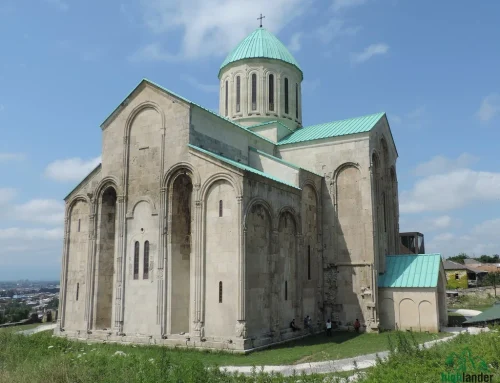
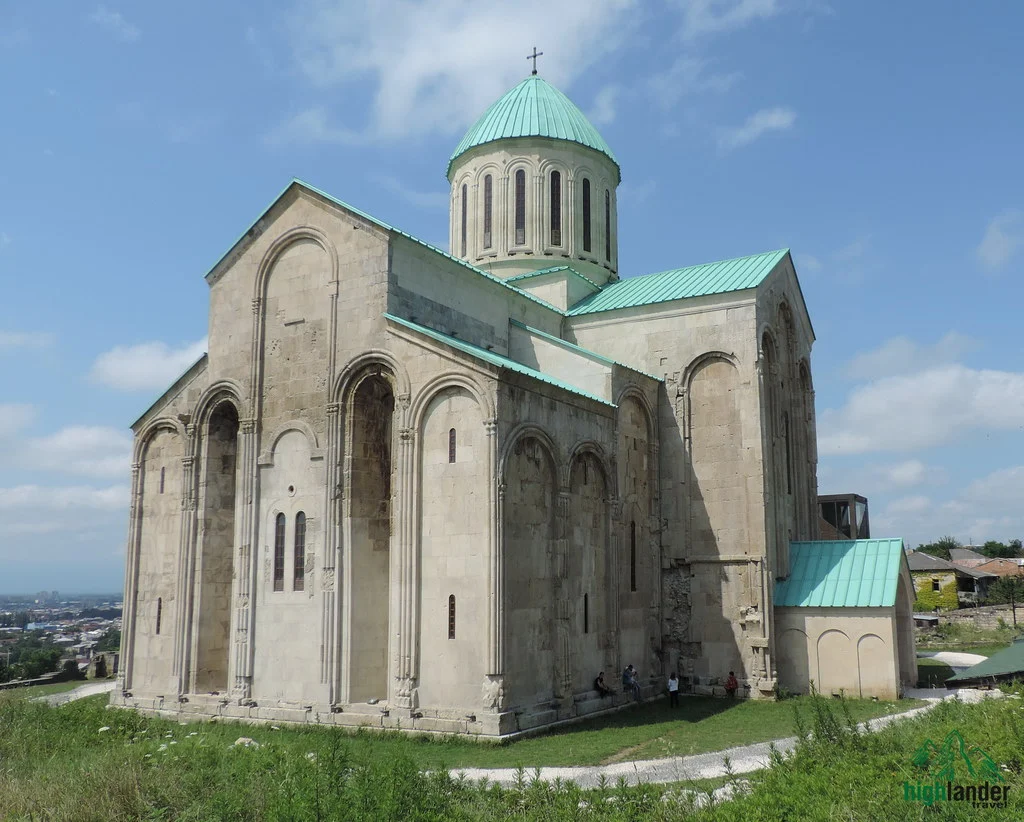
Bagrati Cathedral crowns the hill above Kutaisi. Built in the 11th century, it is one of Georgia’s most important churches and provides panoramic views over the city.
The cathedral was formerly included within a UNESCO World Heritage listing but was removed after controversial reconstruction work. Regardless of that decision, its scale, green roof and commanding position make it one of Kutaisi’s defining landmarks.
Gelati Monastery: Georgia’s Golden Age
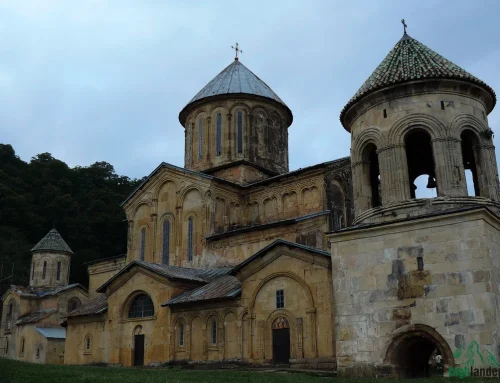
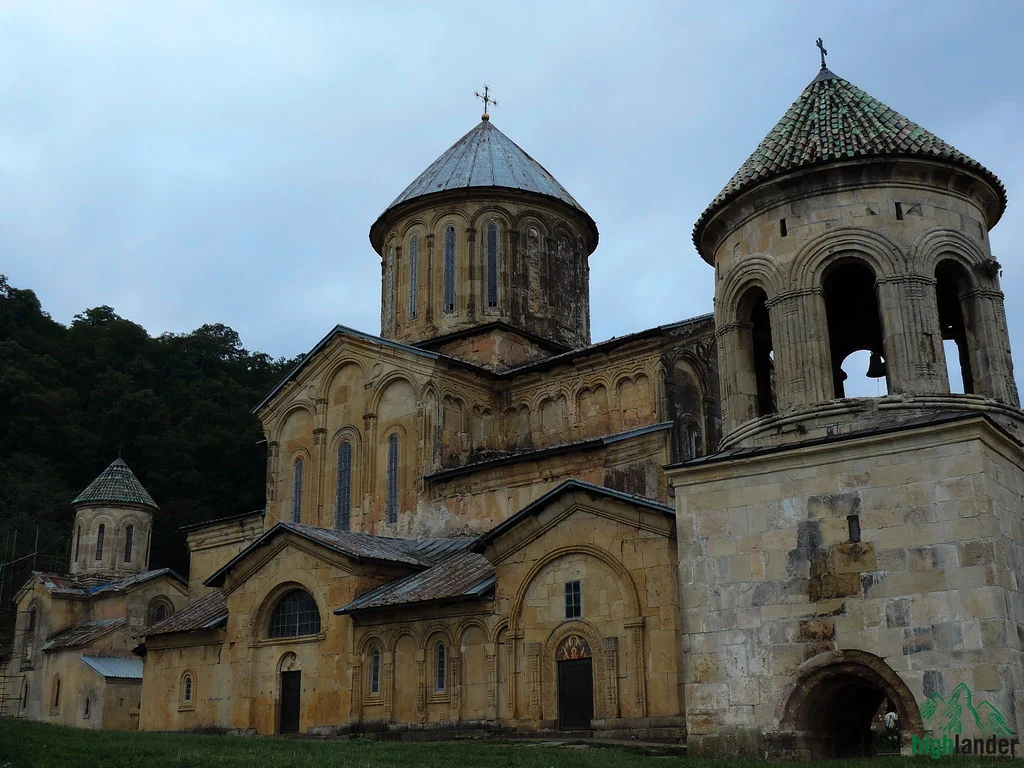
Gelati Monastery, approximately 11 kilometres from Kutaisi, represents Georgia’s medieval Golden Age. King David the Builder founded it in 1106 as both a monastery and an academy, inviting philosophers, scientists and theologians to create an important centre of learning.
The main church contains frescoes created between the 12th and 17th centuries. Its green-tiled roof gives the monastery a distinctive profile visible across the surrounding hills.
Important: Conservation work may affect access to Gelati. Check the current opening arrangements before visiting.
Motsameta Monastery
Approximately two kilometres from Gelati, Motsameta Monastery occupies a dramatic clifftop position above a bend in the river. It is smaller and more intimate than Gelati, with expansive views across the Imereti landscape.
Agro Guesthouse Korena
Between Gelati and Motsameta, Agro Guesthouse Korena provides traditional meals and cooking experiences. The guesthouse is associated with Dali Doghonadze, who is also depicted in a well-known mural near the Green Bazaar.
Day Trips from Kutaisi
Sataplia Nature Reserve and Prometheus Cave
Sataplia Nature Reserve, approximately nine kilometres from Kutaisi, protects one of Georgia’s most important palaeontological sites. Its dinosaur footprints are believed to be around 120 million years old.
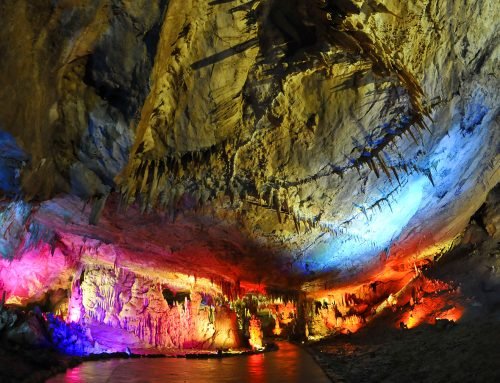
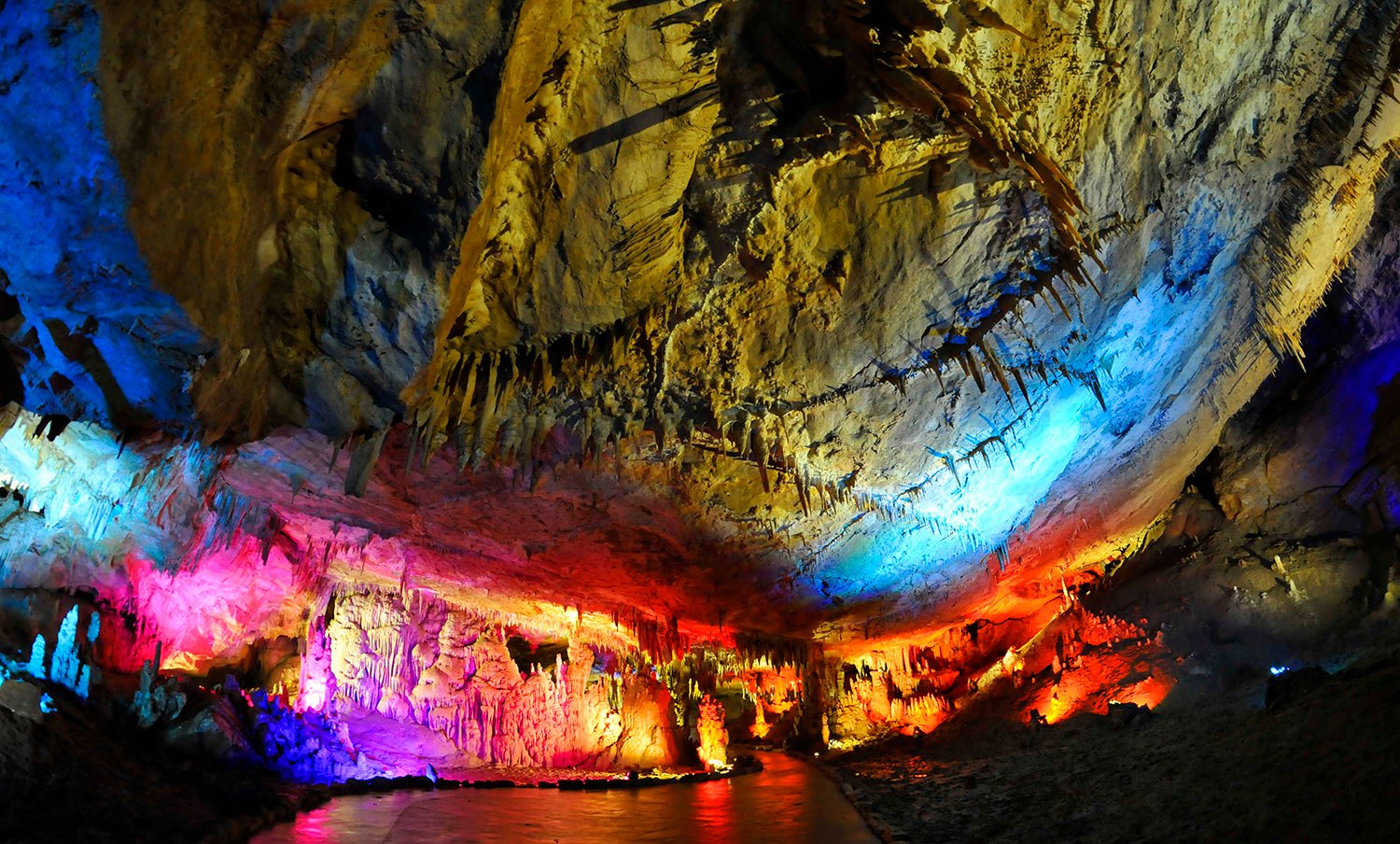
Prometheus Cave, also known as Kumistavi Cave, is approximately 20 kilometres from Kutaisi. The visitor route passes through illuminated chambers filled with stalactites, stalagmites and other limestone formations.
Martvili Canyon
Martvili Canyon, approximately 50 kilometres from Kutaisi, is known for its turquoise pools, high rock walls and moss-covered cliffs. Walking trails and seasonal boat trips provide different perspectives on the canyon.
Tskaltubo and Its Soviet Sanatoriums
Tskaltubo, approximately nine kilometres from Kutaisi, was one of the Soviet Union’s leading spa resorts. Its radon-carbonate mineral waters attracted political leaders and visitors from across the USSR.
Several former sanatoriums remain in varying states of abandonment, creating one of Georgia’s most unusual architectural landscapes. Access conditions change frequently, and some buildings are unsafe or privately controlled.
Practical Information for Visiting Kutaisi
Getting Around Kutaisi
Central Kutaisi is compact and easy to explore on foot. For longer journeys, use city buses or a registered taxi application such as Bolt.
When to Visit Kutaisi
- Spring: Magnolia blossoms, green landscapes and comfortable temperatures
- Summer: Hot and humid, with long daylight hours
- Autumn: Comfortable temperatures and golden foliage
- Winter: Relatively mild but frequently wet
Frequently Asked Questions
How many days should I spend in Kutaisi?
A minimum of two full days is recommended. Use the first day to explore the city centre and nearby historical sites. Dedicate the second day to an excursion such as Martvili Canyon, Prometheus Cave or Tskaltubo.
What is the best way to get from Kutaisi Airport to the city?
A registered taxi application such as Bolt is generally the most convenient option. Official shuttle services may also be available. Check the current timetable and prices before arrival.
Is there a dress code for churches and monasteries?
Yes. Shoulders and knees should be covered. Women may be asked to cover their heads and use a wrap skirt, while men should avoid shorts. Major sites often provide scarves and wraps at the entrance.
Can I explore the abandoned sanatoriums in Tskaltubo?
Access varies by building. Some former sanatoriums are private property, under redevelopment or structurally unsafe. Never enter a restricted building, and avoid unstable floors, broken glass and unprotected staircases.
Is Kutaisi safe for international travellers?
Kutaisi is generally considered safe, with relatively low levels of serious crime. Use normal precautions, watch your belongings in crowded areas such as the Green Bazaar and use registered taxi applications.
When is the best time to visit Kutaisi?
April and May offer spring flowers, comfortable temperatures and the Kutaisoba festival. September and October are also excellent, with mild weather, autumn foliage and the regional harvest season.
Ready to explore Kutaisi? Georgia-Tours.eu offers private tours with transportation and experienced local guides. Visit Georgia-Tours.eu to plan your Kutaisi journey.



[…] into Kutaisi rather than Tbilisi cuts three hours off the drive, and low-cost carriers serve it from across […]