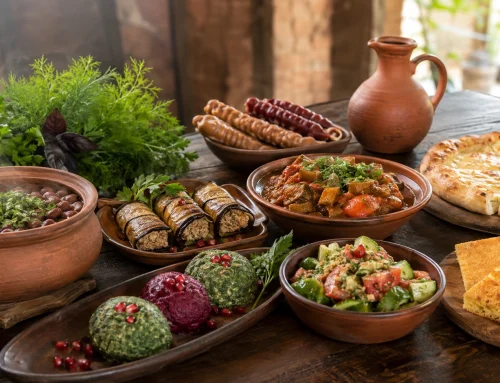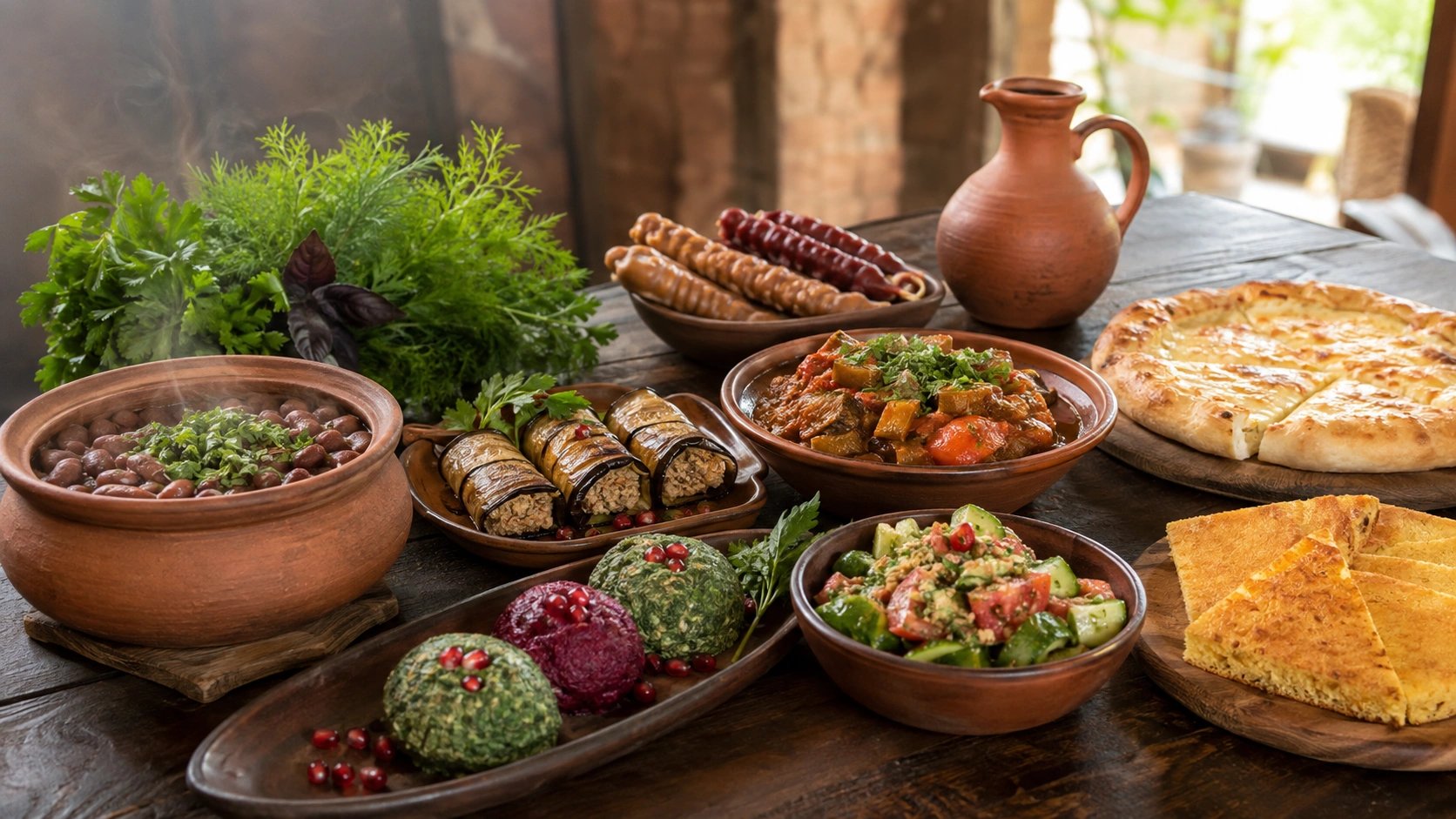
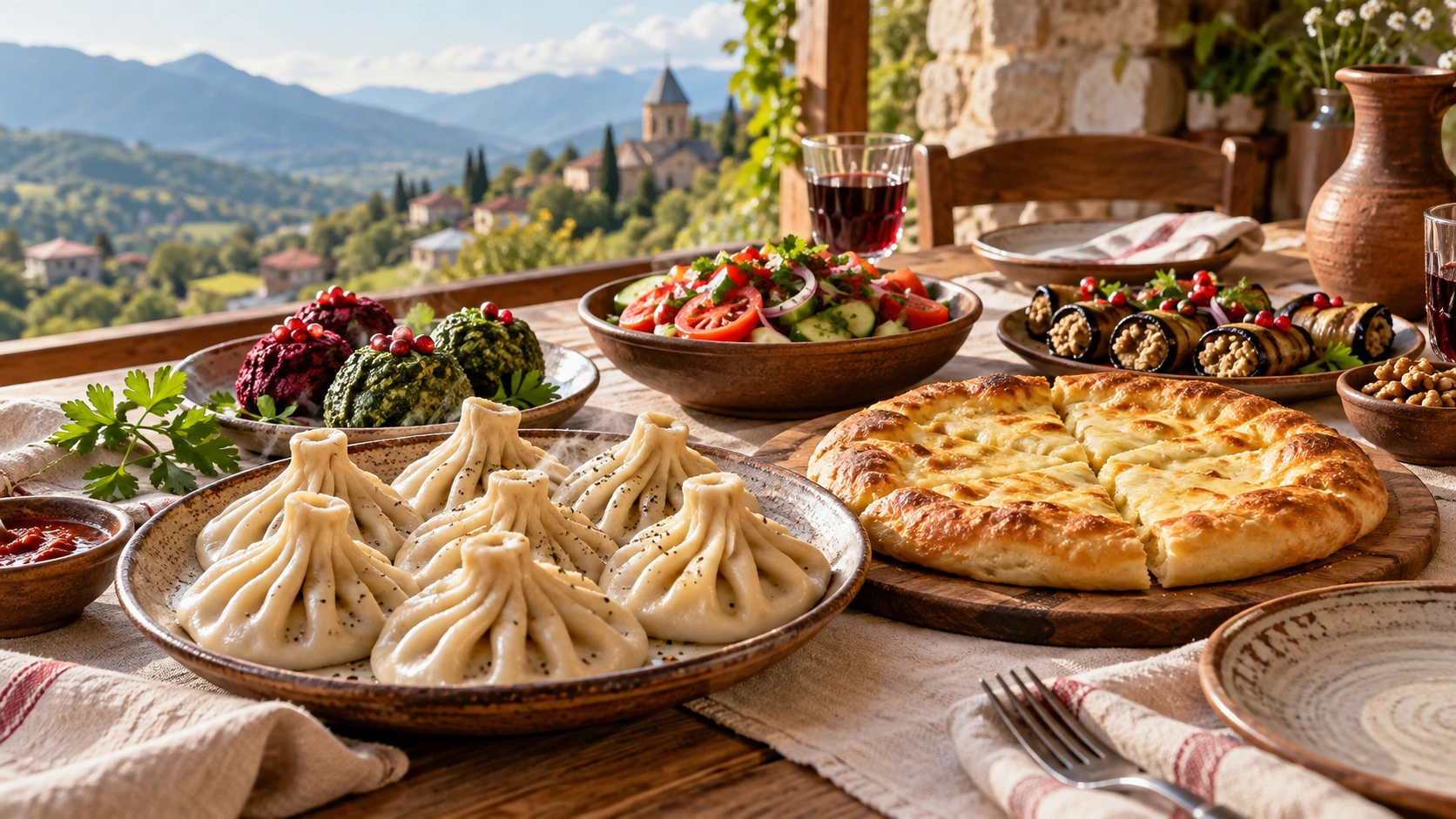
Georgian food is built on bread, cheese, walnuts, fresh herbs and sour fruit, cooked very differently from one region to the next. Eastern Georgia leans toward wheat bread, grilled meat and wine. The west leans toward cornmeal, cheese, walnuts and chilli. In the mountains, dumplings, dairy and cured meat take over. These are tendencies, not rules, and every region borrows from the others.
Most dishes are shared from the middle of the table rather than served as individual plates. Cold starters arrive first and stay out all meal, and hot dishes follow.
Is Georgian food spicy? Mostly not. The dominant flavours are herbal, garlicky, nutty and sour. Real heat is concentrated in western Georgia, especially in Megrelian cooking, and in chilli pastes such as ajika that are usually served on the side. If you dislike heat, ask before ordering kharcho or any dish described as Megrelian.
Five foods to try first:
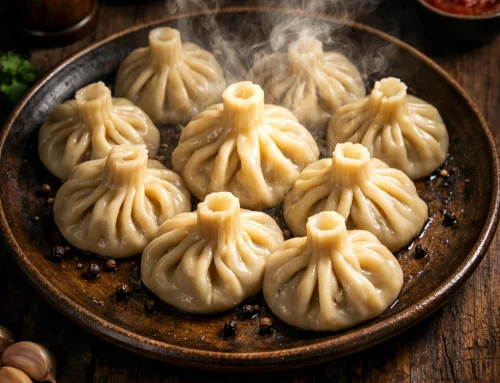
- Khinkali – juicy meat dumplings, eaten by hand.
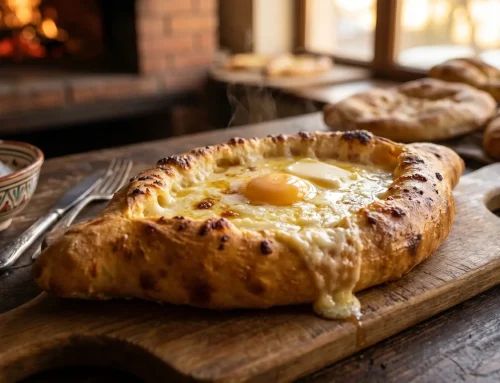
- Imeruli or Adjaruli khachapuri – Georgia’s cheese bread, in its everyday round form or the egg-and-butter “boat”.
- Pkhali – vegetables pounded with walnuts, garlic and herbs.
- Badrijani nigvzit – fried aubergine rolled around walnut paste.
- Mtsvadi – pork or lamb grilled on skewers, ideally over vine cuttings.
That combination gives you dumplings, bread, a vegetable dish, a walnut dish and grilled meat – a fair cross-section of the cuisine in one meal.
In this guide
- Essential Georgian dishes
- Georgian food by region
- Eastern Georgia
- Western and southern Georgia
- Sauces, spices and cheeses
- Vegetarian, vegan and dietary needs
- Drinks, sweets and food to take home
- Georgian food through the seasons
- Costs, ordering and table etiquette
- Food experiences and routes
- FAQ
Essential Georgian dishes
Khinkali
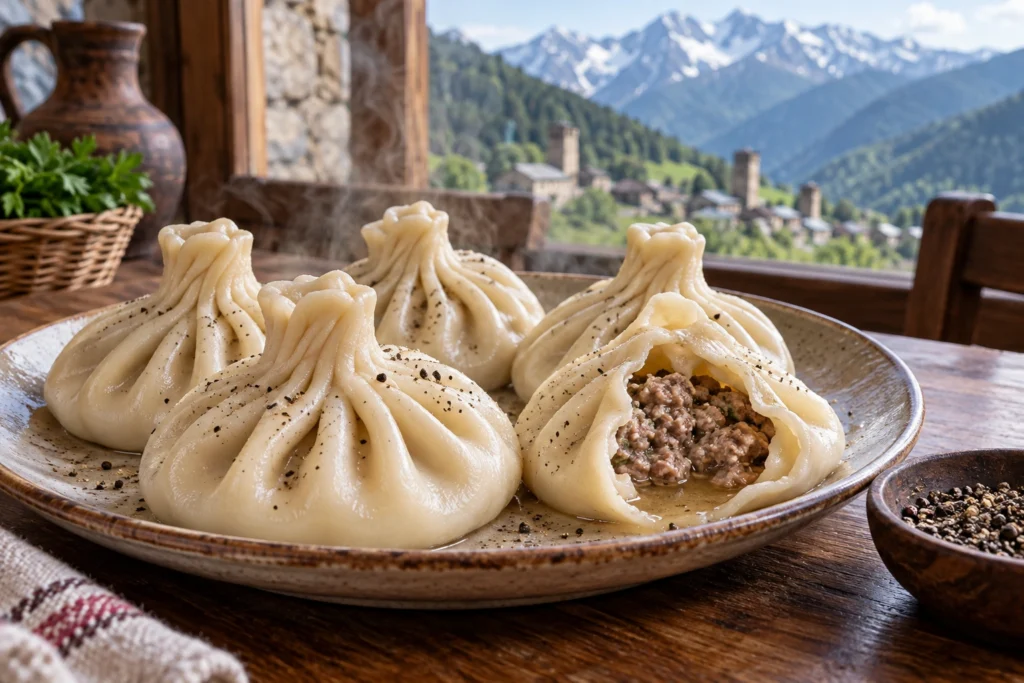
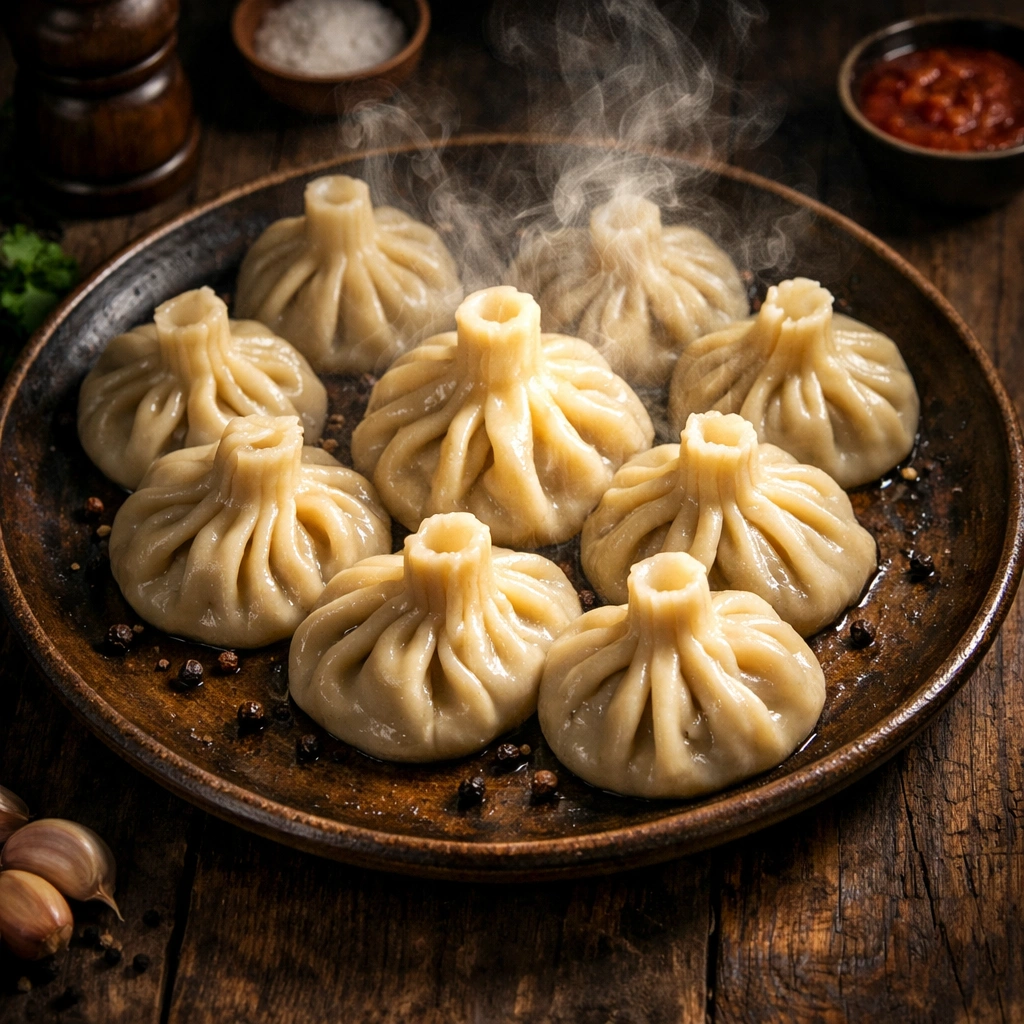
Pleated dumplings twisted into a knot at the top and filled with raw minced meat, which cooks into broth inside the dough. Hold the knot, bite a small hole, drink the juice, then eat the rest and leave the knot on the plate. Khinkali come from the mountains of Pshavi, Mtiuleti and Khevsureti, and seasoning varies by area and cook: chilli and onion in some villages, cumin in Tushetian versions, chopped herbs in the Tbilisi style called kalakuri. Cheese, mushroom and potato fillings are common too. See our complete guide to khinkali.
Khachapuri
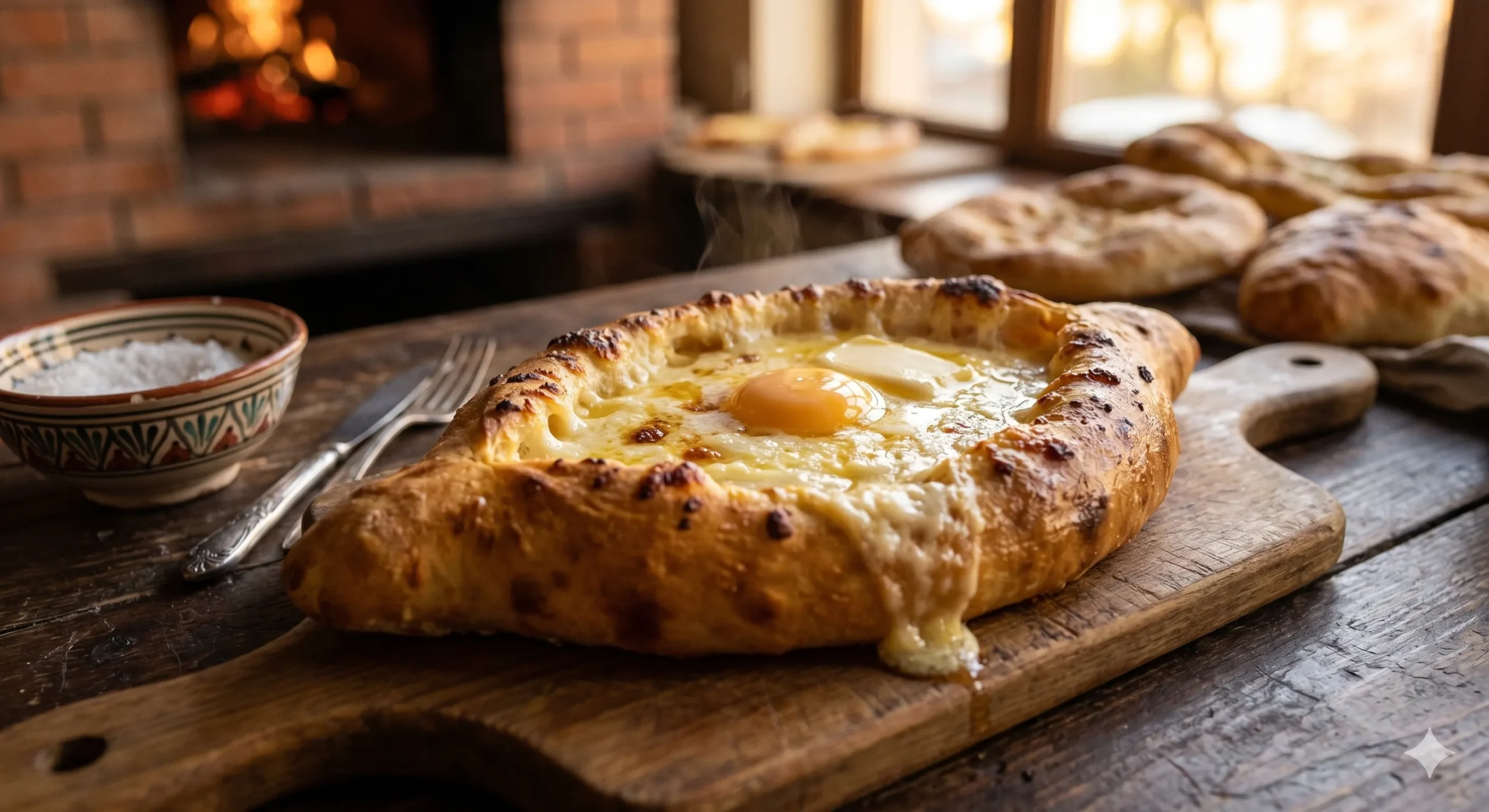
The name means cheese bread, and most regions bake their own version. Imeruli is the everyday round with cheese sealed inside. Megruli adds cheese on top. Adjaruli is an open boat of dough with molten cheese, finished with an egg yolk and butter that you stir in at the table. Our guide to 11 khachapuri varieties covers the rest.
Other dishes you will meet often
- Pkhali. Spinach, beetroot, leek or green beans chopped fine and bound with walnut paste, garlic and herbs. A standard cold starter.
- Badrijani nigvzit. Thin fried aubergine rolled around a garlicky walnut filling; soft, rich and served cold.
- Lobio. Red beans stewed with coriander and savory, often served in a clay pot with cornbread and pickles. Some regional versions include meat or ham.
- Mtsvadi. Skewered pork or lamb grilled over embers, traditionally of vine cuttings, served with raw onion and sometimes pomegranate juice.
- Chakapuli. Lamb or veal braised with tarragon, sour green plums and white wine. Associated with spring and Easter.
- Chakhokhbili. Chicken stewed with tomato, onion and fresh herbs.
- Shkmeruli. Fried chicken baked in a clay dish with garlic and milk, named after the village of Shkmeri in Racha. Garlic is the defining flavour.
- Kharcho. Two different dishes share the name: a walnut-thickened stew in Samegrelo, and a spiced beef and rice soup on many Tbilisi menus.
- Satsivi. Cold poultry in a cooked walnut sauce with blue fenugreek and cinnamon. Traditionally a New Year dish.
- Ojakhuri. Pork fried with potatoes and onion in one pan. A familiar home-style dish.
- Mchadi and ghomi. Western Georgia’s corn staples: a dense cornbread and a soft cornmeal porridge.
- Churchkhela. Walnuts on a string dipped repeatedly in thickened grape juice, then dried. Sold at markets and roadside stalls.
Georgian food by region
Each region has dishes you rarely see elsewhere, and the best way to understand the cuisine is to eat them where they come from. The table gives a quick comparison; the sections below explain each region.
| Region | Cooking style | Dishes to try | Good base |
|---|---|---|---|
| Tbilisi | A sampler of every region | Kalakuri khinkali, regional menus | Tbilisi |
| Kakheti | Wine, grilled meat, wheat bread | Mtsvadi, chakapuli, churchkhela, shoti | Telavi, Sighnaghi |
| Shida Kartli and Kvemo Kartli | Orchards, farm produce, mixed cultures | Fruit, home cooking, tenili cheese in the south | Gori, Tbilisi |
| Mtskheta-Mtianeti and the eastern highlands | Mountain dumplings and dairy | Mtiuluri khinkali, khabizgini | Pasanauri, Stepantsminda |
| Imereti | Cheese, vegetables, walnuts | Imeruli khachapuri, pkhali, Imeretian cheese | Kutaisi |
| Samegrelo | Hottest kitchen, cornmeal, sulguni | Elarji, gebzhalia, kharcho, ajika | Zugdidi, Martvili |
| Guria | Hazelnuts, cheese pies, corn | Gurian pie, bazhe dishes | Ozurgeti |
| Adjara | Butter, dairy, coastal | Adjaruli khachapuri, borano, sinori, chirbuli | Batumi |
| Racha | Smoked meat, mountain cooking | Shkmeruli, Rachan ham, lobiani | Ambrolauri, Oni |
| Svaneti | High-mountain, hearty | Kubdari, tashmijabi, chvishtari, Svan salt | Mestia |
| Samtskhe-Javakheti (Meskheti) | Dough, butter, cured meat | Tatarberaki, Meskhetian khachapuri, tenili, apokhti | Akhaltsikhe |
Eastern Georgia
Tbilisi
The capital has no single cuisine of its own, which makes it the easiest place to sample everyone else’s. Many restaurants are run by families from a particular region, and their menus show it: Megrelian places for elarji and spicier kharcho, Rachan places for ham and lobiani, Adjarian places for the boat-shaped khachapuri. The city’s own contribution is kalakuri khinkali, the herb-flecked city version.
Where to start: a sakhinkle (khinkali house) for dumplings, a neighbourhood tone bakery for bread straight from the clay oven, and the Dezerter Bazaar for cheese, spices and seasonal produce. Popular restaurants fill up on weekend evenings, so book ahead then.
Kakheti
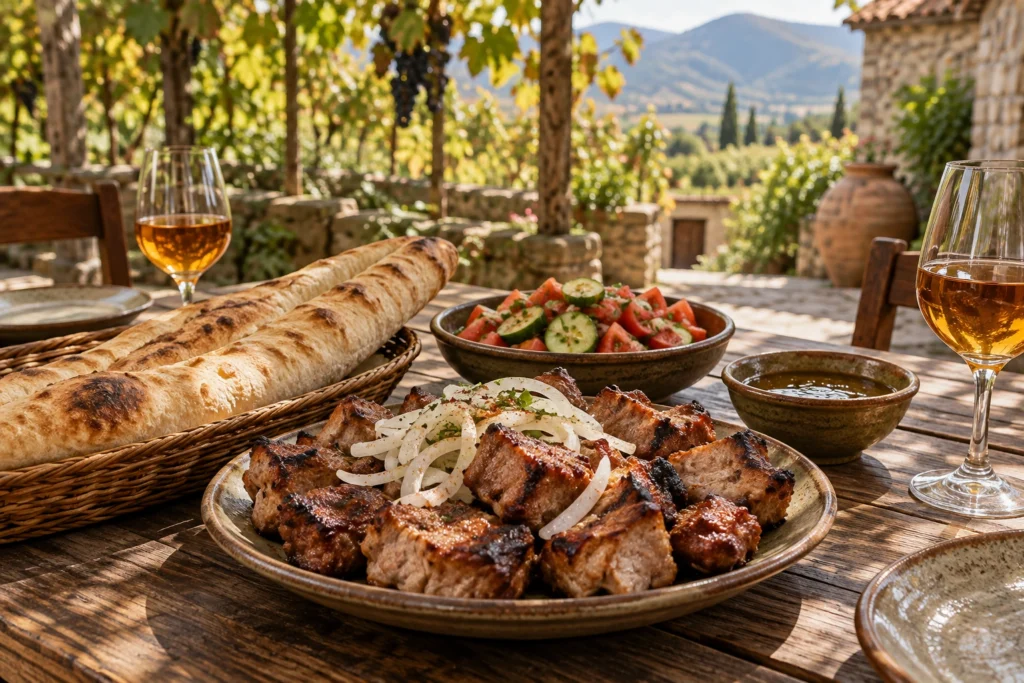
Kakheti is Georgia’s main wine region, and its food is meant to be eaten with wine. Expect mtsvadi grilled over vine cuttings, shoti bread from the tone, chikhirtma (a chicken soup thickened with egg), chakapuli in spring and churchkhela at harvest.
Where to start: the Telavi food market, known for its cheeses, churchkhela, fruit leathers, chacha and draft qvevri wine. Base yourself in Telavi or Sighnaghi. Family cellars and home-cooked meals usually need to be arranged in advance; our guide to Georgian wine varieties helps you choose what to taste.
Kartli
Shida Kartli, around Gori, is farm and orchard country, best known for its fruit. It has fewer signature dishes than Kakheti or Samegrelo, and most travellers taste it through village guesthouses on the way to Uplistsikhe or Borjomi. Kvemo Kartli, south of Tbilisi, is one of Georgia’s most mixed regions, and its home cooking reflects Azerbaijani and Armenian communities as well as Georgian ones. Tenili cheese is made here as well as in Meskheti.
Mtskheta-Mtianeti and the eastern highlands
This is the homeland of khinkali. On the road to Kazbegi, Pasanauri is the traditional stop for mtiuluri khinkali with hand-chopped meat. In Kazbegi, look for khabizgini, a cheese-and-potato pie of Ossetian origin. Further east, Tusheti (administratively part of Kakheti) has a sheep-herding kitchen: lamb khinkali, guda cheese matured in sheepskin, and no pork. Khevsureti, covered in our Khevsureti travel guide, shares the same mountain tradition.
Access matters here. Kazbegi is reachable most of the year, but Tusheti’s road is open only for a few months in summer and early autumn.
Western and southern Georgia
Imereti
Imereti is the gentlest of the western kitchens, built on soft, salty Imeretian cheese, vegetables and walnuts. Imeruli khachapuri comes from here, and the region is known for its pkhali, including versions made with ekala, a local wild green.
Where to start: the central market in Kutaisi, whose dairy hall sells the cheese used in khachapuri. Our Kutaisi travel guide covers the city.
Samegrelo
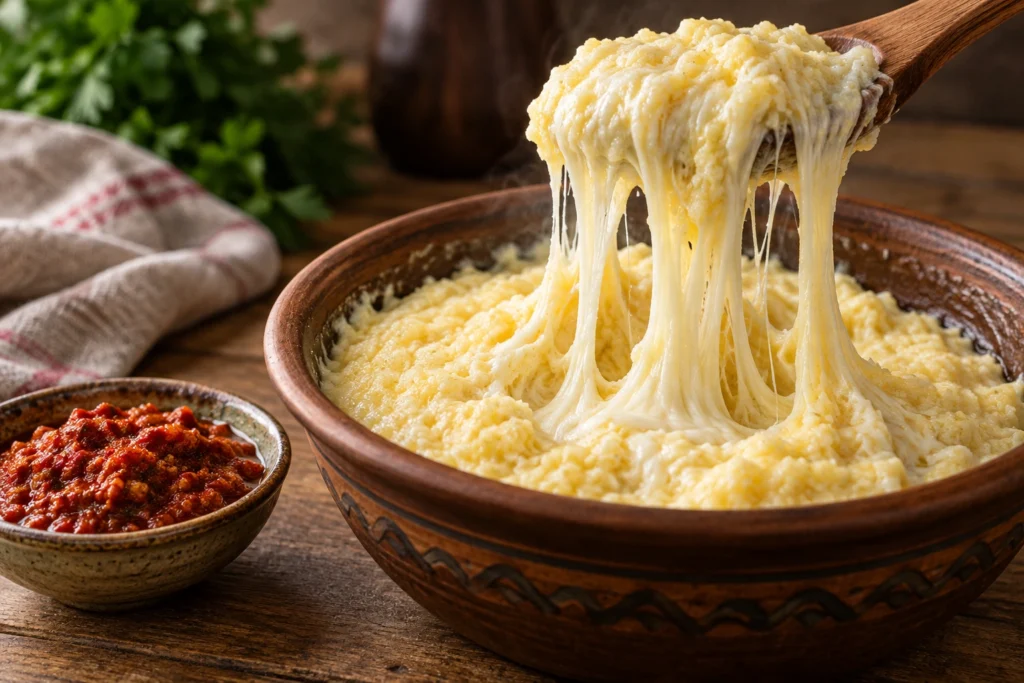
Megrelian food has the most heat and the most cheese in Georgian cooking. Try elarji, cornmeal beaten with sulguni until it stretches; gebzhalia, rolls of fresh cheese in a mint-scented yoghurt sauce; and the walnut-thick Megrelian kharcho. Ajika is central here.
Where to start: Zugdidi and the area around Martvili. Zugdidi has hosted an annual Ajika Festival, held in summer or autumn, since 2018.
Abkhazian culinary traditions
Ajika belongs to both Abkhazian and Megrelian traditions; the word itself comes from Abkhaz. Abkhazian cooking shares much with Megrelian, including cornmeal porridges, walnut sauces and smoked pepper pastes. Travellers mostly encounter these dishes in Samegrelo and Tbilisi rather than in Abkhazia itself.
Guria
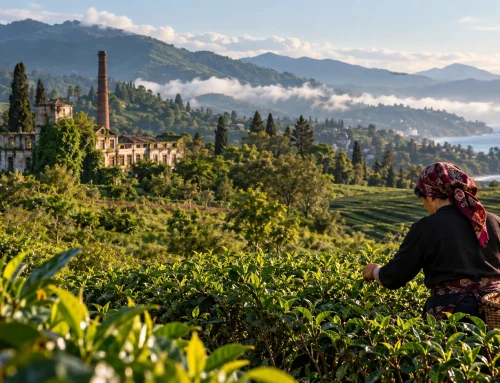
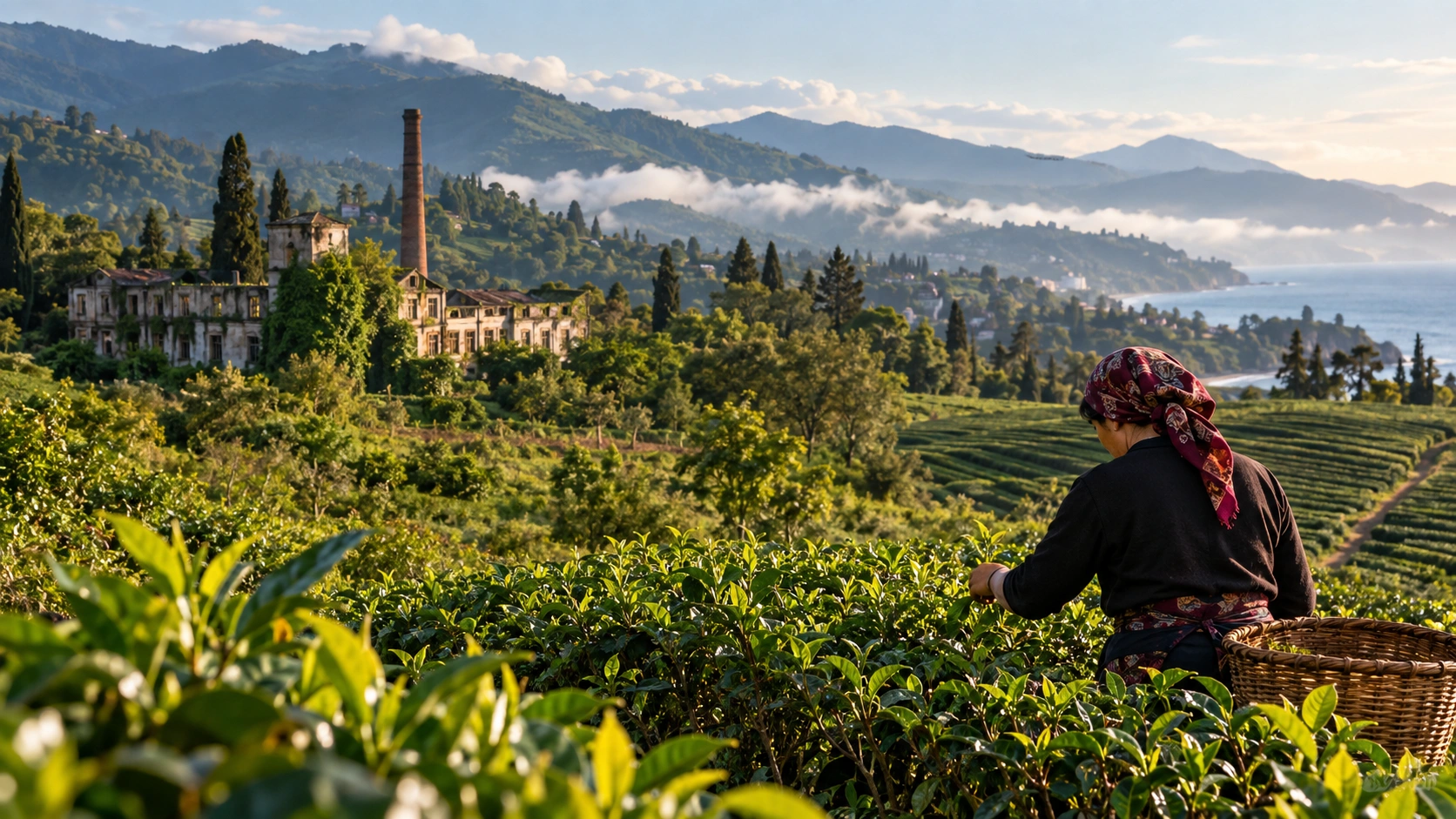
Gurian cooking uses hazelnuts as well as walnuts and is known for its crescent-shaped Gurian pie, filled with cheese and boiled egg and traditionally baked for Christmas. Guria is also Georgia’s tea country; read about Georgian tea and its revival.
Adjara
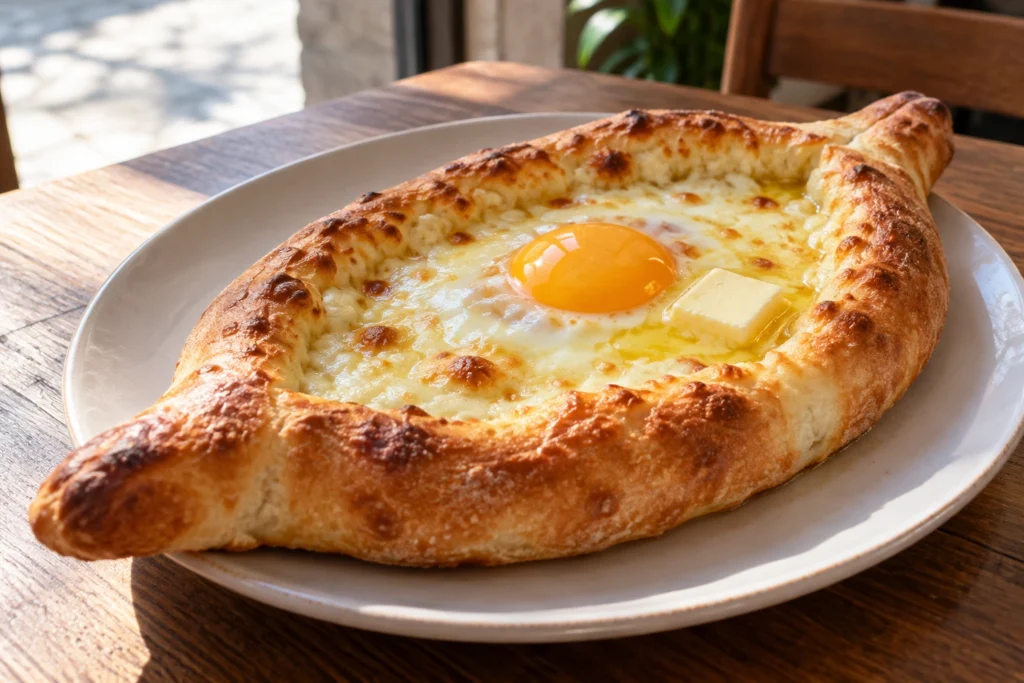
Coastal Adjara gave Georgia its best-known khachapuri, the Adjaruli boat. The upland villages add butter-rich dishes such as borano, cheese melted in butter, and sinori, rolled thin dough baked with cottage cheese and butter. For breakfast, try chirbuli: eggs cooked in a tomato and walnut sauce.
Where to start: Batumi, but ask locally which restaurant makes the best Adjaruli. Quality varies widely.
Racha
Racha is a small mountain region known for smoked ham, shkmeruli and lobiani made with ham folded into the beans. It is also home to Khvanchkara, a naturally semi-sweet red wine. Note that our Racha-Lechkhumi destination page covers both Racha and neighbouring Lechkhumi.
Svaneti
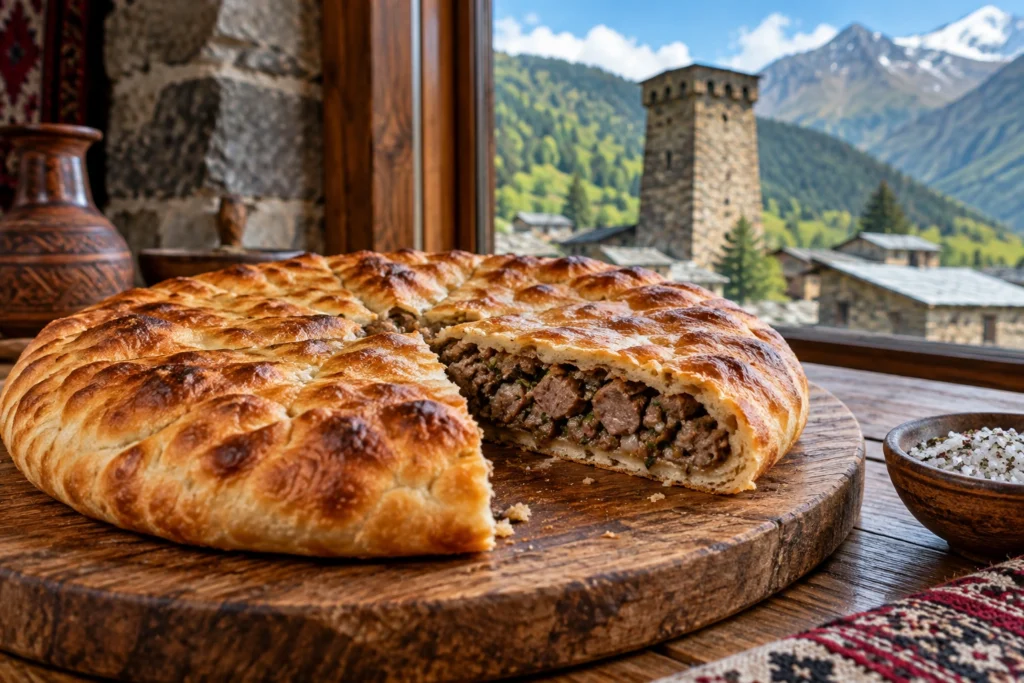
Svaneti’s kitchen is built for long winters at altitude. Look for kubdari, bread stuffed with hand-cut spiced meat; tashmijabi, mashed potato worked with cheese until it pulls into strings; chvishtari, cornbread with cheese; and svanuri marili, Svan salt. The best kubdari is usually in family guesthouses. Start in Mestia.
Meskheti (Samtskhe-Javakheti)
This section covers Meskheti, the western part of Samtskhe-Javakheti; the Javakheti plateau has its own, different traditions. Meskhetian cooking relies on dough, butter, dairy and cured meat. Try tatarberaki, boiled squares of thin dough with matsoni, butter and fried onion; the layered Meskhetian khachapuri; tenili, a fine stringy cheese listed as Georgian intangible heritage; and apokhti, salted and dried meat, traditionally goose, which also appears in local khinkali.
Where to start: Akhaltsikhe. Tenili demonstrations and goose dishes generally need to be arranged ahead.
Sauces, spices and cheeses
Walnuts, fresh herbs and sour fruit do most of the work in Georgian cooking. Ground walnuts thicken sauces and give them body, much as cream does elsewhere. Coriander, tarragon, dill, parsley and purple basil are used generously and are often served raw on a plate of their own. Sour plum, pomegranate and vinegar cut through rich meat and cheese.
Sauces
- Tkemali. A tart sauce of cherry plums, garlic and herbs. Green versions use unripe spring plums; red versions use ripe summer and autumn fruit. Served with grilled meat and potatoes.
- Ajika. A paste of chilli, garlic, salt and spices from the Abkhazian and Megrelian traditions. It comes red, green or dry, and colour is not a reliable guide to heat, so taste a little first.
- Bazhe. A walnut sauce made with garlic, spices and water, served with poultry or fried fish.
- Satsivi. A related but different preparation: the walnut sauce is cooked with poultry broth and served cold with the bird. Recipes vary between families.
Spices
The spice most associated with Georgian food is utskho suneli, blue fenugreek, with a mild, nutty warmth. It is a core part of khmeli suneli, the dried herb blend sold at every market. Dried marigold petals, sold as Imeretian saffron, coriander seed and summer savory complete the basic spice kit. From Svaneti comes svanuri marili, a coarse salt ground with garlic, chilli and other spices.
Cheeses
| Cheese | Region | What it’s like |
|---|---|---|
| Sulguni | Samegrelo, now everywhere | Brined, stretchy and salty; often smoked |
| Imeretian | Imereti, now everywhere | Soft, fresh and salty; the classic khachapuri cheese |
| Guda | Tusheti | Sheep’s cheese matured in sheepskin; strong and pungent |
| Tenili | Meskheti, Kvemo Kartli | Fine strands of cheese aged in clay with cream |
| Nadughi | Widespread | Soft curd similar to ricotta, often mixed with mint |
Vegetarian, vegan and dietary needs
Georgia is easier for vegetarians than its meat-heavy reputation suggests. The Orthodox calendar includes long fasting periods without meat, dairy or eggs, and over the centuries this produced many traditional plant-based dishes: pkhali, badrijani nigvzit, lobio, ajapsandali (a stew of aubergine, pepper and tomato), mushrooms baked in clay dishes, and pickled jonjoli, the flower buds of the bladdernut tree. Vegetarians who eat dairy also have the whole khachapuri family and cheese or mushroom khinkali.
Traditional plant-based versions exist, but preparation varies, so always confirm. Watch for:
- Meat stock in soups and some bean dishes.
- Animal fat in pastry, including some Meskhetian khachapuri, and in fried dishes.
- Ham or bacon in some regional lobio and in Rachan lobiani.
- Butter, cheese or egg added to dishes that are vegan in their fasting form.
Nuts. Walnuts appear in pkhali, badrijani, satsivi, bazhe, Megrelian kharcho and churchkhela, and hazelnuts are common in Guria and Adjara. If you have a nut allergy, assume any cold vegetable dish or sauce may contain nuts until staff confirm otherwise.
Gluten. Khinkali, khachapuri, lobiani and most breads are wheat-based. Cornbread and cornmeal dishes are traditionally made from corn, but ask about added flour and shared kitchens.
Dairy. Cheese, butter and matsoni yoghurt are everywhere, especially in Adjara, Meskheti and Samegrelo.
State your needs clearly and early, preferably in writing, and tell guesthouse hosts in advance. Our guide to vegan and vegetarian Georgian food goes into much more detail.
Drinks, sweets and food to take home
What to drink
- Wine. Georgia’s traditional method ferments grapes in qvevri, clay vessels buried in the ground; white grapes fermented with their skins become amber wine. Common grapes include Saperavi, Rkatsiteli, Kisi and Mtsvane. See our guide to Georgian wine varieties.
- Chacha. A strong grape spirit distilled from the pomace left after winemaking. Usually served in small glasses.
- Mineral water. Borjomi, Nabeghlavi, Likani and Sairme are widely available. Borjomi is noticeably salty.
- Lemonades. Georgian sodas come in flavours such as tarragon and pear and are a good non-alcoholic pairing for khinkali or khachapuri.
- Tea. Grown in Guria and other western regions; small producers are reviving it. Read about Georgian tea.
You are never obliged to drink alcohol, including at a supra. Non-alcoholic drinks are easy to request.
Sweets
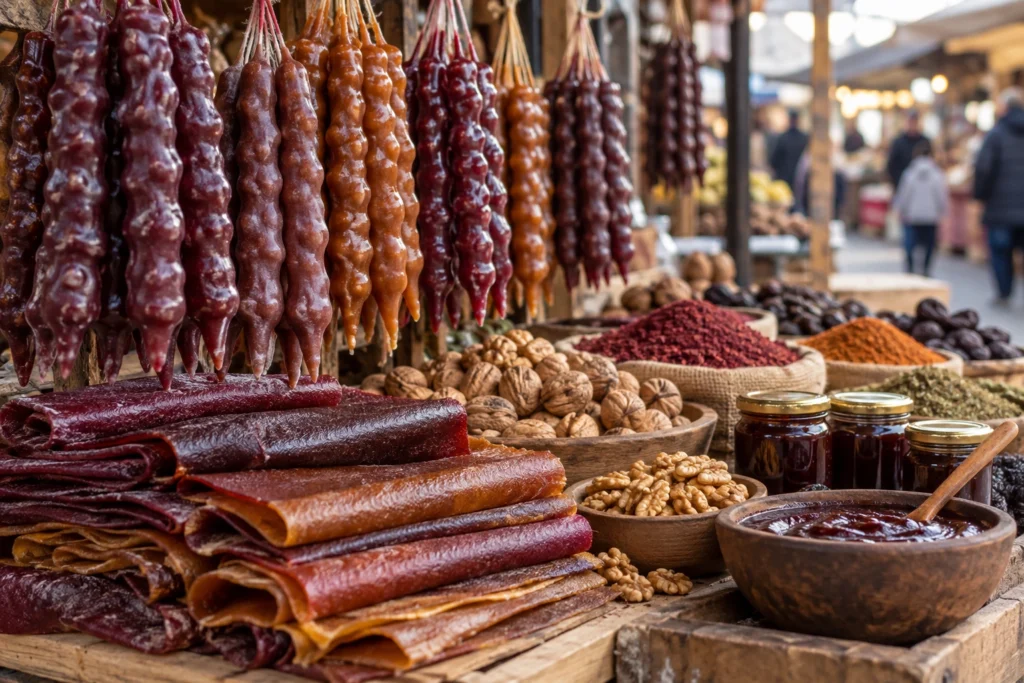
- Churchkhela. Walnuts or hazelnuts coated in thickened grape juice.
- Pelamushi. A set pudding of grape juice and flour, made around the harvest.
- Tklapi. Thin sheets of dried fruit purée, sometimes sour plum, sold at markets.
- Gozinaki. Walnuts set in honey, made for New Year.
- Nazuki. A sweet, spiced bread, sold at roadside stalls around Surami on the main road west of Tbilisi.
Food to take home
Churchkhela, spice blends such as khmeli suneli and Svan salt, bottled tkemali, tea, wine and chacha all travel reasonably well. Check your home country’s customs allowances for alcohol, cheese and meat before you buy.
Georgian food through the seasons
There is no bad season for Georgian food, but each one puts different dishes on the table. Two things are worth separating: what is in season, and which regions you can reach. High mountain areas such as Tusheti, and some passes into Racha and upper Svaneti, are accessible only in summer and early autumn.
| Season | On the table | At the market | Food events and access |
|---|---|---|---|
| Spring (March–May) | Chakapuli, green tkemali, wild-green pkhali, Easter eggs and sweet Easter bread | Jonjoli, young herbs, sour green plums | Wine from the previous harvest is opened from the qvevri; wine festivals in May |
| Summer (June–August) | Tomato and cucumber salads with walnuts, grilled fish and meat, cold dishes | Tomatoes, cucumbers, apricots, peaches, berries | Mountain regions open; best time for Tusheti and high Svaneti |
| Autumn (September–November) | Mtsvadi, churchkhela, pelamushi, red tkemali | Grapes, pomegranates, persimmons, fresh walnuts | Rtveli grape harvest in September–October; Tbilisi Wine Festival in October |
| Winter (December–February) | Satsivi and gozinaki at New Year, Gurian pie at Christmas, hearty stews and soups | Citrus from the west, dried fruit, nuts, pickles | Lowlands and Tbilisi are easy; some mountain roads close |
A note on harvest wine. During Rtveli you can join the picking and pressing, and taste fresh grape juice and fermenting must. The wine you drink at a cellar that week is from earlier vintages; the new wine needs months in the qvevri, and many producers open it from late winter into spring.
For spring and autumn travel, our 7-day spring and autumn tour combines Kakheti’s wine villages with Meskheti and includes regional dinners, a chacha tasting and a farewell supra. In winter, our guide to Tbilisi in autumn and winter is a good place to start.
Costs, ordering and table etiquette
What food costs
Eating out in Georgia is still inexpensive by Western European standards, but prices are rising: restaurant meals cost 7.6% more in May 2026 than a year earlier, according to Georgia’s statistics office. Typical ranges in Tbilisi and Batumi, collected in September and early October 2026:
| Item | Typical price |
|---|---|
| Khachapuri or pastry from a bakery | 3–5 GEL |
| Khinkali, per piece | 1–2 GEL |
| Adjaruli khachapuri in a restaurant | 14–25 GEL |
| Cappuccino | 7–9 GEL |
| Lunch at an ordinary café, per person | 20–40 GEL |
Prices are higher in tourist areas and lower in regional towns. Many restaurants add a service charge of 10–18% to the bill, so check the menu before adding a tip.
How much to order
Portions vary a lot between restaurants, so there is no universal rule. As a starting point, two people sharing a first meal might order:
- ten khinkali,
- one Imeruli or Megruli khachapuri,
- a plate of mixed pkhali or badrijani,
- a tomato and cucumber salad,
- bread, and drinks.
Add a hot dish such as mtsvadi or chakhokhbili if you are hungry. Khinkali are ordered by the piece, and some places set a minimum of five.
Table etiquette
- Eat khinkali with your hands and leave the knot of dough on the plate.
- Dishes are shared, so taste a little of everything rather than finishing one plate.
- At a feast, the tamada (toastmaster) leads the toasts; wait for the toast before drinking wine. Read our guide to the Georgian supra and its etiquette.
- Leftover food on the table is normal; hosts would rather over-provide than run short.
- Small restaurants and markets may be cash-only, so carry some lari.
Food experiences and routes
Choose your experience
| If you want… | What it involves | Booking |
|---|---|---|
| Regional meals | Eating each region’s dishes where they come from | Easy on your own in towns; guesthouse dinners need notice |
| Markets | Cheese, spices, churchkhela and seasonal produce at Tbilisi, Telavi or Kutaisi markets | No booking; mornings are best |
| Wine and chacha | Tastings at estates and family cellars, mainly in Kakheti | Family cellars need advance arrangement |
| Cooking | Hands-on khinkali or khachapuri classes in Tbilisi, Kakheti and elsewhere | Book ahead |
| A supra | A full feast led by a tamada | Arranged in advance with a host or restaurant |
On a private tour in Georgia, we can build any of these into your route, along with restaurant choices and dietary requirements. Tell us what you would like when you enquire.
Sample food routes
- Eastern Georgia (3–5 days). Tbilisi’s markets and khinkali houses, then Kakheti for the Telavi market, Sighnaghi and family cellars. Add a day north through Pasanauri to Kazbegi for mountain khinkali. See also our wine tours in Georgia.
- Western Georgia (4–6 days). Start in Kutaisi for Imeretian cheese and khachapuri, continue to Samegrelo for elarji and ajika, then Guria and Batumi for Gurian pie and Adjaruli. Our tours from Kutaisi cover parts of this route.
- Southern Georgia (2–3 days). Borjomi and Akhaltsikhe for tatarberaki, tenili and Meskhetian khachapuri, combined with Vardzia.
- Mountain summer (3–7 days). Svaneti for kubdari and tashmijabi, Racha for ham and shkmeruli, or Tusheti for guda and lamb khinkali. These routes are seasonal.
FAQ
What is Georgia’s national dish?
Khachapuri and khinkali both have a claim. The khachapuri tradition was added to Georgia’s list of intangible cultural heritage in 2019, while khinkali is the dish most travellers seek out first.
Is Georgian food spicy?
Most of it is not. Heat is concentrated in Megrelian cooking and in chilli pastes like ajika, which are usually served separately.
Is Georgia good for vegetarians and vegans?
Yes, thanks to a long tradition of Orthodox fasting dishes. Confirm each dish, as stock, animal fat, butter or ham are sometimes added.
Do I need to tip in Georgian restaurants?
Many restaurants add a service charge of 10–18%. If it is on the bill, an extra tip is optional; if not, around 10% is a common gesture for good service.
I only have a few days. Where should I eat?
Tbilisi gives you the widest regional range in one place. If you can add a day or two, Kakheti offers markets, family cellars and home cooking within a couple of hours of the capital.
Can I eat with a Georgian family or take a cooking class?
Yes. Guesthouses in the regions often cook for guests, and khinkali and khachapuri classes run in Tbilisi and Kakheti. Both should be arranged in advance, and we can include them in a private tour.
Plan a food trip in Georgia
The quickest way to understand Georgian cooking is to follow it across the country, from Kakhetian cellars to Megrelian kitchens and mountain guesthouses. Tell us which regions, dishes and experiences interest you, and we will shape a private tour in Georgia around them, at your pace and in any season. If you travel in spring or autumn, our 7-day spring and autumn tour is a ready-made option. Or send us your dates and we will suggest a route.