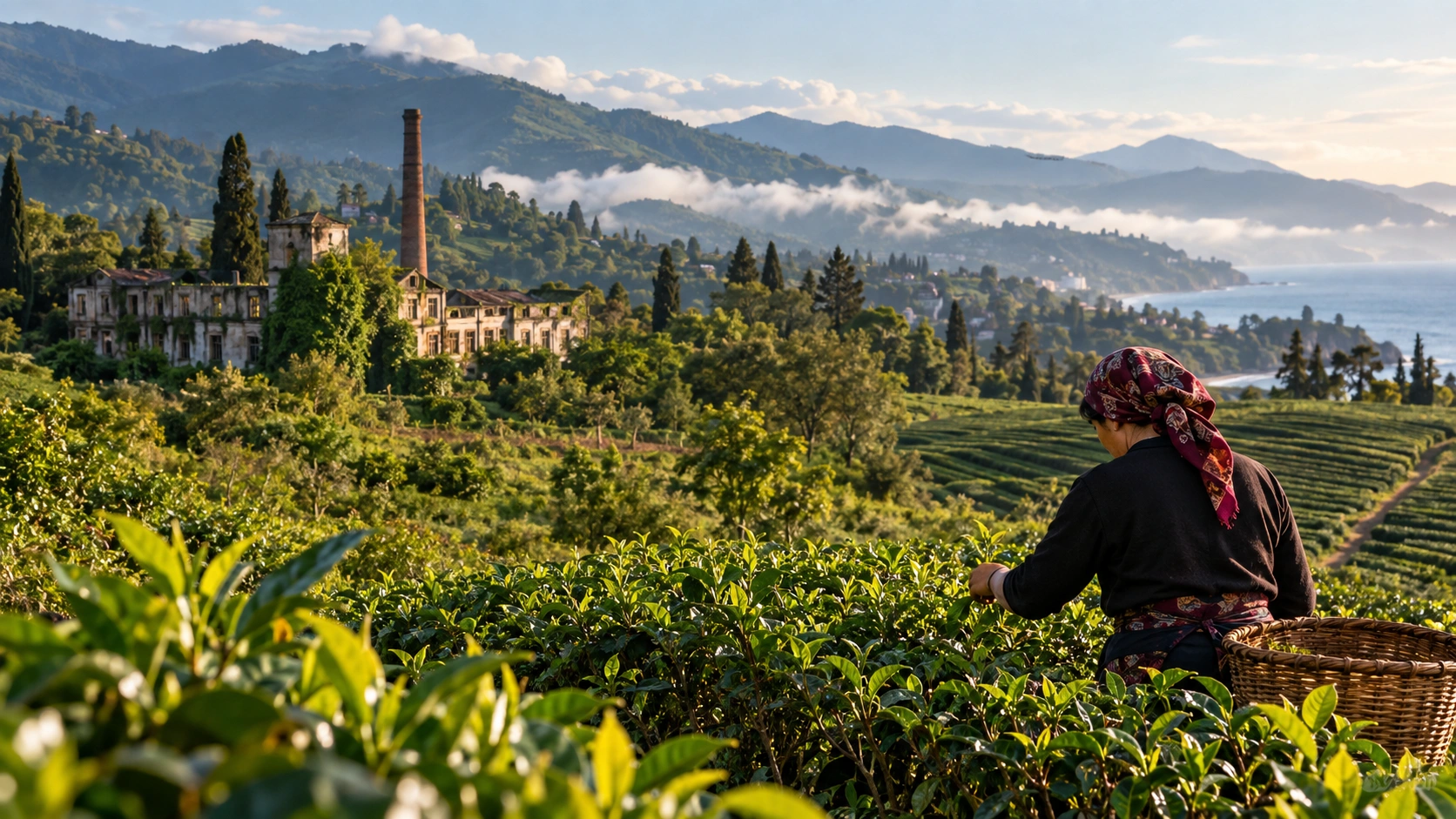
Ask most visitors what Georgia drinks and you will hear one word: wine. Then drive west from Kutaisi towards the Black Sea, and somewhere in the green hills of Guria the vines thin out and something else takes over. Low, rounded hedges, clipped flat on top, running in rows across the slopes like the ribs of a giant animal. Some are neat. Others have grown into shaggy thickets taller than a person, with ferns and blackberry pushing through.
Those are tea bushes. Most of them were planted to supply the Soviet Union.
Georgian tea has had an unlikely life: a nobleman’s experiment in the 19th century, a commercial breakthrough led by a tea master from China, decades as one of the USSR’s great industrial crops, near-total collapse after 1991, and now a small, stubborn revival led by family farms. This is the biography of that industry, and a guide to what you will find in the cup today.
Does Georgia Really Grow Tea?
Yes. Tea has been grown in western Georgia since the 19th century, and commercially since the 1890s. Georgia and neighbouring Azerbaijan sit in one of the northernmost tea-growing regions in the world, and by the 1980s the two countries supplied most of the tea drunk across the Soviet Union.
The tea country is the humid west: Guria, Adjara, Imereti and Samegrelo, with large plantations historically in Abkhazia as well.
Why the west, and not Kakheti?
Kakheti is wine country for the same reason it is poor tea country: it is dry, with hot summers and cold winters. Tea wants almost the opposite. The western lowlands and foothills get heavy rain off the Black Sea, mild winters and acidic soils, which is roughly what Camellia sinensis asks for.
Georgia is still at the edge of where the plant will grow. Cool nights and long winters slow the bushes down, so they put out fewer shoots than they would in Assam or Sri Lanka. That is a handicap for anyone chasing tonnage, and an advantage for anyone chasing flavour, a tension that runs through the whole story.
Where Did Georgian Tea Begin?
There is no single founding date, and you will find at least three in circulation: 1799, 1840 and 1847. They are not really competing answers. Each refers to something different, and the difference is the interesting part.
- An ornamental plant. Tea bushes are said to have grown in the garden of the Gurian princes around the turn of the 19th century, as a curiosity rather than a crop. Sources disagree on the details, so treat this one as tradition.
- An experiment. In 1840, on the estate of Mikheil Eristavi at Gora-Berezhouli in Guria, a tea-like product was made for the first time in Georgia, by hand and by trial and error. Eristavi later showed his tea at an agricultural exhibition in St Petersburg in 1864, where it was recognised.
- A first plantation. Many accounts date Eristavi’s first proper planting to 1847. A popular story has him smuggling the seeds out of China, where their export was restricted. It is a good story; nobody has produced the bamboo cane to prove it.
What matters is the gap. Georgians knew tea would grow here half a century before anyone made a business of it.
Gora-Berezhouli today
The Eristavi estate sits on a hill above the Supsa River valley in Chokhatauri municipality. In Soviet times it became an agricultural school, and a dendrological park was laid out around the old trees, including an oak said to be about three centuries old, a giant sequoia, ginkgo and camellias. The Eristavi palace and its walled fortress still stand. It is a quiet place, and an easy detour if you are crossing Guria by road.
The Chinese Tea Master Who Changed Georgian Tea
The commercial story starts on the coast of Adjara, a few kilometres north of Batumi, in the village of Chakvi.
In 1893 the Russian tea merchant Konstantin Popov, whose family firm sold Chinese tea across the empire, invited a Chinese tea specialist to come and work on his estate there. His name appears in Chinese as Liu Junzhou. In Georgia he is remembered as Lao Jin Jao, and you will also see Lau Dzhen Dzhau and several other spellings. They are all the same man.
Liu arrived with tea seeds, young plants and a small team of Chinese workers. Instead of trying to grow tea the way it was grown at home, he adapted it: selecting plants that could cope with Adjara’s cooler winters and setting up processing that suited the local leaf. Within a few years the results were good enough to travel. Tea from Popov’s Chakvi estate, made under Liu’s direction, won a gold medal at the 1900 Paris World Exhibition.
Think about the route that tea took. Leaf grown on the Black Sea coast by a Chinese master, for a Russian merchant house, judged in Paris. Georgian tea was international before it was Georgian.
Liu stayed for more than two decades, training growers and running plantations into the early Soviet years. His house in Chakvi still stands, long neglected, and calls to restore it come up regularly. For Georgia and China, he has become a small diplomatic symbol: when Chinese tea companies began working with Georgian growers in recent years, his name was the one both sides reached for.
Georgian Tea in Seven Dates
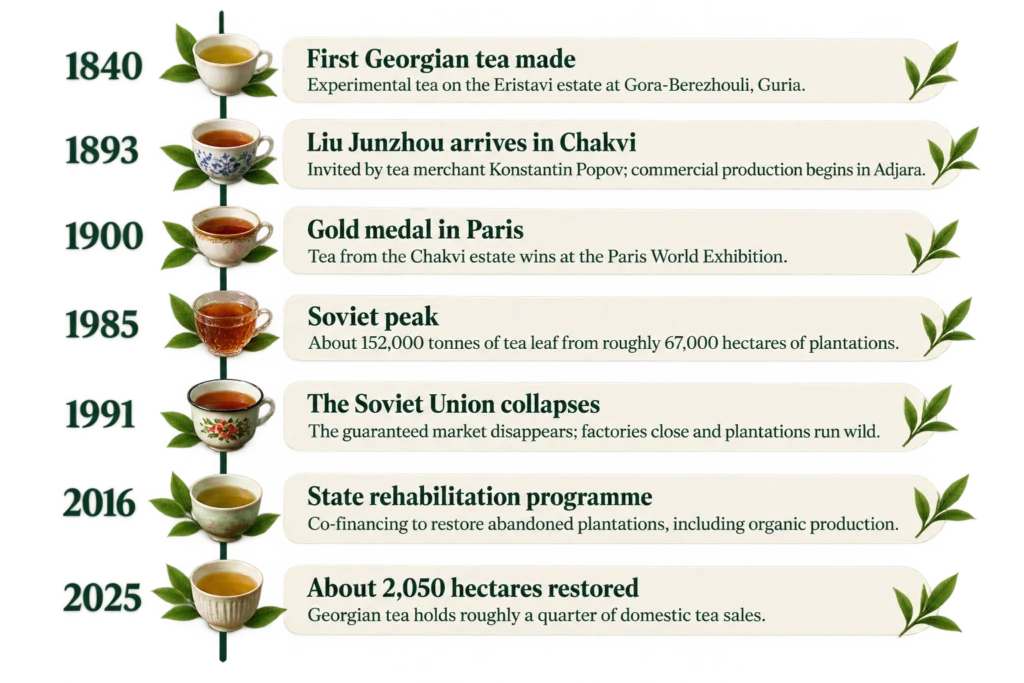
The milestones are evenly spaced here, not to scale: the long Soviet expansion sits between 1900 and 1985, and the fall from the peak took barely a decade.
Georgian Tea Becomes a Soviet Industry
When Georgia was absorbed into the Soviet Union in 1921, Moscow inherited a modest but proven tea sector, and a vast market of tea drinkers that depended on imported leaf. The logic was simple: grow it at home. From the late 1920s onwards, western Georgia was planted on a scale Popov could never have imagined.
By the mid-1980s the numbers were enormous. In 1985 Georgia harvested about 152,000 tonnes of tea leaf from roughly 67,000 hectares of plantations. Together with Azerbaijan, it made the USSR the world’s fourth-largest tea producer, behind only India, China and Sri Lanka.
Numbers like these hide the human side. At the peak, an estimated 180,000 people worked somewhere along the tea chain. In practice that meant:
- Whole villages organised around the harvest. In parts of Guria and Samegrelo, almost every household had a stake in tea, and the picking season set the rhythm of the year.
- Factories in the valleys. Leaf went to local processing plants, then on to packing and blending facilities that shipped tea across the Soviet Union.
- Machines in the rows. Mechanised harvesters were brought in to raise output and cut labour costs.
- A research culture. Breeders developed new cultivars for Georgian conditions, and agronomists studied everything from soil to processing.
Anaseuli and Georgian tea science
The centre of that research was Anaseuli, just outside Ozurgeti in Guria, home to the institute for tea and subtropical crops. It is still a reference point for the industry; in 2022 the Ministry of Agriculture held a national tea conference there. If you drive through Anaseuli, the plantations around it are some of the most visible reminders of the Soviet tea economy.
Quantity Won, Quality Lost
Soviet Georgian tea was not simply bad. But the system that produced it rewarded volume, and that shaped what ended up in the packet.
Targets were set in tonnes. Machines cut coarser leaf than hand pickers would choose. Georgian leaf was increasingly blended with imported tea, and the whole output went to a captive market that had few alternatives. The fine, slow-growing tips that had won a medal in Paris were not what the plan was asking for.
This matters for understanding today’s revival. The new producers are not trying to rebuild the Soviet industry. In many ways they are trying to go back to what came before it.
What Happened After the Soviet Union Collapsed?
The market vanished almost overnight. Georgian tea had been built to supply one customer, and in 1991 that customer ceased to exist. Independent Georgia then went through civil war, two separatist conflicts and an economic collapse that left the state barely functioning.
The tea industry did not decline gradually. It fell off a cliff:
- Factories closed or were stripped for equipment and scrap.
- Plantations were abandoned, and many were later cleared for hazelnuts, blueberries and other crops.
- Cheap imports filled the shelves. Shoppers who had grown up on Soviet blends could now buy better tea from Asia for less.
- The workforce scattered. Families who had lived from tea for generations had to find something else.
By 2014, Georgian tea leaf production had fallen to about 1,800 tonnes, roughly 99 percent below the 1985 peak. FAO found that by the end of the 2010s, Georgia and Azerbaijan together produced less than 2 percent of what they had in the 1980s.
The tea forests
Many of the bushes, though, did not die.
A tea plant can live for a century or more, and left alone it stops looking like a hedge and starts looking like a small tree. All over western Georgia, former plantations turned into thickets of overgrown tea, tangled with ferns and bramble, their old rows still faintly visible under the green. Walking through one is a bit like finding a ballroom that has been left with the furniture still in place, thirty years after the last dance.
For today’s growers, those survivors are an asset. Mature root systems, adapted over generations to Georgian winters, can be cut back and brought into production again much faster than new bushes could be grown from seed.
The Revival of Georgian Tea
In 2016 the Georgian government launched the Georgian Tea Plantation Rehabilitation Programme. Its aim is to bring abandoned plantations back into use and encourage high-quality production, explicitly including organic tea. The state co-finances the clearing and restoration work, covering a larger share for agricultural cooperatives and for state-owned land leased to growers.
Progress has been steady rather than spectacular:
| Indicator | Figure | Source |
|---|---|---|
| Soviet peak (1985) | About 152,000 t of tea leaf, about 67,000 ha | ISET Policy Institute |
| Production in 2014 | About 1,800 t of tea leaf | Geostat |
| Plantations rehabilitated with state support | About 2,050 ha (2025) | Georgian Tea Producers Association |
| Georgian tea’s share of domestic tea sales | About 25% (2025) | Georgian Tea Producers Association |
| Production in 2025 | About 2,200 t of tea leaf (preliminary) | Geostat |
Read those numbers side by side and the scale of the change is obvious. Georgian tea has not returned to anything like its former size, and the people running the revival say plainly that it never will. Much of the old plantation land now grows hazelnuts and blueberries. What they talk about instead is quality, and a target of a few thousand hectares rather than tens of thousands.
The weak spot is exports. Georgian tea has found buyers at home, but producers still struggle to reach international markets in volumes that would make a real difference.
From Mass-Market Tea to Artisan Tea
The most interesting part of the revival is happening on family farms, mostly in Guria and Imereti, where a new generation of growers has taken over old plantations or reclaimed the tea forests their parents walked away from.
Many of these newer small producers work very differently from the Soviet factories:
- Hand-picking. Leaves and buds are picked by hand, often just the tip and the top two leaves, which is slower but gives better tea.
- Small batches. Instead of one standard product, a single farm may make several different teas in a season, each in small quantities.
- Careful processing. Withering, rolling and oxidation are judged batch by batch rather than run to a fixed factory standard.
- Organic growing. Several farms hold organic certification. The cool climate means fewer pests than in the tropics, which makes organic cultivation more realistic here.
- Direct sales and visitors. Producers sell from the farm gate, online and to specialist shops in Europe, and some now welcome guests for walks and tastings.
Not every Georgian producer works this way. Larger processors still make inexpensive black tea for the domestic market. But the farms that have changed the conversation about Georgian tea are the small ones.
What Does Georgian Tea Taste Like?
There is no single flavour called “Georgian tea”. What ends up in your cup depends on where the bush grows, which cultivar it is, when the leaf was picked, how much of the shoot was taken and, above all, how it was processed.
Still, some patterns come up again and again when you taste Georgian teas side by side. Treat these as possibilities, not rules:
| Style | What you might notice | How common |
|---|---|---|
| Black tea | Soft tannins, honey, dried fruit, sometimes a woody or malty edge; rarely harsh | The mainstay, from both large and small producers |
| Green tea | Fresh, grassy or herbal, sometimes a little nutty | Widely made, often by the same farms |
| White and other experimental teas | Delicate, floral, light in colour | Small batches from a handful of artisan makers |
The slow growth that frustrated Soviet planners is the reason many people find Georgian black tea mellow. Cool nights mean the bushes take their time, and the shoots that come through tend to be gentle rather than astringent. If you usually take your tea with milk, try a good Georgian black tea without it first.
Black, green and white: the same plant
Black, green and white tea all come from the same species, Camellia sinensis. The difference lies mainly in what happens after picking. Green tea is heated soon after harvest to stop the leaf oxidising, so it keeps its fresh, vegetal character. Black tea is rolled and left to oxidise fully, which turns the leaf dark and brings out deeper, sweeter flavours. White tea is handled as little as possible, usually just withered and dried.
So when a Gurian farmer offers you three teas from the same hillside, that is not a trick. It is three decisions made with the same leaf.
Is Georgian tea organic?
Some of it is. Several Georgian producers hold organic certification, and the state programme specifically supports organic production. The cool climate also helps, because the bushes face less pest pressure than in hotter tea countries.
But Georgian tea as a category is not automatically organic. If it matters to you, look for certification on the packet or ask the producer directly.
Where Georgian Tea Grows: The Four Regions
| Region | Role in Georgian tea | What you can still see |
|---|---|---|
| Guria | The historic heartland: Eristavi’s first experiments, Soviet research at Anaseuli, many of today’s artisan farms | Plantations around Ozurgeti, the Eristavi estate at Gora-Berezhouli, family tea farms |
| Adjara | Birthplace of commercial production at Chakvi under Liu Junzhou | Hillside plantations north of Batumi, Liu’s house in Chakvi |
| Imereti | A major Soviet-era producer and a large share of today’s rehabilitated plantations | Restored plantations and processing plants in the hill districts |
| Samegrelo | Extensive Soviet plantations and factories | Old plantations and factory buildings, some now being reclaimed |
Guria: The Cultural Heart of Georgian Tea
If the story of Georgian tea has a home, it is Guria, the small region squeezed between the Black Sea coast and the Meskheti range. Here the tea landscape is still part of everyday life. You see it in the patchwork of plantations around Ozurgeti, in the research grounds at Anaseuli, and in the old manor at Gora-Berezhouli where the first Georgian tea was made.
Guria is also where the revival feels most personal. Several of the new artisan producers are families who have taken back tea land their parents or grandparents once worked. Tea here sits alongside the rest of Gurian farm life: citrus, hazelnuts, a vegetable garden, a cellar of homemade wine.
Visitors are often surprised by how green it all is. After a week of dry eastern landscapes, Guria in early summer feels like someone has turned up the saturation.
Chakvi: Birthplace of the Commercial Tea Industry
Chakvi is easy to miss. It is a seaside village a short drive north of Batumi, and most people pass it on the way to the beach. But this is where Popov’s estate stood, where Liu Junzhou planted his first Georgian tea, and where the Paris medal-winning leaf was grown.
The hills behind the village still hold tea, and Liu’s house survives, in poor condition, as a reminder of how unlikely the whole enterprise was. If you are spending a few days in Batumi, Chakvi is a good half-day reason to look away from the sea and up at the hills.
Can You Visit Tea Farms in Georgia?
Yes. A growing number of farms in Guria, Imereti and Adjara open their doors to visitors, and the official tourism board lists experiences where you can watch the leaf being picked and processed and then taste the result. A typical visit includes a walk through the plantation, a look at withering and rolling, and a tasting at the family table.
A few things are worth knowing before you go:
- Book ahead. These are working family farms, not visitor centres. Most need a call or a message a day or two in advance.
- Go with a driver or guide. Many farms sit on narrow village roads with little signage, and some hosts speak only Georgian or Russian.
- Bring cash. Buying tea at the farm is part of the point, and card payment is not guaranteed.
- Combine it with the region. A tea visit fits easily into a day in Guria or a half-day from Batumi; it rarely needs a trip of its own.
When Is Tea Harvested in Georgia?
The picking season follows the warm months. Bushes put out new shoots in several waves, or flushes, from late spring into early autumn, and producers pick each flush as it comes. The exact start and finish move with altitude, weather and the farm’s own choices, so if you want to see picking in action, ask the farm before you plan around it.
[Placeholder – add a short quote from an active Gurian or Imeretian tea producer on when they pick and what changes between the first and last flush. This would be the single most valuable addition to the article.]
Georgian Tea vs Georgian Wine: Two Very Different Stories
Wine in Georgia is ancient and homegrown. Grapes have been made into wine here for thousands of years, from indigenous varieties, in clay vessels, by families who never really stopped. Tea is the opposite on almost every count: a 19th-century import, developed with Chinese expertise, scaled up by Soviet planners and nearly wiped out within a single decade.
That is why the tea story is worth knowing. It is a compressed history of modern Georgia in one crop: imperial agriculture, a Chinese master, Soviet industry, post-Soviet collapse, and a new generation trying to make something small and good out of what was left. Wine shows you how deep Georgian traditions go. Tea shows you how much has happened on the surface in the last 150 years.
Georgian Tea FAQ
Does Georgia produce tea?
Yes. Tea is grown in humid western Georgia, mainly in Guria, Imereti, Adjara and Samegrelo. Production today is small compared with the Soviet era, but it has been growing again since the state rehabilitation programme began in 2016.
Where is tea grown in Georgia?
Mainly in Guria, Imereti, Adjara and Samegrelo, where Black Sea rainfall, mild winters and acidic soils suit the tea plant. Dry eastern Georgia, including Kakheti, is not tea country.
When did tea production start in Georgia?
Experiments began in the 19th century, with tea made on the Eristavi estate in Guria in 1840. Commercial production followed in the 1890s at Chakvi in Adjara.
Who was Liu Junzhou?
Liu Junzhou, known in Georgia as Lao Jin Jao, was a Chinese tea specialist who came to Chakvi in 1893 at the invitation of the merchant Konstantin Popov. His work laid the foundations of commercial tea production in Georgia, and tea made under his direction won a gold medal at the 1900 Paris World Exhibition.
Was Georgia a major Soviet tea producer?
Yes. Together with Azerbaijan, Georgia supplied most of the tea drunk in the Soviet Union by the 1980s. Georgian production peaked at about 152,000 tonnes of tea leaf in 1985.
Is Georgian tea still produced today?
Yes, though on a far smaller scale. By 2025 about 2,050 hectares of plantations had been restored with state support, and Georgian tea accounted for roughly a quarter of domestic tea sales.
What kind of tea does Georgia produce?
Mostly black and green tea. A few artisan producers also make white tea and other small-batch specialities.
Can you visit tea plantations in Georgia?
Yes, particularly in Guria, Imereti and Adjara. Several family farms offer plantation walks, processing demonstrations and tastings, usually by advance booking.