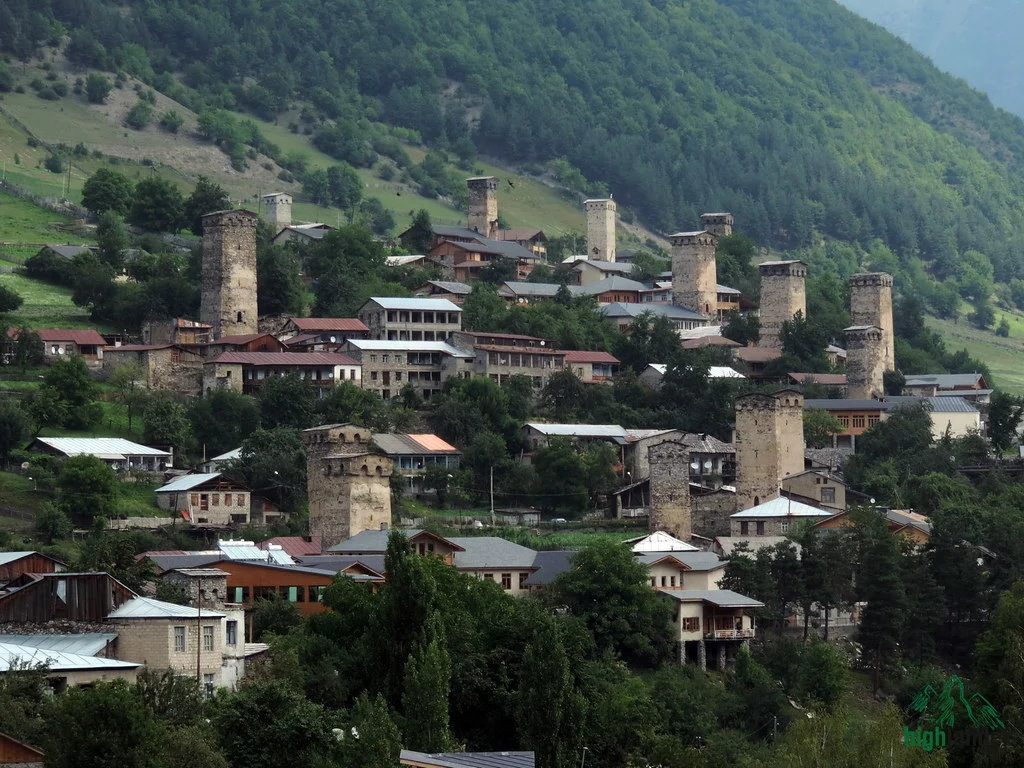
Stand in Seti Square at dusk and count the towers. You’ll lose track somewhere past twenty. They rise from the old quarters around you, square and grey, with stone roofs like hats pulled low. Behind them the snowfields of the Caucasus catch the last light, and a cow ambles past a café serving flat whites. That collision of a thousand years of blood feuds and a decade of good espresso is Mestia in one frame.
Mestia is the main town of Upper Svaneti, a high valley in Georgia’s Greater Caucasus, at about 1,500 m. It’s known for its medieval Svan defensive towers, the Svaneti Museum’s collection of medieval icons and manuscripts, and the trailheads around it, from the Chalaadi glacier to the Koruldi lakes and the four-day trek to Ushguli. Plan at least two full days. Four is better.
Mestia in brief
- Where: Upper (Zemo) Svaneti, northwest Georgia, on the Mestiachala river, about 130 km from Zugdidi.
- Altitude: about 1,500 m, with peaks over 4,000 m on the horizon, including Ushba (4,710 m) and Tetnuldi (4,858 m).
- Known for: Svan towers, the Svaneti Museum, the Hatsvali cable car, glacier and lake hikes, and as the start of the Mestia–Ushguli trek.
- UNESCO: Upper Svaneti has been a World Heritage Site since 1996, mainly for its tower villages.
- Getting there: about 3 hours by road from Zugdidi, 8–9 hours from Tbilisi, or a short flight from Tbilisi or Kutaisi when the weather allows.
- Best time: June–September for hiking, December–March for skiing, and late September–October for colour and quiet trails.
Mestia’s history in a few lines
Svaneti spent most of its history cut off by mountains, and that isolation shaped everything you’ll see in Mestia: the towers, the treasures and the traditions. When invaders swept through the Georgian lowlands, churches and noble families sent their most precious icons and manuscripts up here for safekeeping. That’s why a village museum holds a 9th-century gospel book.
The Svans governed themselves through village councils, had their own language (Svan, still spoken today), and lived under a code of blood vengeance that made every family a small fortress. Each household built a koshki, a tower of four or five storeys, beside its machubi, the long stone house shared with the livestock in winter. Most towers date from the 9th to the 13th centuries. When a feud flared, the family retreated up the tower and pulled the ladder in behind them.
Until the 2000s, getting to Mestia was a long, rough adventure. A major redevelopment from about 2010 brought a new road from Zugdidi, an airport, a rebuilt town centre, a modern museum building and the Hatsvali ski area. Mestia changed fast, but its old quarters kept their towers.
The historic districts of Mestia
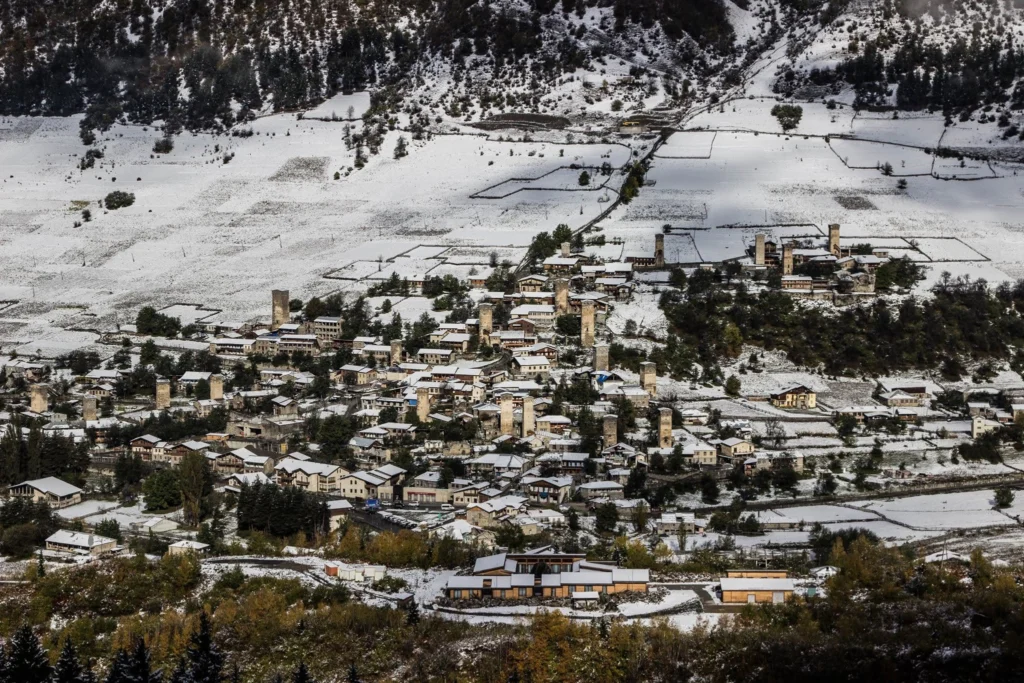
Mestia grew from several historic communities, each clustered around its own church and towers. Walking between them is the best way to understand the town. The new centre around Seti Square is only one of them.
- Seti: the historic heart, and the name the whole settlement once went by. Today it’s the main square, the town hall and the café strip, with the medieval church of St George a few steps away.
- Lanchvali: the steep upper quarter, where towers stand in a row down the slope like organ pipes. It’s home to the Margiani House Museum and the Lanchvali church, and it has the best tower views in town.
- Lagami: the oldest quarter, about a 20-minute walk east of the square along the Mestiachala river. It holds the Church of the Transfiguration and the Mikheil Khergiani House Museum, and it feels most like a village.
- Lekhtagi: a quieter residential district with towers between the houses. Good for an aimless evening walk.
A loop through Lanchvali and Lagami, with the two house museums, takes about half a day on foot.
Museums and churches in Mestia
If you see only one thing in town, make it the Svaneti Museum. Then climb a real Svan tower at the Margiani or Khergiani house museums. Together they explain everything else you’ll see in the valley.
Svaneti Museum of History and Ethnography
This is one of the best museums in Georgia, and a surprise to find in a mountain town of 2,000 people. Founded in 1936 and reopened in a modern building in 2013, it holds more than 4,000 items. The treasures are on the upper floors: gold and silver icons from the 10th to 12th centuries, hammered by Svan and Georgian masters, and illuminated manuscripts including the Adishi Gospels of 897, one of the oldest Georgian manuscripts. Lower floors cover archaeology, weapons, coins, textiles and everyday Svan life. The panoramic window at the top frames the town’s towers like a painting.
- Hours: 10:00–18:00, closed on Mondays.
- Tickets: the official listing shows 7 GEL for adults, plus 10 GEL for a guided tour. Check at the desk, as prices change.
- Time: allow at least 1.5–2 hours.
Margiani House Museum (Lanchvali)
The best place to see how a Svan family actually lived. The Margiani family’s machubi is on the ground floor. Here people and animals shared one dark, smoky room through the winter, with carved wooden stalls for the cattle and the family’s seats above them, so the animals’ warmth rose to the people. Beside it stands the family koshki, and you can climb up inside it on ladders. The view from the top over the Lanchvali towers is the classic photo of Mestia. Expect steep ladders and narrow openings, and allow about an hour.
Mikheil Khergiani House Museum (Lagami)
Mikheil Khergiani, born in Mestia in 1932, was one of the greatest rock climbers of the Soviet era, nicknamed the “Tiger of the Rocks”. He died in a climbing accident in the Italian Dolomites in 1969. His family house in Lagami opened as a museum in 1983. It shows his climbing gear, photographs and medals, and you can climb the family tower. Even if mountaineering isn’t your thing, it’s a moving portrait of a Svan family and of what the mountains mean here.
Church of the Transfiguration (Lagami)
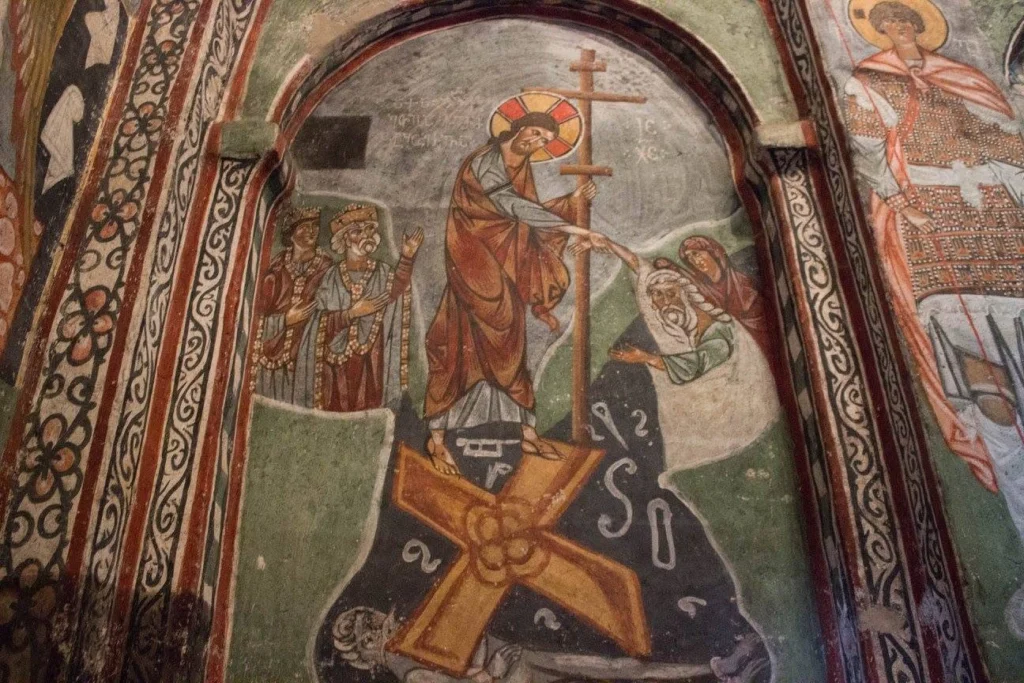
Lagami’s main church has two storeys from two eras: a lower church from about the 9th century and an upper one from the 13th–14th centuries, with medieval frescoes inside. Like most Svan churches it’s often locked. Ask in the neighbourhood for the keyholder, and leave a small donation. Svan churches are small, dark and intensely painted, and seeing one with a candle lit is worth the effort of finding the key.
More churches to look for
- Lanchvali church in the upper quarter, near the Margiani house.
- St George’s church in Seti, by the main square.
- Lashtkhveri church, just outside town, with rare 14th–15th-century frescoes on its outer walls showing scenes from the Georgian epic Amiran-Darejaniani.
| Sight | District | Time needed | Good for |
|---|---|---|---|
| Svaneti Museum | Centre | 1.5–2 h | Icons, manuscripts, history |
| Margiani House Museum | Lanchvali | About 1 h | Climbing a tower, the classic view |
| Khergiani House Museum | Lagami | About 1 h | Mountaineering history, a family tower |
| Church of the Transfiguration | Lagami | 20–30 min | Frescoes (if you find the key) |
Outdoor things to do around Mestia
For the views without the effort, take the Hatsvali cable car to Zuruldi. For a real day out, hike to the Chalaadi glacier or the Koruldi lakes. Everything below starts within 30 minutes of the centre.
Hatsvali and the Zuruldi ridge
Hatsvali is Mestia’s ski area, a few kilometres above town. In summer its cable car becomes the easiest viewpoint in Svaneti. A gondola carries you up from Mestia, then a chairlift continues to the Zuruldi ridge at about 2,340 m, where Café Zuruldi sits on the crest with a terrace facing Ushba, Tetnuldi and the whole Mestia valley. Bring a jacket: it’s often 10 degrees colder than in town.
In recent years the summer lifts have run from mid-June to September, roughly 11:00–17:00, for about 25 GEL return. Check the dates locally, as they shift every year. From the top you can walk back down through forest and meadows to Mestia in 2–3 hours, or follow the ridge toward Ieli village. In winter Hatsvali is a small, friendly ski area, best for beginners and families.
Heshkili huts
On the ridge above Mestia, near the turn-off to Ieli village, the Heshkili huts are a cluster of wooden cabins with open-air seating, a swing over the drop, and one of the widest mountain panoramas around Mestia. Come for lunch and the view, or stay the night to see the peaks at sunrise without anyone else around. You can reach them by 4×4 along the jeep road, or on foot from Mestia or the Hatsvali area.
Chalaadi glacier
The easiest glacier walk in Svaneti. A 20-minute drive takes you to the trailhead, then a mostly flat walk of about 6 km (around 2.5 hours return) leads through birch and pine forest along the river to the grey-blue snout of the glacier. It’s ideal for a half day, or for families with older children. Our sister site has the full route: Chalaadi glacier hike guide.
Koruldi lakes
The classic big day hike from Mestia. A steep climb leads up to small alpine lakes at about 2,740 m, and on a still day Ushba is reflected in the water. The full return route is just over 16 km with a lot of climbing, so allow 7 hours or more. Many people take a 4×4 to the cross above town to save the first part. The details, including the 4×4 shortcut, are in our sister site’s Koruldi lakes hiking guide.
The adventure park near the airport
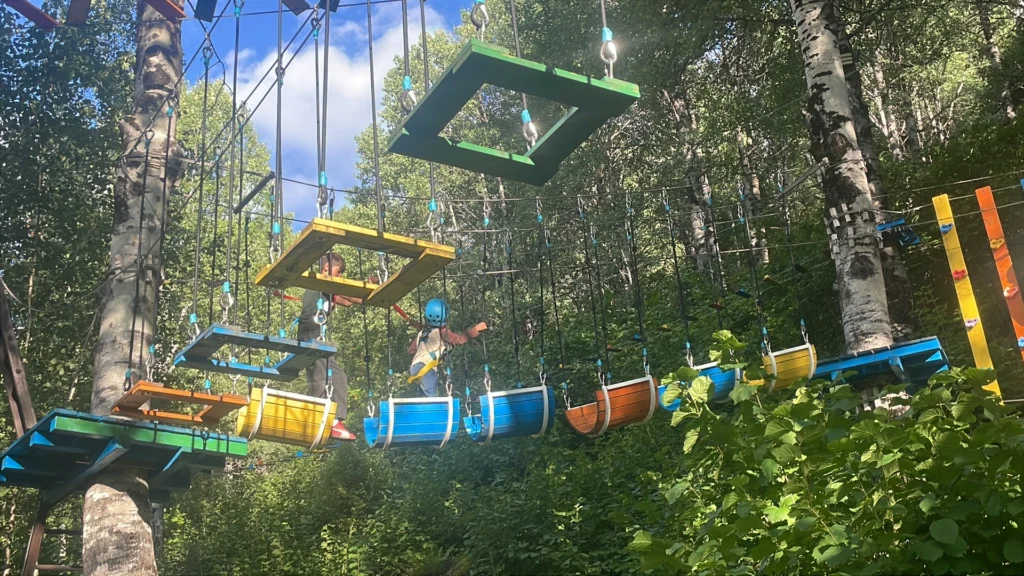
If you are travelling with kids – don’t miss it! On the flat ground near Queen Tamar Airport, just outside the centre, Mestia has an adventure park: an easy win for families and a good way to spend a day without a long hike. It’s handy for a cloudy afternoon when the peaks are hidden, or for children who’ve had enough of churches.
Hiking and trekking beyond Mestia
Mestia is the start of the four-day Mestia to Ushguli trek, Georgia’s best-known multi-day hike, and of longer routes over the Guli Pass beneath Ushba. To explore Svaneti on a guided trip from Mestia, see the Mestia and Svaneti tour on svanetitrekking.com.
| Activity | Time from Mestia | Effort | Season |
|---|---|---|---|
| Hatsvali cable car to Zuruldi | 2–3 h | Easy | Mid-June–Sept, plus the ski season |
| Heshkili huts | Half day | Easy by 4×4, moderate on foot | Summer–autumn |
| Chalaadi glacier | Half day | Easy | June–October |
| Koruldi lakes | Full day | Hard | July–September |
| Adventure park | 1–3 h | Easy | Summer |
Food in Mestia: what to order
Svan food is mountain food: meat pies, cheese, cornbread and plenty of Svan salt. Order these at least once.
| Dish | What it is |
|---|---|
| Kubdari | Svaneti’s signature pie: bread stuffed with chopped beef or pork, onion and spices. Heavier and spicier than khachapuri |
| Chvishtari | Cornbread with sulguni cheese baked inside, crisp outside and stretchy within |
| Tashmijabi | Mashed potato beaten with cheese until it pulls like elastic |
| Svan salt | Coarse salt ground with garlic, blue fenugreek, coriander and chilli. Sprinkle it on everything, and buy a jar to take home |
| Trout | Fresh from mountain rivers, grilled simply, at its best in the villages around Mestia |
Bars, cafés and restaurants in Mestia
Mestia now has a small but good food scene: specialty coffee, terraces with mountain views, classic Svan kitchens and a couple of proper bars. Most places are around Seti Square and along the main street, so you can choose by mood.
- For coffee and breakfast: Erti Kava does specialty coffee and generous breakfasts. Coffee Kor has a sunny terrace for a slow morning before the museum.
- For classic Svan cooking: Vichnashi is a long-time favourite for kubdari and Svan staples. Café Laila on the main square is the town’s busy all-rounder, with live music on summer evenings. Don’t miss also Lushnu kor and Buba.
- For a view with dinner: Zhuzhu’s Terrace and Twin Peaks pair Georgian dishes with panoramas, and BBQ Garden is the place for grilled meat outdoors.
- For drinks: KRK Bar is a tiny, low-lit cocktail bar where hiking boots are welcome. Pub & Cinema Dede combines beer with films on bad-weather nights.
- On the trail: Café Zuruldi at the top of the Hatsvali lift, and Khevi Café near the Chalaadi trailhead, for a hot drink with a view.
Restaurants in Mestia open and close quickly. Check recent reviews before planning a meal around one.
Where to stay in Mestia
Stay in the centre for restaurants and the museum, in Lanchvali or Lagami for towers outside your window, or on the ridge for the big views.
Our favourite: Mestia Panorama
When guests ask us where to stay in Mestia, Mestia Panorama is the first name we give. It’s a small, personal place with the kind of mountain view its name promises, and the hosts make you feel like a returning friend rather than a booking number. It’s the hotel we use when we want our travellers to fall for Mestia on the first evening.
Other good options
- Boutique hotels near the centre: Hotel Lahili is a short walk from both the museum and the cable car.
- Family-run hotels and guesthouses: Family Hotel Kala and White House Nakani are well located, with good breakfasts. Many Svan guesthouses serve home-cooked dinners, often the best meal you’ll eat in town.
- Cabins and cottages: Bude Mestia Cottages has A-frame cabins about 3 km from the square, for quiet and stars.
- On the ridge: the Heshkili huts, for sunrise over the peaks without leaving bed.
- For skiers: stay close to the Hatsvali lift station to save the morning shuttle.
| Where to stay | Best for | Trade-off |
|---|---|---|
| Centre (Seti Square) | Restaurants, the museum, first-timers | Busier and noisier in summer |
| Lanchvali or Lagami | Tower views and old-town atmosphere | Steep walks, and fewer places to eat |
| Ridge (Heshkili area) | Panoramas, sunrise, peace | You’ll need a car or a long walk |
| Near Hatsvali | Skiing | Quiet in the evenings |
How to get to Mestia
Most travellers drive or take a minibus from Zugdidi, about 3 hours. The fastest option is a short flight from Tbilisi or Kutaisi, when the weather lets the plane land.
| From | By road | Notes |
|---|---|---|
| Zugdidi | About 3 h (130 km) | Marshrutkas run year-round. The road follows the Enguri gorge past the Enguri dam |
| Kutaisi | 4.5–5 h | Direct vans in season, or change in Zugdidi |
| Tbilisi | 8–9 h | Direct vans and shared transfers, or the night train to Zugdidi and then a minibus |
| Batumi | 5–6 h | Direct vans in summer |
| Ushguli | About 1.5 h (45 km) | Paved for most of the way. Mestia’s 4x4s do day trips |
| By air | About 1 h | Small planes from Natakhtari (near Tbilisi) and Kutaisi to Queen Tamar Airport. Often cancelled in bad weather, so keep a buffer day |
In summer, the Zagaro Pass road from Lentekhi through Ushguli makes a dramatic but rough alternative route in or out. It’s 4×4 only, and only from about July to September.
When to visit Mestia, and how long to stay
Come between mid-June and September for hiking, from December to March for skiing, and in late September or October for golden larches and quiet trails. Allow at least two full days for Mestia itself, plus extra days for Ushguli or the trek.
| Season | What to expect |
|---|---|
| June | Green valleys, snow still on high passes. The cable car usually opens mid-month |
| July–August | Peak season: every trail open, busy guesthouses, the warmest weather |
| September–October | Clear air, autumn colours, fewer people. The best season for photography |
| November–April | Snow and skiing at Hatsvali and Tetnuldi. Some roads and trails closed |
| May | Shoulder season. Muddy trails and the upper areas still snowbound |
For the winter side of Svaneti, from skiing to the Lamproba festival, see our winter in Svaneti guide and Lamproba guide.
Practical tips for Mestia
- Bring cash. There are ATMs in the centre, but guesthouses, drivers, villages and the Ushguli road run on lari.
- Keep a buffer day if you fly. Mountain weather grounds the small planes regularly.
- Ask for the church keys. Most Svan churches are locked. Neighbours usually know who has the key.
- Pack layers. Even in August, evenings at 1,500 m are cool, and Zuruldi can be cold and windy.
- Use local 4x4s. For Koruldi, Ushguli and the ridge roads, local drivers are safer and often cheaper than driving yourself.
- Respect the towers. Many are private family property. Climb only where you’ve been invited or paid entry.
Tours to Mestia and Svaneti
| Tour | Length | Highlights |
|---|---|---|
| Mestia to Ushguli Trek | 4 days | Georgia’s classic tower-village trek |
| 8-Day Svaneti Trek | 8 days | Ushba glacier, the Guli Pass and Ushguli |
| Svaneti and Racha | 7 days | Mestia, Ushguli and the Zagaro Pass into Racha |
| Svaneti and Vardzia | 10 days | Three nights in Svaneti, plus the cave city |
| Around Georgia | 12 days | Svaneti, wine country and the cave cities |
For the whole region, from Ushguli to Lower Svaneti, read our Svaneti travel guide.
Frequently asked questions about Mestia
Is Mestia worth visiting?
Yes. Mestia combines medieval Svan towers, one of Georgia’s best museums and easy access to glaciers, alpine lakes and the Caucasus’ highest peaks, with good cafés and hotels. It’s the base for almost everything in Upper Svaneti.
How many days do you need in Mestia?
Two full days cover the museums, the towers and one hike or the cable car. Four days let you add Ushguli and a big hike such as Koruldi. Add four more for the Mestia–Ushguli trek.
How do I get from Tbilisi to Mestia?
By road it takes 8–9 hours, by direct van or via Zugdidi (night train plus a 3-hour minibus). By air, small planes fly from Natakhtari near Tbilisi in about an hour, weather permitting.
What is the best time to visit Mestia?
Mid-June to September for hiking, with July–August busiest. Late September–October for autumn colours and quieter trails. December–March for skiing at Hatsvali and Tetnuldi.
Can you climb a Svan tower in Mestia?
Yes, at the Margiani House Museum in Lanchvali and the Mikheil Khergiani House Museum in Lagami. Both let you climb the ladders inside a family tower. Expect steep, narrow climbs.
What should I eat in Mestia?
Kubdari, the spiced meat pie of Svaneti, and chvishtari, a cheesy cornbread. Try tashmijabi too, and take home a jar of Svan salt.