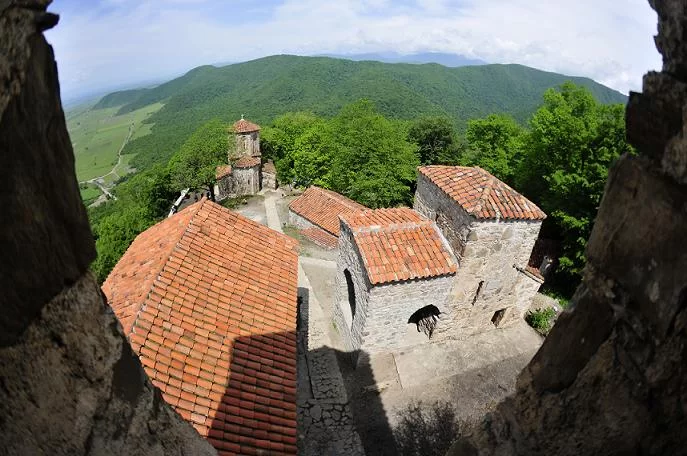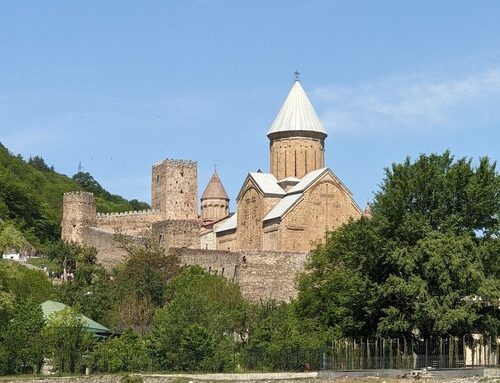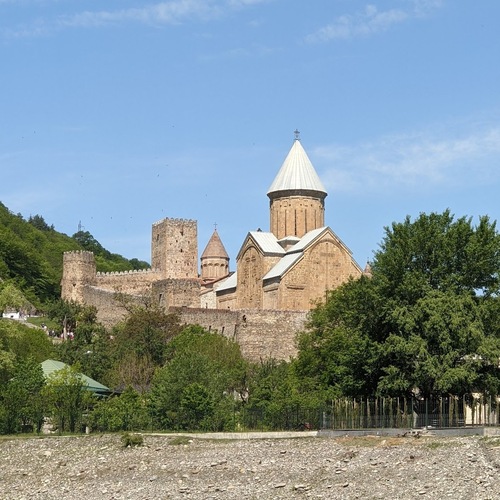
St. George monastery in Ubisa
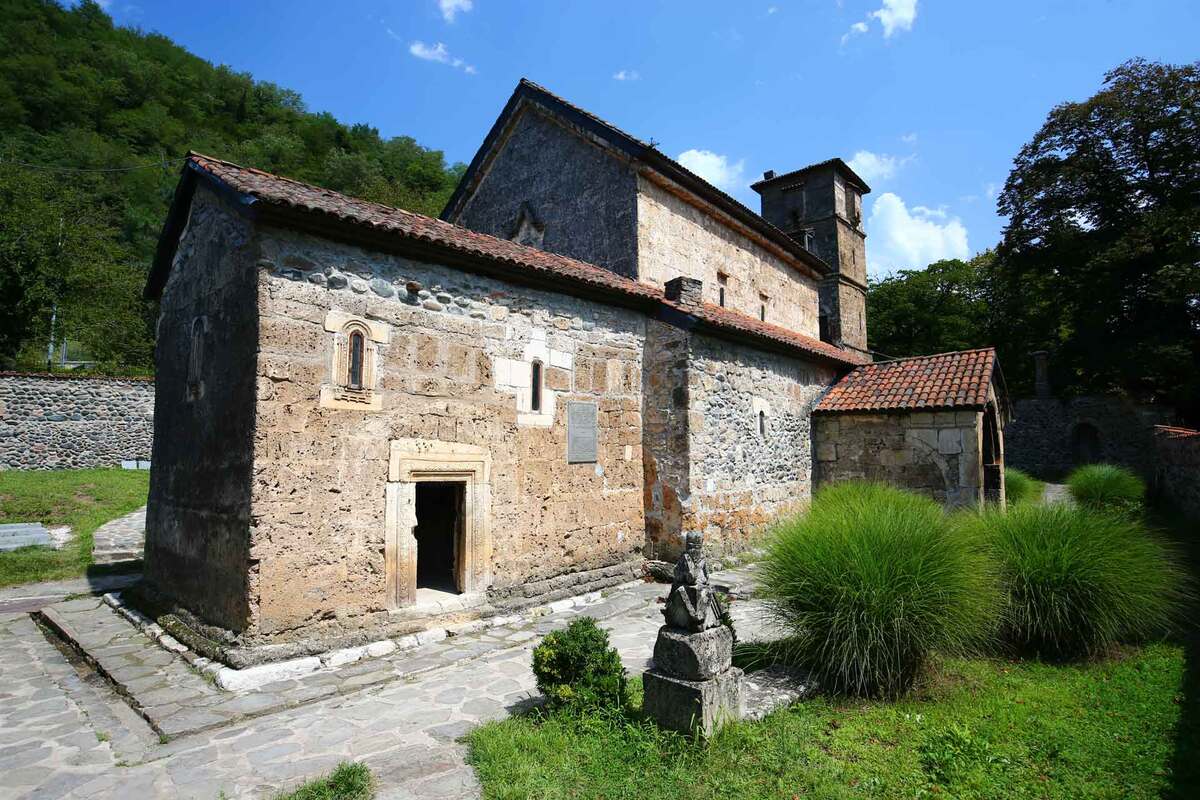
In a small church beside the Tbilisi-Kutaisi highway, almost invisible behind its ancient stone walls, survive some of the finest medieval frescoes in Georgia—painted by the mysterious master Damiane in a style that would transform Georgian art forever. This is Ubisa, where a 9th-century foundation meets a 14th-century Renaissance.
Introduction: Why Ubisa Deserves Your Attention
Most travelers speed past Ubisa Monastery on the main highway between Tbilisi and Kutaisi, never suspecting what lies hidden behind the unassuming stone walls just off the road. From the outside, the complex appears modest—no soaring domes, no dramatic mountain setting.
But step inside the small Church of St. George, and you enter one of Georgia’s greatest artistic treasures: walls covered floor to ceiling with 14th-century frescoes by the medieval master Damiane, painted in the sophisticated Palaeologan style that swept through the Byzantine world during its final flourishing.
Art historians consider these paintings among the most significant examples of Georgian monumental art, remarkable for their emotional depth, mastery of perspective, and vibrant colors that survive almost intact after seven centuries.
Add to this a precisely dated 1141 tower with its original inscription still readable, the legacy of St. Gregory of Khandzta—one of Georgia’s most important saints—and a living monastic community famous for its honey, and you have a destination that rewards the curious traveler willing to make a brief detour.
Quick Overview:
- Founded: 9th century (c. 830s–850s)
- Founder: St. Gregory of Khandzta
- Frescoes: Late 14th century by Damiane
- Tower: 1141 (precisely dated by inscription)
- Location: Village of Ubisi, Imereti region
- Distance: ~60 km west of Kutaisi, ~25 km from Kharagauli
- Elevation: 320 meters above sea level
The Saint Who Built Monasteries: Gregory of Khandzta and the Birth of Ubisa
A Centenarian Saint
The story of Ubisa begins with St. Gregory of Khandzta (759–861), one of the most remarkable figures in Georgian Christianity—a man who lived to 102 years old, founded or inspired a dozen monasteries, and played a crucial role in Georgia’s medieval national revival.
Born into an aristocratic family in Kartli, Gregory was raised at the court of Prince Nerse of Iberia. Highly educated in theology, philosophy, and languages, he could have pursued a brilliant secular or ecclesiastical career. Instead, he chose the life of a monk.
Escape to the Wilderness
In the early 780s, when Gregory was still in his twenties, he left Arab-controlled Kartli and traveled south to Tao-Klarjeti, the only region of Georgia free from Muslim rule. There, in the remote wilderness of Klarjeti, he founded Khandzta Monastery (c. 782)—the first of many.
Over the following decades, Gregory became the spiritual architect of Georgian monasticism’s golden age. He founded or supervised twelve monasteries throughout Tao-Klarjeti, creating a “monastic republic” that became the spiritual heart of Georgia’s national revival.
His biography, written in 951 by Giorgi Merchule, preserves both his spiritual teachings and his remarkable ability to influence political affairs—including once facing down an assassin sent by a corrupt bishop, who was struck dead by divine intervention before he could complete his mission.
The Foundation of Ubisa
In the 830s–850s, King Demetre II of Abkhazeti (837–872) requested that the famous Gregory establish a monastery in his kingdom, in the region of Imereti.
Gregory chose a site overlooking the gorge of the Dzirula River, in the village then called Ubisi. He appointed as first abbot his disciple St. Hilarion of Jerusalem—a learned monk who had spent many years at the Lavra of St. Savva in the Holy Land before returning to Georgia.
According to Orthodox Church tradition:
“Later this clever and learned father began construction of Ubisi Church in Imereti, where he labored until his death.”
The original 9th-century church, dedicated to St. George, still stands—making Ubisa one of Georgia’s oldest continuously functioning monasteries.

The Church of St. George: A 9th-Century Survivor
Architecture of the Original Church
The main church at Ubisa is a modest but venerable single-nave, barrel-vaulted basilica dating to the 9th century—one of the oldest church structures still standing in western Georgia.
Original features:
- Built of stone and mortar with local pumice stone (shirimi) blocks of yellowish color
- Supported by two transverse arches
- Apse hidden within the thickness of the eastern wall—an archaic feature
- Originally had two open porches at the southern and western entrances
- Interior paved with uneven stone slabs giving a wonderfully ancient appearance
- Triangular carved decoration above the sanctuary window—the only ornament on the otherwise plain exterior
Later additions:
- Chapels attached from the south, west, and north sides
- The western annex is configured like a small domed church and contains the ossuary of the Abashidze princely family, who were patrons of Ubisa in later centuries
- In the 16th century, a representative of the Abashidze family named Demetre added another attachment from the west, richly decorated with carved stonework
The Unique Iconostasis
One of Ubisa’s most distinctive features is its altar iconostasis—unusual for Georgia.
Rather than the typical Georgian stone iconostasis with carved arches, Ubisa preserves a Byzantine-style templon: stone pillars supporting a wooden beam across the top.
For the Byzantines, this upper beam—the “templon”—was the essential element of the altar screen, from which the entire structure took its Greek name. Ubisa’s iconostasis is one of the best surviving examples of this older style in Georgia, likely dating to the church’s earliest period.
Damiane’s Frescoes: Georgia’s Palaeologan Masterpiece
The Mysterious Master
The overwhelming reason to visit Ubisa is its 14th-century wall paintings, which completely cover the interior of the church from floor to vault.
These frescoes were painted by Damiane (sometimes spelled Damian)—a medieval Georgian artist known only by this single name, whose works hold a special place in the history of Georgian monumental painting.
We know Damiane through two inscriptions he left at Ubisa:
- Along the edge of the table in the Last Supper scene in the apse:
“Holy fathers and saints, beseech the mercy of Our Lord Jesus Christ, as He showed mercy to the holy woman and pray for the salvation of Damiane, so that you, too, should find salvation.”
- On the triumphal arch:
“In the name of the Lord poor sinner Damiane, disciple of Gerasim, has adorned this monastery with Holy Images.”
The second inscription tells us that Damiane was the student of a master named Gerasim (also called Gerasime or Gerasidze). Art historians have debated the precise relationship between the two painters and which parts each executed, but it’s clear that Damiane was the principal artist responsible for the masterpiece we see today.
The Palaeologan Style
Damiane painted during the reign of King George V “the Brilliant” (r. 1299–1302, 1314–1346), a period when Georgia enjoyed a brief cultural renaissance despite Mongol overlordship.
His style belongs to what art historians call the Palaeologan Renaissance (named after the Palaeologan dynasty that ruled Byzantium from 1261 to 1453)—the final great flowering of Byzantine art before the fall of Constantinople.
Characteristics of this style that Damiane mastered:
- Keen interest in space and perspective—figures placed in believable architectural settings
- Crowded, dynamic compositions with a sense of movement
- Emotional expressiveness—figures with individual character and feeling
- Moderation of rigid religious asceticism—greater humanity and naturalism
- Freedom in composition—departure from strict iconic conventions
- Subtle, vibrant colors that remain remarkably fresh after 700 years
Damiane combined these international Byzantine trends with traditional Georgian artistic elements, creating a synthesis that represents the pinnacle of medieval Georgian painting.
As one art historian noted:
“Damiane’s new style was characterised by a keen interest in space and perspective, with a moderation of religious asceticism and contains a greater deal of freedom in the composition of his paintings. The style adopted by Europe marked the beginning of a new artistic aesthetic that opposed the current medieval outlook.”
In other words, Damiane was working in parallel with developments that would soon transform Western European art in the early Renaissance.
What to See: The Fresco Program
The paintings cover the entire vault, walls, and pilasters almost to the floor. Despite some damage from dampness and human interference over the centuries (some areas were smeared or rubbed), they survive remarkably well.
The Apse:
- Crowded Deësis scene on the vault: Christ enthroned in a larger scale than surrounding figures, flanked by a tetra-morph (four-faced creature symbolizing the evangelists) and a cherub
- The Theotokos (Virgin Mary) and angels in supplication
- The famous Last Supper along the lower register, with Damiane’s inscription
The Twelve Great Feasts: The walls depict the Dodekaorton—the twelve major feast days of the Orthodox Church:
- Annunciation
- Nativity
- Presentation in the Temple
- Baptism of Christ
- Transfiguration
- Raising of Lazarus
- Entry into Jerusalem (Palm Sunday)
- Crucifixion
- Resurrection (Anastasis)
- Ascension
- Pentecost
- Dormition of the Virgin
Scenes of St. George: Given the church’s dedication, special attention is paid to St. George—Georgia’s beloved patron saint—with scenes from his life and martyrdom. These are among the most striking images in the church.
Other notable elements:
- Christ Pantocrator
- Figures of saints, apostles, and martyrs
- Emperor Diocletian (who persecuted St. George)
- Expressions of emotion and individual character in faces—visitors describe feeling that the figures might “start talking”
Tips for Viewing
- Take your time: These frescoes reward slow, careful observation
- Bring a flashlight: Some areas are dimly lit
- Look at faces and gestures: Damiane’s genius lies in the expressiveness of his figures
- Notice the colors: The subtle palette has survived remarkably well
- Ask about the bats: A colony of bats now inhabits the church—adding an unexpected element of atmosphere
The Icons: Treasures Now in Tbilisi
The Ubisa monastery complex originally housed twelve icons commissioned for the church, which formed an integral set with the iconostasis and wall paintings.
According to inscriptions, these were ordered by a patron named Bablak Laklakidze. Art historians note that the icons share strong stylistic and artistic affinities with the frescoes, suggesting they were created around the same time—possibly by the same workshop or under Damiane’s direction.
The icons include:
- Two icons with doors (wing panels)
- A range of plea icons (small devotional images)
For their protection, these twelve icons are now preserved in the Shalva Amiranashvili State Museum of Art (part of the Georgian National Museum) in Tbilisi. If you visit Ubisa and are moved by Damiane’s frescoes, seeing the associated icons in Tbilisi provides a fuller understanding of this remarkable 14th-century artistic program.
The Tower of 1141: A Precisely Dated Medieval Survivor
Svimon Chkondideli’s Legacy
Approximately 3 meters from the eastern façade of the church stands a remarkable four-story tower, one of the best-preserved medieval residential towers in Georgia.
We know its exact date thanks to a stone inscription on the southern wall, which reads:
“I, Simon Chkondideli, poor in spirit, have been chosen by Our Lord to build this monastery and this tower in the reign of Dimitri, by the Grace of God King of Kings, son of the Great King David, in the year of Our Lord 361, or 535 according to the Saracen calendar.”
This dates the tower precisely to 1141, during the reign of King Demetrius I (1125–1156), son of David the Builder.
Who Was Svimon Chkondideli?
Svimon (Simon) Chkondideli was one of the most powerful figures in 12th-century Georgia:
- Archbishop of Chkondidi (modern Martvili)—one of the most important ecclesiastical positions in western Georgia
- A confidant of King David the Builder himself
- Governor of Imereti under both David and Demetrius I
- A patron of churches and monasteries throughout the region
His tower at Ubisa reflects both his wealth and his position as a leader who needed secure quarters.
The Tower: Floor by Floor
Built of the same yellowish pumice stone (shirimi) as the church, with brick arcades decorating the exterior, the tower rises four stories:
First Floor (Basement):
- Used as a pantry/storage for provisions
- Accessed from the second floor
Second Floor (Main Entrance):
- The entrance is on this level (typical for defensive towers—no ground-floor door to breach)
- Contains living quarters with:
- A large fireplace for heat and cooking
- A dressing/rest room
- Even a primitive toilet—sophisticated for the 12th century
Third Floor:
- Reserved for prayer and scholarly work
- Contains traces of wall paintings
- Features a balcony overlooking the monastery
Fourth Floor:
- Served a defensive function—the lookout and last refuge in case of attack
- Stone staircase connects the floors internally
Architectural Significance
The Ubisa tower is notable for:
- Its complete preservation—all four stories survive
- The original inscription still readable after nearly 900 years
- The combination of residential comfort (fireplace, toilet) with defensive capability
- The brick arcade decoration—an elegant touch on a functional building
Interestingly, both the tower and the church bear the name of a builder called Mauricius, suggesting a close relationship in their construction or reconstruction.
Monastery Life Today: Monks and Honey
An Active Monastery
Ubisa remains a functioning Orthodox monastery with a small community of monks. Visitors should behave respectfully:
- Women: Cover head, shoulders, and knees; wear long skirt (wraps available)
- Men: Long trousers, shoulders covered
- Photography: Usually permitted but ask first; no flash during services
- Behavior: Maintain quiet, especially if monks are praying
The Honey Tradition
One of Ubisa’s charming distinctions is its monastery honey. The monks maintain beehives and produce honey that visitors can sometimes purchase.
This tradition connects Ubisa to the broader Georgian Orthodox practice of monastic self-sufficiency—monks supporting themselves through agricultural work, crafts, or beekeeping while maintaining their spiritual discipline.
If honey is available during your visit, it makes a meaningful souvenir with a direct connection to the monastery’s living community.
Visiting Ubisa: Complete Practical Guide
Location and Getting There
Ubisa sits just off the main highway connecting Tbilisi, Borjomi, and Kutaisi—making it an easy stop if you’re traveling this route anyway.
Distances:
- From Kutaisi: ~60 km east (about 1 hour by car)
- From Kharagauli: ~25 km (about 30 minutes)
- From Borjomi: ~60 km northwest (about 1.5 hours)
- From Tbilisi: ~200 km west (about 3–3.5 hours via Khashuri/Zestaponi highway)
By Car: The monastery is clearly signed from the highway. Turn off and follow the local road into the village of Ubisi. The monastery sits on a slope overlooking the Dzirula River gorge.
By Public Transport: Any marshrutka or bus traveling between Tbilisi and Kutaisi can drop you at the Ubisi turn-off (tell the driver “Ubisa”). From there, it’s a short walk or taxi to the monastery. Return buses pass frequently.
By Tour: Ubisa can be included in day trips from Kutaisi (combined with Gelati, Motsameta, and other Imereti sites) or as a stop on longer Tbilisi-Kutaisi routes.
Opening Hours and Admission
- Hours: Generally open during daylight hours; no fixed schedule
- Admission: Free (donations appreciated)
- Services: Orthodox services are held regularly; attending one adds to the experience
What to Bring
- Flashlight/phone light: For examining frescoes in darker corners
- Head covering for women: Scarves usually available but bring your own to be safe
- Water and snacks: Limited facilities
- Camera: Photography generally permitted
Time Needed
- Minimum: 30 minutes (quick look at church and tower)
- Recommended: 1–1.5 hours (thorough exploration of frescoes, tower, grounds)
- With Shrosha: Add 30–60 minutes for the ceramics market
Combining Ubisa with Other Sites
Shrosha Ceramics Market
Just a few kilometers beyond Ubisa along the highway toward Kutaisi lies the village of Shrosha, famous for its traditional ceramics.
Roadside stalls sell:
- Qvevri (traditional Georgian wine vessels)
- Decorative pottery
- Clay cookware
- Ornamental pieces
The clay comes from local deposits, and the ceramic tradition here dates back generations. Prices are reasonable, and you can watch potters at work.
Other Imereti Sites
From Ubisa toward Kutaisi:
- Gelati Monastery (UNESCO World Heritage Site, ~70 km)
- Motsameta Monastery (dramatically situated above a river canyon, ~70 km)
- Bagrati Cathedral (in Kutaisi, ~60 km)
- Prometheus Cave (~80 km)
- Sataplia Nature Reserve (dinosaur footprints, ~70 km)
From Ubisa toward Borjomi:
- Borjomi-Kharagauli National Park
- Borjomi (mineral springs, ~60 km)
- Vardzia (cave monastery, ~120 km)
Suggested Itineraries
Half-Day from Kutaisi: Kutaisi → Gelati → Motsameta → Ubisa → Shrosha → return to Kutaisi
En Route Tbilisi to Kutaisi: Stop at Ubisa for 1 hour as a break on the journey
Imereti Cultural Day: Kutaisi → Bagrati → Gelati → Motsameta → Ubisa → Shrosha → Prometheus Cave → Kutaisi
Why Ubisa Matters
For Art History
Ubisa contains one of the most complete and finest examples of 14th-century Georgian monumental painting. Damiane’s frescoes demonstrate:
- Georgian participation in the broader Byzantine artistic tradition
- A sophisticated synthesis of international Palaeologan style with local traditions
- An artistic achievement contemporary with early Renaissance developments in Western Europe
- Remarkable preservation allowing study of medieval painting techniques
For Georgian History
The monastery represents multiple layers of Georgian history:
- The 9th-century monastic movement led by St. Gregory of Khandzta
- The 12th-century “Golden Age” under David the Builder and his successors
- The 14th-century cultural flourishing under George V the Brilliant
- The continuity of monastic life through centuries of political change
For the Traveler
Ubisa offers something increasingly rare: an authentic, uncrowded encounter with medieval Georgian art and architecture. There are no tour buses, few visitors, and no commercialization—just you, the ancient walls, and Damiane’s seven-century-old masterpiece.
Frequently Asked Questions
When was Ubisa Monastery founded? In the 830s–850s (9th century), by St. Gregory of Khandzta at the request of King Demetre II of Abkhazeti. The current church dates from this period.
Who painted the frescoes? Damiane, a 14th-century Georgian master working in the Palaeologan Byzantine style, along with his teacher Gerasim. Both names appear in inscriptions at the site.
When were the frescoes painted? In the late 14th century, during the reign of King George V “the Brilliant” (1299–1302, 1314–1346).
What is the tower? A four-story residential and defensive tower built in 1141 by Svimon Chkondideli, Archbishop of Chkondidi and confidant of King David the Builder.
Are the original icons still at Ubisa? No. The twelve original icons were moved for safekeeping to the Georgian National Museum in Tbilisi, where they are now displayed.
Is the monastery still active? Yes. A small community of monks lives at Ubisa, and regular Orthodox services are held.
Can I buy the monastery honey? Sometimes. The monks produce honey, but availability for visitors varies. Ask politely when you visit.
How long should I spend there? 30 minutes minimum, but 1–1.5 hours allows proper appreciation of the frescoes and tower.
Is it accessible by public transport? Yes. Any marshrutka on the Tbilisi-Kutaisi route can drop you at the Ubisi turn-off. The monastery is a short walk from the highway.
What should I wear? Modest dress required: women should cover head and wear long skirts (wraps available), men should wear long trousers. Shoulders covered for everyone.
Is there a connection to David the Builder? Yes. The tower was built by Svimon Chkondideli, a close associate of David the Builder, during the reign of David’s son Demetrius I.
Conclusion: The Hidden Treasure Worth Finding
Ubisa Monastery asks little of the traveler—just a brief detour from the highway, a moment of patience to find the entrance, and the willingness to look closely at ancient walls.
In return, it offers one of Georgia’s greatest artistic treasures: frescoes that capture a medieval world with a humanity and sophistication that still speaks across seven centuries.
Damiane left two inscriptions asking visitors to pray for his salvation. Perhaps the best tribute to his work is simply to stand before it in silence, appreciating what he achieved in this small church beside the Dzirula gorge—a masterpiece hidden in plain sight on the road to Kutaisi.