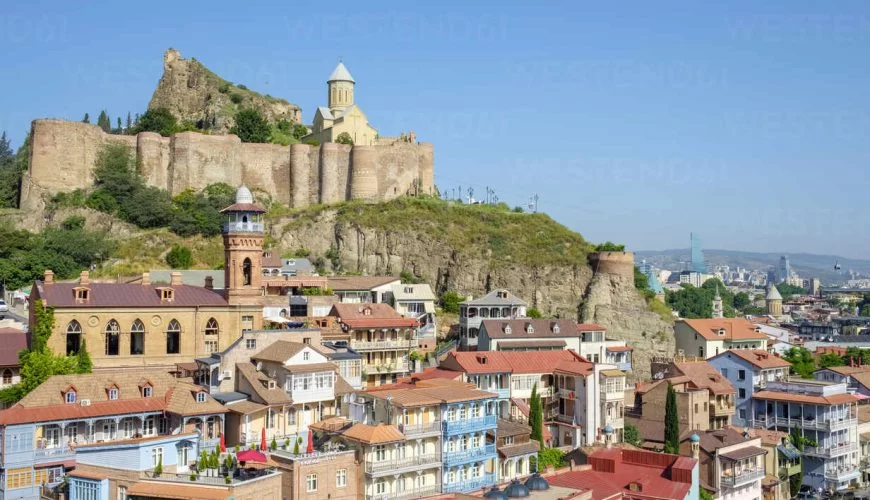
Narikala Fortress has watched over Tbilisi for seventeen centuries. Rising from a rocky outcrop high above the Mtkvari River, this ancient citadel forms the city’s most recognizable silhouette – visible from nearly every neighborhood in the capital. Locals call it “the heart and soul of Tbilisi,” and no visit to the Georgian capital is complete without climbing its weathered walls.
The fortress offers more than history. From its ramparts, the entire Old Town spreads below: the domed roofs of the Abanotubani sulfur baths, the carved wooden balconies of Sololaki, the glass sweep of the Peace Bridge, and the Metekhi cliff across the river. At sunset, when the stone glows amber, and the city lights begin to flicker on, Narikala becomes one of the most photographed spots in the Caucasus.
This guide covers everything you need to plan your visit: the fortress’s layered history, how to get there (cable car and walking routes), what to see inside the walls, the Mother of Georgia statue, the nearby Botanical Garden, and practical tips for making the most of your time.

History of Narikala Fortress
The origins of Narikala reach back to the 4th century AD, when the site served as a Persian citadel guarding the narrow valley where Tbilisi would later rise. In Georgian historical sources, the fortress appears under the name “Shuris-tsikhe” – the Rival Fortress – and later as “Dedatsikhe,” the Mother Fortress.
The structure you see today reflects layers of construction spanning more than a millennium. The earliest surviving walls date from the 4th century Persian period. In the 7th and 8th centuries, Arab emirs who controlled Tbilisi significantly expanded the fortifications, building the robust walls that still define the outline of the citadel. The Arab rulers maintained their palace within the fortress walls, making Narikala the administrative heart of their Caucasian territories.
Subsequent centuries brought Mongol, Ottoman, and Persian occupiers, each leaving its mark on the architecture. Georgian kings rebuilt and reinforced the walls during periods of independence. The most substantial Georgian additions came in the 16th and 17th centuries, when the fortifications reached their greatest extent.
The fortress remained militarily significant until 1827, when a catastrophic explosion destroyed the inner structures. Russian imperial troops had stored ammunition within the walls; whether the destruction came from an accidental detonation or an earthquake remains disputed by historians. The blast left only the external walls standing, creating the romantic ruins visible today.
Narikala is divided into two sections: an upper fortress on the hilltop and a lower fortress on the slope facing the Old Town. The upper section remains largely inaccessible, while the lower fortress has been partially restored and is open to visitors.
What to See at Narikala Fortress
Don’t expect a pristine medieval castle. Narikala is atmospheric ruins – crumbling walls, exposed foundations, and panoramic views. The appeal lies in the textures of ancient stone, the sweep of the cityscape below, and the opportunity to walk where soldiers and kings walked seventeen centuries ago.
The Fortress Walls and Towers
Enter the lower fortress through the main tower gate on the eastern side. Before going inside, walk along Data Gulua’s Rise (the street in front of the entrance) to view the exterior towers. Some features of ornamental brickwork are visible only from the outside.
Inside, you can climb portions of the rebuilt wall immediately to the left of the entrance. This section offers excellent views down to the Old Town and allows you to walk along the battlements above the main gate. The tops of the towers have a distinctive scalloped profile when viewed from this angle.
The Famous Staircase
The most photographed spot inside Narikala is a dramatically built-in stone staircase rising roughly 10 meters along one of the interior walls. You’ll find it on the far right of the complex, behind the church. The staircase leads nowhere — it’s a remnant of a structure destroyed in 1827 — but the visual effect of ancient steps climbing into empty sky has made it an Instagram favorite.
St. Nicholas Church
At the center of the fortress grounds stands St. Nicholas the Wonderworker Church, a working Orthodox church rebuilt in the 1990s. The original 12th-century church on this site was destroyed by fire; the current structure replicates its design.
Inside, vivid wall frescoes depict scenes from the Bible alongside episodes from Georgian history. Illuminated icons line the walls, and at the back of the church, you’ll find wooden boxes stacked with additional icons sorted alphabetically — a uniquely Georgian organizational system.
The church is typically open from 11 am to 6 pm. To enter, you’ll need modest dress: covered knees and shoulders for everyone, plus a headscarf for women (available at the door if you forget). Photography is not permitted inside.
Upper Fortress and Watch Towers
The upper fortress remains closed to visitors, but you can view its walls from the pathway leading to the Mother of Georgia statue. At the back of the lower fortress, opposite the main entrance, look over the edge to see stone watchtowers embedded in the hillside above the Botanical Garden valley. These towers are easy to miss — most visitors never notice them.
Kartlis Deda: The Mother of Georgia Statue
Standing 500 meters west of Narikala along the ridge, the Kartlis Deda (Mother of Georgia) monument has watched over Tbilisi since 1958, when it was erected to celebrate the city’s 1500th anniversary.
The aluminum figure towers 20 meters high over the Sololaki district. In her right hand, she holds a bowl of wine to welcome guests who come as friends. In her left hand, she grips a sword to meet enemies. This dual symbolism captures the Georgian national character: legendary hospitality paired with fierce independence.
The original statue was carved from wood; the current aluminum version replaced it in 1963. The design by sculptor Elguja Amashukeli has become one of Tbilisi’s most recognizable symbols.
You can stand on a small viewing platform at the statue’s base for photographs and city views. The pathway between Narikala and Kartlis Deda is paved and takes about 5 minutes to walk.
How to Get to Narikala Fortress
Three main options: cable car, walking up, or driving. For the best experience, take the cable car up and walk down through the Old Town.
Rike Park Cable Car (Recommended)
The Tbilisi Aerial Tramway connects Rike Park (on the left bank of the Mtkvari, near the Peace Bridge) with the hilltop station near Narikala.
Details:
- Duration: 2 minutes and 10 seconds
- Distance: 686 meters
- Capacity: 8 passengers per cabin
- Special feature: Glass floors for aerial views during the ride
- Cost: 2.5 GEL one way (pay with MetroMoney card – the white rechargeable card used for Tbilisi metro and buses)
- Hours: 10 am–10 pm daily; until midnight on Saturdays in summer; 10 am–10 pm in winter
From the upper cable car station, walk down the stairs to reach the main fortress entrance.
Walking Routes
Two main walking routes lead to Narikala from the Old Town. Both take approximately 20 minutes and involve steep climbs.
Route 1: Via Orbiri Street from Abanotubani
Start at Meidan Square in the sulfur bath district. Follow Orbiri Street uphill — it begins with a steep staircase offering excellent views over the domed bathhouses. You’ll pass close to the minaret of the Tbilisi Mosque. The path continues upward, eventually joining the main ridge path near Kartlis Deda.
Route 2: Via Betlemi Street Stairs from Sololaki
Starting from Lado Asatiani Street, follow Betlemi Rise uphill to Betlemi Church. Pause on the terrace here for views before continuing. The path winds through a patch of forest, emerging at the Kartlis Deda viewpoint. From here, the fortress entrance is 500 meters east along a paved pathway.
Both routes are fully paved but steep. Wear comfortable shoes.
By Car
A narrow, winding road leads to a small parking area near the main fortress entrance. However, the road is steep, congested during daylight hours, and parking spaces are limited. If you prefer to drive, visit early morning (before 9am) or late evening (after 10pm). The approach is via Sololaki district.
Narikala Fortress Opening Hours & Entrance Fee
Opening hours: Narikala Fortress is open 24 hours a day, 7 days a week. Security guards are present at all times, and the fortress is illuminated at night.
Entrance fee: Free. There is no charge to enter the fortress grounds.
Paid attractions nearby:
- Cable car: 2.5 GEL one way
- Tbilisi Botanical Garden: 4 GEL entrance fee
Best Time to Visit Narikala
For Photography and Atmosphere
Sunset is the prime time. The fortress faces west, so the Old Town catches golden light while you stand in comfortable shade on the walls. In summer, golden hour falls around 7–8pm; in winter, around 4–5pm. Photographers gather along the walls in the hour before sunset.
Night offers a different experience. The fortress walls are illuminated, and the city lights spread below like a carpet of stars. The atmosphere is romantic and uncrowded. Security guards remain on duty, so it’s safe to visit.
Early morning (before 10am) means fewer visitors and softer light. You’ll have sections of the walls to yourself for photos.
When to Avoid
Midday in summer — the exposed hilltop offers no shade, and temperatures can exceed 35°C. The climb up becomes genuinely unpleasant.
Holiday weekends — the cable car queues grow long, and the fortress fills with tour groups.
Seasonal Considerations
- Spring (April–May): Mild temperatures, wildflowers on the hillside, Botanical Garden in bloom
- Summer (June–August): Hot; visit early morning or sunset; cable car runs until midnight on Saturdays
- Autumn (September–October): Excellent weather, smaller crowds, beautiful light
- Winter (November–March): Cool but often sunny; check cable car hours (may close earlier)
Other Things to Do Near Narikala
Tbilisi Botanical Garden
The National Botanical Garden of Georgia fills the valley directly behind Narikala Fortress. Covering 161 hectares with over 4,500 plant species, it’s one of the oldest botanical gardens in the former Soviet Union.
Highlights include the Botanical Garden Waterfall, a large cascade crossed by a white bridge; the Japanese Garden (spectacular during spring cherry blossom season); and the medicinal plant collections. The upper trails offer hiking routes with views back to the fortress walls.
Two entrances: One near Kartlis Deda (via steep stairs), another just outside the Narikala main gate (turn right immediately after exiting).
Hours: 9am–5:30pm daily
Entrance: 4 GEL
Abanotubani Sulfur Baths
The historic bathhouse district lies directly below Narikala. The domed brick roofs of the baths are visible from the fortress walls. After your visit, descend to Abanotubani for a traditional sulfur bath experience — a Tbilisi ritual dating back centuries.
Leghvtakhevi Waterfall
A boardwalk from the bath district leads through a narrow gorge to this small urban waterfall. The walk takes 10 minutes and offers a cool escape on hot days. The gorge is visible from the pathway between Narikala and Kartlis Deda.
Zipline
A zipline stretches from near the fortress across the Botanical Garden — 270 meters long, suspended 30 meters above the trees. The ride ends at a platform inside the garden.
Betlemi Street and Sololaki District
If you walk down via the Betlemi Stairs route, you’ll pass through one of Tbilisi’s most atmospheric neighborhoods. Highlights include Betlemi Church, historic Sololaki mansions with their carved balconies, and Gudiashvili Square.
Nearby Churches
Within walking distance:
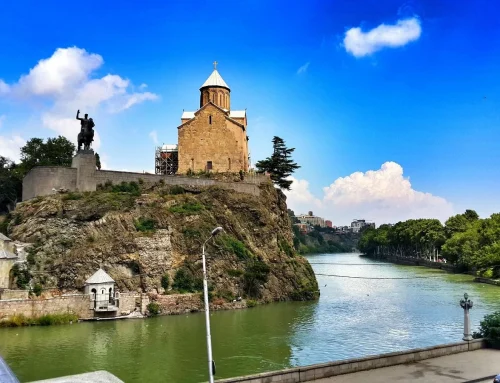
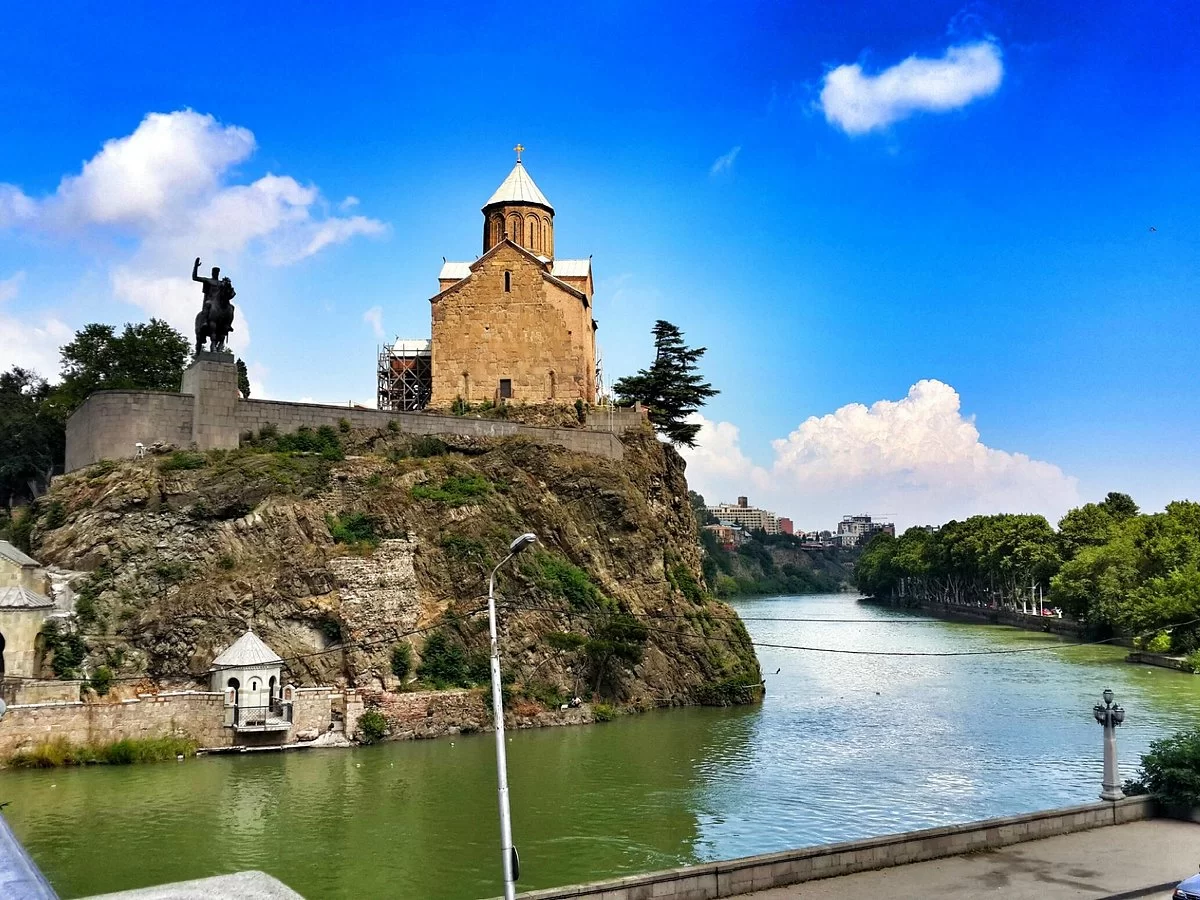
- Metekhi Church — 15-minute walk via Metekhi Bridge
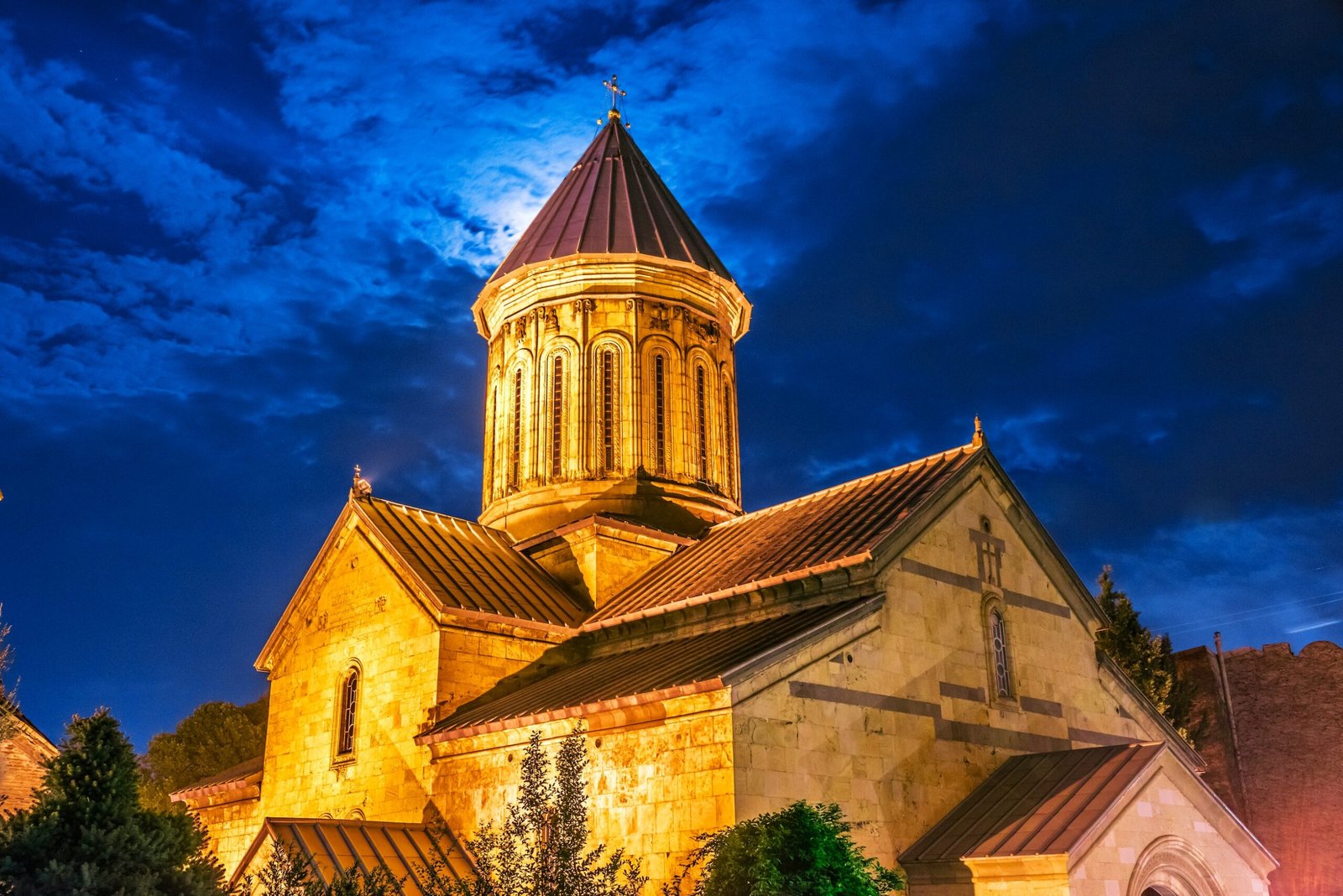
- Sioni Cathedral — 10-minute walk downhill
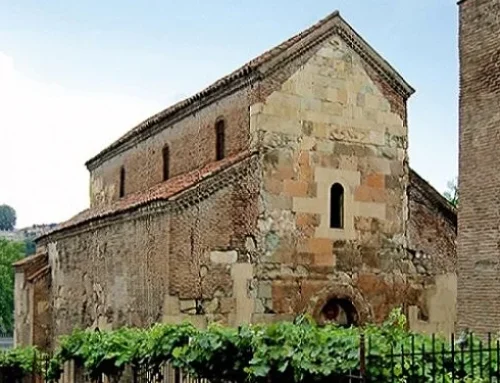
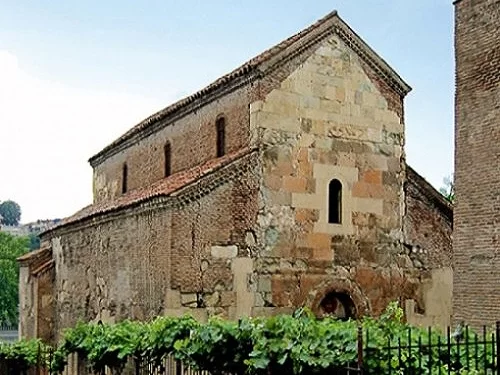
- Anchiskhati Church — 12-minute walk, Tbilisi’s oldest church
Where to Eat Near Narikala
The Old Town area around Narikala is crowded with tourist restaurants, many overpriced and mediocre. A few reliable options:
For breakfast/brunch: Cafés in Sololaki open from 9 am onwards. Look for local spots on Lado Asatiani Street rather than the tourist-heavy Shardeni area.
For lunch or dinner, The sulfur bath district (Abanotubani) and Meidan Square have numerous restaurants serving Georgian cuisine. Avoid the establishments with aggressive touts; the better places don’t need them.
Budget option: Grab a khachapuri or lobiani from a street bakery near Meidan Square before climbing.
Post-visit drinks: The cafés along Shardeni Street are convenient for a coffee or wine after your descent.
Best Views of Narikala Fortress

From the fortress, you see the city. But for photos OF Narikala itself, head to other viewpoints:
Tabor Monastery viewpoint — The hill above Abanotubani (follow Firdousi Street then Bazovi Street) offers arguably the best view of Narikala, with the fortress walls stretching along the ridge and the Old Town below. This is a favorite for photographers.
Metekhi Church plateau — Looking across the river, you can frame Narikala rising above the Old Town rooftops.
Rike Park — The cable car’s starting point offers good framing, especially with the Peace Bridge in the foreground.
Mtatsminda — From the TV tower hill, Narikala appears in context with the entire city, though it’s small in the frame.
Essential Tips for Visiting Narikala
What to Wear and Bring
- Comfortable shoes — The terrain inside the fortress is uneven stone and dirt. Stairs are worn and irregular. Don’t wear heels or flimsy sandals.
- Water — Bring your own. Spring water fountains exist inside the Botanical Garden, but not inside the fortress. The climb is hot in summer.
- Sun protection — Hat and sunscreen essential, especially midday. The hilltop is fully exposed.
- Headscarf — Women visiting St. Nicholas Church needa head covering. Shared scarves are available at the church door if you forget.
- Camera — Obviously. The views are extraordinary.
Safety Considerations
- No safety rails — Many walls and ledges have sheer drops with no barriers. Take care near edges, especially with children.
- Uneven terrain — Loose stones, worn steps, crumbling walls. Watch your footing.
- Night visits — The fortress is lit but not uniformly. Bring a phone flashlight for darker sections.
Accessibility
Narikala Fortress is not wheelchair accessible. The combination of steep approaches, stairs, and rough terrain makes the site unsuitable for visitors with mobility limitations. Those unsteady on their feet should stick to the area immediately inside the main gate and use the cable car for access.
Time Needed
- Quick visit (walls and views only): 30–45 minutes
- Thorough exploration (fortress, Kartlis Deda, both viewpoints): 1.5–2 hours
- Combined with Botanical Garden: 3–4 hours
- With a sulfur bath afterward: Half a day
Planning Your Visit
We include Narikala Fortress in our Old Tbilisi City Tour, which covers both banks of the Mtkvari River and the major Old Town landmarks.
Suggested Itinerary: Half-Day Narikala Circuit
Morning route:
- Start at Rike Park, take the cable car up
- Walk to Kartlis Deda for photos
- Explore Narikala Fortress (30–45 minutes)
- Descend via Betlemi Street stairs through Sololaki
- End at Abanotubani for lunch or a sulfur bath
Sunset route:
- Walk up via Orbiri Street from Abanotubani (20 minutes)
- Explore the fortress as the light changes
- Watch the sunset from the walls
- Walk to Kartlis Deda for night views
- Take the cable car down (runs until 10 pm/midnight)
Combine With
- Tbilisi Botanical Garden — Directly behind the fortress
- Metekhi Church — Across the river, 15-minute walk
- Anchiskhati Church — Tbilisi’s oldest church, in the Old Town below
- Sulfur baths — Traditional Tbilisi experience at the foot of the hill