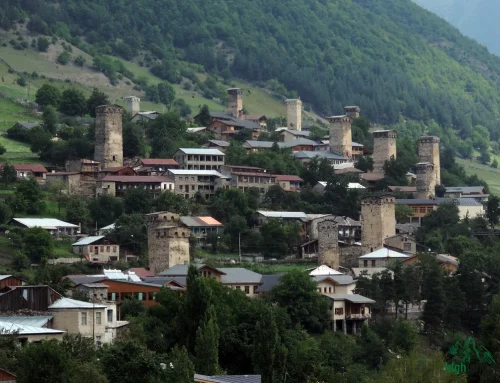
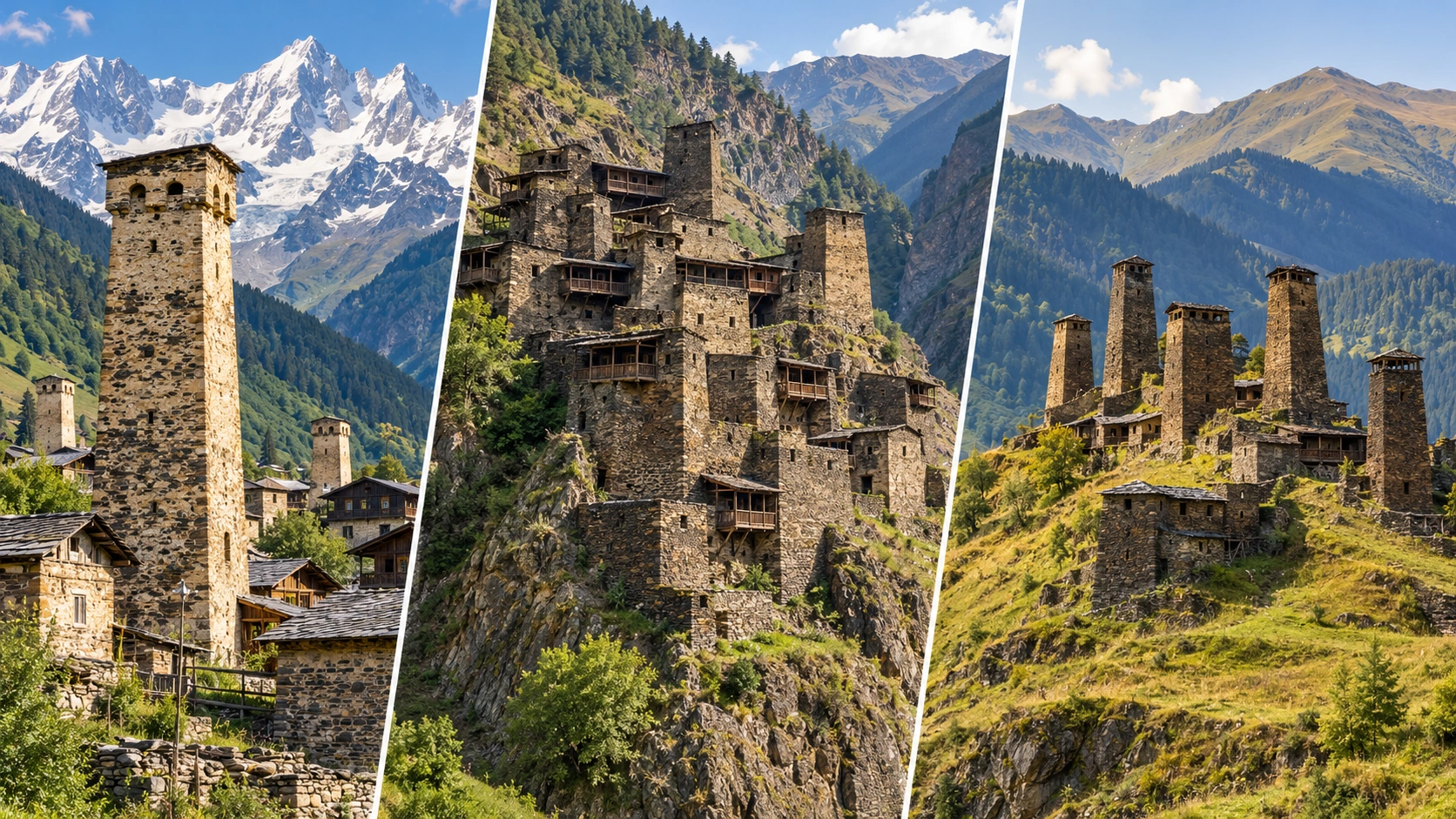
Stand in Mestia and count the towers. Each one rises alone beside a family house, square and slightly tapering, like a stone chimney for a fire that was never lit. Now picture Shatili, on the far side of the country. There you cannot count anything. Sixty-odd towers and flat-roofed houses are packed so tightly against the cliff that the whole village reads as one building.
Then go to Tusheti, and the pattern changes again: tall towers above Omalo watching the valley, fortress-houses woven through village lanes, lookouts on the ridges.
All three are “Georgian mountain towers”. Travellers tend to call every one of them a Svan tower. They are not variations of the same idea. In Svaneti, the tower usually belonged to a household. In northern Khevsureti, the settlement itself could become the fortress. In Tusheti, towers, fortified homes and lookouts served communities that spent half the year moving with their flocks.
So why did three highland societies, all facing the same mountains, build three such different answers? That is what this article is about.
Georgia’s Mountain Towers at a Glance
| Region | Typical defensive form | Who it protected | Best examples |
|---|---|---|---|
| Svaneti | A tall tower attached to or beside a two-storey family house | The household and its lineage | Mestia, Ushguli (Chazhashi) |
| Khevsureti | Fortress-houses and towers joined into one defensive block | The whole settlement | Shatili, Mutso |
| Tusheti | Defensive towers, residential fortress-towers and lookout towers | Households, villages and the routes between them | Keselo above Omalo, Dartlo |
These are broad patterns, not rigid rules. Architecture varies inside each region, and many buildings were rebuilt, extended or adapted over centuries. Svaneti has free-standing towers too; Tusheti has villages that feel almost as compact as Shatili. The table describes what each region does most characteristically, which is also what you will notice first when you get there.
Why Did Georgian Highlanders Need Towers?
Before the differences, the common ground. Svaneti, Khevsureti and Tusheti all sit high in the Greater Caucasus, and all three shared a set of pressures that made stone fortifications sensible:
- Border geography. The high valleys lie close to passes and routes that connected Georgian communities with the North Caucasus. Whoever lived there lived on a frontier.
- Raids from outside. Some settlements guarded exposed approaches and could expect armed visitors, sometimes for livestock, sometimes for more.
- Conflict at home. In some regions, Svaneti above all, feuds between lineages were as real a threat as anything arriving over the pass.
- Distance from help. No royal army was going to reach a snowbound village in time. Communities had to defend themselves.
- Wealth that could not be moved. Livestock, grain, hay and tools were the difference between surviving a winter and not. They needed protecting.
- The terrain itself. Steep slopes, narrow ridges and cliffs decided where anything could be built, and shaped how a settlement could be defended.
One caution: do not reduce every tower to warfare. Many structures combined several jobs at once, including defence, storage, refuge, observation, residence and a visible statement of a family’s standing. Which of those mattered most changed from region to region and from century to century.
Svaneti: A Fortress for the Household
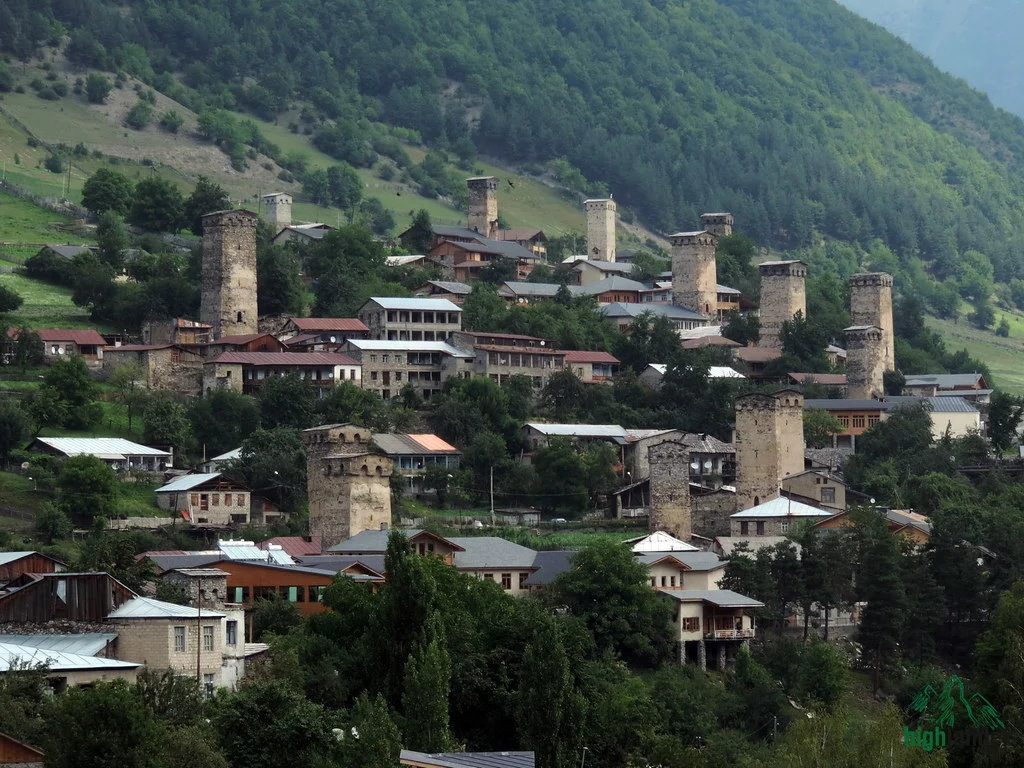
The basic unit in Upper Svaneti is not the tower on its own. It is a pair: a stone family house and a defensive tower joined to it or standing right beside it.
The house, the machubi, is where life happened. Its ground floor was a single large hall with a hearth, shared by people and animals in winter, the two separated by carved wooden partitions. Above it, the upper floor served as summer living space and storage for hay and tools, and from there you could reach the tower.
The tower was the household’s insurance policy. Its upper floors had one job only: defence, with narrow openings and a top level from which the family could fight back. It was also where people retreated when the danger was close.
What a Svan tower looks like
- Square in plan and tall. Usually three to five storeys, rising well above the house roofs.
- Tapering. The walls get thinner as they rise, which gives the tower its slender, slightly pinched silhouette.
- Narrow openings. Small windows and slits, wide enough to shoot from and far too small to climb through.
- Built from local stone and slate, set in lime mortar, often finished with a projecting “cap” at the top.
- Tied to a family. A tower stood with a particular household, and in a village of many towers, each one marked a separate family compound.
Tower heights and details vary from village to village, so be wary of any single number quoted for “the” Svan tower.
Why did each family need its own tower?
Because the threat was not only outside the valley. Svan society was organised around households and lineages, and disputes between them could turn into blood feuds that lasted generations. A tower protected a family in a world where the danger might come from invaders, but might just as easily come from the house across the lane.
That is the single biggest difference from Khevsureti. In Svaneti, defence was organised family by family, and the village skyline still shows it: every tower stands apart, a household’s own declaration of independence in stone.
Chazhashi, Ushguli and the UNESCO landscape
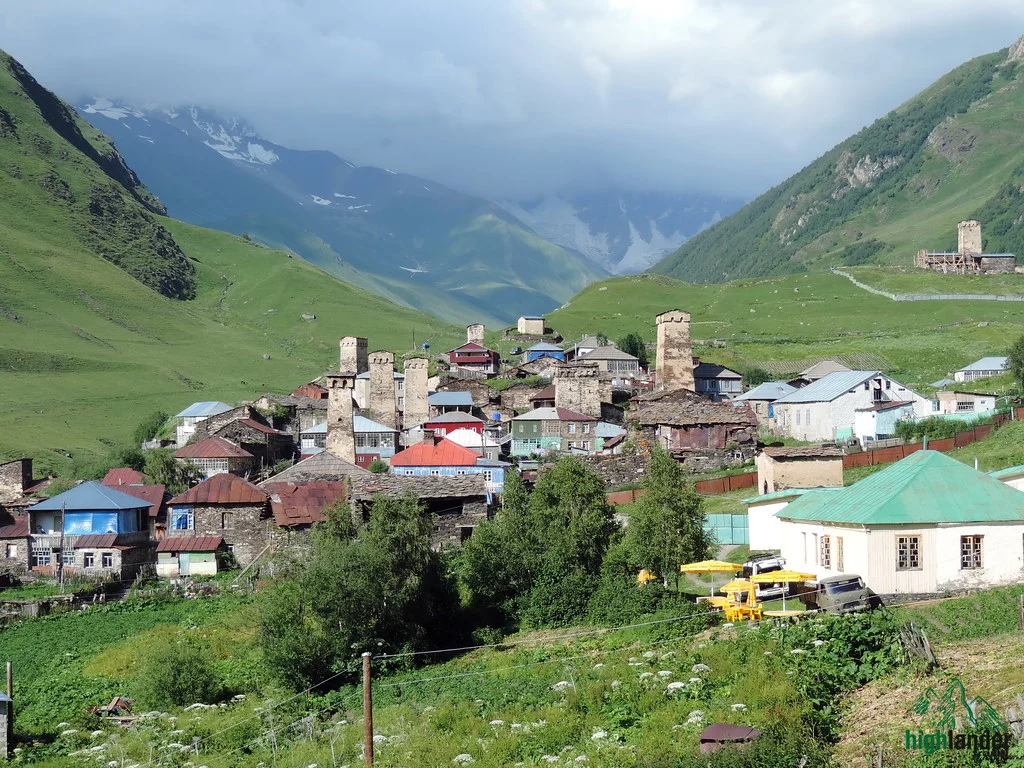
Upper Svaneti has been a UNESCO World Heritage Site since 1996, recognised as an exceptional mountain landscape of medieval villages and tower houses. Its showpiece is Chazhashi, one of the villages of the Ushguli community at the head of the Enguri valley, where more than 200 tower houses, churches and castles survive inside a museum-reserve.
One precision matters here. The World Heritage property is the Upper Svaneti cultural landscape. It is wrong to say that “Svan towers are UNESCO monuments” as a blanket claim; towers outside the protected area, in Lower Svaneti for example, are not covered.
For the travel side of the region, see our Svaneti travel guide. In Mestia, the easiest place to understand a tower from the inside is the Margiani family compound, described in our Mestia travel guide. To see Chazhashi’s towers in the evening light, after the day-trippers have gone, our Svaneti and Racha tour spends a night in Ushguli beneath Mount Shkhara.
Khevsureti: When the Whole Village Became the Fortress
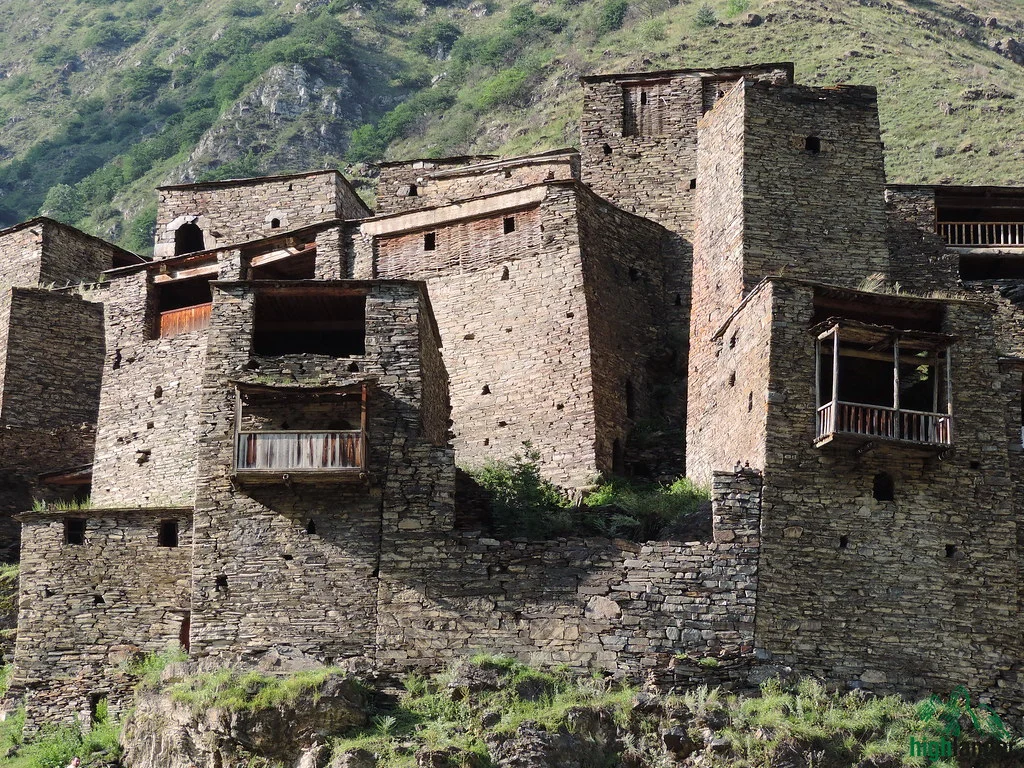
If a Svan village is a row of individual fortresses, Shatili is one fortress with a village inside it.
It sits at about 1,400 metres in the deep Arghuni gorge, on the northern side of the Greater Caucasus, close to the border with Chechnya. UNESCO’s Tentative List describes it as a complex of medieval-to-early-modern fortresses and fortified dwellings that served both as homes and as a fortress guarding Georgia’s north-eastern edge. Some 60 towers and flat-roofed houses step up the slope in terraces and lock together into a single chain of fortifications.
How Shatili works
- Packed tight. Buildings press against each other with almost no gaps, so the outer walls of the houses double as the settlement’s defensive perimeter.
- Built in terraces. The village climbs a narrow rocky spur, each level stacked on the one below.
- Flat roofs. Roofs serve as walkways and platforms, part of the circulation of the whole complex.
- Inside connections. Interior passages and staircases link one building to the next, so people could move through the village without showing themselves to anyone outside.
- Towers among houses. The towers rise from inside the cluster rather than standing beside a single home.
The effect is the opposite of Svaneti. A Svan tower stands out from its village. In Shatili, individual buildings disappear into a larger fortified organism, a bit like cells in a honeycomb: each has its own walls, but none of them makes sense alone.
That is what you notice on the ground, too. Walk between compounds in Mestia and every tower is clearly someone’s. Step into old Shatili and it quickly becomes hard to tell where one building ends and the next begins.
Shatili also has a 20th-century story. Most of its people were moved down to the lowlands by the Soviet authorities in the early 1950s. The empty village later served as a film set, and when families returned, they mostly built new houses below the old fortress, which is one reason the historic complex survived so intact.
Why Did Khevsureti Build Differently?
Geography, mostly. The Arghuni valley is a corridor on the northern side of the main Caucasus ridge, facing routes towards what is now Chechnya and Ingushetia. A settlement there could not rely on each family looking after itself; the community needed to hold the gorge as a whole.
It would be too simple to say Shatili was “built to defend Georgia against the Chechens”. The valley was an exposed border corridor where communities had to defend their households and the settlement together, against raids from outside and conflicts closer to home. The architecture follows from that: defence organised at the scale of the village, not just the family.
Mutso: Fortress Architecture on a Cliff
About ten kilometres further down the valley, Mutso shows a related answer to a different piece of ground. Here the fortress-village climbs a steep, narrow ridge above the river, with dozens of houses on vertical terraces and defensive towers on the heights.
If Shatili is a compressed block, Mutso is a fortification that scales a cliff. Same culture, same logic of shared defence; different terrain, so a different shape. Mutso was abandoned for many years and has since been restored; the climb up to it is short but steep.
For routes, roads and where to stay, see our Khevsureti travel guide. If you would rather have the 4×4 and the mountain road taken care of, our two-day Khevsureti tour sleeps beside Shatili and continues up the valley as far as Ardoti.
Tusheti: Towers Across a Pastoral Landscape
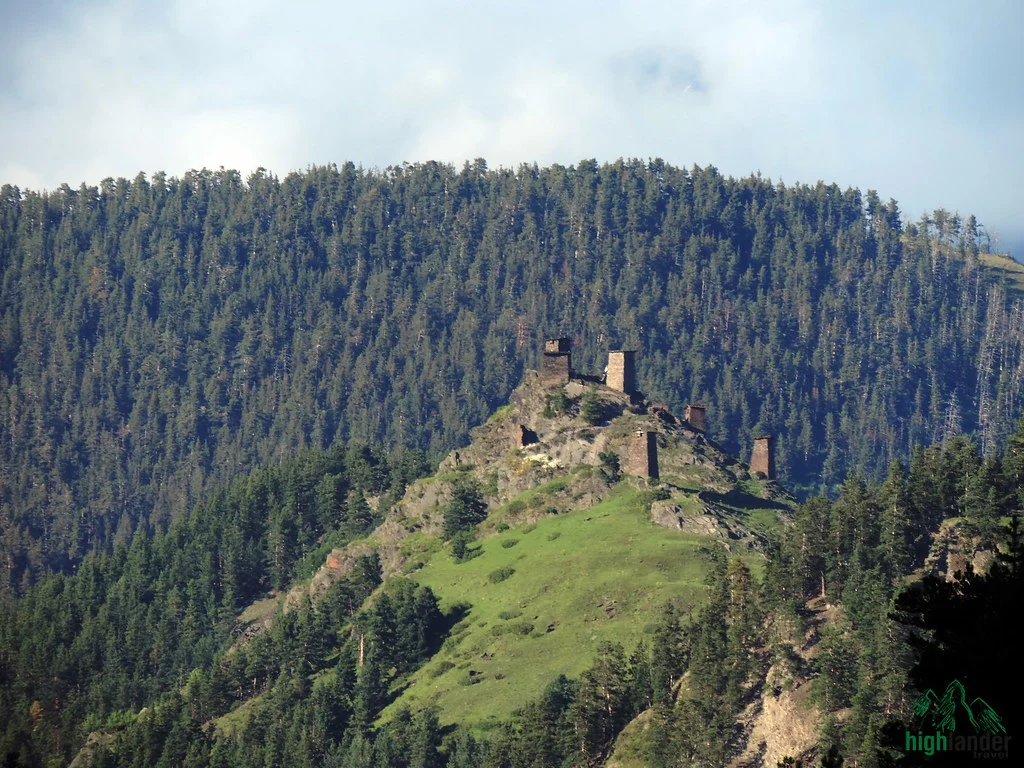
Tusheti is often described as “another Svaneti”. It is not, and the reason starts with sheep.
Tushetians have long been pastoralists, moving their flocks between high summer pastures in the mountains and winter grazing in the Kakheti lowlands. Villages like Dartlo were traditionally emptied in the cold months and filled again in summer. A society that is half the year on the move needs different things from its buildings than one that stays put.
The result is variety. Tusheti’s protected landscape records several distinct building types side by side: defensive towers, residential fortress-towers, ordinary houses, farm buildings, shrines, churches and crypts. UNESCO’s Tentative List entry for Mta-Tusheti singles out its fortress-like residential buildings as one of the region’s defining features.
Three kinds of tower
- Defensive towers. Tall refuges where a village could shelter and hold out, often standing above or at the edge of the settlement.
- Residential fortress-towers. Buildings that blend house and fortress more directly than in Svaneti, with living space and defensive levels in the same structure.
- Lookout towers. Positioned to watch roads, passes and grazing routes, so that warning of approaching danger could pass from one community to the next.
That third type is the important difference. In Tusheti, defence was not only about protecting a house or a village at the moment of attack. It was also about seeing trouble coming across a wide, open landscape and raising the alarm in time.
Keselo, Dartlo and the Tushetian Village
Keselo above Omalo
On a ridge above Omalo, the cluster of towers known as Keselo is the image most visitors take home from Tusheti: grey stone shafts against an enormous sky, the valley falling away below. It shows the defensive tradition at its most dramatic.
How old are they? Here it pays to be careful. You will read that the Keselo towers are 13th-century structures built against the Mongols. The evidence is less tidy. Scholars give dates ranging from the medieval period to the 17th and 18th centuries for different Tushetian towers, and individual structures were repaired and rebuilt over time. The honest answer is that Keselo belongs to a long defensive tradition, and that dating any single tower precisely is difficult.
Dartlo: more than towers
Dartlo is the place to see that Tushetian architecture is a whole village system, not a collection of towers. Alongside its defensive towers and fortress-houses are family residential complexes, shrines, petroglyphs, a 19th-century church and a 16th-century courthouse. Twelve stone seats for jurors face a taller stone chair for the judge, a reminder that these communities organised justice as carefully as defence.
For how to get to Tusheti, when the road is open and where to stay, see our Tusheti National Park guide. The shortest practical way to see Keselo and the villages around it is our 3-day Tusheti jeep tour from Tbilisi, with an experienced driver for the Abano Pass road.
So Why Do the Three Regions Look Different?
It is tempting to say the towers exist because the mountains were isolated. That is true, but it only explains half the story. Isolation made self-reliance necessary. What self-defence actually looked like depended on four other things: the kind of threat, how society was organised, the shape of the ground and the way people made a living.
| Svaneti | Khevsureti | Tusheti | |
|---|---|---|---|
| Threats | Raids, plus blood feuds between lineages | Raids along an exposed border corridor, plus local conflict | Raids, border defence, threats to flocks and routes |
| Social structure | Strong household and lineage identity | Collective defence of the settlement, clearest at Shatili | Pastoral communities guarding people, flocks and passes |
| Terrain | Broad inhabited valleys under high peaks | Narrow gorges and rocky spurs | High valleys, ridges and grazing slopes |
| Way of life | Settled farming households | Settled villages holding a strategic gorge | Seasonal herding between mountain and lowland pastures |
| Result: defensive form | A tall tower beside each family house; defence organised family by family | Houses and towers locked into one defensive block; the settlement defends itself | Refuge towers, fortress-houses and lookouts that watch passes and pastures |
| Skyline | Towers rise well above the roofs | Flat roofs merge into one stepped mass | Stone villages folded into the hillside, towers above |
| Where to see it | Mestia, Ushguli | Shatili, Mutso | Omalo (Keselo), Dartlo |
Geography Was Part of the Architecture
The ground set the brief before anyone laid a stone.
- Svaneti has relatively broad valleys with room for villages to spread out. Each family could have its own compound, and the tower went up, not out.
- Khevsureti offered narrow gorges and defensible rocky spurs. With little flat land and an exposed approach, it made sense to compress a whole settlement onto one strong position.
- Tusheti is a landscape of high valleys, ridges and long grazing routes. Seeing across distance mattered as much as holding a single point, so lookouts and signal positions joined the refuge towers.
If you travel between the regions, this is the most useful thing to watch for. Look at where the village sits before you look at the towers, and the towers start to explain themselves.
Were the Towers Built Against Foreign Invaders?
Sometimes. But that is never the whole story, and the balance is different in each region.
| Region | Outside threats | Threats closer to home | What else the buildings did |
|---|---|---|---|
| Svaneti | Raids and invasion | Blood feuds between lineages | Storage, refuge, family status |
| Khevsureti | Raids along an exposed border corridor | Local conflict | Everyday housing, built into the defences |
| Tusheti | Raids and border defence | Local disputes | Warning systems; protecting villages, flocks and routes |
A single cause cannot explain buildings that were used, repaired and rebuilt over several hundred years. Be suspicious of any account that pins all of them on one invader.
Did People Actually Live in the Towers?
It depends on the region and on the building. This is one of the most common oversimplifications in travel writing, so it is worth getting right.
- In Svaneti, daily life happened in the machubi, the house next to the tower. The tower’s upper floors were defensive, and the family retreated into it when threatened. “Svan families lived in their towers” is too simple; “Svan households lived beside and with their towers” is closer.
- In Khevsureti, the distinction largely disappears. At Shatili, homes and fortifications are the same buildings, so living and defending happened under one set of roofs.
- In Tusheti, both exist. Some towers were refuges, while residential fortress-towers combined a home and a defensive structure in one building.
Are Svan, Khevsur and Tushetian Towers the Same Age?
No, and many of them cannot be dated precisely at all.
- Upper Svaneti preserves a landscape that is strongly medieval in character, which is what UNESCO recognised.
- Shatili is described on UNESCO’s Tentative List as medieval-to-early-modern, built, rebuilt and modified over a long period.
- Tushetian towers vary. Different sources date different structures anywhere from the medieval period to the 17th and 18th centuries, and scholars warn against assigning one construction period to all of them.
Stone towers are hard to date. Walls were patched, upper storeys rebuilt, roofs replaced. When you see a confident single date on a sign or a website, read it as a likely period, not a birth certificate.
Why Stone?
Because it was there. Every one of these valleys is a quarry with grass on it, and stone and slate were the obvious materials. But stone also did several jobs that timber could not:
- It does not burn. In a raid, fire was one of the fastest ways to destroy a wooden building.
- It carries height. Thick masonry walls can rise four or five storeys and still bear their own weight.
- It lasts. Stone buildings survive generations of snow, rain and neglect.
- It defends. Thick walls with small openings are hard to break into and easy to shoot from.
- It blends in. Built from the slope it stands on, a tower or a fortress-village reads from a distance as part of the mountain.
One claim to treat with care: stone did not keep mountain homes warm on its own. Winter comfort came from the whole arrangement, including the hearth, animals sharing the ground floor, thick walls and few openings, not from the material alone.
Why Are So Many Towers Still Standing?
Partly because they were built to last. But there is no single reason, and “untouched for a thousand years” is not one of them.
- Massive masonry. Thick stone walls are simply hard to knock down.
- Remoteness. These valleys escaped much of the redevelopment that replaced old buildings in the lowlands.
- Care. In many villages, families kept repairing their own towers and houses for generations.
- Emptiness, sometimes. When villages like Shatili were depopulated in the Soviet era, the old buildings were left alone rather than replaced.
- Restoration. Heritage programmes in recent decades have stabilised and restored many towers and fortress-houses.
What you see today has been repaired, altered, abandoned and restored in turn. UNESCO’s own documents on Upper Svaneti talk about conservation and authenticity, not about buildings that have never changed. These are working buildings with long, untidy histories, and the patches and rebuilds are part of what they can tell you.
UNESCO Status: Don’t Confuse the Three Regions
Many travel sites call all of these places “UNESCO”. Only one of them is a World Heritage Site.
| Place | UNESCO status | Since |
|---|---|---|
| Upper Svaneti | World Heritage Site | 1996 |
| Shatili | Tentative List only | 2007 |
| Mta-Tusheti | Tentative List only | 2007 |
The Tentative List is a country’s shortlist of places it may nominate in future. Being on it is a meaningful recognition, but it is not World Heritage status.
Where Can You See the Best Examples?
If you want to see all three traditions, these are the places to aim for:
- Mestia, Svaneti. The easiest place to start: dozens of family towers in and around town, and the Margiani compound, where you can see a machubi and its tower together.
- Ushguli (Chazhashi), Svaneti. The densest surviving tower landscape in the country, under Mount Shkhara.
- Shatili, Khevsureti. The fortress-village at its most complete. Walk the lanes and passages rather than just photographing it from the road.
- Mutso, Khevsureti. The same idea on a cliff; the steep climb is the point.
- Keselo above Omalo, Tusheti. Defensive towers on a ridge with the whole valley below.
- Dartlo, Tusheti. Towers, fortress-houses and the old stone courthouse in one village.
All three regions are mountain destinations with short seasons and demanding roads, so use the regional guides linked in each section above for practical planning.
The eastern traditions can even be seen on one journey. The Atsunta Pass trek crosses on foot from Shatili and Mutso in Khevsureti over a 3,431-metre pass into Tusheti, ending at Dartlo, which makes it one of the few routes where you meet both architectural worlds back to back.
For more on Georgian building traditions, from churches to cave monasteries, browse our architecture of Georgia articles.
Georgian Mountain Towers FAQ
Why does Georgia have so many stone towers?
Georgia’s high mountain communities lived far from any central protection, on routes exposed to raids and, in some regions, amid long-running local feuds. Stone towers gave them refuge, defence, storage and lookout points. Different threats, social structures and terrain in Svaneti, Khevsureti and Tusheti produced three distinct tower traditions.
What are Svan towers called?
In Georgian a tower is koshki (კოშკი), so a Svan tower is a svanuri koshki. In English they are usually called Svan towers or Svan tower houses. Each typically stands with a family house called a machubi, and the two together form one household compound.
What were Svan towers used for?
Mainly defence and refuge. The upper floors were purely defensive, and families retreated into the tower when threatened, whether by raiders from outside or by rival lineages during blood feuds. Towers also provided extra storage space and marked a family’s standing in the village.
Did families live in Svan towers?
Not in the everyday sense. Daily life took place in the machubi, the two-storey house beside the tower, where people and animals shared the ground floor in winter. The tower was the household’s defensive refuge, used in times of danger.
How is Shatili different from Svaneti?
In Svaneti each family had its own tower standing beside its house. In Shatili, around 60 towers and flat-roofed dwellings are packed together and joined by interior passages, so the whole village works as one fortress. Svaneti organised defence by household; Shatili organised it by settlement.
Are Tusheti’s towers medieval?
Some may be, but not all. Sources date different Tushetian towers from the medieval period to the 17th and 18th centuries, and many were repaired or rebuilt over time. Treat any single date for all of them, such as “13th century”, with caution.
Which Georgian mountain towers are UNESCO-listed?
Only Upper Svaneti, including Mestia and Ushguli, is a UNESCO World Heritage Site, inscribed in 1996. Shatili and Mta-Tusheti have been on Georgia’s UNESCO Tentative List since 2007, which means they may be nominated in future but are not World Heritage Sites.