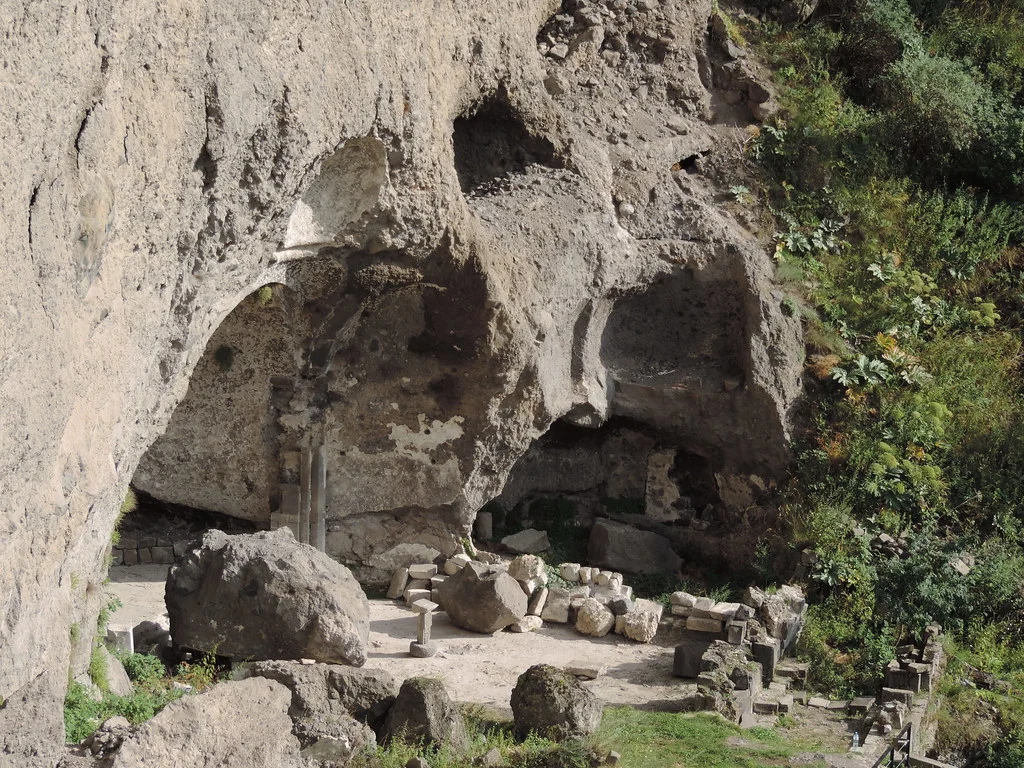
Four hundred years before Queen Tamar’s masons started on Vardzia, monks were already cutting cells into a cliff three and a half kilometres down the same valley. That cliff is Vanis Kvabebi, the Vani Caves, in the Samtskhe-Javakheti region of southern Georgia (the country in the Caucasus, not the US state).
Most people drive past it. The turn-off is a concrete sign on the road from Khertvisi, and by then everyone’s eyes are on the bigger name ahead. Look up from the road, though, and you’ll see a small white chapel standing on a ledge high above the road. Behind it, a rock face pocked with dark doorways rises like the honeycomb of some enormous stone hive.
This guide covers what Vanis Kvabebi is, why it matters to Georgian history, and the question that most other guides skip: can you actually go inside in 2026?
Vanis Kvabebi at a Glance
| Georgian name | ვანის ქვაბები (Vanis Kvabebi, also written Vahanis Kvabebi) |
| Meaning | “The caves of Vani” — kvabebi means caves |
| Location | Aspindza Municipality, Samtskhe-Javakheti, southern Georgia |
| Distance from Vardzia | About 3.5 km, on the Akhaltsikhe side |
| Founded | 8th century |
| Layout | Up to about 200 rock-cut rooms over 16–19 levels, several churches, a defensive wall of 1204 |
| Protected status | Part of the Vardzia Historical-Architectural Museum-Reserve |
| Current status | Cave tiers closed to visitors for safety; check before you go (see below) |
| Time needed | 15 minutes from the road; about an hour if the upper tiers reopen |
| Best season | May–June and September–October |
Is Vanis Kvabebi Open in 2026?
Not fully. The cave tiers have been closed to visitors for several years because of rockfall risk, and that was still the case in autumn 2026.
The cliff is made of soft volcanic tuff and breccia, and it sheds stone after heavy rain. A large section came down in 2017. Since 2018 the site has been under a protection and stabilisation campaign, including drone surveys and landslide-hazard assessments (MDPI Remote Sensing, 2021). In practice this means a no-entry sign at the foot of the slope, and staff who will turn you back from the caves themselves. Travellers were still being turned back in September 2026.
What that means for your visit:
- You can still see it. The complex faces the valley, so the wall of 1204, the white chapel and the tiers of caves are all visible from the road and the small car park below. With binoculars or a long lens you can pick out individual doorways and stairs.
- The monastery is inhabited. A few monks have lived here since monastic life resumed in 2010. Some visitors report being allowed up to the lower church with permission; don’t count on it, and never climb past a barrier.
- Older guides are out of date. Many blogs and review sites still describe free, open access from before the closure. They are describing a site you can’t currently visit.
- Vardzia has its own restrictions. A rockfall near Vardzia’s Secret Tunnel in May 2026 also shortened the route there. The Vardzia guide has the details.
This is a working heritage site under active repair, so the situation can change quickly. Our guides drive this valley through the season and can tell you before you set off whether the gate is open.
What Is Vanis Kvabebi?
Vanis Kvabebi is a rock-cut monastery founded in the 8th century on the right bank of the Mtkvari, opposite the side Vardzia stands on. It is roughly four centuries older than its famous neighbour and was a working monastery for most of the next eight hundred years.
It began in the era Georgians call the time of the udabno, the “desert” monasteries, when monks went looking for empty, hard places to pray. Over time it grew into something far more organised: cells, refectories, granaries, crypts and burial chambers, chapels, tunnels linking the levels, and three separate channels bringing water down through the rock to a reservoir. The cliff is U-shaped, so from almost any ledge you look straight across at another tier of doorways.
Counts vary by source. Older surveys speak of around 100 cells, later ones of up to 200 rooms spread across 16 to 19 levels. Either way, picture a tower block of sixteen floors with no lift, carved downward and inward rather than built up.
History of Vanis Kvabebi
The monastery’s story is a cycle that repeats: build, shake, rebuild, burn. Earthquakes struck this valley in 1089, 1283 and 1319, and each one cracked the soft rock and brought chambers down.
| Date | What happened |
|---|---|
| 8th century | Monks cut the first group of caves and a church, in the period of Georgian desert monasticism |
| 9th–11th centuries | The Church of St George and a new group of cells are carved at the foot of the complex |
| 1089 | A major earthquake destroys the central part of the monastery |
| Late 11th–12th centuries | The local noble Gurgenidze family rebuild it and treat it as their family monastery |
| 1191 | Vanis Kvabebi passes to the royal court in the reign of Queen Tamar, and reconstruction begins |
| 1204 | Anton, Tamar’s chancellor and bishop of Chqondidi, has a limestone defensive wall built across the front, enclosing an inner courtyard |
| 1204–1283 | The Tmogveli lords of Javakheti, based at nearby Tmogvi, run the monastery and write its rule, the Charter of Vanis Kvabebi |
| 1265–1283 | A bell tower, a new gate for St George’s church and a stone hall church are added |
| 1283 and 1319 | Two more earthquakes cause heavy damage |
| 15th century | Inscriptions, including two lines of Rustaveli, are written on the plaster of the upper chapel |
| 1551 and 1576 | Persian and then Ottoman armies sack the monastery; monastic life ends and the caves are blackened by fire |
| 1829 | The region passes from Ottoman to Russian rule after the Russo-Turkish war |
| 2010 | Monks return and the monastery reopens as a religious community |
| 2017–present | A rockfall leads to closure of the cave tiers; stabilisation and conservation work continues |
Two threads tie Vanis Kvabebi to its neighbours. The Gurgenidze patron Ichkit, credited with restoring the monastery after 1089, also built the church of St John the Baptist at Tsunda, a few kilometres down the valley. And the Tmogveli family who ran the monastery after 1204 ruled from the fortress of Tmogvi, whose ruins still crown the ridge above the gorge. One family’s money, one valley, three monuments.
The 1204 date is worth pausing on. Vardzia’s great church had been carved and painted in the mid-1180s, less than twenty years earlier. While the royal monastery up the road was at its height, the court’s chancellor was spending money on walls here. That tells you how seriously Vanis Kvabebi was taken.
What to See at Vanis Kvabebi
When the caves are open, the route climbs from the car park through the wall and up the tiers to the highest chapel, the equivalent of a sixteen-storey staircase. While they are closed, most of what follows is seen from below. It is still worth knowing what you’re looking at.
- The defensive wall of 1204. A pale limestone barrier built across the mouth of the U, turning the lower complex into a closed courtyard. It is the clearest single sign that this was a fortified community, not a scatter of hermit holes.
- The Church of St George. At ground level, carved in the 9th to 11th centuries. Its outer wall has gone; an altar arch and part of the dome survive, open to the air like a half-peeled fruit.
- The hall church near the top of the wall. A built stone church from the late 13th century, in good condition and the one you’ll see clearly from the road.
- The domed chapel on the highest tier. Small, clinging to the rock at the level of the uppermost tunnels, and the most important room in the complex for one reason (below).
- Cells, granaries and crypts. Doorways, steps and windows cut into the cliff on every level. Many interiors are black with soot from the fires of the 16th century.
- The water system. Three rock-cut channels fed a reservoir; traces of it survive, along with a spring the monks still use.
The Oldest Written Lines of “The Knight in the Panther’s Skin”
If Vanis Kvabebi has a single claim to national fame, it is a few words scratched into plaster.
The little domed chapel on the top tier is covered in stucco, and in the second half of the 15th century people wrote on it: prayers, names, drawings. Several were left by nuns of a later community, and some of their names survive. Among them are two lines from Shota Rustaveli’s The Knight in the Panther’s Skin, the epic written around 1200 that Georgians treat roughly the way English speakers treat Shakespeare.
The surviving manuscripts of the poem are all much younger, so these lines on a cave wall are widely cited as the oldest known written record of Georgia’s national poem. Think about that the next time someone tells you graffiti has no historical value.
Vanis Kvabebi vs Vardzia: Which Should You See?
See both if you can, but go in with the right expectations. Vardzia is the royal showpiece; Vanis Kvabebi is the older, rougher, quieter prototype across the river.
| Vanis Kvabebi | Vardzia | |
|---|---|---|
| Founded | 8th century | Main phase 1156–1213, under Giorgi III and Tamar |
| Patrons | Local nobles, then the royal court and the Tmogveli lords | The crown |
| Size | Up to about 200 rooms over 16–19 levels | About 500 surviving caves over 13 levels, once around 6,000 |
| Signature feature | 1204 defensive wall; oldest written lines of Rustaveli | Church of the Dormition and its portrait of Queen Tamar painted in her lifetime |
| River bank | Right | Left |
| Visitors | Very few | Coaches in summer from about 10:30 |
| Access in 2026 | Cave tiers closed; viewable from below | Open daily, route shortened after the May 2026 rockfall |
| Ticket | No ticket office | 15 GEL adults |
| Time needed | 15 minutes now; about an hour if reopened | 2–3 hours |
The practical answer: Vardzia is the destination, and Vanis Kvabebi is the stop on the way in or out that makes the valley make sense. Seeing the older monastery first is like reading the draft before the finished book.
How to Get to Vanis Kvabebi
Vanis Kvabebi sits on the S11 road between Khertvisi Fortress and Vardzia, about 3.5 km before Vardzia. Look for a concrete signpost and a short, steep paved lane climbing to a small car park below the cliff. GPS: 41.3817, 43.3064.
| From | Distance and time | Route |
|---|---|---|
| Vardzia | About 3.5 km, 5 minutes by car, 45–60 minutes on foot | Back along the main road towards Khertvisi |
| Akhaltsikhe | About 55 km, roughly an hour | Via Aspindza and Khertvisi |
| Borjomi | About 2 hours | Via Akhaltsikhe |
| Tbilisi | About 250 km, 4–5 hours | Via Borjomi and Akhaltsikhe, or via the Javakheti plateau and Akhalkalaki |
By car. The road from Akhaltsikhe is fully paved and fine for a sedan. The lane up to the car park is steep but short.
By public transport. Minibuses (marshrutkas) run from Akhaltsikhe bus station to Vardzia a few times a day. Ask the driver to drop you at the Vanis Kvabebi sign. Schedules are thin and change without notice, so plan to sleep in Akhaltsikhe or near Vardzia; our Akhaltsikhe travel guide covers where to base yourself.
On a tour. This is the easiest way, because the sites in this valley are spread out and transport between them is scarce.
Tours That Visit Vanis Kvabebi and Vardzia
All our southern Georgia tours are private, so the route bends to what you want to see. Vanis Kvabebi is a few minutes from Vardzia on every one of them.
| Tour | Length | How Vanis Kvabebi fits |
|---|---|---|
| Mystic South Georgia: Vardzia, Volcanic Lakes and Borjomi | 4 days | A planned stop on Day 2, with Khertvisi, Vardzia and the jeep track to Upper Tmogvi |
| Cave Monastery Vardzia Tour from Tbilisi | 2 days | Passes the foot of the cliff on the way to Vardzia; ask your guide to stop |
| Javakheti & Borjomi Trek | 8 days | Cultural day at Rabati, Saro and Vardzia between the forest and volcano treks |
| Svaneti and Vardzia | 10 days | Night near Vardzia after Khertvisi; easy to add on Day 8 or 9 |
| Around Georgia in 12 Days | 12 days | Vardzia at dawn on Day 11; the stop fits on the drive in |
If you only have a weekend, the 2-day Vardzia tour is the shortest sensible way to see this valley. A same-day return from Tbilisi means around ten hours in a car, which leaves no time for side stops like this one. Browse all short tours from Tbilisi or plan a private trip around your own dates.
Tips for Visiting Vanis Kvabebi
- Check the status on the day. Ask at the Vardzia ticket office or your guesthouse whether the caves are open. If they are, go: it may not last.
- Respect the barriers. The closure is about falling rock, not bureaucracy, and the cliff still sheds stone after heavy rain.
- Bring binoculars or a zoom lens. From the car park they turn a cliff of dark holes into stairs, doorways and the outline of the upper chapel.
- Pair it with Vardzia. Stop on the way in, before Vardzia opens at 10:00, or on the way out once the coaches arrive.
- Dress for a monastery. Cover shoulders and knees, and women should carry a headscarf in case you’re invited into a church.
- Keep your voice down. Monks live in the lower cells. Don’t photograph their living quarters or knock on doors.
- Carry cash and water. There is no café, shop or ticket office here; the nearest are at Vardzia.
- Wear proper shoes. Even the lane from the car park is steep, and the rock underfoot is loose grit.
Best Time to Visit
Late spring and early autumn are best. In May and June the valley turns green and poppies come up along the Mtkvari; in September and October the light is soft and the vineyards on the terraces are being harvested. July and August are hot and shadeless in this gorge, so plan the stop for early morning. In winter the road stays open, but ice makes any slope dangerous.
What to See near Vanis Kvabebi
Vanis Kvabebi is one point on a short stretch of the Mtkvari valley packed with monuments. These are all within about 20 km:
- Vardzia (3.5 km): the 12th-century royal cave monastery and its Queen Tamar fresco.
- Upper Vardzia (about 3 km beyond Vardzia): an older church on the slope above, now a working convent.
- Tsunda Church (a few kilometres towards Khertvisi): St John the Baptist, built by the same Gurgenidze patron who restored Vanis Kvabebi.
- Tmogvi Fortress: the ruined seat of the lords who ran Vanis Kvabebi after 1204, high on a ridge above the gorge.
- Khertvisi Fortress (about 13 km): one of Georgia’s oldest fortresses, where the Paravani joins the Mtkvari.
Further afield, the Akhaltsikhe guide covers Rabati Castle and Sapara Monastery, and Zarzma Monastery is a good addition to a longer route. For the whole region, start with our Samtskhe-Javakheti guide.
Frequently Asked Questions about Vanis Kvabebi
What is Vanis Kvabebi?
Vanis Kvabebi (“the Vani Caves”) is an 8th-century rock-cut monastery in the Samtskhe-Javakheti region of southern Georgia. It has up to about 200 rooms over 16–19 levels, several churches and a defensive wall built in 1204.
Where is Vanis Kvabebi?
It is in Aspindza Municipality, on the right bank of the Mtkvari River, about 3.5 km from Vardzia on the road from Khertvisi and Akhaltsikhe.
Is Vanis Kvabebi open to visitors?
The cave tiers have been closed for several years because of rockfall risk, and they were still closed in autumn 2026. You can see the complex from the road and the car park below. Check locally before making a special trip.
Is there an entrance fee?
There is no ticket office. When the site was open it was free to enter, and donations to the monastery were welcome.
How old is Vanis Kvabebi compared with Vardzia?
Vanis Kvabebi was founded in the 8th century, about 400 years before the main construction of Vardzia under Giorgi III and Queen Tamar in the late 12th century.
Can you walk from Vardzia to Vanis Kvabebi?
Yes. It is about 3.5 km along the main road, which takes 45–60 minutes. There is no separate footpath, so walk facing the traffic.
How long do you need at Vanis Kvabebi?
About 15 minutes to see it from below while the caves are closed. If the upper tiers reopen, allow an hour for the climb to the top chapel and back.
Do monks live at Vanis Kvabebi?
Yes. Monastic life resumed in 2010, and a small community of monks lives in the lower part of the complex.
Why is Vanis Kvabebi important?
Besides its age, its upper chapel holds 15th-century inscriptions that include two lines of Rustaveli’s The Knight in the Panther’s Skin, the oldest known written record of the poem.
Which tours include Vanis Kvabebi?
Our 4-day Mystic South Georgia tour stops there on its Vardzia day. On the 2-day Vardzia tour and our longer private tours, your guide can add the stop on request.
Is Vanis Kvabebi Worth the Stop?
Yes, even from the bottom of the slope. Ten minutes at the foot of that cliff, with the wall of 1204 above you and the white chapel on its ledge, changes how you see Vardzia afterwards. The famous monastery stops looking like a one-off miracle and starts looking like what it was: the grandest chapter in a story this valley had already been telling for four hundred years.
Explore the 2-Day Vardzia Tour · See the 4-Day Mystic South Georgia Tour · Plan a Private Trip