Located in the historic city of Mtskheta, Samtavro Monastery is one of Georgia’s most important Christian sites and one of the key monuments included in the UNESCO-listed Historical Monuments of Mtskheta.
Its significance goes far beyond architecture.
According to Georgian Christian tradition, this is the place where St Nino, the woman credited with bringing Christianity to the Kingdom of Iberia, found shelter after arriving in Mtskheta. The monastery is also associated with King Mirian III and Queen Nana, the royal couple traditionally linked with the adoption of Christianity as the state religion of Georgia in the 4th century.
Today Samtavro remains an active convent and an important pilgrimage site. It is one of the principal stops on our Mtskheta Tour from Tbilisi, together with Jvari Monastery and Svetitskhoveli Cathedral.
Where Is Samtavro Monastery?
Samtavro stands in the centre of Mtskheta, only a short walk from Svetitskhoveli Cathedral.
Mtskheta lies close to Tbilisi and is one of the easiest historic destinations to visit from the capital.
The monastery belongs to the Mtskheta-Mtianeti region and forms part of the wider UNESCO ensemble known as the Historical Monuments of Mtskheta.
For travellers planning a short cultural trip from the capital, Samtavro is naturally combined with the major sites included in our Mtskheta private tour.
Samtavro and St Nino
The history of Samtavro is inseparable from the story of St Nino.
According to Georgian tradition, Nino arrived in Mtskheta from Cappadocia during the 4th century and initially lived in the royal garden in the area where Samtavro now stands.
A small church associated with her later developed on this site.
For travellers interested in the beginnings of Christianity in Georgia, Samtavro is closely connected with Jvari Monastery, where St Nino is traditionally believed to have erected a wooden cross above the ancient capital.
These two sites, together with Svetitskhoveli Cathedral, form the core of the Christian history of Mtskheta.
King Mirian III and Queen Nana
Samtavro is also traditionally associated with King Mirian III and Queen Nana, regarded as Georgia’s first Christian royal couple.
Their graves are located inside the main church.
This connection makes Samtavro particularly important when visiting Mtskheta as a complete historical landscape rather than viewing each monument separately.
Jvari Monastery, Svetitskhoveli Cathedral and Samtavro together tell much of the story of Georgia’s conversion to Christianity and the later development of medieval church architecture.
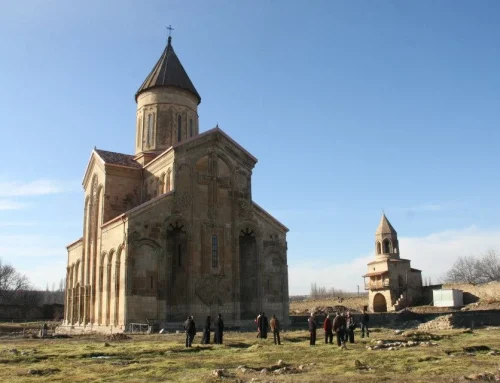
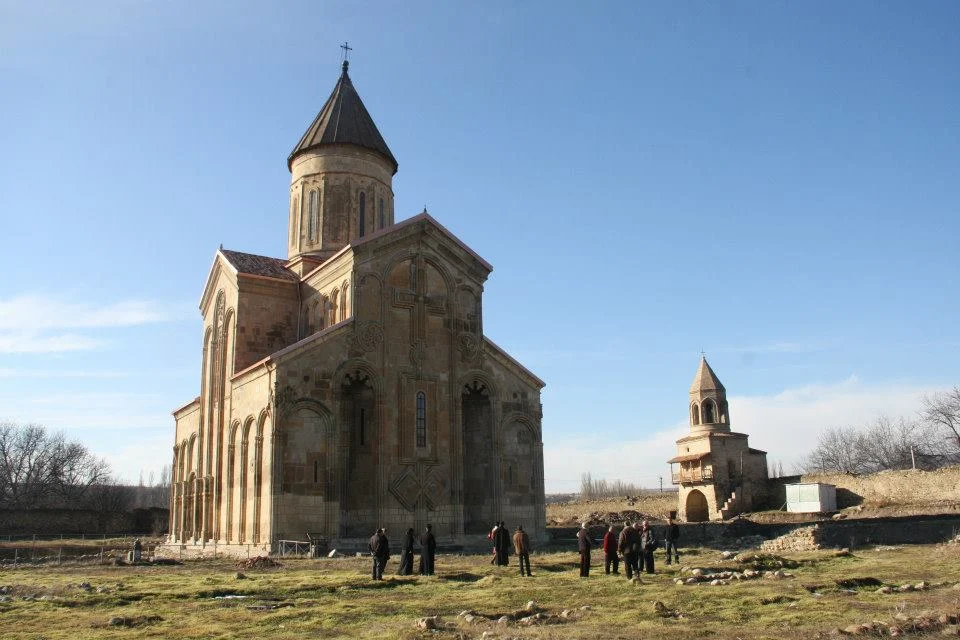
The Main Church of Samtavro
The principal church at Samtavro dates from the early 11th century.
It is dedicated to the Transfiguration and belongs to the mature tradition of medieval Georgian cross-domed architecture.
The present structure incorporates elements from earlier building phases, reflecting the long religious history of the site.
From the outside, the church appears relatively compact, but its proportions and vertical emphasis give it a strong monumental character.
Its façades combine blind arcades, carved stone decoration and sculptural details characteristic of Georgian ecclesiastical architecture of the 11th century.
Travellers interested in medieval Georgian architecture can compare Samtavro with other important religious monuments in Mtskheta-Mtianeti.
Architecture of the Main Church
The main church follows a cross-in-square or inscribed-cross plan, a form that became fundamental to medieval Georgian church architecture.
The dome rises above the central crossing, supported by structural piers and arches.
The exterior decoration is especially interesting.
The eastern façade is articulated by blind arcading and niches, while the northern and southern façades contain more unusual ornamental compositions.
Carved vegetal patterns, recessed niches, framing motifs and carefully shaped stonework create strong contrasts between light and shadow.
For a broader comparison of medieval religious architecture in the region, see the monuments described in our Mtskheta travel guide.
The Southern and Northern Façades
The southern and northern sides of Samtavro are particularly notable because they do not simply repeat the same design.
On the southern side, small recessed niches and angled stone surfaces create a highly plastic façade in which light changes the appearance of the stone throughout the day.
The northern side relies more heavily on carved vegetal ornament and interlaced decorative forms.
These differences give the cathedral an unusually varied exterior.
For travellers interested in stone carving, Samtavro is worth examining slowly rather than simply walking directly into the church.
The Stone Iconostasis and Frescoes
Inside the church, visitors can see a carved stone iconostasis dating from the later medieval period.
Fragments of historical wall painting also survive.
Like many Georgian churches that remained in use for centuries, Samtavro contains artistic layers from different periods rather than one completely preserved medieval interior.
This combination of 11th-century architecture, later sculpture and later wall painting reflects the continuing religious importance of the site.
St Nino’s Small Church
Close to the main church stands the smaller building traditionally associated with St Nino.
Although it has undergone repeated reconstruction and restoration, its origins are linked to the earliest Christian period of Mtskheta.
The contrast between this modest structure and the larger 11th-century cathedral is important.
Together they illustrate the transformation of Samtavro from an early Christian sacred site into a major medieval ecclesiastical complex.
St Gabriel Urgebadze
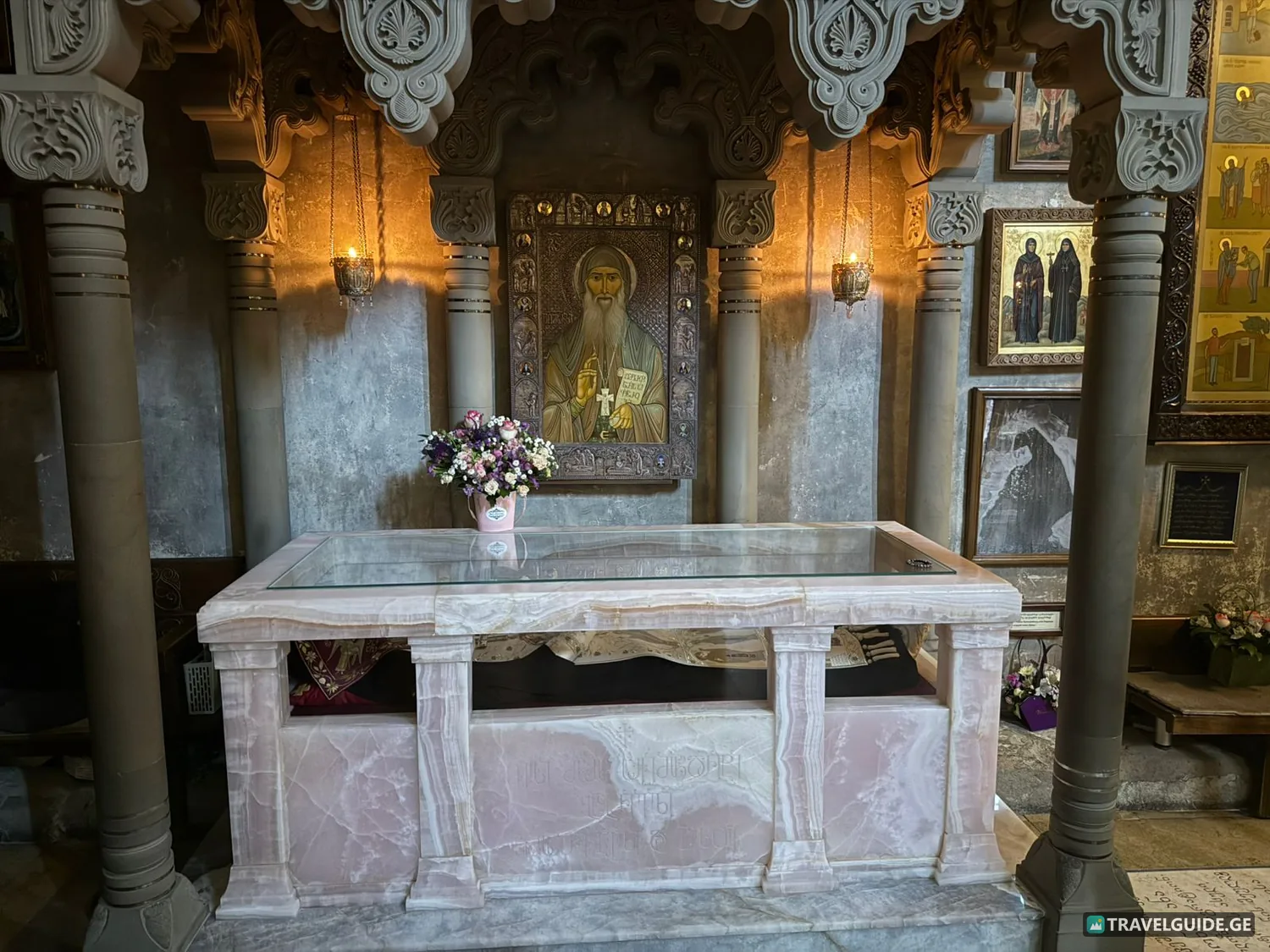
Samtavro is also strongly connected with St Gabriel Urgebadze, one of the most widely venerated Georgian saints of the modern period.
His grave is located at Samtavro and attracts large numbers of Georgian pilgrims.
This makes the monastery not only a historical monument but also a living pilgrimage destination.
Visitors should therefore remember that Samtavro is an active religious site rather than simply an architectural attraction.
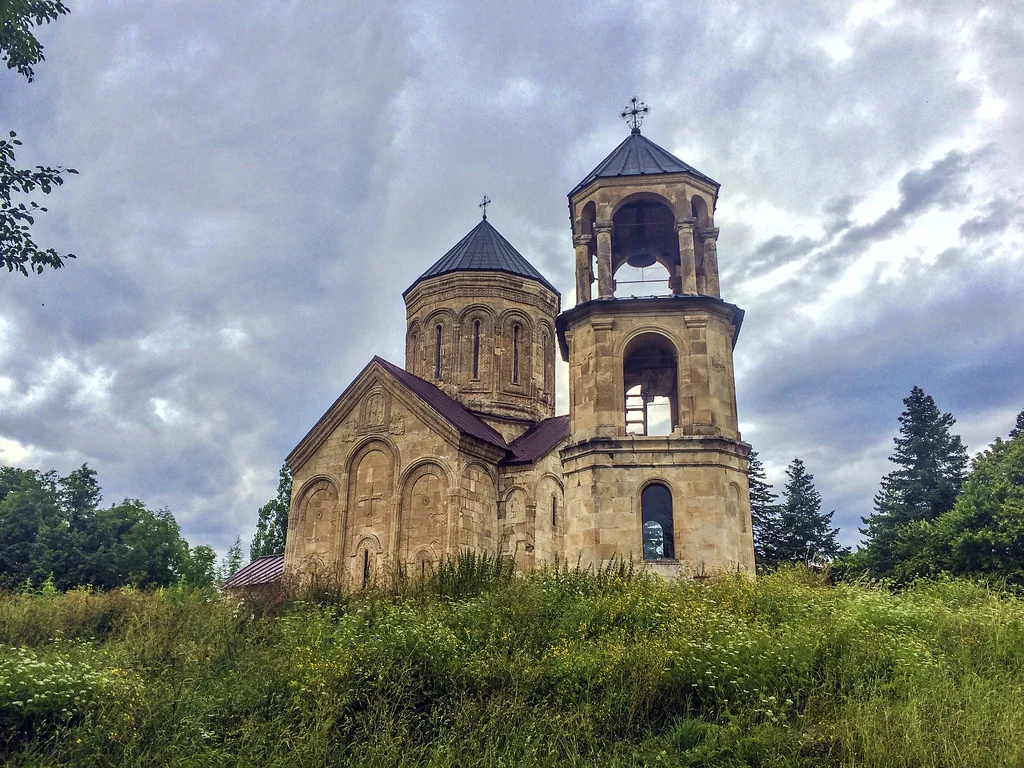
The Bell Tower and Monastery Walls
The complex also includes a historic bell tower and defensive walls.
These structures demonstrate how Samtavro continued to develop long after the construction of the main cathedral.
The monastery today therefore presents several architectural periods within one compact ensemble.
If you are exploring the wider region, our Mtskheta-Mtianeti destination guide provides additional ideas for nearby historical and religious sites.
Samtavro and UNESCO Mtskheta
Samtavro forms part of the Historical Monuments of Mtskheta, together with Svetitskhoveli Cathedral and Jvari Monastery.
These monuments reflect the development of Mtskheta as the ancient political and spiritual centre of Georgia.
For visitors, that means Samtavro is best understood as one part of a larger historical landscape rather than as an isolated church.
If you are planning your visit independently, our Mtskheta travel guide gives a broader overview of the town and its main attractions.
Visit Samtavro on Our Mtskheta Tour from Tbilisi
The easiest way to see Samtavro together with Mtskheta’s other major monuments is our Mtskheta Tour from Tbilisi.
The standard itinerary includes:
- Jvari Monastery
- Svetitskhoveli Cathedral
- Samtavro Monastery
- the historic streets of Mtskheta
Because Mtskheta lies close to Tbilisi, this is one of the most practical cultural half-day trips from the capital.
Travellers with more time can also combine Mtskheta with central Georgian destinations on the Mtskheta, Gori and Uplistsikhe Tour.
Samtavro, Svetitskhoveli and Jvari
These three monuments should ideally be visited together.
Jvari Monastery represents one of the earliest masterpieces of Georgian cross-domed architecture and occupies the traditional site where St Nino erected a cross overlooking Mtskheta.
Svetitskhoveli Cathedral became one of the most important religious buildings in Georgia and is closely linked with Georgian kings, major Christian relic traditions and the history of the Georgian Church.
Samtavro complements them through its direct association with St Nino, Mirian III and Queen Nana.
Together, they provide a much clearer picture of how Mtskheta became the spiritual centre of Christian Georgia.
What Else to See in Mtskheta
If you have more time, Mtskheta offers much more than the three best-known monuments.
Additional historical sites include:
- Jvari Monastery
- Svetitskhoveli Cathedral
- Shio-Mgvime Monastery
- Armaztsikhe-Bagineti archaeological site
- the Samtavro archaeological burial ground
- the historic centre of Mtskheta
For travellers interested in a broader cultural route, the Mtskheta, Gori and Uplistsikhe Tour connects Mtskheta with some of central Georgia’s most important historical sites.
Practical Tips for Visiting Samtavro
Samtavro is an active Orthodox convent, so visitors should dress appropriately.
Men should wear long trousers and cover their shoulders. Women are generally expected to cover their shoulders and wear clothing below the knee; a head covering may also be requested.
Photography should be discreet, particularly during religious services.
Because Samtavro is located within the town of Mtskheta, it is easily combined with Svetitskhoveli Cathedral on foot.
Why Visit Samtavro?
Samtavro is one of the best places in Mtskheta to understand the continuity of Georgian Christianity.
The site connects several distinct periods:
the story of St Nino in the 4th century, the conversion of King Mirian III and Queen Nana, the development of monumental Georgian architecture in the 11th century, and the continuing pilgrimage tradition represented today by the grave of St Gabriel Urgebadze.
That combination makes Samtavro more than another medieval church.
It is one of the places where the religious history of Georgia remains particularly visible.
For travellers staying in Tbilisi, the simplest way to see it is on our private Mtskheta Tour, together with Jvari and Svetitskhoveli.
Frequently Asked Questions
Where is Samtavro Monastery?
Samtavro is located in the centre of Mtskheta, close to Tbilisi.
How old is Samtavro Monastery?
The site has early Christian associations dating to the 4th century, while the principal surviving church dates from the early 11th century.
Is Samtavro part of UNESCO-listed Mtskheta?
Yes. Samtavro forms part of the Historical Monuments of Mtskheta together with Svetitskhoveli Cathedral and Jvari Monastery.
Who is buried at Samtavro?
The monastery is traditionally associated with the graves of King Mirian III and Queen Nana. It is also the burial place of St Gabriel Urgebadze.
What is Samtavro’s connection with St Nino?
According to Georgian Christian tradition, St Nino lived on the site after arriving in Mtskheta. A small church within the complex commemorates her association with the place.
Is Samtavro included in a Mtskheta tour?
Yes. Samtavro is included in our standard Mtskheta Tour from Tbilisi together with Jvari, Svetitskhoveli and the old town.
Can Samtavro, Jvari and Svetitskhoveli be visited in one day?
Yes. All three can easily be combined during a private Mtskheta tour from Tbilisi.