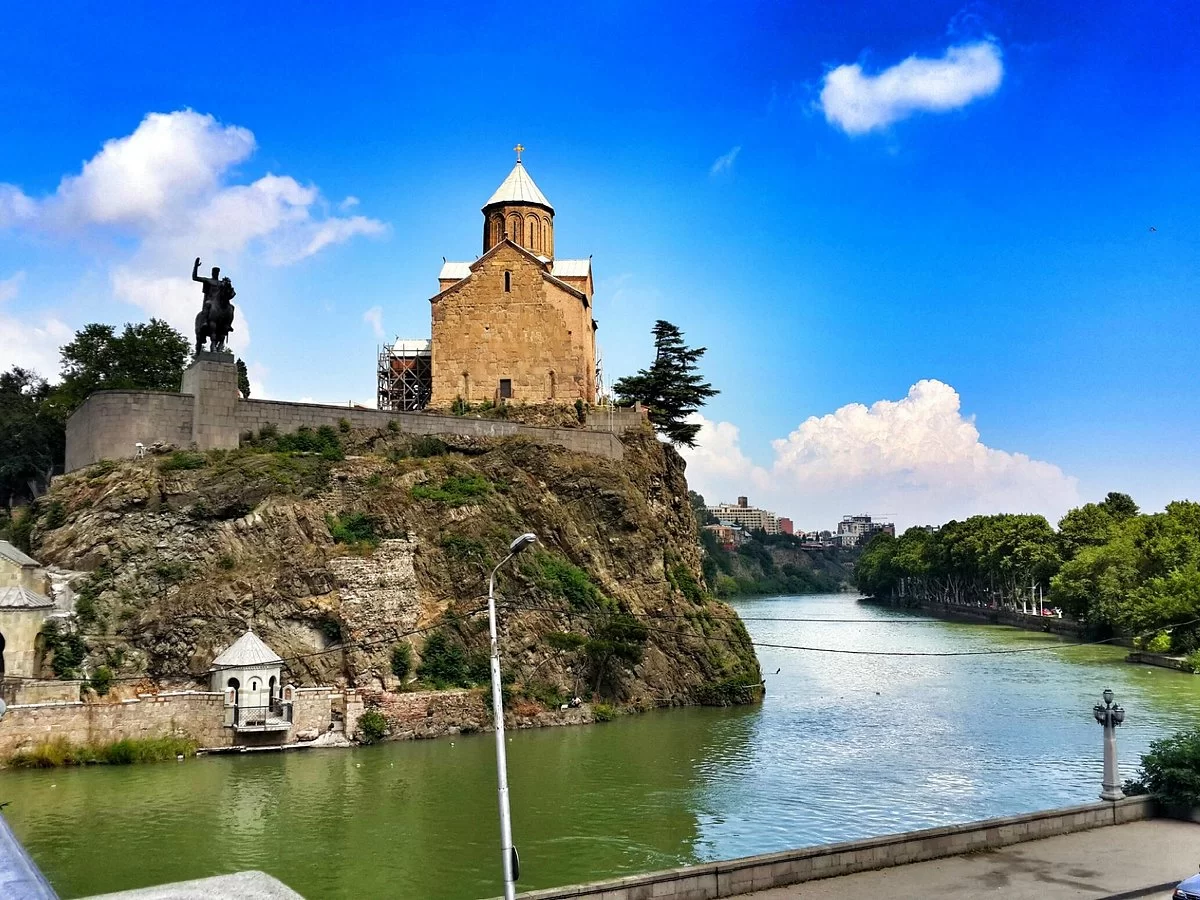
Metekhi Church rises from a rocky cliff above the Mtkvari River, creating one of Tbilisi’s most recognizable silhouettes. Standing beside it, the bronze equestrian statue of King Vakhtang Gorgasali gazes across the water toward the Old Town he founded fifteen centuries ago. Together, the 13th-century church and the statue of Tbilisi’s founder form the city’s most iconic viewpoint — and one of the first images most visitors encounter of the Georgian capital.
The Metekhi plateau offers something rare in Tbilisi: a single vantage point that captures the layered history of the city. From here, you can see Narikala Fortress crowning the opposite ridge, the domes of the sulfur baths district below, the carved balconies of the Old Town, and the glass curves of the modern Peace Bridge. At sunset, when the cliff face glows amber, and the city lights begin to flicker on, this becomes one of the most photographed spots in the Caucasus.
The Vakhtang Gorgasali Statue
The massive bronze equestrian statue dominating the Metekhi cliff depicts King Vakhtang I Gorgasali, who founded Tbilisi in the 5th century AD. According to legend, the king was hunting in the forested valley when his falcon pursued a pheasant into a hot spring. The bird was cooked by the thermal waters, and Vakhtang, recognizing the potential of these natural springs, established his capital here. The city’s name derives from “tbili” (warm) in Old Georgian.

The statue, created by sculptor Elguja Amashukeli, was installed in 1967. Vakhtang sits astride his horse in full battle armor, sword at his side, facing west across the river toward the Old Town. The scale is imposing — the monument stands roughly 22 meters tall, including its pedestal. For Georgians, this image represents national identity: Vakhtang Gorgasali is remembered not only as Tbilisi’s founder but as a warrior king who fought to preserve Georgian independence and Orthodox Christianity.
The plaza around the statue offers the best photo opportunities, particularly in the late afternoon when the light falls across the Old Town.
History of Metekhi Church
The origins of Metekhi Church are intertwined with legend. According to tradition, a church stood on this cliff during the reign of Vakhtang Gorgasali himself, in the late 5th century. The same tradition holds that St. Shushanik, one of Georgia’s earliest Christian martyrs, was buried here. Her story, recorded in the 5th-century text “Martyrdom of St. Shushanik” by the monk Jacob – the oldest surviving original work of Georgian literature – tells of a noblewoman perished by her husband for refusing to renounce Christianity.
However, historians note that neither the 5th-century church nor St. Shushanik’s burial at this site can be confirmed by reliable sources. What is certain is that a church and royal palace complex occupied the Metekhi cliff by the reign of Queen Tamar in the late 12th century.
The current church dates to 1278–1289, built during the reign of King Demetre II, known as Tavdadebuli (“the Self-Sacrificed”). The earlier structures were destroyed during the Mongol invasion of 1235, when the commander of the Tbilisi garrison ordered the palace and church burned rather than surrender them. King Demetre rebuilt the church in the cross-dome style typical of medieval Georgian architecture, though the floor plan — with three extended apses and four free-standing dome-supporting columns — appears to preserve elements of the earlier building.
Architecture and What to See
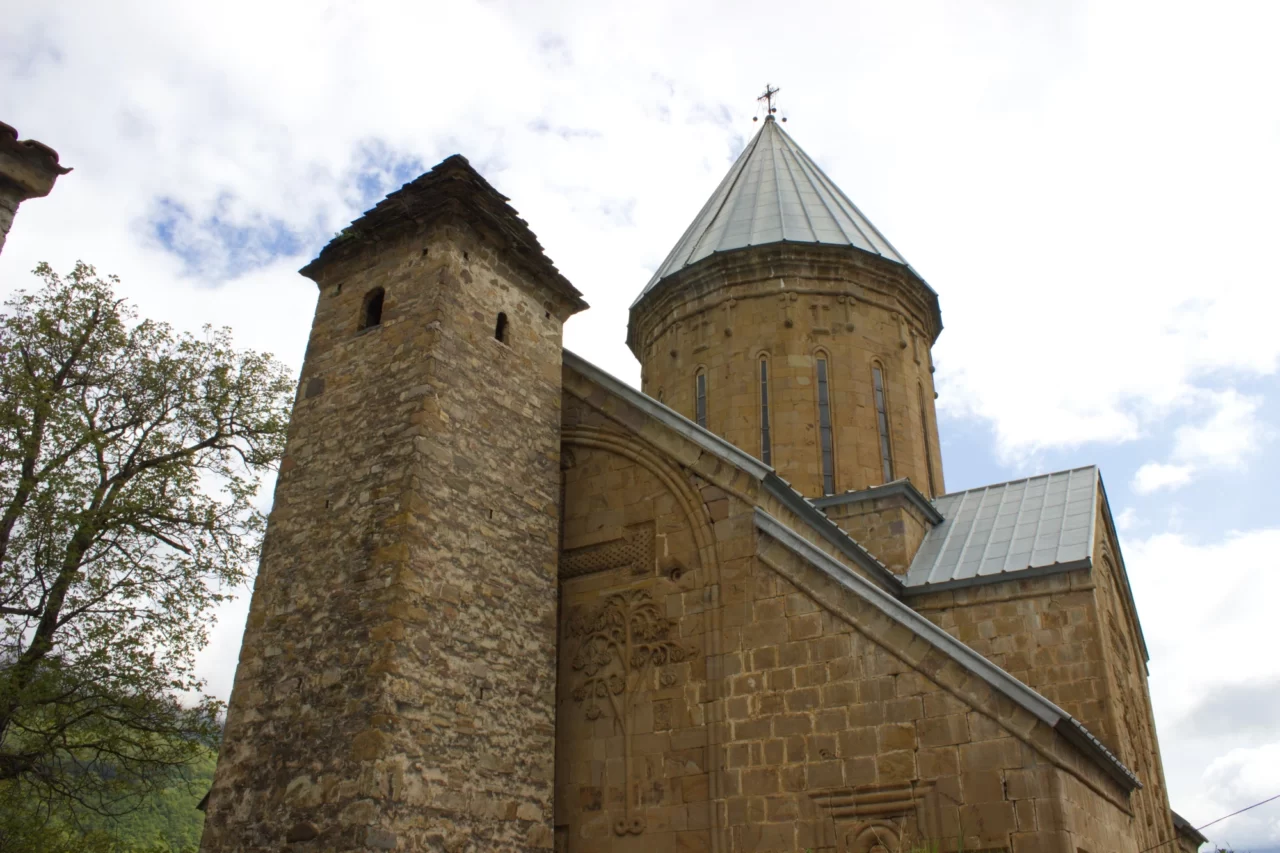
Metekhi Church is a relatively compact structure built from carefully cut stone blocks. The exterior shows the decorative vocabulary of 13th-century Georgian church architecture: horizontal stone bands dividing the facades, carved crosses, and geometric fretwork. The eastern apse, facing the river, displays a large carved cross flanked by ornamental squares — a design pattern with roots in earlier Georgian churches.
The building has been reconstructed multiple times over its 700-year history. Layers of brick repair work from the 16th, 17th, 18th, and 19th centuries are visible on the walls, each restoration leaving its mark on the structure.
Inside, the church is a working place of worship rather than a museum. The interior is modest compared to Georgia’s great cathedrals, with the accumulated patina of centuries of candle smoke darkening the stone. The atmosphere is intimate and contemplative.

The Prison Years: A Dark Chapter
Metekhi’s history took a grim turn under Russian Imperial and Soviet rule. After Georgia’s annexation by the Russian Empire in the early 19th century, the ancient stone walls surrounding the church were demolished, and a prison was constructed on the plateau. The Metekhi Prison became one of the most notorious detention facilities in the Caucasus.
During the Soviet period, the prison continued operating until 1934. Among its inmates was a young Joseph Stalin, held briefly in 1903–1904 for revolutionary activities — an irony given the prison’s later expansion under his rule.
After the prison’s closure, the church building itself was repurposed. It served variously as a museum, an artist’s workshop, and even a theater. The building sat empty for years before being returned to the Georgian Orthodox Church. Today, Metekhi functions again as an active parish church.
Visiting Metekhi Church: Practical Information
Address: Metekhi Rise, Avlabari district, Tbilisi (right bank of the Mtkvari River)
How to get there:
- Metro: Avlabari station (Line 1), then a 5-minute walk downhill toward the river
- On foot: 10-minute walk from Freedom Square, crossing the Metekhi Bridge
- From Old Town: Cross the Metekhi Bridge from the sulfur baths area; the church is directly ahead
Opening hours: Daily, approximately 9:00–19:00
Entrance fee: Free (both church and statue plaza)
Time needed: 20–30 minutes to see the church and statue; longer if photographing at sunset
Dress code: Modest dress for entering the church. Women should cover their shoulders; headscarves are available at the entrance. Men should remove hats.
Accessibility: The plateau is accessible, but reaching it involves slopes and some steps.
Best Time to Visit Metekhi
Sunset is the prime time. The western-facing viewpoint means the Old Town across the river catches golden hour light while you stand in comfortable shade. Photographers gather here in the hour before sunset, particularly in summer.
Morning offers softer light and fewer visitors. The church interior is quietest on weekday mornings.
Night brings a different atmosphere. The church and statue are illuminated, and the Old Town lights reflect off the river below.
Avoid midday in summer — the exposed plateau offers no shade, and temperatures can be intense.
Nearby Attractions
Metekhi’s central location makes it easy to combine with other Tbilisi highlights:
Rike Park — Directly below Metekhi across the river. Home to the cable car station for Narikala Fortress. 5-minute walk via Metekhi Bridge.
Peace Bridge — The modern glass pedestrian bridge is visible from Metekhi and reachable in 5 minutes on foot.
Sulfur Baths District (Abanotubani) — The historic bathhouse quarter lies just across the river. 10-minute walk.
Narikala Fortress — The ancient citadel on the opposite ridge. Take the cable car from Rike Park or walk up (steep, 20–30 minutes).
Anchiskhati Church — Tbilisi’s oldest church, a 10-minute walk through the Old Town.
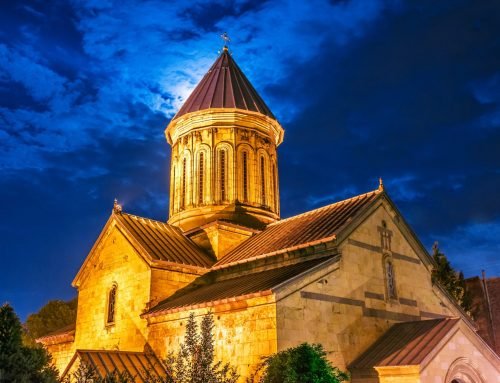
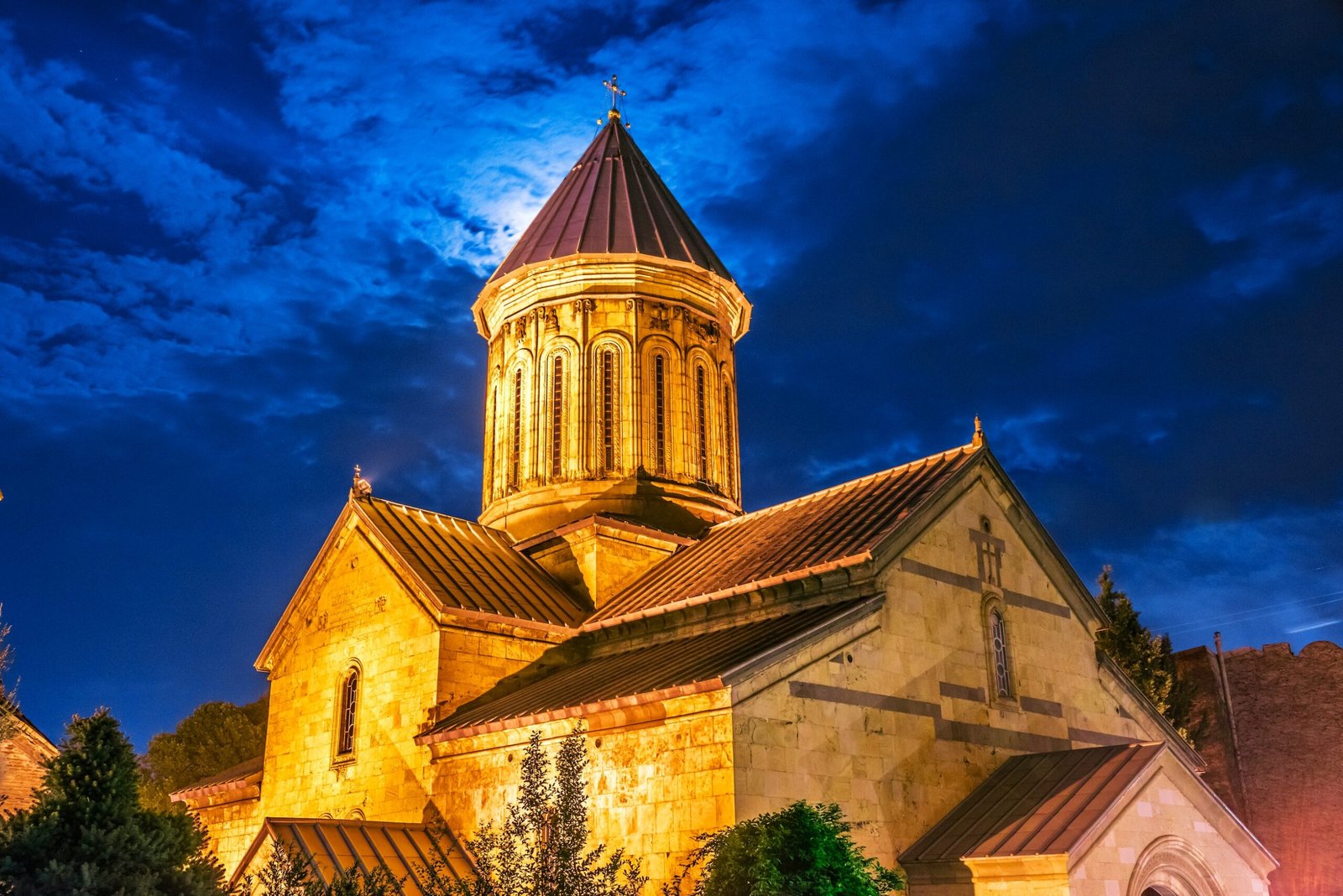
Sioni Cathedral — The historic main cathedral of Tbilisi, an 8-minute walk.
Avlabari neighborhood — The area around Metekhi is historically Armenian and worth exploring for its quieter streets and local atmosphere.
Metekhi in Context: Why It Matters
Metekhi’s significance goes beyond its architecture. The site embodies the continuity of Tbilisi itself — a city destroyed and rebuilt repeatedly over fifteen centuries, yet always returning to its original location between the river and the hills.
The combination of the medieval church and the Soviet-era statue creates a visual shorthand for Georgian national identity: Orthodox Christianity and warrior kingship, ancient roots and 20th-century nation-building. That these monuments stand on a cliff that once held a notorious prison adds another layer — the resilience of a culture that outlasted both Russian Imperial and Soviet repression.
For travelers, Metekhi offers an efficient introduction to Tbilisi. In thirty minutes, you can see an important medieval church, photograph the city’s most iconic statue, and take in a panoramic view that orients you to the Old Town’s geography. It’s worth visiting early in your stay to establish the lay of the land, then returning at sunset when you can appreciate what you’ve explored.
Planning Your Visit
Metekhi is included in our Old Tbilisi City Tour, which covers both banks of the Mtkvari River.
For independent visitors, consider this route: Start at Avlabari metro, walk down to Metekhi for morning photos, cross the bridge to the Old Town, explore Anchiskhati and Sioni, lunch on Shardeni Street, then return to Metekhi at sunset for golden hour shots.