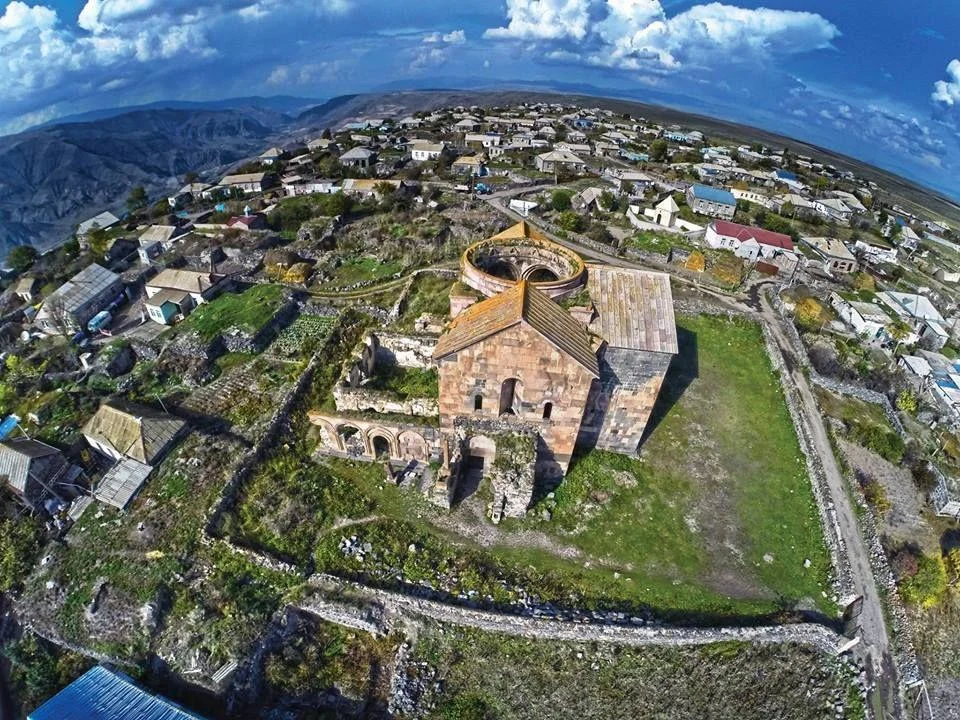
On the open volcanic plateau of Samtskhe-Javakheti, where long horizons, treeless hills and severe winters shape the landscape, stands one of the most unusual monuments of medieval Georgian architecture.
Kumurdo Cathedral was built in 964, making it one of the rare Georgian churches whose construction can be dated with exceptional precision. Even more unusually, surviving inscriptions preserve the names of the people responsible for its creation: Bishop Ioane of Kumurdo and the architect Sakotsari.
Located in the village of Kumurdo, around 12–14 kilometres from Akhalkalaki, the cathedral is important not simply because of its age. Its complex polyapsidal plan, sophisticated stone carving, extensive medieval inscriptions and surviving fragments of wall painting place it among the major architectural monuments of 10th-century Georgia.
Kumurdo has also undergone centuries of alteration, damage and reconstruction. The loss of its original dome and sections of the western part of the building dramatically changed its silhouette, while modern conservation work has added another chapter to a monument that has been evolving for more than a thousand years.
Kumurdo Cathedral at a Glance
| Feature | Details |
|---|---|
| Location | Kumurdo village, near Akhalkalaki |
| Region | Samtskhe-Javakheti |
| Historical area | Javakheti |
| Elevation | About 1,740 metres |
| Construction date | 964 |
| Architect | Sakotsari |
| Patron | Bishop Ioane of Kumurdo |
| Historical ruler | Leon III, King of the Abkhazians |
| Architectural type | Domed polyapsidal cathedral |
| Known for | Unusual plan, stone carving, inscriptions and medieval sculpture |
| Later additions | 11th-century porch and gallery; later repairs |
| Recommended visit | Around 45–60 minutes |
A Cathedral on the Javakheti Plateau
The landscape surrounding Kumurdo is very different from the green valleys commonly associated with other parts of Georgia.
Javakheti is a high volcanic plateau. Settlements lie among broad grasslands, dark volcanic hills and open skies, with relatively few trees to soften the landscape. Winters are long and severe, while even summer evenings can be surprisingly cool.
Kumurdo Cathedral seems particularly suited to this setting.
Its massive stone walls and strong geometric forms have a monumental quality that becomes even more striking against the open plateau. Unlike monasteries hidden in forests or perched on wooded hillsides, Kumurdo stands exposed to wind, weather and distant views.
For travellers exploring Samtskhe-Javakheti, the journey to the cathedral is therefore part of the experience. Kumurdo is not simply a church reached at the end of a road; it belongs to the distinctive cultural landscape of highland Javakheti.
An Exact Date: 964
One of the most important features of Kumurdo is its extraordinary collection of inscriptions.
The principal construction inscription records that the cathedral was built in 964, during the reign of Leon III, King of the Abkhazians. Construction was initiated by Bishop Ioane of Kumurdo, and the inscription also preserves the name of the architect, Sakotsari.
Knowing the architect’s name is particularly significant.
Most medieval churches survive without any record of the individual who designed them. At Kumurdo, visitors can connect an exceptionally sophisticated piece of architecture with a named 10th-century master builder.
The cathedral’s walls contain numerous additional inscriptions. They record clergy, patrons, commemorations and later construction work, making Kumurdo important not only to architectural historians but also to specialists studying medieval Georgian epigraphy.
The inscriptions are written in Asomtavruli, the monumental early form of the Georgian script.
The Architecture of Kumurdo
Kumurdo is immediately recognizable to architectural historians because of its unusual plan.
The cathedral belongs to the Georgian tradition of polyapsidal domed churches, which reached an important stage of development during the 10th and early 11th centuries.
From the exterior, the building has a broadly cross-shaped form. Inside, however, the spatial arrangement is considerably more complex.
Five semicircular apses open toward the central space, while the western arm is rectangular. This composition developed from the family of Georgian multi-apse churches, but at Kumurdo the architect created a particularly sophisticated relationship between the central domed space, apses and western section.
The result is a building that feels both centralized and directional.
Instead of the interior simply leading the eye toward the sanctuary, the apses create a sequence of curved spaces around the centre. At the same time, the longer western arm gives the cathedral an unmistakable east-west liturgical orientation.
Architecture Designed for Movement
One of Kumurdo’s greatest architectural achievements is the sense of vertical movement created inside the building.
Strong piers once supported the dome, while pointed arches and carefully proportioned transitional spaces drew the eye upward.
The lateral apses are connected through trapezoidal sections rather than being arranged as simple radial niches. This gives the interior a more dynamic geometry than might be expected from the relatively severe exterior.
The original dome has not survived, so modern visitors cannot experience the interior exactly as Sakotsari intended it.
Even without it, however, the surviving structure makes the original architectural ambition clear.
Kumurdo was designed to feel monumental without relying simply on size. The proportions, curves, arches and changing planes of the walls create much of the effect.
The Stonework
The quality of Kumurdo’s masonry is another reason the cathedral occupies such an important place in Georgian architectural history.
The exterior was faced with carefully dressed stone. Individual blocks fit together with remarkable precision, producing broad, relatively clean wall surfaces.
Against these large areas of masonry, sculpted decoration was concentrated around windows, cornices, entrances and other important architectural elements.
This contrast is effective.
Instead of covering the building with ornament, the architect allowed decorated elements to stand out against large expanses of stone.
Visitors should spend time looking closely at the façades rather than concentrating only on the general shape of the cathedral.
Some of Kumurdo’s finest details are easy to miss from a distance.
Stone Carving and Decorative Details
The cathedral’s carved decoration demonstrates the exceptional skill of medieval Georgian stonemasons.
Window frames are surrounded by intricate geometric and vegetal patterns. Cornices contain additional ornamental motifs, while the large eastern sanctuary window received particularly elaborate treatment.
The carving is often shallow and precise, creating patterns that can appear almost like metalwork or embroidery when viewed closely.
Relief sculpture introduces a more figurative element.
Human figures, angels and symbolic images appear among the architectural decoration, creating one of the richest sculptural programmes associated with a Georgian church of this period.
This combination of architecture and sculpture makes Kumurdo particularly valuable for visitors interested in the development of Georgian decorative art before the great flowering of church ornament in the 11th and 12th centuries.
Royal Figures in Stone
Among Kumurdo’s best-known sculptures are figures traditionally identified with members of the Georgian royal elite of the 10th century.
Reliefs associated with Queen Gurandukht, King Leon and King Gurgen form part of the cathedral’s complex visual programme.
The figures are relatively flat and stylized rather than naturalistic portraits in the modern sense. Their importance comes from their placement within the architecture and their connection with political authority.
Other sculpted heads and angelic figures have a noticeably more three-dimensional quality.
For travellers, these carvings are particularly interesting because they reveal that Kumurdo was not an isolated rural church. It belonged to a wider world of episcopal authority, royal patronage and sophisticated court culture.
The 11th-Century Additions
Kumurdo did not remain unchanged after its construction in 964.
During the 11th century, additional structures were built around the western and southern parts of the cathedral. These works are associated with the period of King Bagrat IV and his mother, Queen Mariam.
A southern porch or stoa became one of the most important later additions.
Its architectural decoration continued the high standard established by the original cathedral while introducing stylistic features belonging to a later generation of Georgian builders.
These additions are important because they demonstrate that Kumurdo remained an influential religious centre long after its initial construction.
Rather than being preserved as a static monument, the cathedral continued to develop as the needs and ambitions of its community changed.
Medieval Wall Paintings
Fragments of wall painting survive within Kumurdo.
The paintings do not all belong to the original construction period. Research has identified several layers of decoration, indicating that the interior was painted and repainted at different times.
Some surviving fresco fragments belong to the later medieval period.
Although only portions remain, they are valuable because they show that the interior would once have been much richer visually than the exposed stone surfaces suggest today.
The combination of architecture, sculpture, inscriptions and painting makes Kumurdo an unusually complete source for understanding medieval Georgian church art, even though much of the original building has been lost.
Kumurdo as an Episcopal and Cultural Centre
The scale and sophistication of Kumurdo reflect its historical role.
The cathedral served as the seat of the Kumurdo bishopric, making it an important religious centre for Javakheti.
Medieval clerics and scholars connected with Kumurdo participated in the wider intellectual life of Georgia. The cathedral therefore belonged to a network of ecclesiastical centres that preserved manuscripts, supported education and maintained links with other Georgian religious communities.
This helps explain why such an ambitious building was constructed in what may today appear to be a remote highland village.
In medieval Georgia, Javakheti was not a forgotten edge of the country. It occupied an important position in the political and cultural landscape of southern Georgia.
Destruction and the Missing Dome
The most obvious feature of Kumurdo today is something that is no longer there.
The original dome collapsed, and substantial parts of the western section were also damaged or lost.
The exact sequence of all the destruction is difficult to reconstruct, although earthquakes and periods of political instability contributed to damage at different stages of the cathedral’s history.
Later builders repaired and altered parts of the monument.
This gives Kumurdo a very different appearance from intact medieval Georgian churches. Instead of seeing a finished architectural composition, visitors encounter a building whose history is exposed through broken masonry, reconstructed sections and surviving fragments.
From an archaeological perspective, that can actually make the cathedral more revealing.
Different construction periods can be read directly in the walls.
Restoration of Kumurdo Cathedral
Kumurdo has undergone several conservation and restoration campaigns in modern times.
Work was carried out during the 20th century, while a major new rehabilitation programme began in 2015. The project has included work on the southern porch and western section, together with proposals concerning the reconstruction of the missing dome.
Restoring a monument such as Kumurdo is particularly complicated.
Large portions of the original structure have disappeared, meaning specialists must balance structural protection with the risk of reconstructing elements whose original details are not completely known.
The restoration programme has therefore generated professional discussion about conservation methods and the treatment of surviving medieval fabric.
For travellers, there is a practical consequence: parts of the complex may be affected by conservation work, and its appearance can change as rehabilitation progresses.
Two Medieval Stone Stelae
Near the cathedral are historic stone stelae associated with the medieval site.
These carved monuments add another archaeological layer to the complex and are easy to overlook when attention is focused on the cathedral itself.
Take time to walk around the surrounding area rather than immediately returning to the car after seeing the main building.
At Kumurdo, smaller stone fragments, inscriptions and carved architectural elements often contain as much historical information as the large structure.
What to Look For During Your Visit
Kumurdo rewards careful observation. In particular, look for:
- the Asomtavruli inscriptions identifying Bishop Ioane and architect Sakotsari;
- the unusual relationship between the five apses and rectangular western arm;
- the finely cut masonry of the original 10th-century structure;
- decorative window frames and the elaborate eastern façade;
- medieval figurative reliefs and angelic heads;
- differences between the original cathedral and later additions;
- surviving fragments of wall painting;
- restoration work that reveals how the monument has changed over time.
Allow at least 45 minutes to one hour if architecture is one of your main interests.
Visiting Kumurdo from Akhalkalaki
Kumurdo lies roughly 12–14 kilometres from Akhalkalaki, making the town the most practical base for visiting the cathedral.
The drive itself is relatively short, although local road and weather conditions can affect travel time.
Akhalkalaki sits high on the Javakheti Plateau and has shops, fuel and basic visitor services that are not necessarily available around the cathedral.
If you are travelling independently, it is sensible to organize food, water and fuel before leaving the town.
Visiting Kumurdo from Tbilisi
Kumurdo is more than 200 kilometres from Tbilisi, and the journey normally takes several hours each way.
For that reason, it is not an ideal stand-alone day trip from the capital.
The cathedral makes much more sense as part of a journey through Samtskhe-Javakheti, particularly when combined with the Javakheti Plateau, Vardzia and other historical sites around Akhalkalaki and Aspindza.
Travellers interested specifically in architecture can also build a route connecting Kumurdo with medieval churches, fortresses and cave complexes across southern Georgia.
Best Time to Visit Kumurdo
The easiest period for visiting Kumurdo is generally late spring through early autumn.
Summer temperatures on the plateau are comfortable compared with Tbilisi, but the altitude means evenings can become cold even in July and August.
Spring arrives relatively late.
September and early October can be particularly beautiful, with clear light and fewer travellers, although temperatures begin dropping quickly.
Winter travel is much more demanding. Snow, ice, wind and rapidly changing weather can affect local roads, and the open plateau provides little protection from severe conditions.
A windproof layer is useful at almost any time of year.
What to See Near Kumurdo
Kumurdo is best treated as part of a wider exploration of southern Georgia rather than an isolated destination.
Nearby and regional highlights include Akhalkalaki, the volcanic landscapes and lakes of Javakheti, Khertvisi Fortress, Tmogvi, Vardzia, the villages of the Mtkvari Valley and archaeological sites scattered across the plateau.
Our Samtskhe-Javakheti travel guide provides a broader overview of the region’s churches, fortresses, cave monasteries, traditional villages and natural landscapes.
Kumurdo and Our South Georgia Tours
Kumurdo is an excellent site for travellers with a particular interest in medieval Georgian architecture, but it is not currently listed as a standard stop on our published South Georgia itineraries.
Our Mystic South Georgia: Vardzia, Volcanic Lakes and Borjomi — 4 Days travels across the Javakheti Plateau and explores Vardzia, Khertvisi, Vanis Kvabebi, Upper Tmogvi, local villages and the volcanic landscapes of southern Georgia.
Because our tours are private and itineraries can be tailored, travellers who specifically want to visit Kumurdo can request it when planning their route.
For an itinerary centred on Javakheti archaeology, medieval churches and lesser-known monuments, use our custom Georgia trip planner and mention Kumurdo among the places you do not want to miss.
Why Kumurdo Cathedral Is Worth Visiting
Kumurdo is not the easiest Georgian cathedral to understand at first sight.
Its dome is missing. Sections have been rebuilt. Some of its finest sculpture is small enough to disappear into the walls unless you deliberately look for it.
That is also what makes the monument so rewarding.
The cathedral preserves the name of its 10th-century architect. Its inscriptions document medieval patrons and clergy. Its unusual plan captures an experimental period in Georgian architecture, while its carved decoration anticipates artistic developments that would flourish during the following centuries.
Later porches, frescoes, repairs and modern conservation work add further layers to the story.
For travellers interested in architecture, Kumurdo offers something different from the better-known monuments of Georgia. It is not simply a beautiful medieval church. It is a building in which more than a thousand years of construction, destruction, restoration and cultural change remain visible in the stone.