
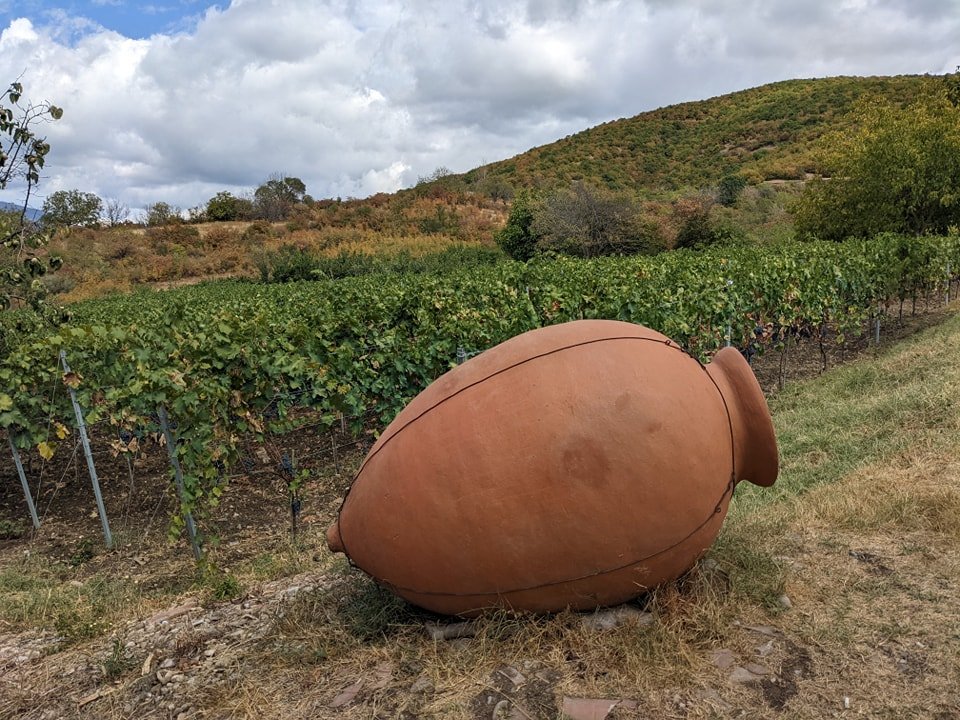
Somewhere in the Alazani Valley, an old man lifts a stone lid from a hole in the floor of his cellar. Underneath, buried to its rim, is a clay vessel the size of a person. He dips a hollowed gourd inside and pulls it out dripping with young wine — dark amber, slightly cloudy, smelling of earth and something you can’t name. He pours it into a chipped ceramic cup and hands it to you without a word.
This gesture has been repeated here for eight thousand years. That’s not a marketing line — it’s what archaeologists found in clay vessels scattered across this valley, vessels containing grape residue and tartaric acid that predate Rome, Egypt, and virtually everything we call civilization. And you can still taste the same grapes, made the same way, in the same landscape.
If you visit only one region outside Tbilisi, make it this one.
Why Kakheti Matters
Kakheti is Georgia’s Tuscany — if Tuscany were a fraction of the price, had monasteries instead of Renaissance villas, and could claim to have invented the whole enterprise. The Alazani Valley is a patchwork of vineyards, orchards, and villages stretching from the foothills to the snow-capped Caucasus. Seventy percent of Georgia’s wine comes from here. The rest of the country would argue with that comparison, but the math doesn’t lie.
This is where the qvevri method — fermenting wine in large clay vessels buried underground — has been practiced continuously for millennia. UNESCO recognized it as Intangible Cultural Heritage. You can visit cellars where the practice is alive, taste the results, and during harvest season, participate in the process yourself.
But Kakheti isn’t only wine. Sighnaghi is one of Georgia’s most photogenic towns. David Gareja is a cave monastery in a semi-desert landscape that feels closer to Jordan than the Caucasus. Tusheti, in the far northeast, is one of the most remote inhabited mountain regions in Europe. And the food — rich, meaty, walnut-heavy, designed to pair with exactly the wines being poured — is reason enough to come even if you don’t drink.
Let’s be honest, though: wine tourism has changed Kakheti. Some wineries now have professional tasting rooms, on-site restaurants, and hotels. Prices at tourist-facing estates approach Western levels. Sighnaghi on a Saturday in September can feel overcrowded. The intimate family-cellar experience still exists, but you have to look for it — or have someone who knows where to send you.
Wine in Kakheti: What You Need to Know
The qvevri method
Georgian wine is different from anything else you’ve tasted, and the reason is buried in the ground.
Qvevri are egg-shaped clay vessels — some hold up to 3,000 liters — buried in the floor of a marani (wine cellar). After harvest, grapes go in whole: juice, skins, seeds, and often stems. Wild yeasts from the grape skins start fermentation. The qvevri stays sealed for months, maintaining a stable underground temperature while the wine develops.
When white grapes ferment with their skins — the way red wine is normally made — you get amber wine (also called orange wine). It’s tannic, nutty, sometimes funky, often with a color that ranges from deep gold to copper. Natural wine enthusiasts around the world have been obsessing over Georgian amber wines for years. But tasting them here, from the source, in the cellar where they were made — that’s different from ordering a bottle in Brooklyn.
Not everyone loves qvevri wines on first taste. The tannins, the oxidative character, the unusual texture — they demand attention. That’s part of the point. These aren’t background wines. They’re wines that require a conversation.
Grape varieties you should know
| Variety | Color | Character | Pairs with |
|---|---|---|---|
| Saperavi | Red (nearly black) | Deep color, high tannins, dark fruit, spice, leather. Ages beautifully | Grilled meats, rich stews, hard cheese |
| Rkatsiteli | White | Modern style: crisp, citrusy. Qvevri style: amber wine — tannic, nutty, complex | Georgian cuisine, fatty meats, cheese |
| Mtsvane | White | Aromatic, often blended with Rkatsiteli | Salads, lighter dishes |
| Kisi | White | Complex, ages well, excellent in qvevri | Aged cheese, nut dishes |
| Khikhvi | White | Rare, makes outstanding qvevri wines | Fish, poultry |
Georgia has over 500 indigenous grape varieties — more than any other country. Most are cultivated in tiny quantities. Every family winery visit becomes a discovery: a variety you’ve never tasted, a name you’ve never heard, a flavor you weren’t prepared for.
What to Eat in Kakheti (and Why It Matters as Much as the Wine)
Kakhetian food is the heartiest in Georgia. This is a farming region, a physical-labor region, a region where meals are built to sustain and celebrate.
Mtsvadi — Georgian barbecue, but in Kakheti they grill it over burning grapevine cuttings. The vine smoke gives the meat a faintly sweet, woody flavor you won’t find anywhere else. Best with pork or veal, served with tkemali (sour plum sauce) and a fistful of fresh herbs.
Churchkhela — Walnuts or hazelnuts threaded on a string and dipped repeatedly in thickened grape juice until they form chewy bars that look like candles. During Rtveli, they make them from fresh must — soft, slightly sticky, completely different from the dried versions sold in Tbilisi markets months later.
Khinkali — The Kakhetian version is stuffed with beef and pork, generously spiced with cumin and cilantro. Ten pieces for $3 at any roadside spot. Eat them by the dough knot, bite a hole, drink the broth. Never use a fork. Leave the knots on the plate so the waiter can count.
Tone bread — Baked in a round clay oven sunk into the ground. The baker slaps dough against the scorching-hot wall, and minutes later pulls out a loaf that’s charred on the edges and soft in the center. Tear it open, stuff it with young suluguni cheese and a glass of Rkatsiteli. That’s a Kakhetian breakfast.
Also worth seeking out: pkhali (walnut-herb paste — the spinach version is addictive), badrijani (eggplant rolls with walnut filling), nadughi (fresh cottage cheese wrapped in suluguni leaves), and whatever fruit is in season. The peaches in late summer are absurdly good.
Sighnaghi: The Town That Looks Too Good to Be Real
Sighnaghi sits on a hilltop overlooking the Alazani Valley, surrounded by 18th-century defensive walls with 23 towers, vineyards stretching to the horizon, and the Caucasus Mountains behind everything. Cobblestone streets wind between pastel houses with carved wooden balconies. At sunset, the valley turns gold and the mountains go pink and the whole thing looks like a painting that you’d dismiss as too idealized if it were hanging in a gallery.
By the early 2000s, the town was nearly abandoned. In 2007, President Saakashvili’s government renovated it as part of a tourism push. Whether the renovation was sensitive restoration or theme-park treatment depends on who you ask. Either way, Sighnaghi is now one of Georgia’s most-visited towns — and deservedly so, even with the crowds.
It’s called the “City of Love” because the marriage registry office is open 24/7 for spontaneous weddings. A marketing gimmick, but one that stuck.
What to see and do
The city walls — Walk sections of the 4 km defensive wall for panoramic views. The eastern side at sunrise is worth the early alarm. Free access, 1–2 hours.
Bodbe Monastery — 2 km below town. Burial place of St. Nino, who brought Christianity to Georgia in the 4th century. Beautiful gardens, views, a holy spring down a steep path. Free, modest dress required. Walk down (30–40 min) or take a taxi (5–10 lari round trip).
Pheasant’s Tears — Both a winery and Sighnaghi’s best restaurant, with traditional Georgian food, farm-to-table ingredients, and their own natural wines. Reservations essential. $15–25 per person with wine. If you eat at one place in Kakheti, make it this one.
Okro’s Wines — Winery-restaurant with their own production, authentic Kakhetian dishes ($10–18). Restaurant 49 — reliable Georgian food with a valley-view terrace.
Where to stay
| Category | Price/night | What to expect |
|---|---|---|
| Budget | $20–35 | Family guesthouses, clean, often include breakfast and valley views |
| Mid-range | $40–80 | Boutique guesthouses in renovated old-town buildings |
| Upscale | $80–150 | Design hotels with pools, wine cellars (Pheasant’s Tears Guesthouse, Hotel Brigitte) |
Tip: Request a room with a valley view — it’s half the reason you’re here. Book ahead for September and October.
Telavi: The Working Town
Telavi is Kakheti’s regional capital (~20,000 people). Larger, rougher, more Georgian than Sighnaghi. This isn’t a destination town — it’s where Kakhetians actually live. A busy market, good cheap restaurants, and proximity to most of the major monasteries and wineries.
In town: a 900-year-old plane tree in the center (enormous and impressive), the Batonis-Tsikhe fortress (17th-century royal residence, small museum, 5 lari entry), and a few blocks of pleasant walking.
Choose Telavi if: You want a central base with shorter drives to wineries and monasteries, lower prices, and fewer tourists. Choose Sighnaghi if: You want atmosphere, views, and romance. They’re different experiences.
The Big Sights
Monasteries and churches
Alaverdi Cathedral (11 km from Telavi) — One of Georgia’s tallest and oldest churches, built in the 11th century, rising from the valley floor like something the earth pushed up. Every September, the harvest festival Alaverdoba fills the grounds with wine, food, and celebration.
Gremi — The 16th-century capital of the Kakhetian kingdom. The Archangels’ Church on the fortress hill, with the Caucasus behind it, is one of the most recognizable images in the country.
Ikalto Monastery — Ruins of one of the oldest academies in the world (9th century), where among other subjects, they taught viticulture. A university of wine, centuries before any European equivalent.
David Gareja — A 6th-century cave monastery complex in semi-desert on the Azerbaijan border. Frescoes from the 12th century in rock-hewn cells, a landscape that looks lunar, a feeling of absolute remoteness just 90 minutes from Tbilisi. Note: parts of the complex are on Azerbaijani territory, and border guards occasionally turn visitors back. Check conditions before going.
Also worth visiting: Old Shuamta (5th–7th century, in a forest clearing), New Shuamta (16th-century nunnery), Nekresi (monastery on a mountain ridge with panoramic views).
Fortresses
Beyond Gremi: Khornabuji, Ujarma, and Bochorma — all with views, all with history, all without the crowds.
Nature and national parks
Vashlovani — Semi-desert canyons and savannah, jeep tours, Georgia’s driest landscape. Lagodekhi — Subtropical forest, waterfalls, hiking trails. Tusheti National Park — High mountain wilderness, accessible only in summer. Batsara Reserve — Ancient yew forest.
Rtveli: The Grape Harvest
From late September through October, Kakheti comes alive with Rtveli — the grape harvest. It’s not just agriculture. It’s the most important communal event of the year.
Families converge on their vineyards. Grapes are picked by hand. In the traditional satsnakheli (wooden press), they’re crushed by foot. The must goes into qvevri. Then everyone sits down for a supra — a Georgian feast — with the year’s first wine, endless toasts, and enough food to last until next harvest.
Some wineries offer tourist harvest experiences: picking, pressing, feasting. Cost: $50–150 per person. Book well in advance — these fill up.
The honest version: tourist Rtveli can feel staged. The genuine family harvests are messier, louder, and harder to access. But the staged version still gives you something real — the feel of grapes in your hands, the sticky sweetness of fresh must on your feet, the first glass poured from the press. If you want the authentic version, you need local connections. Talk to us — we can arrange it.
Tusheti: The Other Side of Kakheti
In Kakheti’s northeast corner, pressed against the borders of Chechnya and Dagestan, lies Tusheti — a high mountain region that functions as a kind of time capsule. Medieval stone towers rise from alpine villages at 1,900–2,300 meters. No paved roads. Almost no mobile signal. Electricity from generators.
The drive from Telavi via Abano Pass (2,926 m) takes three to four hours — 70 km of hairpin turns with no guardrails, sheer drops, and views that alternate between terrifying and breathtaking depending on which side of the car you’re sitting on. 4WD is mandatory. The road is open only from late June to October.
What you get: untouched wilderness, multi-day village-to-village treks (Omalo, Dartlo, Girevi), ancient traditions preserved by isolation, and mountain panoramas that rival anything in Svaneti.
Know before you go: Cash only — no cards accepted anywhere. Don’t bring pork (local tradition). Bring your own supplies — shops are virtually nonexistent and prices are steep. Mobile coverage is spotty at best.
Full details in our Tusheti adventure guide.
Practical Information
Getting to Kakheti from Tbilisi
| Option | Cost | Time | Notes |
|---|---|---|---|
| Marshrutka to Telavi | 10–12 lari (~$3–4) | 2–2.5 hrs | From Didube, frequent departures |
| Marshrutka to Sighnaghi | 8–10 lari (~$3) | ~2 hrs | From Samgori, less frequent |
| Organized day tour | $40–60 | 10–12 hrs | Transport, guide, 3–4 tastings included |
| Private driver | $80–120/day | Flexible | Most comfortable option |
| Rental car | From $30/day | Flexible | Not advisable if you plan to taste wine |
About drinking and driving: Georgia has strict laws. If you’re tasting wine, you need a driver, a tour, or a taxi. Renting a car and tasting your way through Kakheti won’t work — legally or practically.
Budget overview
| Expense | Approximate cost |
|---|---|
| Full-day wine tour (organized) | $40–60 |
| Bottle of wine at a winery | $10–30 |
| Vineyard lunch with wine | $15–25 |
| Guesthouse in Sighnaghi | $20–35/night |
| Winery hotel (Schuchmann, Mosmieri) | $80–150/night |
| Rtveli experience (harvest + feast) | $50–150 |
Compare that to Tuscany, Bordeaux, or Napa Valley. Kakheti delivers wine tourism at a fraction of the cost — with wines that are increasingly catching global attention.
Best time to visit
| Season | Verdict |
|---|---|
| May–June | Ideal — comfortable temperatures, blooming landscapes, moderate crowds |
| July–August | Hot (35°C+), dusty. Fine for cellar tastings, less fun for sightseeing |
| September–October | Harvest season (Rtveli) — atmospheric but crowded. Golden vines, festivals, best food |
| November–March | Quiet, cold, few tourists. Wineries open but some reduce programming |
Frequently Asked Questions About Kakheti
How do I get from Tbilisi to Kakheti?
Marshrutkas from Didube (Telavi) and Samgori (Sighnaghi) run multiple times daily, 8–12 lari. Organized tours from $40. Private driver: $80–120/day.
How many days do I need?
2–3 days minimum. 4–5 for David Gareja, Tusheti, or smaller wineries. A day trip works but feels rushed.
What is qvevri wine?
Wine fermented in large clay vessels buried underground — grape skins, seeds, and all. The method is 8,000 years old and UNESCO-recognized. White grapes made this way produce amber (orange) wine.
When is the best time to visit?
May–June and September–October. Rtveli (harvest) in late September/October is the highlight — atmospheric but crowded.
How much does a wine trip cost?
Full-day tour with tastings: $40–60. Wine bottle at a winery: $10–30. Vineyard lunch: $15–25. A fraction of European wine region prices.
Can I do Kakheti in one day?
Yes, but you’ll be rushing. A day covers 2–3 wineries, Sighnaghi, and a monastery. Staying overnight is strongly recommended.
What is Rtveli?
The Georgian grape harvest (late September–October). Tourist experiences include picking, pressing, and feasting. $50–150 per person. Book ahead.
Where should I stay?
Sighnaghi for beauty. Telavi for central location and authenticity. Winery estates (Schuchmann, Mosmieri) for the full wine-country experience.
What if I don’t drink wine?
You’ll still love it. Monasteries, Sighnaghi, Vashlovani, Tusheti, and outstanding food make the trip worthwhile without a single glass.
Is Tusheti worth it?
For adventurers — absolutely. Remote, stunning, only accessible June–October via one of Europe’s scariest roads. Plan 3+ extra days.
The Longer View
Kakheti is a region in transition. You can still find old winemakers in village cellars, making wine exactly the way their grandfathers did — foot-crushed, wild-fermented, sealed in qvevri for the winter. And a few kilometers down the road, you can visit a sleek modern estate with a tasting room, a sommelier, and a hotel with a pool.
Both versions of Kakheti are real. Both are worth experiencing. The trick is knowing which doors to knock on — and having someone who can open them for you.
Wine tourism has changed this valley. Sighnaghi has been polished. Prices have risen. Some of the rough edges have been smoothed. But the wine is still real. The traditions are still alive. The Alazani Valley at sunset, with the vineyards going gold and the Caucasus behind them, still stops you in your tracks.
And the experience of tasting wine where it was first made — in the method it was first made — remains something you can’t get anywhere else on earth.
Explore Kakheti With Highlander Travel
Whether you’re planning a quick wine tour, a deep dive into Georgia’s winemaking heritage, or a trek into remote Tusheti, we help you experience Kakheti beyond the tourist wine trail.
We work with small family producers, arrange private tastings in cellars no guidebook lists, book Pheasant’s Tears (they’re always full), organize Tusheti adventures, and make sure you’re tasting real qvevri wine — not tourist versions.
Popular combinations:
- Classic Wine Tour (2–3 days from Tbilisi)
- Kakheti + Mtskheta + Kazbegi (5–7 days: wine, history, mountains)
- Tusheti Adventure + Wine (7–10 days: remote trekking + wine culture)
- Complete Georgia (12–14 days: all regions including Kakheti)