
Batumi at a Glance
| Detail | Information |
|---|---|
| Where | Southwest Georgia, Black Sea coast; capital of the Adjara Autonomous Republic |
| Population | Around 180,000; Georgia’s second-largest city |
| Distance from Tbilisi | About 370–380 km; roughly 5 hr 20 min by train or 5.5–6.5 hours by road |
| Distance to Turkish border | ~17 km to the Sarpi crossing |
| Best months | Late May–June and September; early October can still be pleasant |
| Beach season | June to early October; warmest water July–September |
| Currency | Georgian lari (GEL). Cards accepted almost everywhere; markets and marshrutkas want cash |
| Languages | Georgian; Russian widely spoken; English common in tourist businesses |
| Time needed | 2 days for the city, 4–5 with day trips, a week for Adjara properly |
| Entry requirement | Tourists must carry health and accident insurance with at least 30,000 GEL coverage |
Why Batumi? (And Who Should Skip It)
-
- The food is different from the rest of Georgia. Two and a half centuries of Ottoman rule left their mark on Adjarian cooking. There’s more butter, more cheese, more fish, and dishes — borano, sinori, chirbuli — that you simply won’t find on a menu in Tbilisi.
-
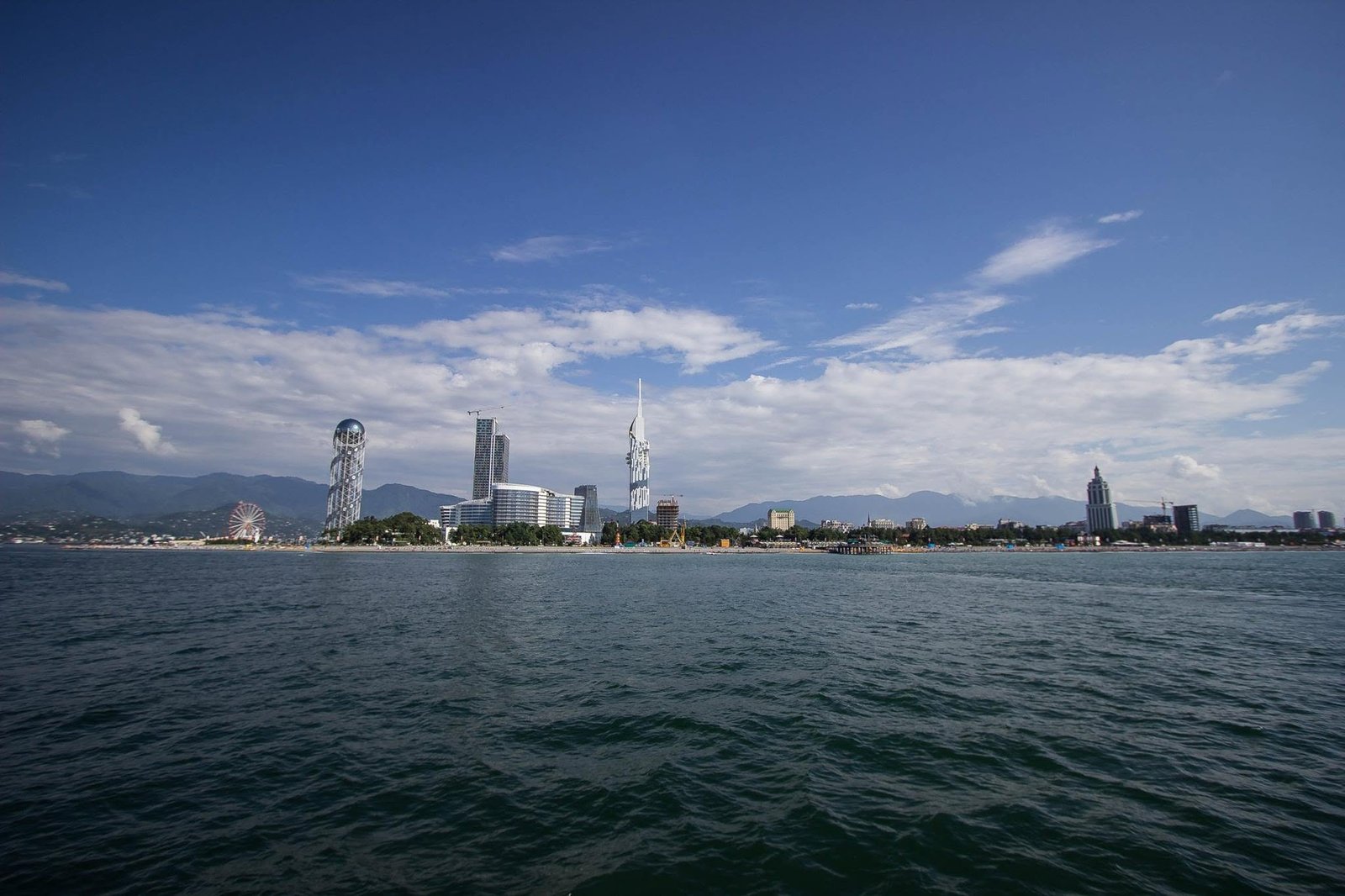
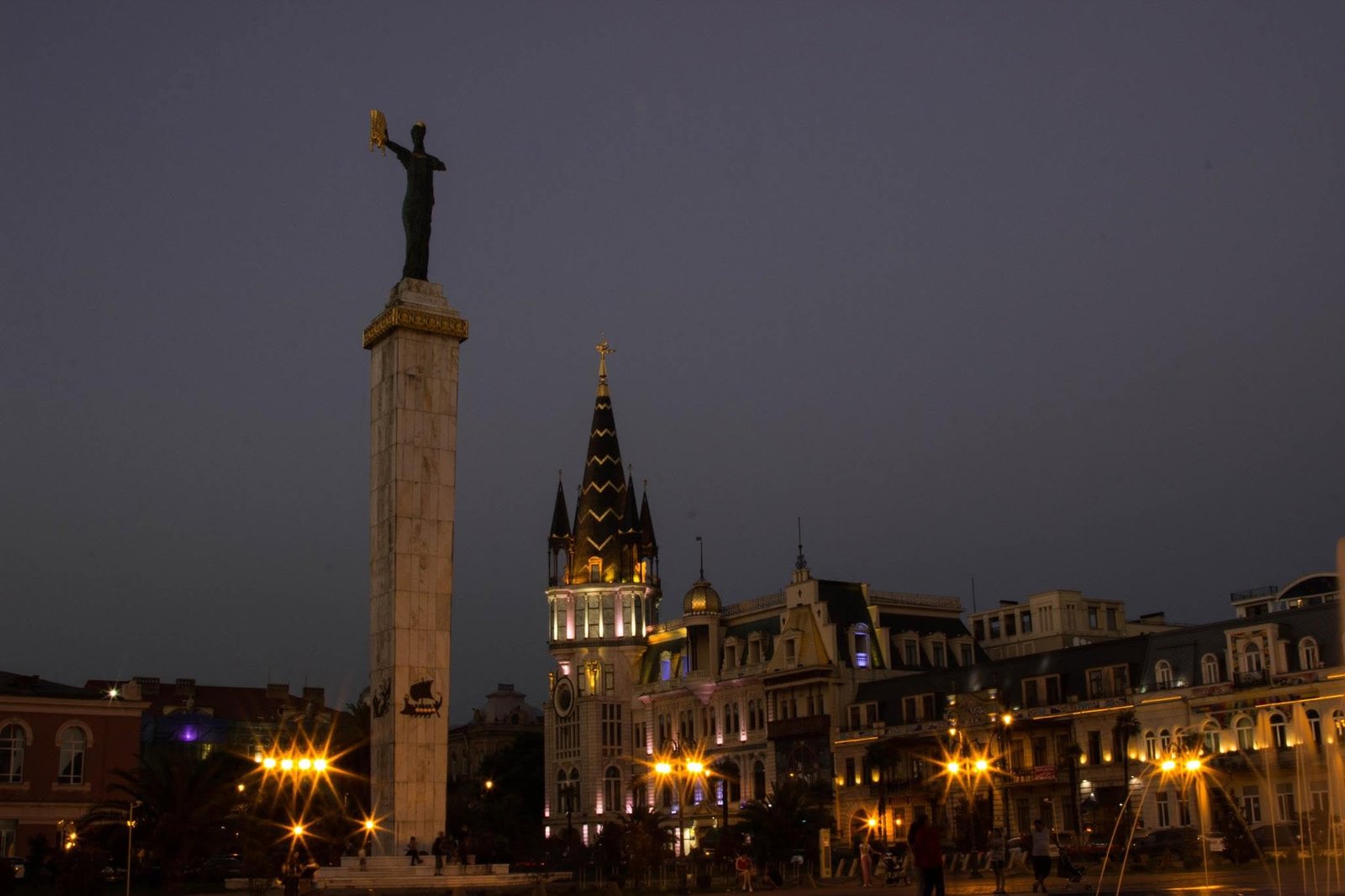
- The architecture is genuinely absurd. A 130-metre tower wrapped in the Georgian alphabet. A skyscraper with a Ferris wheel bolted into its side. A clock tower built to dispense free grape brandy. It shouldn’t work. It kind of does.
-
- The mountains start immediately. Thirty minutes inland and you’re in one of the wettest forests in the Caucasus, with waterfalls, stone bridges and villages where tea still grows on the terraces.
-
- It’s cheap outside July and August. Off-season, a decent hotel room on the coast costs less than a mediocre lunch in Western Europe.
How to Get to Batumi
From Tbilisi by train
This is the option we recommend to most travellers. Georgian Railway’s current Stadler services take about 5 hours 17–35 minutes. Published fares are 34 GEL in second class, 74 GEL in first class and 124 GEL in business class. Second class is comfortable for most visitors, and the coastal approach to Batumi is one of the most attractive parts of the journey. Book through the official Georgian Railway ticket site, app or station. Tickets are normally released up to 20 days before departure, and summer services can sell out. The regular timetable currently lists daytime and evening Stadler trains; do not plan around an overnight sleeper unless Georgian Railway announces a seasonal service.From Tbilisi by marshrutka or bus
Intercity coaches and marshrutkas connect Tbilisi and Batumi throughout the day. Allow roughly 5.5–6.5 hours depending on traffic. A reserved coach currently costs around 45 GEL, while marshrutka fares vary by operator. From Kutaisi, allow about 2–2.5 hours and roughly 25–35 GEL. Confirm the departure terminal when booking because operators use different stations.By car
Allow about 5.5–6.5 hours from Tbilisi on the main east–west route, longer on peak summer weekends. Highway upgrades have improved much of the journey, but roadworks, weather and traffic around Rikoti can still affect arrival time. Driving is useful if you want to break the trip in Imereti: Prometheus Cave and Sataplia are possible detours near Kutaisi.By air
Batumi International Airport is about 6 km south of the centre and serves Istanbul plus seasonal European and regional routes. Municipal bus 10 links the airport with central Batumi; cashless payment is required. A Bolt ride to the centre is commonly around 12–20 GEL depending on demand. Kutaisi International Airport, roughly two to two and a half hours away, often has a wider selection of low-cost European flights.From Turkey
The Sarpi crossing is about 17 km south of Batumi. Coaches travel from Trabzon and Hopa, while Batumi municipal bus 16 connects the Georgian side of the border with the city. Border-processing times vary considerably, especially on summer weekends and holidays, so avoid building a tight onward connection around an assumed 30-minute crossing.Best Time to Visit Batumi
The short answer: late May to June, or September. These periods usually balance warm weather, lighter crowds and lower prices. The sea is most reliably warm from July through September; early October can still work, but conditions are less predictable. The longer answer depends on what you want: Summer (July–August). Peak everything. Temperatures of 30–35°C with heavy humidity, sea water at 24–26°C, and a beach that’s genuinely shoulder-to-shoulder near the centre. Hotels double or triple their rates and the good restaurants need reservations. This is when Batumi is at its loudest — beach clubs, nightly fountain shows, casinos running around the clock. If that’s the holiday you want, it delivers. Book two to three months ahead. Velvet season (September–October). Locals will tell you this is the right answer, and they’re not wrong. The sea holds its warmth into early October, the crowds thin by the second week of September, and hotel prices fall 30–50%. It’s also grape harvest time in the Adjarian mountain villages, which makes the Upper Adjara wine route far more interesting than it is in June. Spring (April–May). Good for everything except swimming — the sea is still around 16–18°C in April. But the Botanical Garden is at its best, the waterfalls run hard after the winter rain, and hiking in Mtirala or Kintrishi is much more pleasant than it will be in August. Rain is likely; bring a jacket you don’t mind wearing. Winter (November–March). Beach infrastructure and many seasonal businesses close, and rain is frequent. The Botanical Garden remains worthwhile and accommodation is cheaper. Goderdzi ski resort is 109 km inland, not a quick two-hour excursion: the final mountain-road section can be unpaved, and a 4×4 is recommended in winter. For a more developed Georgian ski resort, see Bakuriani. For a country-wide view of seasons, our guide on when to travel to Georgia breaks down each region month by month.Where to Stay in Batumi
Location matters more than star rating here, because Batumi is compact and the difference between a good stay and an irritating one is usually a ten-minute walk. Old Town and the boulevard. First-timers should stay here. You’re walking distance from the beach, the restaurants, Europe Square and the nightlife. Prices run €30–100 in summer, €15–40 off-season. The trade-off is noise in July and August. Behind 6 May Park. Quieter, more residential, better cafés, easier parking, and still ten minutes from the promenade. This is where the self-catering apartments make sense, and where we’d stay for a week rather than a weekend. New Boulevard (south). The high-rise strip. Modern apartment-hotels with sea views and balconies, directly on the beach, a bit removed from the old centre. Good for families who want a pool and space, less good if you want to walk to dinner. Budget. Hostel dorms run 20–30 GEL. Guesthouses one block inland from the boulevard go for €15–25 outside peak season. Apartment rentals usually beat hotels for groups or stays over three nights. Booking rule of thumb: July–August, book two to three months ahead and expect tripled prices. May–June and September, two to four weeks is plenty. October–April, walk in and negotiate.Best Things to Do in Batumi
Walk the boulevard (and rent a bike for the far end)
Batumi Boulevard runs about 7 km along the shore, from the port down to the newer southern extension. It was laid out in the 1880s, when Batumi was booming on Caspian oil money, and it has been the city’s living room ever since. Sculptures, dancing fountains, a Japanese garden, Soviet-era mosaics, chess tables, and an unbroken line of cafés facing the water. Walking the whole length takes two to three hours. Renting a bike (5–10 GEL per hour) makes more sense if you want to reach the New Boulevard. Go in the early morning for empty paths and good light, or after eight in the evening, when the entire city seems to turn up at once and the sea goes the colour of a bruise. One local rule: eat one block inland. The boulevard-front restaurants charge tourist prices for mediocre food, and the difference in quality thirty metres away is embarrassing.Watch Ali and Nino move
Tamar Kvesitadze’s kinetic sculpture, officially titled Man and Woman, stands near the northern end of the boulevard. The eight-metre figures approach, merge and separate in a cycle of roughly ten minutes. The evening movement is commonly scheduled from around 7pm, although maintenance or weather can interrupt it. The popular names come from Kurban Said’s 1937 novel about an Azerbaijani Muslim man and a Georgian Christian woman whose relationship is overtaken by history. Dusk is the best time to see the illuminated sculpture.Explore the Old Town — with adjusted expectations
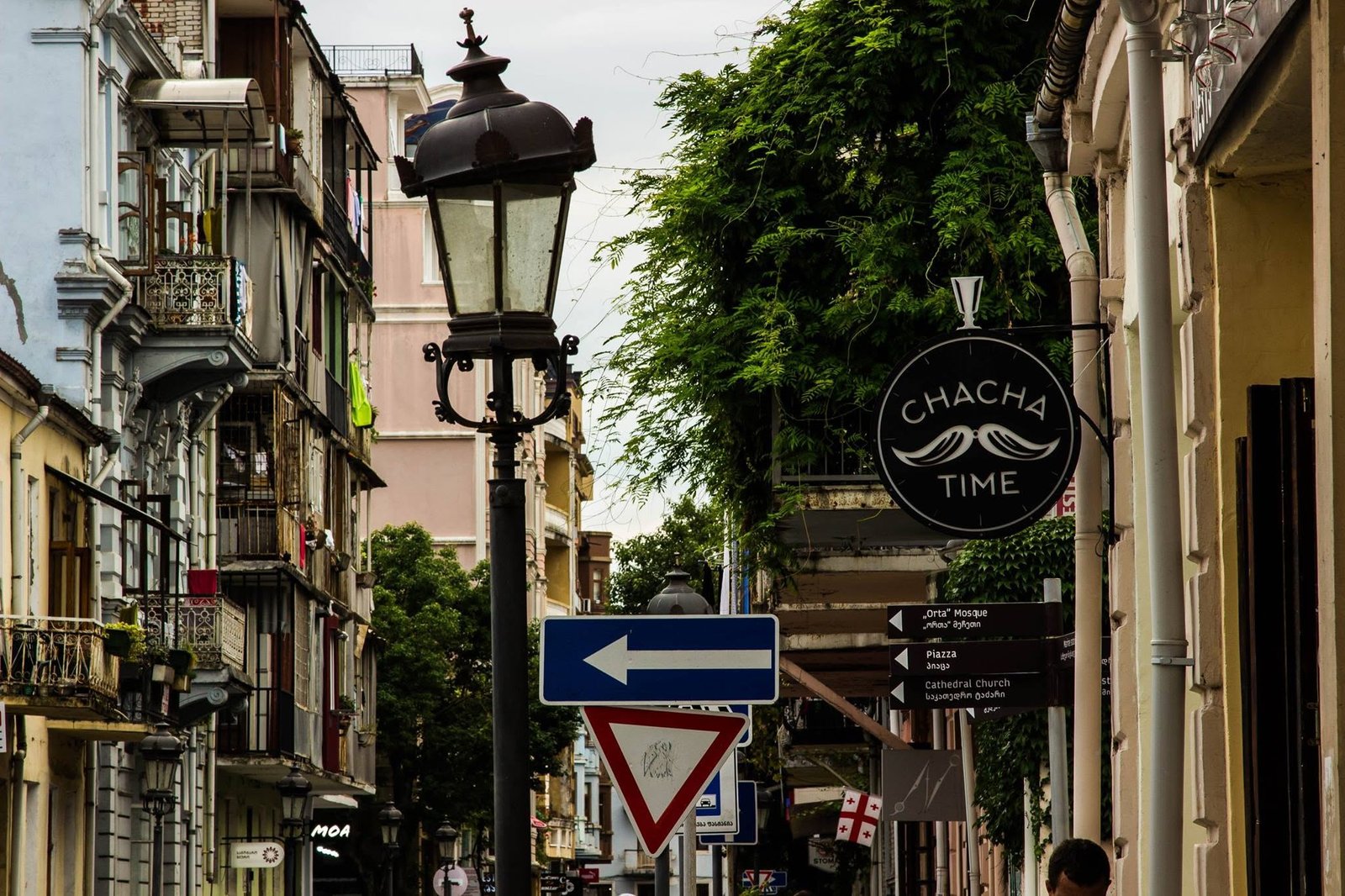
Batumi’s Old Town is small. You can walk it in half an hour, and a fair share of the “19th-century” facades were built in the last twenty years. What survives is genuinely lovely: Art Nouveau balconies with wrought-iron detail, heavy wooden doors, the Apollo cinema, and Europe Square with its Medea statue holding the Golden Fleece — a nod to the Argonaut legend that put this coastline in Greek mythology in the first place. Piazza, the Italianate square with mosaic floors and stained glass, is entirely artificial and entirely pleasant. Have a coffee, watch the wedding photographers work, and move on. This isn’t Tbilisi’s Old Town and it doesn’t pretend to be.Ride the Argo cable car — or hike to Sameba instead
The Argo cable car climbs about 2.5 km to Anuria Mountain, reaching an upper station roughly 250 metres above sea level in around fifteen minutes. The official round-trip fare is currently 39 GEL for visitors aged 12 and over and 9 GEL for children aged 5–11. The observation terrace is most rewarding before sunset; check same-day operating hours and visibility before buying a ticket. Lower-cost alternative: take a taxi to Holy Trinity Cathedral — Sameba — on the opposite hillside and enjoy the terrace views. Dress for an active Orthodox church, confirm access hours locally and arrange return transport rather than relying on an unmarked downhill route after dark.Look properly at the skyline
Batumi’s building boom in the 2000s produced a skyline that architecture critics dislike and everyone else photographs. Worth finding:-
- Alphabet Tower — 130 metres, wrapped in a double helix carrying all 33 letters of the Georgian alphabet, topped by a rotating sphere. Take the lift up for the views; skip the restaurant.
-
- Batumi Tower — the 200-metre former university tower with a Ferris wheel embedded high in its façade. The wheel is an architectural curiosity, not a dependable operating attraction.
-
- Public Service Hall — the Italian-designed glass cylinder near the port, which looks like a spacecraft parked badly.
Batumi Botanical Garden
Nine kilometres north of the centre at Green Cape (Mtsvane Kontskhi), Batumi Botanical Garden covers a steep coastal hillside and displays plants from East Asia, the Himalayas, New Zealand, Mexico, the Mediterranean and the Caucasus. Founded in 1912, it needs at least two to three hours. The current entrance fee is 25 GEL for foreign visitors and 10 GEL for Georgian citizens. Bus 10/10A and local minibuses serve Green Cape, while electric transport inside the garden is available for an additional charge. Check current hours before travelling and wear shoes suitable for steep paths. Allow three hours minimum. Paths wind through bamboo groves and eucalyptus, opening every so often onto a view of the Black Sea from a height that makes the container ships look like toys. Marshrutka 31 or bus 10 gets you there for a couple of lari; a taxi is 10–20 GEL. Entry has been rising in recent seasons — check the current rate before you go — and there are electric buggies inside if the hills are too much. Start at the northern entrance and finish at Green Cape beach if you want to end the day with a swim.The fish market ritual
Past the port, the fish market operates on a system that takes about ninety seconds to understand and stays with you for years. You choose your fish from the vendors — red mullet (barbuni) is the local favourite, though kalkan and fresh anchovy are worth asking about — it gets cleaned and weighed, and then you carry it next door to one of the small restaurants, where they fry it and bring it out with pickles, bread and a cold beer. It costs a fraction of what a seafront restaurant charges. The bill lands in the range of 25–45 GEL per person depending on how greedy you were at the counter. This is the single best meal in Batumi, and no restaurant with a sea view is going to beat it.Batumi Central Market
The agricultural market near the bus station is where Adjara shows what it grows. Wheels of sulguni cheese stacked like poker chips, churchkhela hanging in rows of purple candles, honey, tea from the plantations at Chakvi, spices sold by the scoop, and mandarins in autumn that ruin supermarket citrus for you permanently. Come in the morning. You don’t need to buy anything.Street art and Soviet mosaics
Batumi’s mural scene has grown quickly, with large-scale works by Georgian and international artists across the Old Town and the residential blocks behind 6 May Park. Some of the largest painted walls in the country are here, tucked into courtyards nobody sends you to. The Soviet mosaics are the more interesting hunt. The one outside the Dolphinarium, made in 1974, shows swimmers and sea creatures in that particular palette of blue and green that Soviet monumental artists used along the whole Black Sea coast. Another sits near the marina. Their future isn’t guaranteed, which is a good enough reason to go and look now.Orta Jame Mosque
Built in 1866, Orta Jame is Batumi’s only functioning mosque and a reminder that Adjara spent 250 years inside the Ottoman Empire. The interior woodwork and painted plaster were restored recently and are genuinely beautiful. Visitors are welcome outside prayer times; dress modestly. Within a fifteen-minute walk you can also reach an Orthodox cathedral, an Armenian church and a synagogue — which tells you most of what you need to know about this port’s history.Museums worth an hour
-
- Batumi Archaeological Museum — Greek, Roman and local archaeological material from the coast, including ceramics, jewellery and coins. Current adult admission is 6 GEL; published hours are 10:00–18:00, but confirm the operating day before visiting.
-
- Nobel Brothers Technological Museum — the story of Batumi’s oil-era development and the people and technologies that connected Baku with the Black Sea port. Current standard admission is 6 GEL and published hours are 10:00–18:00.
-
- Borjgalo Ethnographic Museum — Kemal Turmanidze’s detailed reconstruction of traditional Adjarian work and village life, south of the centre. Current adult admission is 15 GEL; the museum publishes daily opening hours of 10:00–17:00.
Dolphins, fountains and the things we’d skip
Bottlenose dolphins are sometimes visible offshore, particularly in calm conditions, but sightings from the promenade are never guaranteed. If animal attractions are not for you, watching the sea around golden hour is the low-key alternative to the Dolphinarium. The dancing fountains behind the stadium run on summer evenings, synchronised to everything from Beethoven to Georgian folk. It’s unashamedly touristy and completely fun. Arrive fifteen minutes early in August. Many Batumi casinos operate late or around the clock, usually inside large hotels. Entry policies vary and visitors should carry identification, check the legal minimum age and set a firm spending limit. If gambling does not appeal, they are simply part of the illuminated skyline.What to Eat in Batumi: Adjarian Cuisine
Adjara cooks differently from the rest of Georgia. The Ottoman centuries, the dairy-heavy mountain villages and a coastline full of fish produced a regional cuisine that leans richer and more buttery than anything you’ll eat in Kakheti.| Dish | What it is | Where it works best |
|---|---|---|
| Adjarian khachapuri | Bread boat filled with molten cheese, topped with butter and a raw egg you stir in at the table | Any local restaurant one block inland; expect 15–25 GEL |
| Borano | Sulguni cheese melted in hot butter until it pulls into ropes; sometimes lightened with corn flour or potato | Traditional Adjarian restaurants; share it |
| Sinori | Rolls of thin lavash layered with cottage cheese and butter, baked until the edges crisp | Starter, before you commit to a khachapuri |
| Achma | The same components built lasagna-style, dense and unapologetic | Village restaurants inland |
| Chirbuli | Eggs in a spicy walnut and tomato sauce | Breakfast, ideally the morning after a night on the boulevard |
| Iakhni | Beef stew thickened with walnut and spice, associated with Kobuleti | Rainy days, of which Batumi has many |
| Black Sea fish | Red mullet, turbot, anchovy — fried simply, with garlic | The fish market restaurants past the port |
| Chkhaveri | Pale rosé-toned wine from the local Chkhaveri grape, grown in Upper Adjara and Guria | Family cellars around Keda |
-
- Traditional Adjarian: BatuMarani, Cafe Adjara, Laguna
-
- Khachapuri: Laguna, Retro, Sakhachapure N1
-
- Seafood: the fish market restaurants; Fishlandia near the port for something more composed
-
- Coffee: Rhino Coffee, Coffeetopia, Erti Kava — Batumi’s café culture is better than the city gets credit for
-
- Wine bars: Georgian Naturale, Garage Wines
-
- Rooftop: Clouds at the Radisson Blu; the terrace bar at Kartuli Hotel for sunset
Day Trips from Batumi
This is the part most visitors skip, and it’s the part we’d fight for. Adjara’s interior is one of the wettest, greenest, least-visited corners of Georgia, and the drive from beach to rainforest takes half an hour.Gonio Fortress — 15 km south
Gonio Apsaros was a Roman fort by the 1st century AD, later used by the Byzantines and Ottomans. Its surviving walls enclose an active archaeological site and the symbolic grave of the Apostle Matthias. The current foreign-adult admission price is 15 GEL, and the normal published hours are 10:00–18:00. Bus 16 and local minibuses toward Gonio or Sarpi stop nearby; allow about an hour for the site. Pair it with Gonio beach, which is cleaner and calmer than Batumi’s, or with the hike above the village.Gonio Cross hike
The best short walk near the city. The trail climbs from Gonio village through orchards and forest to a hilltop cross, 1.5–2 hours each way, ending with the whole coastline laid out below you and Turkey visible to the south. Take water, and start early enough to be down before dark — the descent is not fun by phone torch.Kvariati and Sarpi
South of Gonio, Kvariati has the clearest water on this coast and a stretch of beach backed by cliffs. Sarpi, right at the border, is worth the trip for the checkpoint building alone — a wave of concrete that looks like it’s about to break over the road, and one of the more photographed pieces of modern architecture in Georgia. Bus 14 runs the route for around 1 GEL, or cycle it as a half-day ride.Makhuntseti waterfall and Queen Tamar’s bridge
Thirty kilometres inland, the Makhuntseti falls drop about 20 metres into a pool you can swim in if you’re brave about cold water. A few minutes away, a medieval arched stone bridge crosses the river — one of dozens of “Queen Tamar” bridges across Georgia, most of them built long after her reign, all of them beautiful. This is the most popular day trip from Batumi and it gets busy after eleven. Combine it with lunch at a village restaurant and a tasting at a family wine cellar around Keda, and you have a full day that costs almost nothing.Mtirala National Park — 25 km
Mtirala means “the crying one,” a fitting name for one of Georgia’s wettest forest landscapes. The protected Colchic forest is rich in moss, ferns, chestnut and beech, with waterfalls and river crossings around Chakvistavi. The established Tsablnari day trail is about 7 km; a longer two-day route is also available. Register at or contact the visitor centre before choosing a route, and carry rain protection even when Batumi is sunny. See our guide to Georgia’s national parks for wider planning. Trails range from an easy 2 km loop to a serious 14 km climb. The visitor centre near Chakvi has maps. Bring a rain jacket regardless of forecast; the forecast here is a formality. Mtirala is one of over 35 protected areas nationally — see our guide to Georgia’s national parks if you’re planning to string several together.Machakhela National Park
The valley follows the Turkish border into the mountains, through villages that spent centuries making rifles — the Machakhela musket was a genuine regional craft, and the small ethnographic museum tells that story alongside traditional Adjarian house architecture. Fewer visitors come here than anywhere else in Adjara. You’ll need a car or a guide.Kintrishi Nature Reserve
Kintrishi is higher, wilder and less convenient than Mtirala. The route to Lake Tbikeli is normally planned as a demanding two-day hike or horse trek rather than a casual day walk. Trail conditions, access roads and overnight arrangements should be confirmed with the protected-area administration; private transport is usually required.Upper Adjara: Keda, Khulo and Goderdzi
Drive inland along the Adjaristsqali and the landscape changes from citrus and vineyards to steep villages and alpine pasture. Keda and Khulo are the main service towns. The 1.7 km Khulo–Tago cable car crosses the gorge without intermediate supports; check locally that it is operating before building an itinerary around it. Family wineries around Keda produce Chkhaveri, a pale local red often served like a rosé — worth tasting even if you have already joined a wine tour in Kakheti. Goderdzi is about 109 km from Batumi at roughly 2,027 metres elevation. The final stretch beyond Khulo can be unpaved, so allow most of a day and use a suitable vehicle, particularly in winter.North: Kobuleti, Petra and the black sand beaches
Kobuleti is the quieter resort town half an hour north — more Georgian families, fewer casinos. Just before it, the Byzantine fortress of Petra sits on a headland at Tsikhisdziri with a view down both directions of the coast. Further on, Ureki and Shekvetili have coarse black magnetic sand that locals have credited with therapeutic properties for generations, and calmer, warmer water than Batumi. Kolkheti National Park protects the wetlands beyond, where boat trips push through channels full of birds.Batumi Beaches: What to Expect
Let’s deal with this directly, because it’s the single most common disappointment: Batumi’s beaches are pebble, not sand. Smooth grey stones, a steep entry, and water that is warm and swimmable but rarely clear in the way the Mediterranean is clear. Bring water shoes or buy a pair locally for about 10 GEL. Your feet will thank you within the first four steps. The upside is real, though: no beach entry fees anywhere, water that stays around 24–26°C from July to September, and far fewer people than any comparable Mediterranean resort in August. Batumi city beach. Runs the length of the boulevard. Loungers 10–20 GEL, beach clubs, bars, fairground rides. Most crowded in the centre, noticeably quieter at the northern and southern ends. Gonio beach. Cleaner, calmer, 15 km south, with the fortress and a row of fish restaurants behind it. Our pick for a swimming day. Kvariati. The clearest water on the Adjaran coast, backed by cliffs, 20 minutes south. Green Cape. Below the Botanical Garden, small and quiet, ideal after a morning in the gardens. Ureki and Shekvetili. Roughly an hour north, these resorts have dark magnetic-sand beaches and shallower water than central Batumi. They are the practical sandy-beach choice for families, but traditional therapeutic claims about the sand should not replace medical advice.Batumi Nightlife
The city changes character after dark, and not subtly. Rooftops. Clouds at the Radisson Blu has the best terrace in town for a sunset drink — better views and better value than the Alphabet Tower restaurant. Kartuli Hotel’s sky bar is the quieter alternative. Wine bars. Georgian Naturale pours qvevri and natural wines from across the country with staff who can actually explain what’s in the glass. Garage Wines in the Old Town does bottles and cheese boards. Bars and pubs. Chacha Time for cocktails and, improbably, the best burgers in Batumi. Sami Ludi for craft beer. Mary’s Irish Pub for the expat crowd. Freespace and Komuna for something more local and less polished. Beach clubs. Summer only, roughly June to September, concentrated on the southern beaches. Expect loud house music, expensive cocktails and a scene that takes itself moderately seriously. Casinos. Batumi has a large concentration of licensed casinos, many attached to international hotels. Entry rules, identification requirements and minimum age are set by law and individual venues. Georgia permits licensed gambling beyond Adjara as well, so describe Batumi as the country’s main casino cluster rather than the only place where gambling is allowed. Set expectations: this is beach resort nightlife, not Tbilisi’s warehouse techno scene. It’s fun, loud and unsophisticated, and it stops almost entirely in October.Practical Information
Travel insurance is now mandatory
Since 1 January 2026, tourists entering Georgia must hold health and accident insurance valid for the full stay, with coverage of at least 30,000 GEL. The policy may be issued by a Georgian or foreign insurer, must be available electronically or on paper, and must be written in Georgian or English. It should clearly state the insured parties, territory, dates, risks and coverage limit. Buy the policy before departure and keep the document accessible during travel. Check the official Georgian consular guidance for exemptions and document requirements applicable to your status. If you take prescription medication, read our note on bringing medication into Georgia first — some common drugs are controlled here in ways travellers don’t expect.Getting around
Central Batumi is small enough to walk end to end in about an hour. For everything else:-
- City buses are cashless. A Batumi transport card or a compatible contactless bank card can be used; verify the fare shown by the validator. Bus 10 serves the airport and Green Cape, while bus 16 serves Gonio and Sarpi.
-
- Bolt operates throughout the city. Typical central rides are often 5–10 GEL, while airport trips commonly cost around 12–20 GEL depending on demand.
-
- Marshrutkas serve nearby towns and villages, but routes and fares are not always displayed consistently. Confirm the destination and price with the driver before boarding.
-
- Bike rental on the boulevard runs 5–10 GEL per hour, 30–40 GEL for a day.
Money
ATMs are everywhere and cards work in most restaurants, hotels and shops. Keep cash for markets, marshrutkas, village restaurants and the fish market. Small notes are useful; nobody enjoys breaking a 100 GEL bill for a 2 GEL fare.Internet and phone
Wi-Fi is fast and standard in hotels and cafés. Magti and Silknet SIM cards with generous data allowances are available at the airport and in any phone shop, and cost very little. Bring your passport.Safety
Batumi is a safe city, including at night. The realistic risks are the sea rather than people: currents can be strong, the pebble entry is slippery, and summer sun here is more intense than the temperature suggests. Petty theft happens occasionally on crowded summer beaches — the usual precautions apply. Emergency number is 112.What things cost
| Item | Typical price (Aug 2026) |
|---|---|
| Adjarian khachapuri | 15–25 GEL |
| Fish dish, local restaurant | 20–35 GEL |
| Fish market meal per person | 25–45 GEL |
| Local beer | 4–7 GEL |
| Glass of wine | 8–15 GEL |
| Beach lounger | 10–20 GEL |
| Argo cable car (return) | 39 GEL adult; 9 GEL age 5–11 |
| Bolt across town | 5–10 GEL |
| Taxi day trip to Makhuntseti | Around 70–120 GEL per vehicle, depending on waiting time and stops |
Suggested Batumi Itineraries
Two days: the city
Day 1. Morning at the Central Market and the Old Town, coffee at Piazza, lunch one block inland. Afternoon on the beach or at the Archaeological Museum if it’s raining. Argo cable car for sunset, dinner at the fish market, and the boulevard after dark to catch Ali and Nino lit up. Day 2. Botanical Garden in the morning; allow at least two to three hours and consider finishing at Green Cape. Return to town for the mosaics and street art behind 6 May Park. End with a rooftop sunset and the dancing fountains if the seasonal evening programme is running.Four days: city and mountains
Add: Day 3. Gonio fortress, the cross hike above the village, and an afternoon swim at Kvariati. Fish lunch in Gonio. Day 4. Inland: Makhuntseti waterfall and Queen Tamar’s bridge in the morning, a family wine cellar near Keda for lunch and Chkhaveri, and Mtirala National Park or a drive up to Khulo if you have the energy.A week: Adjara properly
Add Machakhela valley, Kintrishi and the Tbikeli lake hike, Goderdzi Pass, a day north to Kobuleti, Petra fortress and the black sand beaches, and one full day doing nothing at all on a quiet stretch of coast. If you’d rather not drive the mountain roads yourself, this is exactly the kind of week we build as a private tour.Batumi With Kids
The city works well for families, with a few adjustments. The pebble beach is hard on small feet, so water shoes are useful; Ureki offers sand and Green Cape is quieter. 6 May Park has a lake and family attractions, while the Argo cable car and Borjgalo ethnographic museum are straightforward options. At Mtirala, choose a child-appropriate walk with the visitor centre instead of assuming the main 7 km trail will suit every family. Avoid the boulevard between 8pm and 11pm in August unless you enjoy losing people in crowds.Frequently Asked Questions
Is Batumi worth visiting?
Yes, especially for two to four days if you want a coastal contrast to Tbilisi and the Caucasus. Batumi combines beaches, distinctive Adjarian food, unusual architecture and easy access to subtropical forests and mountain villages.
How many days do you need in Batumi?
Two days covers the central city and Botanical Garden. Four days allows time for Gonio, Keda or Makhuntseti and Mtirala. Plan a week if you want to explore Upper Adjara and the northern coast without rushing.
What is the best time to visit Batumi?
Late May through June and September usually offer the best balance of warm weather, manageable crowds and lower prices. The sea is most reliably warm from July through September, while early October can still be pleasant but is less predictable.
Are Batumi beaches sandy?
No. Batumi, Gonio, Kvariati and Green Cape mainly have pebble beaches. For dark sand and shallower water, travel north to Ureki or Shekvetili.
How do I get from Tbilisi to Batumi?
The current Stadler train takes about 5 hours 17–35 minutes and costs 34 GEL in second class, 74 GEL in first class or 124 GEL in business class. Coaches cost around 45 GEL and take roughly six hours; driving time depends heavily on traffic.
How much does the Argo cable car cost?
The official round-trip fare is currently 39 GEL for visitors aged 12 and over and 9 GEL for children aged 5–11. Children under five travel free. Check same-day hours and weather before buying.
How much is Batumi Botanical Garden?
The current admission price is 25 GEL for foreign visitors and 10 GEL for Georgian citizens, with reduced categories available. Allow at least two to three hours and expect steep paths.
Can you swim in Batumi?
Yes, usually from June to early October. Water is warmest from July to September, but currents, waves and water clarity change with weather. Gonio, Kvariati and Green Cape are popular alternatives to the central beach.
Is Batumi safe for tourists?
Batumi is generally safe, including after dark. The more common risks are strong currents, slippery pebble entries, summer heat, traffic and occasional theft on crowded beaches. Use normal precautions and call 112 in an emergency.
Do tourists need travel insurance for Georgia?
Yes. Since 1 January 2026, tourists must carry health and accident insurance valid for the full stay with at least 30,000 GEL coverage. The policy must be available in Georgian or English, electronically or on paper.
Which bus goes from Batumi to Sarpi?
Municipal bus 16 connects Batumi with Gonio and the Sarpi border area. Schedules and border waiting times can change, so allow extra time and verify the return service on the day.
Can I visit Goderdzi as a quick day trip from Batumi?
Goderdzi is about 109 km from Batumi, and the final section beyond Khulo can be unpaved. It is not a quick two-hour excursion; allow a long day or overnight and use a suitable vehicle, especially in winter.
Final Thoughts
Batumi is a city that resists its own reputation. Call it the Las Vegas of the Black Sea and you’ve described the casinos and missed everything else — the mosaic outside the Dolphinarium, the smell of frying mullet by the port, the tea terraces going gold in October, the elderly men playing backgammon under the palms while a Ferris wheel turns inside a skyscraper behind them. It doesn’t resolve into a single idea, and that’s the point. Give it more than an afternoon. Go inland at least once. Eat the fish from the market rather than the restaurant with the sea view. What people remember about this city is almost never what brought them here in the first place.Highlander Travel has been running private tours across Georgia since 2011, including Adjara and the Black Sea coast. If you’d like a Batumi itinerary built around what you actually want to do — mountains, food, beaches or all three — get in touch or browse our tour packages. For the wider region, see our Adjara destination guide; for first-time planning, start with our essential travel tips for Georgia.



That sounds like a really interesting installation! I’ve heard Batumi’s seafront is quite lively in the evenings.
[…] Beach Season: June to September – swimming weather in Batumi […]
[…] depends greatly on where you order it. The best versions are found in Adjara and Tbilisi. Even in Batumi, it is worth asking locals which restaurant prepares the best Adjaruli. Because it is difficult to […]
[…] Batumi International Airport (BUS) operates international, regional and seasonal flights. […]
[…] Taxi from Batumi (fare varies; confirm before travel) to the Chakvistavi village visitor […]