
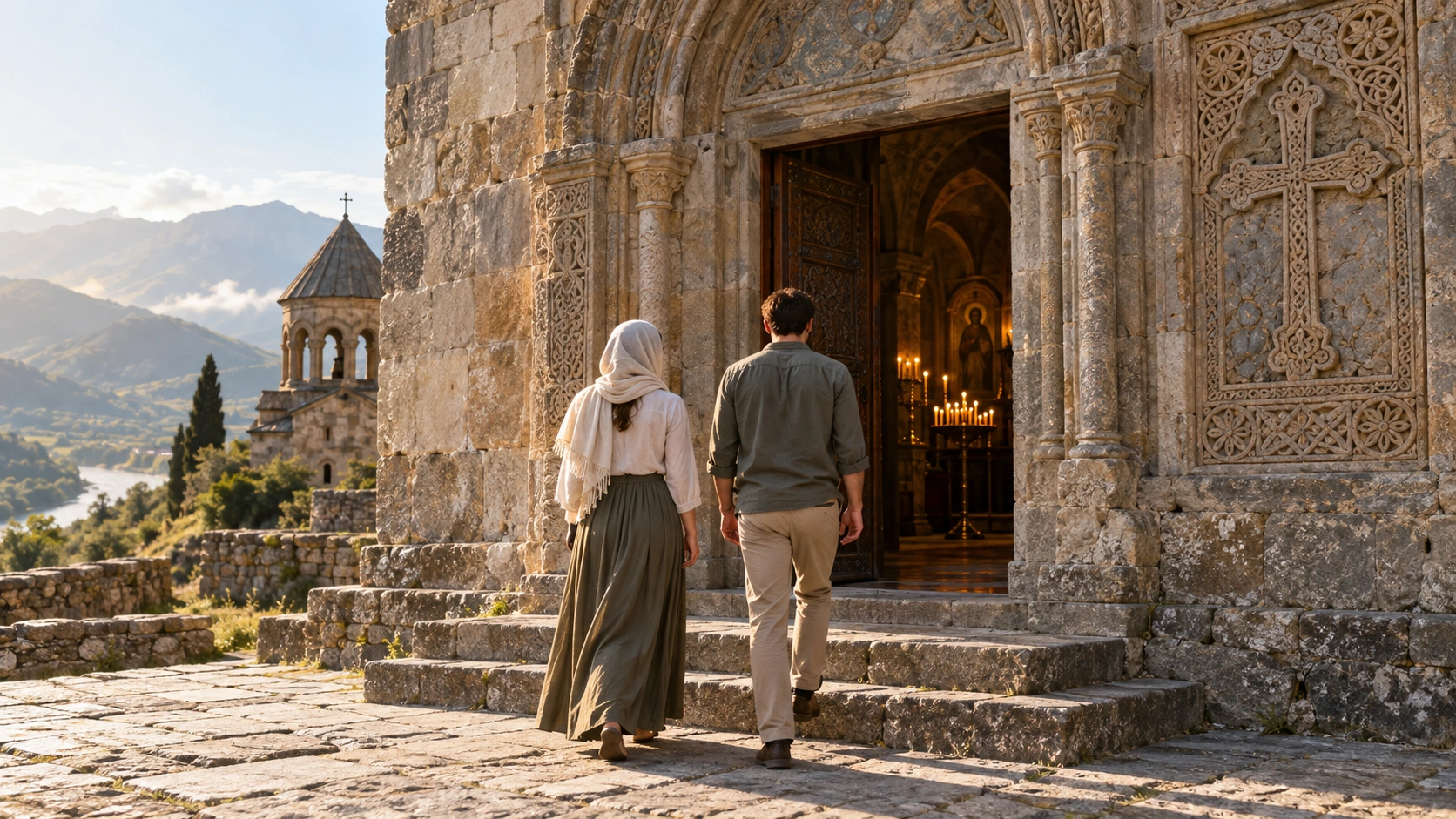
At the gate of almost every well-known church in Georgia there is a wooden rack or a basket, and in it a heap of faded wrap-around skirts and cotton headscarves. Visitors hesitate in front of it. Do I need one? Does everyone? Is my long dress enough?
Then you step inside, out of the bright courtyard, and the questions multiply. The air is cool and smells of beeswax and incense. Candles flicker in a sand-filled stand. An elderly woman kisses an icon, crosses herself three times and moves on. A man in a black cassock walks past without a glance. There are no pews, no signs, no ticket desk, and nobody explains anything.
Georgian churches are not museums. Even the oldest and most famous of them are working places of worship, and the Georgian Orthodox Church is central to life in the country. Most of the rules come down to modesty and quiet, and once you know them, you can relax and enjoy some of the most extraordinary interiors in the Caucasus. Here is what to wear, what to do with a candle, when to put the camera away, and how monasteries differ from ordinary parish churches.
Georgian Church Etiquette: The Short Version
If you read nothing else, these are the essentials:
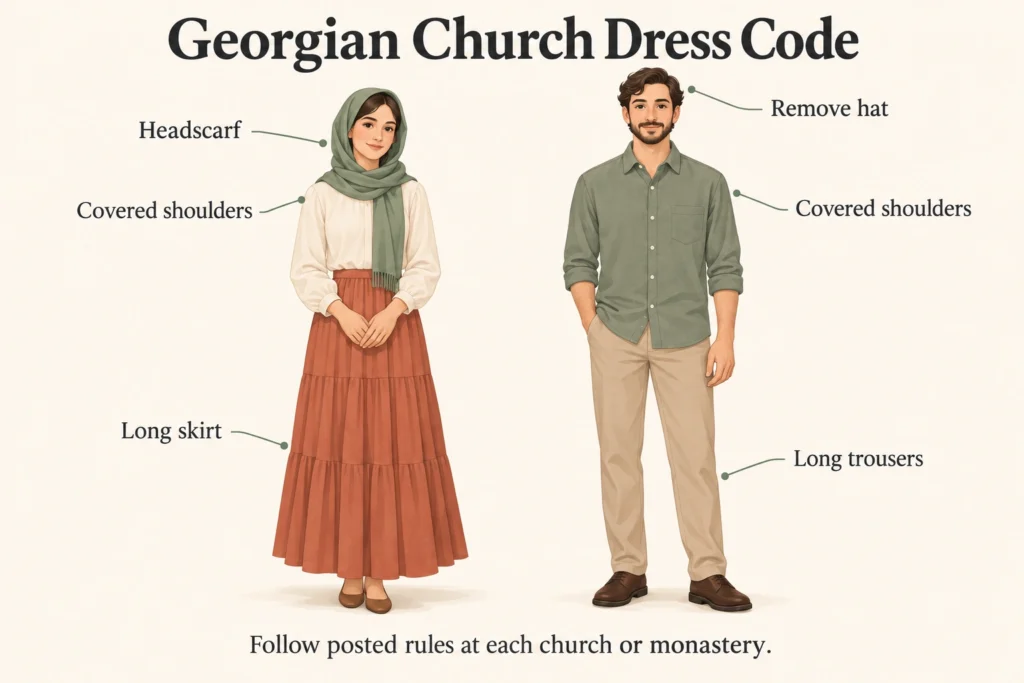
- Cover shoulders and knees. This applies to everyone, men and women, in every church.
- Women: cover your hair and wear a skirt. A headscarf and a skirt below the knee are the norm. Most major churches lend both at the entrance.
- Men: long trousers, hats off. Shorts are generally not accepted, and caps come off at the door.
- Keep your voice low and your phone silent. People are praying, even when it does not look like a service.
- Stay out of the sanctuary. The area behind the icon screen, the iconostasis, is for clergy only.
- Ask before you photograph. Some churches allow it, some forbid it inside, and almost none welcome it during a service.
- Do not sit in the patriarch’s chair, or in any carved throne-like seat in a cathedral.
Georgia Church Dress Code at a Glance
| Women | Men | |
|---|---|---|
| Head | Headscarf covering the hair | Bare head; remove hats and caps |
| Shoulders and arms | Covered; no tank tops or bare shoulders | Covered; no tank tops |
| Legs | Skirt or dress below the knee; trousers are often not accepted | Long trousers; no shorts |
| Neckline | Modest | Modest |
| Borrowed items | Scarves and wrap skirts at most major churches | Wraps for men in shorts at some churches |
| Footwear | Anything practical; no need to remove shoes | Same |
The rules are applied most strictly in monasteries, cathedrals and popular sites such as Gergeti Trinity. In a small village church you may see local women without a headscarf. That is their call to make; as a visitor, it is simpler and more respectful to follow the standard dress code everywhere.
What to Wear to a Georgian Church
For women
The standard is a headscarf, covered shoulders and a skirt or dress that reaches below the knee. Trousers, even long and loose ones, are often not accepted, which surprises many visitors. At the bigger churches, someone at the door may hand you a wrap skirt before you have a chance to ask.
The headscarf does not need to be anything special. A light cotton or silk scarf that covers most of your hair is enough; no one will check how tightly it is tied. It does not have to be dark or plain either. Georgian women wear everything from black lace to bright florals.
For men
Long trousers, a shirt or T-shirt that covers the shoulders, and no hat once you step inside. Shorts are the most common problem for male visitors, especially on hot summer days in Mtskheta or on the hike up to Gergeti. Some churches keep wraps for men too, but do not count on it.
Borrowing scarves and skirts
Most of the well-known churches, including Svetitskhoveli, Jvari, Gergeti Trinity and Sameba Cathedral in Tbilisi, keep a supply of headscarves and wrap skirts at the entrance, usually free of charge. They are practical, but they are shared, often a bit worn and sometimes all in use on a busy day.
A few tips:
- Carry your own scarf. A thin scarf weighs nothing, doubles as sun protection and saves you queuing at the rack.
- A long skirt in your daypack solves the problem for a whole day of church visits, especially in Mtskheta, where several churches are close together.
- Return what you borrow to the rack or the person who gave it to you.
- Smaller and village churches rarely have anything to lend, so dress for them before you set out.
- In the mountains, layer up. Churches such as Gergeti Trinity sit high above the valley, and a wrap skirt over hiking trousers is a common sight.
Think of the scarf and skirt as you would a jacket at a formal dinner. Nobody will lecture you if you forget, but having them on means nobody looks twice.
How to Behave Inside a Georgian Church
The layout of an Orthodox church explains most of the rules. The open space where you stand is for everyone. At the far end, a screen covered in icons, the iconostasis, separates that space from the sanctuary, where the altar stands and where the liturgy is celebrated. Only clergy go behind it.
Within that shared space, a few habits will keep you out of trouble:
- Speak quietly, or not at all. Even with no service on, someone is usually praying. A whisper carries further than you think under a stone dome.
- Stay out of the sanctuary, and do not step up onto the raised area in front of the iconostasis unless you are invited.
- Do not sit on the special chairs. Cathedrals often have a carved seat for the Catholicos-Patriarch, the head of the Georgian Orthodox Church. Ordinary visitors never use it. Benches along the walls, where they exist, are mainly for the elderly and unwell.
- No food, drink or chewing gum. Finish your water bottle outside.
- Hands out of pockets, hats off, for men; and nobody leans on walls covered in frescoes.
- Give way to worshippers. If someone is waiting to reach an icon or light a candle, step aside.
- Children are welcome, but keep them close and quiet; churches are not playgrounds, however tempting the space.
Icons
Icons are not decoration. For believers they are windows onto the saints they depict, and you will see people cross themselves, bow and kiss them. As a visitor you are not expected to do any of this, and you should never feel pressured to.
What you should do is look, not touch. Do not run your fingers over an icon, a silver cover or a fresco, however old and tempting the surface. Centuries of candle smoke have already done enough damage.
Lighting candles
Lighting a candle is the one ritual many visitors join in, and it is welcomed.
- Buy a candle at the small church shop near the entrance or just inside. Thin beeswax tapers cost very little; the money supports the church.
- Light it from another candle already burning, not with a lighter.
- Place it in a stand in front of an icon, pressing the base into the sand or holder until it stands upright.
- Leave it to burn. Do not move or blow out other people’s candles; church staff tidy the stands.
Many churches have a separate stand for candles in memory of the dead, often rectangular and sometimes with a small crucifix. Candles for the living go in front of icons. If you are not sure which is which, watch what others do, or simply ask.
The effect, in a dim church on a winter afternoon, is something like a field of small yellow flames, each one a private request. It is one of the most beautiful things you will see in Georgia, and it is free.
Can You Take Photos Inside Georgian Churches?
Sometimes. There is no single national rule, and practice varies from church to church:
| Situation | What to expect |
|---|---|
| Outside and in the courtyard | Almost always fine |
| Inside, no service on | Allowed in many churches, forbidden in some, such as Gergeti Trinity |
| During a service | Avoid it, even where photos are normally allowed |
| Priests, monks and nuns | Ask first, every time |
| People praying | Do not photograph them |
| Flash | Never; it damages frescoes and disturbs worshippers |
Look for a sign at the door, often a crossed-out camera. If there is none, watch whether others are taking pictures, and if in doubt, ask whoever is at the candle counter. A shake of the head means no.
Two more things. Selfies and posed photos in front of the iconostasis tend to go down badly, even where photography is allowed. And drones are a separate question entirely: flying one over a monastery without permission is a good way to end a pleasant visit early.
Attending a Service as a Visitor
You are welcome to attend. The main service, the Divine Liturgy, is held on Sunday mornings and on feast days, and many churches also hold services on other days. Start times vary, so check locally.
A Georgian Orthodox service can feel unfamiliar at first:
- Everyone stands. There are no pews. Services can last two hours or more, and nobody expects you to stay for all of it.
- People come and go. Worshippers arrive late, light a candle, pray for a while and leave. You can do the same, as long as you move quietly.
- Stay near the back or to one side, out of the way of processions and of people approaching the icons.
- No communion for non-Orthodox visitors. Communion is for Orthodox Christians who have prepared for it. Stay in place when others go forward.
- No photos and no wandering. During a service, sightseeing stops. Stand still, listen, or step outside.
The reward is the singing. Georgian church chant is a polyphonic tradition of its own, usually in three parts, and hearing it under a stone dome is very different from hearing it on a recording. Choirs are not guaranteed at every service, but the larger churches and monasteries often have them. To learn more about the tradition, read our guide to Georgian polyphonic singing.
Feast days
Major feasts bring huge crowds, long services and an atmosphere you will not forget, but also full churches and little room for sightseeing. The biggest dates include Orthodox Christmas on 7 January, Easter (on the Orthodox date, which usually differs from the Western one) and Svetitskhovloba, the feast of Svetitskhoveli Cathedral in Mtskheta, on 14 October. On those days, come for the occasion rather than for the frescoes.
Visiting Monasteries: A Little Stricter
A monastery is a home before it is a sight. Monks or nuns live, work and pray there on a daily schedule, and visitors are guests in that routine. Expect the dress code to be enforced more firmly, and a few extra rules.
- Dress conservatively. Long sleeves are sometimes expected as well as covered shoulders, and women may be asked for a longer skirt than at a city church.
- Respect closed areas. Living quarters, refectories and gardens are private. A closed gate or an unmarked door usually means it is not for visitors.
- Check visiting hours. Some monasteries close to visitors during services, meals or at certain times of day.
- Accept that some areas may be closed to women, or open only at certain times. These rules are set by each community; arguing with them at the gate never ends well.
- Keep it quiet outside, too. The courtyard is part of the monastery, not a picnic area.
- Buy something if you can. Many monasteries sell candles, icons, honey, wine or herbal teas. It is a good way to support the community.
Remote monasteries add practical questions to the etiquette. At David Gareja, in the semi-desert near the Azerbaijani border, part of the complex lies on the other side of the frontier, and access can change. At cave monasteries such as Shio-Mgvime, you may need to climb, so wear shoes that grip as well as a skirt that covers the knee. A long wrap skirt over hiking trousers is often the answer.
Monks and nuns are often happy to talk, particularly if you speak some Georgian or Russian, but let them start the conversation. A small nod or a quiet gamarjobat, the polite form of hello, is the right greeting.
The Churches You Are Most Likely to Visit
The basics are the same everywhere, but each of the big sites has its own character:
| Church | Where | What to know |
|---|---|---|
| Svetitskhoveli Cathedral | Mtskheta | Georgia’s most important cathedral. Dress code applies across the grounds, not just inside; scarves at the entrance; photos usually allowed without flash |
| Jvari Monastery | Above Mtskheta | Small and often crowded; wraps usually available. The hilltop is windy, so tie your scarf firmly |
| Samtavro | Mtskheta | A working convent and a place of pilgrimage; expect a quieter, more devout atmosphere |
| Gergeti Trinity | Above Stepantsminda (Kazbegi) | Strict dress code with wraps provided; photography is not allowed inside |
| Sameba (Holy Trinity) Cathedral | Tbilisi | The city’s huge modern cathedral and seat of the Patriarch; dress code and quiet taken seriously |
| Bodbe Monastery | Near Sighnaghi, Kakheti | A convent and the burial place of St Nino; modest dress expected throughout |
| David Gareja | Semi-desert, Kakheti | Remote cave monastery; dress modestly but practically for heat and rough paths |
Mtskheta has three of these within a short drive of each other, which makes it the easiest place to practise. Our Mtskheta travel guide covers the town, and our half-day Mtskheta tour from Tbilisi takes you to all three with a guide who can explain what you are looking at.
Georgian Church Etiquette FAQ
What should women wear to a church in Georgia?
A headscarf covering the hair, a top that covers the shoulders, and a skirt or dress below the knee. Trousers are often not accepted. Most major churches lend scarves and wrap skirts at the entrance, but bringing your own is easier.
Can men wear shorts in Georgian churches?
Generally no. Men should wear long trousers, cover their shoulders and remove hats inside. Some popular churches keep wraps for men in shorts, but not all do.
Do I need to cover my head in a Georgian church?
Women are expected to cover their hair with a scarf; men should go bareheaded. A light scarf that covers most of the hair is enough.
Can I take photos inside Georgian churches?
It depends on the church. Many allow photos without flash when no service is under way, while some, such as Gergeti Trinity, forbid photography inside. Never photograph during a service or take pictures of clergy or people praying without permission.
Can non-Orthodox visitors attend a service?
Yes. Visitors are welcome to stand quietly at the back during the liturgy, and to come and go discreetly. Communion is for Orthodox Christians only.
How do I light a candle in a Georgian church?
Buy a thin candle at the church shop, light it from a candle already burning, and place it in a stand in front of an icon. Candles in memory of the dead go in a separate stand.
Are the rules stricter in monasteries?
Usually. Expect the dress code to be enforced more firmly, long sleeves to be preferred, some areas to be closed to visitors or to women, and visiting hours that fit around the community’s daily routine.
Do I have to pay to enter Georgian churches?
No. Churches in Georgia are generally free to enter. Buying a candle or leaving a donation is a welcome way to contribute.