
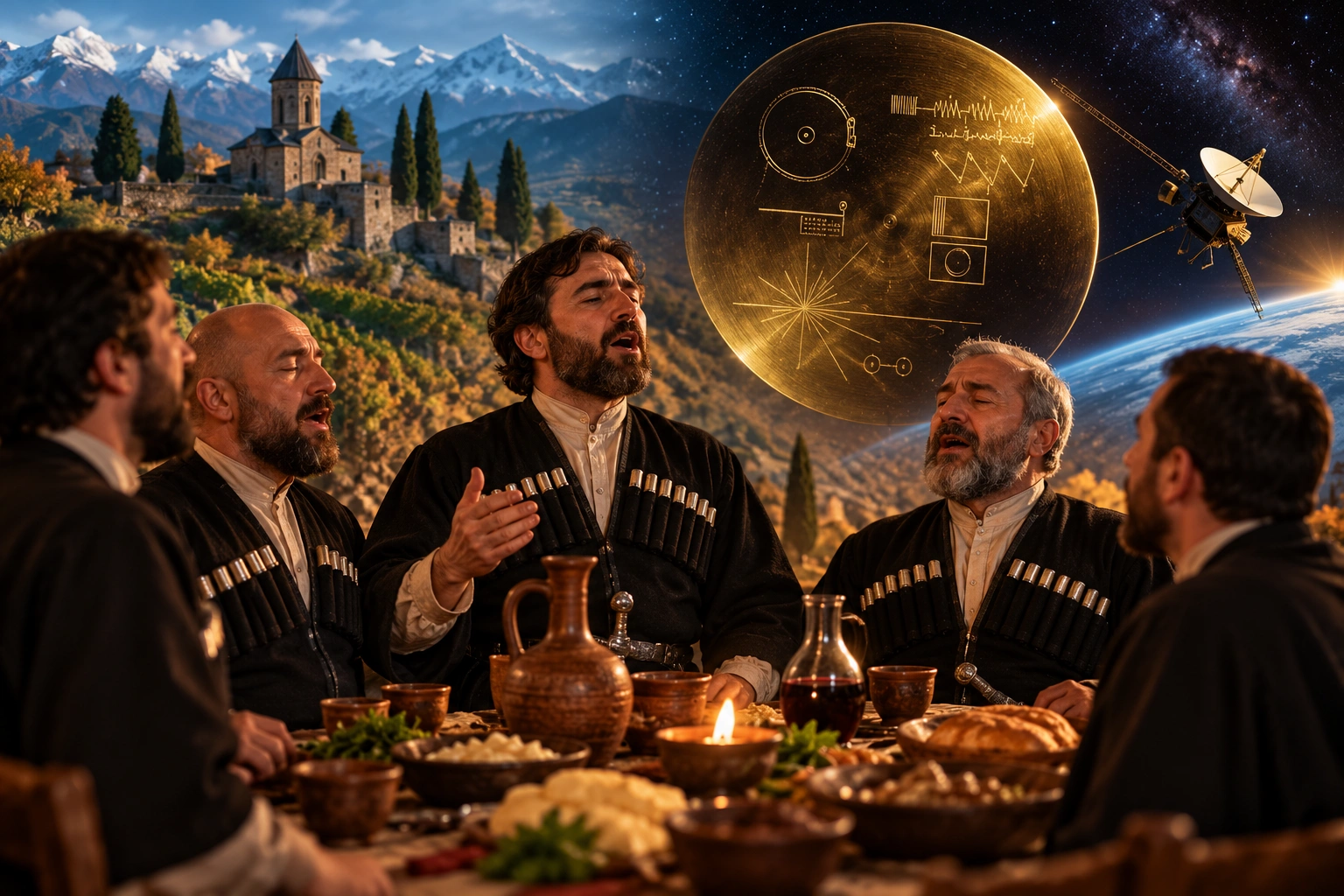
In the late summer of 1977, two small spacecraft left Earth carrying a gold-plated copper record. On it, for anyone who might one day find it, are greetings in 55 languages, the sound of rain and a heartbeat, and about 90 minutes of music. Bach is there, and Beethoven, Chuck Berry, a Japanese shakuhachi, Javanese gamelan.
So is a two-minute-eighteen-second recording from Soviet Georgia: Chakrulo.
Play it next to anything else on the record and you hear why it was chosen. Two male voices climb and twist above a low, sustained bass, sliding through intervals that a Western choir would never sing, holding notes that seem to bend rather than resolve. It sounds less like a choir performing a piece and more like a small argument conducted in harmony.
What makes Georgian singing sound like this? And why does a song from Kakheti sound almost nothing like one from Guria, on the other side of the same small country? This guide follows Chakrulo into space, then comes back down to explain the regional traditions behind it, and where you can still hear them in Georgia today.
What Is Georgian Polyphonic Singing?
Georgian polyphonic singing is traditional vocal music in which two or more independent voice parts are sung at the same time. Each region developed its own way of doing it, from long, ornamented melodies over a bass drone in Kakheti to fast, fiercely independent voices and the yodel-like krimanchuli of western Georgia.
UNESCO first proclaimed Georgian polyphonic singing a Masterpiece of the Oral and Intangible Heritage of Humanity in 2001, and it was inscribed on the Representative List of the Intangible Cultural Heritage of Humanity in 2008. Two clarifications save a lot of confusion:
- It is intangible heritage, not a World Heritage Site. UNESCO recognised a living practice, not a place or a monument.
- The tradition is listed, not individual songs. Chakrulo is famous, but it is not a UNESCO element of its own; Georgian polyphonic singing as a whole is.
Georgian Polyphony at a Glance
| Tradition | What it sounds like | Typical features |
|---|---|---|
| Kakheti and Kartli (east) | Long, ornamented upper voices over a sustained bass | Two soloists, a group bass, extended table songs such as Chakrulo |
| Guria (west) | Several voices that seem to compete, fast and rhythmically complex | Krimanchuli, trio singing, elaborate work songs |
| Svaneti (north-west) | Dense, block-like chords; a strong collective sound | Songs tied to ritual, round dances and communal life |
| Imereti, Samegrelo, Adjara (west) | Contrasting, mobile voice parts with local character | Work songs, table songs, two- and three-voice forms |
| Church chant | Usually three-part sacred polyphony | A distinct ecclesiastical tradition with its own repertoire |
UNESCO’s own summary sorts Georgian polyphony into three broad types: complex polyphony in Svaneti, polyphonic dialogue over a bass in Kakheti, and contrasting, partly improvised three-part singing in western Georgia.
That is a useful starting map, not the full one. Georgian ethnomusicologists recognise many more regional musical dialects, often counted at around sixteen, grouped broadly into eastern and western families. Racha, Lechkhumi, Meskheti and Khevsureti all have their own sound.
Why Does Georgian Polyphony Sound So Different?
Most visitors arrive with a choir in their heads: one tune on top, everyone else filling in the harmony underneath. Georgian singing works on different principles, and four of them explain most of what you hear.
Independent voices
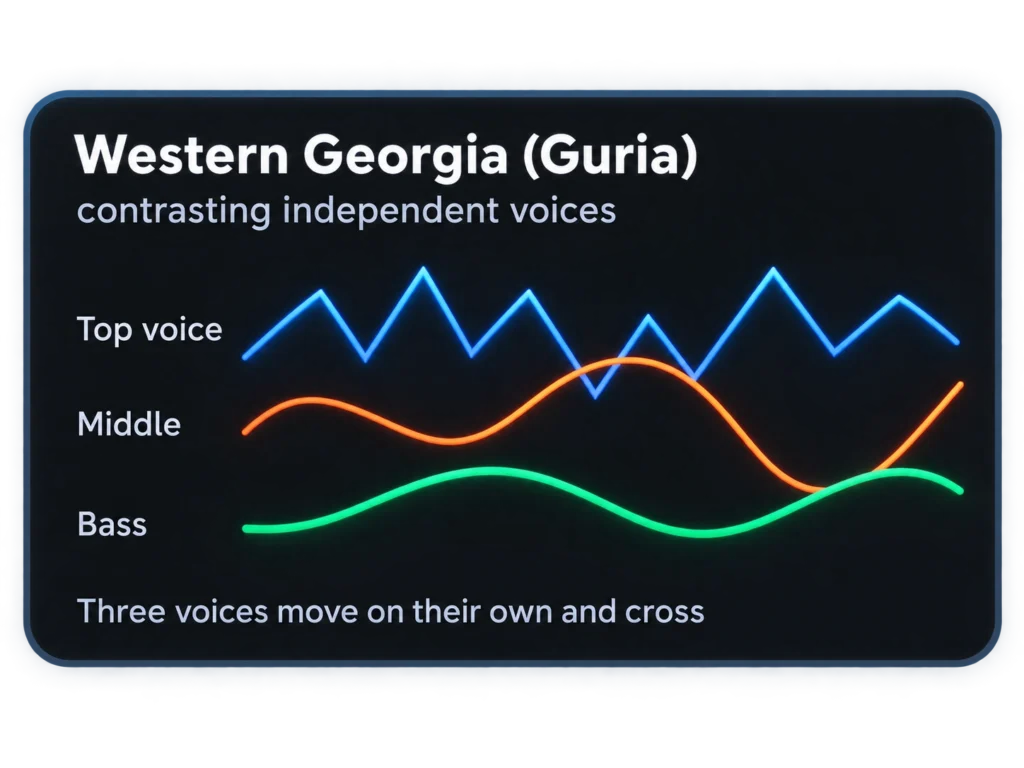
In much Georgian polyphony, no single part is “the melody” with the others supporting it. Each voice has its own line, and the relationships between them vary: one voice may hold still while another moves, two may run in parallel, or all three may go their separate ways and meet only at the end of a phrase.
The bass is not background
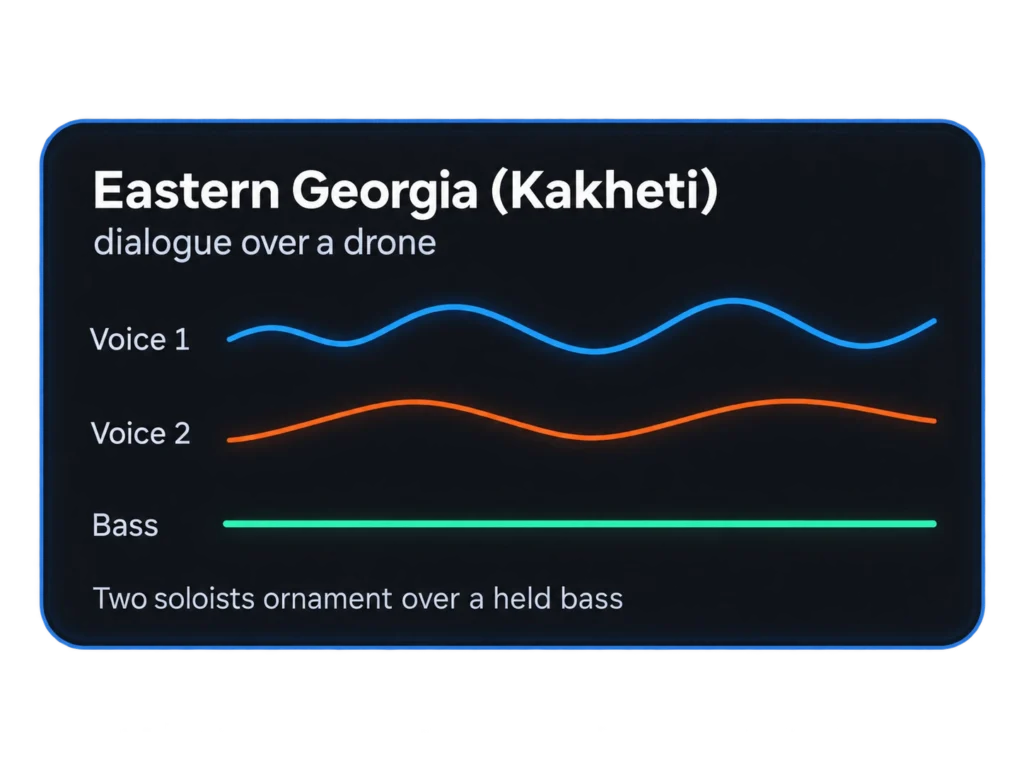
In eastern Georgia, especially in Kakhetian table songs, the bass is often a group of singers holding a long, low note, or moving very slowly, while two soloists weave above it. That held bass works like the ground under a dancer: the upper voices can take risks because it never moves.
The intervals are deliberate
Listeners raised on Western harmony often hear some Georgian chords as tense, even slightly “off”. They are not mistakes. Traditional Georgian tuning does not line up neatly with the equal-tempered system of a piano, and close, rubbing intervals are part of the sound singers aim for.
Room to improvise
In several regional styles, especially in the west, singers improvise and vary their lines within a traditional framework. The same song does not sound identical every time, and good singers are judged partly on what they add to it.
Kakheti: The Sound Behind Chakrulo
Kakheti, the wine country of the east, and neighbouring Kartli share a musical dialect, and Chakrulo belongs to it. Kakhetian songs are usually in three parts and share a few traits:
- Two solo upper voices, each sung by one person, often trading phrases or overlapping.
- A group bass that holds a long, low note or moves very slowly underneath.
- Rich ornamentation in the upper parts: turns, slides and long melismas on a single syllable.
- Flexible rhythm. Many table songs breathe rather than march, stretching phrases as the singers choose.
- Length. The great Kakhetian table songs are long, unhurried pieces built for a long evening.
Long Kakhetian songs tend to feel spacious and suspended, as if the music were floating on the bass. Hold that impression; it will help when we get to Guria.
What Is Chakrulo?
Chakrulo (ჩაკრულო) is a Kartli-Kakhetian polyphonic song, traditionally sung by two soloists over a choral bass. It is one of the most demanding songs in the Georgian repertoire, and one of the most admired.
Its text is built from metaphor rather than story, and its imagery circles around courage, readiness for battle, loyalty and the defence of one’s own. Georgians often describe it as a song of resistance. It is not, however, Georgia’s national anthem, a mistake that turns up surprisingly often online.
Is Chakrulo a drinking song?
Not in the way the phrase sounds in English. Chakrulo belongs to the eastern Georgian tradition of extended table songs, sung in ceremonial and communal settings around the feast table. “Drinking song” suggests a pub chorus; Chakrulo is closer to a solemn piece of shared performance that happens to take place over wine. More on that below, in singing at the supra.
Does Chakrulo use krimanchuli?
You will sometimes read that it does, and UNESCO’s own short description of Georgian polyphony links Chakrulo with krimanchuli. Georgian ethnomusicologists, however, classify Chakrulo as a Kartli-Kakhetian song, while krimanchuli is a technique characteristic of western Georgian polyphony, above all in Guria. Treat the krimanchuli label for Chakrulo with caution: the high, ornamented upper voices you hear in it are part of the eastern table-song style.
How Chakrulo Ended Up on the Voyager Golden Record
NASA launched Voyager 2 on 20 August 1977 and Voyager 1 on 5 September 1977. Each spacecraft carries an identical Golden Record, a 12-inch gold-plated copper disc meant as a portrait of Earth for anyone, or anything, that might find it. A committee chaired by the astronomer Carl Sagan chose its contents: images, natural sounds, spoken greetings and around 90 minutes of music from across cultures and centuries.
The 27 musical selections range from Bach’s Brandenburg Concerto and Beethoven to Chuck Berry’s “Johnny B. Goode”, Indian raga, Javanese gamelan, a Japanese shakuhachi piece and Bulgarian folk singing. NASA’s track list includes one Georgian entry, credited simply as a chorus from the Georgian S.S.R. performing “Tchakrulo”, collected through Radio Moscow.
The story usually told in Georgia adds a twist. According to accounts published around the song’s later celebrations in Tbilisi, Soviet officials proposed a different song, the Russian favourite “Moscow Nights”, and the record’s compilers chose Chakrulo instead. That version has not been documented by NASA, so treat it as a good story rather than established fact.
| Chakrulo on Voyager | |
|---|---|
| Launched | 1977 (Voyager 2 on 20 August, Voyager 1 on 5 September) |
| Spacecraft | Both Voyager 1 and Voyager 2 |
| Record | The Voyager Golden Record |
| Listed as | “Tchakrulo”, Georgian S.S.R., chorus |
| Origin | Georgia, then the Georgian Soviet Socialist Republic |
| Length | 2 minutes 18 seconds |
| Where it is now | Beyond the heliosphere, in interstellar space, still travelling |
Two common errors are worth correcting. Chakrulo did not fly on Voyager 2 alone: both spacecraft carry the same record. And the song is not listed by UNESCO in its own right; the recognition belongs to Georgian polyphonic singing as a whole.
Who Sang the Chakrulo Recording?
The recording is attributed to the Georgian State Folk Song and Dance Ensemble, the group known today as Erisioni, with Ilia Zakaidze and Rostom Saginashvili as the two soloists. According to members of the ensemble, the singers had no idea at the time that their performance had been chosen to leave the solar system; Georgia only began to celebrate the connection decades later.
There is something fitting about that. Two singers recorded a table song, the way such songs are passed around a feast, and it ended up as one of humanity’s messages to the stars without anyone asking them first.
Guria: Georgia’s Most Virtuosic Polyphony?
If a Kakhetian table song floats, a Gurian song sprints. In Guria, the small region between the Black Sea and the Meskheti mountains, polyphony becomes a contest of independent minds. Three voices can each carry what sounds like a separate melody, crossing, interrupting and racing each other, yet the whole thing locks together with the precision of clockwork.
What to listen for:
- Truly independent parts. Each voice has its own line and rhythm; none is simply accompanying.
- Trio singing. Gurian tradition prizes small groups, often just three singers, so every voice is exposed.
- Rhythmic complexity. Fast exchanges, syncopation and phrases that seem to start in the middle of someone else’s.
- Improvisation. Singers vary their parts within the song’s structure, and the best ones are known for what they invent.
- Krimanchuli riding on top of everything.
What is krimanchuli?
Krimanchuli is a high, yodel-like vocal technique used in western Georgian polyphony, above all in Guria. The top singer flips rapidly between chest voice and falsetto, producing a bright, leaping line that interacts with the other voices rather than simply sitting above them.
“Georgian yodelling” is a handy shortcut, but it is only that. Krimanchuli developed within Georgian polyphony and has its own logic; it is not a borrowed Alpine yodel. In a good Gurian performance it sounds less like decoration and more like a voice that has decided to win the argument.
Naduri: Music Designed for Work
Polyphony did not grow up in concert halls. Much of it grew up in fields.
Naduri are western Georgian work songs, sung during collective labour such as hoeing, harvesting or clearing land. They are among the most complex forms in the whole tradition, often in three or four parts, and they fold the sounds of physical effort, the shouts and grunts of the work itself, into the music. The rhythm helped a group keep pace, and turning hard labour into a shared performance made a long day shorter.
Georgian researchers who travelled through Guria on recording expeditions documented a large work-song repertoire, which is a useful reminder: the songs you hear on stage today were, not long ago, tools for getting a field dug.
Svaneti: A Completely Different Sound
High in the north-west, Svaneti sings in yet another way. Where Gurian voices split apart, Svan voices tend to move together, in dense, block-like chords that sound heavy and close, as if the singers were leaning on each other’s shoulders.
What sets Svan singing apart:
- Collective sound. Less emphasis on one virtuoso soloist, more on the weight of the group.
- Dense harmony. Chords stacked closely, with sharp, rubbing intervals.
- Ritual and dance. Many songs belong to round dances and to religious and seasonal rituals rather than to the table.
- The Svan language. Much of the repertoire is sung in Svan, a separate Kartvelian language, not in Georgian.
Ethnomusicologists often describe Svan polyphony as preserving musical forms of an archaic character. Be careful with claims that it is simply “older” than other Georgian traditions; that is hard to prove.
The best place to hear it in its own setting is a living ritual. During Lamproba, the February festival of torches, families sing as they carry burning birch-bark to ancestral graves.
Western Georgia Beyond Guria
Guria and Svaneti get most of the attention, but the west holds several other distinct musical dialects:
- Imereti, around Kutaisi, has a rich multi-part tradition with its own table songs and work songs, a little less extreme than Guria’s but full of moving, contrasting voices.
- Samegrelo has a separate musical dialect, and many songs are sung in Megrelian, another Kartvelian language.
- Adjara, in the south-west, has two- and three-voice traditions shaped by its long history on the Ottoman frontier.
- Racha and Lechkhumi, in the mountains east of Svaneti, have their own repertoires again.
Together they show how varied a small country can be: drive for an afternoon and the way people harmonise changes as clearly as the dialect they speak.
Singing at the Supra
The most natural home of Georgian secular polyphony is not a stage. It is the feast table.
At a traditional supra, singing rises between the toasts. There is no microphone, no conductor and no audience in the formal sense. Nobody announces a performance. Someone simply starts a line, a second voice joins, the bass gathers around the table, and a conversation turns into music. The guests are the choir.
That is the key to understanding the tradition: it was participatory music, made by the people in the room for each other. For a visitor, being at a table when this happens is usually more memorable than any concert, precisely because nobody planned it.
Sacred Polyphony: Georgian Church Chant
Georgia also has a separate, major tradition of sacred polyphony. Georgian church chant developed alongside Christianity in the country and became a distinct national form, typically sung in three parts.
Folk polyphony and church chant are not the same thing. They have different repertoires, different functions and different rules, but they grew up in the same musical culture and share some of its sound. If you hear a church choir and a village trio on the same trip, you will notice both the family resemblance and the difference.
The best chance of hearing chant is at a service in a working church or cathedral, such as Svetitskhoveli in Mtskheta. Choirs are not guaranteed at any particular service, so check locally. Our Mtskheta travel guide has practical details for visiting the town’s churches.
Was Georgian Polyphony Always Sung by Men?
No. Photos of Georgian choirs tend to show rows of men in chokhas, and male ensembles do dominate the concert stage, but the tradition itself is broader. Depending on the region and the genre, Georgia has:
- Men’s repertoire, including many table songs and work songs.
- Women’s repertoire, including lullabies, laments, healing songs and songs for particular rituals and tasks.
- Children’s songs and games.
- Mixed singing in some contexts and communities.
Who sings what has always depended on region, ritual, genre, gender and age. Today women’s and mixed ensembles perform across Georgia and abroad.
Stage Performance vs Village Singing
The Georgian polyphony most visitors hear first is staged: a professional or semi-professional ensemble in costume, performing a polished programme for an audience. It is often superb, and it is not the same thing as traditional singing.
| Stage ensemble | Traditional setting | |
|---|---|---|
| Where | Concert hall, festival stage, restaurant show | Supra, field, wedding, funeral, church, village festival |
| Who sings | Trained performers | Whoever is present and knows the song |
| Repertoire | Rehearsed, often arranged | Local versions, passed on by ear |
| Variation | Mostly fixed from show to show | Changes with the singers and the occasion |
| Audience | Listens | Usually takes part |
Neither is “fake”. Ensembles have kept many songs alive and carried them around the world. But if you have only heard Georgian music on a stage, a song that starts by accident at a village table will feel like a different art form.
How Did Georgian Polyphony Survive the Soviet Period?
It is tempting to say the Soviets banned Georgian music. They did not. What happened was more complicated, and more interesting.
Soviet cultural policy did two things at once:
- It preserved. Folk music was collected, recorded and archived. State ensembles were funded, toured widely and turned Georgian polyphony into an internationally known art form. The Chakrulo recording that went to space is itself a product of that system.
- It reshaped. Songs were arranged and standardised for the stage, religious content was pushed out of public performance, and church chant lost most of its everyday setting. Village singing, tied to rituals and farm work that collectivisation changed, came under pressure.
The result is a paradox: the same institutions that helped save a large part of the repertoire also changed how it was sung. UNESCO’s own description of the tradition notes that Georgian music suffered from socialist cultural policies, and that today it faces different threats, chiefly rural depopulation and competition from pop music.
How Is the Tradition Surviving Today?
The tradition was alive long before UNESCO took notice, and it survives today for the same reason it always did: people keep singing. It is carried in several places at once:
- Families and villages. Songs still pass from older singers to younger ones by ear.
- The supra. Table singing remains a normal, if less universal, part of a Georgian feast.
- Churches. Sacred chant has returned to regular use since the end of Soviet rule.
- Ensembles. Professional groups and a large number of amateur choirs, in Georgia and abroad, perform and teach.
- Research and archives. The International Research Center for Traditional Polyphony at Tbilisi State Conservatoire, founded in 2003, studies the tradition, safeguards archive recordings and runs field expeditions.
- Festivals and rituals. Community celebrations such as Lamproba in Svaneti keep songs in the settings they were made for.
There is also a steady stream of people learning Georgian songs abroad, from community choirs in Britain to workshops in the United States. Some of them end up travelling to Georgia to hear the songs where they come from.
Where Can Travellers Hear Georgian Polyphonic Singing?
Venues and schedules change too often to list reliably, so think in terms of settings rather than addresses:
- At a supra. The most natural secular setting. A family or winery feast in the regions is far more likely to produce real table singing than a city restaurant.
- At a church service. For sacred chant, attend a Sunday or feast-day liturgy at a cathedral or monastery, and stay quietly at the back.
- At a folklore performance. Concerts by state and independent ensembles give you technically polished versions of the great songs, with dance alongside.
- In the regions. Svaneti, Guria and other regions are where local styles are strongest, especially around village festivals and saints’ days.
- At festivals. Folk and polyphony festivals bring village groups and ensembles from across Georgia to one stage.
If you want a better than even chance of hearing singing at the table, tell your hosts or guide in advance that it matters to you. Georgians are rarely shy about a song once someone has asked.
Five Georgian Songs Worth Hearing
Many Georgian songs exist in several regional versions, so the region matters as much as the title.
| Song | Region | Why listen |
|---|---|---|
| Chakrulo | Kakheti and Kartli | The Voyager song; two soaring soloists over a held bass |
| Khasanbegura | Guria | A showcase of Gurian complexity, with fiercely independent voices |
| Naduri (any good recording) | Guria, Imereti | Work-song polyphony, with the sounds of labour built into the music |
| Lile | Svaneti | A Svan song often described as a hymn to the sun; dense, archaic-sounding chords |
| Mravalzhamieri | Many regions | A song wishing “many years” of life, sung in numerous regional versions |
One listening tip: play a Kakhetian Chakrulo and a Gurian Khasanbegura back to back. Even with no musical training, you will hear the difference between a song that floats and a song that races, and you will understand Georgian polyphony better than any definition can manage.
Georgian Polyphonic Singing FAQ
What is Georgian polyphonic singing?
It is traditional Georgian vocal music in which two or more independent voices are sung at the same time. Each region developed its own style, from Kakhetian table songs with two soloists over a sustained bass to the fast, independent voices and krimanchuli of Guria and the dense chords of Svaneti.
Why does Georgian polyphony sound unusual?
The voices often move independently rather than one melody being harmonised, the bass can hold a long drone, and traditional tuning uses close, tense intervals that do not match Western piano tuning. Many styles also leave room for improvisation, so a song is rarely sung exactly the same way twice.
How many voices are used in Georgian singing?
Most often three, but the tradition includes one-, two-, three- and four-part forms. Eastern table songs typically have two solo upper voices and a group bass, while some western work songs use four parts.
What is Chakrulo?
Chakrulo is a Kartli-Kakhetian table song for two soloists and a choral bass. Its metaphorical text speaks of courage and readiness for battle, and it is one of the most admired and technically demanding songs in Georgian polyphony.
Was Chakrulo sent into space?
Yes. A recording of Chakrulo is on the Voyager Golden Record, an identical copy of which travels aboard both Voyager 1 and Voyager 2, launched in 1977. NASA lists it as a 2:18 recording by a chorus from the Georgian S.S.R.
What is krimanchuli?
Krimanchuli is a high, yodel-like vocal technique of western Georgian polyphony, especially in Guria. The top singer switches rapidly between chest voice and falsetto, creating a leaping line that interacts with the other voices.
Is Georgian polyphonic singing UNESCO-listed?
Yes. UNESCO proclaimed it a Masterpiece of the Oral and Intangible Heritage of Humanity in 2001 and inscribed it on the Representative List of the Intangible Cultural Heritage of Humanity in 2008. It is intangible heritage, not a World Heritage Site, and individual songs are not listed separately.
Is Georgian church singing the same as folk polyphony?
No. Georgian church chant is a separate sacred tradition, usually in three parts, with its own repertoire and rules. It grew up in the same musical culture as folk polyphony and shares some of its sound, but serves a different purpose.
Where can tourists hear Georgian polyphony?
At a traditional supra, at church services for sacred chant, at folklore concerts by professional ensembles, and in regions such as Svaneti and Guria during village festivals. Asking your hosts in advance improves your chances of hearing singing at the table.


