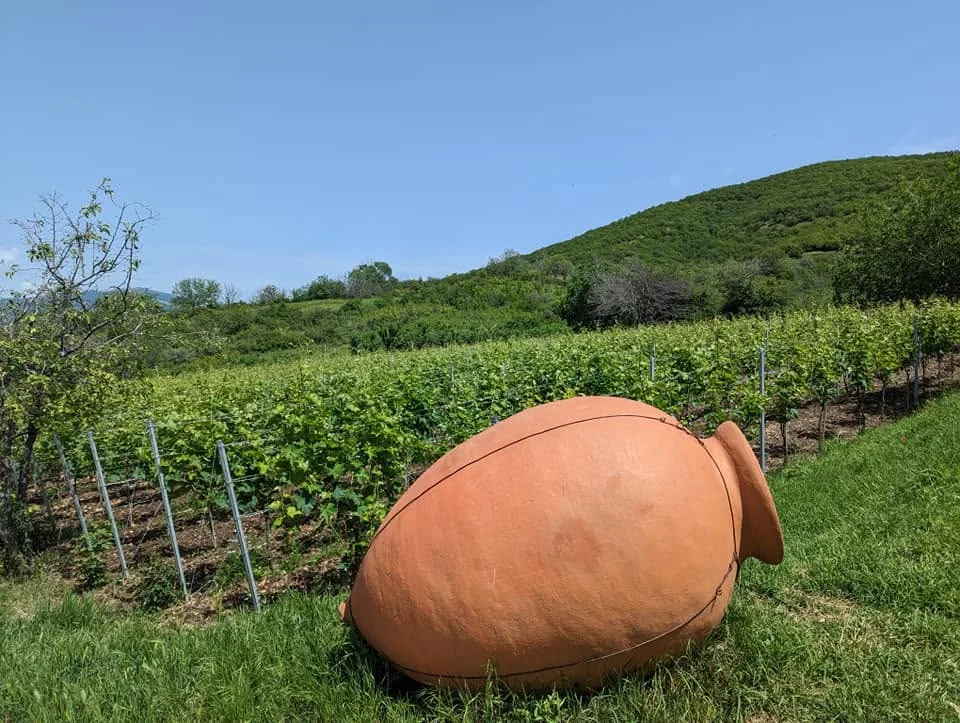
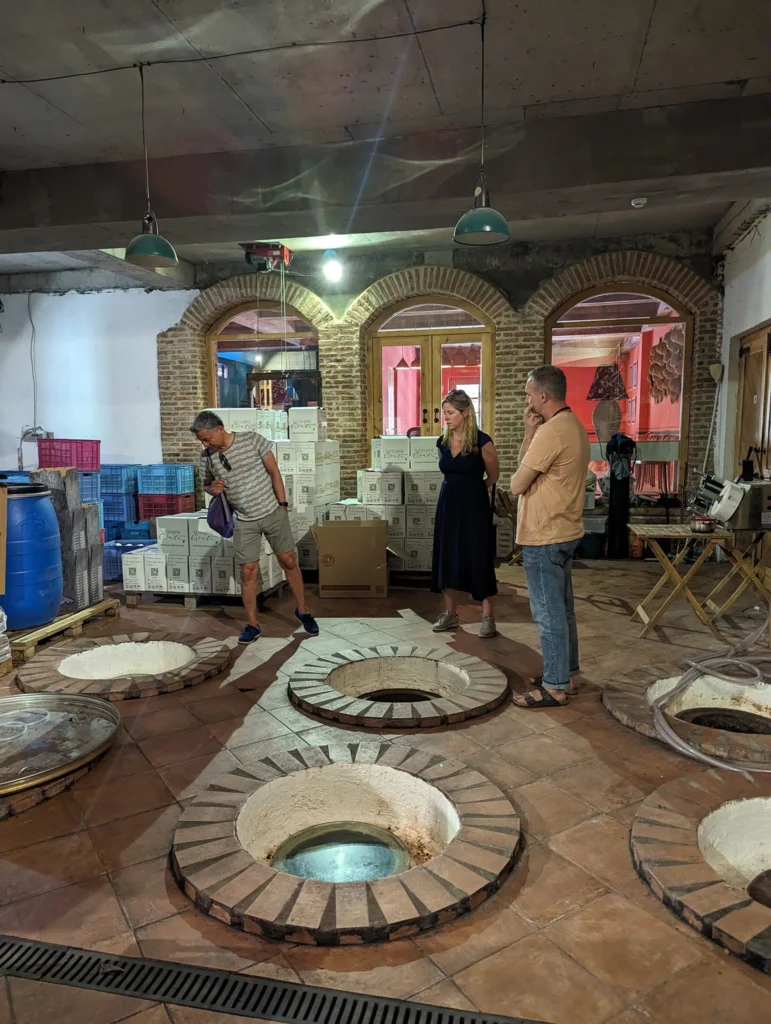
Most visitors meet a qvevri after it has already disappeared. In a Kakhetian marani, all you see is a round clay rim set into the floor, maybe with a stone lid on top, and a winemaker lowering a long-handled ladle into the dark. It looks like a well.
See the same vessel in a potter’s yard, before it goes into the ground, and the scale changes completely. A large qvevri stands taller than the person who built it, wider than a doorway at its belly, its walls just a few centimetres of fired clay. And it was made without a potter’s wheel, without a mould, by hand, one ring of clay at a time.
This article follows one qvevri from the clay pit to the cellar floor, before a single grape goes into it. In this story the winemaker plays a supporting role. The potter is the one who matters.
What Exactly Is a Qvevri?
A qvevri (ქვევრი) is a large, handmade earthenware vessel used in Georgia for fermenting, ageing and storing wine. It is usually egg-shaped, fired like pottery and buried almost completely in the floor of a marani, the Georgian wine cellar. You will also see it spelled kvevri; both transliterations refer to the same thing.
Qvevri is not an amphora
Internationally, qvevri are often called “Georgian amphorae”. It is a convenient shorthand, but a misleading one.
| Amphora | Qvevri | |
|---|---|---|
| Purpose | Transporting and storing goods, including wine and oil | Fermenting, ageing and storing wine |
| Mobility | Portable, made to be carried and shipped | Installed in the cellar floor and left there |
| Handles | Usually two | None |
| Size | Typically tens of litres | Often hundreds to thousands of litres |
| Base | Often pointed, for stacking or standing in sand | Narrow, tapered base, sunk in earth |
An amphora moves wine around. A qvevri becomes part of the building.
Is the Qvevri Really 8,000 Years Old?
Georgian winemaking is. The vessel in its modern form is younger.
Archaeologists have found pottery with chemical traces of grape wine at Neolithic sites in southern Georgia, dated to around 6000–5800 BC. That is the basis of the famous “8,000 years”. But those early jars were not today’s qvevri. Georgia’s own official documentation on the qvevri traces a series of stages: early wine pottery in the 6th–5th millennia BC, larger wine vessels from the 3rd millennium BC, and further development of the form over the following centuries.
So the honest version is this: clay vessels have been central to Georgian winemaking since prehistoric times, and the characteristic egg-shaped qvevri evolved over thousands of years. Saying that Georgians have made exactly the same qvevri for 8,000 years is a good line for a label, and not a fact.
How a Qvevri Is Made, at a Glance
A qvevri goes through nine stages before it ever holds wine. Most of them are slow, and one of them can destroy months of work in a night.
| Stage | What happens | Why it matters |
|---|---|---|
| 1. Local clay | Clay is dug near the workshop and cleaned of stones and roots | One pebble in a wall can become a crack in the kiln |
| 2. Prepare the clay | Mixed with fine sand where needed and kneaded with water | The clay must be soft enough to shape but firm enough to stand |
| 3. Form the base | A small, solid foundation is built first | Everything above rests on it |
| 4. Build the walls | Rings of clay about 15–20 cm high are added one at a time | Each ring must firm up before it can carry the next |
| 5. Dry slowly | Weeks in shade, away from drafts and direct sun | Uneven drying cracks the walls |
| 6. Fire in the kiln | About a week in a wood-fired, bricked-up kiln | The riskiest stage: hidden flaws show here |
| 7. Line with beeswax | Hot wax applied to the warm inner surface | Reduces porosity and makes cleaning easier |
| 8. Transport | The fired vessel is padded, roped and moved slowly | Huge, heavy and brittle at the same time |
| 9. Bury in the marani | Lowered into a pit, packed with earth, rim left at floor level | Support, stable temperature and permanence |
The sections below follow each stage in turn.
A Qvevri Begins With the Clay
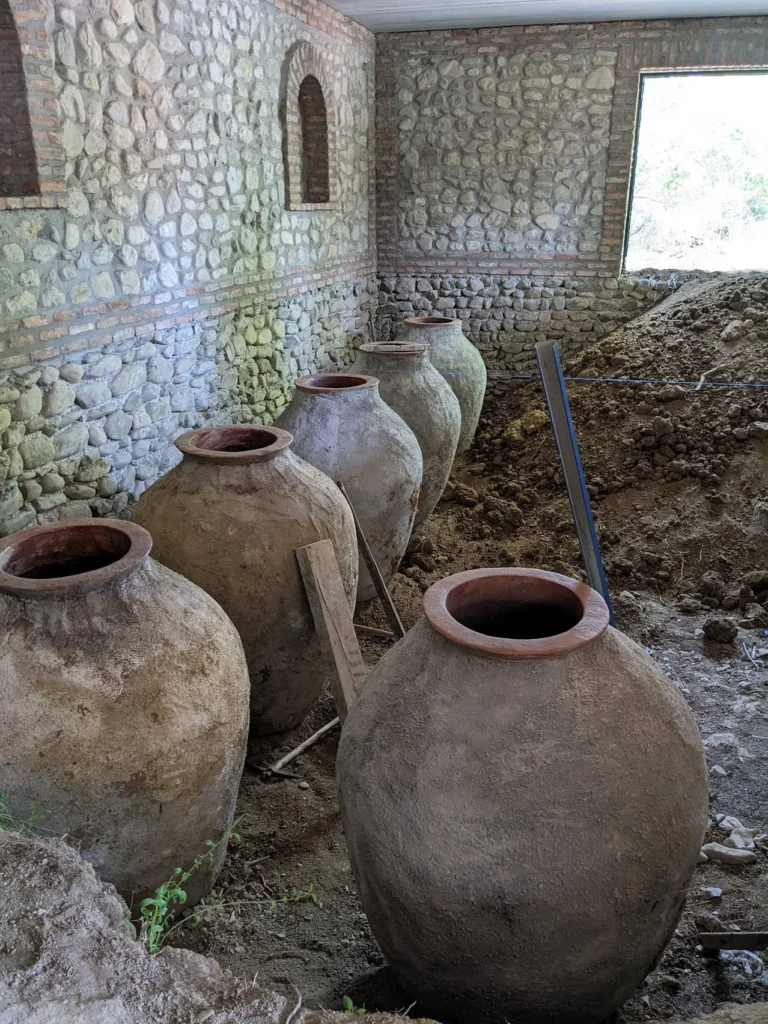
Every qvevri starts as a pile of local earth. Makers traditionally dig their clay close to the workshop, and many will tell you exactly which hillside or riverbank theirs comes from. Georgia’s official qvevri specification goes further: the raw materials must come from Georgian territory, and the vessel must be made in Georgia.
Preparing the clay is slow, physical work:
- Cleaning. Stones, roots and lumps are picked out, because a single pebble in a wall can become a crack in the kiln.
- Mixing. The clay is combined with fine alluvial sand where needed, which helps it hold its shape and dry more evenly.
- Kneading. Water is worked in until the clay reaches exactly the right plasticity: soft enough to shape, firm enough to stand.
There is no single national recipe. Each workshop adjusts the mix to its own clay, and that knowledge is one of the things passed down from master to apprentice.
Why can’t you use ordinary pottery clay?
Because a qvevri has to survive things a vase never meets. It must carry its own enormous weight while still soft, come through days in the kiln, travel on a truck, bear the pressure of the earth packed around it, and then hold hundreds or thousands of litres of fermenting wine for decades. The clay and the way the walls are built are structural decisions, not aesthetic ones.
Built by Hand, Not on a Potter’s Wheel
A qvevri is far too big for a wheel. Instead, it is built upwards from the base in rings of clay, a method closer to bricklaying than to the pottery most people picture.
The maker starts with a small, solid base, then adds a band of clay around its edge, pressing and smoothing it into the wall below. The official specification puts each new layer at about 15 to 20 centimetres high. Then comes the part that defines the craft: the maker stops and waits.
Wet clay is weak. If you build a two-metre wall in a day, the bottom slumps under the weight of the top. So each layer has to firm up enough to carry the next before work continues. Build, wait, build, wait. A qvevri grows only as fast as its last ring can bear the next one.
Many makers work on several vessels at once, moving from one to the next as each layer stiffens, so a workshop in the building season is a forest of half-finished jars at different heights.
How long does it take?
It depends on the size of the vessel, the weather and the workshop. Georgia’s National Wine Agency and individual makers put the average at around three months for a large qvevri, from the first layer to a finished, fired vessel, with most of that time spent building and drying. Smaller vessels take less; very large ones can take longer.
[Placeholder – if possible, add a short quote from a qvevri maker on which stage is hardest: building the walls, drying or firing.]
Shaping an Egg Without a Mould
There is no template. No mould fixes the final shape, and no machine checks the curve. As the walls rise, the maker judges everything by eye and hand:
- The curve. The walls lean outwards from the narrow base, swell into the belly, then draw back in towards the neck.
- Wall thickness. Georgia’s official specification gives a range of roughly 25 to 40 millimetres, depending on the vessel’s capacity. Too thin and it will crack; too thick and it becomes heavy and uneven.
- Symmetry and balance. A lopsided qvevri carries its weight unevenly, which matters when it is fired, moved and buried.
- The neck and opening. Wide enough to work inside and clean, narrow enough to seal.
- The volume. The maker builds towards the capacity the winemaker ordered, usually hundreds or thousands of litres.
This is why qvevri making is a trade learned over years, not simply “big pottery”. The difficult part is not making a pot. It is making a two-metre pot stand up.
Why the egg shape?
There is no single magic explanation, but the shape does several useful things at once:
- The narrow base collects grape skins, seeds and sediment as they settle, keeping them in one place, away from most of the wine.
- The wide belly gives fermentation the volume it needs.
- The narrowing top makes the vessel easier to close and seal.
- The curved walls spread the pressure of the surrounding earth and the liquid inside evenly, the same reason an egg is strong for its thickness.
You may read that the egg shape creates a “natural vortex” that improves the wine. That is a marketing line, and not one the craft needs.
Drying: The Stage You Cannot Rush
A finished but unfired qvevri is full of water. Before it can go near a kiln, that water has to leave, slowly and evenly. If one side dries faster than the other, the clay shrinks unevenly and the wall cracks, sometimes invisibly, until the fire finds the flaw.
So makers manage the drying as carefully as the building:
- No direct sun on one side of the vessel.
- No strong drafts through the workshop.
- Steady temperature and humidity, as far as the season allows.
- Time. Weeks, not days, for a large vessel.
It is the least dramatic stage, and one of the most nerve-racking. A careless week of drying can ruin a vessel that took a month to build, before it ever reaches the kiln.
Firing a Qvevri: The Most Dangerous Stage
Once the vessel is dry, it goes into a large, purpose-built kiln, often several qvevri at a time. The kiln is wood-fired, and the opening is bricked up around the vessels to hold in the heat.
Firing is slow on purpose. Heat it too fast and the remaining moisture turns to steam inside the walls and blows them apart. Georgia’s official qvevri specification describes raising the temperature gradually over the first days and then holding it at around 1,050°C before a slow cool-down. Makers describe the whole firing as lasting about a week, sometimes a little longer. Quoted temperatures vary a lot from workshop to workshop and source to source, so treat any single figure as approximate.
What the fire does:
- Drives out the last moisture from deep inside the walls.
- Transforms the clay permanently into ceramic, rigid and water-resistant.
- Tests the work. Any hidden flaw left from building or drying shows itself now.
That last point is what makes firing so tense. Three months of building and drying come down to a few days in the fire, and when the kiln is opened, the maker finds out whether a vessel survived. One crack, and the work is lost.
Why Is Beeswax Used Inside a Qvevri?
While the vessel is still warm from the kiln, many makers coat the inside with hot beeswax. The warmth lets the wax flow into the surface of the ceramic instead of sitting on top of it.
The beeswax does three jobs:
- Reduces porosity. It fills the fine pores of the inner surface, so the clay absorbs less wine.
- Makes cleaning easier. A waxed surface is smoother and easier to scrub between vintages.
- Stays neutral. Beeswax is food-safe and does not flavour the wine.
Two cautions. Beeswax lining is common, but not every qvevri is waxed in exactly the same way, and practice varies between makers and regions. And it does not turn the vessel into a sealed tank; it reduces porosity rather than eliminating it. Be wary of precise claims about how much oxygen passes through the walls.
Wax inside, lime outside
The beeswax belongs on the inside. On the outside, many qvevri get a coat of lime wash or a thin cement-based layer, which protects the vessel during transport and once it is in the ground.
How Do You Move a 2,000-Litre Clay Vessel?
Carefully, and with a lot of help. A fired qvevri is three awkward things at once: huge, heavy and brittle. It cannot be stacked, it rolls if you let it, and a knock against a stone or a truck bed can crack it.
So the work does not end at the kiln door. Getting a finished qvevri from the workshop to the winery takes its own skills: padding and roping the vessel, lifting it without point loads on the walls, and driving slowly on village roads. UNESCO’s description of the tradition names collecting clay and making and firing qvevri among the skills passed down in families and villages; moving a finished vessel safely belongs to the same body of practical knowledge.
Why Is a Qvevri Buried Underground?
Three reasons, and they work together.
- Support. The earth packed around the vessel takes the outward pressure of hundreds or thousands of litres of liquid. Above ground, a full qvevri would be under far more stress.
- Stable temperature. Underground, the vessel is shielded from swings in cellar temperature between day and night, and between seasons. Georgia’s National Wine Agency gives a typical range of about 13–15°C for buried qvevri, though the real figure depends on the cellar, the depth and the region.
- Permanence. Once buried, the qvevri stops being a container and becomes part of the cellar itself.
That last point is easy to miss. A barrel is equipment; you can roll it out and replace it. A buried qvevri is infrastructure, more like a well than a tank, and many stay in the same spot for generations.
How a Qvevri Is Installed in a Marani
The marani (მარანი) is the Georgian wine cellar, traditionally treated as one of the most respected rooms in a family home. Installing a qvevri in one follows a simple sequence:
- A pit is dug to the depth and shape of the vessel.
- The qvevri is lowered in, slowly and level.
- The space around it is filled and packed so the walls are supported evenly all the way round.
- The rim is left at floor level, accessible from above.
- The cellar floor is finished around it, often in stone or clay, so that only the mouth remains visible.
To see how a working marani looks once the vessels are in use, read what 8,000 years of winemaking actually tastes like.
Does Every Georgian Qvevri Look the Same?
No. The basic idea is shared, but size and proportions vary by region and by workshop. It is worth knowing, because Kakhetian wine culture often gets presented as the whole of Georgian wine culture, and it is not.
Kakheti
Kakheti, the country’s main wine region, is associated with the biggest vessels. Georgia’s National Wine Agency records Kakhetian qvevri of 6,000 to 8,000 litres, although the ones you are most likely to see in a family marani hold around 1,000 to 2,000 litres. The village of Vardisubani, near Telavi, is one of the best-known qvevri-making centres, and Kakheti is where our organic wine tour stops at a qvevri master’s workshop.
Imereti
In Imereti, western Georgia’s main wine region, vessels are often smaller, and the regional wine style uses less grape solids (more on that below). The village of Shrosha is known for its potters.
Guria
Guria, better known for its tea and its singing, also keeps the craft alive in a handful of villages. It is another reminder that western Georgia’s farm traditions are as rich as the east’s; our article on Georgian tea tells a related story of a rural craft rebuilt by small producers.
Qvevri or Churi?
In parts of western Georgia, especially Imereti and Guria, clay wine vessels have traditionally gone by another name: churi. Be careful with the shortcut that a churi is simply “a small qvevri”. Regional terms and forms overlap in complicated ways, and usage differs from village to village.
For a visitor, the simple version is enough: qvevri is the internationally recognised Georgian word, and western Georgian wine regions keep their own older names alongside it, including churi.
Who Still Makes Qvevri Today?
Qvevri making is a specialist craft, and it has always been a small one. The skills run in families, are learned by working beside a master for years, and are concentrated in a few traditional villages in Kakheti, Imereti and Guria.
You will find exact numbers online, such as “only eight families still make qvevri”. Treat them with caution. The count depends on who you include, from full-time workshops supplying commercial wineries to part-time makers working for their neighbours, and it changes from year to year. What is safe to say is that the number of specialist workshops is small compared with the size of Georgia’s wine industry.
The craft has had a boost in recent years. Demand now comes from Georgian family cellars, commercial wineries and winemakers abroad who want genuine Georgian vessels. The UNESCO recognition also drew attention to the potters as well as the winemakers.
Is Qvevri Making UNESCO Heritage?
Not as a separate listing, but it is part of one. In 2013 UNESCO inscribed the “Ancient Georgian traditional Qvevri wine-making method” on the Representative List of the Intangible Cultural Heritage of Humanity.
What makes that inscription interesting for this article is how much of it is about the vessel. UNESCO’s description explains that knowledge of qvevri manufacture and winemaking is passed down through families, neighbours, friends and relatives, and that children learn to tend vines, press grapes, ferment wine, collect clay, and make and fire qvevri by watching their elders.
Two things it is not:
- It is not a World Heritage Site. It is intangible cultural heritage, a living practice.
- The pottery is not listed on its own. Qvevri making is recognised as part of the wider winemaking tradition, not as a separate element.
After the Qvevri Is Made: What Goes Inside?
Only now, months after the first ring of clay, does the qvevri meet any grapes. The winemaking itself deserves its own article, so here is the short version:
- The grapes are crushed after the harvest, the Rtveli.
- The juice goes into the qvevri together with, depending on the region and the winemaker, a share of the skins, seeds and sometimes stems.
- It ferments in the buried vessel, then the qvevri is sealed and the wine matures on its solids for several months.
- The wine is drawn off into a clean qvevri or into bottles.
- The qvevri is cleaned and made ready for the next vintage.
Note that traditionally the grapes are pressed or crushed first; the “whole grapes go into the qvevri” line you sometimes read is too simple.
Kakhetian vs Imeretian qvevri wine
The biggest regional difference is how much of the grape solids, called chacha in Georgian, goes into the vessel.
| Kakheti | Imereti | |
|---|---|---|
| Grape solids in the qvevri | Traditionally all of them | A smaller share, often cited as up to about a third |
| Typical result for white grapes | Deep amber, firm tannin | Lighter, fresher amber or white |
For the grapes themselves and the regions they come from, see our guide to Georgian wine varieties.
How Long Can a Qvevri Last?
A well-made, well-installed qvevri can stay in use for many decades, and some family cellars still use vessels made generations ago. How long one lasts depends on the quality of the build and the firing, how it was buried, and above all how carefully it is cleaned and maintained.
That is a real difference from a barrel. Oak barrels are often replaced after a number of vintages, partly because they stop giving flavour. A qvevri is not meant to flavour the wine at all, so a sound one has no reason to be retired. It simply becomes part of the family cellar.
How Is a Qvevri Cleaned?
The craft does not end with firing. It continues every year, with a brush.
After the wine is drawn off, the inside of the qvevri is scrubbed with water and long-handled brushes, traditionally made from plant material such as cherry bark, then rinsed thoroughly. In some cellars, lime is also used on the inside walls between vintages. Someone usually has to lean deep into the vessel, or even climb inside a large one, to do it properly.
One myth to avoid: clay is not magically self-cleaning, and qvevri do not need less hygiene because they are “natural”. The reverse is true. A badly cleaned qvevri can spoil the next vintage, and Georgian winemakers take the job very seriously.
Why Qvevri Making Still Matters
Without qvevri makers, there is no qvevri wine, only qvevri museums.
That is the real reason the craft matters. The tradition UNESCO recognised is not one skill but a chain of them: growing vines, harvesting, pressing, fermenting, sourcing clay, building walls ring by ring, drying, firing, waxing, burying, cleaning and teaching the next generation. Break any link and the rest stops working. A winemaker can buy a steel tank anywhere in the world. A qvevri has to be made by someone in a Georgian village who learned how from someone else.
So when you next taste amber wine in a marani, look at the round rim in the floor and think about what is under it: a vessel that took a season to build, that survived its week in the fire, and that a potter somewhere in Kakheti, Imereti or Guria will be making again next spring.
If you would like to see a qvevri before it disappears into the ground, our Organic Wine Tour in Kakheti includes a visit to a qvevri master who still builds the vessels by hand, alongside tastings at three family qvevri estates.
[Placeholder – Highlander Travel expert note: if our guides take guests to a qvevri maker, add one genuine observation here, e.g. how guests react to seeing an unburied vessel for the first time.]
Qvevri FAQ
What is a qvevri made from?
Local clay, cleaned of stones and often mixed with fine sand, kneaded with water to the right plasticity. After firing, the inside is usually coated with beeswax, and the outside often gets a lime or cement wash for protection.
How is a qvevri made?
By hand, without a potter’s wheel or mould. The maker builds the walls upwards from the base in rings of clay about 15–20 cm high, letting each layer firm up before adding the next. The vessel is then dried slowly, fired in a wood-fired kiln for about a week, lined with beeswax and buried in the cellar floor.
How long does it take to make a qvevri?
Around three months on average for a large vessel, according to Georgia’s National Wine Agency and makers, though size, weather and workshop methods all change the timing. Most of that time goes on building and drying.
Why are qvevri buried underground?
The earth supports the walls against the pressure of the wine, keeps the temperature stable (typically around 13–15°C) and turns the vessel into a permanent part of the cellar.
Why is beeswax used in a qvevri?
Beeswax, applied hot to the warm inner surface, reduces the clay’s porosity, makes the vessel easier to clean and is food-safe and neutral in flavour. It is widely used, though practice varies between makers.
Is a qvevri the same as an amphora?
No. Amphorae were portable vessels with handles, used to transport and store goods. A qvevri has no handles and is buried in the cellar floor, where it is used to ferment, age and store wine.
How big can a qvevri be?
Most qvevri in family cellars hold around 1,000–2,000 litres. Georgia’s National Wine Agency records Kakhetian vessels of 6,000–8,000 litres, and much smaller ones are made too.
Is qvevri winemaking UNESCO-listed?
Yes. The “Ancient Georgian traditional Qvevri wine-making method” was inscribed on UNESCO’s Representative List of the Intangible Cultural Heritage of Humanity in 2013. It includes the knowledge of making qvevri, but it is intangible heritage, not a World Heritage Site.
Is qvevri wine really 8,000 years old?
Georgian winemaking is: chemical traces of wine in pottery from southern Georgia date to around 6000–5800 BC. The egg-shaped qvevri in its modern form developed later, over thousands of years.