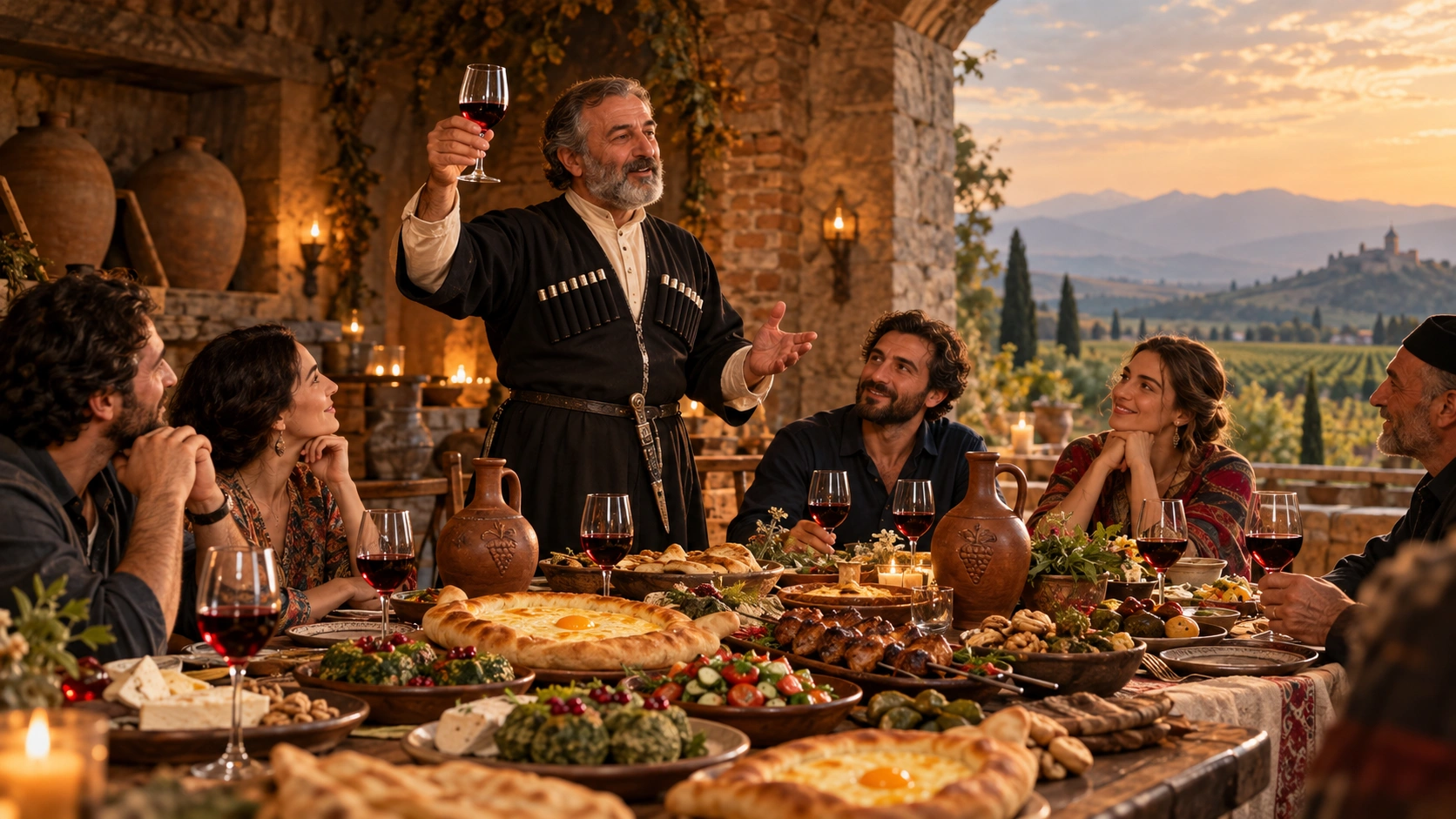
Nobody hands you a menu. Plates arrive anyway, then keep arriving until their rims overlap: cheese, aubergine rolls, a loaf still too hot to tear. Your glass has been filled, yet nobody at the table is drinking. People talk, pass bread and reach across each other for bunches of tarragon.
Then one person raises a glass, and the table goes quiet.
That person is the tamada, and the quiet is the moment an ordinary meal turns into a supra. What follows has a shape: themes, speeches, answers, songs, a rhythm of talking and drinking that every Georgian at the table seems to understand without being told.
This guide is written from the guest’s chair. It explains what the tamada is doing, when you are expected to drink, what to say if someone hands you the floor, and why nobody minds if you leave half your wine in the glass.
What Is a Georgian Supra?
A supra (სუფრა) is a Georgian communal feast built around shared food, wine, conversation and a sequence of toasts led by a tamada. The word literally means “tablecloth”, which is a fair summary: everything happens on, around and over it.
Georgians distinguish two broad kinds:
- Keipi – the festive supra, for birthdays, weddings, christenings, holidays, the end of the grape harvest or the arrival of an important guest.
- Kelekhi – the memorial supra held after a funeral or on remembrance days. The structure is similar, but the tone is grave, and the toasts are for the dead and for those left behind.
Not every Georgian meal is a supra
A plate of khinkali with friends is not a supra. Neither, usually, is a restaurant dinner with Georgian dishes, however much food arrives. What makes a supra is not the menu but the structure: a tamada, toasts with themes, and a table that follows them.
Many meals sit somewhere in between. A family lunch at a village winery may start relaxed and drift into a few proper toasts once the second jug arrives. You will usually feel the moment it changes.
Is the Georgian supra UNESCO heritage?
No, not as a standalone element. The traditions of the Georgian supra were added to Georgia’s own national list of intangible cultural heritage in 2017. You will see claims online that the supra is “UNESCO heritage”; that is a mix-up, possibly with the Georgian qvevri winemaking method, which UNESCO did inscribe in 2013.
What Makes a Meal a Supra?
A supra has a cast and a loose script. Learn who does what, and the noise around you starts to make sense.
| Element | What it is | What it means for you as a guest |
|---|---|---|
| The table | Dishes are shared and keep coming; nobody orders a personal plate | Help yourself, and expect to be helped |
| Tamada (თამადა) | The toastmaster who leads the evening | Follow their lead on when to drink and listen |
| Merikipe (მერიქიფე) | At larger or formal supras, the person who keeps glasses and jugs filled | Your glass will be topped up; you can decline |
| Toasts (sadghegrdzelo) | Short speeches on a theme, followed by drinking | The core of the evening, not a background ritual |
| Wine | Traditionally homemade, often from qvevri | Raise your glass; how much you drink is up to you |
| Song, stories, humour | Polyphonic singing, poems, jokes, sometimes dancing | Join in as far as you like; listening is participation too |
The Georgian word for a toast, sadghegrdzelo (სადღეგრძელო), is built on the idea of long life. A toast, in other words, is a public wish for someone’s wellbeing, said out loud in front of everyone.
One more thing guests notice: the table rarely empties. Plates are stacked on top of plates. A bare patch of tablecloth is, to a Georgian host, a small embarrassment, so do not take a full table as a sign that you must eat everything on it.
Who Is the Tamada?
The tamada (თამადა) is the toastmaster who leads the supra, choosing the themes of the toasts and setting the pace of the evening. Calling the tamada a master of ceremonies undersells the job. A closer comparison is a conductor who also has to improvise the music.
Over a long evening, a good tamada will:
- Choose the themes of the toasts and adapt them to the occasion, so a wedding and a farewell dinner never sound alike.
- Set the pace, deciding when the next toast comes and when the table needs time simply to eat and talk.
- Hand out the floor, inviting others to speak on a theme so that every guest, including foreign ones, has a voice.
- Balance the mood, moving from a solemn toast to a light one without the table feeling the gear change.
- Read the room, noticing who is tired, who has drunk enough, and who has something to say but is too shy to ask.
- Start the singing, at tables where songs are part of the evening.
How is the tamada chosen?
At a family table the host often leads, or asks someone respected to do it. At larger events the hosts choose in advance. They look for a mix of qualities: eloquence, humour, judgement, knowledge of the traditions and the ability to stay in control of both the table and themselves.
Traditionally the tamada has usually been a man, and at many tables still is. It is not a rule, though. Women lead supras too, particularly in cities and at gatherings of friends.
The skill that is hardest to see from outside is timing. Knowing when a serious toast needs complete silence, when a guest should be invited to speak, and when the evening simply needs a joke is what separates a good tamada from someone who just talks a lot.
[Placeholder – Highlander Travel expert note: add a genuine observation from our guides or hosts, e.g. what guests notice about a good tamada at a winery supra. Do not publish without real input.]
How Georgian Toasts Actually Work
A Georgian toast is a short speech on a theme, not a quick “cheers”. It might be a memory, a blessing, a story with a point, a thank-you or a piece of philosophy that arrives by way of a joke.
At a traditional supra, a toast usually unfolds like this:
- The tamada announces a theme, such as peace, parents or friendship.
- The tamada speaks on it, sometimes for half a minute, sometimes for five.
- Others may be invited to add to it, one after another (this is the alaverdi, explained below).
- The table drinks to the theme once it has been spoken.
- Conversation and eating resume until the tamada opens the next theme.
At a traditional or formal supra, wine is normally drunk in connection with the toasts rather than sipped casually throughout the meal. Family tables are often looser. Water, juice and lemonade are fine at any moment.
Is There a Fixed Order of Georgian Toasts?
There is no single fixed order of toasts at every Georgian supra. The sequence depends on the region, the family, the occasion and, above all, the tamada. In parts of western Georgia, for example, the first toast is often to peace; elsewhere a table may begin with God, or with the reason everyone has gathered.
Certain themes do turn up at most festive supras. Treat this as a map of the territory, not a numbered script:
| Common theme | What the toast is about |
|---|---|
| Peace | Gratitude that the table can gather at all |
| God or a blessing | More common at religious or traditional tables |
| The occasion | The birthday person, the couple, the harvest, the guest of honour |
| Georgia | The country and belonging to it |
| Parents and ancestors | Those who came before and made this table possible |
| The departed | Remembrance of those who have died |
| Children | The next generation and the future |
| Guests | Hospitality, and the people who travelled to be here |
| Friendship | The bonds around this table |
| Love | Partners, family, the people who matter most |
| Meeting again | The hope that everyone will gather once more |
The toast to those who have died
The mood changes noticeably for this toast. Voices drop, and at some tables people stand. In many families glasses are not clinked for the departed, and some people pour a little wine onto bread or the table in their memory.
Customs differ from family to family, so the simplest rule for a foreign guest is to watch the table and follow the tamada.
What Does “Alaverdi” Mean at a Supra?
Alaverdi (ალავერდი) is the tamada handing the floor to another person so they can continue the same toast. It does not mean “cheers”, and it is not an invitation to toast whatever you like.
Say the tamada raises a glass to friendship, speaks for a minute, then turns to you: “Alaverdi to our guest from Germany.” Your job now is to say something about friendship. Toasting the food or the view at this point would be like answering a different question.
The person who receives alaverdi may, in turn, pass it on to someone else, so a single theme can travel around the table like a ball in a slow, polite game of catch.
If you are given alaverdi:
- Keep it short. Twenty to forty seconds is plenty. Nobody expects a polished speech from a visitor.
- Stay on the theme. Start by picking up the tamada’s subject in a sentence.
- Add one personal thought. A memory, an observation from your trip, something you noticed at this very table.
- Thank your hosts if it fits the theme.
- Finish with “Gaumarjos!” and drink, or simply raise your glass.
What Does “Gaumarjos” Mean?
Gaumarjos (გაუმარჯოს) is the word Georgians say when they drink to a toast. Literally it carries the sense of “victory to” or “may it prevail”; in practice it works like “cheers” or “to…”.
You will hear it on its own, or attached to what is being toasted:
- საქართველოს გაუმარჯოს (Sakartvelos gaumarjos) – “To Georgia.”
- ჩვენს მეგობრობას გაუმარჯოს (chvens megobrobas gaumarjos) – “To our friendship.”
It shares its root with გამარჯობა (gamarjoba), the everyday “hello”, which carries the same idea of victory. The usual reply, გაგიმარჯოს (gagimarjos), wishes it back to you.
Do You Have to Drink Every Glass?
No. Taking part in a supra means taking part in the toasts, not matching the table glass for glass. A good tamada is admired for eloquence and moderation, not for how much wine they can put away, and the same goes for guests.
A few habits help:
- Raise your glass for every toast. That is the gesture that counts. A sip is enough.
- Do not try to keep up with Georgians who have been drinking homemade wine at family tables all their lives.
- Drink water between toasts. There will almost always be a jug of it, or mineral water such as Borjomi, on the table.
- Leave your glass full if you do not want a refill. Whoever is pouring will read a full glass as a polite no.
- Tell your host early if you do not drink alcohol at all. Then raise a glass of water, juice or lemonade with everyone else.
You may meet the occasional enthusiast who insists you empty your glass. Raise it, take a sip and carry on. At a well-run table, the tamada will usually step in before you have to.
What about the drinking horn?
The kantsi (ყანწი) is a horn, traditionally made from a goat or ram’s horn, sometimes mounted in silver. It appears at weddings, big celebrations and for special toasts. Because it cannot be set down until it is empty, being handed one is both an honour and a challenge.
It is not part of every supra, and at most family tables you will never see one. If it does come your way and you would rather not drain it, it is acceptable to say so, or to ask for only a small pour.
What Food Is Served at a Georgian Supra?
There is no fixed supra menu. What lands on the table depends on the season, the region, the occasion and whoever is cooking. Some dishes appear so often, though, that you can almost count on them:
- Bread and cheese – shoti or tonis puri from the clay oven, and a salty white cheese such as sulguni or imeruli.
- Pkhali – small balls or patties of spinach, beetroot or other vegetables pounded with walnuts and herbs.
- Badrijani nigvzit – fried aubergine rolled around a walnut and garlic paste, often scattered with pomegranate seeds.
- Fresh herbs and salads – bunches of tarragon, coriander and basil are eaten as they are, not just used as garnish.
- Khachapuri – cheese bread, in whichever regional style the hosts prefer; our guide to khachapuri sorts out the differences.
- Mtsvadi – meat grilled over vine cuttings, usually pork, arriving later in the evening.
- Seasonal and festive dishes – satsivi (poultry in walnut sauce) at New Year, or whatever the garden produced that week.
What surprises most visitors is the order, or the absence of one. A Georgian table does not move neatly from starter to main to dessert. Dishes accumulate, stay out, get refilled, and new ones are squeezed in between. Pace yourself: the best thing on the table may arrive two hours in.
Khinkali, when they appear, come with a small etiquette of their own; our khinkali guide explains how to eat them without losing the broth.
Wine and the Supra
At a supra, wine is less a drink than the medium of the toasts. Ideally it is the family’s own wine, made from their own grapes, often fermented in a qvevri, the large clay vessel buried in the ground that is central to Georgian winemaking. Hosts are proud of it in the way other people are proud of their children’s school reports, and they will want to know what you think.
Even so, nobody at a good supra measures the evening in bottles. What guests remember afterwards is what was said.
To learn more about the grapes in your glass, see our guide to Georgian wine varieties. For what happens in a family cellar before the jug reaches the table, read what 8,000 years of winemaking actually tastes like. And if you would like a seat at a winery table yourself, several of our wine tours in Georgia end with a traditional meal.
The supra at Rtveli
Rtveli, the grape harvest in late summer and autumn, is one of the most natural settings for a supra. After a day of picking and pressing, families and helpers often sit down together at a long table, and the toasts turn to the vines, the year’s work and the wine still to come.
The supra is not limited to the harvest, but this is its most natural setting. To join one, plan your trip to Kakheti for the second half of September or October, and read our guide to Rtveli in Georgia for timing and how to take part.
Are All Georgian Supras the Same?
No. The structure is recognisable everywhere, but the size, tone and formality change with the occasion.
| Type of supra | What to expect |
|---|---|
| Family supra | Smaller, flexible, often noisy. Toasts mix with ordinary conversation, and the tamada may be the host |
| Wedding supra | Large, long and ceremonial. Hundreds of guests, a carefully chosen tamada, music and dancing |
| Harvest (Rtveli) supra | Outdoors or in the cellar, after work. Earthy, generous, focused on the vines and the year |
| Holiday or religious table | Extra themes linked to the feast day, and often specific dishes |
| Memorial supra (kelekhi) | Quiet and serious. Not an occasion for jokes, songs or clinking glasses |
| Restaurant “supra” | Anything from a properly led feast with a hired tamada to a group dinner with Georgian food and a few toasts |
If a tour or restaurant offers you a “supra”, it is worth asking what that means in practice. A real tamada and a table that follows the toasts make the difference.
Regional differences
Each region of Georgia has its own habits around the table. Kakheti, the wine country, is known for long, wine-centred feasts. In western Georgia, including Guria and Imereti, the order and style of toasts can differ noticeably, and Gurian tables are known for their singing.
The practical lesson for a guest is the same everywhere: there is no single Georgian supra script, so the tamada’s version is the right one for that evening.
Georgian Supra Etiquette for Foreign Guests
Georgian hosts are forgiving with foreigners. Nobody expects you to know the rules, and small mistakes are met with laughter rather than offence. A few habits, though, will make you a better guest straight away.
| Do | Don’t |
|---|---|
| Listen while a toast is being made | Carry on a side conversation during a serious toast |
| Follow the tamada’s lead | Propose your own unrelated toasts over the tamada |
| Speak when invited, briefly and sincerely | Panic when you are given alaverdi |
| Raise your glass for each toast | Feel you must finish every glass |
| Mention dietary needs before the meal | Expect the table to work like a restaurant order |
| Follow the table during the memorial toast | Clink glasses automatically when the departed are toasted |
| Thank your hosts, during the evening and at the end | Treat the supra as a drinking contest |
If You Are Invited to a Georgian Home
Should I bring something?
It is a kind gesture, not an obligation. Good choices include a box of chocolates or sweets, flowers, a bottle of wine, or something small from your own country, which often sparks the best conversations of the evening. Do not worry about getting it exactly right.
Should I arrive hungry?
Yes. The amount of food at a Georgian table is usually far more than first-time visitors expect, and your hosts will keep offering more. Hosts notice which dishes you go back to, and more of them tends to appear.
What about dietary requirements?
Tell your hosts before the meal, not when the plates arrive. This matters most if you are vegetarian or vegan, have allergies, follow religious food rules or do not drink alcohol. Georgian cooking has many meat-free dishes, especially during Orthodox fasting periods, so hosts usually have plenty of options once they know.
Can I leave early?
Yes, but do not slip away unnoticed. Tell your host, and if there is a tamada, let them know too. They may propose a short toast to see you off, which is a nice way to leave.
How to Give Your First Georgian Toast
Sincerity matters more than eloquence. Nobody minds a clumsy sentence from a visitor. A recited stock phrase is what falls flat. If you are handed alaverdi or asked to say a few words, this four-step shape works almost every time:
- Pick up the theme. “Thank you for this toast to friendship.”
- Make it personal. “I came to Georgia as a visitor, but sitting at this table, it already feels less like a foreign country.”
- Wish something. “I hope we meet around a table like this again, here or in my home.”
- Finish. “Gaumarjos!”
That takes about twenty seconds, which is plenty.
Three small things help. Look at the people you are toasting rather than at your glass. Say gaumarjos with some conviction, not as a question. And if your hosts have been feeding you all evening, a short thank-you to whoever cooked will rarely be out of place.
Georgian Supra FAQ
What is a supra in Georgia?
A supra is a Georgian communal feast where shared food and wine are accompanied by a series of themed toasts led by a toastmaster called the tamada. It marks occasions from birthdays and weddings to harvests and memorials.
What does supra mean in Georgian?
Supra (სუფრა) literally means “tablecloth”. By extension it refers to the feast laid on it.
What is a tamada?
The tamada is the toastmaster of a Georgian supra. They choose the themes of the toasts, set the pace of the evening, invite others to speak and keep the table in balance.
What is alaverdi?
Alaverdi is when the tamada passes the floor to another guest, who continues the same toast theme. It is not a general “cheers” and not an invitation to change the subject.
What does gaumarjos mean?
Gaumarjos is the word Georgians say when drinking to a toast. It literally carries the sense of “victory to” and is used much like “cheers” or “to…”.
Do you have to drink alcohol at a Georgian supra?
No. Raise your glass for the toasts, sip as much or as little as you like, or tell your host in advance and toast with water or juice.
Is there a fixed order of Georgian toasts?
There is no single fixed order. Common themes include peace, the occasion, Georgia, parents, the departed, children, guests and friendship, but the sequence depends on the region, the occasion and the tamada.
What should I bring to a Georgian supra?
Nothing is required. Chocolates, sweets, flowers, wine or a small gift from your home country are all welcome gestures.
Is the Georgian supra UNESCO heritage?
No. The supra was added to Georgia’s national list of intangible cultural heritage in 2017, but it is not inscribed on UNESCO’s lists. Georgian qvevri winemaking, however, is on UNESCO’s Representative List.