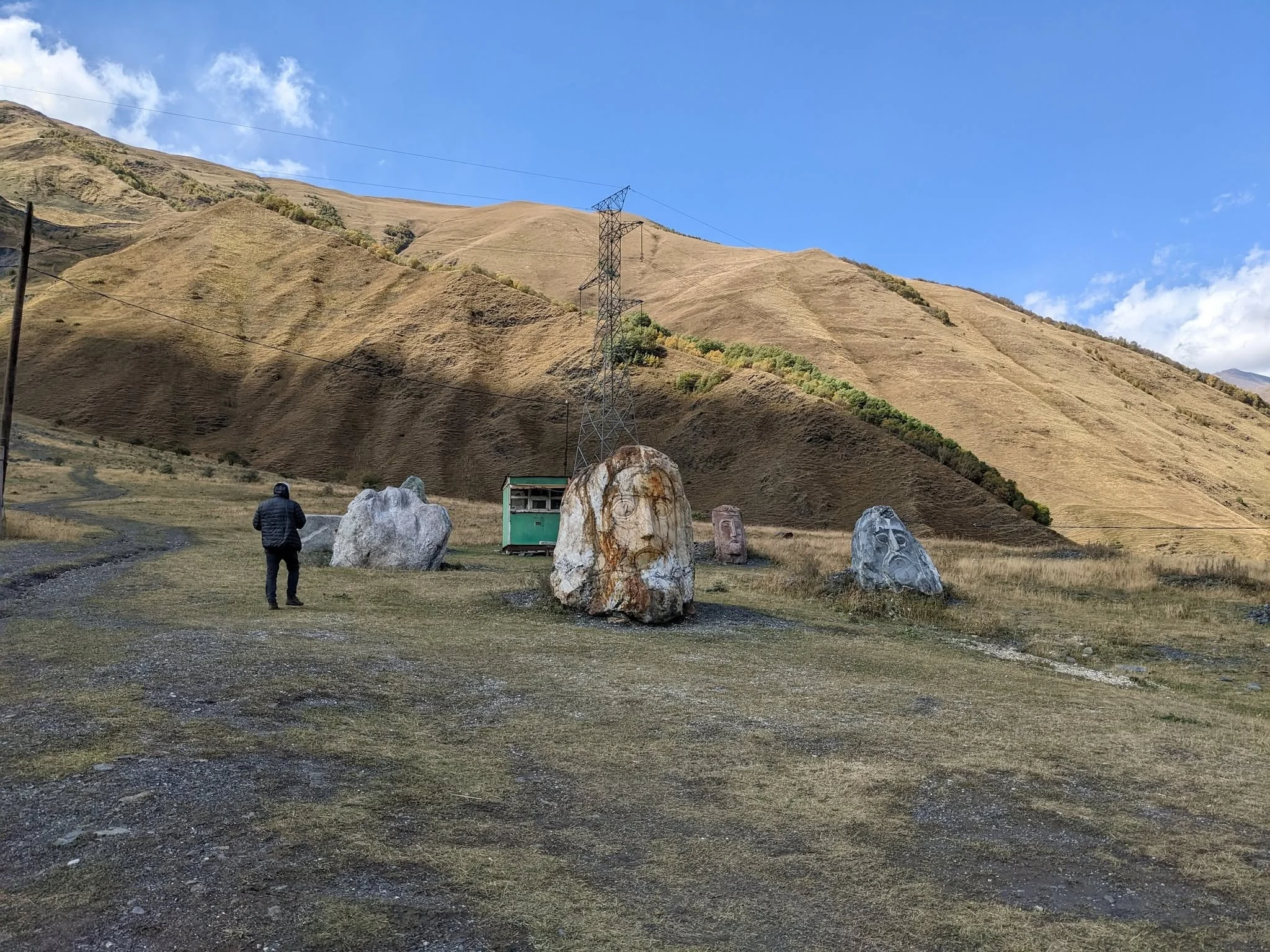
The first one stops you mid-sentence. You round a bend on the road to Juta, and there on a grassy slope is a face several times taller than you, grey granite, staring out across the valley as if it has been waiting for you for centuries. Then you notice the others, a whole row of them, like a council of giants that sat down in the meadow and never got up again. Mount Kazbek is somewhere behind you, and for once nobody’s looking at it.
The Sno stone heads are a group of giant granite sculptures of Georgian poets, writers and saints in Sno village, about 4 km southeast of Stepantsminda (Kazbegi). They’re the life’s work of Merab Piranishvili, a sculptor born in Sno, who has been carving them by hand since 1984. Entry is free, they’re on the way to Juta, and a visit takes 30–60 minutes.
The Sno stone heads at a glance
- Where: Sno village, Kazbegi district, at the turn-off from the Georgian Military Highway toward Juta.
- What: seven monumental granite sculptures, mostly heads, of Georgia’s greatest writers plus St George and Christ.
- Who made them: Merab Piranishvili, a local artist trained at the Tbilisi Academy of Arts, working since 1984.
- Entry: free, open-air, always accessible.
- Time needed: 30–60 minutes. Longer if you also see Sno’s fortress and church.
- Still growing: the sculptor’s goal is an open-air museum of hundreds of heads.
The sculptor: Merab Piranishvili
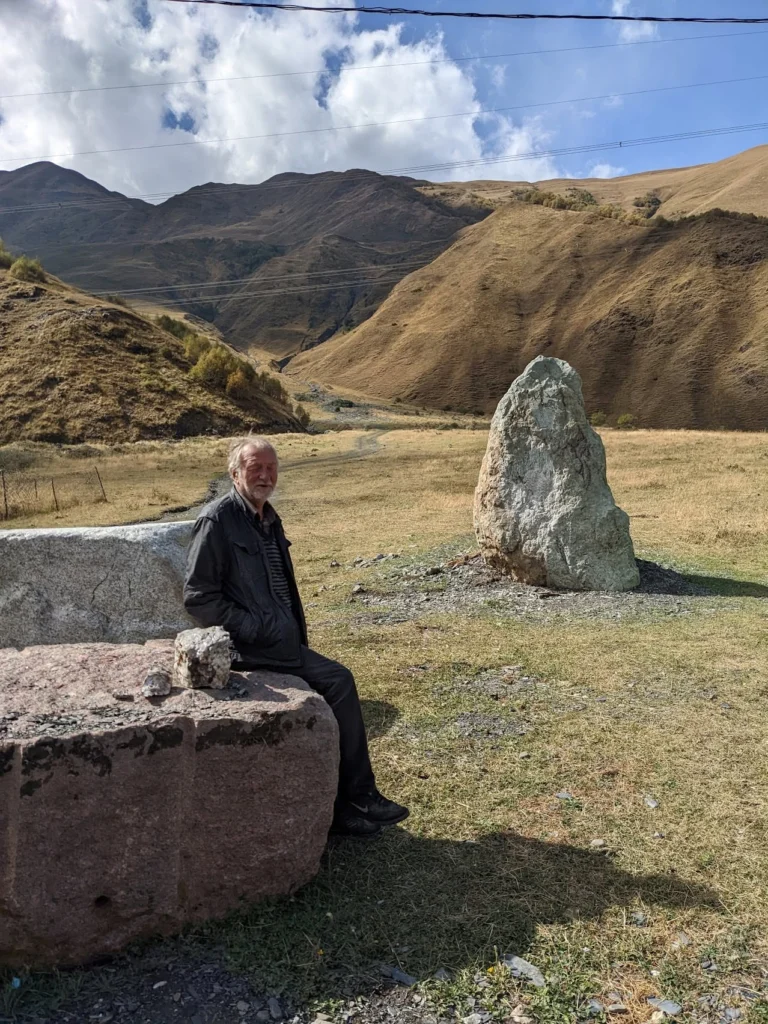
Every head in Sno is the work of one man, Merab Piranishvili, who was born in the village and came home to carve it a museum. He studied at the Tbilisi Academy of Arts, graduating in 1977, and taught art in the capital before returning to Sno in the 1980s. In 1984 he finished his first monumental piece, a figure of St George. He has been adding to the hillside ever since.
What makes the project remarkable is how it’s made. Each sculpture is cut from a single block of granite. The boulders come from the surrounding mountains and are dragged down to the village before any carving begins. In the early years Piranishvili worked with nothing but a hammer and chisel, and a single head could take him an entire summer. The short Kazbegi season meant one face a year, if the weather was kind. Today he uses electric tools and can rough out a head in about a week. The finishing is still done by hand, which is why every face has the slight unevenness of something touched rather than machined.
The work began with state support in Soviet times. When that ended, he carried on at his own expense. He has spoken about wanting to preserve Georgia’s history in stone for future generations, and about wanting the whole world to see it, not just his neighbours. His long-term plan is an open-air museum at the entrance to Sno, with hundreds of heads and room for Georgia’s kings, including David the Builder and Queen Tamar, alongside its poets.
Standing among the heads, you feel the scale of that ambition. One man, one village, a few months of good weather each year, and a plan measured in centuries. It’s the kind of project that only makes sense in a place where people still talk about medieval kings as if they’d met them.
The faces of Sno: who’s who
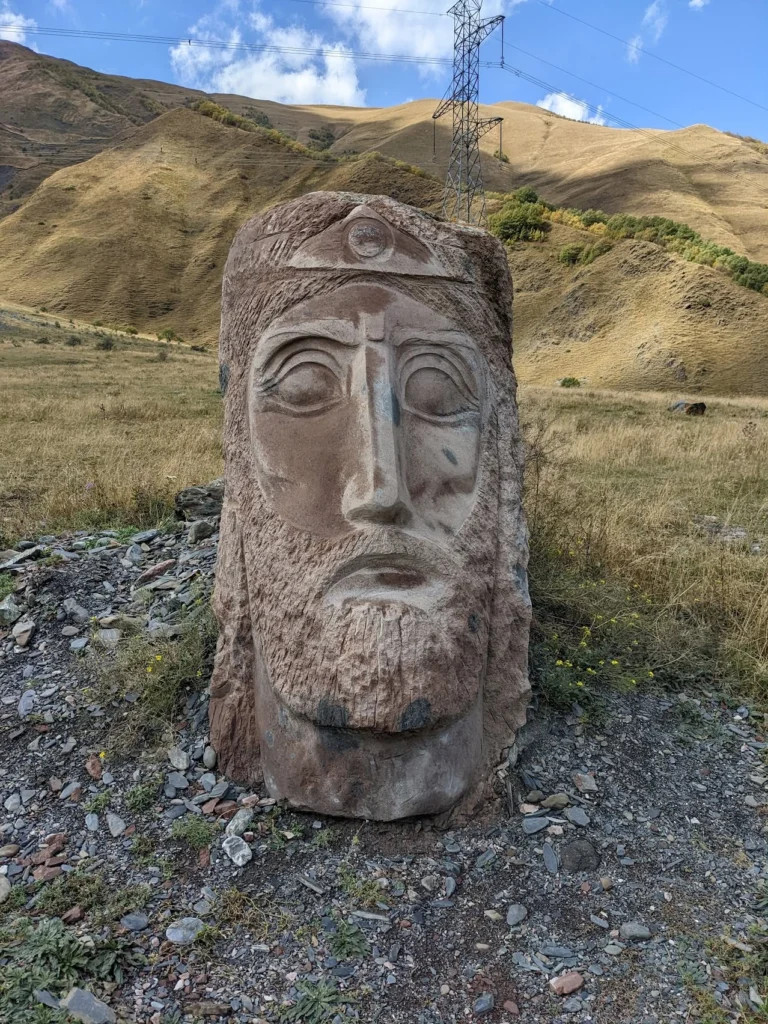
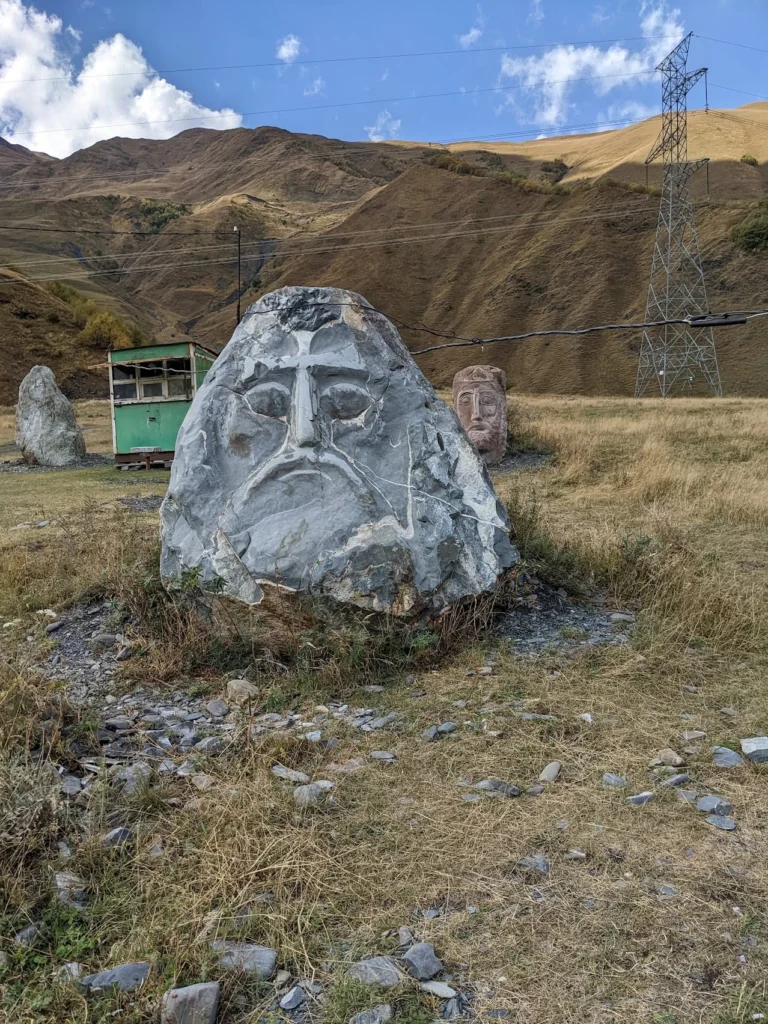
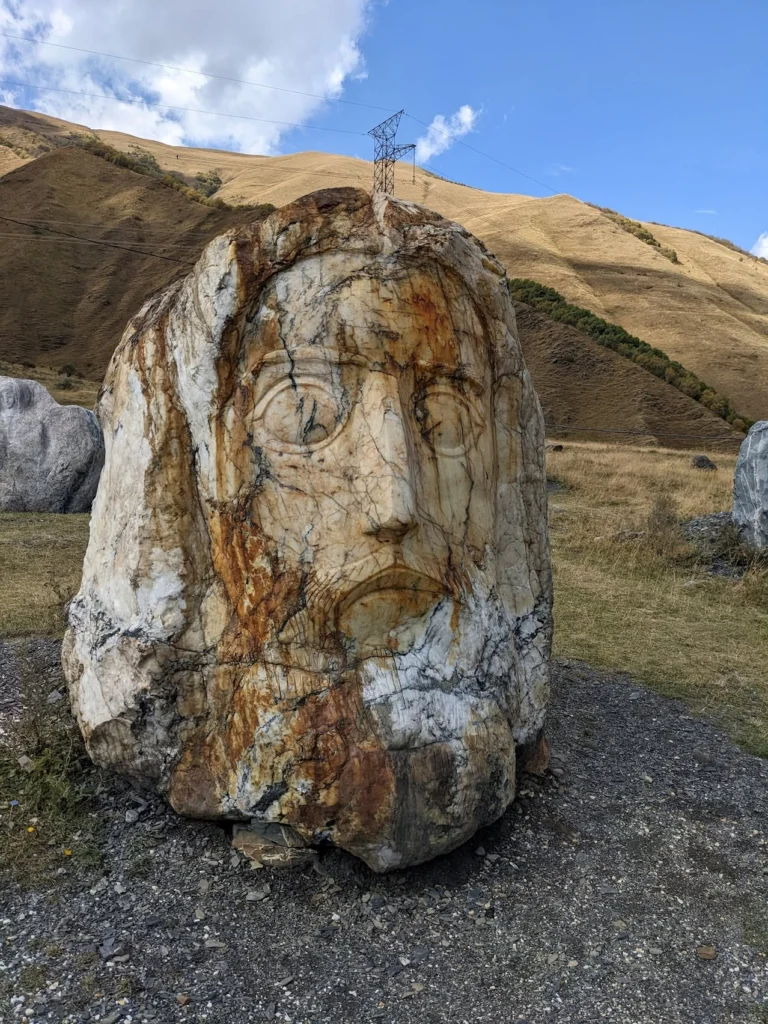
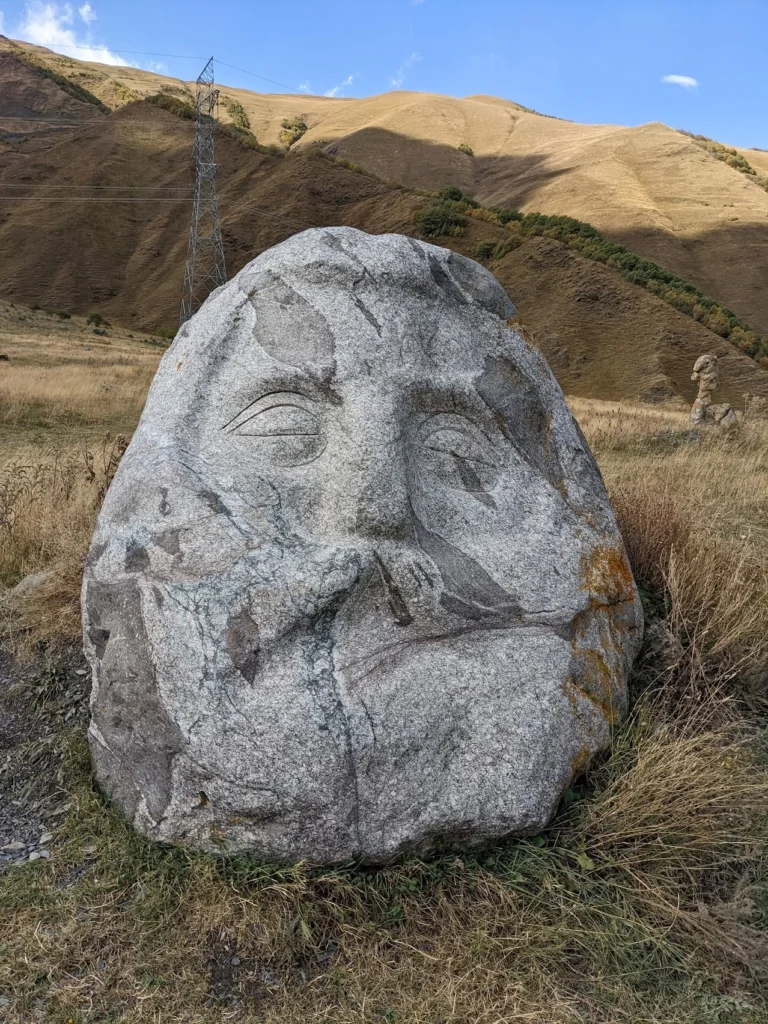
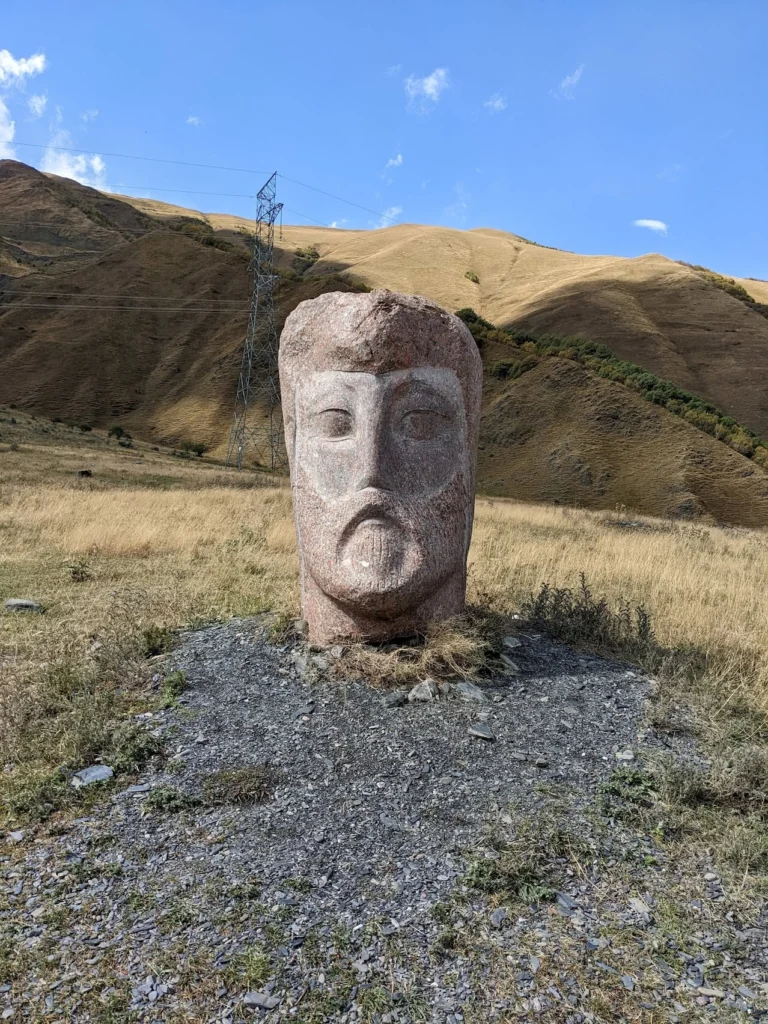
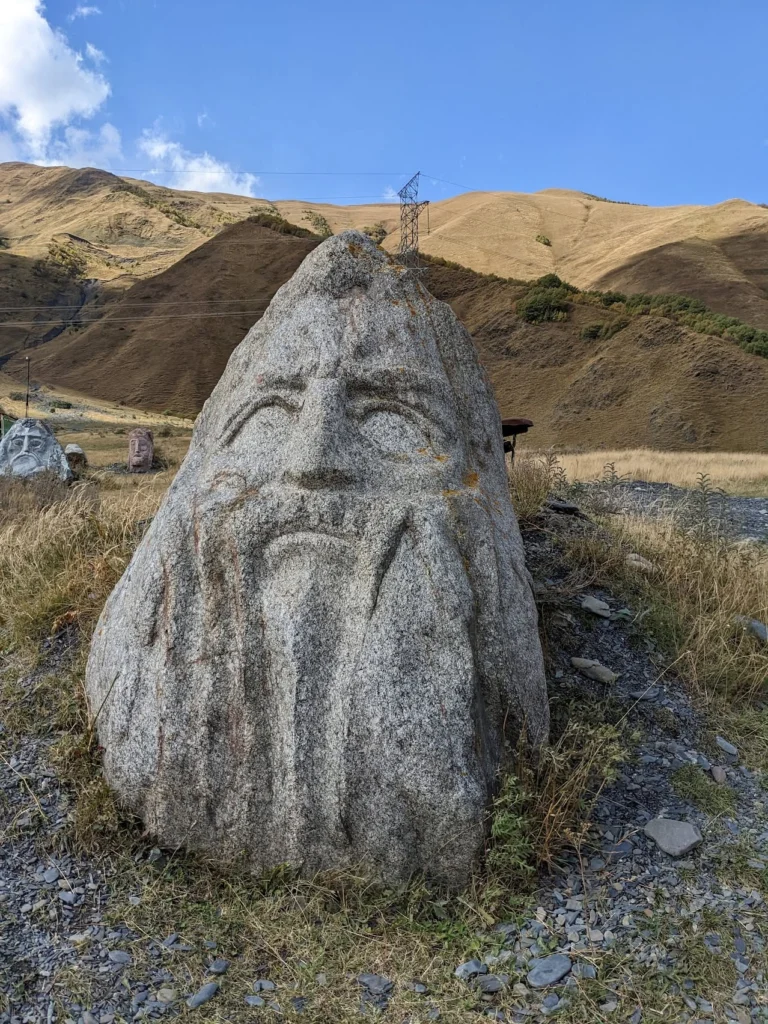
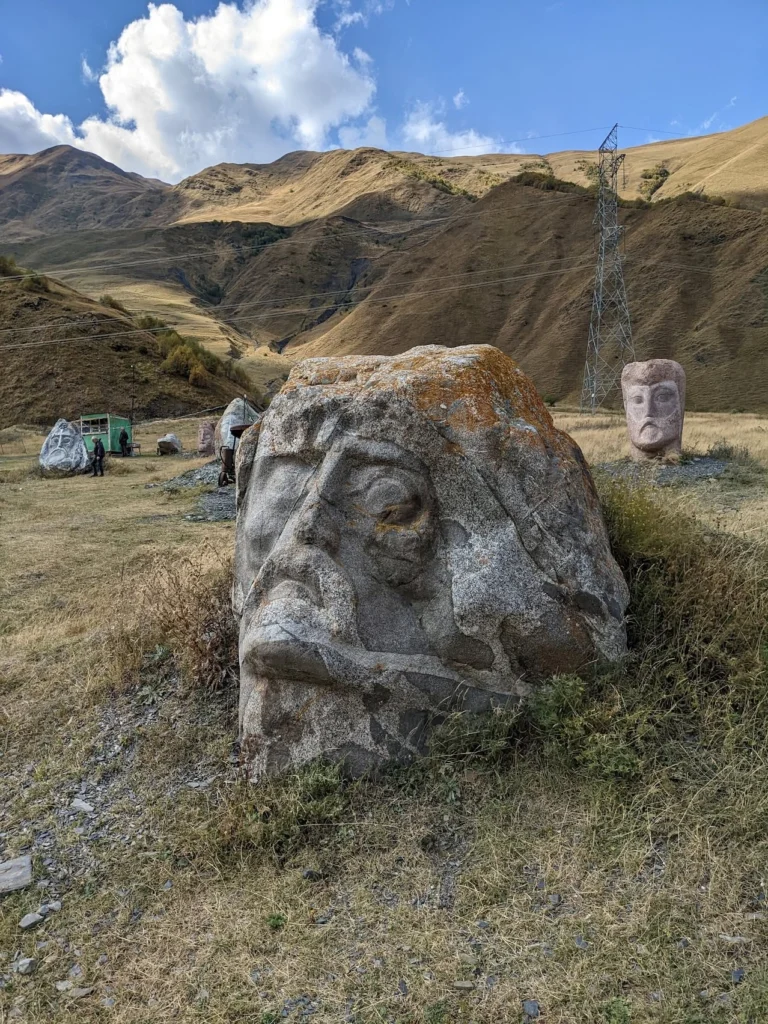
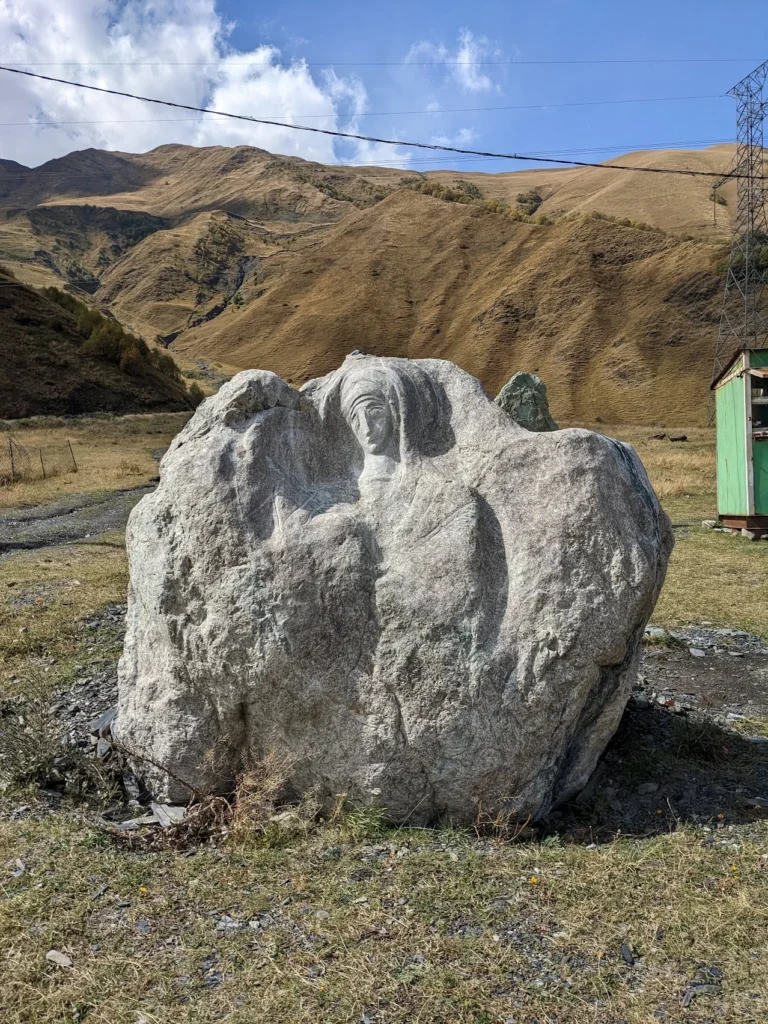
The heads portray the people Georgians consider the makers of their culture: the national poet, the 19th-century writers who revived Georgian identity, a son of Kazbegi itself, St George and Christ. Knowing who they are turns a photo stop into a short lesson in what Georgia values.
Shota Rustaveli
Georgia’s national poet, author of the 12th-century epic The Knight in the Panther’s Skin. Rustaveli served at the court of Queen Tamar, and his poem about friendship, love and loyalty is still learned by heart in Georgian schools. Many Georgian families keep a copy at home, and it has traditionally been given to brides. It’s no surprise he’s here: to Georgians he’s somewhere between Shakespeare and Dante.
Ilia Chavchavadze
Writer, publisher and the leading figure of the 19th-century Georgian national revival, often called the “father of the nation”. Ilia campaigned for the Georgian language and education under Russian imperial rule. He was assassinated in 1907 and was later canonised by the Georgian Orthodox Church as St Ilia the Righteous. His face appears on the 20-lari banknote.
Akaki Tsereteli
Ilia’s contemporary and fellow reformer, a much-loved poet whose verses became songs. His poem Suliko is one of the best-known Georgian songs, sung everywhere from village feasts to concert halls. Where Ilia was the nation’s conscience, Akaki was its voice.
Vazha-Pshavela
The poet of the mountains, and the most fitting face for this valley. Born in Pshavi, in the highlands east of here, Vazha-Pshavela (the pen name of Luka Razikashvili) wrote epic poems about mountain clans, honour, nature and blood feud. His world was very like the one around Sno. If you’ve hiked in Khevsureti or Tusheti, you’ve walked through his poems.
Alexander Kazbegi
The local hero. Alexander Kazbegi (1848–1893) was born in Stepantsminda into the family that ruled the Khevi valley. He gave up his privileges to live as a shepherd, then wrote novels about the hard, proud life of the mountain people. The town was named Kazbegi in his honour for most of the 20th century, and his house in Stepantsminda is a museum.
St George
The first sculpture Piranishvili completed, in 1984, and the largest. St George is Georgia’s patron saint, and he’s everywhere here, from church icons to the national flag’s crosses. A second figure, St George on horseback, stands a short walk uphill from the main group.
Jesus Christ
The head of Christ is a reminder of how central Orthodox Christianity is to Georgian identity. Next to the poets, it frames the group as a portrait of a nation built on faith and literature.
| Figure | Who they were | Era |
|---|---|---|
| Shota Rustaveli | National poet, The Knight in the Panther’s Skin | 12th century |
| Ilia Chavchavadze | Writer, reformer, “father of the nation” | 1837–1907 |
| Akaki Tsereteli | Poet, author of Suliko | 1840–1915 |
| Vazha-Pshavela | Poet of the mountains and highland life | 1861–1915 |
| Alexander Kazbegi | Novelist from Stepantsminda | 1848–1893 |
| St George | Georgia’s patron saint | 4th century |
| Jesus Christ | Central figure of the Georgian Orthodox faith | 1st century |
Visiting the Sno stone heads
The heads are at the entrance to Sno village, about 3 km off the Georgian Military Highway on the road to Juta. They’re free to visit and open at all times.
- Getting there: about 15 minutes by car from Stepantsminda. Take the turn-off toward Achkhoti and Juta just south of town. There’s no public transport, so come by car, taxi or tour. Most Juta day trips stop here on the way.
- Parking: at the roadside beside the sculptures.
- Time needed: 30 minutes for the heads, or about an hour with the uphill walk to St George on horseback.
- Best light: morning and late afternoon, when side light brings out the carving. At midday the faces flatten.
- Season: the road to Sno is paved and open all year. In winter the heads sit in snow, which can be beautiful, but the onward road to Juta is often closed.
- Etiquette: you may see the sculptor at work in summer. Ask before photographing him, and remember this is his life’s work, not a playground. Please don’t climb on the sculptures.
More to see in Sno
- Sno fortress: the ruined medieval towers of the village fortress above the river.
- The village church and the residence linked to Patriarch Ilia II, whose family came from Sno.
- The Juta road: carry on 11 km to Juta and the Chaukhi massif. Our Stepantsminda guide explains the road conditions and the 4×4 options.
For everything else in the area, from Gergeti Trinity to the Truso valley, see our Kazbegi National Park guide and Gergeti Trinity Church guide.
Tours that pass the Sno heads
| Tour | Length | Why it fits |
|---|---|---|
| 2-Day Kazbegi Tour from Tbilisi | 2 days | Time for Gergeti, Sno and the Truso valley |
| Kazbegi, Chaukhi Pass & Khevsureti | 4 days | Passes through Sno on the way to the Juta trailhead |
| Kazbegi Tour from Tbilisi | 1 day | Ask us to add the 30-minute detour to Sno |
Frequently asked questions
Who made the stone heads in Sno?
Merab Piranishvili, a sculptor born in Sno and trained at the Tbilisi Academy of Arts. He completed his first sculpture, St George, in 1984, and has carved every head by hand since.
Who do the Sno stone heads represent?
Shota Rustaveli, Ilia Chavchavadze, Akaki Tsereteli, Vazha-Pshavela and Alexander Kazbegi, together with St George and Jesus Christ. A separate figure of St George on horseback stands uphill.
How do I get to the Sno stone heads?
Drive about 15 minutes from Stepantsminda: take the turn-off toward Achkhoti and Juta, and the heads are at the entrance to Sno village, about 3 km from the highway. There’s no public transport.
Is there an entrance fee?
No. The sculptures stand in the open and are free to visit at any time.
What are the heads made of?
Each sculpture is carved from a single block of local granite.
Is the project finished?
No. Piranishvili plans an open-air museum with hundreds of heads, including Georgian kings such as David the Builder and Queen Tamar.