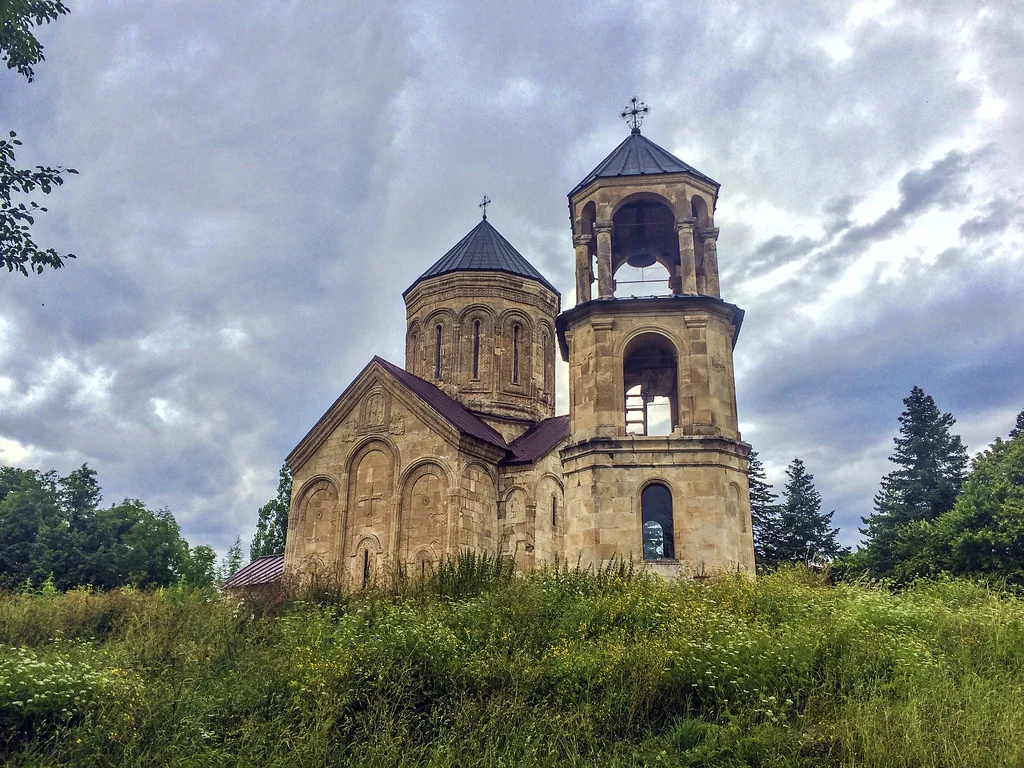
In the mountain village of Nikortsminda, surrounded by the wooded hills of Racha-Lechkhumi, stands one of the most richly decorated churches in Georgia.
Nikortsminda Cathedral, dedicated to Saint Nicholas, was built between 1010 and 1014 during the reign of King Bagrat III, the first ruler of a politically unified medieval Georgian kingdom.
Its importance lies not simply in its age.
Nikortsminda represents one of the high points of medieval Georgian stone carving. Almost every major exterior surface contributes to an elaborate decorative programme of arches, ornamental bands, crosses, biblical scenes, saints, animals and fantastic creatures.
Inside, the character changes completely. The pale carved stone of the exterior gives way to an interior covered with colourful late-medieval frescoes.
For travellers interested in Georgian architecture, Nikortsminda is one of the essential monuments of Racha.
Nikortsminda Cathedral at a Glance
| Feature | Details |
|---|---|
| Location | Nikortsminda village |
| Region | Racha-Lechkhumi and Kvemo Svaneti |
| Nearest town | Ambrolauri |
| Construction | 1010–1014 |
| Patron | King Bagrat III |
| Dedication | Saint Nicholas |
| Architectural type | Domed multi-apse church |
| Famous for | Exceptional medieval stone carving |
| Interior decoration | Mainly 16th–17th-century frescoes |
| Bell tower | 19th century |
| UNESCO status | Tentative List |
| Best combined with | Shaori, Barakoni, Ambrolauri and Khvanchkara |
Built During the Reign of Bagrat III
An inscription associated with the western entrance dates Nikortsminda Cathedral to 1010–1014.
This places its construction during the reign of Bagrat III, one of the most important rulers in medieval Georgian history.
Bagrat’s reign coincided with the political consolidation of different Georgian lands into a more unified kingdom.
Architecture played an important role in that period.
Large churches were not simply religious buildings. They also expressed political authority, cultural ambition and the growing confidence of the Georgian state.
Nikortsminda belongs to this architectural generation.
Other monumental churches from around the same period demonstrate how rapidly Georgian builders were experimenting with increasingly complex domed designs and sophisticated exterior decoration.
An Unusual Architectural Plan
Nikortsminda’s interior is more complex than its exterior first suggests.
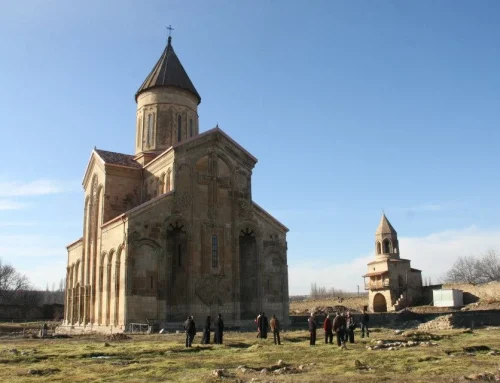
The central space is surrounded by five apses, while a rectangular western arm extends toward the entrance.
Seen from outside, however, the cathedral presents a broadly cross-shaped composition.
This difference between internal and external geometry required considerable architectural skill.
The builder had to fit a complicated arrangement of curved apses and subsidiary spaces into an exterior that appears much more orderly.
The result is not completely symmetrical.
Some windows and façade elements are slightly displaced because they respond to the complicated internal structure behind them.
Rather than being a flaw, this irregularity helps reveal how the church was designed.
At Nikortsminda, interior space took priority over perfect exterior symmetry.
The Central Dome
Above the complex ground plan rises Nikortsminda’s dominant feature: its dome.
The drum is pierced by twelve windows, bringing light into the central space below.
Externally, the drum is one of the most heavily decorated parts of the cathedral.
Windows are framed by carved ornament, while horizontal and vertical decorative bands organize the surface into an intricate but controlled composition.
This treatment became particularly influential.
The idea of treating the entire dome drum as a coherent field of ornament became a major feature of later Georgian church architecture.
Nikortsminda therefore matters not simply because its decoration is beautiful, but because it represents an important stage in the development of Georgian architectural ornament.
A Cathedral Covered in Sculpture
The most remarkable feature of Nikortsminda is its exterior carving.
Many Georgian churches contain beautiful carved window frames or decorated portals.
Nikortsminda goes much further.
Its sculpture is integrated throughout the architecture, turning the façades into a carefully organized visual programme.
Visitors will find:
- geometric ornament;
- interlaced vegetal patterns;
- crosses;
- saints and angels;
- biblical scenes;
- real animals;
- fantastic creatures;
- decorative arcades;
- richly framed windows and entrances.
The carvings are not scattered randomly.
They are positioned in relation to arches, pediments, doors and windows, so sculpture and architecture function as a single composition.
This is one reason Nikortsminda is considered such an important monument in the history of Georgian medieval art.
Decoration That Looks Almost Woven
The finest stone carving at Nikortsminda has an extraordinary delicacy.
Leaves, twisting stems and geometric patterns overlap in narrow ornamental bands that appear almost woven into the stone.
From a distance, these details create texture.
Up close, individual leaves, knots and curves become visible.
The effect is especially impressive around window frames and on the drum of the dome, where successive layers of ornament create visual depth without overwhelming the architecture.
For travellers interested in sculpture, it is worth walking slowly around the entire cathedral.
The exterior is not designed to be understood from one viewpoint.
Biblical Scenes in Stone
Nikortsminda’s sculptural programme also includes figurative scenes connected with Christian theology.
Reliefs include subjects associated with the Transfiguration, the Last Judgment and other biblical themes.
Figures of saints appear alongside symbolic animals and ornamental motifs.
These reliefs were not merely decorative.
For medieval worshippers, they formed part of a visual religious language in which architecture, sculpture and scripture reinforced one another.
The façades therefore functioned almost like a stone picture book.
Even visitors unfamiliar with the individual scenes can appreciate how carefully the figures are fitted into the architectural spaces around them.
Animals and Fantastic Creatures
One of the pleasures of examining Nikortsminda closely is discovering animals hidden among the religious imagery.
Medieval Georgian sculptors used both real and imaginary creatures as part of architectural decoration.
Some had symbolic Christian meanings. Others belonged to a broader decorative tradition inherited from earlier Caucasian and Near Eastern art.
At Nikortsminda, these animals appear beneath architectural elements and within carved compositions around the cathedral.
They bring movement and variety to surfaces that might otherwise have been dominated by repeating geometric patterns.
The Entrances and Tympanums
The cathedral entrances are among its most carefully decorated architectural elements.
Above the doors, carved tympanums contain religious imagery framed by ornamental stonework.
The southern and western sides are especially worth examining.
These entrance compositions demonstrate the skill of the sculptors particularly well because architecture, relief and decorative carving are compressed into relatively small areas.
Visitors often walk directly through the doorway without looking upward.
At Nikortsminda, that means missing some of the church’s finest medieval sculpture.
The Porch
A porch attached to the cathedral belongs to the early development of the building and continues the elaborate decorative language of the main façades.
Its arches and carved details create a transition between the exterior courtyard and the church interior.
Like much of Nikortsminda, the porch has undergone alterations and repairs over the centuries.
Even so, it contributes to the unusually rich architectural composition of the cathedral.
What Happened to the Original Architecture?
Nikortsminda has survived remarkably well for a building more than a thousand years old.
Unlike many Georgian medieval churches that lost their domes or were substantially rebuilt, the cathedral retains much of its original architectural character.
That does not mean it remained untouched.
Repairs and alterations took place during several periods.
Parts of the building were restored in the 16th century, and later conservation work addressed damage caused by age, weather and earthquakes.
The major earthquake that struck Racha in 1991 affected many historic buildings across the region and led to further conservation work at Nikortsminda.
Visitors looking carefully at the masonry can see that different periods of repair have left their marks.
Inside Nikortsminda Cathedral
The interior produces a very different impression from the exterior.
Outside, attention is drawn toward pale stone and fine sculpture.
Inside, almost every major surface is covered with painting.
The surviving frescoes belong primarily to the 16th and 17th centuries, several centuries after the cathedral itself was constructed.
This separation between architectural date and painted decoration is important.
The church was not completed artistically in 1014 and then left unchanged.
Successive generations continued to reinterpret and decorate its interior.
The Frescoes
Nikortsminda’s wall paintings contain an extensive cycle of religious imagery.
Scenes from the life of Christ, saints and other biblical subjects cover the walls and vaults.
Portraits of historical patrons also appear within the programme.
The density of painting gives the interior a very different atmosphere from many Georgian churches where only fragments of fresco survive.
Here, architecture and painting compete for attention.
The curved apses, dome supports and vaults create a complicated surface for the artists, who adapted their compositions to the shape of the building.
The result reinforces the highly centralized character of the cathedral interior.
Medieval Patrons and Portraits
Among the paintings are portraits connected with members of the regional elite who supported the cathedral.
Such donor portraits are valuable historical documents.
They reveal clothing, status and political identity while also demonstrating the relationship between aristocratic families and major churches.
Racha’s medieval and early modern noble families played an important role in maintaining religious monuments long after the original royal patrons had disappeared.
Nikortsminda therefore records more than one political era.
The architecture belongs to the unified monarchy of Bagrat III, while much of the painting reflects later centuries of regional patronage.
The Iconostasis
A substantial iconostasis separates the sanctuary from the main body of the church.
Like the frescoes, it belongs to a later stage in Nikortsminda’s religious life rather than the original 11th-century construction.
The presence of later liturgical furnishings is another reminder that the cathedral has remained a living religious building rather than becoming an archaeological monument frozen in one period.
Nikortsminda continues to function as an Orthodox cathedral today.
The Bell Tower
A separate bell tower stands within the cathedral grounds.
Unlike the church, it is not medieval.
The elegant multi-storey structure dates from the 19th century.
Its open upper arches create a light silhouette that contrasts with the more compact mass of the cathedral.
The bell tower is particularly photogenic when viewed together with the church because the two structures demonstrate very different periods of Georgian religious architecture within the same enclosure.
Nikortsminda as an Episcopal Centre
Nikortsminda eventually became the seat of a bishop.
Its status as an episcopal centre added to the importance of the cathedral and helped make it a repository of manuscripts, church objects and religious culture.
The diocese was historically associated with a broad area of Racha.
This ecclesiastical role helps explain why such a sophisticated monument stands in what is now a relatively small mountain village.
Medieval Nikortsminda belonged to a regional religious and political landscape very different from the modern settlement pattern.
Nikortsminda and UNESCO
Nikortsminda Cathedral has been on Georgia’s UNESCO World Heritage Tentative List since 2007.
A Tentative List entry is not the same as World Heritage inscription.
It means Georgia has identified the cathedral as a site it may consider nominating for World Heritage status.
The proposed significance emphasizes both the architecture and the cathedral’s exceptional sculptural decoration.
For visitors, UNESCO status is less important than the building itself, but the listing reflects the international significance attributed to Nikortsminda’s medieval art.
Galaktion Tabidze and “Praise to Nikortsminda”
Nikortsminda also occupies a place in modern Georgian culture.
The celebrated Georgian poet Galaktion Tabidze wrote Praise to Nikortsminda, inspired by the cathedral.
His response is understandable.
Nikortsminda is a building whose effect comes from accumulation: arch after arch, carving after carving, until the entire exterior seems to become a single sculptural composition.
The literary connection has helped make the cathedral familiar even to Georgians who have never travelled to Racha.
Visiting Nikortsminda Today
Nikortsminda Cathedral stands in the village of the same name, approximately 16 kilometres from Ambrolauri.
The village lies at around 1,180 metres above sea level, north of Shaori Reservoir.
Road access is straightforward in the warmer months, and a normal vehicle is sufficient under ordinary conditions.
The cathedral grounds are compact.
Allow approximately 45 minutes to one hour if you want to examine the exterior carvings properly and see the frescoes inside.
Travellers with a strong interest in architecture or photography may easily spend longer.
What to Look For During Your Visit
Do not limit the visit to the main façade.
Walk around the entire church and look for:
- the twelve-windowed dome drum;
- ornamental bands around the windows;
- biblical relief scenes;
- carved saints and angels;
- animal and fantastic-creature motifs;
- richly decorated tympanums;
- asymmetries caused by the complex internal plan;
- changes in stonework from later restoration;
- the contrast between exterior sculpture and interior frescoes;
- the separate 19th-century bell tower.
Nikortsminda is one of those churches where binoculars or a camera with moderate zoom can reveal details difficult to appreciate from ground level.
Photography at Nikortsminda
The cathedral is especially rewarding in angled light.
Morning or late-afternoon sun creates shadows within the shallow stone carving and makes the ornament much easier to see.
Flat midday light can make some relief work almost disappear.
The bell tower provides a useful second element in wider compositions, while the surrounding mountains and trees establish the Racha setting.
Inside, photography rules should be checked before taking pictures.
Nikortsminda remains an active church, and services take priority over sightseeing.
Visiting from Ambrolauri
Ambrolauri is the most practical base for exploring central Racha.
Nikortsminda is only a short drive away, while Barakoni, Khvanchkara wine villages and the Rioni Valley can all be combined into the same regional itinerary.
Our Racha-Lechkhumi travel guide covers accommodation, roads, wineries and other attractions around Ambrolauri.
Staying at least one night in the region is preferable to rushing through from the lowlands.
Racha’s distances may look short on a map, but mountain roads and frequent scenic stops make travel slower than expected.
Visiting from Kutaisi
Kutaisi is the most convenient large city for reaching Nikortsminda.
The drive takes roughly 1.5–2 hours, depending on the route and road conditions.
The road climbs from Imereti toward the high plateau around Shaori before continuing to Nikortsminda.
This makes the cathedral possible as a long day trip from Kutaisi.
A better option, however, is to continue deeper into Racha and stay overnight around Ambrolauri.
That allows time for Barakoni, wine tasting and mountain landscapes without spending most of the day in the vehicle.
Shaori Reservoir
Nikortsminda lies close to Shaori Reservoir, one of the most recognizable landscapes in central Racha.
The reservoir sits among densely wooded hills and is particularly attractive in autumn, when the surrounding forests change colour.
Shaori makes a natural stop when travelling between Kutaisi and Nikortsminda.
The contrast is useful: a medieval stone cathedral followed by open water and mountain forest within the same short route.
Combine Nikortsminda with Barakoni
Another natural architectural pairing is Barakoni Church.
The two buildings were constructed more than seven centuries apart.
Nikortsminda belongs to the early 11th century and represents the extraordinary sculptural tradition of medieval unified Georgia.
Barakoni was built in 1753, near the end of the long tradition of monumental Georgian domed church construction.
Seeing the two on the same day creates an unusually clear comparison.
At Nikortsminda, the exterior is dense, experimental and covered in sculpture.
Barakoni is more restrained and elegant, representing a much later interpretation of Georgian architectural tradition.
Nikortsminda and Khvanchkara Wine
Racha is not only a region of churches and mountains.
It is also one of Georgia’s most distinctive wine regions.
The slopes around Ambrolauri and Khvanchkara are associated with Alexandrouli and Mujuretuli, the grape varieties used for the naturally semi-sweet red wine Khvanchkara.
A visit to Nikortsminda can therefore be combined easily with a family wine cellar.
This works particularly well because it places two important aspects of Racha’s identity — medieval architecture and wine — within the same day.
Visit Nikortsminda on Our Racha Tour
Nikortsminda is a confirmed stop on our Svaneti and Racha: 7 Days Over the Zagaro Pass.
The route begins and ends in Kutaisi and crosses some of western Georgia’s most dramatic mountain landscapes.
After travelling through Svaneti and crossing into Racha, the final Racha day combines Barakoni, Khvanchkara wine and Nikortsminda Cathedral.
This is particularly useful for travellers who want to understand Nikortsminda as part of the region rather than making a stand-alone excursion.
Svaneti and Racha: 7 Days Over the Zagaro Pass
Our 7-day Svaneti and Racha tour includes:
- Kutaisi and Gelati;
- Svaneti villages and mountain landscapes;
- Chalaadi Glacier;
- Ushguli;
- the Zagaro Pass route into Lower Svaneti and Racha;
- Barakoni Church;
- a Khvanchkara wine tasting;
- Nikortsminda Cathedral.
At Nikortsminda, the emphasis is on the cathedral’s exterior carving and its later painted interior before continuing toward Kutaisi.
The tour is seasonal because the high mountain section across the Zagaro Pass depends on road and weather conditions.
Planning a Shorter Racha Trip
Travellers who want to visit Nikortsminda without including Svaneti can request a private itinerary through our Georgia trip planner.
A two- or three-day Racha route can be built around:
- Nikortsminda;
- Shaori Reservoir;
- Barakoni Church;
- Ambrolauri;
- Khvanchkara wine villages;
- Oni;
- local food and family wineries.
Starting from Kutaisi is generally the most efficient option.
Best Time to Visit Nikortsminda
Nikortsminda can be visited for much of the year, but May through October offers the easiest conditions.
Spring brings intense greenery to Racha.
Summer is warm without usually reaching the extreme temperatures of eastern Georgia.
Autumn is particularly beautiful around Shaori and Nikortsminda because the surrounding forests turn yellow, orange and red.
Winter can be spectacular but more difficult.
Snow is common in Racha, particularly around Shaori and higher villages, and road conditions can change quickly.
Visiting an Active Cathedral
Nikortsminda remains an active Georgian Orthodox church.
Visitors should dress respectfully and behave quietly inside.
Women may be expected to cover their heads, while both men and women should wear clothing covering shoulders and knees.
Avoid photographing worshippers or religious services without permission.
The church’s artistic importance can make it feel like a museum, but its religious function continues.
Frequently Asked Questions
Where is Nikortsminda Cathedral?
Nikortsminda Cathedral is located in Nikortsminda village in the Racha-Lechkhumi region of northwestern Georgia, approximately 16 kilometres from Ambrolauri.
When was Nikortsminda Cathedral built?
The cathedral was constructed between 1010 and 1014 during the reign of King Bagrat III.
Who is Nikortsminda Cathedral dedicated to?
The cathedral is dedicated to Saint Nicholas.
Why is Nikortsminda famous?
Nikortsminda is particularly famous for its exceptionally rich medieval exterior stone carving, including ornamental patterns, biblical scenes, saints, animals and fantastic creatures.
Are the frescoes as old as the cathedral?
No. The building dates to the early 11th century, while most of the surviving interior wall paintings are from the 16th and 17th centuries.
Is Nikortsminda a UNESCO World Heritage Site?
Not currently. Nikortsminda Cathedral has been on Georgia’s UNESCO World Heritage Tentative List since 2007.
How far is Nikortsminda from Ambrolauri?
The village is approximately 16 kilometres from Ambrolauri.
Can I visit Nikortsminda from Kutaisi?
Yes. It can be visited on a long day trip from Kutaisi, although staying overnight in Racha allows a much better regional itinerary.
What should I combine with Nikortsminda?
The easiest combination is Shaori Reservoir, Ambrolauri, Barakoni Church and a wine tasting in the Khvanchkara area.
Is Nikortsminda included in Highlander Travel tours?
Yes. It is a scheduled stop on our Svaneti and Racha: 7 Days Over the Zagaro Pass.
Why Nikortsminda Cathedral Is Worth Visiting
Nikortsminda is one of the best places in Georgia to understand that medieval architecture was never only about engineering.
The building itself is highly sophisticated, but its sculptors transformed that architecture into something richer.
Windows became frames for ornament.
Arches became surfaces for carved patterns.
Pediments became settings for biblical scenes.
Animals and fantastic creatures appeared beneath the dome.
The entire exterior was treated almost like a monumental piece of sculpture.
Inside, later generations added another artistic layer through extensive fresco painting.
That combination makes Nikortsminda unusual even in a country with an extraordinary concentration of medieval churches.
For travellers exploring Racha, it is more than an attractive historical stop.
Nikortsminda is one of the clearest surviving demonstrations of the ambition and skill of medieval Georgian architects and stone carvers.