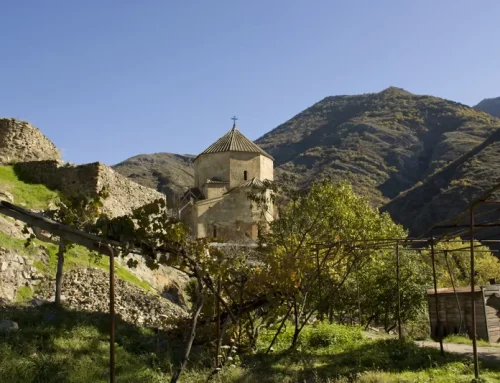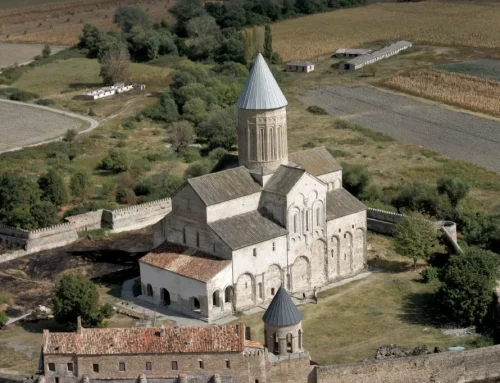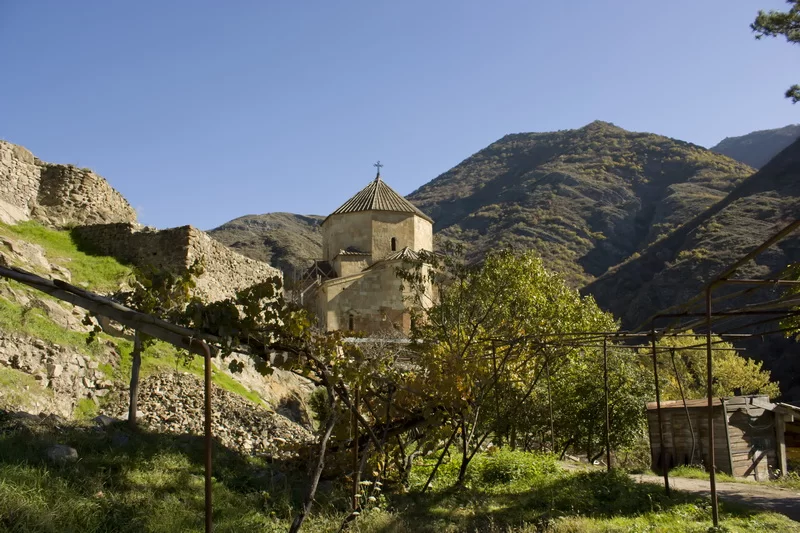
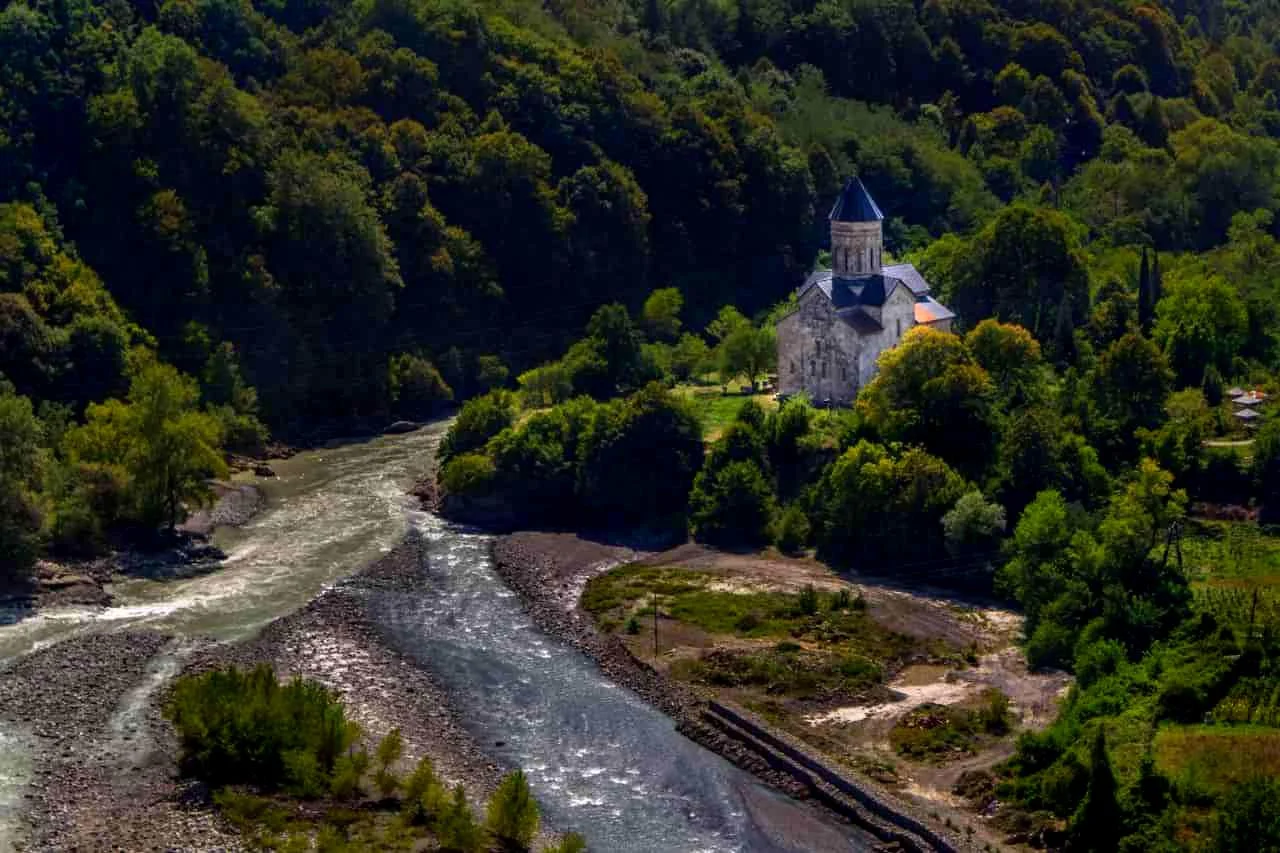
Set among the forested mountains of Racha, close to the village of Tsesi, Barakoni Church is one of the region’s most recognizable historic landmarks. Its pale stone walls rise above the valley near the meeting point of the Rioni and Lukhuni rivers, creating one of the most memorable combinations of architecture and landscape in western Georgia.
Officially known as the Barakoni Church of the Mother of God, the church was built in 1753. Although much younger than Georgia’s famous medieval cathedrals, its architect deliberately drew on the country’s centuries-old church-building tradition.
For travelers exploring Racha, Barakoni offers more than a quick photo stop. Its architecture, stone carving, religious importance and dramatic location make it one of the most rewarding places to visit near Ambrolauri.
Barakoni Church at a Glance
| Location | Tsesi, Ambrolauri Municipality, Racha, Georgia |
| Built | 1753 |
| Dedicated to | Mother of God |
| Patron | Rostom, Eristavi of Racha |
| Architect | Avtandil Shulavreli |
| Architecture | Georgian domed cruciform church |
| Nearby rivers | Rioni and Lukhuni |
| Suggested visit | 30–60 minutes |
| Best for | History, architecture, photography and Racha road trips |
The History of Barakoni Church
Barakoni Church was commissioned in 1753 by Rostom, Eristavi of Racha, one of the principal regional rulers of the period. Construction is attributed to the Georgian master builder Avtandil Shulavreli.
Shulavreli’s name is particularly significant because the architects of many historic Georgian churches are unknown. An inscription associated with the master survives on Barakoni itself, preserving a direct connection between the monument and the person responsible for its construction.
According to Georgia’s official tourism information, stone used for the church was brought from the nearby village of Itsi. The quality of the masonry and carved decoration reflects the considerable skill of the craftsmen involved in the project.
Barakoni’s construction date also makes the church historically interesting. It was built centuries after the high point of medieval Georgian cathedral architecture, yet its designers consciously returned to earlier Georgian architectural traditions instead of adopting an entirely different style.
Architecture: Medieval Traditions in an 18th-Century Church
Barakoni is a domed cruciform Georgian church. Its dome rises above the central part of the building and is supported by the eastern structure of the sanctuary together with two freestanding pillars.
From a distance, the church appears balanced and relatively restrained. Up close, however, the façades reveal a considerable amount of detail. Carved crosses, decorative window frames, geometric patterns and ornamental stonework cover important sections of the exterior.
The eastern façade deserves particular attention. Its decorative treatment follows architectural ideas found in much older Georgian churches, while the surviving inscription connects the building directly with Avtandil Shulavreli.
This mixture of old forms and later craftsmanship is central to Barakoni’s importance. It is not a medieval church, but it demonstrates how strongly medieval Georgian architecture continued to influence builders well into the 18th century.
Why Is Barakoni Called “Little Svetitskhoveli”?
Barakoni is sometimes referred to as “Little Svetitskhoveli” or “Small Svetitskhoveli.”
The nickname reflects similarities visitors associate with Svetitskhoveli Cathedral in Mtskheta. Both are important domed Georgian churches, and both occupy striking locations connected with the meeting of rivers.
Barakoni is considerably smaller and belongs to a much later historical period, so the nickname should not be taken to mean that the two churches are identical. Instead, it reflects Barakoni’s use of architectural traditions that had already been established in Georgia centuries earlier.
Stone Carvings and the Exterior
One of the best ways to appreciate Barakoni is simply to walk slowly around the exterior.
The stone façades contain carved crosses, frames and ornamental details that can easily be missed when viewing the church only from a distance. These decorations add rhythm to the walls without overwhelming the overall proportions of the building.
The craftsmanship becomes especially impressive when considered in the context of 18th-century Georgia, a period marked by political instability and repeated conflict. Despite those circumstances, Barakoni was executed with a high degree of technical and decorative skill.
Inside Barakoni Church
The interior continues the sense of height created by the exterior dome. One of its most notable elements is the church’s painted iconostasis, which contains religious imagery and provides a visual contrast with the stone architecture surrounding it.
Barakoni remains an active Georgian Orthodox church rather than simply a historical attraction. Visitors should enter quietly, dress respectfully and avoid disturbing services or worshippers.
Barakoni During the Soviet Period and the 1991 Earthquake
The church’s history did not end in the 18th century. During the Soviet period, Barakoni was closed and suffered the same suppression that affected many religious monuments across Georgia.
Another major challenge came in 1991, when a powerful earthquake struck Racha. Barakoni was damaged, including parts of its dome, and subsequently underwent restoration.
The church seen today therefore represents both the craftsmanship of its original builders and the preservation work that allowed the monument to survive one of the most destructive natural disasters in modern Georgian history.
An Older Religious Site
The history of worship at Barakoni appears to predate the present 1753 church.
Sources describe remains of an earlier religious building in the surrounding area, while Georgian tourism information also refers to the ruins of an older single-nave basilica associated by tradition with the period of Queen Tamar.
This means Barakoni should be understood not simply as an isolated 18th-century monument but as part of a landscape with a considerably longer religious and political history.
The Setting: Where the Rioni and Lukhuni Meet
Architecture alone does not explain Barakoni’s appeal. Its setting is just as important.
The church stands on elevated ground near the point where the Lukhuni River joins the Rioni. Forested mountains rise around the valley, while the rivers and surrounding slopes create changing views from different sides of the church.
In spring and summer, dense greenery surrounds the monument. Autumn brings warmer colors to the Racha forests, while winter exposes more of the mountains and emphasizes the pale stone of the church.
For photographers, this relationship between church and landscape is one of Barakoni’s greatest advantages. The monument does not feel separate from Racha; it appears to belong naturally to the valley around it.
Why Visit Barakoni Church?
- See one of Racha’s most important 18th-century monuments.
- Examine traditional Georgian stone carving and church architecture.
- Visit a historic Georgian Orthodox church that is still used for worship.
- Enjoy views over one of the most scenic river valleys near Ambrolauri.
- Combine the visit easily with other attractions on a Racha road trip.
Visiting Barakoni Church
Barakoni Church is located near Tsesi village in Ambrolauri Municipality. Its position makes it an easy stop while traveling through the Rioni valley between Ambrolauri and the eastern parts of Racha.
Most travelers will find that 30 to 60 minutes is enough for a relaxed visit. That gives you time to walk around the exterior, examine the stone carvings, enter the church when permitted and enjoy the surrounding landscape.
What to Know Before You Visit
- Dress modestly: Barakoni is an active Georgian Orthodox church.
- Be quiet inside: Religious services may be taking place.
- Check photography etiquette: Ask before photographing icons or worship inside.
- Allow time outside: Some of the best details are on the exterior façades.
- Do not rush the setting: The mountain and river views are an important part of the experience.
What to See Near Barakoni
Barakoni works particularly well as part of a wider Racha road trip. Ambrolauri is the most convenient base for exploring the surrounding area, and several of the region’s best-known attractions can be combined with the church.
- Ambrolauri — the main town and practical base for central Racha.
- Nikortsminda Cathedral — one of Georgia’s outstanding medieval churches, particularly famous for its stone carving.
- Shaori Reservoir — a scenic mountain reservoir surrounded by forest.
- Khvanchkara wine area — one of Racha’s best-known wine-producing zones.
- Oni — a historic mountain town farther east in Racha.
Combining these places creates a route that brings together Racha’s architecture, history, wine culture and mountain landscapes rather than treating Barakoni as an isolated attraction.
Why Barakoni Church Is Important
Georgia has many churches that are substantially older than Barakoni. What makes this monument especially interesting is when it was built.
By 1753, the great medieval era of Georgian cathedral construction had been over for centuries. Yet Barakoni’s builders continued to use the domed forms, carefully worked stone and decorative vocabulary associated with that earlier tradition.
The result is a building that connects two periods of Georgian history. Barakoni is unmistakably an 18th-century monument, but its architectural roots reach much further into Georgia’s medieval past.
Combined with its position above the Rioni and Lukhuni rivers, that continuity makes Barakoni one of the most rewarding cultural landmarks to visit in Racha.
FAQ About Barakoni Church
Where is Barakoni Church?
Barakoni Church is near Tsesi village in Ambrolauri Municipality, Racha, Georgia.
When was Barakoni Church built?
The present Barakoni Church was built in 1753.
Who built Barakoni Church?
It was commissioned by Rostom, Eristavi of Racha, and constructed by master builder Avtandil Shulavreli.
How long do you need at Barakoni?
Allow around 30–60 minutes to see the church, carvings and surrounding views.