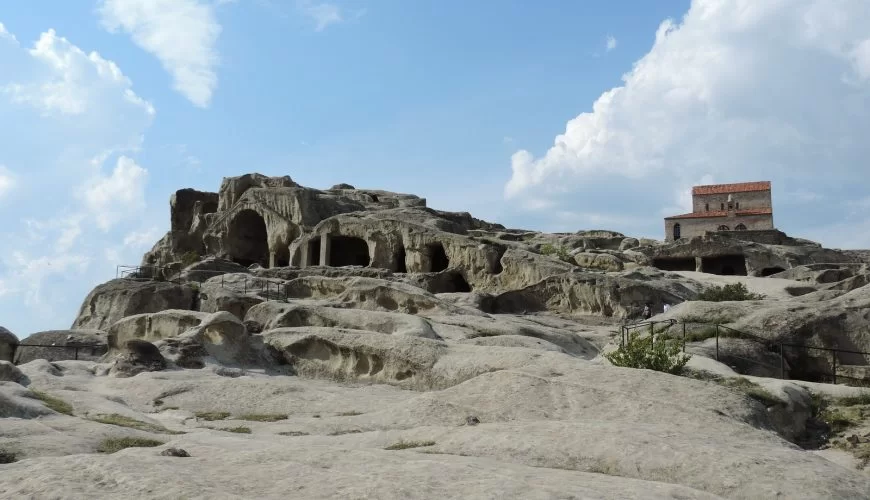
The first thing you notice from the road is that the cliff doesn’t look like much. A long rocky ridge above a bend in the Mtkvari River, pale and exposed, unremarkable from a distance. You might miss it entirely if you didn’t know to look. Then the minibus rounds a curve, and you see the openings — dozens of dark rectangular holes peppering the rock face, arranged in rough rows like windows in a building whose walls have been dissolved by time. Your eye adjusts and suddenly the cliff is a city: streets, chambers, doorways, a theater, temples, all carved into sedimentary rock that has been standing here since before classical antiquity.
That moment of recognition — cliff becoming city — is one of the better arrival experiences in Georgia.
What Uplistsikhe Is
Uplistsikhe (უფლისციხე, roughly oop-LEES-tsee-kheh, meaning “the Lord’s Fortress”) is an ancient rock-hewn town in Georgia’s Shida Kartli region, carved into the left bank of the Mtkvari River about 10 kilometers east of Gori. People began cutting it from the rock around the 6th century BC. They were still living here when the Mongols came in the 13th century AD. Nearly 3,000 years of continuous habitation, in a single piece of stone.
At its peak, the city held around 20,000 residents. What visitors walk through today — the Shida Qalaqi, or Inner City — covers 40,000 square meters and represents less than half of what originally existed. You are seeing a fragment. Keep that in mind as you walk the carved streets: the scale of what’s gone exceeds the scale of what remains.
The site has been on UNESCO’s tentative World Heritage list since 2007. Most of the excavated artifacts — gold and silver jewelry, ceramics, sculptures spanning the Bronze Age through the Middle Ages — are held at the National Museum in Tbilisi, not on-site. If you want to understand Uplistsikhe fully, you need both.
The Rock Itself
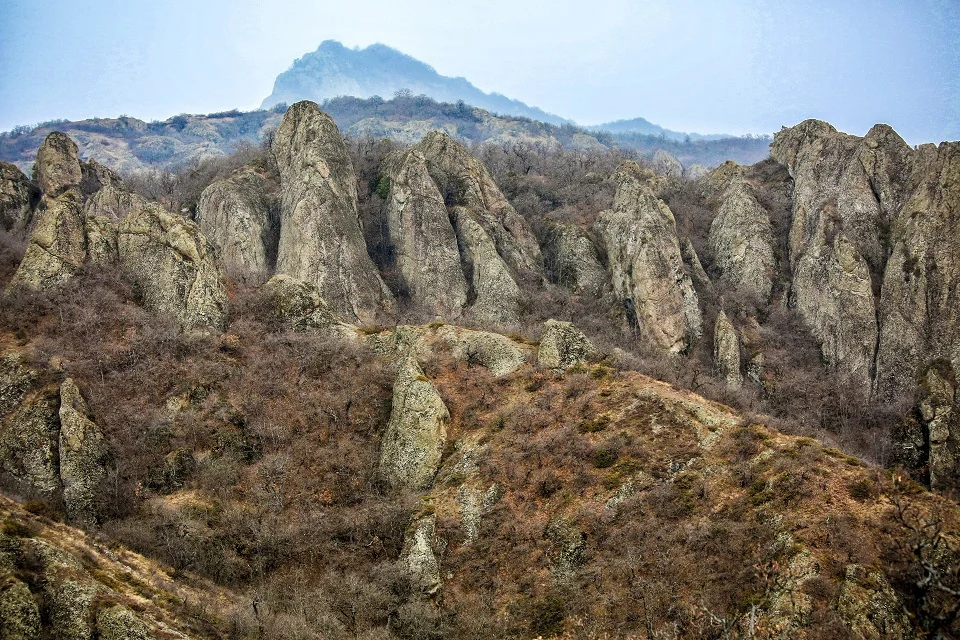
Uplistsikhe is carved from sedimentary sandstone — specifically the layered, compacted stone of the Kvernaki Ridge, which rises from the Mtkvari valley in a series of exposed strata laid down over millions of years. The rock is soft enough to have been worked with iron tools, which is precisely why people chose this particular cliff. It is also, and this matters for anyone who visits, extraordinarily beautiful.
The sandstone is warm-toned: cream and pale ochre in flat daylight, deepening to amber and burnt gold in the afternoon when the sun catches the carved surfaces at a low angle. Run your hand along a wall and the stone has a fine grain to it, almost like compressed earth. Inside the larger chambers, where the light filters in from carved openings, the walls hold a coolness that the plateau above does not. Step from the exposed rock of the main street into one of the temple interiors and the temperature drops immediately — not cold, but perceptibly cooler, the way a stone church feels on a hot summer day. This is incidental climate control that worked for 3,000 years without any engineering.
The surface of the stone has weathered unevenly. Some carved details are still crisp — you can trace the lines where a craftsman’s chisel turned a corner. Other sections have rounded and blurred, the original form legible only in outline. An earthquake in 1920 collapsed some of the most vulnerable areas entirely. Conservation work continues, funded partly through a World Bank and Georgian government program launched in 2000, but the site remains under constant pressure from weather and the accumulated weight of centuries.
The History of Uplistsikhe
Foundation and the Pagan City (6th Century BC – 4th Century AD)
Medieval Georgian chronicles ascribe the founding of Uplistsikhe to Uplos, son of Mtskhetos, grandson of Kartlos, the mythical ancestor of the Georgian people. Whether any historical kernel underlies the legend is impossible to say. What archaeology confirms is that the site was inhabited from around 1000 BC, with the earliest surviving rock-cut structures dating from the beginning of the first millennium BC.
Between the 6th century BC and the 1st century AD, Uplistsikhe grew into the most important religious and political center of ancient Kartli — the kingdom the Greeks and Romans knew as Iberia. The city’s religion centered on the sun goddess, and the largest structures were temples built in her honor. Rooms designated for ritual sacrifice to the gods of earth, water, and sun have been identified in the excavations. The civic infrastructure was extensive: a theater, a throne hall, pharmacies, bakeries, wine-pressing facilities, and a drainage system. The architectural style is unlike anything else in Georgia — scholars have traced parallels with rock-cut cultures in Cappadocia (present-day Turkey) and Northern Iran, suggesting that Uplistsikhe sat at a crossroads of influence as well as trade.
Christianity Arrives (4th Century AD)
When Christianity reached Kartli in the 4th century AD, Uplistsikhe lost its position as Georgia’s religious center to Mtskheta. The city didn’t collapse — it adapted. The first Christian basilica was constructed here in the 6th century, and for a period the new faith and the old occupied the same carved spaces. Pagan temple and Christian church, side by side in the same rock. That particular overlap is worth dwelling on as you walk the site. The transition from one belief system to another was not an event; it was a negotiation that played out across generations, written into stone.
The Second Heyday: Royal Capital (8th – 11th Centuries)
When Arab forces occupied Tbilisi in 645 AD, the Christian kings of Kartli needed a defensible capital. They chose Uplistsikhe. For the better part of three centuries, while Tbilisi was under Muslim rule, this cave city served as the seat of a Christian kingdom — strategically placed on a cliff above a river, positioned along the main Silk Road caravan route running from Central Asia into Europe. The city grew to its maximum population. The architecture from this period — including the triple-church basilica at the summit — reflects that renewed investment and confidence.
The second chapter ended when King David the Builder retook Tbilisi in 1122. With the capital restored, Uplistsikhe’s political purpose dissolved. Decline followed, and then the Mongol raids of the 13th century brought the city’s long story to a close. After 1240, the site was abandoned, occasionally used as a temporary shelter in later invasions but never again as a functioning settlement. By the 19th century, it was lost under accumulated layers of soil and sand, known only to the people of nearby villages.
Rediscovery
In 1957, Soviet archaeologists excavating on the riverbank hit the roof of a cave. Then another. Then an entire network of carved chambers, streets, and structures was buried under centuries of sediment. The excavation that followed was one of the more remarkable archaeological projects in the Caucasus — a whole city, hidden in plain sight, emerging slowly from the rock. Work has continued ever since. The site you walk through today is still being understood. Not all the questions are answered.
What to See at Uplistsikhe
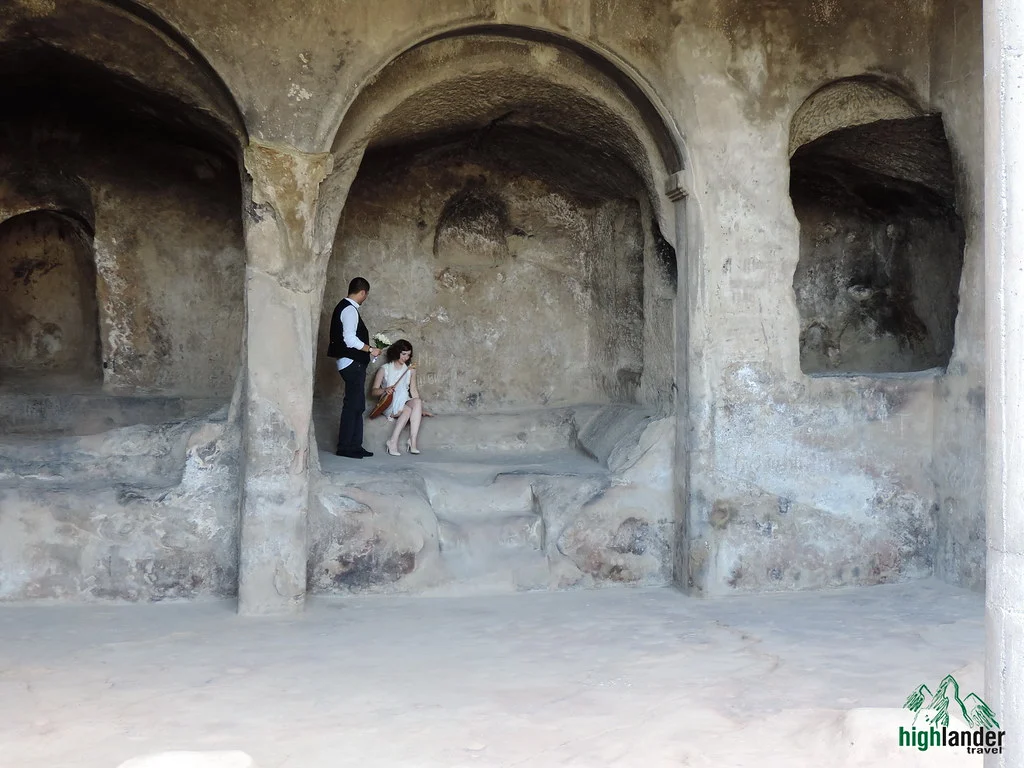
A word before you enter: the site has minimal on-site interpretation. Plaques are sparse. Without context, the carved chambers can blur into each other, and the visit can feel less than it is. Hiring a guide, either at the entrance or through a tour from Tbilisi, transforms the experience. Visitors who know what they’re looking at in the Hall of Queen Tamara — who understand what kind of city this was, what was worshipped here and by whom — spend the same 90 minutes very differently from those who don’t.
Tamaris Darbazi — Hall of Queen Tamara
The largest and most architecturally impressive structure in the complex. Two columns cut from the living rock once supported the ceiling; a carved stone bench at the far end served as a ruler’s seat. The proportions are generous enough to feel ceremonial — you understand immediately that this was not domestic space. A coffered tunnel-vaulted ceiling, with the stone carved in precise imitation of wooden beams, runs the length of the hall. The craftsmen who cut this room worked entirely in stone but thought entirely in wood, replicating the aesthetics of a construction material they could not use underground.
Local tradition holds that Queen Tamara, Georgia’s celebrated 12th-century ruler, was crowned here. Historical records don’t confirm it. The hall bears her name because its scale seemed worthy of her reputation, which is its own kind of tribute.
The Temple of Makvliani
One of the major pre-Christian temples, with an inner recess behind an arched portico. The carved decoration is more restrained than the Hall of Queen Tamara but the religious intent is clearer — the orientation, the placement of the inner recess, the deliberate relationship between interior and the light source all suggest a space designed for ceremony rather than administration.
The Theater
Near the main gate, a carved space that may have served as a theater or as a temple where religious mystery plays were performed — the distinction would not have been sharp in ancient Kartli. It dates from the 1st or 2nd century AD. Stand in the center and speak; the curved carved walls still carry sound to the back. The acoustics were not accidental.
Uplistsulis Eklesia — The Basilica at the Summit
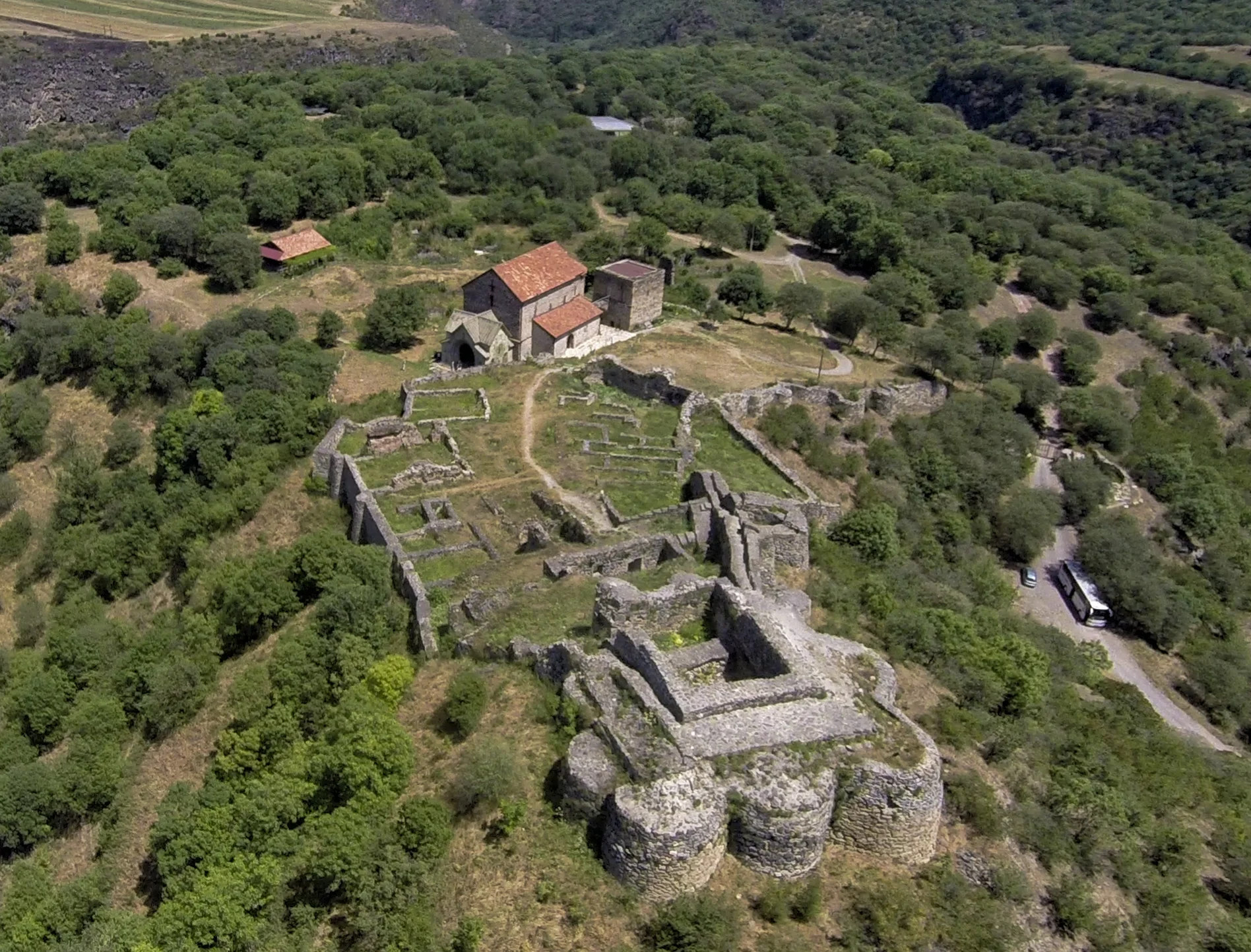
A triple-church basilica built in the 10th century at the highest point of the complex, directly over what was almost certainly Uplistsikhe’s most important pagan temple. The symbolism is unambiguous — Christianity placed on top of paganism, literally and architecturally. The view from here over the Mtkvari valley and the Kartlian plain is the best on the site. On a clear day the landscape opens for miles in every direction, and you can understand immediately why someone chose this particular cliff to build a city.
The Escape Tunnel
A tunnel runs from near the main gate down through the rock to the river. During sieges, residents used it to collect water. It is steep and the footing is careful work, but it is passable for anyone reasonably fit. Most visitors see it and decide against it. This is a mistake. The view from the riverbank — looking back up at the carved cliff face from below, seeing the full height of what was cut from this stone — is a different experience from anything available on the plateau above. It also gives you a sense of the river’s role in the city’s logic: the cliff exists because of the water, and the city exists because of the cliff.
The On-Site Winery
A small winery operates near the entrance, a quiet reminder that Uplistsikhe had wine-pressing facilities two thousand years ago. The tasting after a morning of walking on warm rock is a minor pleasure. Try it.
The Golden Pickaxe
Local tradition says slaves built Uplistsikhe with double-headed pickaxes — iron on one end for cutting rock, gold on the other. A slave who wore through the iron completely earned his freedom and kept the gold.
Whether or not any of that is literally true, the legend earns its place. The amount of human labor cut into this cliff is staggering. Someone valued this place enough to invest what must have been generations of organized effort. And the gold detail is not arbitrary — the region around Uplistsikhe had real gold-mining traditions going back to antiquity. The legend may be preserving a memory of that local wealth, encoding something true inside something fantastic, which is what good legends do.
Planning Your Visit
Getting There
From Tbilisi (80 km): Drive west on the main highway toward Gori, then east toward Kvakhvreli village. The drive takes about 1.5 hours. Signs for Uplistsikhe are well-marked from Gori.
By public transport: Marshrutkas run frequently from Tbilisi’s Didube station to Gori (about 1 hour, 5 GEL). From Gori a taxi to Uplistsikhe takes 15–20 minutes and costs around 15–20 GEL. Taxis wait at the entrance for the return trip. Note that public buses from Gori go only as far as Kvakhvreli village, which leaves you with a 2.5-kilometer walk. Budget extra time.
On a guided tour: Our Mtskheta, Gori and Uplistsikhe day tour covers all three sites with hotel pickup from Tbilisi, entrance fees included, and a guide who can name every structure and give you the context to actually understand it. Given how sparse the on-site interpretation is, this matters more at Uplistsikhe than at many Georgian heritage sites.
Opening Hours and Prices
Tuesday through Sunday, 10:00 to 18:00 (last entry 17:00). Closed Mondays. Hours may extend in summer.
Entrance: 15 GEL adults / 5 GEL students / free for children under 6. Audio guides available at the entrance.
When to Go
Spring and autumn are the most comfortable seasons for the exposed plateau — mild temperatures, good light, manageable crowds.
Summer mornings are the right time if you’re visiting in July or August. The sandstone plateau has no shade and reflects heat. Arrive at opening, spend the morning, leave before midday.
Winter is underrated. A dry winter day — even a cloudy one — is genuinely good for visiting Uplistsikhe. The crowds disappear almost entirely. The warm-toned sandstone looks striking against a grey sky. The temperature inside the carved chambers is not much colder than the outside air. What you want to avoid is rain, which makes the rock surfaces slippery, and the fierce wind that sometimes comes across the upper plateau — but on a still winter day, the site is at its quietest and most atmospheric.
Afternoon light is worth timing for if photography matters to you. The sandstone turns amber and gold in the hour or two before sunset, and the carved surfaces catch a depth of shadow they don’t have at midday.
What to Bring
Sturdy shoes with grip — the rock surfaces are uneven and can be slippery after rain. Sandals are genuinely a poor choice. Bring water (at least a liter per person; nothing is available inside the complex) and sun protection in summer. The cafes near the entrance are adequate for a drink before or after. For a proper meal, go into Gori.
Combining Uplistsikhe with Nearby Sites
Gori and the Stalin Museum is ten minutes away by car. The museum is a serious piece of Soviet-era history wrapped in complicated local pride — polarizing and worth seeing.
Mtskheta lies between Tbilisi and Gori, making it a natural pair with Uplistsikhe on the same day. The two sites together trace a coherent arc: pagan Kartli at its peak, then Christian Georgia at its founding moment. Our Mtskheta, Gori and Uplistsikhe tour is built around this pairing.
Ateni Sioni and the Tana Gorge add a 7th-century church set in a valley that produces some of Georgia’s finest wine. A detour of about two hours, worthwhile for anyone with a serious interest in Georgian wine culture.
Vardzia, Georgia’s other great cave city in Samtskhe-Javakheti, represents medieval Christian cave architecture, where Uplistsikhe is pre-Christian. Seeing both reveals 2,000 years of evolution in rock-cut construction — a genuinely illuminating comparison.
The National Museum in Tbilisi — not adjacent, but relevant. The gold, silver, and bronze objects excavated at Uplistsikhe, along with ceramics and sculpture spanning the Bronze Age through the Middle Ages, are displayed there, not at the site itself. A visit to Uplistsikhe and a visit to the relevant gallery at the National Museum together give you the complete picture.
From the Guide
After standing on this plateau a few hundred times, one thing continues to strike me: the ceiling of the Hall of Queen Tamara. Not the overall scale — most visitors notice that immediately — but the specific moment when you realize the stone ceiling is carved to look like wood. The craftsmen who cut this room from solid rock then spent additional effort making it look like something it wasn’t. They were working in the most permanent material available and chose to imitate the most temporary. I have never entirely decided what to make of that. But I always point it out, and people always stop and look up.
Frequently Asked Questions
How old is Uplistsikhe? The earliest human presence in the area dates to around 1000 BC. The oldest surviving rock-cut structures are from the beginning of the first millennium BC. The city was inhabited until the Mongol invasions of the 13th century — a span of roughly 3,000 years.
What does Uplistsikhe mean? “The Lord’s Fortress” in Georgian — uflisci (the Lord’s) and sikhe (fortress or citadel).
How do you pronounce it? Approximately oop-LEES-tsee-kheh. The “kh” is the guttural sound found in Scottish loch or Spanish jota. Most visitors simplify it to “Cave City,” which the site is also commonly called and which is accurate enough.
How many people lived here? At its maximum, during the period when Uplistsikhe served as the royal capital of Kartli (8th–11th centuries), around 20,000 people.
How long does a visit take? Budget 1.5 to 2 hours for the main structures. Add 30 minutes if you take the tunnel to the river. The walk from the parking lot to the site entrance is 10–15 minutes each way — factor that in before you cut the visit short.
Is a guide necessary? Not strictly. But the on-site interpretation is sparse, and without context the carved chambers don’t communicate what they were. A guide makes a significant difference at Uplistsikhe more than at many other Georgian heritage sites.
Where are the excavated artifacts? Most are at the National Museum in Tbilisi. The site itself has a small museum near the entrance worth checking before entering the complex.
Is it suitable for children? Yes. The uneven terrain requires care, but children generally enjoy the spatial experience of the site. The lower sections are more accessible; the upper plateau and tunnel require more effort.
Book Your Visit
Our Mtskheta, Gori and Uplistsikhe day tour is the most complete way to see Uplistsikhe properly — with transport from Tbilisi, a guide who knows the site in depth, and time built in to actually understand what you’re looking at.