Tsunda
Where a powerful feudal lord built his family chapel on the ruins of an ancient city, and where natural hot springs still bubble beneath terraced gardens in the shadow of Vardzia.
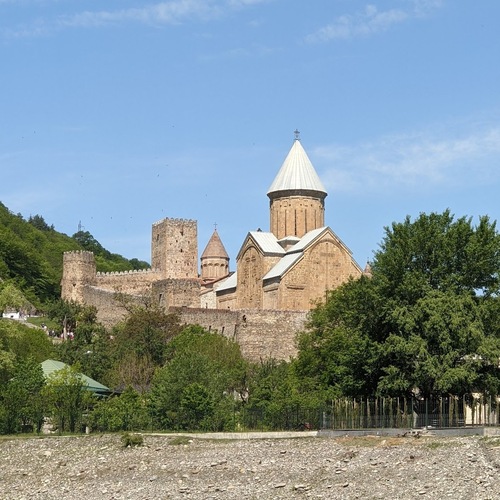
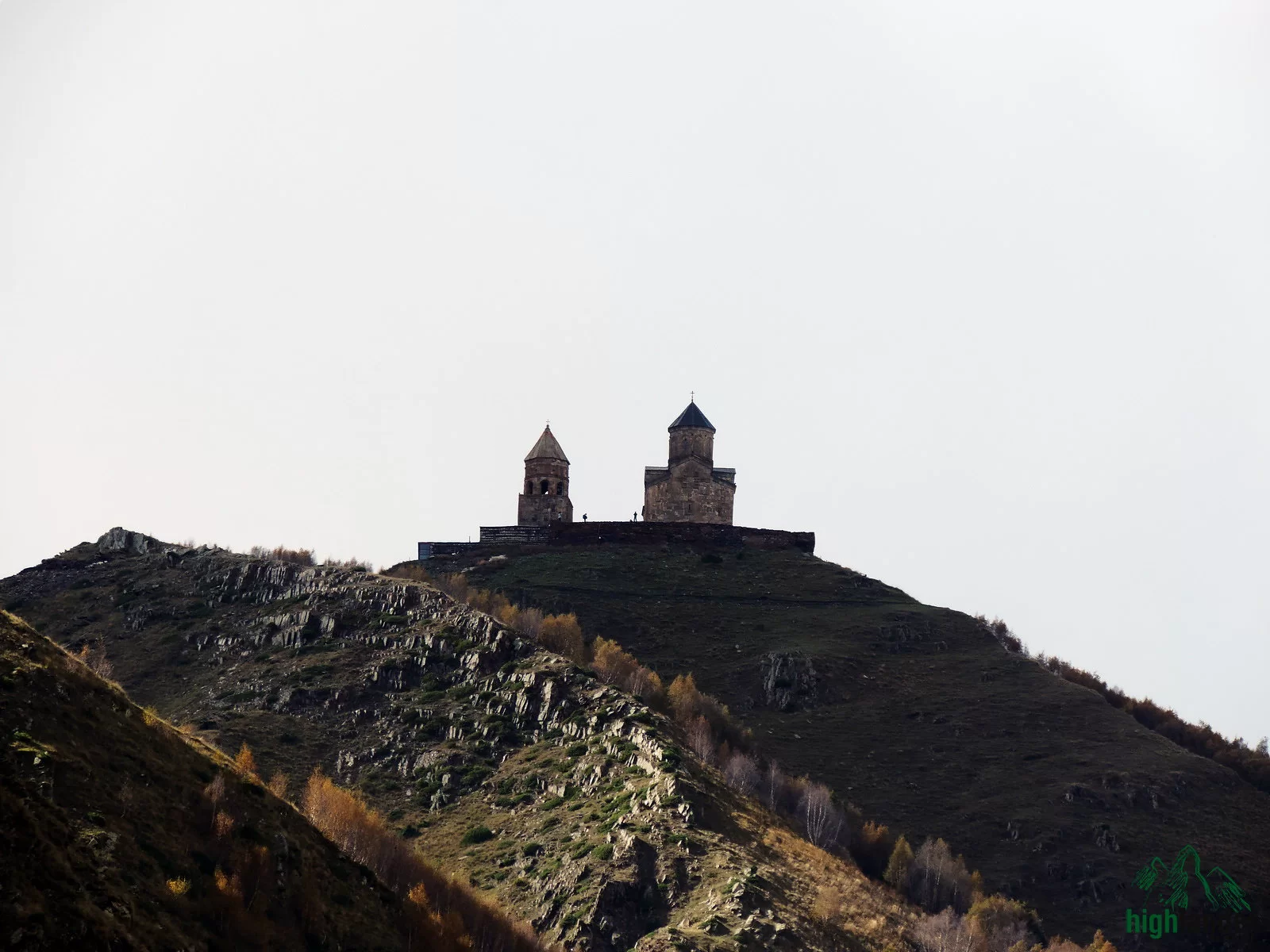
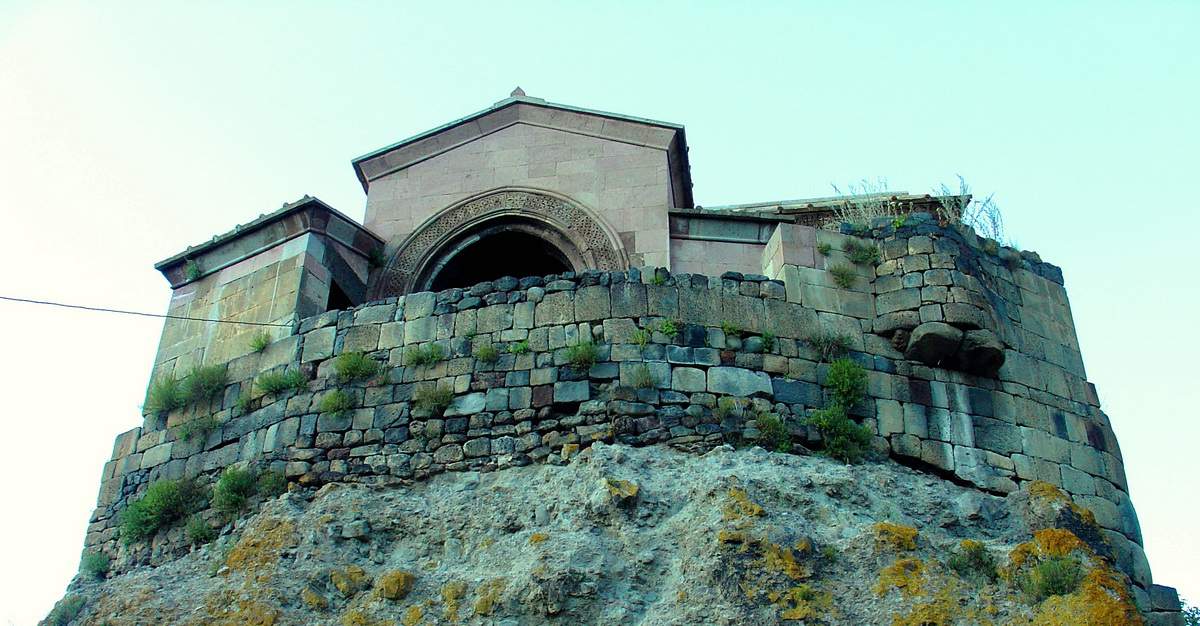
Just seven kilometers from the famous cave city of Vardzia, perched on a rocky outcrop above the Mtkvari River, stands a church that most visitors to the region never see. Tsunda Church dedicated to Saint John the Baptist rises from the site of an ancient city, surrounded by terraced orchards and natural thermal springs. It’s a masterwork of medieval Georgian architecture built by one of Queen Tamar’s most trusted nobles, yet it remains one of the least-visited monuments in a region overflowing with historical treasures.
For travelers who venture beyond Vardzia’s well-worn paths, Tsunda offers something rare: the chance to experience Georgia’s Golden Age in near-solitude, where the only sounds are birdsong, rushing water, and the whisper of history through ancient stones.
The Builder: Ichkit Gurgenisdze
Understanding Tsunda Church begins with its patron: Ichkit Gurgenisdze (also written as Ichkitman, son of Gurgen). He was one of the most influential feudal lords of the late 12th and early 13th centuries, a contemporary of Queen Tamar during Georgia’s zenith of power and cultural achievement.
The Gurgenisdze family were hereditary lords in the Javakheti region, and Ichkit used his considerable wealth and influence to sponsor religious construction across the area. His name appears in several historical sources, most notably in inscriptions at the Vanis Kvabebi Cave Monastery, located about 10 kilometers upstream from Vardzia.
At Vanis Kvabebi, which served as the family monastery of the Gurgenisdze clan before 1191, Ichkit oversaw major restoration work after a devastating earthquake in 1089 had collapsed the central church and much of the cave complex. Between 1186 and 1191, he rebuilt the Church of Saint George, adorned it with precious icons, and constructed an adjacent chapel (eukterion). His patronage helped transform Vanis Kvabebi into one of the most important monastic centers in the region.
The construction of Tsunda Church was likely part of the same campaign of religious building that saw the Gurgenisdze family consolidate their spiritual and political influence in the Javakheti highlands. As a personal chapel built on family lands, Tsunda was meant to serve as a place of prayer for Ichkit’s parents and himself—a function explicitly stated in the church’s foundational inscription.
The Inscription
One of Tsunda Church’s most precious features is the well-preserved inscription carved in Asomtavruli—the oldest form of the Georgian alphabet, which is no longer in everyday use. Located on the arch above the western entrance, the inscription reads:
“In the name of God, I, Ichkitman the son of Gurgen, have built a church in this land of ours, in the name of Saint John the Baptist, to offer prayers for my parents and me.”
Paleographic analysis of this inscription has been crucial in dating the church. The letter forms and style place it firmly in the late 12th to early 13th century—precisely the period when Ichkit was active at Vanis Kvabebi and when Queen Tamar’s Georgia was at the height of its power.
The Ancient City of Tsunda
The church stands on a site with far older significance. According to Georgian chronicles, Tsunda was once a substantial city and an important religious center dating back to the early centuries AD—possibly as early as the 5th century, when Christianity was first becoming established throughout the region.
The chronicles describe Tsunda as a large settlement, though little archaeological work has been done to verify these accounts. What is known is that the city of Tsunda had declined significantly by the early medieval period. The nearby fortress of Tmogvi, whose ruins still crown a dramatic cliff above the Mtkvari River, gained prominence after Tsunda’s decline around 900 AD.
When Ichkit Gurgenisdze chose this location for his church, he was consciously building on sacred ground—layering medieval Christianity over the remains of an older Christian community. This continuity of worship across centuries is a common pattern throughout Georgia, where many famous churches stand on sites that have been considered holy for a millennium or more.
Architecture: Skill in Simplicity
Tsunda Church is a hall church (darbazi type in Georgian)—a single-nave structure with a barrel-vaulted ceiling and a semicircular apse with a conch (half-dome) at the eastern end. This straightforward plan was common for smaller medieval Georgian churches, and while it lacks the complexity of the great domed cathedrals like Svetitskhoveli or Bagrati, its simplicity allows the quality of its construction to shine.
The builders of Tsunda were clearly master craftsmen. The proportions of the interior space achieve a balance of clarity and lightness that belies the massive stonework. The walls are constructed of precisely cut yellow-brown stone blocks, laid with impressive precision.
Distinctive Features
The Crypt: Unlike many Georgian churches, Tsunda has a basement level containing a crypta—a subterranean chamber that may have served as a burial vault for the Gurgenisdze family.
Stone Carvings: While the original article describes the decoration as “rather poor,” this is somewhat misleading. The door and window frames feature carved relief work, and decorative elements including bunches of grapes appear along the corner rods (pilastri). These grape motifs were common in Georgian church decoration, symbolizing both the Eucharist and Georgia’s ancient wine-making tradition.
The Portal: The main entrance portal was added sometime after the church’s initial construction, though still within the medieval period (between the 12th and 14th centuries). Its relief decorations show a slightly different artistic hand, suggesting that later patrons continued to embellish Ichkit’s original creation.
Site Layout: The church sits on an elevated stone terrace, with the building occupying the northern portion and a walled courtyard extending to the south. Additional structures—a gate and small storehouses—were added on the east and west sides during the 13th–14th centuries, creating a small monastic compound.
The Tsromi Connection
Some scholars have noted that while Tsunda doesn’t directly copy the 7th-century Tsromi Cathedral (as Samshvilde Sioni did), it shares certain principles with Georgian architectural tradition—particularly in its emphasis on precise stonework, balanced proportions, and the integration of building and landscape.
A Perfect Setting
What distinguishes Tsunda from dozens of other medieval Georgian churches is its extraordinary setting. The builders chose a location at the edge of the Mtkvari River’s cliffs, where the rock drops away to the floodplain below. The church seems to grow naturally from the landscape, a quality that speaks to what the original article correctly identifies as the architects’ “maturity”—their understanding of how to place a building in harmony with its surroundings.
Around the church, terraced gardens step down the hillside. These agricultural terraces are themselves ancient, part of the traditional Georgian practice of carving productive farmland from mountain slopes. Today, they still produce fruit and vegetables, and in spring the orchards surrounding Tsunda burst with blossoms.
Below the church, natural hot springs emerge from the earth. The Aspindza area has long been known for its thermal waters, which have been used for therapeutic bathing since ancient times. These springs add another dimension to the Tsunda experience—after exploring medieval ruins, visitors can enjoy warm mineral waters in a landscape that has changed little in centuries.
The Historical Context: Georgia’s Golden Age
Tsunda Church was built during the most brilliant period in Georgian history. Queen Tamar (1184–1213), under whom Ichkit Gurgenisdze served, presided over a kingdom that stretched from the Black Sea to the Caspian, from the northern Caucasus to northern Iran. It was an era of military victories, artistic achievement, and religious flowering.
The great poet Shota Rustaveli wrote his masterpiece The Knight in the Panther’s Skin during this period, likely at Tamar’s court. The cave city of Vardzia was completed under Tamar’s patronage. Churches and monasteries were built throughout the realm, funded by a wealthy aristocracy that competed in displays of religious devotion.
Ichkit Gurgenisdze was part of this aristocratic culture. His church at Tsunda, modest compared to royal commissions like Vardzia, represents the second tier of Golden Age construction—the personal chapels and family monasteries that nobles built to assert their status and ensure prayers for their souls. These smaller buildings often preserve a warmth and intimacy that the great cathedrals, with their subsequent restorations and tourist crowds, have lost.
Within two decades of Tamar’s death, this golden era would end. The Mongol invasions of the 1230s shattered Georgian power and brought centuries of decline, invasion, and fragmentation. Churches like Tsunda, built at the apex of medieval Georgian civilization, preserve the artistic achievements of a culture on the edge of catastrophe.
Restoration History
Like many Georgian monuments, Tsunda fell into disrepair over the centuries following the Mongol invasions, Ottoman conquest, and the general decline of the region. By the early 20th century, the church was in poor condition, its frescoes nearly destroyed and its structure compromised.
In 1938, the Committee for the Protection of Antiquities undertook initial conservation work, cleaning the church and partially reinforcing its structure. This was part of the broader Soviet-era effort to document and preserve Georgia’s architectural heritage—an effort that, whatever its ideological motivations, saved many monuments from complete ruin.
A comprehensive restoration was completed in 1982, returning the church to structural stability while preserving its medieval character. Today, Tsunda stands as a well-maintained monument, though it sees far fewer visitors than nearby Vardzia.
Visiting Tsunda
Location
Tsunda is located in the Aspindza Municipality of the Samtskhe-Javakheti region, approximately 7 kilometers from Vardzia and close to the village of Tmogvi. The church sits near the Mtkvari (Kura) River, on the road that connects Vardzia with Khertvisi Fortress and, ultimately, Akhaltsikhe.
Getting There
Organised tour: We visit Tsunda church in our tours in Samtskhe-Javakheti. Check out our 2 day tour to Vardzia and tour to mystic south Georgia.
By Private Vehicle: The most practical option. From Akhaltsikhe, drive southeast toward Vardzia (approximately 60 km). The turnoff for Tsunda comes before reaching Vardzia itself. Roads are paved but winding.
With a Tour: Day tours from Akhaltsikhe or Tbilisi to Vardzia can sometimes include Tsunda, though you may need to specifically request it. Most standard itineraries focus on Vardzia, Vanis Kvabebi, and Khertvisi Fortress.
From Vardzia: If you’re already at Vardzia, Tsunda makes an easy addition—just 7 km back along the road you came.
What to Expect
Tsunda is a quiet, uncommercial site. There are no ticket offices, no souvenir shops, no guides waiting at the entrance. The church is typically open and free to visit, though you should dress modestly as you would for any Georgian church (women should cover their heads and shoulders; men should wear long pants).
The grounds include the church itself, the remains of the medieval compound walls, and views over the Mtkvari valley. The surrounding orchards and terraces invite wandering, and on a clear day you can see Tmogvi Fortress on its cliff across the valley.
Allow 30–45 minutes for a leisurely visit to the church and its immediate surroundings.
The Hot Springs
The thermal springs near Tsunda are not developed as a formal spa facility. Expect rustic conditions—natural pools rather than tiled bathtubs. The experience is authentic but basic. If you’re interested in the hot springs, ask locally for current conditions and access.
Combining Tsunda with Other Sites
The Vardzia area is one of the most monument-rich regions in Georgia. A full day of exploration might include:
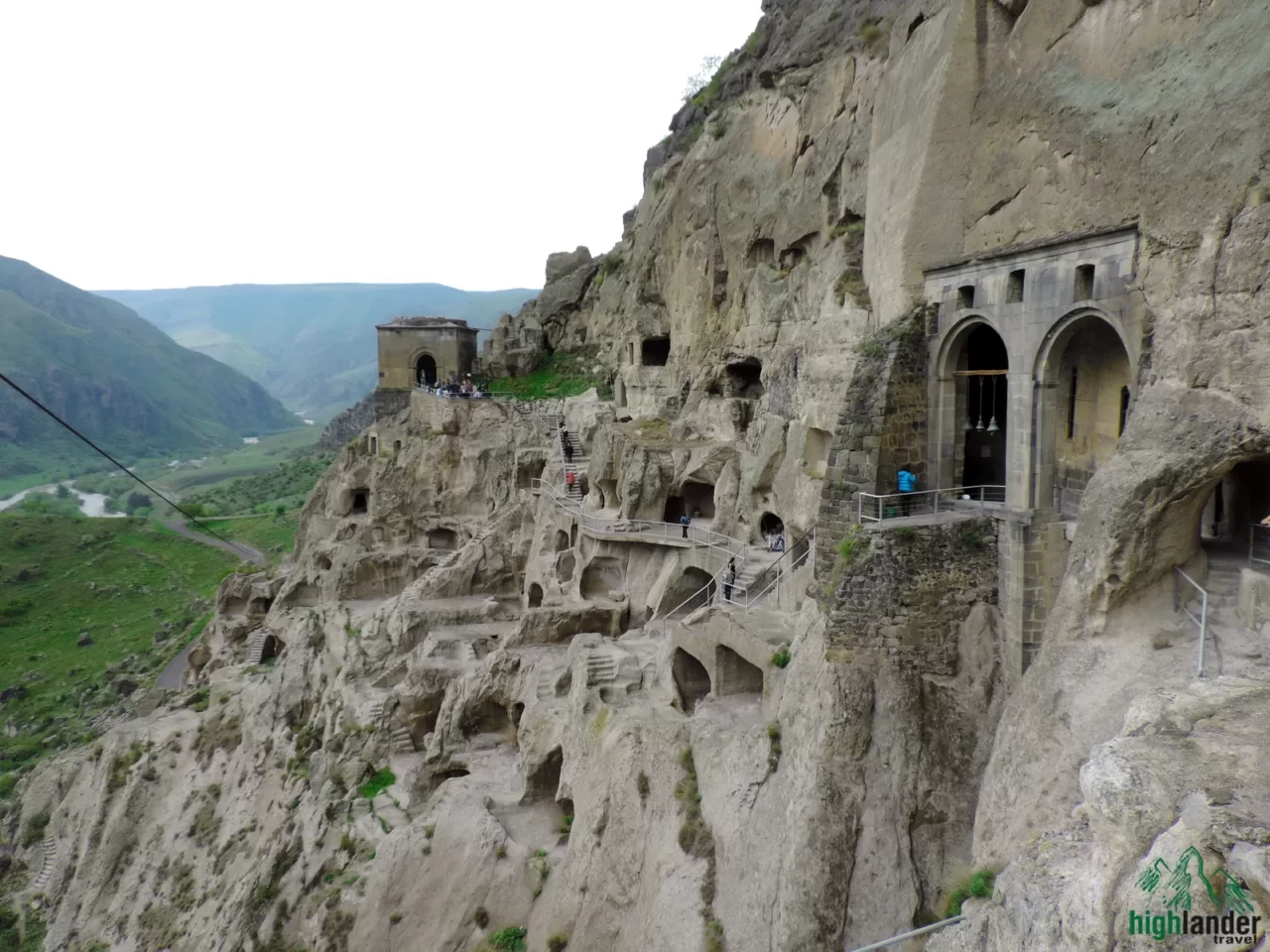
Vardzia Cave City: The main attraction—a massive 12th-century cave monastery carved into Erusheti Mountain, with the famous Church of the Dormition containing frescoes of King George III and Queen Tamar. Plan 2–3 hours minimum.
Vanis Kvabebi: The cave monastery where Ichkit Gurgenisdze—Tsunda’s builder—also worked. Older than Vardzia (8th century origins) and far less crowded. About 10 km from Vardzia.
Tmogvi Fortress: The dramatic ruins of a medieval fortress perched on cliffs above the Mtkvari River, about 4 km from Tsunda. First mentioned in 10th-century sources, Tmogvi controlled trade routes between the Javakheti plateau and the lowlands. The castle was ruled by various noble families including, for a time, the Tmogveli—a name derived from the fortress itself.
Khertvisi Fortress: One of the oldest fortresses in Georgia, at the confluence of the Mtkvari and Paravani rivers. Dating back at least to the 10th century, with some sources claiming much older origins.
A logical route would be: Khertvisi Fortress → Vanis Kvabebi → Tsunda → Tmogvi Fortress (views) → Vardzia. This follows the valley southward and ends at the region’s most famous site.
Frequently Asked Questions
When was Tsunda Church built? In the late 12th or early 13th century, during the reign of Queen Tamar (1184–1213). The exact year is not recorded, but the inscription and architectural style confirm this period.
Who built Tsunda Church? Ichkit Gurgenisdze (or Ichkitman, son of Gurgen), a powerful feudal lord who also restored Vanis Kvabebi Cave Monastery. He built the church as a family chapel for prayers on behalf of his parents and himself.
What kind of church is it? A hall church (single-nave) dedicated to Saint John the Baptist, with a barrel-vaulted ceiling, semicircular apse, and a crypt beneath.
Is Tsunda an active church? The church is primarily a historical monument, though services may occasionally be held. Treat it as you would any Georgian church—with respect and appropriate dress.
What was the ancient city of Tsunda? Georgian chronicles describe Tsunda as a significant city and religious center from the early centuries AD. The medieval church was built on this ancient site, though little remains visible of the earlier settlement.
Are there really hot springs at Tsunda? Yes, natural thermal springs exist in the area. They are not developed as a formal spa—expect rustic natural pools rather than commercial facilities.
How far is Tsunda from Vardzia? Approximately 7 kilometers by road.
Can I visit Tsunda without a guide? Yes. The site is open and there is no admission fee. The church and grounds can be freely explored.
Is Tsunda worth visiting if I’m already going to Vardzia? Absolutely. Tsunda offers a quiet, intimate experience that contrasts with Vardzia’s scale and crowds. The connection between Tsunda and Vanis Kvabebi (through their shared patron, Ichkit Gurgenisdze) also adds historical depth to your understanding of the region.
A Church and Its Landscape
In the end, what makes Tsunda memorable is not just its architecture or history, but the way it sits in its landscape. The medieval builders understood something that modern construction too often forgets: that a building should belong to its place, should seem to have grown from the earth rather than been imposed upon it.
Standing at Tsunda, looking across the terraced gardens to the Mtkvari valley and the ruined fortress of Tmogvi beyond, you sense the continuity of human presence in this landscape—from the ancient city whose ruins lie beneath your feet, through Ichkit Gurgenisdze’s medieval chapel, to the farmers who still tend the orchards today.
This is not Georgia’s most famous church, nor its most spectacular. But for travelers who seek out the quiet corners where history speaks in whispers rather than shouts, Tsunda offers something precious: a direct encounter with Georgia’s Golden Age, unmarred by crowds, unmarked by souvenir stands, unchanged in essence since a feudal lord built his family chapel here eight centuries ago.
Tsunda church can be visited during tour in Vardzia.