Sataplia – Imereti caves protected areas
Sataplia is unlike any other attraction in Georgia. Where else can you stand in 120-million-year-old dinosaur footprints, walk through a dramatically lit cave, and then step onto a glass platform suspended over a cliff, all within an hour?
Located just 10 kilometers from Kutaisi, this compact nature reserve packs genuine natural wonders into an easy half-day visit. For families with children, the dinosaur connection makes it unforgettable. For anyone interested in geology or simply wanting panoramic views of Imereti, Sataplia delivers.
Quick Facts
| Detail | Information |
|---|---|
| Location | Village Banoja, Tskaltubo Municipality |
| Distance from Kutaisi | 10 km (20 minutes) |
| Distance from Tbilisi | 250 km (3.5 hours) |
| Entry fee (foreigners) | 17 GEL |
| Entry fee (Georgian residents) | 8 GEL |
| Time needed | 1.5 to 2 hours |
| Cave temperature | 14°C year-round |
| Best for | Families, geology enthusiasts, photographers |
What Makes Sataplia Special
The reserve was established in 1935 for a specific reason: to protect fossilized dinosaur footprints discovered two years earlier. This remains one of the few places in the world where tracks from both herbivorous and carnivorous dinosaurs are preserved at the same site.
But Sataplia offers more than ancient footprints. The name means “place of honey” in Georgian, referring to the wild bees that historically inhabited Sataplia Mountain. Today the reserve combines four distinct attractions: the dinosaur footprint conservation building, a karst cave with stalactites and stalagmites, a glass observation platform with panoramic views, and walking trails through ancient Colchic forest.
Dinosaur Footprints
The footprints are the headline attraction and something genuinely rare. Discovered in 1933, they date back approximately 120 million years to the Cretaceous period.
The conservation building houses the main display with two distinct layers of tracks:
The lower layer contains 30-centimeter footprints from a raptor, a meat-eating dinosaur that walked on two legs.
The upper layer shows larger 48-centimeter prints from an herbivore, a plant-eating dinosaur.
These tracks formed thousands of years apart but are preserved in the same location, making Sataplia scientifically significant. The dinosaurs that left these prints have been named “Satapliasaurus” and differ from European dinosaur species.
A small museum provides context with displays about the dinosaurs and the geological history of the region. Life-sized dinosaur models outside add atmosphere, particularly appealing to children.
For kids fascinated by dinosaurs, standing where these creatures actually walked creates a connection that pictures in books cannot match.
The Cave
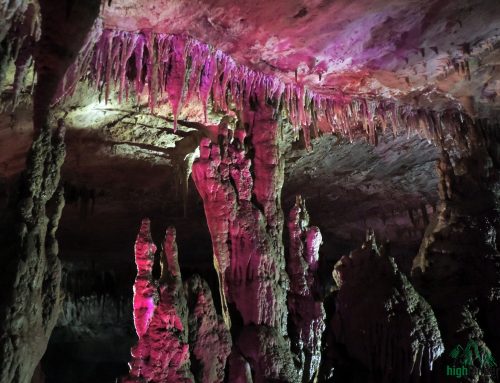
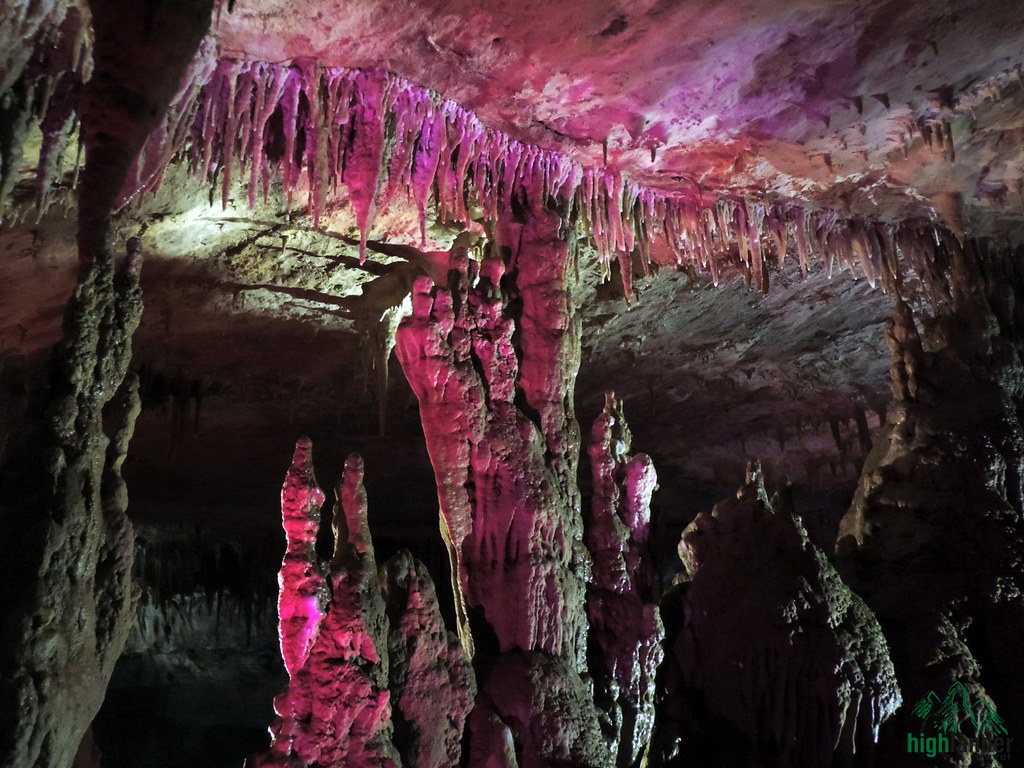
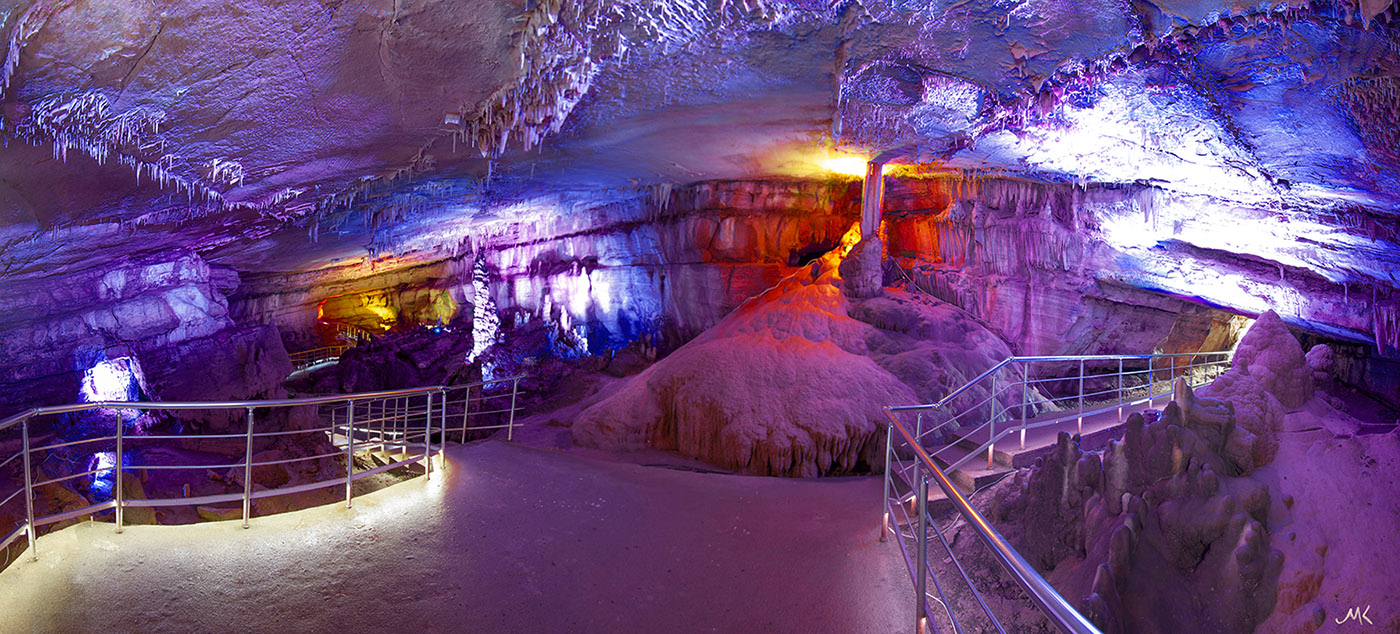
Sataplia Cave stretches approximately 900 meters in total length, though the visitor path runs 314 meters through the accessible section. The cave reaches 10 meters in height and 12 meters in width at its largest points.
Inside, you will find:
Stalactites hanging from the ceiling, formed over millions of years by mineral-rich water dripping through limestone.
Stalagmites rising from the floor where those drops landed and deposited their minerals.
Dramatic colored lighting that highlights the formations, accompanied by audio effects.
One formation resembles a giant human heart. The guides point it out, and once you see it, the resemblance is striking.
The path is paved and equipped with handrails, making it accessible for most visitors. The cave section takes 20 to 30 minutes to walk through.
The temperature inside remains constant at approximately 14°C regardless of outside weather. Bring a light jacket even in summer, as the cool air feels noticeably cold after walking around outside.
Glass Observation Platform
The observation deck sits at the highest point of the reserve and provides the most dramatic moment of any Sataplia visit.
Built into the cliff in a horseshoe shape, the platform extends over empty space with a transparent glass floor. Standing on it feels like hovering above the valley, with Kutaisi and the Imereti countryside spread out below.
The glass is completely safe, but that does not stop the instinctive unease of looking down through your feet at a significant drop. Some visitors find this thrilling; others prefer to admire the view from the solid edges. Children generally love it.
The platform faces west, making late afternoon the best time for photography when the light softens and the views become particularly atmospheric.
Colchic Forest
The reserve protects a patch of Colchic forest, the ancient subtropical woodland that once covered much of western Georgia. This is genuinely old growth, with species dating back to the Tertiary period.
Walking trails wind through vegetation that includes:
Colchic box trees are an evergreen species found only in this region.
Yew trees (Taxus baccata), some of significant age.
Rhododendrons that flower in spring.
Various endemic plants are found nowhere else.
The forest loop takes 30 to 45 minutes for those who want to explore beyond the main attractions. Wildlife includes foxes, badgers, martens, and various birds, though sightings are not guaranteed.
For most visitors, the forest provides a pleasant walk between the cave, dinosaur exhibit, and viewpoint rather than a destination in itself. But for those interested in botany or simply wanting more time in nature, the trails reward exploration.
Practical Information
Getting There
From Kutaisi by taxi: 15 to 20 minutes, approximately 15 to 20 GEL one way. Use Bolt app or agree on price before departure.
From Kutaisi by local transport: Bus or marshrutka to Banoja village (2 GEL), then local taxi to the reserve entrance (approximately 10 GEL). Less convenient but cheaper.
By rental car: Easy drive from Kutaisi center, well signposted. Free parking at the reserve.
By organized tour: Often combined with Prometheus Cave for a full day, or included in broader Imereti itineraries.
Visitor Information
Opening hours: 10:00 to 18:00 daily. Hours may vary seasonally; confirm before visiting.
Entry fees:
- Adults (foreigners): 17 GEL
- Georgian residents: 8 GEL
- Children under 18: Free
- Guide service included in entry fee
Languages: Tours available in Georgian, English, and Russian.
Tour format: Visitors join guided groups. The guide leads you through the dinosaur exhibit, cave, and observation platform. Forest trails can be explored independently afterward.
Facilities: Visitor center, cafe (hours variable), restrooms, souvenir shop, children’s play area, parking.
What to Bring
Comfortable walking shoes. Trails can be muddy after rain, and the cave floor, though paved, can be slippery. Avoid white shoes.
Light jacket for the cave. The 14°C temperature feels cold after being outside in summer.
Camera. Photography is permitted throughout, though flash is discouraged in the cave.
Best Time to Visit
Sataplia works year-round. The cave maintains a constant temperature regardless of outside weather, making it equally appealing in summer heat or winter cold.
Spring brings flowering rhododendrons in the forest. Autumn offers pleasant temperatures and fall colors. Summer is busiest with longer wait times for groups. Winter is quietest.
Navenakhevi Cave: The Hidden Gem
Most visitors to Imereti head straight for Prometheus Cave or Sataplia, overlooking a smaller cave that in some ways surpasses both. Navenakhevi Cave opened to tourists only in 2018 and remains relatively unknown, which is precisely its appeal.
Overview
Navenakhevi is a two-story karst cave with four halls, stretching 250 meters into the hillside. What makes it special is the density and quality of its formations: the cave contains 120 stalagnates (columns formed when stalactites and stalagmites meet), more than both Sataplia and the famous New Athos Cave in Abkhazia.
The cave was first explored in the 1930s by Georgian scientist Professor Levan Maruashvili but remained largely unknown until local residents, the Khujadze sisters, brought attention to it in the 1980s. Development for tourism began much later, with the official opening in 2018.
Located in Terjola Municipality about 20 kilometers from Kutaisi, Navenakhevi offers an intimate cave experience without the crowds that can gather at more famous sites.
What You Will See
The cave divides into two parts around the 30-meter mark from the entrance. A staircase connects the two floors, allowing visitors to explore both levels.
The formations here are exceptional:
Stalactites in various shapes and sizes hang from ceilings.
Stalagmites rise from the floor, some quite substantial.
Stalagnates, the columns formed when stalactites and stalagmites join, appear throughout. The 120 stalagnates represent an unusually high concentration for a cave this size.
A massive 7-meter-thick stalagnate blocks what would have been the exit, meaning the cave has only one entrance. This formation alone took millions of years to develop.
The cave temperature remains constant at 14°C, identical to other caves in the region.
Facilities
The Agency of Protected Areas developed proper infrastructure around Navenakhevi:
Visitor center with information displays.
Amphitheater for events and educational programs.
Cafeteria for refreshments.
Souvenir shop.
Educational space with eco-lessons available.
Children’s entertainment area.
Forest trails in the surrounding woodland.
For families, these facilities make Navenakhevi particularly practical. Children can explore the cave, then burn off energy in the play area while parents relax at the cafe.
Practical Information
Location: Village Navenakhevi, Terjola Municipality, 20 km from Kutaisi, 7 km from the main highway.
Entry fee: 6 GEL for all visitors.
Getting there: From Kutaisi, drive toward Terjola on the main highway. The turnoff to Navenakhevi is well marked, with 7 km of local road to the cave. Total drive time approximately 25 to 30 minutes. Taxi from Kutaisi costs approximately 25 to 35 GEL one way.
Time needed: 1 to 1.5 hours for the cave tour and facilities.
Why Visit Navenakhevi
The low entry fee (6 GEL versus 17 to 23 GEL for Sataplia and Prometheus) makes Navenakhevi excellent value.
Smaller crowds mean a more personal experience, often with smaller tour groups.
The concentration of stalagnates is genuinely impressive and rivals larger caves.
Family-friendly facilities make it practical for visitors with children.
The combination of quality formations, reasonable price, and lack of crowds makes Navenakhevi worth the slight extra effort to reach.
Comparing the Caves: Which Should You Visit?
| Feature | Sataplia | Navenakhevi |
|---|---|---|
| Main draw | Dinosaur footprints + glass platform | Dense stalagnate formations |
| Cave length (visitor route) | 314 m | 250 m |
| Entry fee | 17 GEL | 6 GEL |
| Distance from Kutaisi | 10 km | 20 km |
| Crowds | Moderate to busy | Usually quiet |
| Best for | Families, dinosaur fans, views | Cave enthusiasts, budget travelers |
| Unique feature | 120-million-year-old footprints | 120 stalagnates on two floors |
Choose Sataplia if: You are traveling with children, want the dinosaur experience, or prioritize the glass observation platform and views.
Choose Navenakhevi if: You want a quieter cave experience, are watching your budget, or particularly appreciate geological formations.
With time for both: Visit Sataplia in the morning for the dinosaur footprints and viewpoint, then Navenakhevi in the afternoon for a more intimate cave experience. The two sites are about 25 minutes apart by car.
Combining with Other Attractions
Full Day: Sataplia + Navenakhevi
Start at Sataplia when it opens at 10:00. Spend 1.5 to 2 hours seeing the dinosaur footprints, cave, and observation platform. Drive to Navenakhevi (25 to 30 minutes) for the cave tour. Total time: 4 to 5 hours.
Full Day: Sataplia + Prometheus Cave
The most popular combination. Sataplia in the morning, then Prometheus Cave (15 to 20 minutes away) for the larger cave and boat ride. Total time: 5 to 6 hours.
Adding Kutaisi Sightseeing
Gelati Monastery (UNESCO World Heritage site) lies between Kutaisi and Sataplia. Visit the monastery first, then continue to Sataplia. Alternatively, explore Kutaisi’s old town and Bagrati Cathedral after returning from the caves.
Frequently Asked Questions
Is Sataplia suitable for children?
Yes, particularly well suited. The dinosaur footprints capture young imaginations, the cave is short enough to hold attention, and the glass platform thrills most kids. The children’s play area provides additional entertainment.
How long do I need at Sataplia?
Plan 1.5 to 2 hours to see everything: dinosaur exhibit, cave, observation platform, and a short walk in the forest.
Is the glass platform safe?
Completely safe. The glass is engineered to support significant weight. The unease some visitors feel is psychological rather than based on any actual risk.
Can I visit both Sataplia and Navenakhevi in one day?
Yes, easily. They are 25 to 30 minutes apart. Combined, they take 3 to 4 hours plus transport.
Which cave is better, Sataplia or Navenakhevi?
Different strengths. Sataplia offers the dinosaur footprints and glass platform, which Navenakhevi lacks. Navenakhevi has more impressive cave formations and far fewer visitors. If you must choose one, pick Sataplia for the overall experience, Navenakhevi for the cave itself.
Do I need a guide?
Yes, guided tours are mandatory at both caves. Guides are included in the entry fee and available in English, Georgian, and Russian.
What is the temperature inside the caves?
Both caves maintain approximately 14°C year-round. Bring a light jacket.
Is Sataplia accessible for people with mobility issues?
Limited accessibility. The cave path is paved with handrails but involves some stairs and uneven sections. The observation platform is accessible. The full forest trails may be challenging.
Experience Sataplia with Highlander Travel
The caves near Kutaisi offer something different from Georgia’s mountain scenery and ancient churches. At Sataplia, you walk where dinosaurs once walked. The footprints are not replicas or reconstructions but actual impressions left 120 million years ago, preserved in stone.
We include Sataplia in our Kutaisi and western Georgia itineraries, combining the caves with Gelati Monastery, the canyons of Samegrelo, or the mountain roads to Svaneti. Whether you want a focused cave day or a broader exploration of Imereti, we can design an itinerary that fits your interests.
View Our Kutaisi Tours | Contact Us
Highlander Travel has been organizing tours in Georgia since 2011. Based in Tbilisi, we operate throughout the country and know Imereti’s caves, canyons, and hidden corners intimately.