Samegrelo

Written by Highlander Travel | Local tour operators since 2011
Last updated: December 2025
Overview: The Land of Colchis
Samegrelo occupies western Georgia between the Black Sea and the mountains that rise toward Svaneti. Most travelers pass through on the road to Mestia, catching glimpses of the Enguri reservoir from marshrutka windows. They’re missing one of Georgia’s most distinctive regions.
The Megrelians – “Megrelebi” in Georgian – are Georgians with their own language, cuisine, and cultural identity. Megrelian isn’t a dialect; it’s a separate South Caucasian language that predates written history. Every Megrelian grows up bilingual, speaking both their native tongue and Georgian. The region’s historical name, Odishi, appears in medieval chronicles, though most Georgians simply call it Samegrelo — “land of the Megrelians.”
This is the ancient Kingdom of Colchis, where Greek mythology placed the Golden Fleece that Jason and the Argonauts sought. The myth almost certainly reflects real trade connections – Colchian gold, extracted from rivers using sheep fleeces to trap particles, was famous throughout the ancient Mediterranean. Archaeological sites across Samegrelo continue to yield evidence of sophisticated Bronze Age civilization.
For modern visitors, Samegrelo offers Georgia’s most accessible canyon experiences, a UNESCO-recognized wetland ecosystem, the country’s spiciest regional cuisine, and the practical gateway to Svaneti’s mountain villages.
Tours in Samegrelo
Getting to Samegrelo
From Tbilisi
- By train: The train to Zugdidi departs Tbilisi Station around 9 am, arriving approximately 2 pm. Second-class sleeper compartments cost 25-35 GEL. Comfortable, practical option that saves a hotel night and arrives early enough to start exploring.
- By marshrutka: Minibuses depart from Tbilisi’s Didube station throughout the day (roughly hourly from 7 am-6pm). Journey takes 5-6 hours, depending on traffic and stops. Fare approximately 30 GEL to Zugdidi.
- By car: 320 km via the main E60 highway through Kutaisi. Road fully paved, straightforward driving, 4-5 hours without stops. Consider breaking the journey in Kutaisi to visit Gelati Monastery or Prometheus Cave.
From Kutaisi
The practical gateway for most Samegrelo visits. Zugdidi lies just 100 km northwest — about 1.5 hours by car or marshrutka. Frequent minibuses depart from Kutaisi’s central station (10-15 GEL). From Kutaisi, day trips to Martvili and Okatse Canyons are easily manageable.
From Batumi
Marshrutkas connect Batumi to Zugdidi (2.5-3 hours, 15-20 GEL). The coastal road passes through Poti before turning inland. Less frequent service than from Kutaisi — typically 3-4 daily departures.
Zugdidi as a Transit Hub
Most travelers encounter Zugdidi as the transfer point for Svaneti. Marshrutkas to Mestia (3-4 hours, 25-30 GEL) depart from Zugdidi’s central station throughout the morning. If you’re heading to or from Svaneti anyway, building in a day or two for Samegrelo makes geographic sense — the canyons and Dadiani Palace lie directly along your route.
Best Time to Visit
May to June: Ideal conditions. Warm but not oppressive (22-28°C), waterfalls at maximum flow from spring melt, canyons at their most dramatic, and lush green landscapes. Kolkheti wetlands are alive with migratory birds. July to August: Hot and humid (30-35°C in lowlands). Peak domestic tourism — canyons can be crowded, especially on weekends. Beach resorts in Anaklia are busy with Georgian families. Early morning canyon visits are recommended to beat both heat and crowds. September to October: Excellent shoulder season. Temperatures moderate (20-26°C), summer crowds thin, and autumn colors begin in the foothills. Good weather for hiking. Hazelnuts and kiwis harvested — Samegrelo supplies both Ferrero and European markets. November to April: Rainy season in the lowlands — Samegrelo receives more precipitation than almost anywhere else in Georgia. Canyons remain accessible but less spectacular with lower water levels. Mountain roads to the Tobavarchkhili lakes are closed by snow. Fewer tourists mean lower prices and more authentic local interaction. Note on weather: Samegrelo’s subtropical humidity surprises visitors expecting dry heat. Summer afternoons often bring thunderstorms. Mornings are typically clearest — plan outdoor activities accordingly. Read more about seasons in Georgia in our blog post.
Zugdidi: The Regional Capital
Zugdidi functions as Samegrelo’s administrative and commercial center, though it lacks the architectural charm of Kutaisi or Telavi. The city of approximately 42,000 people serves primarily as a base for exploring surrounding attractions. Most travelers spend a night here while visiting canyons and the Dadiani Palace.
Dadiani Palace Museum
The Dadiani family ruled Samegrelo as princes for centuries, and their palace complex remains the most important historical site in Zugdidi. The main building dates to the 17th century, later expanded and Europeanized in the 19th century, when the Dadiani princes cultivated connections with the European aristocracy. The museum collection exceeds 40,000 items: weapons, furniture, paintings, icons, archaeological finds, and manuscripts. Two objects draw particular attention: Napoleon’s death mask: One of only three bronze casts made from the original. It arrived here through Princess Salome Dadiani, who married Achille Murat, grandson of Napoleon’s sister Caroline. The connection brought numerous Napoleonic artifacts to this unlikely corner of the Caucasus. The Virgin Mary’s shroud: Allegedly brought from Constantinople after its fall in 1453. The relic remains in the Virgin Tower and is publicly displayed only once yearly in August. Believers travel from across Georgia for the viewing. Beyond these headline pieces, the museum offers genuine insight into Georgian aristocratic life and regional archaeology. David Dadiani, one of the last princes, was a serious archaeologist who excavated Nokalakevi and brought many finds here. Hours: 10 am-6 pm, closed Mondays. Entry: 7 GEL. Duration: 1-2 hours. The surrounding botanical garden, established by the Dadiani family, offers pleasant walks.
Practical Information
Zugdidi has several ATMs (TBC Bank, Bank of Georgia near the central square), a pharmacy, a market, and the essentials. Where to eat in Zugdidi: For authentic Megrelian cuisine, locals recommend Diaroni – a reliable choice for elarji, kharcho, and kupati in generous portions. Mendzeli offers a slightly more refined setting with the same traditional dishes, good for a longer meal with wine. Both serve the full range of Megrelian specialties and are accustomed to visitors. Prices are reasonable: expect 25-40 GEL per person for a full meal with drinks. Accommodation: Several hotels in the 80-150 GEL range. Guesthouses outside town offer quieter settings at lower prices (50-80 GEL with breakfast). Nothing approaches luxury, but comfortable rooms with private bathrooms are readily available.
Martvili Canyon
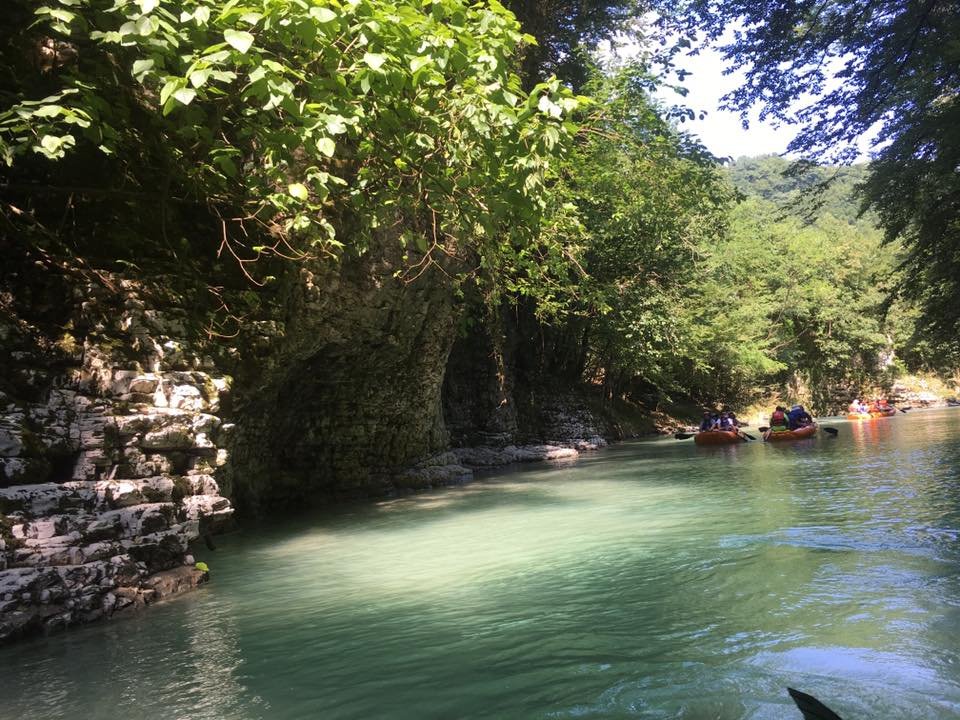
The image that sells Samegrelo: emerald water flowing through a narrow gorge, towering rock walls draped in vegetation, small wooden boats gliding beneath natural bridges. Martvili Canyon genuinely looks like the photographs — one of the few Georgian attractions that does. The canyon formed over millennia as the Abasha River carved through limestone. The result is a 2.4-kilometer gorge with depths reaching 40 meters, the water tinted blue-green by dissolved minerals. Small waterfalls cascade down moss-covered walls. In the narrowest sections, sunlight barely penetrates.
Visiting Martvili Canyon
The visitor center (opened 2016) organizes access efficiently. Two sections exist:
- Upper section (walking trail): A 700-meter path along the canyon rim with viewing platforms overlooking the gorge. Takes 30-40 minutes, included in basic entry fee.
- Lower section (boat ride): The main attraction. Small motorboats carry visitors through the canyon’s most dramatic stretch — approximately 300 meters of narrow gorge with waterfalls and rock formations. Boats hold 4-6 people; trip lasts 15-20 minutes.
- Entry fee: 20 GEL (walking trail only) or 50 GEL (including boat ride). As of 2024-2025 prices — check current rates.
- Hours: 10 am-6 pm daily (later in summer). Arrive early to avoid crowds and heat.
- Swimming: Prohibited in the main canyon. A swimming area exists near the entrance during summer months.
- Best time: May-June for maximum water flow and waterfall intensity. Morning visits year-round for better light and smaller crowds.
- Getting there: Martvili town lies 35 km northeast of Zugdidi (40 minutes by car). The canyon is 3 km outside town — taxis available from Martvili center. No direct public transport to the canyon itself; marshrutkas connect Zugdidi to Martvili town.
Combining with Other Sites
Martvili Monastery sits on a hill above the town – a 7th-century church with later additions, worth a brief stop for the views and historical context. The Chkondidi Assumption Church within the complex contains medieval frescoes. Where to eat in Martvili: Sanapiro is the local favorite – a family-run restaurant near the river serving excellent Megrelian dishes. The elarji here is properly made (stretchy, hot, generous with cheese), and the kupati are grilled to order. Outdoor seating overlooks the water. A full lunch runs 20-35 GEL per person. Our guides stop here regularly with tour groups.
Balda Canyon
Less developed and less visited than Martvili, Balda Canyon offers a wilder experience for those wanting to escape the organized tourism of its famous neighbor. The canyon lies near Balda village, approximately 15 km from Martvili. Where Martvili has visitor centers and boat queues, Balda remains largely natural. The canyon is narrower and more intimate, with crystal-clear pools suitable for swimming in summer. Local guides lead visitors along the riverbed, wading through shallow sections and scrambling over rocks to reach hidden pools and small waterfalls. The experience depends heavily on water levels. In spring and early summer, higher water makes some sections impassable, but the scenery is more dramatic. By late summer, water drops enough to walk the full canyon length, and the pools warm to swimmable temperatures. Visiting Balda: No formal entrance fee or visitor infrastructure. Local guides from Balda village lead canyon walks — arrange through guesthouses in Martvili or contact us for organized trips. Expect to pay 50-80 GEL for a guided walk (2-3 hours). Bring water shoes or sandals that can get wet, swimwear, and a dry bag for electronics. Best for: Travelers who’ve already seen Martvili and want something less touristy, or those specifically seeking swimming opportunities. Not recommended for those with mobility limitations — the terrain is uneven and requires wading.
Kolkheti National Park
While canyons draw most tourists, Kolkheti represents Samegrelo’s most significant natural heritage. This UNESCO-recognized wetland ecosystem preserves the ancient Colchian forests and marshes that once covered much of western Georgia’s coast. The park centers on Paliastomi Lake and the surrounding wetlands near Poti. The ecosystem supports over 100 bird species — particularly significant during spring and autumn migration. Colchian forests contain relict plant species that survived the Ice Ages in this humid refuge, some found nowhere else in Europe.
Visiting Kolkheti
The park visitor center in Poti arranges boat tours through the wetlands and the lake. Options include: Paliastomi Lake boat tour: 2-3 hour excursion through the lake and connecting channels. Best for birdwatching (bring binoculars). Approximately 40-60 GEL per boat. Kayak rental: Available for independent exploration. Prior kayaking experience recommended for navigating the channels. Walking trails: Several marked paths through wetland and forest ecosystems. Boardwalks protect both visitors and fragile habitat. Best time: April-May and September-October for bird migration. Summer months hot and humid with mosquitoes — bring repellent. Getting there: Poti lies 55 km south of Zugdidi on the Black Sea coast. The visitor center is located at the lake entrance. Marshrutkas connect Zugdidi to Poti (1 hour, 5-7 GEL).
Enguri Dam
The drive to Svaneti passes the Enguri reservoir — a vast turquoise body of water visible for kilometers. Most travelers photograph it from the marshrutka without realizing what they’re seeing. The Enguri Dam ranks as the world’s second-highest concrete arch dam at 271 meters. Construction began in 1961 and took over 25 years to complete — a Soviet megaproject that remains Georgia’s largest power source. The dam itself lies in Georgian-controlled territory while the power station sits in the Gali district, technically in Abkhazia. This geographic split creates one of the few areas where Georgia and Abkhazia cooperate: both sides depend on the electricity, so both sides maintain the infrastructure.
Visiting the Dam
Most travelers only see the reservoir from the main road. However, it’s possible to visit the dam itself with advance arrangements. Tours include the dam crest (views of both reservoir and the valley 271 meters below) and sometimes the underground tunnels. The Georgian government has plans to develop tourism infrastructure here — a visitor center, boat tours on the reservoir, and potentially a viewing platform. As of 2025, these remain plans rather than reality. Current access requires arranging with local guides or tour operators. Getting there: The dam lies approximately 30 km north of Zugdidi on the road to Mestia. A detour from the main highway adds about 30 minutes. Not accessible by public transport.
Archaeological Sites
Nokalakevi
The ancient capital of western Georgia, Nokalakevi was a major city from the 4th century BC through the medieval period. Archaeological excavations — ongoing since the 19th century — have revealed successive layers of Colchian, Roman, Byzantine, and Georgian construction. The site occupies a strategic position overlooking the Tekhuri River. Visible remains include city walls, defensive towers, a palace complex, and early Christian churches. A museum displays finds from the excavations: jewelry, weapons, pottery, and coins spanning multiple civilizations. Nokalakevi lacks the visual drama of Vardzia or David Gareja, but for those interested in Colchian history, it provides tangible evidence of the sophisticated culture that developed here 2,500 years ago. Location: 20 km east of Senaki. Entry: 15 GEL (museum separate). Duration: 1-2 hours for the site and the museum.
Other Historical Sites
Rukhi Fortress: 17th-century castle near Zugdidi, built by Levan II Dadiani at the height of Samegrelo’s independence. Partially restored, offers good views of the surrounding plain. Tsaishi Cathedral: 10th-11th century church with notable medieval frescoes. Located near the village of Tsaishi, approximately 45 km from Zugdidi. Khobi Monastery: Working monastery with a 13th-century church. The katholikon contains frescoes and carved stone decoration worth examining. Salkhino: Summer residence of the Dadiani princes, set in gardens outside Zugdidi. The house itself is less impressive than the main palace, but the grounds are pleasant.
Trekking in Samegrelo
Samegrelo’s lowland character means it’s not a primary trekking destination — most serious hikers head directly to Svaneti. However, the Egrisi Mountains along the region’s northern edge offer routes that remain far less crowded than Svaneti’s famous trails.
Tobavarchkhili Lake Trek
The most celebrated trek in Samegrelo leads to Tobavarchkhili Lake (the “Silver Lake”), a glacial lake at 2,650 meters in the Egrisi Range. The lake earns its nickname from the milky color produced by suspended mineral particles. Three main routes reach the lake: Standard route (4-5 days): Begins near Mukhuri village, climbs through forest and alpine meadows, reaching the lake on day 2-3. Return by same route or continue to Svaneti via Chvelpi Pass. Okare Pass route (3 days): More challenging approach from Skuri village via the 2,760-meter Okare Pass. Remote and rarely traveled. From Svaneti (2 days): Starting from Khaishi, this route approaches from the north. Difficult terrain, experienced hikers only. All routes require camping — no guesthouses exist in the mountains. Trails are unmarked and difficult to follow without GPS tracks or local guide. Weather changes rapidly at altitude; come prepared for rain and cold even in summer. Best season: July to September when high passes are snow-free.
Day Hikes
Intsra Waterfall: Easy 3-hour walk from the Intsra Valley to a scenic waterfall. Good option for those with limited time or fitness. Mt. Kvira (2,000m): Moderate 2-day trek with views over Samegrelo lowlands. Route passes the Kuakantsalia “Swinging Stone” — a 12-ton boulder balanced on a small base that rocks when pushed. Toba and Oniore Waterfalls: One of the best day hikes accessible from Kutaisi, visiting several waterfalls in a single loop. 5-6 hours, moderate difficulty.
Megrelian Cuisine
Every Georgian will tell you that Megrelian food is the country’s spiciest and most flavorful. They’re right. Samegrelo’s cuisine developed distinctive characteristics over centuries – heavier use of walnuts, more aggressive seasoning, and the famous adjika hot paste that anchors the regional flavor profile. The historical explanation: malaria was endemic to Samegrelo’s subtropical lowlands until Soviet-era drainage projects. Heavily spiced food was believed to help prevent the disease. Malaria is long gone, but the taste for heat remains.
Essential Megrelian Dishes
Elarji: The signature dish – cornmeal (ghomi) cooked with large quantities of fresh cheese until it becomes an elastic, stretchy mass. Served hot, it pulls in long strands like mozzarella. The texture is unlike anything else in Georgian cuisine. Eat it with meat dishes or on its own with more cheese on top. Ghomi: Cornmeal porridge that serves as the Megrelian staple instead of bread. Plainer than elarji, it served as an accompaniment to stews and meats. Proper ghomi should be thick enough to stand a spoon upright. Megrelian khachapuri: Unlike the boat-shaped Adjarian version or the simple Imeretian circle, Megrelian khachapuri includes cheese both inside and on top, then baked until the surface browns and bubbles. Richer and more intensely cheesy than other regional varieties. Kharcho: Beef in walnut sauce, more substantial than the soup version found elsewhere in Georgia. The Megrelian kharcho uses ground walnuts, garlic, and a complex spice blend including coriander, fenugreek, and blue fenugreek (utskho suneli). Thick, rich, intensely flavored. Kupati: Sausages filled with pork heart, liver, and lungs mixed with pomegranate seeds and spices. Grilled until the casing crisps. Far more flavorful than the description suggests — the pomegranate adds unexpected brightness. Satsivi: Turkey or chicken in cold walnut sauce, traditionally served at New Year celebrations. The Megrelian version uses more garlic and spice than preparations from other regions. Gebzhalia: Fresh cheese curds rolled in mint-infused whey paste, served cold as an appetizer. The combination of tangy cheese and cooling mint works surprisingly well, especially in hot weather. Often served alongside elarji as a lighter contrast. A distinctly Megrelian preparation you won’t find elsewhere in Georgia. Smoked sulguni: While sulguni cheese exists throughout Georgia, the Megrelian version — particularly the smoked variety — is considered the finest. The cheese is formed into braided ropes or rounds, then cold-smoked over fruit wood until the exterior darkens and develops a firm, slightly chewy texture. Inside remains soft and stretchy. Served sliced as an appetizer, or melted into dishes. Buy it at Zugdidi market directly from village producers — the industrial versions sold in supermarkets don’t compare.
Adjika
The defining condiment. Real Megrelian adjika is a paste made from hot peppers, garlic, herbs, and spices — nothing like the watery hot sauces sold to tourists. The paste keeps for months and gets used in virtually everything. Sixty distinct adjika varieties reportedly exist in Samegrelo, each family maintaining its own recipe. The differences involve pepper varieties, spice proportions, and preparation methods. UNESCO has recognized adjika as part of Georgia’s intangible cultural heritage. Visitors can buy adjika at any market in Samegrelo. Quality varies enormously — taste before purchasing, and expect to pay more for small-batch family production than mass-produced versions.
Where to Eat
Restaurant quality in Samegrelo varies significantly. In Zugdidi, Diaroni and Mendzeli consistently deliver authentic Megrelian cooking — proper elarji, well-seasoned kharcho, kupati grilled rather than boiled. In Martvili, Sanapiro offers riverside dining with the full range of regional dishes. These are working restaurants serving locals, not tourist traps with laminated menus. Guesthouses often provide excellent home-cooked Megrelian meals. When staying overnight, arrange full board — the opportunity to eat authentic family cooking shouldn’t be missed. Home-prepared gebzhalia and fresh smoked sulguni from village producers often surpass restaurant versions.
Megrelian Wine
Though not Georgia’s primary wine region, Samegrelo produces distinctive wines from local grape varieties. The winemaking method differs slightly from Kakhetian tradition: grape skins remain in contact with juice for only one week rather than several months, producing lighter, fruitier wines. Notable varieties: Ojaleshi: The most famous Megrelian wine, a semi-dry red with deep color and berry flavors. Widely available throughout Georgia, though quality varies by producer. Commercial wineries exist, but family cellars produce the most interesting wines in small quantities. Ask guesthouse hosts about local production.
Anaklia: Black Sea Resort
Samegrelo’s stretch of Black Sea coast includes several resort areas, with Anaklia positioned as the most developed. The government invested heavily here in the 2010s, building a modern promenade, beach infrastructure, and conference facilities. The beach is fine sand, the water reasonably clean, and summer brings Georgian families for seaside holidays. Anaklia attracts a younger crowd than traditional resort towns, with music festivals and beach clubs operating in peak season. For international visitors, Anaklia offers a pleasant day or overnight if you’re in the area, but probably doesn’t justify a special trip — Georgia’s beaches don’t compare to Mediterranean or Southeast Asian alternatives. The appeal is local atmosphere rather than world-class facilities. Getting there: 30 km from Zugdidi. Marshrutkas run in summer; off-season transport is limited. Nearby: The Anaklia fortress dates to Byzantine times, with later Ottoman additions. Ruins are accessible from the beach area.
Samegrelo as Gateway to Svaneti
Most travelers encounter Samegrelo en route to Mestia and Ushguli. Rather than treating the transit as dead time, consider building in a day or two for Samegrelo attractions. Logical routing:
- Option 1: Arrive in Zugdidi by overnight train from Tbilisi (6 am arrival). Visit Dadiani Palace that morning, then continue to Mestia by marshrutka or arranged transport.
- Option 2: Stay overnight in Zugdidi or the Martvili area. Full day for Martvili Canyon, Okatse Canyon, and Kinchkha Waterfall. Next morning, continue to Svaneti.
- Option 3: Return from Svaneti via Zugdidi. Spend the final day in canyons before the evening train to Tbilisi.
The Enguri Dam lies directly on the Zugdidi-Mestia road — all Svaneti-bound traffic passes the reservoir. The dam itself requires a short detour but combines naturally with the journey.
Read about Samegrelo in our blog
Martvili monastery
Martvili monastery, also known as Chkondidi cathedral stands just above [...]
Practical Information
Getting Around
Public transport connects major towns (Zugdidi, Martvili, Senaki, Poti) but doesn’t reach attractions directly. Practical options:
- Taxi: Negotiate day rates for canyon visits. Expect 80-120 GEL for a full day covering Martvili and Okatse Canyons from Zugdidi.
- Rental car: Roads are good throughout the lowlands. Useful if combining Samegrelo with Svaneti, though mountain roads require experience.
- Organized tours: We offer day trips from Zugdidi or Kutaisi covering major attractions. Our drivers know the roads and our guides know the history — and the best lunch spots.
Accommodation
- Zugdidi: Hotels in the 80-150 GEL range. Several adequate options near the central square and Dadiani Palace.
- Martvili: Guesthouses in and around town, 50-80 GEL with breakfast. Good base for canyon visits.
- Anaklia: Beach hotels and guesthouses, prices higher in summer (100-200 GEL).
- Rural areas: Family guesthouses throughout, typically 40-70 GEL including breakfast, dinner available on request.
Money
ATMs available in Zugdidi, Senaki, and Poti. Bring cash for smaller towns, canyon entrance fees, and guesthouses. Credit cards accepted at larger hotels and some restaurants in Zugdidi.
Language
Megrelians speak both their native language and Georgian — you’ll hear both in daily conversation. Russian is widely understood by older residents. English is limited outside tourism-focused businesses. Basic Georgian or Russian phrases help considerably.
Frequently Asked Questions
Book Your Samegrelo Trip
Samegrelo combines well with Svaneti trips or stands alone for visitors based in Kutaisi or traveling to Georgia’s western regions. Our tours include transport, guides who speak your language and know the region intimately, and recommendations for the best local restaurants — details that independent visitors often miss.
Contact us to arrange day trips to the canyons, multi-day Samegrelo exploration, or combined Samegrelo-Svaneti itineraries. View our private Georgia tours for packages including this region.


