Bolnisi Sioni church
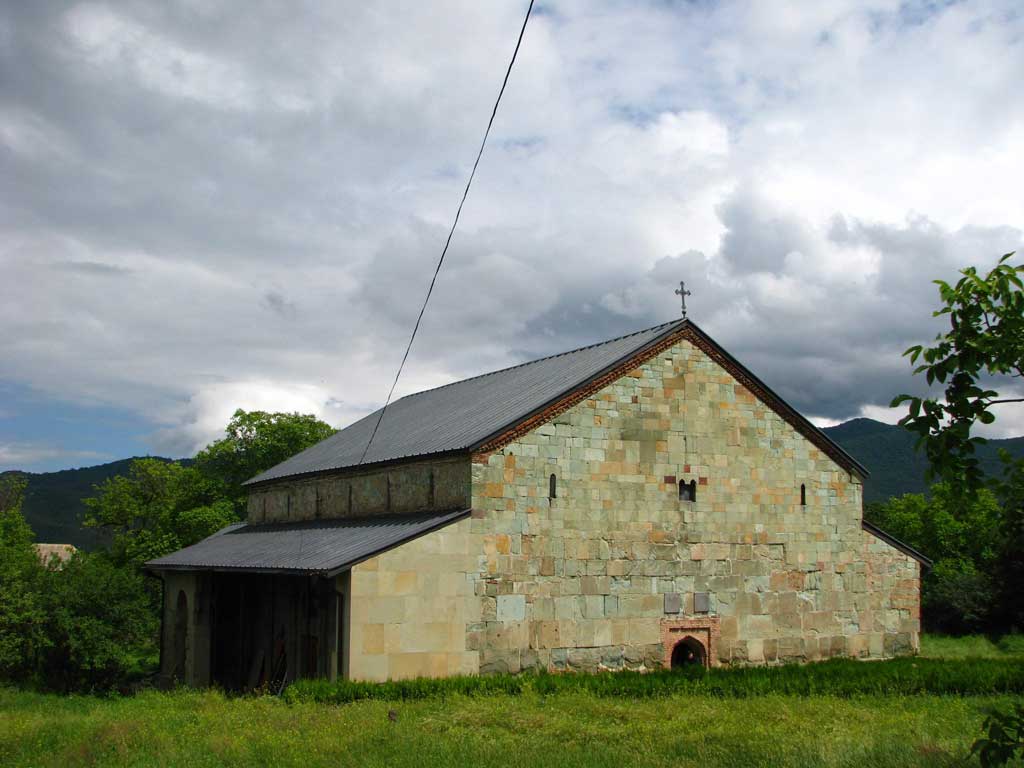
This 5th-century basilica holds the oldest dated Georgian inscriptions—and gave Georgia the cross that appears on its national flag.
Seventy kilometers south of Tbilisi, in the agricultural heartland of Kvemo Kartli, stands the oldest church building in Georgia. Bolnisi Sioni Cathedral was constructed between 478 and 493 AD—we know this precisely because the builders carved the dates into stone, creating what are among the oldest surviving examples of Georgian writing. But Bolnisi Sioni’s significance extends far beyond its age. The distinctive cross carved into its facade has become one of Georgia’s most powerful national symbols, appearing on everything from the state flag to jewelry to wine labels.
For visitors who want to understand Georgia’s deep Christian roots and the origins of its written language, no site is more important than this turquoise-green basilica in a quiet village south of the capital.
Why Bolnisi Sioni Matters
Georgia converted to Christianity around 337 AD, making it one of the first countries in the world to adopt the faith as its state religion. Yet few physical traces of that early Christian period survive. The churches of Mtskheta date mostly from the 6th century and later. Jvari Monastery was built in the 580s–600s. Bolnisi Sioni predates them all.
Constructed during the reign of King Vakhtang I Gorgasali—one of the most celebrated rulers in Georgian history—Bolnisi Sioni represents the moment when Georgian Christianity moved from a young faith to an established institution with the resources to build monumental architecture. The church’s inscriptions explicitly date its construction to the 20th year of the reign of Persian King Peroz I, placing the foundation in 478/479 AD. Fifteen years later, in 493/494, the work was complete.
This matters for three reasons. First, Bolnisi Sioni is the oldest precisely dated church in Georgia—and one of the oldest in the entire Caucasus region. Second, its inscriptions represent the oldest dated examples of Georgian writing found within Georgia itself. Third, the distinctive cross carved into its facade became the Bolnisi Cross, now one of Georgia’s most recognized national symbols.
The Architecture: A Three-Nave Basilica
Unlike the domed churches that would later define Georgian ecclesiastical architecture, Bolnisi Sioni follows the basilica form—a rectangular building with a central nave flanked by two side aisles, ending in a semicircular apse. This was the dominant church design in the early Christian world, and Bolnisi Sioni is Georgia’s largest and finest surviving example.
The Exterior
What strikes visitors first is the color. The walls are faced with greenish volcanic tuff, a local stone quarried in the Bolnisi area. These smoothly dressed blocks have a distinctive turquoise tint that glows in sunlight, giving the massive structure an unexpected lightness and warmth.
The building is substantial—a large rectangular structure with a two-pitched roof, built to impress and to last. The facades are relatively plain, with decoration concentrated around the entrances and windows. But that decoration is extraordinary.
Entrances and Layout
One unusual feature of Bolnisi Sioni is the placement of its entrances. Rather than the traditional western entrance common in most churches, Bolnisi has its main entrances on the northern and southern walls—two doors on the north side and one on the south. This gives the interior a more symmetrical feel, as worshippers enter from the sides rather than one end.
The interior is divided by five pairs of cruciform piers (cross-shaped columns) that support the roof. An open arched gallery runs along the entire northern facade, while the southern side has a smaller gallery and a separate baptistery. A small chapel was added to the eastern end in the 8th century.
The Horseshoe Arches
Inside, the arches and vaults follow a horseshoe shape—a characteristic of early medieval architecture in the Caucasus and the broader Near East. This distinctive curved form, where the arch continues past the semicircle, connects Bolnisi Sioni to the broader artistic world of the Sassanian Persian Empire, which dominated the region politically during the church’s construction.
The Inscriptions: Georgia’s Oldest Dated Writing
The walls of Bolnisi Sioni bear several inscriptions in the ancient Asomtavruli script—the oldest of the three Georgian alphabets. These are not merely decorative; they are historical documents of immense importance.
The Main Inscription
The most significant inscription appears above the northern entrance. It reads, in translation:
“With the mercy of the Trinity, in the 20th year of the rule of King Peroz the foundation of this church was made, and after 15 years it was completed.”
This inscription provides the precise dating of the church to 478–493 AD. The reference to Peroz I, the Sassanian Persian king, reflects the political reality of the time: Caucasian Iberia (the Georgian kingdom) was under Persian influence, and events were dated according to the Persian royal calendar.
Bishop David’s Inscription
Another inscription on the eastern facade, above the sanctuary window, commemorates Bishop David of Bolnisi, who oversaw the construction:
“Jesus Christ, have mercy on David the Bishop and those who built this church for your worship.”
Scholars have identified this Bishop David as the same David who participated in a joint church council of Albanians, Georgians, and Armenians at Dvin in 506 AD—placing him in the historical record through multiple sources.
Historical Significance
The Bolnisi inscriptions were long considered the oldest examples of Georgian writing. While earlier inscriptions have since been discovered in Palestine (dating to 428–432 AD) and possibly at Nekresi in Kakheti, the Bolnisi inscriptions remain the oldest dated Georgian texts found within Georgia itself.
Today, the original stone bearing the main inscription is preserved in the Simon Janashia National Museum in Tbilisi. Replicas remain at the church.
The Bolnisi Cross: From Church Ornament to National Symbol
Among the decorations on the church walls, one motif would become more famous than any other: the Bolnisi Cross.
The Design
The Bolnisi Cross is a variant of the cross pattée—a cross with arms that are narrow at the center and widen toward the ends. The Bolnisi version has distinctive flared, slightly concave arms that give it an elegant, radiating appearance. Examples carved into the church walls are often enclosed within circular frames.
From Church to Flag
For centuries, the Bolnisi Cross remained a regional symbol, associated with this particular church and the surrounding area. That changed dramatically in 2004.
During the Rose Revolution of November 2003, which brought Mikheil Saakashvili to power, protesters carried a flag featuring five red crosses on a white background—a central St. George’s Cross with four smaller Bolnisi Crosses in each quadrant. When Saakashvili became president, this flag was officially adopted as Georgia’s national flag on January 14, 2004.
Today, the Bolnisi Cross appears everywhere in Georgia: on the national flag, on government documents, on commercial products, and in jewelry and souvenirs. When Georgians see this symbol, they recognize it as uniquely their own—a design that originated in a 5th-century church and now represents their nation to the world.
The Stone Carvings: Persian Influence in Christian Georgia
Bolnisi Sioni was the first Georgian church to be decorated with stone-carved reliefs—making it a milestone in the development of Georgian ecclesiastical art.
Decorative Elements
The capitals of the pillars and the spaces around doors and windows feature carved ornaments including geometric patterns, vine scrolls with grapes, foliate motifs, and animal figures. Among the animals are birds, bulls’ heads, and other creatures.
Sassanian Influence
These decorations show clear influence from Sassanian Persian artistic traditions. The curling vine scrolls, arabesques, and certain geometric patterns closely resemble motifs found in Persian art and architecture of the 4th and 5th centuries. This makes sense historically: Georgia was within the Persian sphere of influence during this period, and skilled craftsmen may have traveled between the two cultures.
Yet the decoration is also distinctly Christian. The crosses, the religious inscriptions, and the overall program of decoration serve the purposes of the church rather than Persian royal ideology. Bolnisi Sioni represents a creative synthesis—Persian artistic techniques adapted to express Georgian Christian faith.
History Through the Centuries
The Medieval Period
After its construction, Bolnisi Sioni served as an important episcopal center—the seat of the Bishop of Bolnisi. The church and its surrounding community prospered for centuries.
Destruction and Restoration
In 1643, during one of the devastating Persian invasions that repeatedly ravaged Georgia, Bolnisi Sioni was heavily damaged. The invaders destroyed all the vaults and part of the western wall. Within a few years, restoration began under King Rostom of Kartli and his wife Queen Mariam. The brick vaults, cornices, and western door visible today date from this 1640s restoration.
Later, in the 1680s, Bishop Nicolas of Bolnisi added wall paintings to the interior and constructed the bell tower that now stands southeast of the main church.
Abandonment and Revival
The turbulent history of the region—invasions, population displacement, and political upheaval—eventually led to the decline of the Bolnisi Eparchy. By the early 19th century, the church had fallen into disuse. For over two hundred years, Bolnisi Sioni stood largely abandoned.
Revival came in the late 1980s, as Georgia began to reassert its cultural and religious identity in the waning years of Soviet rule. The Bolnisi Eparchy was re-established, and Bolnisi Sioni once again became an active church. Today, regular liturgical services are held, and the cathedral draws both pilgrims and tourists.
In 2006, Bolnisi Sioni was designated an Immovable Cultural Monument of National Significance.
The Village of Bolnisi: A Surprising History
The town surrounding the cathedral has its own remarkable story.
German Colonists
In 1818, during the Russian Empire period, 95 German families from Swabia (in present-day Germany) settled here, founding a colony they named Katharinenfeld (Catherine’s Field) after Tsar Alexander I’s sister. These German colonists brought new agricultural techniques—viticulture, horticulture, irrigation systems—and built cheese, wine, and cognac factories.
The German community thrived until 1941, when Stalin’s deportation policies removed all ethnic Germans (except those married to Georgians) to Siberia and Kazakhstan. The town was renamed Bolnisi, and most traces of the German colony were erased—though a small cemetery, some 19th-century architecture on Mill Street, and a few German-language signs survive.
Bolnisi Museum
Opened in 2020, the Bolnisi Museum tells the full story of the region across four halls: the Dmanisi hominins (1.8 million years ago), Bronze Age cultures and early metallurgy, early Christian architecture including artifacts from Bolnisi Sioni, and the history of the German settlers. It’s an excellent complement to a visit to the cathedral.
How to Get There
Bolnisi Sioni is located in the village of Bolnisi (also called Kvemo Bolnisi), approximately 70 km south of Tbilisi in the Kvemo Kartli region. The church sits on the left bank of the Poladauri River.
From Tbilisi
By car, the journey takes about 1 hour 15 minutes via the main highway south. The road is in good condition.
Marshrutkas (minibuses) run from Tbilisi’s Ortachala or Didube stations to Bolnisi, though schedules can be irregular. A taxi or hired car offers more flexibility, especially if you want to combine Bolnisi with other sites.
Organized Tours
Most visitors combine Bolnisi Sioni with Dmanisi Archaeological Site and Tsughrughasheni Church on a day trip from Tbilisi. This itinerary covers the major historical sites of southern Georgia efficiently.
Visiting the Cathedral
Practical Information
Bolnisi Sioni is an active church, so appropriate dress and behavior are required. Women should cover their heads and shoulders; long skirts are expected. Men should wear long pants.
The church is typically open during daylight hours, roughly 10 AM to 6 PM. There is no entrance fee, though donations are appreciated.
What to Look For
When visiting, pay attention to:
The greenish tuff stone of the exterior walls—notice how the color shifts in different light
The Bolnisi Cross carved above the northern entrance, alongside the main inscription (the original stone is in Tbilisi; look for the replica)
The cruciform piers inside and the horseshoe-shaped arches
The carved capitals with their animal figures and vine scrolls showing Persian influence
The bell tower from the 1680s, standing separately from the main church
The 8th-century chapel attached to the eastern end
Time Needed
Allow 30–45 minutes to explore the cathedral and its grounds. If you visit the Bolnisi Museum as well, add another hour.
Combining with Other Sites
Bolnisi makes an excellent day trip from Tbilisi when combined with other southern Georgian sites.
Dmanisi Archaeological Site
About 35 km from Bolnisi (40 minutes by car), Dmanisi is one of the world’s most important archaeological sites. Here, in 1991, researchers discovered 1.8-million-year-old hominin remains—the oldest human ancestors found outside Africa. The site includes an open-air museum, the medieval ruins of Dmanisi town, and the 6th-century Dmanisi Sioni church.
The combination of Bolnisi Sioni (Georgia’s oldest church) and Dmanisi (Europe’s oldest human settlement) creates a day trip spanning from the dawn of human history to the early medieval period.
Tsughrughasheni Church
Just 10 km from Bolnisi stands the Tsughrughasheni Church, a 13th-century cross-domed church famous for its elegant proportions and exceptionally fine stone carving around windows and arches. The contrast with Bolnisi Sioni is striking—700 years of Georgian architectural development visible in a single day.
Suggested Itinerary: Kvemo Kartli Heritage Day
Morning: Depart Tbilisi, visit Bolnisi Sioni and the Bolnisi Museum
Midday: Continue to Tsughrughasheni Church, have lunch in the area
Afternoon: Explore Dmanisi Archaeological Site
Evening: Return to Tbilisi
Frequently Asked Questions
Is Bolnisi Sioni really the oldest church in Georgia? Yes. Built between 478 and 493 AD, it is the oldest extant church building in Georgia. Earlier churches existed but have not survived.
Why is it called “Sioni”? “Sioni” refers to Mount Zion in Jerusalem. Medieval Georgians named many churches after holy sites in the Holy Land. Several Georgian churches bear this name—Tbilisi Sioni, Ateni Sioni, Dmanisi Sioni—so Bolnisi Sioni is specified by its location.
What is the Bolnisi Cross? A distinctive variant of the cross pattée, with flared arms that widen toward the ends. First appearing at Bolnisi Sioni in the 5th century, it became a Georgian national symbol and now appears on Georgia’s national flag.
Can I see the original inscriptions? The most important inscription stone was removed and is now in the Simon Janashia National Museum in Tbilisi. Replicas remain at the church, and other original inscriptions are still in place on the walls.
Why do the decorations look Persian? Georgia was within the Sassanian Persian sphere of influence during the 5th century. The church’s decorative motifs—vine scrolls, geometric patterns, certain animal figures—reflect Persian artistic traditions adapted for Christian purposes.
Is the church active? Yes. After more than two centuries of abandonment, Bolnisi Sioni was restored to active use in the late 1980s. Regular services are held.
How do I combine Bolnisi with Dmanisi? The two sites are about 35 km apart and are commonly visited together on a day trip from Tbilisi. Most tour operators offer this combination, or you can hire a car and driver.
What is the Bolnisi Museum? Opened in 2020, the museum covers the region’s history from the 1.8-million-year-old Dmanisi hominins through the Bronze Age, early Christian period, and German colonial era. It’s located in Bolnisi town.
What happened to the German colonists? German settlers arrived in 1818 and built a prosperous community called Katharinenfeld. In 1941, Stalin deported all ethnic Germans from the region. Some architectural traces remain, and the museum documents their history.
Is there an entrance fee? No. The church is free to visit, though donations are welcome.
The Significance of Bolnisi Sioni
Georgia has thousands of churches—on mountaintops and in river valleys, in cities and in villages, ancient and modern. But none carries quite the weight of Bolnisi Sioni.
This is where Georgia’s documented Christian history begins in stone. This is where the oldest dated examples of the Georgian language were carved by hands that shaped the building 1,500 years ago. This is where the cross that now flies on Georgia’s flag first appeared.
When Georgians adopted the Five Cross Flag in 2004, they reached back to Bolnisi Sioni for their symbol—choosing an image from the country’s earliest Christian monument to represent their hopes for the future. In that choice lies Bolnisi Sioni’s true significance: not just as a relic of the past, but as a living connection between Georgia’s ancient identity and its modern aspirations.
For visitors, the turquoise-green basilica in the quiet village south of Tbilisi offers something rare: the chance to stand where Georgia’s Christian story began, reading words carved in stone before most of Europe had churches at all.
We visit unique church Sioni in Bolnisi in our one day tour to Bolnisi and Dmanisi.