
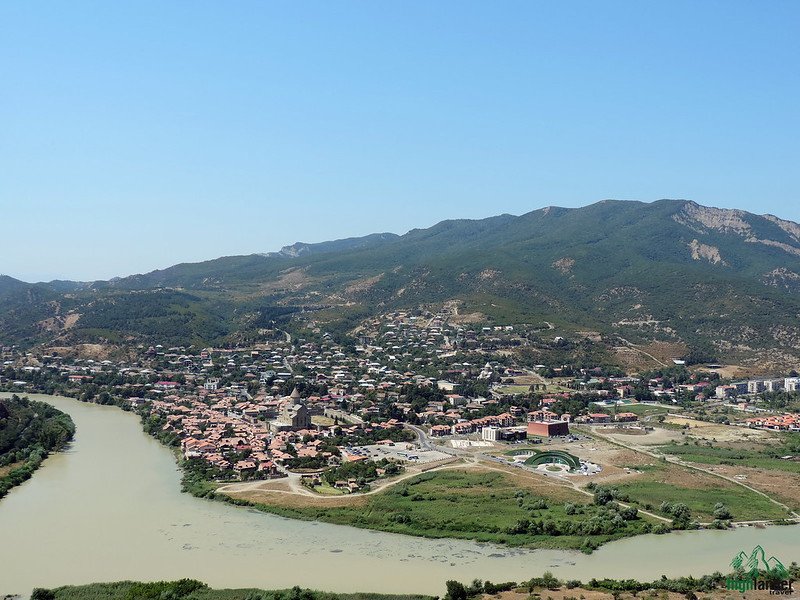
I was perhaps seven or eight the first time I saw Mtskheta. My mother and I travelled there from Tbilisi. I remember her telling me to be quiet and behave because this was a sacred place. I remember the massive walls of Svetitskhoveli Cathedral rising above everything else. Most clearly, I remember a tiny tree growing from the roof—sprouting from the ancient stone, impossibly green against the weathered grey.
My grandmother crossed herself three times before we even arrived. She still does that every time we pass Jvari.
That is the thing about Mtskheta for Georgians. It is not simply a tourist attraction. It is where Georgian Christianity began, where kings were crowned and where couples still choose to marry because nowhere else feels quite right. My cousin married at Svetitskhoveli, and the church was so full that people stood in the courtyard listening through the open doors.
For travellers, Mtskheta is Georgia’s ancient capital and a UNESCO World Heritage Site. For Georgians, it is where the country’s soul lives.
This guide balances what I know as a Georgian with what visitors need to plan their trip. Let me show you Mtskheta in both ways: the historical facts everyone should know and the stories that explain why the city still matters.
Why Mtskheta Matters Beyond Its UNESCO Status
Approximately 25 kilometres north of Tbilisi, the Aragvi and Mtkvari rivers meet. Ancient Iberians established their capital here between the 5th and 1st centuries BC because of its strategic position, water access and location at the junction of trade routes connecting Byzantium, Syria and the Silk Road.
The defining moment came in the 4th century, when King Mirian III and Queen Nana converted to Christianity, making Georgia one of the world’s earliest Christian nations. Saint Nino, a young woman from Cappadocia, played a central role in their conversion. Jvari Monastery now stands where she is believed to have erected a wooden cross, while Svetitskhoveli Cathedral occupies the site associated with Mtskheta’s first church.
The Georgian Orthodox Church recognises Mtskheta as a Holy City. When locals cross themselves as their vehicle passes Jvari, you understand that this is not merely a collection of historical monuments. The place still holds profound meaning.

The Three Essential Sights in Mtskheta
Svetitskhoveli Cathedral
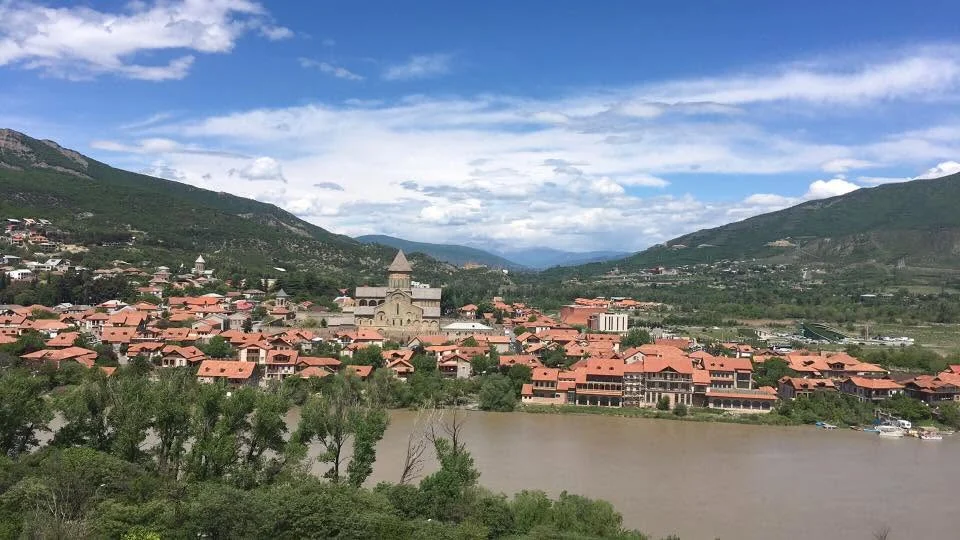
This enormous 11th-century cathedral dominates central Mtskheta both physically and spiritually. Svetitskhoveli means “Cathedral of the Living Pillar,” a name connected to one of Georgia’s most important Christian legends.
According to tradition, a Jewish man from Mtskheta was in Jerusalem during the Crucifixion. He obtained Christ’s seamless robe and brought it home. His sister Sidonia touched the robe and died from the intensity of the experience. She was buried holding it, and a sacred cedar tree grew from her grave.
When builders attempted to cut down the tree to construct the first church, one of its pillars rose into the air and could not be lowered until Saint Nino prayed. This became the “living pillar” from which the cathedral takes its name.
Several Georgian monarchs are buried inside, including Vakhtang Gorgasali, traditionally associated with the foundation of Tbilisi. The cathedral’s frescoes combine biblical scenes with unusual zodiac imagery.
On the northern exterior wall, look for the carved or painted hand associated with the cathedral’s architect. A popular legend claims that King Giorgi ordered the architect’s hand to be cut off so that he could never create anything equally beautiful. Historians treat this as legend rather than established fact, but it remains part of Svetitskhoveli’s story.
The cathedral houses relics that believers associate with the True Cross and Christ’s robe. Religious or not, watching pilgrims pray here reveals how differently a living sacred site feels from a museum.
Tip: If possible, visit during a service. Georgian Orthodox liturgy features polyphonic chanting rooted in a tradition recognised by UNESCO as intangible cultural heritage.
Jvari Monastery and the Famous View
Almost every visitor photographs Jvari Monastery, and the viewpoint can become crowded. There is, however, a good reason this 6th-century monastery has become one of Georgia’s most recognisable images.
The monastery occupies a dramatic clifftop position above Mtskheta. Below, the clearer Aragvi flows into the muddier Mtkvari, with the different colours remaining visible before the rivers merge. On clear days, the Caucasus Mountains frame the landscape.
According to tradition, this is where Saint Nino raised the first wooden cross, using the site of an earlier pagan sanctuary. The cross represented the establishment of Christianity on one of the region’s most important spiritual sites.
The church itself is a restrained example of early medieval Georgian architecture, emphasising proportion, symmetry and integration with the surrounding landscape.
Tip: A Sunday morning service provides an opportunity to hear polyphonic chanting inside the small stone church. Check service arrangements locally and remain respectful of worshippers.
Samtavro Monastery
A short walk from Mtskheta’s main square, Samtavro Monastery feels very different from the grandeur of Svetitskhoveli and the dramatic position of Jvari. It remains an active nunnery with gardens, fountains and a peaceful atmosphere.
The current church dates mainly from the 11th century, although the sacred site reaches back to the 4th century. Saint Nino is believed to have lived here, and a small chapel marks the place associated with her residence.
King Mirian III and Queen Nana, Georgia’s first Christian monarchs, are buried in twin stone tombs within the complex.
The main church also contains the tomb of Saint Gabriel Urgebadze, a modern Georgian saint who died in 1995 and was canonised in 2012. He became known for openly opposing Soviet atheism, including burning a portrait of Lenin during a parade in Tbilisi.
Locals fill bottles from the monastery spring, which some believe has healing properties. Whatever your beliefs, the water is cold and fresh, so bring a reusable bottle if you would like to try it.
Hidden Places Most Visitors Miss
Shio-Mgvime Monastery
Approximately 11 kilometres west of Mtskheta, Shio-Mgvime Monastery sits within a dramatic limestone canyon. It receives far fewer visitors than Jvari, despite containing some of the region’s most interesting medieval architecture and frescoes.
Father Shio, one of the 13 Assyrian Fathers who helped spread Christianity across 6th-century Georgia, founded the monastery. The community eventually grew to include thousands of monks living in caves cut into the cliffs. Openings from some of these caves remain visible.
The smaller church contains the cave associated with Father Shio’s final years. The larger church preserves colourful medieval frescoes and detailed biblical scenes.
The monastery shop sells honey and beeswax candles produced locally. These make more authentic souvenirs than many of the mass-produced items sold around central Mtskheta.
Getting there: Shio-Mgvime is approximately 20 minutes from Mtskheta by car, followed by a short uphill walk.
Antioch Church
Follow the residential lanes towards the Aragvi River to find this small early Christian church, which most organised groups overlook.
Modern frescoes by artist Irakli Tsintsadze depict important moments in Saint Nino’s life. The riverside terrace provides a quiet view of Jvari Monastery across the valley. It is a good place to sit and enjoy Mtskheta away from the busiest streets.
Zedazeni Monastery
If you have a car and time for another monastery, consider Zedazeni. It stands at approximately 1,170 metres in the Saguramo Range and provides extensive views towards Mtskheta, Tbilisi and the Caucasus.
According to tradition, the 13 Assyrian Fathers gathered here before travelling across Georgia to establish new monasteries. The Christian complex replaced an earlier sanctuary dedicated to the pagan deity Zaden.
The road passes through Tbilisi National Park. The final approach is steep, so drive carefully and check road conditions during winter or wet weather.
An informal outdoor shrine containing religious icons surrounds a large metal cross near the monastery. Visitors can purchase candles from the small shop to support the local community.
Note: Monastery opening hours may change. Check locally before planning an early-morning or late-afternoon visit.
Archaeological Sites around Mtskheta
Mtskheta stands above several layers of ancient settlement, and archaeological excavations continue to uncover new evidence of its long history.
Bagineti, near the river, contains Hellenistic and early medieval remains. Armazi, the ancient lower town on the opposite bank of the Mtkvari, has revealed traces of a royal palace, public baths, wine cellars and a sophisticated water system. The ruins of Armazi Fortress stand on a nearby hill.
Bebristsikhe Fortress lies approximately two kilometres from central Mtskheta. The ruins are weathered and include loose stones and exposed drops, so walk carefully.
These sites may be less immediately dramatic than Mtskheta’s churches, but they provide important context for understanding how the city functioned as a trading and political centre between East and West.
Getting to Mtskheta and Planning Your Visit
How to Get to Mtskheta from Tbilisi
Marshrutka: Minibuses depart from the Didube transport area in Tbilisi and travel to central Mtskheta. Departure points and fares can change, so confirm the location and price before boarding. The journey normally takes around 30 minutes, depending on traffic.
Taxi or Bolt: A registered taxi application is convenient for reaching central Mtskheta. If you want to include Jvari, Shio-Mgvime or Zedazeni, arrange for the driver to wait or agree on a longer itinerary in advance.
Organised tour: A guided trip provides historical context and simplifies transportation between sites outside the town centre. Private tours allow more control over the route and pace. See our Mtskheta tour from Tbilisi for details.
Self-driving: The drive from Tbilisi is straightforward and follows good roads. Parking can be limited in the pedestrian area around Svetitskhoveli, so arrive early or use one of the parking areas outside the old town.
Where to Eat in Mtskheta
Salobie: Located on the approach to Mtskheta, this large traditional restaurant is popular with Tbilisi residents. Its speciality is lobio—beans cooked in a clay pot and served with fresh bread. Orders may be placed at the upstairs counter rather than through a waiter.
Ornament Express: Located behind Svetitskhoveli, this restaurant has a terrace overlooking the cathedral and serves Georgian food, fresh khachapuri and desserts.
Adacafe: A contemporary riverside café with large windows, coffee and a mixture of Georgian and international dishes.
Restaurant Check-In Garden: A more formal riverside option serving traditional Georgian food in generous portions.
The Tourist Market
The pedestrian streets around Svetitskhoveli contain stalls selling churchkhela, spices, carpets, ceramics, chacha, wine and souvenirs.
Quality varies, and some items are mass-produced imports. If buying churchkhela, look for vendors who make it themselves. A pottery workshop on the main road also sells handmade ceramics.
Winery Khareba, opposite the entrance to Svetitskhoveli, offers opportunities to taste Georgian wine and learn about local grape varieties. Confirm current tasting conditions before visiting.
Many small vendors accept only cash, so carry Georgian lari in smaller denominations.
Should You Stay Overnight in Mtskheta?
Most visitors explore Mtskheta as a day trip, but staying overnight has several advantages:
- Experience the town after the tour buses leave
- See Svetitskhoveli and Jvari in softer morning or evening light
- Enjoy dinner without rushing back to Tbilisi
- Use the town as a base for exploring the wider Mtskheta-Mtianeti region
- Avoid returning to Tbilisi if you are continuing north towards Kazbegi
Accommodation options:
- Guest House Ebralidze: A simple guesthouse with a garden behind Svetitskhoveli
- Hotel Bagineti: A mid-range option in the old town
- Château Mukhrani: A historic winery with upscale accommodation northwest of Mtskheta
- Sevsamora Resort and Spa: An accessible hotel near Zedazeni with a swimming pool
What to Bring and Wear
- Appropriate clothing: Religious sites require covered shoulders and knees. Women may be asked to cover their heads. Scarves and wrap skirts are often available at monastery entrances.
- Comfortable shoes: Expect cobblestones, steps and uneven paths.
- Reusable water bottle: This is particularly important during hot summer weather.
- Small banknotes: Useful for candles, donations and market purchases.
- Sun protection: Bring sunscreen, sunglasses and a hat during the warmer months.
When to Visit Mtskheta
Mtskheta can be visited throughout the year, although each season offers a different experience.
- Best overall: May, September and October offer comfortable temperatures and softer light.
- Summer: June through August can be extremely hot and crowded. Start early, carry water and visit on a weekday if possible.
- Autumn: The surrounding mountains develop rich autumn colours. The Svetitskhovloba religious festival takes place on October 14 and brings ceremonies, performances and large crowds.
- Winter: The town is quieter and occasionally receives snow. Roads normally remain accessible, although weather should still be checked.
- Spring: April and May bring wildflowers, green landscapes and comfortable temperatures.
Combining Mtskheta with Other Destinations
Mtskheta, Ananuri and Kazbegi: A popular route following the Georgian Military Highway north. Ananuri Fortress is the natural next stop before continuing towards Gudauri and Kazbegi.
Mtskheta, Gori and Uplistsikhe: A full-day cultural route combining Mtskheta with the Stalin Museum in Gori and the ancient rock-cut settlement of Uplistsikhe.
Both routes are easier with a private driver or organised tour. Travelling entirely by marshrutka requires several connections and careful timing.
Frequently Asked Questions
How much time do I need in Mtskheta?
A half-day of three to four hours is enough for Jvari, Svetitskhoveli and Samtavro. A full day allows time for Shio-Mgvime, archaeological sites and a relaxed lunch. Staying overnight gives you the quieter evening and early-morning atmosphere.
Do I need a guide?
A guide is not essential, but much of Mtskheta’s significance lies in its legends, history, architecture and continuing religious importance. A knowledgeable guide can make the monuments considerably more meaningful.
How do you pronounce Mtskheta?
The name sounds roughly like “mts-khe-ta,” with the “kh” pronounced from the back of the throat. Do not worry if it takes practice—Georgian consonant combinations can be difficult for visitors.
Is Mtskheta suitable for children?
Children often enjoy the river views and fortress ruins. Younger visitors may find long church visits less engaging. Cobblestones, steps and uneven paths can make some locations difficult for pushchairs.
Is Mtskheta wheelchair accessible?
Svetitskhoveli and Samtavro are relatively flat, although surfaces may be uneven. Jvari includes steps, while remote monasteries such as Zedazeni require uphill walking. Confirm specific accessibility arrangements before travelling.
Can vegetarians and vegans eat well in Mtskheta?
Yes. Georgian cuisine includes pkhali, lobio, badrijani, vegetable dishes, salads and several types of khachapuri. Vegans should confirm that dishes do not contain cheese, butter, eggs or matsoni.
Is Mtskheta safe?
Mtskheta is generally considered safe for visitors. Use normal travel precautions, protect your belongings in busy areas and take care around uneven ruins and riverbanks.
Why Mtskheta Resonates with Non-Religious Visitors
You do not have to be religious to feel the weight of a place where belief has been concentrated for seventeen centuries. The stone walls have absorbed generations of faith, grief, celebration and collective memory.
Watch a grandmother light candles for her husband, listen to monks chanting harmonies rooted in medieval traditions or see newlyweds taking photographs in Svetitskhoveli’s garden. These moments reveal that Mtskheta is not a museum. It is a living connection between Georgia’s past and present.
The Georgian Orthodox Church survived invasions, foreign occupations, imperial rule and Soviet suppression. Through these upheavals, Mtskheta remained a spiritual anchor. That continuity and persistence reflect an important part of Georgia’s national story.
Whether or not you believe in God or care deeply about Christian history, Mtskheta has the power to create an emotional response. That is worth more than any photograph.
Ready to Visit Mtskheta?
We organise day tours from Tbilisi with guides who understand the legends, history and architectural details that make Mtskheta meaningful rather than simply photogenic.
Visit Georgia-Tours.eu to check available tours and plan your trip. Private itineraries can include the essential monuments as well as quieter sites such as Shio-Mgvime and Zedazeni.
See you in Mtskheta.




[…] TipsTags: Cchurches of Georgia, Mtskheta, UNESCOSvetitskhoveli Cathedral dominates the centre of Mtskheta, Georgia’s ancient capital. The present cathedral was built between 1010 and 1029 on a site […]