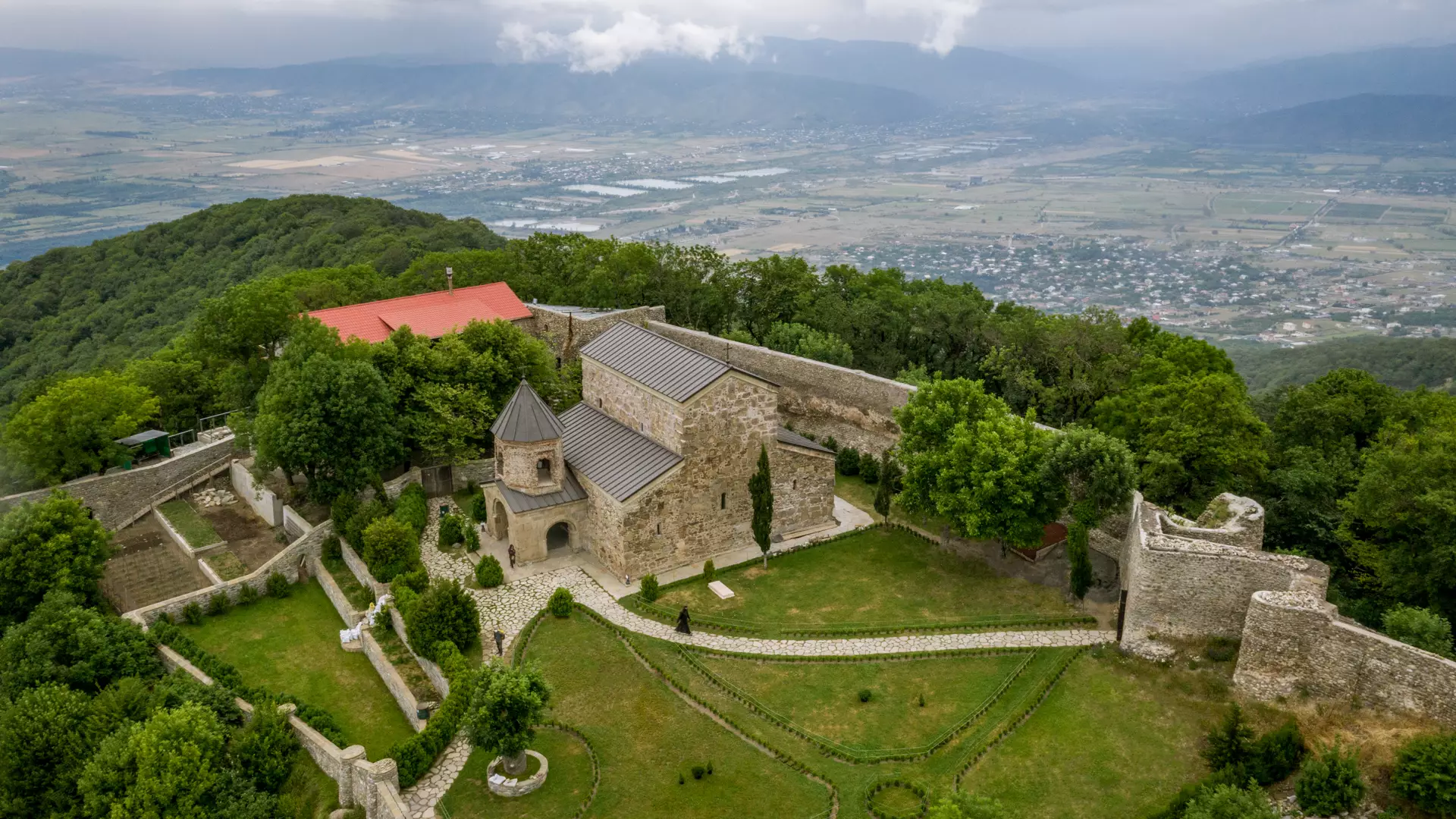
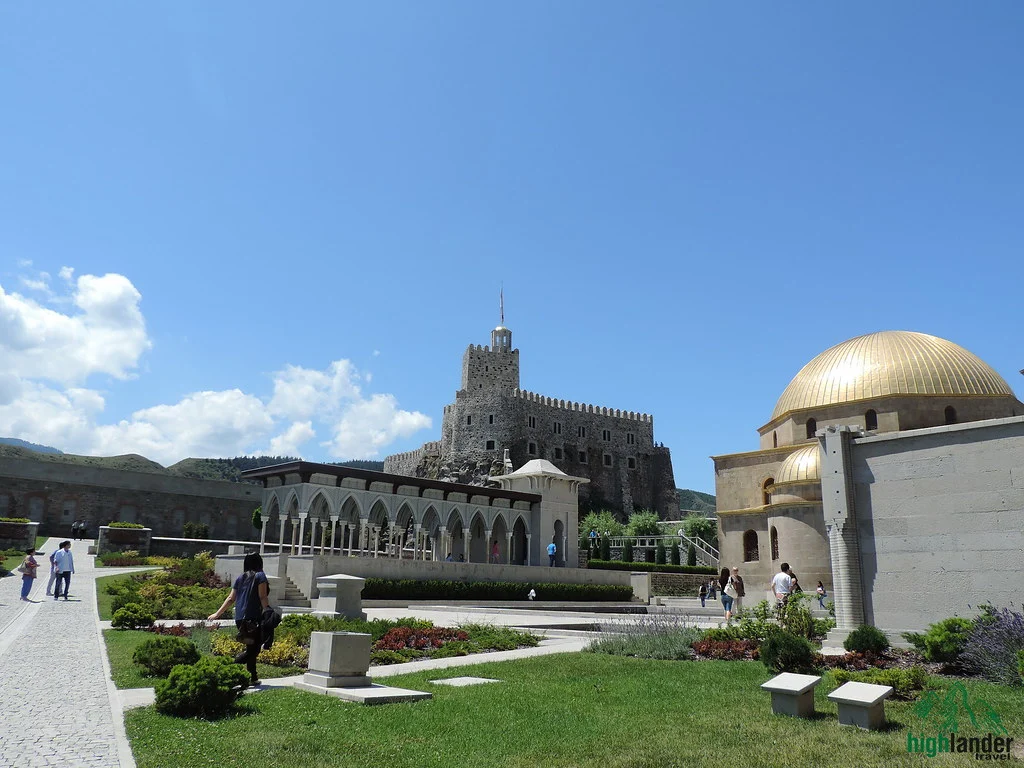
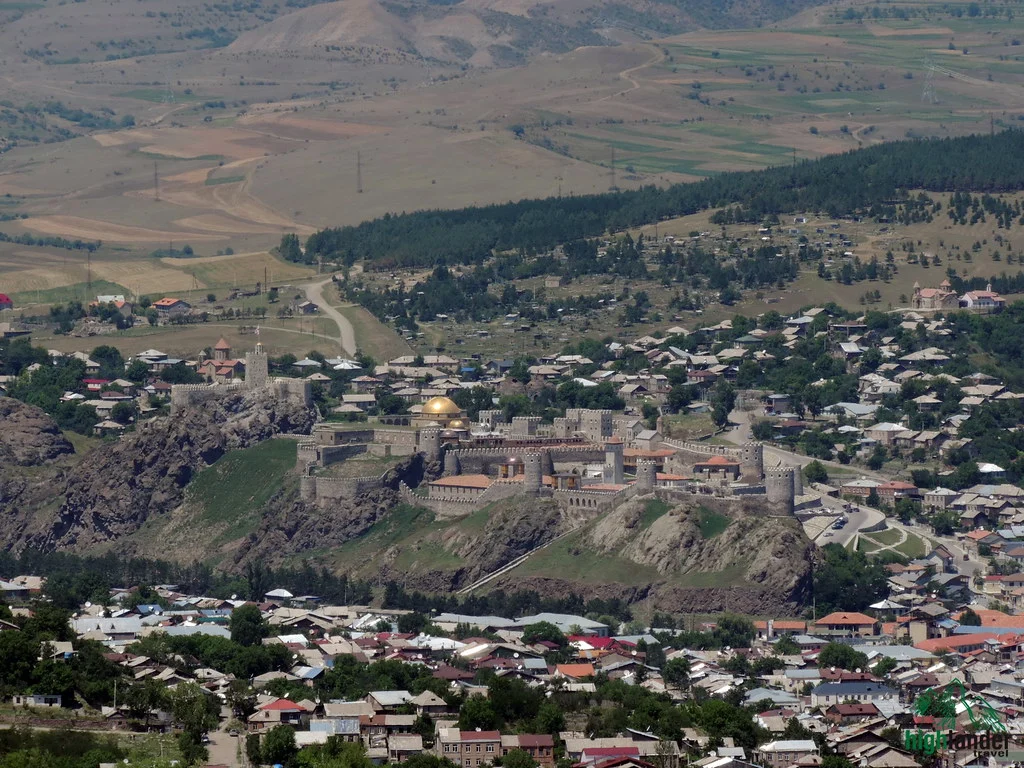
From the ring road below, Rabati looks almost too finished. The walls are the colour of fresh bread, the towers stand straight, and above them a golden dome catches the light. Then you walk through the gate and the story gets complicated. That dome sits on a mosque built by a Georgian prince who had converted to Islam, and a Christian church stands beside it. The palace over the courtyard belonged to a family who ruled this corner of Georgia for the best part of six centuries, first as vassals of Georgian kings and then as Ottoman pashas.
Rabati Castle, officially Akhaltsikhe Castle, is the main stop in the town of Akhaltsikhe, about an hour from Borjomi on the road to Vardzia. Most travellers pass through on their way to the cave city. That’s also how our 2-day Vardzia tour from Tbilisi takes it. But the castle is worth more than a quick photo from the car park, and this guide explains why, how much it costs, and how long to give it.
Rabati Castle at a glance
- Where: Akhaltsikhe, Samtskhe-Javakheti, about 200 km (3–3.5 hours’ drive) from Tbilisi.
- Built: founded in the 9th century, rebuilt from the 12th, with most of what you see restored in 2011–2012.
- Tickets: 20 GEL for foreign adults. The history museum inside charges a separate fee.
- Opening hours: 9:00–18:00 according to the official site. Hours can change for events.
- Time needed: 1.5–2 hours for the castle, or 3 hours with the museum.
- Combine with: Vardzia, Sapara Monastery and Borjomi.
A short history of Rabati Castle
Rabati packs a lot of history into eight hectares. Here it is in five chapters.
The Lion Castle (9th century). The first fortress on this hill was called Lomsia, from lomi, the Georgian word for lion. Tradition credits it to Guaram Mampali, a prince of the Tao kingdom, which then stretched across what is now northeast Turkey.
The new fortress (12th century). Rebuilt and enlarged in the late 12th century, the castle became a town and took a new name: Akhaltsikhe, “new fortress”. The word rabati comes from the Arabic for a fortified suburb. Locals applied it to the old quarter below the walls, and eventually to the whole castle.
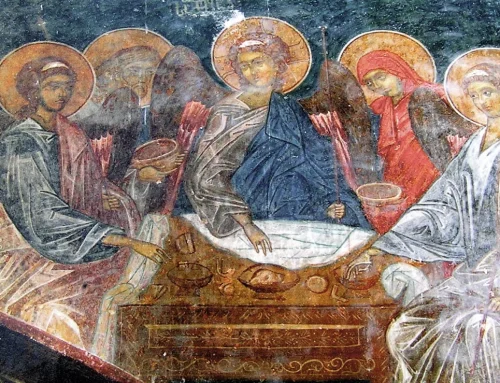
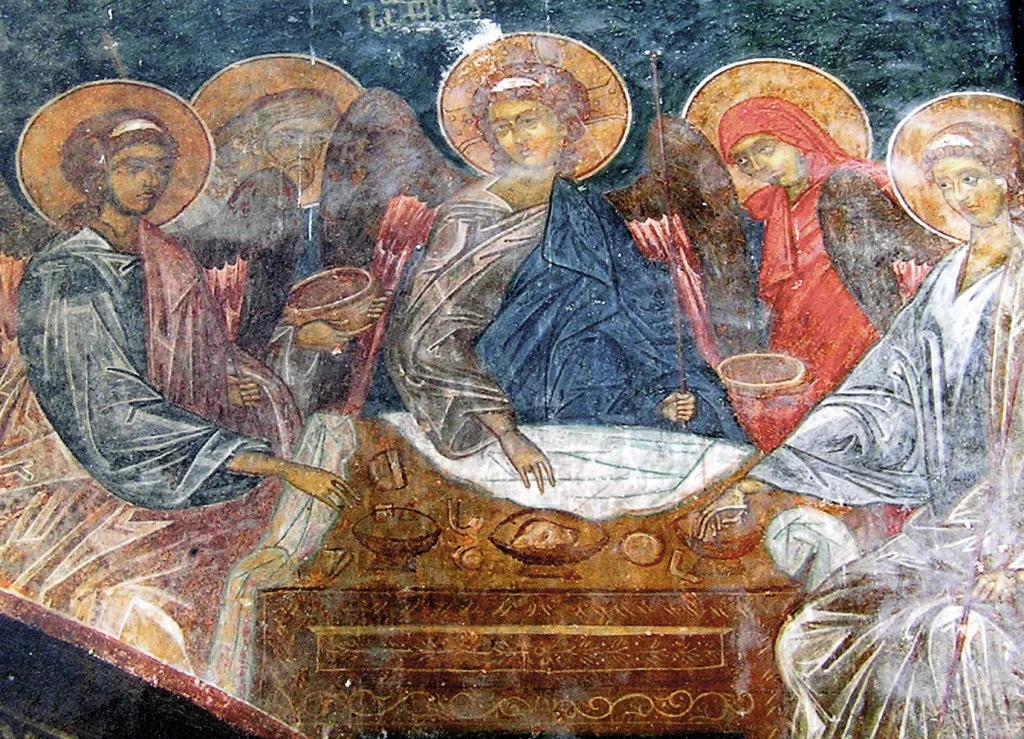
The Jaqeli centuries (13th–16th centuries). From the 13th century this was the seat of the Jaqeli family, the atabegs (hereditary governors) of Samtskhe-Saatabago. Their principality in southern Georgia was rich and stubborn, often more independent than the Georgian crown liked. The castle withstood Timur’s armies in 1393, and the Jaqelis endowed monasteries across the region. Sapara and Zarzma, both within a short drive, owe their finest frescoes to them.
The pashas (1590–1828). The Ottoman Empire took Samtskhe in 1590, and the Jaqelis kept power by converting to Islam and ruling as pashas. In 1752 Haji Ahmed Pasha Jaqeli built the mosque that now dominates the skyline, loosely modelled on Hagia Sophia. For two centuries Akhaltsikhe was a frontier city and a trading hub, with Georgians, Turks, Armenians and Jews living in its streets.
Russia and the restoration (1828–today). Russian troops under Ivan Paskevich stormed the fortress in 1828, and the Treaty of Adrianople handed the region to the Russian Empire the following year. The mosque stopped functioning and was later consecrated as a church. The castle then slowly crumbled until 2011–2012, when the government rebuilt the complex almost entirely.
That restoration is the one thing everyone argues about. Critics say the new stonework and gilded dome turned a ruin into a film set. Others point out that, without it, there would be little left to see. Either way, go in knowing that most of the surfaces you touch are about fifteen years old, even if the plan of the castle is centuries older.
What to see inside Rabati Castle
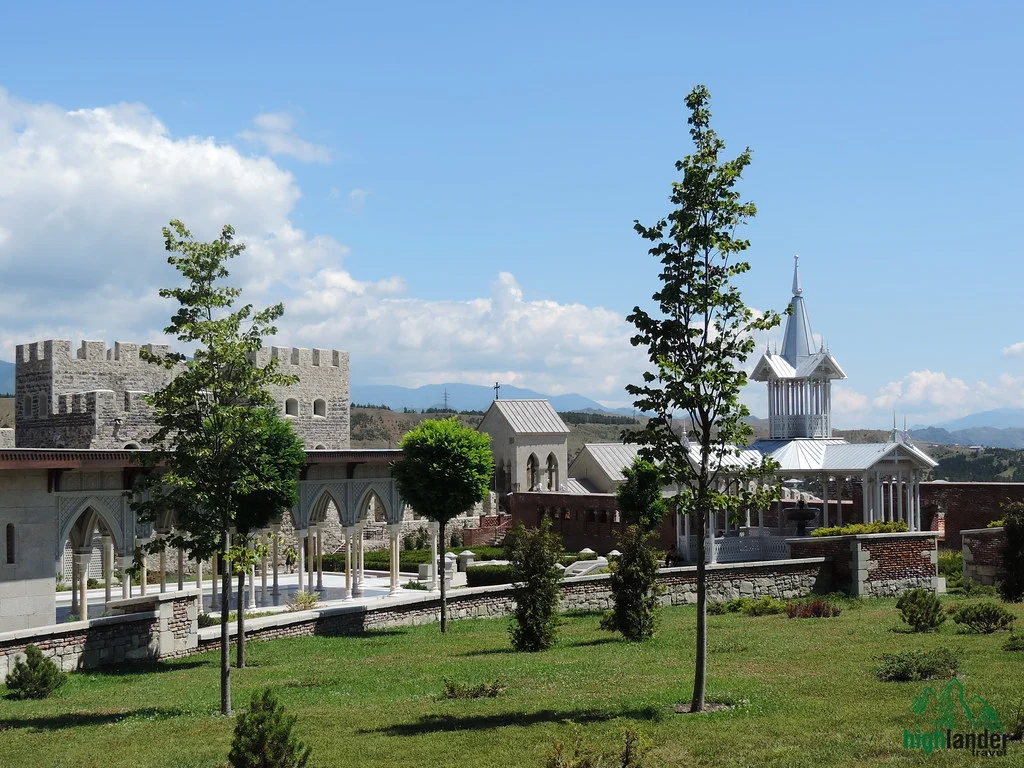
The complex has two levels. The lower courtyard, with cafés, souvenir and wine shops and a hotel, is open without a ticket. The ticketed upper castle is where the history lives. There’s little signage, so here’s a route that works.
- Start at the Ahmed Pasha Mosque. The ribbed golden dome is what you saw from the road. Look for traces of its double life: from the 1850s to 1920 it served as a church. The slim minaret and the small madrasa beside it complete the Ottoman corner of the castle.
- Walk the gardens and arcades. The terraces between the buildings are the calmest part of the complex. In late afternoon the arches throw long shadows over the lawns, and the wasps from the rose bushes are the only ones in a hurry.
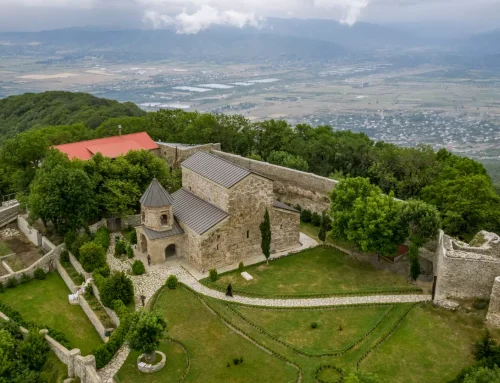
- Look into the church. The Georgian Orthodox church in the upper castle is the oldest layer of the complex, dated by the castle to the 9th–10th centuries. It sits a few steps from the mosque. That closeness is the whole story of Akhaltsikhe in one view.
- Visit the Jaqeli palace and the history museum. The Ivane Javakhishvili Samtskhe-Javakheti History Museum takes a separate ticket, and it’s worth it. The collections span the region’s archaeology and its Christian and Ottoman periods, and they make sense of what you’ve just walked through.
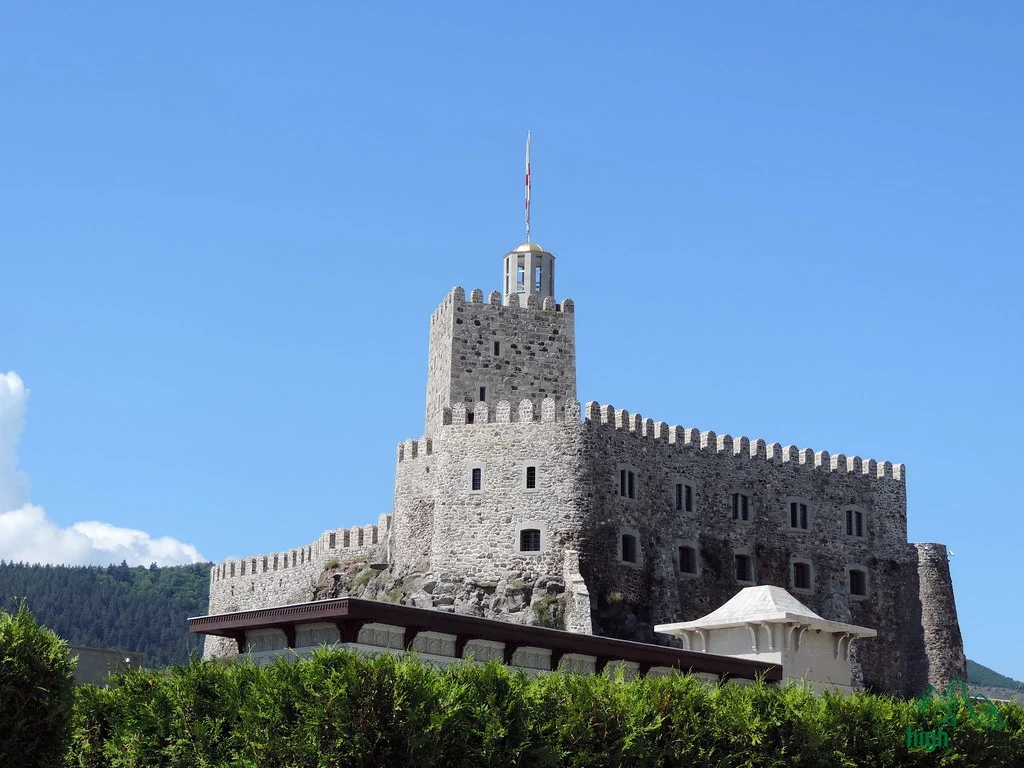
- Climb the citadel last. The tower at the top is the best viewpoint in town. The whole of Akhaltsikhe spreads below you, with the Potskhovi River and the Meskheti hills on the horizon. Go near closing time for the softest light.
Outside the walls: the old Rabati quarter below the castle once held a synagogue, an Armenian church, a Catholic church and mosques within a few streets of each other. Some are restored, some are ruins. A 30-minute walk through them gives the castle its context.
Rabati Castle tickets and opening hours (2026)
Prices are from the castle’s official site, checked in September 2026. Confirm them before you go, because they change.
| Ticket | Price |
|---|---|
| Foreign adult | 20 GEL |
| Foreign student or pupil | 15 GEL |
| Georgian citizen or resident | 10 GEL |
| Georgian student, pupil or pensioner | 3 GEL |
| Children under 6 | Free |
| Audio guide | 15 GEL |
| Live guide | 20 GEL (1–2 people), 40 GEL (3–10 people) |
| History museum | Separate ticket, bought at the museum |
Opening hours: 9:00–18:00 according to the official site. Recent visitors report longer summer evening hours, so it’s worth asking at the gate. The history museum usually closes on Mondays.
How long to spend at Rabati Castle
It depends on what else you’re fitting into the day.
| Visit style | Time | Good for |
|---|---|---|
| Quick stop on the way to Vardzia | 45–60 minutes | Mosque, gardens and the citadel view |
| Proper visit | 1.5–2 hours | The full upper castle at an easy pace |
| Castle + museum | About 3 hours | History fans, or a rainy day |
| Castle + old Rabati quarter + dinner | Half a day | An overnight in Akhaltsikhe |
If you’re driving from Tbilisi to Vardzia in one day, you’ll barely have an hour here. That’s the main argument for splitting the trip over two days: a night in the area lets you see Rabati in the evening light and reach Vardzia before the tour buses. Our Vardzia guide covers the cave city itself.
Getting to Akhaltsikhe
- From Tbilisi (about 200 km): 3–3.5 hours by car via Borjomi. Marshrutkas run through the day and take slightly longer.
- From Borjomi (about 50 km): around an hour by car or minibus, which makes it an easy half-day trip. See our Borjomi travel guide.
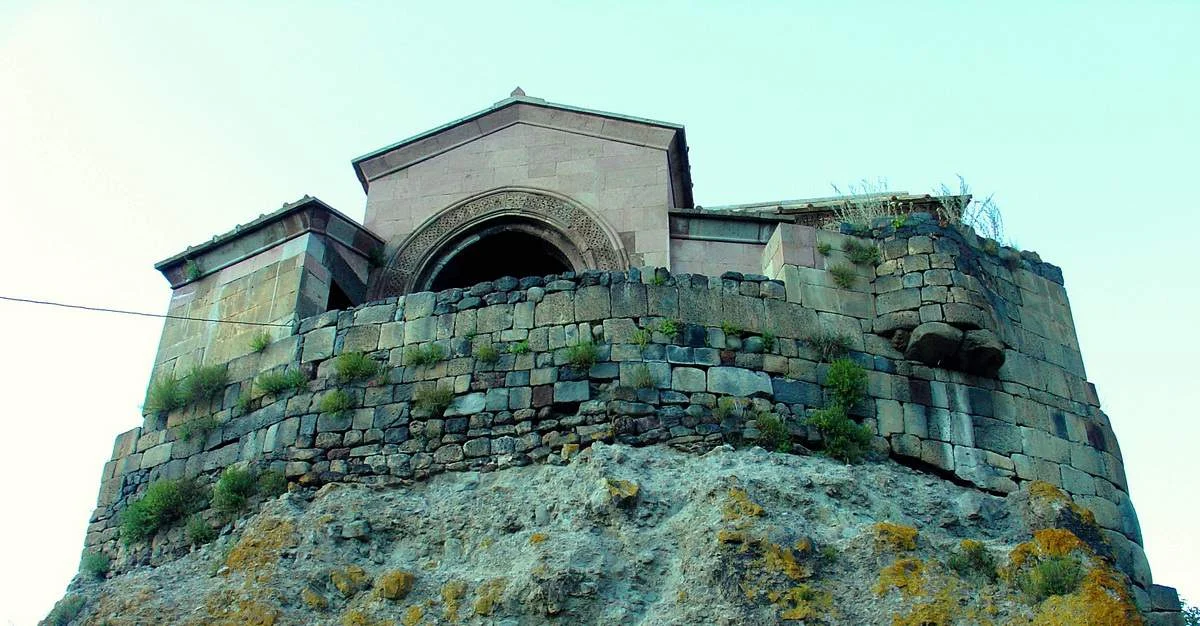
- From Vardzia (about 60 km): a little over an hour back up the Mtkvari valley, past Khertvisi fortress.
The castle is in the centre of town, a short walk from the bus station. It has a car park at the lower entrance.
Tips for visiting
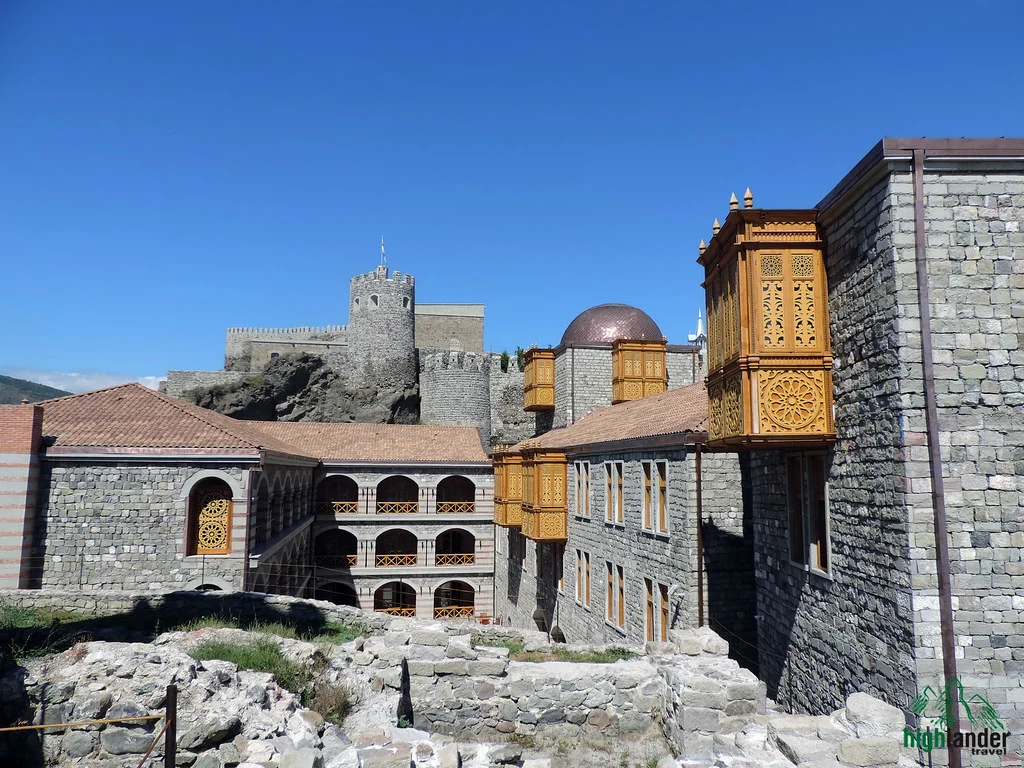
- Come late in the day. The walls glow in the afternoon light, the day-trippers have left, and the citadel view is at its best.
- Take the guide or audio guide. Signs are few, and without context the complex can feel like a set of handsome buildings with no story. A local guide costs about the same as a second ticket.
- Wear proper shoes. The citadel stairs are steep, and the stone gets slippery after rain.
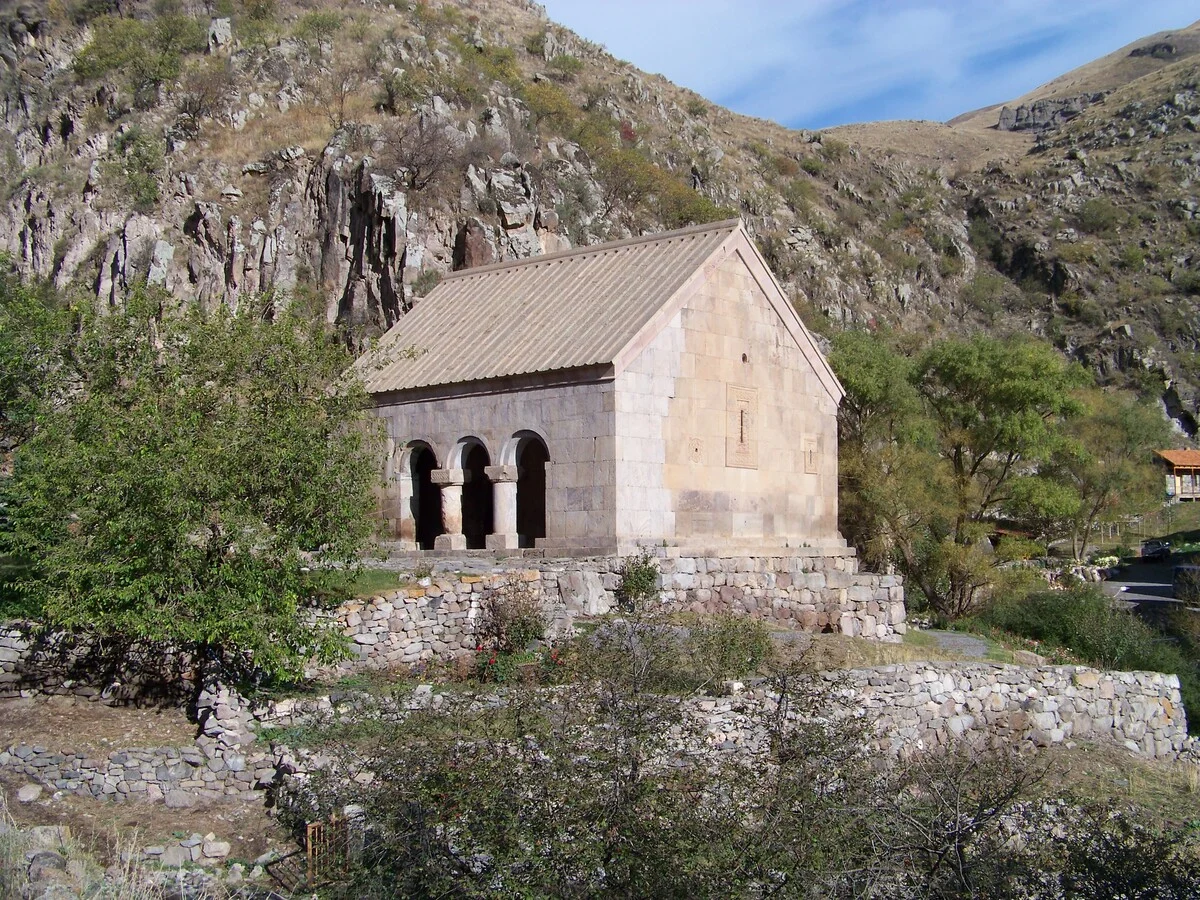
- Pair it with Sapara. The monastery is about 12 km away in a forested gorge. It’s the perfect contrast: original, quiet and still lived in by monks.
- Eat Meskhetian. Look for tashmijabi (potato mash with cheese) and Meskhetian khinkali in town. They’re heavier and more rustic than the Tbilisi versions, and very welcome after a day of stairs.
See Rabati with Highlander Travel Rabati is on the route of our 2-day Vardzia tour from Tbilisi, with Borjomi, Sapara and Khertvisi, and of the 4-day Mystic South Georgia tour with the Javakheti volcanic lakes. Plan my trip
Frequently asked questions about Rabati Castle
How much is the ticket to Rabati Castle?
Foreign adults pay 20 GEL, and foreign students and pupils pay 15 GEL. Georgian citizens and residents pay 10 GEL, and children under 6 enter free. The history museum inside the complex has its own ticket.
Is Rabati Castle worth visiting?
Yes, especially if you’re already on the way to Vardzia. The heavy restoration divides opinion, but nowhere else in Georgia shows the country’s Christian, Ottoman and Russian past side by side so clearly. The citadel view alone justifies the stop.
How long do you need at Rabati Castle?
Allow 1.5–2 hours for the castle, or about 3 hours if you add the history museum. A quick stop on the road to Vardzia takes 45–60 minutes.
What is the difference between Rabati Castle and Akhaltsikhe Castle?
They’re the same place. Akhaltsikhe Castle is the official name. Rabati was originally the name of the old quarter below the walls, and it’s now used for the whole complex.
Can you visit Rabati Castle and Vardzia in one day?
Yes, but it’s a long day. Tbilisi to Akhaltsikhe is 3–3.5 hours, and Vardzia is another hour or more. With an overnight stay you can see both properly. Our 2-day Vardzia tour sleeps near the caves and spends a whole morning inside them.
Is there a mosque in Rabati Castle?
Yes. The Ahmed Pasha Mosque was built in 1752 by Haji Ahmed Pasha Jaqeli, a member of the Georgian Jaqeli family who ruled here under the Ottomans. From the mid-19th century until 1920 it was used as a church.