
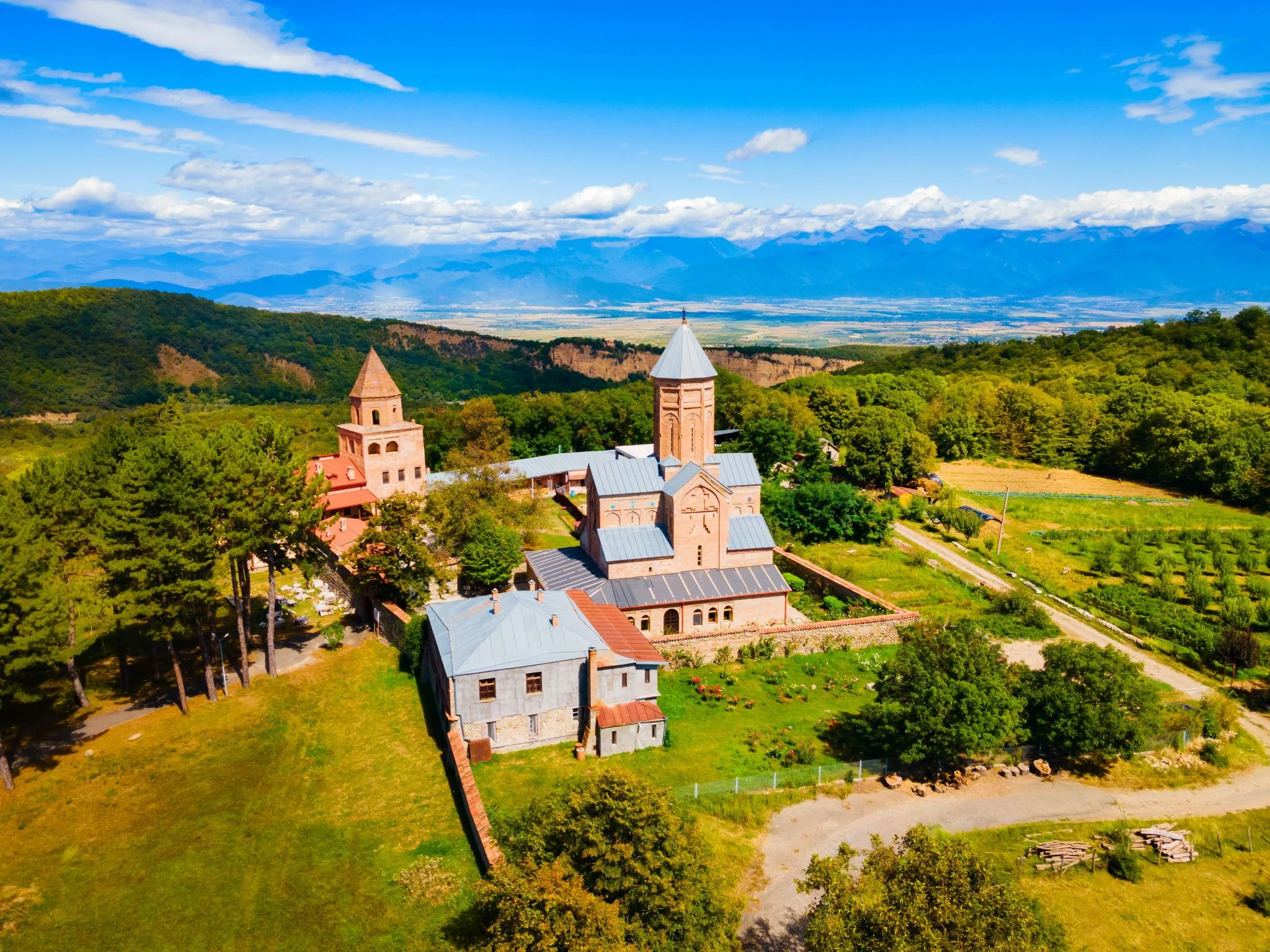
Hidden among the wooded slopes of the Tsiv-Gombori Range near Telavi, New Shuamta Monastery is one of the most elegant religious monuments of 16th-century Kakheti.
The monastery is closely connected with Queen Tinatin, wife of King Levan of Kakheti, who founded the complex during the 1540s. According to Georgian tradition, Tinatin recognized the location from a vision she had experienced earlier in life and chose the forested clearing as the site of a new monastery dedicated to the Mother of God.
The result was very different from the much older Old Shuamta Monastery nearby.
Old Shuamta preserves austere early medieval stone churches dating from the 5th–7th centuries. New Shuamta belongs to another architectural world: tall proportions, red brick, decorative arches, royal portraits and a strongly vertical dome create a church characteristic of the later Kakhetian tradition.
Today, New Shuamta remains an active convent as well as an important architectural monument.
New Shuamta at a Glance
| Feature | Details |
|---|---|
| Location | Near Telavi, Kakheti |
| Historical period | 16th century |
| Main construction | 1540s |
| Founder | Queen Tinatin, wife of King Levan of Kakheti |
| Main church | Nativity of the Mother of God |
| Architectural type | Domed cross-in-square church |
| Main material | Brick with stone elements |
| Known for | Royal foundation, frescoes, Khakhuli icon tradition |
| Current status | Active Georgian Orthodox nunnery |
| Nearby site | Old Shuamta Monastery |
| Best combined with | Telavi, Ikalto, Alaverdi and Old Shuamta |
Why There Are Two Shuamta Monasteries
The name Shuamta means roughly “among the mountains.”
Both monastery complexes stand in the wooded foothills west of Telavi, surrounded by the slopes of the Tsiv-Gombori Range.
But they were created almost a thousand years apart.
Old Shuamta developed during the early centuries of Georgian Christianity. Its three surviving churches represent architecture of the 5th–7th centuries, including an early basilica and domed churches connected with the architectural tradition of Jvari.
By the 16th century, Old Shuamta had largely lost its earlier monastic importance.
A new religious centre was then established approximately two kilometres away.
This became Akhali Shuamta — New Shuamta.
Visiting both monasteries on the same day is particularly rewarding because the contrast between them provides a compact lesson in the development of Georgian church architecture.
Queen Tinatin and the Founding of New Shuamta
The history of New Shuamta is inseparable from Queen Tinatin Gurieli.
Tinatin came from the ruling Gurieli family of western Georgia and married King Levan of Kakheti, whose reign lasted through much of the 16th century.
Historical tradition tells that Tinatin had experienced a vision while still young in which she was shown a place where she would one day build a church dedicated to the Mother of God.
When she later travelled to Kakheti after marrying Levan, she recognized the landscape around Shuamta.
The story belongs partly to religious tradition, but Queen Tinatin’s role in founding the monastery itself is well documented.
Construction of the principal church took place in the 1540s.
Tinatin became not merely a patron who financed a building but a figure whose later life remained closely connected with the monastery.
Queen Tinatin Becomes a Nun
Tinatin’s relationship with King Levan eventually deteriorated.
Georgian historical tradition records that the queen separated from her husband and entered monastic life at New Shuamta.
She is believed to have taken religious vows during the middle of the 16th century.
According to her wishes, she was buried inside the church she had founded rather than beside King Levan.
Her burial remains one of the most historically important features of the monastery.
This personal story gives New Shuamta an unusual character.
Many Georgian churches were commissioned by rulers, but here the founder later withdrew from royal life and became part of the religious community she had helped create.
Architecture of the Main Church
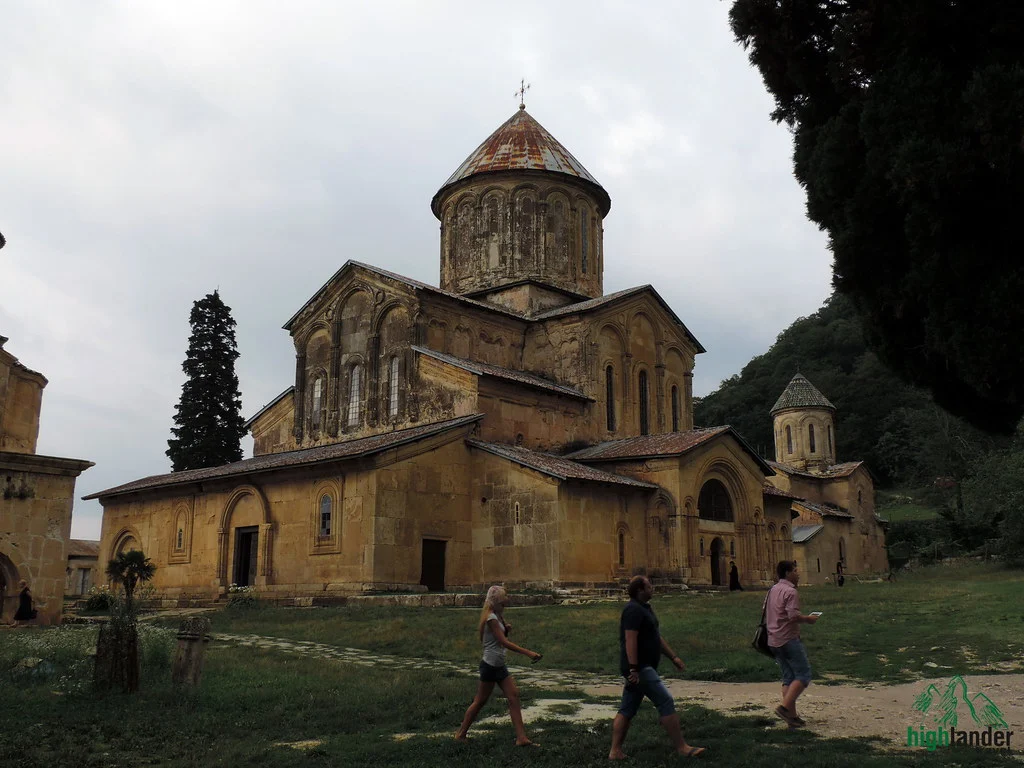
The principal church at New Shuamta is dedicated to the Nativity of the Mother of God.
It belongs to a recognizable group of later medieval Kakhetian churches characterized by brick construction, elongated proportions and tall domes.
The basic layout is a cross-in-square, or inscribed-cross, plan.
Four arms form a cross around the central domed space, while structural supports divide the western section of the interior.
This architectural type had existed in Georgia for centuries, but New Shuamta gives it a distinctly 16th-century Kakhetian interpretation.
The church is noticeably vertical.
Its high drum draws the eye upward and gives the building a much taller appearance than its ground plan might suggest.
This strong vertical emphasis is one of the features that distinguishes New Shuamta from the low, compact medieval churches at Old Shuamta.
The Tall Dome
The dome is perhaps the most recognizable architectural feature of New Shuamta.
Its drum is unusually high and pierced by tall windows.
From a distance, the narrow proportions of the drum make the church appear almost tower-like.
The effect becomes particularly striking when approaching through the surrounding trees.
Instead of spreading horizontally across the landscape, the church rises sharply above the monastery walls.
This verticality is characteristic of several important Kakhetian churches of the period and can also be compared with later 16th-century monuments elsewhere in the region.
For travellers interested in architecture, New Shuamta is therefore useful for understanding how Georgian church design changed after the great stone cathedrals of the 11th–13th centuries.
Brick Architecture in Kakheti
Another important difference is the building material.
Many famous medieval Georgian churches are constructed from carefully cut stone.
New Shuamta relies much more heavily on brick.
Brick was widely used in eastern Georgia during the later medieval period and became particularly expressive in Kakhetian architecture.
At New Shuamta, brick is not simply structural.
Different patterns in the masonry create decorative crosses, arches and recessed fields across the façades.
The material therefore becomes part of the ornament.
Rather than covering the exterior with dense carved stone decoration, the builders used the arrangement of the masonry itself to give rhythm and depth to the walls.
Decorative Arches and Crosses
The façades are articulated by large blind arches.
These shallow architectural frames break up the broad brick surfaces and emphasize the vertical proportions of the church.
Cross motifs also appear within the masonry.
The decoration is comparatively restrained, but the repetition of arches, brick patterns and vertical lines creates an exterior that changes noticeably with the light.
Morning and late-afternoon sun are particularly effective because shadows deepen the recessed brickwork.
This is a building that rewards walking around rather than viewing only from the main entrance.
An Architecture with Eastern Influences
The underlying structure of New Shuamta is firmly rooted in Georgian architectural tradition.
At the same time, art historians have identified details in its exterior decoration that reflect the cultural environment of eastern Georgia during the 16th century.
Kakheti maintained political, commercial and artistic connections with neighbouring Iranian territories, and architectural ideas moved in both directions.
This does not make New Shuamta an Iranian-style building.
Its plan, liturgical organization and overall form remain clearly Georgian.
Instead, selected decorative details show how Georgian builders absorbed outside visual influences without abandoning their own architectural tradition.
This interaction is one of the most interesting features of later medieval architecture in Kakheti.
The Lost Ambulatory
The original church complex was somewhat larger than what visitors see today.
A covered passage or ambulatory once extended around several sides of the church.
Over time, much of this structure was damaged and eventually disappeared.
The monastery suffered particularly during the turbulent 17th century, when Persian campaigns devastated large parts of Kakheti.
Later repairs and rebuilding changed the complex further.
The disappearance of the ambulatory means the church now appears more isolated and vertical than it would have in its original architectural setting.
Frescoes Inside New Shuamta
The interior preserves important 16th-century wall paintings.
These frescoes are especially valuable because they belong closely to the period in which the monastery was founded.
Biblical compositions appear alongside royal donor portraits.
Among the most historically significant images are representations of King Levan, Queen Tinatin and their son.
Such portraits are more than decorative additions.
They document the patrons responsible for the monastery and visually connect royal authority with religious devotion.
For visitors, they also provide a rare opportunity to encounter identifiable historical personalities within the space they commissioned.
The Khakhuli Icon of the Mother of God
New Shuamta was closely associated with an important icon of the Virgin traditionally known as the Khakhuli Mother of God.
Queen Tinatin brought the icon to Kakheti and dedicated the monastery to it.
The icon became one of the important religious objects connected with New Shuamta and helped establish the monastery as a major Marian sanctuary in Kakheti.
King Levan and Queen Tinatin commissioned a richly decorated covering for the icon.
Its connection with the monastery explains why New Shuamta is also formally known as the Khakhuli Theotokos Monastery.
The original icon was removed from the monastery during the Soviet period and transferred to a museum collection.
Its historical association, however, remains central to the identity of New Shuamta.
The Bell Tower
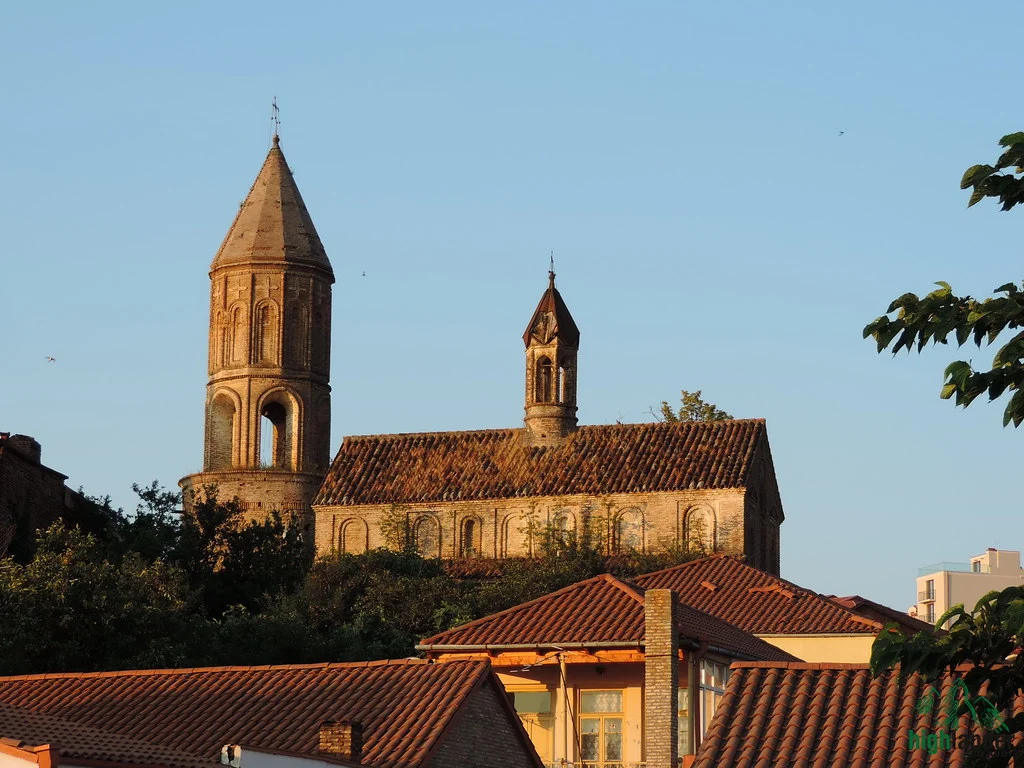
Northwest of the main church stands the monastery’s tall bell tower.
The structure belongs to the 16th-century development of the complex and was reportedly financed by Queen Tinatin’s former nanny.
The multi-storey tower served more than one purpose.
Its upper levels functioned as a belfry, while other parts of the building provided residential space.
Tradition associates the tower with Queen Tinatin’s monastic life.
The combination of religious, residential and defensive-looking architecture makes the bell tower an important part of the ensemble rather than simply an accessory to the cathedral.
The Chapel of the Archangels
The monastery continued to develop after Queen Tinatin’s foundation.
Her daughter, Thekla, who also became a nun, commissioned a Chapel of the Archangels beside the principal church.
The addition demonstrates that New Shuamta remained closely connected with the Kakhetian royal family even after its founder entered monastic life.
These smaller additions are important because they help visitors understand the monastery as an evolving institution rather than a single church constructed at one moment.
New Shuamta Through Later Centuries
The monastery remained an important religious centre after Queen Tinatin’s death.
Royal support continued during later periods.
Renovations took place under King Erekle II in the 18th century, while additional repairs during the 19th century altered parts of the complex.
Like many Georgian monuments, New Shuamta therefore contains multiple layers of construction.
Some belong to the original royal foundation, others to later repairs and restoration.
For architecture enthusiasts, differences in masonry and structural details can reveal where one period ends and another begins.
Soviet Closure
New Shuamta’s religious life was interrupted dramatically during the Soviet period.
The monastery was closed by Soviet authorities in 1926, and the monastic community was expelled.
The complex was then adapted for secular uses.
At different times, buildings served as a holiday facility and an orphanage.
The Khakhuli icon associated with the monastery was transferred to a museum.
This transformation was common across Georgia, where monasteries and churches were closed, repurposed or abandoned under Soviet anti-religious policies.
New Shuamta nevertheless survived as an architectural complex.
Revival of the Nunnery
The monastery was returned to the Georgian Orthodox Church around the end of the Soviet period.
Religious life resumed in 1990, and further restoration followed during the 1990s and later years.
Today New Shuamta functions as an active nunnery.
This is important for travellers to remember.
Although the architecture and frescoes make the monastery an important cultural attraction, it is not primarily a museum.
People live and worship here.
Visitors should approach the site accordingly.
New Shuamta and Old Shuamta: Why Visit Both?
Travellers often ask whether they should visit Old Shuamta or New Shuamta.
The better answer is: visit both.
They represent completely different chapters of Georgian architecture.
Old Shuamta is about the early formation of Georgian church architecture. Its 5th–7th-century buildings are low, severe and constructed largely from stone.
New Shuamta belongs to the royal Kakheti of the 16th century. It is taller, more decorative and built largely in brick.
Seen together, the two complexes reveal almost a millennium of architectural development within a few kilometres.
| Old Shuamta | New Shuamta |
|---|---|
| 5th–7th centuries | 16th century |
| Early Christian architecture | Late medieval Kakhetian architecture |
| Primarily stone | Strong use of brick |
| Compact proportions | Strongly vertical proportions |
| Three historic churches | Planned royal monastic complex |
| Early medieval monastic site | Active nunnery |
For travellers interested in architecture, this pair is one of the most useful comparisons available anywhere in Kakheti.
Visiting New Shuamta from Telavi
New Shuamta lies only a short drive from Telavi.
The monasteries are located along the forested Gombori side of the city, making them particularly convenient for travellers approaching Telavi from Tbilisi across the Gombori Pass.
A private car or taxi is the simplest way to visit.
Because New Shuamta and Old Shuamta are close together, it makes sense to see them on the same excursion.
Travellers based in Telavi can also combine them with Ikalto Monastery and Academy or Alaverdi Cathedral for a day focused almost entirely on Georgian religious architecture.
Walking Between Old and New Shuamta
A forest route links the two monastery areas.
For travellers who enjoy walking, this can be an attractive alternative to driving directly between them.
The landscape is wooded and considerably cooler than the open Alazani Valley during summer.
Conditions can become muddy after rain, so the walk is best attempted with appropriate footwear and after checking locally that the route is clear.
Even when travelling by car, the forest setting is an important part of the experience.
The name Shuamta makes much more sense once you are standing among the surrounding mountain slopes.
What to Look For During Your Visit
New Shuamta can be explored fairly quickly, but a slower visit reveals much more.
Pay particular attention to:
- the tall proportions of the dome drum;
- decorative crosses created through brickwork;
- blind arches across the façades;
- surviving 16th-century frescoes;
- royal donor portraits of Levan and Tinatin;
- Queen Tinatin’s burial place;
- the multi-storey bell tower;
- the relationship between the main church and later chapels;
- changes in masonry resulting from restoration;
- the contrast between New Shuamta and nearby Old Shuamta.
Around 45 minutes is sufficient for the main complex. Allow longer if you plan to visit both Shuamta monasteries.
Visiting an Active Nunnery
New Shuamta remains an active religious community.
Visitors should dress modestly and keep noise low within the monastery grounds.
Women may be asked to cover their heads and wear clothing covering the knees. Men should avoid shorts and sleeveless shirts.
During services, avoid walking unnecessarily around the church interior or photographing worshippers.
Photography rules may vary within religious spaces, so follow signs or ask permission if uncertain.
These are simple courtesies, but they make a significant difference at a small active monastery.
What to See Near New Shuamta
New Shuamta lies in one of the richest areas of Kakheti for historic monuments.
Old Shuamta
Old Shuamta Monastery is the obvious first addition.
Its early medieval churches provide the architectural background needed to fully appreciate how different New Shuamta is.
Telavi
Telavi is the historical and administrative centre of Kakheti.
The city contains the Batonis Tsikhe royal fortress, museums, markets and one of the best selections of restaurants and accommodation in the region.
Ikalto
Ikalto Monastery and Academy combines medieval religious architecture with the ruins of one of Georgia’s important centres of learning.
Its wine presses and qvevri also connect religious history with Kakheti’s winemaking traditions.
Alaverdi Cathedral
Alaverdi Cathedral offers a dramatic contrast with New Shuamta.
Where New Shuamta is a relatively intimate 16th-century royal convent, Alaverdi is a monumental 11th-century cathedral rising from the floor of the Alazani Valley.
Together, they reveal very different scales and periods of Georgian church architecture.
Visiting New Shuamta on Our Kakheti Tours
New Shuamta is not currently listed as a fixed stop on our standard published Kakheti itineraries.
However, its location near Telavi and the Gombori road makes it straightforward to include on a tailor-made private route.
Add New Shuamta to a 2-Day Kakheti Tour
Our 2-Day Kakheti Private Tour from Tbilisi spends its first day on the western and northern side of Kakheti, travelling through the Gombori Range to Ikalto, Alaverdi and Telavi.
For travellers particularly interested in monasteries or Georgian architecture, Old and New Shuamta can be requested as an additional or substitute stop, depending on the pace of the day.
A two-day itinerary is generally better suited to this than trying to add another monastery to an already long one-day route.
Build a Private Architecture and Monastery Tour
Travellers who want to focus specifically on Georgian church architecture can use our private trip planner to build a route around places such as:
- Old and New Shuamta;
- Ikalto;
- Alaverdi Cathedral;
- Nekresi;
- Gremi;
- Telavi.
Such a route can be designed around architecture and history rather than wine tastings, or combine both according to your interests.
Other Kakheti Tours
Our Kakheti in One Day tour currently follows a different historical route through Ujarma, Ikalto, Gremi and Sighnaghi.
Travellers whose priority is New Shuamta should therefore request a customized private route rather than assuming it is included in that itinerary.
Best Time to Visit New Shuamta
New Shuamta can be visited throughout the year.
April to June is particularly pleasant because the forests around Shuamta are green and temperatures are moderate.
September and October combine comfortable weather with Kakheti’s grape harvest season, making it easy to combine monasteries with wineries and traditional food experiences.
Summer can be hot in the Alazani Valley, although the wooded Shuamta area is often cooler.
Winter brings a quieter atmosphere, but snow and ice can occasionally affect roads across the higher parts of the Gombori Range.
Frequently Asked Questions
Where is New Shuamta Monastery?
New Shuamta is located near Telavi in the Kakheti region of eastern Georgia, on the forested slopes of the Tsiv-Gombori Range.
When was New Shuamta built?
The principal church was constructed during the 1540s, under Queen Tinatin, wife of King Levan of Kakheti.
Who founded New Shuamta?
The monastery was founded through the patronage of Queen Tinatin and King Levan of Kakheti, with Tinatin particularly closely associated with its construction and later religious life.
Why is it called New Shuamta?
The name distinguishes it from Old Shuamta, an early medieval monastery located approximately two kilometres away.
What does Shuamta mean?
The name refers to the monastery’s location among the mountains, surrounded by the wooded slopes of the Gombori Range.
Is Queen Tinatin buried at New Shuamta?
Yes. According to her wishes, Queen Tinatin was buried in the monastery she founded.
Is New Shuamta still active?
Yes. New Shuamta functions as an active Georgian Orthodox nunnery.
Can I visit Old and New Shuamta together?
Yes. The two monasteries are close to one another and are best visited together, particularly for travellers interested in Georgian architecture.
How much time do I need?
Allow around 45 minutes for New Shuamta alone and approximately two hours if exploring both Shuamta complexes at an unhurried pace.
Is New Shuamta included in Highlander Travel tours?
It is not currently a fixed stop on the standard published itineraries. It can be requested as part of a customized Kakheti route, particularly a 2-Day Kakheti Private Tour or a tailor-made itinerary created through our trip planner.
Why New Shuamta Is Worth Visiting
New Shuamta is easy to overlook in a region filled with famous cathedrals, royal fortresses and wineries.
That would be a mistake.
The monastery captures an important moment in Kakheti’s history when Georgian religious architecture was adapting older traditions to a new political and artistic environment.
Its tall brick church is unmistakably Georgian yet very different from the stone monuments of earlier centuries.
Its frescoes preserve the faces of the royal patrons who built it.
Its connection with the Khakhuli icon reveals the importance of sacred images in the religious life of medieval Georgia.
And Queen Tinatin’s story gives the monastery an unusually personal dimension: a royal woman who commissioned a church, withdrew from court life, became a nun and was eventually buried within the monastery she had created.
Visit New Shuamta together with Old Shuamta, and the value of both becomes clearer.
Within only a few kilometres, travellers can move from the austere architecture of early Christian Georgia to the tall brick churches of 16th-century Kakheti.
For anyone interested in Georgian architecture, royal history or religious culture, the two Shuamta monasteries form one of the most rewarding historical stops around Telavi.


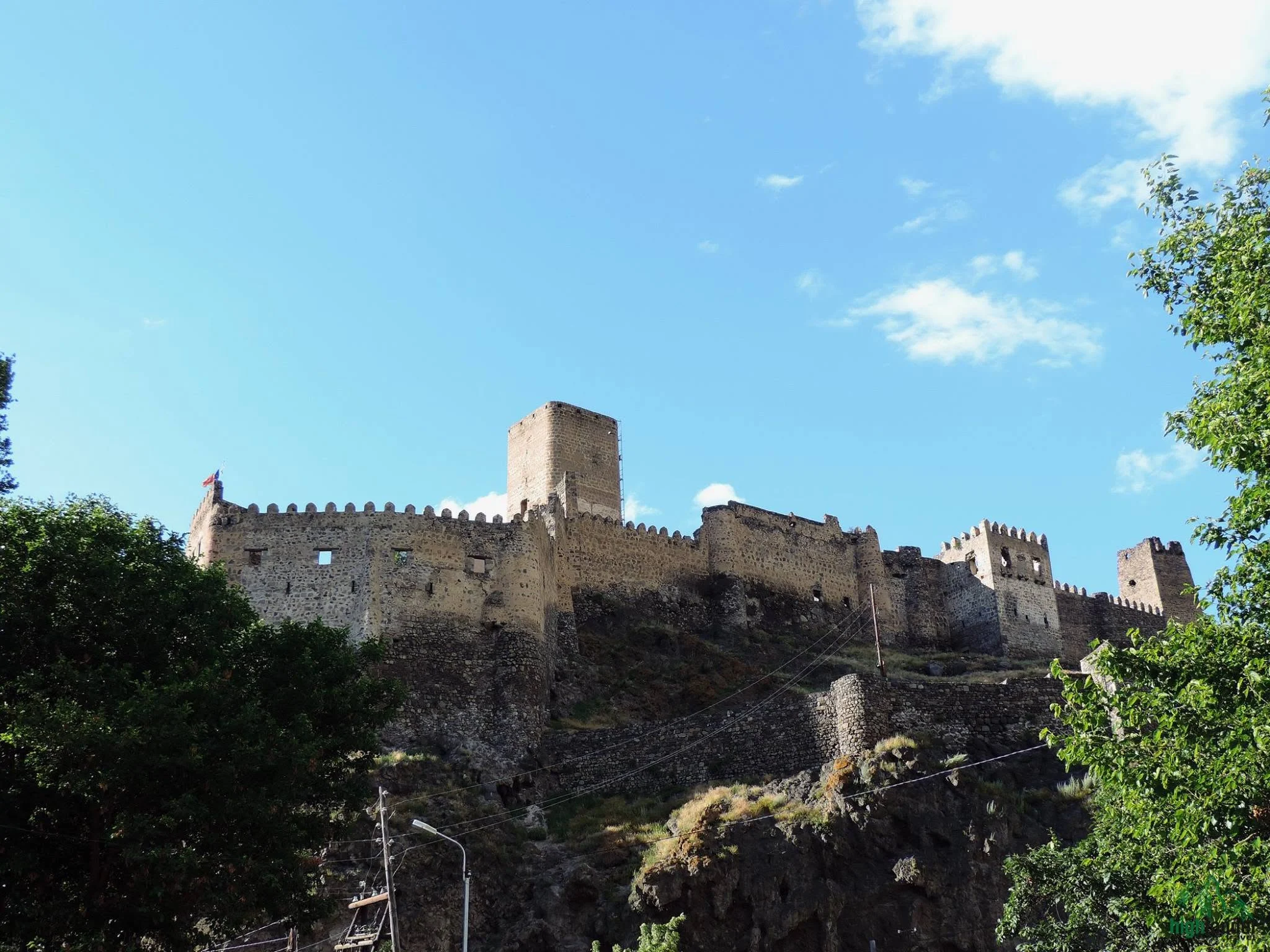
[…] earlier monastic complex. It was eventually abandoned in the 16th century, after which the nearby New Shuamta Monastery developed approximately 2 km […]