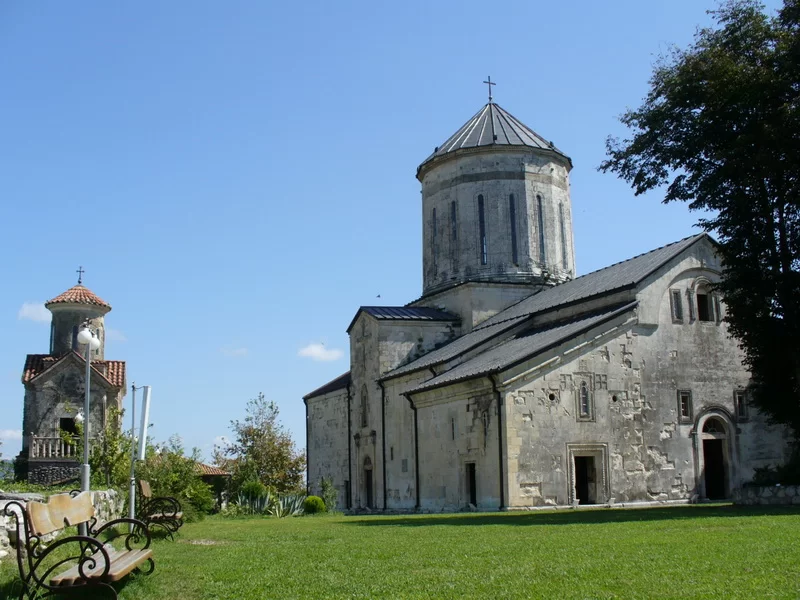
High above the town of Martvili in Samegrelo, one of western Georgia’s most important medieval religious complexes overlooks the broad Colchian lowlands.
Martvili Monastery, historically known as Chkondidi, is much more than a scenic hilltop church. Its architecture reaches back to the 7th century, its surviving frescoes represent several periods of Georgian painting, and for centuries the monastery served as an episcopal, educational and cultural centre of western Georgia.
The complex is also closely associated with Giorgi Chkondideli, one of the most influential figures of medieval Georgia and a leading adviser to King David IV the Builder.
For travellers exploring western Georgia, Martvili provides an excellent counterpoint to the nearby canyons and waterfalls. The natural attractions explain the landscape; the monastery explains the region’s political, religious and cultural history.
Martvili Monastery at a Glance
| Feature | Details |
|---|---|
| Region | Samegrelo-Zemo Svaneti |
| Location | Martvili |
| Historical name | Chkondidi |
| Main church | Dormition of the Mother of God |
| Earliest major construction | 7th century |
| Major rebuilding | 10th century |
| Architectural type | Domed tetraconch / Jvari-type church |
| Frescoes | Mainly 14th–17th centuries |
| Historical role | Episcopal, monastic and educational centre |
| Famous association | Giorgi Chkondideli and David the Builder |
| Current status | Active Orthodox monastery |
| Best combined with | Martvili Canyon, Salkhino and Nokalakevi |
The Meaning of Chkondidi
Before the town became known as Martvili, the place was called Chkondidi.
The name is generally explained from the Megrelian words associated with a large oak tree. According to local and ecclesiastical tradition, a sacred oak stood on this hill before Christianity became established in western Georgia.
Traditional accounts describe the tree as a focus of pre-Christian worship connected with fertility and prosperity. The Christianization story of the site associates Saint Andrew the First-Called with the destruction of the old sacred tree and the establishment of Christian worship in its place.
These stories belong partly to religious tradition rather than securely documented archaeology, but they are important for understanding the symbolic identity of Martvili.
The name Chkondidi — “Great Oak” preserves the memory of a sacred landscape that predates the medieval monastery.
A large oak still grows within the monastery grounds today, reinforcing that connection between the site, its name and local tradition.
The 7th-Century Cathedral
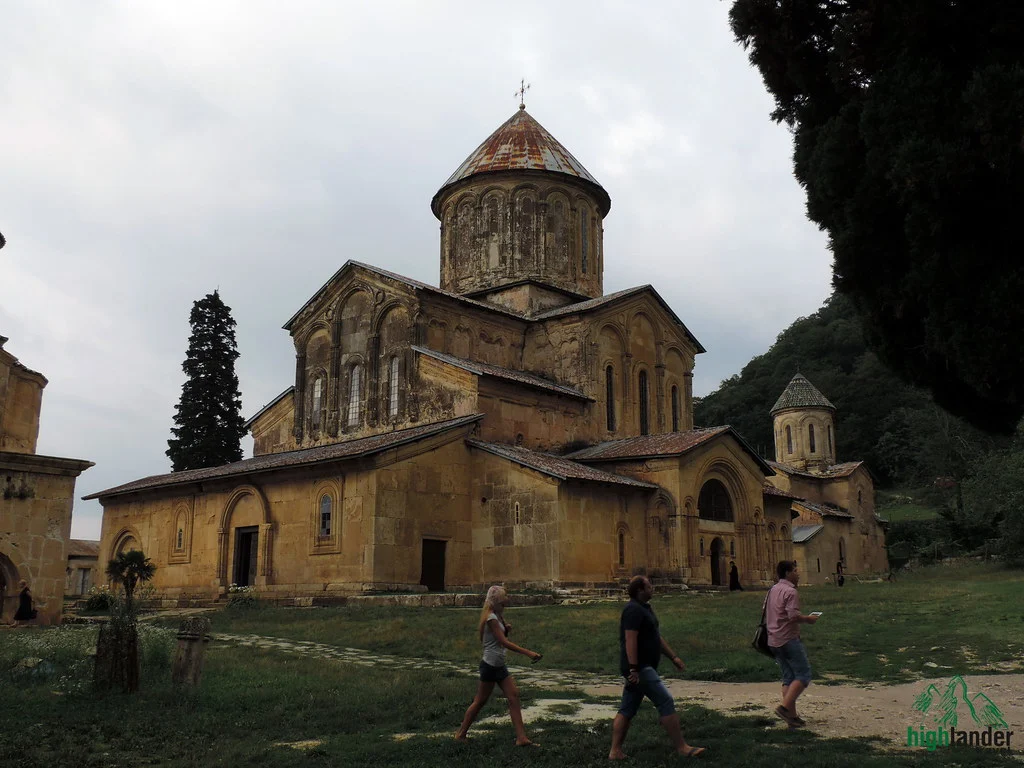
The main cathedral at Martvili is dedicated to the Dormition of the Mother of God.
Its earliest surviving architectural concept belongs to the 7th century and forms part of an important group of Georgian churches influenced by Jvari Monastery near Mtskheta.
Like Jvari, the original Martvili church followed a tetraconch arrangement.
In simple terms, four apses were organized around a central domed space, creating a centralized cross-shaped interior rather than the long rectangular plan found in basilicas.
Martvili was not an exact copy of Jvari.
Its builders adapted the architectural model to western Georgian conditions and created their own proportions and details. Corner spaces, arches and the treatment of the apses produced a lighter and somewhat different interpretation of the Jvari-type church.
This makes Martvili especially interesting for travellers interested in Georgian architecture.
It shows how a successful architectural idea developed in eastern Georgia was adapted and transformed hundreds of kilometres away in Samegrelo.
How the Cathedral Changed
The church standing today is not simply a perfectly preserved 7th-century building.
Martvili was repeatedly damaged, repaired and enlarged over more than a thousand years.
A major reconstruction took place in the 10th century, when the monastery was becoming increasingly important as the ecclesiastical centre of Chkondidi. Architectural changes included work on the dome supports, façades and western part of the cathedral.
Later chapels and other structures were added around the main church.
The result is a monument composed of different historical layers.
For visitors, this is part of its value. Rather than presenting one frozen moment in Georgian architecture, Martvili shows how an important cathedral continued to evolve as religious practices, political circumstances and architectural tastes changed.
Look Closely at the Exterior
Martvili’s architecture rewards slow observation.
The broad mass of the cathedral is impressive from the courtyard, but many of its most interesting details are found around windows, façades and later additions.
Carved stone decoration includes geometric and vegetal patterns as well as relief sculpture.
The western part of the cathedral contains important medieval decorative elements, while changes in masonry reveal where different periods of reconstruction meet.
This is one reason Martvili should not be treated simply as a panoramic stop before visiting the nearby canyon.
Walking around the building allows visitors to read its history directly in the stone.
The Frescoes of Martvili
The interior contains one of the monastery’s greatest artistic treasures: surviving layers of medieval and early modern wall painting.
Most of the important paintings visible today belong to the 14th through 17th centuries, although the church has been painted and altered at different periods.
These frescoes are particularly valuable because they preserve several generations of artistic work within the same cathedral.
Religious compositions occupy the sanctuary and church walls, while donor portraits connect the monastery with the powerful families who supported it.
Among the most important patrons were members of the Dadiani dynasty, the ruling house of Samegrelo.
The portraits provide more than decoration. Clothing, poses and inscriptions offer art historians valuable evidence about political identity and court culture in western Georgia.
A Rare Byzantine Connection
One of the most interesting episodes in Martvili’s artistic history is connected with the late 14th century.
Inscriptions at the cathedral associate painting work with the period of Vameq Dadiani and with the artist Cyrus Emanuel Eugenicos, linked to the Byzantine artistic world.
The surviving work is significant because it demonstrates the cultural connections between medieval Georgia and the wider eastern Christian world.
Martvili was geographically remote from Constantinople, but it was not culturally isolated.
Patrons in Samegrelo could commission artists and artistic traditions that formed part of a much broader network extending across the Black Sea and Byzantine cultural sphere.
The Chikvani Church
North of the main cathedral stands a much smaller domed church traditionally known as the Chikvani Church.
The building belongs to the medieval development of the complex and provides an interesting contrast with the much larger cathedral.
Its compact proportions, carved stone details and vertical arrangement make it easy to overlook beside the main church, but architecture enthusiasts should take time to examine it separately.
The small church demonstrates that Martvili was not a single religious building but a functioning monastic and episcopal complex containing structures created for different purposes and periods.
The Hermit’s Pillar
Southwest of the cathedral stands one of the most unusual structures at Martvili.
Often called the pillar, this tall medieval tower was associated with hermit monks and the Christian tradition of stylitism.
Stylites pursued an extreme form of ascetic life associated with living in elevated isolation. The practice originated in the eastern Christian world and became known in Georgia as well.
The Martvili structure dates broadly to the medieval period and included a small religious space at its upper level.
Hermits continued to be associated with the tower for centuries.
Although its appearance has changed through damage and restoration, the structure provides an unusual reminder that medieval monastic life could take forms far more demanding than communal worship inside the cathedral.
Chkondidi Becomes an Episcopal Centre
From around the 10th century, Chkondidi developed into an important bishopric.
The bishop carried the title Chkondideli, and the office eventually became one of the most influential ecclesiastical positions in medieval Georgia.
The monastery’s importance therefore went well beyond Samegrelo.
Chkondidi became connected with both church administration and royal government, especially during the reign of David IV the Builder.
That political relationship is most clearly represented by Giorgi Chkondideli.
Giorgi Chkondideli and David the Builder
Giorgi Chkondideli was one of the closest advisers of King David IV, better known as David the Builder.
Georgian historical tradition also identifies him as an educator and mentor of the young king.
After David came to the throne in 1089, Giorgi became one of the central figures in the political reforms that helped transform the Georgian kingdom.
His title eventually combined the bishopric of Chkondidi with the important secular office of Mtsignobartukhutsesi, often compared with the role of a senior royal chancellor.
This placed the holder of the office at the intersection of church and state.
The connection gives Martvili unusual significance.
Visitors are not simply standing in an important regional cathedral. They are visiting the religious centre associated with one of the leading political figures behind the consolidation of medieval Georgia.
Some local traditions go further and identify specific parts of the monastery with the education of the young David. These details are better treated as tradition rather than precisely documented historical events, but the broader relationship between Chkondidi, Giorgi and David’s court is central to the monastery’s history.
A Centre of Books and Education
Martvili also developed into an important educational and literary centre.
From the medieval period, monks worked here copying manuscripts, translating texts and producing religious and scholarly writing.
A monastic scriptorium formed part of this intellectual activity.
Before printing, every book had to be copied by hand. A major monastery could therefore function simultaneously as a religious community, school, archive, library and centre of literary production.
Manuscripts associated with Martvili survive today in Georgian collections.
This educational history makes the monastery an interesting counterpart to places such as Ikalto and Gelati, where scholarship was also closely connected with religious institutions.
The Dadiani Dynasty and Martvili
For centuries, the ruling Dadiani family played an important role in Samegrelo.
Their connection with Martvili can still be seen in the cathedral.
Members of the dynasty financed repairs and paintings, commissioned chapels and used the monastery as an important religious and dynastic centre.
Donor portraits survive among the frescoes, while members of the ruling family were buried at Martvili.
The remains associated with the Dadianis help connect the monastery to other important places in Samegrelo, particularly Zugdidi and Salkhino.
A traveller following the history of the dynasty can therefore move between the monastery at Martvili, the princely residences of Samegrelo and the cultural collections preserved in Zugdidi.
Martvili During the Soviet Period
Like many Georgian religious institutions, Martvili suffered during the Soviet period.
Organized monastic life was interrupted, and the religious function of the complex was severely restricted.
The buildings survived, but the living institution that had occupied the hill for centuries largely disappeared.
Monastic life was restored after Georgia regained independence.
In 1998, religious activity at the complex was formally revived, and Martvili again became an active centre of Orthodox worship.
Today the site combines two roles: it is both an important cultural monument and a functioning religious community.
Visitors should keep both in mind.
What to Look For During Your Visit
Martvili rewards visitors who spend longer than a quick photo stop.
Pay particular attention to:
- the overall tetraconch form of the main cathedral;
- architectural similarities with Jvari Monastery;
- changes in stonework created by later reconstruction;
- carved details around windows and entrances;
- the different chronological layers of the interior frescoes;
- Dadiani donor portraits;
- the smaller Chikvani Church;
- the medieval hermit’s pillar;
- historic graves and inscriptions;
- panoramic views over the Samegrelo lowlands.
Around one hour is enough for a good general visit. Travellers interested in architecture or fresco painting may want longer.
The View from Martvili
The monastery occupies one of the best natural viewpoints in the area.
From the hilltop, the landscape opens across the green lowlands of western Georgia.
This view helps explain the long importance of the location.
The site is elevated enough to dominate the surrounding countryside, yet remains close to river valleys, settlements and historic routes through Samegrelo.
On clear days, the courtyard is almost as memorable as the cathedral itself.
How to Get to Martvili Monastery
Martvili is located in the Samegrelo region of western Georgia.
The monastery stands directly above the town and can be reached by paved road.
A cable car has also traditionally connected the town with the monastery area; because operating schedules can change, check locally if you specifically plan to use it.
From Kutaisi
Martvili is approximately an hour from Kutaisi by road and makes an easy day trip.
Our Kutaisi travel guide is useful if you are planning to use the city as your base for exploring western Georgia.
Travelling by private car or driver makes it easy to combine the monastery with Martvili Canyon and other attractions.
From Tbilisi
Martvili is several hours from Tbilisi, so visiting the monastery as a stand-alone day trip from the capital is not particularly practical.
It is better included in a multi-day journey through western Georgia or combined with Kutaisi, Samegrelo and Svaneti.
Combine Martvili Monastery with Martvili Canyon
The most obvious combination is Martvili Monastery and Martvili Canyon.
Despite sharing the same name, they offer completely different experiences.
The monastery represents more than a thousand years of architecture, art and religious history. The canyon is a natural monument created by the Abasha River cutting through limestone.
Martvili Canyon is known for narrow rock walls, waterfalls, green vegetation and turquoise water. Depending on conditions, visitors can follow developed walking routes and take a short boat trip through part of the gorge.
You can read more about Martvili Canyon and other protected natural sites in our guide to Georgia’s national parks and protected areas.
For most travellers, combining the two makes more sense than choosing between them.
Visit the monastery for history and architecture, then spend the second part of the day at the canyon.
Other Places to See Near Martvili
Martvili also works well as part of a wider route through Samegrelo.
Salkhino
Salkhino is associated with the Dadiani dynasty and the famous Ojaleshi wine tradition.
The historic residence and surrounding landscape make it a natural extension of a visit focused on the ruling family of Samegrelo.
Nokalakevi
Nokalakevi is one of western Georgia’s most important archaeological sites.
The fortified settlement served as a major centre of the ancient and early medieval kingdom of Egrisi, or Lazica.
Combining Nokalakevi with Martvili creates a particularly strong historical itinerary: one site explains the political landscape of Late Antiquity, while the other represents medieval Christian and princely Samegrelo.
Zugdidi
Zugdidi was the later political centre of the Dadiani dynasty.
Its palace complex and museum preserve material associated with the princely family and provide useful context for the Dadiani portraits and burials at Martvili.
Visiting Martvili on Our Western Georgia Tours
Our current published itineraries most often feature Martvili Canyon rather than Martvili Monastery as a fixed stop.
However, the monastery is close enough to the canyon to be added naturally to many private western Georgia routes, especially for travellers interested in history, architecture or Orthodox heritage.
Svaneti and Vardzia: 10-Day Private Tour
Our Svaneti and Vardzia 10-Day Tour travels through Samegrelo on the route from Kutaisi toward Svaneti.
The published itinerary includes Martvili Canyon before continuing through Zugdidi and the Enguri Valley toward Mestia.
Because this is a private itinerary, travellers who prefer cultural heritage to spending more time at the canyon can ask about adding Martvili Monastery to the Samegrelo day.
Svaneti and Racha: 7 Days Over the Zagaro Pass
The Svaneti and Racha Tour also passes through western Georgia and offers a choice of canyon experience before the journey into the mountains.
Martvili Canyon is one of the available options.
Travellers with a strong interest in Georgian church architecture can ask whether the nearby monastery can be incorporated according to the day’s timing and route.
Tours from Kutaisi
Martvili is particularly convenient on a private route starting from Kutaisi.
Our Tours from Kutaisi can be adapted around nature, heritage or a combination of both.
A cultural version can combine Martvili Monastery, Martvili Canyon and other Samegrelo sites, while a longer route can continue toward Nokalakevi or Zugdidi.
Best Time to Visit
Martvili Monastery can be visited throughout the year.
Spring is particularly attractive because Samegrelo becomes intensely green and the view from the hilltop is excellent.
Summer is the busiest season, especially when the visit is combined with Martvili Canyon.
Autumn brings comfortable temperatures and fewer visitors.
Winter is quieter and often wet, but the monastery remains accessible in normal conditions.
Because Martvili is in western Georgia, rain is possible in any season. A light waterproof layer is useful even when the forecast looks reasonable.
Visiting an Active Monastery
Martvili is not only a historical monument.
Religious services take place here, and members of the monastic community live and work within the complex.
Visitors should dress respectfully and keep noise low around active church spaces.
As at other Georgian Orthodox monasteries, women may be expected to cover their heads and wear clothing covering the knees, while men should avoid shorts and sleeveless tops.
Photography inside the cathedral may be limited, particularly during services. Follow signs and instructions from monastery staff.
Frequently Asked Questions
Where is Martvili Monastery?
Martvili Monastery stands on a hill above the town of Martvili in Samegrelo-Zemo Svaneti, western Georgia.
How old is Martvili Monastery?
The main cathedral originated in the 7th century, although major reconstruction and additions over later centuries substantially changed its appearance.
What does Chkondidi mean?
Chkondidi is traditionally translated from Megrelian as “Great Oak” or “Big Oak.” The name is linked with traditions about a sacred oak that stood on the site before the establishment of Christianity.
Is Martvili connected with David the Builder?
Yes, through Giorgi Chkondideli, an important churchman and statesman closely associated with David IV. Georgian tradition also identifies him as an educator and mentor of the king.
Are the frescoes original?
The cathedral contains paintings from several periods. Important surviving layers date mainly from the 14th to 17th centuries, including donor portraits connected with the Dadiani dynasty.
Is Martvili Monastery still active?
Yes. Monastic life was restored after the Soviet period, and the complex functions as an active Orthodox religious site.
How long should I spend at Martvili Monastery?
Allow around 45–60 minutes for a general visit. Architecture and art enthusiasts may prefer 90 minutes.
Can I visit Martvili Monastery and Martvili Canyon on the same day?
Yes. The two sites are close together and make an excellent combined cultural and nature itinerary.
Can I visit Martvili from Kutaisi?
Yes. Martvili is roughly an hour from Kutaisi by road, making it one of the easiest excursions from the city.
Why Martvili Monastery Is Worth Visiting
Martvili is one of those monuments whose importance becomes clearer the longer you look.
At first, it is a beautiful hilltop monastery with a wide view across western Georgia.
Then the layers begin to appear.
The main cathedral preserves the architectural ideas of the 7th century. Later reconstruction reflects the rise of Chkondidi as an episcopal centre. Frescoes record centuries of artistic patronage. Dadiani portraits connect the church with the rulers of Samegrelo. The hermit’s tower recalls a demanding form of monastic life, while the monastery’s literary tradition reveals a centre where manuscripts were copied and knowledge preserved.
Above all, Martvili belongs to the political history of medieval Georgia through Giorgi Chkondideli and his relationship with David the Builder.
For travellers, that combination makes the monastery much more than an optional stop beside Martvili Canyon.
Martvili is one of the key places for understanding the architecture, religious culture and medieval history of western Georgia.