
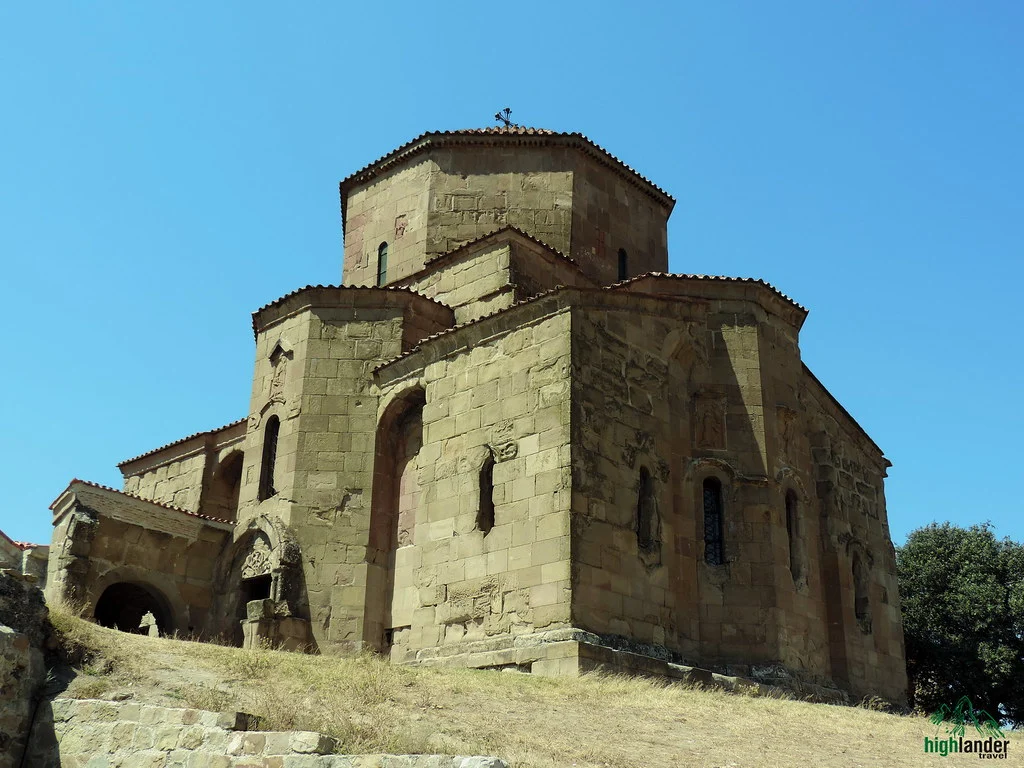
The Story of Jvari
Saint Nino and the Wooden Cross (4th Century)
Georgia’s conversion to Christianity begins with a woman, a vision, and a cross made of grapevines.According to tradition, Saint Nino — a young woman from Cappadocia — arrived in Georgia around 320 AD with a mission to spread Christianity. She carried a cross made from grapevine branches, bound with her own hair (an image you’ll see throughout Georgia, the bent crossbar distinctive).Nino performed healings, won converts, and eventually baptized the Georgian royal family. King Mirian III and Queen Nana embraced Christianity, placing the Georgian kingdom among the earliest states to adopt Christianity as an official religion.According to Georgian Christian tradition, Nino erected a large wooden cross on the hilltop overlooking Mtskheta, then Georgia’s capital. Medieval tradition attributed miracles to the cross, and the site became a destination for pilgrims.The cross remained the focus of worship on the ridge until stone churches were built beside it in the 6th century.The Small Church of Guaram
A small stone church was constructed beside the cross in the mid-6th century and is traditionally associated with Prince Guaram I of Kartli. This “Small Jvari” (which partially survives today, just north of the main church) was built specifically to shelter and honor Nino’s cross.The small church established the site’s sacred significance in stone. But Guaram’s son would think bigger.The Main Church (Late 6th–Early 7th Century)
The principal church that dominates the hilltop was built in the late 6th and early 7th centuries and is associated with Stepanoz I, Guaram’s successor.Its unknown architect created a compact, carefully balanced building whose relationship with the ridge became as influential as its internal plan. Variations of this form appeared in later churches across Georgia and the Caucasus.The central octagonal pedestal is associated with the wooden cross or a later successor. The plan allowed worshippers to move around the sacred focus while the architecture directed attention towards it.This “Jvari type”—a tetraconch plan with four apses, corner chambers and a central dome—became influential in the South Caucasus. Later churches adapted its principles rather than simply copying the building.UNESCO Recognition
In 1994, UNESCO inscribed Jvari Monastery (along with Mtskheta’s other historic monuments) as a World Heritage Site, recognizing its “outstanding universal value” as a masterpiece of medieval religious architecture and a place of exceptional cultural significance.What Makes Jvari Architecturally Important
For visitors without architecture backgrounds, Jvari’s significance isn’t immediately obvious. It’s a stone church — beautiful, but seemingly simple. Understanding what the builders achieved helps appreciate what you’re seeing.The Problem
Jvari belongs to a long tradition of centrally planned and domed Christian buildings. Its particular challenge was to combine a focused central space, four apses and subsidiary rooms within a compact structure that also worked clearly from the outside.The Solution
The architect arranged four apses around the central domed space and placed smaller chambers in the corners. The design creates a unified interior while preserving distinct areas for liturgical use.The exterior reflects the interior logic: the building’s silhouette rises organically to the dome, each element supporting the next. Nothing feels forced or awkward.The Result
Standing inside Jvari, you experience unusual spatial harmony. The dome floats overhead, supported visually by the apses below. Light enters through carefully placed windows, illuminating the octagonal pedestal at center (where the cross once stood). The proportions make the relatively small interior feel coherent and focused.The design also proved durable. Although Jvari has undergone repairs and restoration, its essential architectural form has survived more than fourteen centuries.Influence
The “Jvari type” became an important model in Georgian ecclesiastical architecture, and related variations spread across the Caucasus. When you visit later Georgian churches — Samtavisi, Ateni, Nikortsminda — you’re seeing Jvari’s descendants.The View: Where Two Rivers Meet
The Famous Confluence
The terrace in front of Jvari offers one of Georgia’s most iconic views. Below, the Mtkvari River—known downstream as the Kura—meets the Aragvi. Depending on weather and water levels, the two rivers may appear in noticeably different colours before they merge.On the peninsula formed by this confluence sits Mtskheta, Georgia’s ancient capital, with the great Svetitskhoveli Cathedral visible from above. Beyond the town, wooded ridges and mountains frame the horizon.This combination of church, rivers, town and mountains explains why the viewpoint has become one of Georgia’s best-known landscapes.Lermontov’s Poem
The Russian poet Mikhail Lermontov (1814–1841) drew on a Georgian monastery above the meeting of the Aragvi and Mtkvari rivers in his poem “Mtsyri” (The Novice), published in 1840. Jvari is widely associated with the setting, although the literary connection should not be treated as a precise historical description of the monastery.The poem follows a young novice who escapes his monastery in search of freedom but later dies after returning. Its opening landscape helped establish the literary association between Jvari and the river confluence.For Russian-speaking visitors especially, Jvari carries literary as well as religious significance.Visiting Jvari Monastery
Location
Jvari sits on a ridge reached by road approximately 7 kilometres from central Mtskheta. The monastery is visible from Mtskheta below, and Mtskheta is visible from Jvari above — they’re meant to be experienced together.GPS Coordinates: 41.8382° N, 44.7332° EGetting There
From Mtskheta: The monastery is approximately 7 km from Mtskheta center. Options:- Taxi: Agree on a return fare and waiting time before departure
- Walk: Possible but steep; use a reliable route map and avoid the climb in strong summer heat
- Organised tour: Most Mtskheta tours include Jvari
- By car: 25 km, approximately 30–40 minutes via the highway
- By taxi: Agree on the complete fare and waiting arrangements before leaving Tbilisi; combining Jvari with Mtskheta is more efficient
- By tour: Most half-day and full-day Mtskheta tours include Jvari
Hours and Access
The monastery is generally accessible during daylight hours. Church access can change during services, religious holidays or maintenance, so confirm locally if your plans depend on a very early or late visit.Entrance: Free (donations welcomed)What to See
The Main Church: Enter through the south portal to experience the interior. Note:- The octagonal pedestal in the center — where the original cross stood
- The dome overhead with its harmonious proportions
- Relief carvings on the exterior, including depictions of the church’s builders
- The stonework, remarkably preserved after 1,400+ years
Time Needed
- Quick visit (view + church exterior): 20–30 minutes
- Standard visit (including interior): 45 minutes to 1 hour
- Photography-focused visit: 1–2 hours
Dress Code
As an active Orthodox church, modest dress is required:- Women: Cover shoulders and knees; head covering appreciated
- Men: Long pants preferred; remove hats inside
Best Time to Visit
For photography:- Sunrise: Dramatic light on the church and eastern-facing view; virtually empty
- Golden hour (late afternoon): Warm light, river views beautifully lit
- Avoid: Midday in summer (harsh light, crowded with tour buses)
- Early morning or late afternoon avoids the largest crowds
- Weekday mornings are quietest
- Spring (April–May): Green valleys, wildflowers, comfortable temperatures
- Summer (June–August): Hot midday; visit early or late
- Autumn (September–October): Golden light, harvest colors in valleys
- Winter (November–March): Fewer visitors, potentially dramatic skies; can be cold and windy
Photography Tips
Jvari is one of Georgia’s most photogenic sites. To capture it well:The Classic Shots
Confluence view: Stand on the terrace facing southeast. The two rivers, Mtskheta, and distant mountains create the iconic composition. Best light: morning (rivers front-lit) or golden hour (warm tones).Church exterior: The south and east facades are most photogenic. Include sky for drama; use people for scale.Interior: Photography may be restricted. Follow the signs and instructions on site, never use flash and do not photograph worshippers without permission.Church with mountains: Position yourself east of the building to include Caucasus peaks in the background.Technical Considerations
- Wide-angle lens useful for architecture and landscape
- Telephoto for details (carvings, distant Mtskheta)
- Polarizing filter helpful for sky and river reflections
- Wind is common; secure equipment
Crowds
Jvari sees many visitors, especially when tour buses arrive (typically 10:00–14:00). For empty shots, arrive at sunrise or visit late afternoon.Combining Jvari with Mtskheta
Jvari and Mtskheta belong together — one is incomplete without the other. A logical half-day itinerary:Option 1: Jvari First Start at Jvari in early morning (best light for photos, fewer crowds), then descend to Mtskheta for Svetitskhoveli Cathedral and town exploration.Option 2: Mtskheta First Explore Svetitskhoveli and Mtskheta in the morning, lunch in town, then ascend to Jvari for golden hour light on the confluence view.Full Day Extension: Add Samtavro Monastery (in Mtskheta), the Bebris Tsikhe fortress ruins, or continue along the Georgian Military Highway toward Ananuri Fortress or Kazbegi.Nearby Attractions
Svetitskhoveli Cathedral (in Mtskheta): Georgia’s historic patriarchal cathedral and the centre of traditions concerning Christ’s robe. It forms part of the UNESCO-listed Historical Monuments of Mtskheta.Samtavro Monastery (in Mtskheta): An active monastery traditionally associated with Saint Nino and the burial place of King Mirian and Queen Nana.Bebris Tsikhe (3 km): Medieval fortress ruins with views over Mtskheta.Shio-Mgvime Monastery: A 6th-century monastic complex in a dramatic limestone gorge west of Mtskheta.Zedazeni Monastery: A quieter hilltop monastery in the Saguramo Range with panoramic views.The Meaning of Jvari
“Jvari” means “cross” in Georgian. The name reflects the site’s founding purpose: to honor the wooden cross Saint Nino erected here.But the word carries weight beyond this single location. The cross (jvari) appears throughout Georgian culture — on flags, churches, graves, roadside shrines. It represents not just Christianity in general but Georgia’s specific, ancient, and continuous relationship with the faith.When you stand at Jvari, you’re standing at the symbolic origin of that relationship: the place where, according to tradition, a woman from Cappadocia planted a grapevine cross and changed a nation’s history.Frequently Asked Questions
What does “Jvari” mean?
“Jvari” means “cross” in Georgian. The monastery is named for the wooden cross that Christian tradition says Saint Nino erected on the hill in the 4th century.
Is Jvari Monastery a UNESCO World Heritage Site?
Yes. Jvari is one of the three components of the Historical Monuments of Mtskheta, inscribed on the UNESCO World Heritage List in 1994 together with Svetitskhoveli Cathedral and Samtavro Monastery.
How old is Jvari Monastery?
The principal church was built in the late 6th and early 7th centuries. A smaller church beside it dates from the mid-6th century.
Why is Jvari architecturally important?
Its compact tetraconch plan, corner rooms, central dome and close relationship with the landscape became an influential model for later churches in Georgia and the Caucasus.
Can you see Mtskheta from Jvari?
Yes. The terrace provides a panoramic view over Mtskheta and the meeting of the Aragvi and Mtkvari rivers, with surrounding mountains visible in clear weather.
How do I get to Jvari from Mtskheta?
Jvari is around 7 kilometres from central Mtskheta by road. There is no regular direct public transport, so most visitors use a taxi, private car or organised tour.
Is there an entrance fee for Jvari?
Entry is normally free, although visitors may leave a voluntary donation. Access can occasionally change during services, religious holidays or maintenance.
What should I wear at Jvari Monastery?
Cover shoulders and knees and dress respectfully. Women may be asked to cover their hair, and men should remove hats before entering the church.
How much time do I need at Jvari?
Allow approximately 45 minutes to one hour for the church and viewpoint. Photographers may want longer, especially early or late in the day.
What is the connection between Jvari and Lermontov?
Jvari is widely associated with the Georgian monastery described near the confluence of the Aragvi and Mtkvari rivers in Mikhail Lermontov’s 1840 poem “Mtsyri” (The Novice).



[…] to a distinctive group of churches that art historians call the “Jvari type,” after the famous Jvari Monastery overlooking Mtskheta. Built shortly after Jvari—which dates to the 580s–600s AD—Ateni Sioni […]