Four days exploring the birthplace of wine—from 8,000-year-old qvevri cellars to desert wilderness, medieval academies to traditional supra feasts in family homes
While most tourists see Kakheti in a rushed day trip, this extended journey reveals what makes Georgia’s wine heartland truly special: family cellars where wine still ferments in buried clay qvevri, medieval monasteries perched on clifftops, and landscapes ranging from the snow-capped Caucasus to the semi-desert badlands of Vashlovani.
The route follows the Alazani Valley, a 100-kilometer corridor between two mountain ranges that creates perfect conditions for viticulture. You’ll visit working wineries where families have made wine the same way for generations, taste varieties you won’t find outside Georgia, and sit down to a traditional supra feast complete with a tamada (toastmaster) guiding the evening.
Beyond wine, Kakheti holds some of Georgia’s most important historical sites. The academy at Ikalto taught winemaking as a formal discipline in the 12th century, centuries before European universities existed. The fortress at Gremi was once the capital of the Kakhetian kingdom. And the desert monastery of David Gareja spreads across caves carved into sandstone cliffs on the Azerbaijan border.
Four days allow you to experience the full diversity of Kakheti: multiple wine regions, the Vashlovani wilderness, unhurried time in historic sites, and most importantly, genuine hospitality in local homes. The family dinner in Gurjaani alone is worth the extra time.
This tour suits: Wine enthusiasts seeking deep immersion in Georgian wine culture, history lovers interested in medieval Georgia, adventure travelers wanting to combine culture with wilderness, photographers chasing diverse landscapes, couples seeking romantic destinations, and anyone who values authentic experiences over tourist checkboxes.
This tour doesn’t suit: Those wanting a quick overview (consider our 2-day Kakheti tour instead), travelers uncomfortable with basic guesthouse accommodation, visitors with severe mobility limitations (some sites involve uphill walking), and anyone expecting luxury resort facilities.
Tour highlights
450 kilometers through Georgia’s wine heartland—the complete Kakheti experience
Understanding Kakheti
Kakheti occupies eastern Georgia, stretching from the Greater Caucasus mountains to the Azerbaijan border. The region produces over 70% of Georgia’s wine and contains some of the country’s most significant religious sites. The Alazani Valley—a 100-kilometer fertile plain flanked by mountains on both sides—has been cultivated for wine since at least 6,000 BC, making this arguably the oldest wine-producing region on Earth.
The Qvevri Tradition
What makes Georgian wine different? The qvevri method. Large clay vessels (some holding 1,500+ liters) are buried underground, where they maintain a constant temperature naturally. Grapes ferment with their skins, seeds, and sometimes stems for months, creating wines with complex flavors unlike anything from France or Italy.
White grapes fermented this way produce amber-colored wines with tannins and depth that conventional white wines lack—some describe it as “white wine for red wine lovers.” UNESCO recognized this 8,000-year-old tradition as Intangible Cultural Heritage in 2013.
Over four days, you’ll taste both qvevri wines and European-method wines, understanding the difference firsthand. Expect 15-20 different varieties including Rkatsiteli (dominant white), Kisi, Mtsvane, Saperavi (signature red), Kindzmarauli (semi-sweet red), Mukuzani (dry red), and Tsinandali (white blend).
The Georgian Supra
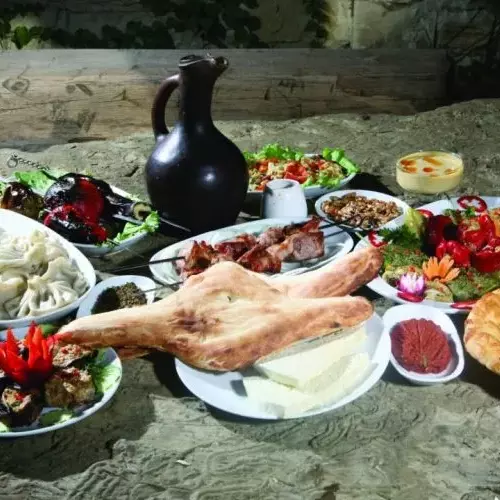
The supra is Georgia’s traditional feast, and experiencing an authentic one in a family home is the heart of this tour. It’s not just a meal—it’s a ritualized celebration guided by a tamada (toastmaster) who leads a series of heartfelt toasts to God, country, family, ancestors, friendship, and more.
Each toast requires drinking wine (you can sip, not drain—despite what Georgians might suggest), and the evening builds through multiple courses: cheese, breads, vegetable dishes, grilled meats, and desserts. The family dinner in Gurjaani gives you this experience authentically—not a restaurant staging, but genuine hospitality in a private home.
Kakheti’s Landscapes
This tour reveals Kakheti’s surprising diversity. The Alazani Valley floor is green and agricultural—endless vineyards backed by the snow-capped Caucasus. The Gombori Pass climbs through oak and beech forests to 1,620 meters. And eastern Kakheti transforms into something unexpected: the semi-desert badlands of Vashlovani, where striped rock formations in red, orange, and cream look more like Arizona than the Caucasus.
The jeep safari through Vashlovani National Park is a highlight for many guests—a complete change of scenery from the wine country, with dramatic canyons, mud volcanoes, and wildlife including gazelles, wolves, and Egyptian vultures.
Why Four Days
A single day in Kakheti means rushed stops and a long drive. Four days allow you to actually absorb what you’re experiencing: linger at wineries, climb to monastery viewpoints without checking your watch, watch sunset from Sighnaghi’s walls, and sit through a proper supra without hurrying to a car.
Two nights in Sighnaghi means you’ll see the town after day-trippers leave, when evening light turns the buildings golden and locals emerge for their evening stroll. One night in Telavi puts you in the heart of wine country. This isn’t tourism—it’s immersion.
Tour Itinerary
Driving distance: ~120 km | Duration: Full day with stops
We leave Tbilisi in the morning, taking the scenic Gombori road rather than the faster highway. This winding route climbs to 1,620 meters through oak and beech forests, offering panoramic views where the Iori Valley gives way to the Alazani plain below.
Morning: Ujarma Fortress
Our first stop is the ancient fortress of Ujarma, dramatically positioned on a rocky ridge above the Iori River. This 5th-century stronghold served as a residence for King Vakhtang Gorgasali before he founded Tbilisi. The partially restored walls and tower still command the valley—you can see why this location controlled the eastern trade routes for centuries. Archaeological excavations here have uncovered artifacts dating back to the Bronze Age.
Late Morning: Ikalto Monastery and Academy
Descending into the Alazani Valley, we reach Ikalto—one of the most significant educational sites in Georgian history. The monastery was founded in the 6th century, but its fame comes from the academy established here in the 12th century by King David the Builder.
What makes Ikalto unique: this was the world’s first institution to teach winemaking as an academic discipline, alongside theology, philosophy, astronomy, and rhetoric. The great poet Shota Rustaveli is believed to have studied here. Today you can walk among the ruins of the academic buildings and see the massive stone wine presses (satsnakheli) where students learned their craft 900 years ago.
Afternoon: Tsinandali Estate
In the village of Tsinandali, we visit the elegant estate of the Chavchavadze family—Georgian aristocrats who transformed winemaking in the 19th century. Prince Alexander Chavchavadze introduced European techniques to Georgia, building the country’s first commercial winery here in 1841.
The estate combines a beautifully preserved manor house (where Chavchavadze hosted Russian poets including Pushkin and Lermontov) with extensive gardens and a wine cellar holding over 16,500 bottles—some dating back to 1841. A tasting here includes their signature white blend, which carries the Tsinandali name and remains one of Georgia’s most recognized wines internationally.
Evening: Telavi
We end the day in Telavi, the administrative center of Kakheti and a pleasant town of about 20,000 people. The old town features a reconstructed fortress and the famous 900-year-old plane tree (platanus) with a trunk circumference of over 12 meters. Evening at leisure to explore the town center before dinner at your guesthouse.
Overnight: Telavi guesthouse (dinner included)
Driving distance: ~80 km | Duration: Full day with wine experiences
Today focuses on the northern Alazani Valley, combining two of Kakheti’s most impressive historical sites with authentic wine experiences.
Morning: Gremi Fortress and Church Complex
Gremi served as the capital of the Kakhetian Kingdom from the 15th to 17th centuries, and at its height was a thriving city of merchants, craftsmen, and nobles. In 1615, Shah Abbas I of Persia destroyed the city so completely that it never recovered—the capital moved to Telavi.
What remains is remarkable: the Church of the Archangels (1565) with its distinctive bell tower, the restored royal residence, and sections of the trading quarter. Inside the church, fragments of original frescoes survive, and from the tower you get sweeping views across vineyards to the Caucasus peaks.
Late Morning: Nekresi Monastery
From Gremi, we drive to the foot of the Caucasus foothills where Nekresi monastery clings to a steep slope 800 meters above the valley floor. The approach requires a short shuttle ride up a winding road (included in tour).
Nekresi is one of Georgia’s oldest Christian sites—the small basilica at the top dates to the 4th century, making it among the first churches built in Georgia after the country’s conversion. Later additions include a 6th-century three-church basilica and a 9th-century bishop’s palace. The views from here are extraordinary: the entire Alazani Valley spreads below, with Mount Tusheti visible on clear days.
Afternoon: Kindzmarauli Wine Tasting
In the town of Kvareli, we visit the Kindzmarauli Corporation winery, producer of one of Georgia’s most famous semi-sweet red wines. The wine tunnel here—a 7.7-kilometer underground complex built during the Soviet era—maintains perfect year-round conditions for aging.
You’ll taste their signature Kindzmarauli along with several other Kakhetian varieties and learn about the distinction between European-method and traditional qvevri winemaking.
Evening: Traditional Dinner in Gurjaani
The highlight of today is dinner with a local family in Gurjaani. This isn’t a restaurant experience—you’ll be guests in a family home where wine has been made the same way for generations.
Before dinner, watch the family prepare chacha (grape brandy) in their copper still and help make churchkhela—the candle-shaped walnut-and-grape-juice sweets that are a Kakhetian specialty. Then sit down to a full supra feast, guided by a tamada who leads traditional Georgian toasts. Expect multiple courses, endless hospitality, and more wine than you thought possible.
Overnight: Sighnaghi guesthouse
Driving distance: ~100 km + jeep safari | Duration: Full day adventure
Today we venture into eastern Kakheti’s most dramatic landscapes—a world away from the green vineyards of the valley.
Morning: Dedoplistskaro and Khornabuji Fortress
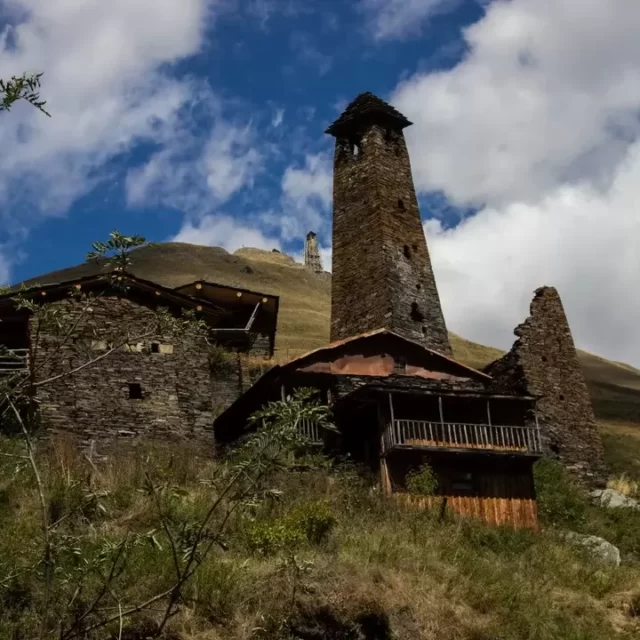
We drive east to Dedoplistskaro, the last significant town before the Azerbaijan border. Just outside town, the medieval fortress of Khornabuji rises from a rocky outcrop. Built between the 4th-7th centuries, this citadel guarded the eastern frontier and is associated with the legend of Queen Ketevan, who was martyred by the Persians in 1624. The climb to the top rewards you with views across the semi-arid steppe.
Full Day: Vashlovani Protected Area — Jeep Safari
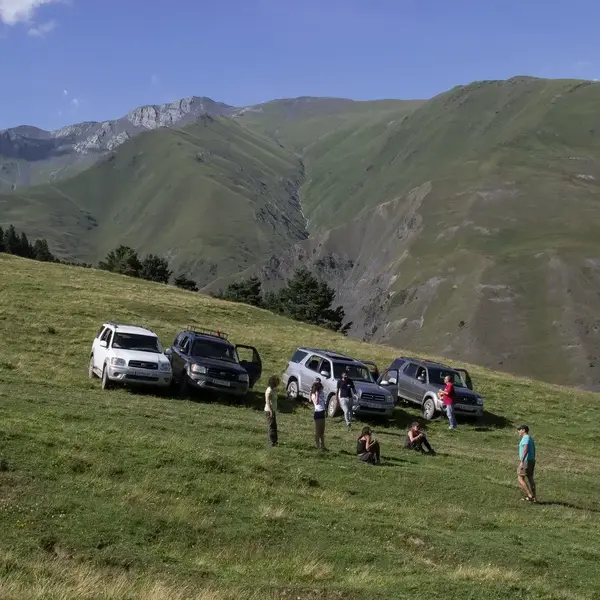
From Dedoplistskaro, we transfer to 4×4 vehicles for the highlight of today: a jeep safari through Vashlovani National Park. This 250-square-kilometer protected area is unlike anywhere else in Georgia—a semi-desert landscape of eroded badlands, dramatic canyons, and mud volcanoes.
The scenery feels more like Arizona or Central Asia than the Caucasus. Striped rock formations in shades of red, orange, and cream have been carved by wind and water over millions of years. Wildlife includes gazelles, wolves, striped hyenas, and over 130 bird species including Egyptian vultures and various eagles.
We’ll stop at key viewpoints, walk short trails to overlooks, and depending on time and conditions, visit the active mud volcanoes that bubble up from the earth. The jeep drivers know the terrain intimately and share stories about the landscape and its wildlife.
Return to Sighnaghi for dinner and overnight.
Overnight: Sighnaghi guesthouse (dinner included)
Driving distance: ~150 km | Duration: Full day, arrival Tbilisi late afternoon
Our final day combines the charming hilltop town of Sighnaghi, an important pilgrimage site, and one of Georgia’s most remarkable monastery complexes.
Morning: Sighnaghi Exploration
Sighnaghi deserves unhurried exploration. Founded in the 18th century as a fortified trading center, this small town wraps around a hillside with views across the Alazani Valley to the Caucasus. The defensive walls—with 23 towers stretching over 4 kilometers—are remarkably well preserved.
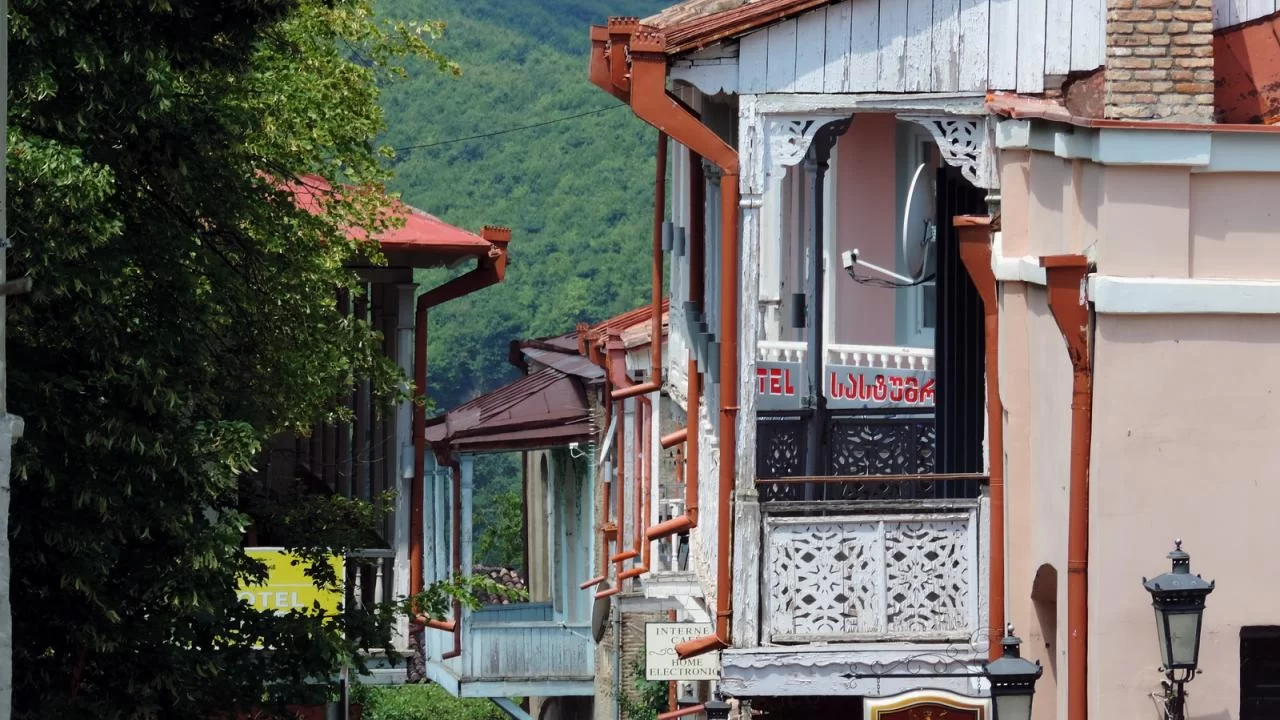
Wander the cobblestone streets past colorful wooden balconies and stop at the Sighnaghi Museum, which houses an excellent collection of works by Niko Pirosmani—Georgia’s most famous painter, a self-taught artist whose naive style captured Georgian life in the early 20th century.
For wine enthusiasts, the “Pheasant’s Tears” cellar offers tastings of natural wines made exclusively in qvevri by American winemaker John Wurdeman and his Georgian partners—representing the cutting edge of Georgia’s natural wine revival.
Late Morning: Bodbe Monastery
Just outside Sighnaghi, Bodbe Monastery holds special significance for Georgian Orthodox believers. This is the burial place of St. Nino, the 4th-century woman credited with converting Georgia to Christianity. The modest church contains her tomb, and pilgrims come from across Georgia to pay respects.
Below the main monastery, a steep path leads to a holy spring where the faithful collect blessed water. The grounds are peaceful and beautifully maintained, with cypress trees and flower gardens.
Afternoon: David Gareja Monastery Complex
Our final destination is David Gareja—a sprawling complex of cave monasteries carved into the semi-desert hills along the Azerbaijan border. Founded in the 6th century by David, one of the thirteen Assyrian monks who established monasticism in Georgia, the complex eventually grew to include thousands of caves and over a dozen separate monasteries.
The main Lavra monastery at the base of the ridge remains active, with resident monks maintaining the ancient traditions. From here, a moderately strenuous 30-minute climb takes you over the ridge to Udabno (“desert”) monastery, where cave cells are decorated with remarkable 10th-13th century frescoes depicting saints, biblical scenes, and the monastery’s founders.
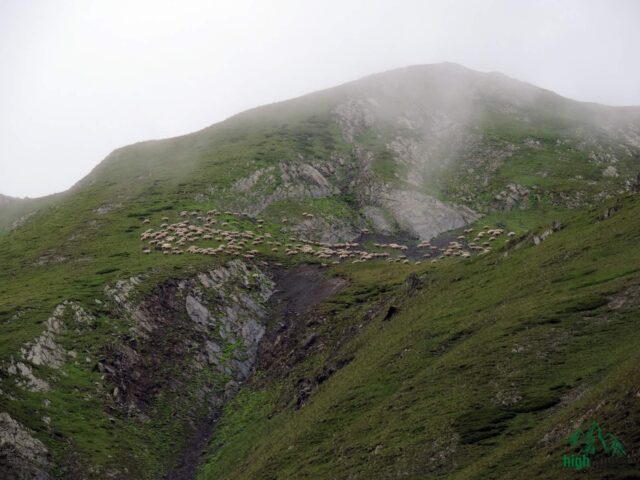
The landscape itself is extraordinary—rolling semi-desert hills stretching to the horizon, dotted with occasional shepherds and their flocks. The border with Azerbaijan runs along the ridge, and on clear days you can see far into both countries.
Evening: Return to Tbilisi
We return to Tbilisi via the direct road (approximately 1.5 hours), arriving in late afternoon.
Arrival in Tbilisi: Late afternoon—with four days of Kakheti memories, dozens of wine varieties tasted, and a deep appreciation for Georgian hospitality.
Price details
[wptb id=17402]
What’s Included
Tour map
Tbilisi
Ujarma Fortress
Gombori Pass (1,620m)
Ikalto Academy
Tsinandali Estate
Telavi (Night 1)
Gremi Fortress
Nekresi Monastery
Kindzmarauli Winery
Gurjaani Family Dinner
Sighnaghi (Nights 2-3)
Khornabuji Fortress
Vashlovani National Park
Bodbe Monastery
David Gareja Monastery
Tour gallery
Practical Information
Duration: 4 days / 3 nights
Total Distance: Approximately 450 km
Difficulty: Easy to Moderate
Best Season: Spring (April-May) or Autumn (September-October)
Starting/Ending Point: Tbilisi
What to Pack
Comfortable walking shoes: Essential for Nekresi climb and David Gareja. Sturdy footwear also needed for Vashlovani terrain.
Layers: Valley is warm but evenings cool, monasteries are drafty.
Sun protection: Vashlovani has little shade—sunscreen, hat, sunglasses essential.
Modest clothing for monasteries: Covered shoulders and knees required.
Appetite: Georgian hospitality is generous—come hungry!
Fitness Level
This tour is rated Easy to Moderate. Most sites are accessible without significant walking, but David Gareja and Nekresi involve uphill climbs (30-45 minutes at moderate pace). Vashlovani includes some walking on uneven terrain. Anyone in reasonable health can manage the itinerary.
Best Time to Visit
Spring (April-May) ⭐⭐⭐⭐⭐: Mild temperatures, green landscapes, wildflowers. Occasional rain possible.
Summer (June-August) ⭐⭐⭐: Hot in valley (30-35°C). Early starts recommended. Vashlovani can be very hot.
Autumn (September-October) ⭐⭐⭐⭐⭐: Ideal season. Grape harvest (rtveli), wine festivals, golden light. Villages alive with winemaking activity.
Winter (November-March) ⭐⭐⭐: Cool but mild. Fewer tourists, cozy wine cellars. Some roads may be muddy. Chance to warm up with chacha beside a fire.
Tour FAQ
Why Book This Tour
This isn’t a highlights reel—it’s a deep dive into Georgia’s most important wine region. Four days allows you to actually understand Kakheti: to compare qvevri wines with European-method wines, to see how family cellars operate differently from commercial wineries, to watch a supra unfold over hours rather than rushing through a tourist dinner.
The experiences here are cumulative. By Day 4, you’ll understand why Georgian wine is different, why the qvevri method produces distinctive flavors, and why Georgians consider wine-making a sacred tradition rather than just agriculture. You’ll have sat with families who’ve made wine for generations, watched the same landscapes shift from vineyard to desert, and experienced hospitality that’s impossible to fake.
We’ve been running tours in Kakheti since 2011 and have built relationships with the families, winemakers, and jeep drivers who make this tour special. Our guides aren’t just translators—they’re connected to this region through years of experience and genuine passion.
The Vashlovani jeep safari sets this tour apart from standard wine itineraries. Most visitors to Kakheti never see this dramatic landscape—the Arizona-like badlands, the mud volcanoes, the wildlife. Combined with wine tastings and historical sites, you get a complete picture of what makes this region extraordinary.
This is for travelers who want depth over breadth, who’d rather know one region intimately than check boxes across a country. If you have four days and want to understand Georgian wine culture from the inside, this is the tour.