Thirteen days crossing the full breadth of Eastern Georgia’s high mountains — from the glaciers of Kazbegi to the fortress villages of Khevsureti, over the Atsunta Pass into Tusheti, and down to the ancient vineyards of Kakheti. The most complete Georgian mountain expedition you can do.
Three mountain regions. Four crossings of the main Caucasus ridge. Eight days of trekking through landscapes that haven’t changed in centuries. This is the Grand Trek in Eastern Caucasus — two of our most celebrated trekking routes combined into a single, continuous expedition that takes you deeper into Georgia’s mountains than almost any other journey on offer.
You begin in Kazbegi, beneath the great peak of Mount Kazbek, and cross the Chaukhi Pass to reach the glacial Abudelauri lakes — one of the Caucasus’s most extraordinary alpine landscapes. From there, a jeep transfer carries you west through the Datvijvari Pass into Khevsureti, where the warrior traditions of medieval Georgia survived intact well into the 20th century. The second half of the trek follows the Khonischala gorge up to the Atsunta Pass (3,431m) and descends through Tusheti’s tower-guarded valleys into one of Europe’s most genuinely remote inhabited regions. The mountains end, as mountains always should, with wine: two days exploring Kakheti, Georgia’s ancient vineyard heartland.
This is not a comfortable tour. The terrain is demanding, the camping is basic, and there are stretches where turning back simply isn’t practical. But for experienced hikers who want to understand Georgia at its most elemental — its geology, its history, its extraordinary mountain cultures — there is nothing else quite like it.
Trek at a Glance
Trek Highlights
Who This Trek Is For
This trek suits: Experienced mountain hikers in excellent physical condition with prior multi-day trekking experience — ideally including high-altitude camping. People who can manage consecutive demanding days, comfortable with elevation gains of over 1,000 meters in a single push, 18km marathon days on rough terrain, and nights at altitude above 3,000 meters. Those seeking not just scenery but cultural depth — this route passes through three distinct highland peoples, each with traditions that evolved in near-total isolation from each other. Anyone who has done the Atsunta trek or the Chaukhi traverse separately and wants to experience both in a single continuous journey.
This trek doesn’t suit: Beginners or occasional day hikers — prior multi-day mountain experience is not optional, it’s a prerequisite. Those who need reliable mobile coverage, comfortable accommodation, or reliable access to medical facilities. Anyone with health conditions affected by altitude, or who cannot commit to 8 days of consecutive hiking with limited exit options in the middle section. If you’re uncertain about your fitness level, we would rather you ask us directly than find out on a mountainside.
Detailed Day-by-Day Itinerary
Airport transfer and hotel check-in. For those arriving with energy to spare, the walk through Tbilisi’s Old Town — past the sulfur bath district, the Narikala fortress walls, and the tangle of carved wooden balconies above — is an excellent way to start calibrating yourself to Georgia. Tonight is for rest, a good dinner, and checking your pack.
This is also the moment to raise any last questions with your guide about gear, fitness, and what lies ahead. The mountains begin tomorrow.
The Georgian Military Highway north from Tbilisi is one of the great mountain drives — the Aragvi valley narrows, the walls close in, and the altitude climbs steadily toward Russia. We stop first at the Zhinvali Reservoir viewpoint, then at Ananuri Castle, a 17th-century fortress complex that sits directly above the reservoir with a church, two towers, and views that stop most people mid-sentence.
Above Gudauri, the road crosses the Cross Pass at 2,379 meters — the point where the Caucasus ridge becomes something you can feel rather than just see. The descent into Stepantsminda (Kazbegi) brings Georgia’s most famous landmark into view: Gergeti Trinity Church, a 14th-century Georgian Orthodox church perched on its improbable ridge with Mount Kazbek — 5,047 meters, permanently snow-capped — filling the sky behind it.
We hike up to Gergeti, spend time at the church, then continue to the Gveleti waterfall gorge before driving the final mountain track to Juta. At 2,200 meters, in the shadow of the Chaukhi massif — a cluster of dolomite spires that looks like the Dolomites after a serious argument — this is your first night under canvas. Dinner is camp-cooked with the peaks visible from the tent.
The first big day. From the Juta camp, the trail climbs steadily toward the Chaukhi Pass at 3,338 meters — gaining over 1,100 meters through alpine meadows that thin out into rocky scree and, depending on the season, patches of snow. The Chaukhi towers, those extraordinary dolomite spires, loom above you for most of the ascent.
The reward at the top is a view that stretches back into the Kazbegi district and forward into the Roshka valley — two completely different geological worlds separated by a single ridge. The descent follows a long, sweeping valley down toward the Abudelauri glacier lakes, which are unlike anything else in the Caucasus. Three lakes in a single glacial basin, each a different color: the White Lake, the Blue Lake, and the Green Lake, their hues determined by the varying mineral compositions of the glacial meltwater feeding them. The effect is disorienting in the best possible way.
From the lakes, the trail continues down to the village of Roshka, where a guesthouse, a warm meal, and a proper roof over your head mark the end of the first real mountain day. Appreciate the bed — it will be a while before the next one.
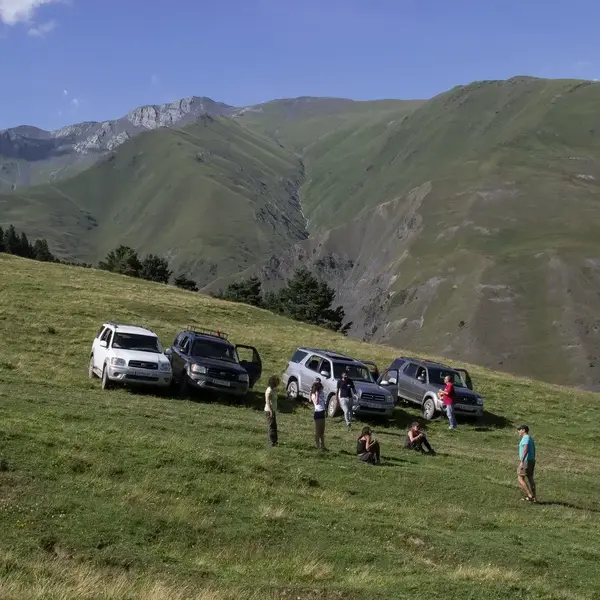
A transitional day between the two trekking sections — and a welcome one after yesterday. From Roshka, a gentle 7-kilometer descent through the valley brings you to the main road and the waiting jeeps, which carry the group and all baggage the 50 kilometers west to Shatili via the Datvijvari Pass.
The road itself is worth attention. It crosses into Khevsureti through the 2,676-meter Datvijvari Pass, with views across some of Georgia’s most remote highland terrain — ridges and valleys stretching to the horizon with no town visible in any direction. En route, the ruins of Kistani village and the defensive tower of Lebaiskari give a first glimpse of the fortress architecture that defines this region.
Shatili itself is one of the most remarkable human constructions in the Caucasus — not a village with towers, but a fortress that is also a village, its dozens of interconnected stone towers grown directly from the ridge above the Argun gorge. Explore on foot in the evening. Sleep in a guesthouse among the towers.
The second full trekking day begins the Khevsureti section in earnest. The trail descends the Argun gorge — the river rushing below, stone towers appearing on every ridge — to the confluence with the Andaki River at a place called Anatori. A cluster of stone burial towers stands here, set slightly apart from the path, in a location that carries a particular weight when you understand their history. During a plague epidemic — the date debated, the story consistent — the people of Anatori walled themselves inside these towers to prevent the disease from spreading to neighboring communities. The towers became their tombs. It is one of those places that requires silence.
Continuing upstream from Anatori, the trail passes the ruined settlement of Mutso — a fortress perched on an almost vertical cliff above the gorge, its towers half-collapsed but still recognizable as what they once were. The detour up to Mutso adds time and elevation but is worth every step for the views and the eerie stillness of an abandoned community hanging above an empty gorge.
From Mutso, the trail follows the valley to the ruins of Ardoti, where the camp is set for the second night under canvas. From here, the horses take over the heavy work.
From Ardoti, the Khonischala gorge opens ahead — a long, progressively narrowing valley that carries you steadily upward toward the base of the Atsunta Pass. This is where the horse handlers and pack animals take over the luggage; from this point until Tusheti, you carry only a daypack. It makes a considerable difference.
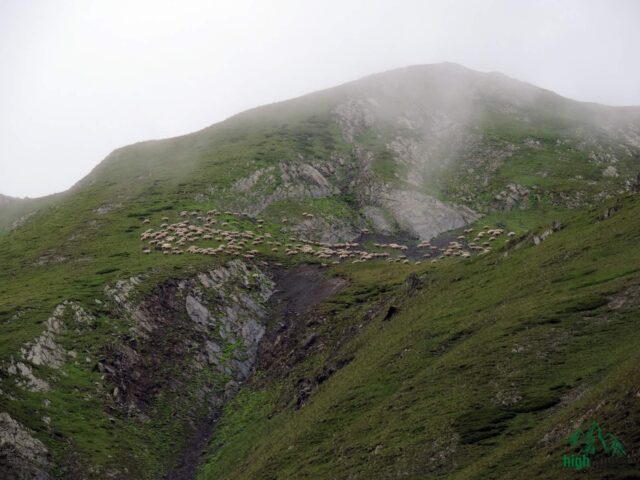
The terrain shifts as you climb: first deciduous forest, then alpine meadow, then the raw rocky ground of the upper gorge where the treeline gives out and the mountains become something more serious. The gorge is wild and sees very few people — no road reaches it, and the trail exists primarily because local horsemen and the occasional expedition party have been using it for generations.
Camp tonight is set at around 2,000 meters — higher than yesterday, cold enough in the evening to make the sleeping bag feel earned. The pass is visible above. Tomorrow is the big day.
The centerpiece of the trek and its hardest day. An early start is not optional — the summit push gains over 1,400 meters from camp through steep, rocky terrain where snow can be present even in August. The final approach to the pass is the kind of climbing that narrows your focus to the next step and the next breath and nothing else.
At 3,431 meters, Atsunta is one of the highest trekking passes in Georgia. From the top, if the weather holds, the view opens across the full depth of the Greater Caucasus in both directions — range after range of peaks diminishing into haze, the valleys of Khevsureti behind you and the valleys of Tusheti below. You are standing on the spine of the mountains that separate, in a geological and historical sense, two different worlds. The community that once crossed this pass regularly — carrying goods, livestock, children — understood it as a threshold. Standing there, you will too.
The descent into Tusheti is careful and steep. Camp is pitched on the eastern side of the pass at around 2,800 meters, still high, still cold, but with the hardest work behind you. Tomorrow is all downhill.
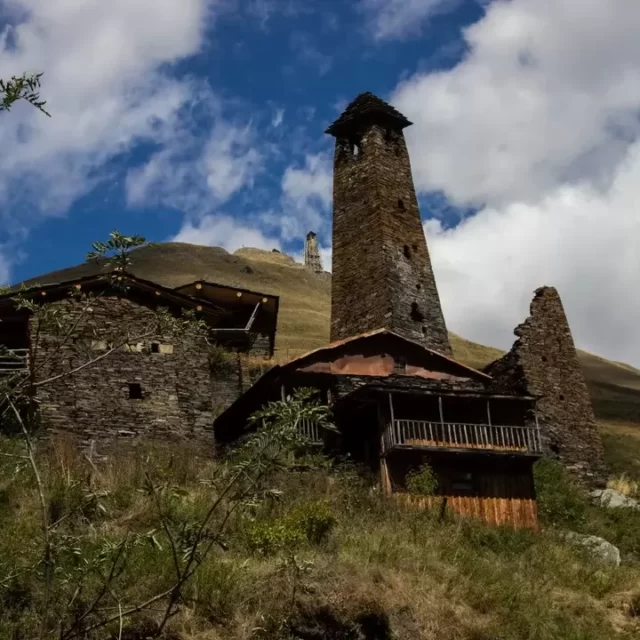
The long descent from the pass into Tusheti’s inhabited valleys passes through the Pirikiti Valley’s remotest settlements — Girevi, Parsma, Chesho — stone tower villages that sit above the trail on slopes of alpine pasture, inhabited only seasonally and seeing a fraction of the visitors that reach Omalo or Dartlo by road. Walking through them feels like a discovery, even if it’s a discovery that others have made before you. The towers are classic Tushetian: tall, narrow, built for defence rather than comfort, and still standing after centuries of abandonment by anyone except the occasional summer shepherd.
At the end of the valley, Dartlo awaits — the village most often described as the finest in Tusheti, with its stone towers above a cluster of timber-balconied houses, its summer families, and its sense of having reached somewhere genuinely far from the ordinary world. A guesthouse, a hot meal, and three nights of camping behind you. Sleep well.
The last trekking day, and by the standards of what came before, a relatively gentle one. The trail from Dartlo to Omalo follows the Pirikiti Alazani river valley through pine forests and summer meadows thick with wild berries — cloudberries, blueberries, raspberries depending on the season. After days of rocky alpine terrain, the change of vegetation feels like a different country entirely.
Omalo is the administrative and practical hub of Tusheti — which is a relative term in a region where the entire population of thousands of square kilometers numbers in the hundreds in summer and near zero in winter. Upper Omalo, perched above the lower village, gives views across the valley and up toward the Keselo Castle towers that define the skyline here. Tonight, a real guesthouse in a remarkable setting. The trek is complete.
Morning visit to Keselo Castle — the fortress tower complex perched above Upper Omalo whose silhouette has appeared on every Tusheti photograph you’ve ever seen. The short walk up earns views across the entire valley, and the towers themselves, several of which have been partially restored, give context to the defensive logic of this entire highland world.
Then begins the Abano Pass descent: 72 kilometers of unpaved mountain road dropping from Tusheti’s plateau at 2,926 meters to the foothills of Kakheti. It is one of the most dramatic drives in the Caucasus — switchbacks above cliff edges, views that keep recomposing as the altitude drops, and a transition from alpine terrain to fertile, vineyard-covered slopes that happens almost visibly over the course of a few hours.
By evening you are in Telavi, Kakheti’s historic capital, where a proper hotel room, a hot shower, and a dinner that didn’t come from a camp stove await. The mountains are behind you. The wine country is ahead.
A day of deliberate deceleration. Kakheti is Georgia’s wine country — the Alazani valley spreading south from Telavi into a broad, sun-soaked plain of vineyards, orchards, and ancient monasteries where the pace of life seems calibrated to centuries rather than schedules.
The program for the day includes a wine tasting at a local producer, with wines made in the traditional qvevri method — clay amphoras buried in the earth that have been used for fermentation here for 8,000 years, producing wines with a depth of tannin and texture that European winemaking simply does not replicate. We also visit Signagi, the small hilltop town above the Alazani valley whose medieval walls and terracotta rooflines make it one of the most photographed towns in Georgia, and the Bodbe Monastery nearby, built over the grave of St. Nino, who brought Christianity to Georgia in the 4th century.
This is also a day for legs that have earned rest, for writing in notebooks, and for eating well.
A morning stop at Alaverdi Cathedral — the great 11th-century church rising from the vineyard plain north of Telavi, one of the tallest medieval structures in Georgia and still an active monastery surrounded by working vineyards — before the drive back to Tbilisi along the Kakheti highway. The tour officially ends on arrival in the capital.
Those flying onward the same day or the next morning will find this schedule workable. Those with time remaining in Tbilisi will find the city feels different after two weeks in the mountains.
Breakfast and airport transfer. The tour ends here. The mountains will stay with you considerably longer.
Price Information
Group Size Price per Person
4 persons $INSERT_PRICE
6 persons $INSERT_PRICE
8 persons $INSERT_PRICE
10–12 persons $INSERT_PRICE
Photo Gallery
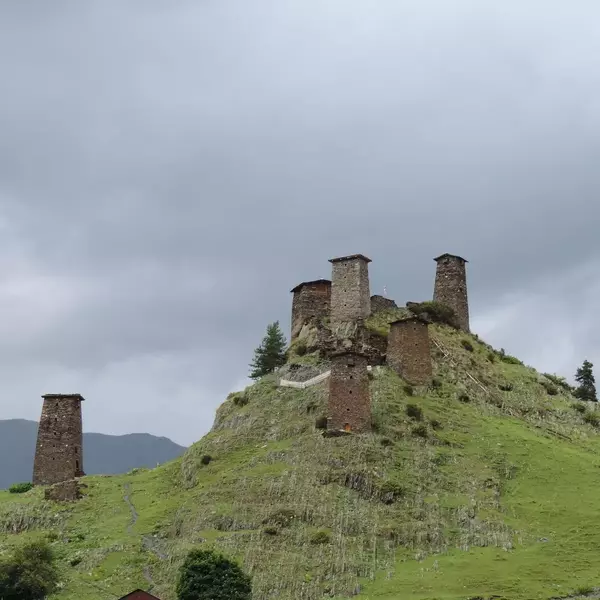
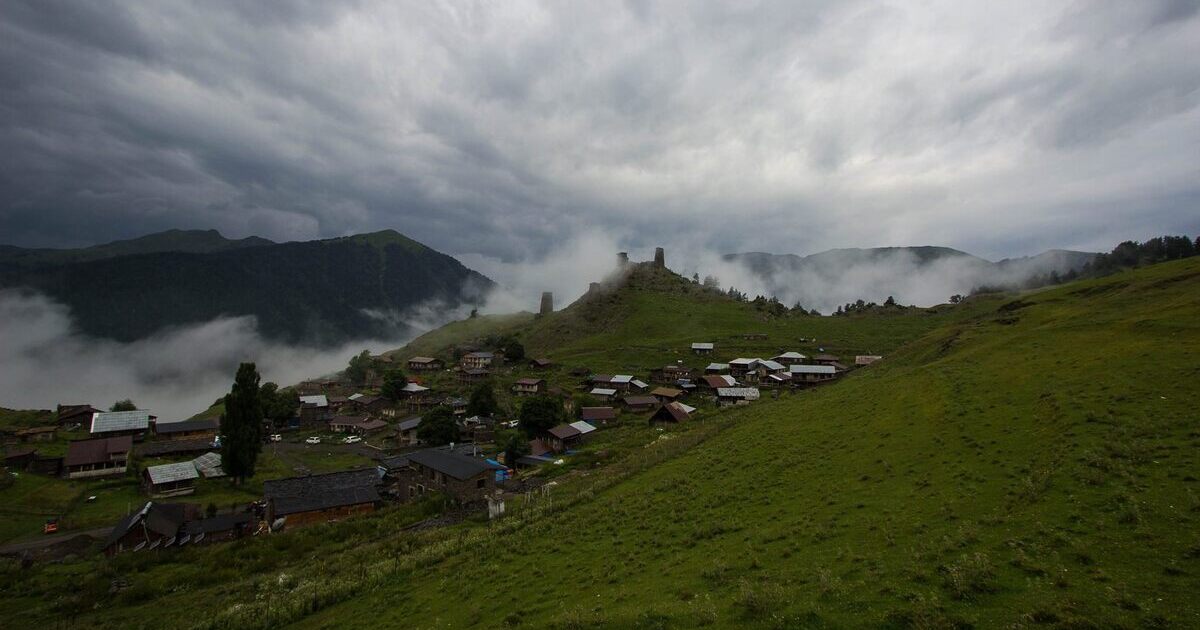
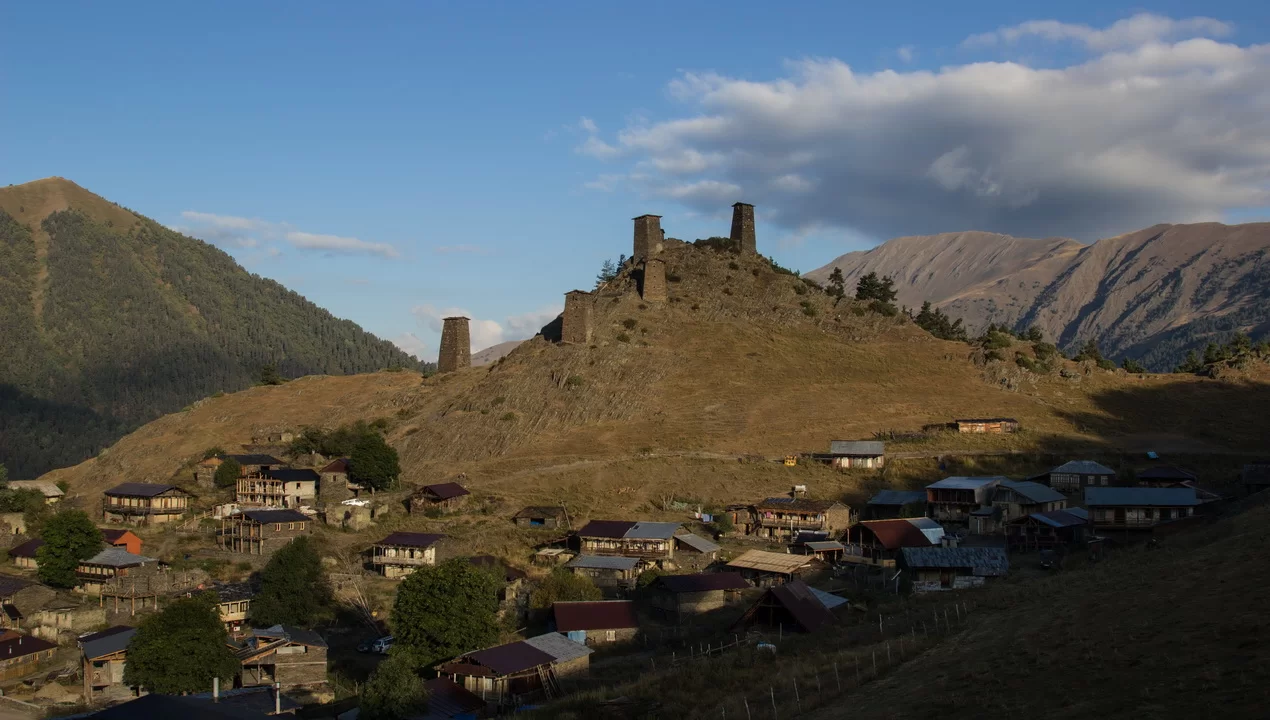
Images: Gergeti Trinity Church, Chaukhi pass, Abudelauri lakes, Shatili fortress, Anatori towers, Mutso ruins, Atsunta Pass summit, Pirikiti valley villages, Dartlo, Keselo Castle, Abano Pass road, Kakheti vineyards
Trek Route Map
Tbilisi
Ananuri Castle
Kazbegi / Stepantsminda
Gergeti Trinity Church
Juta Camp
Chaukhi Pass
Abudelauri Lakes
Roshka
Datvijvari Pass
Shatili
Anatori
Mutso
Ardoti Camp
Atsunta Base Camp
Atsunta Pass
High Camp Tusheti Side
Dartlo
Omalo
Abano Pass
Telavi
Signagi
Practical Information
Fitness Requirements
This is an expedition-grade trek requiring excellent physical fitness and prior mountain hiking experience. Eight consecutive hiking days include two marathon days of ~18–20 km, multiple days with 1,000m+ of elevation gain, three nights camping above 2,000 meters, and a summit day pushing to 3,431m. You should be comfortable with 7–8 hour hiking days, steep and rocky terrain, and the physical and psychological demands of consecutive challenging days with no easy exit option mid-route. If you’re unsure about your fitness level, contact us directly for an honest conversation — we would rather have that discussion before the trek than on a mountainside.
Best Time to Trek
July to early October. Snow can linger on both passes into July in heavy snow years. September offers cooler temperatures and more stable weather, though nights will be cold at high camp. August is peak season for conditions and wildflower meadows. October is possible but requires flexibility around early snowfall.
What to Bring
Essential: Sturdy broken-in mountain boots, layered clothing system (base, mid, insulating, waterproof shell), warm hat and gloves (critical for the pass and high camps), sun protection, headlamp, personal medications, minimum 2L water capacity, small daypack for trekking days.
Sleeping: We provide tents and sleeping mats. Bring your own sleeping bag rated to -10°C, or rent one from us — request at booking.
Recommended: Trekking poles, gaiters, camp sandals for evenings, quick-dry towel, camera with spare batteries, power bank.
Camping and Accommodation
Night 1: Hotel in Tbilisi | Night 2: Camp in Juta (2,200m) | Night 3: Guesthouse in Roshka | Night 4: Guesthouse in Shatili | Night 5: Camp near Ardoti (1,500m) | Night 6: Camp below Atsunta (2,000m) | Night 7: High camp, Tusheti side (2,800m) | Night 8: Guesthouse in Dartlo | Night 9: Guesthouse in Upper Omalo | Nights 10–11: Hotel in Telavi | Night 12: Hotel in Tbilisi
Horse Support
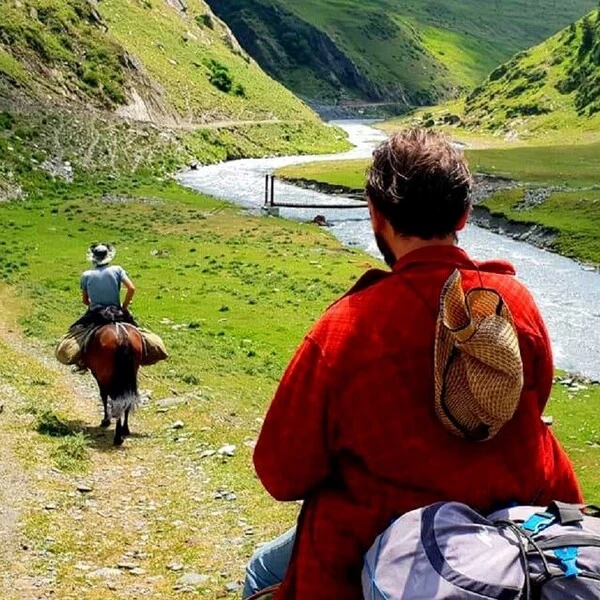
Pack horses carry tents, food, and heavy gear from Ardoti through the Atsunta Pass and into Tusheti. You trek with only a daypack through the most demanding section of the route. The horsemen accompanying us have used these trails across generations.
Vegetarian Options
Dietary requirements are discussed before the tour. Vegetarian meals are fully accommodated throughout. Please inform us when booking.
Cultural Note: Tusheti
An ancient tradition — predating Christianity and observed without exception — prohibits pork products throughout Tusheti. This is not a guideline; it is a strict rule taken very seriously by local people. No pork may enter the region. Please ensure nothing in your food supplies contains pork before crossing the Atsunta Pass.
Kutaisi Airport Option
The tour can be modified for groups arriving or departing via Kutaisi International Airport. This adds approximately two days to the itinerary, beginning in western Georgia before joining the route at Tbilisi. Contact us to arrange a customized start.
Frequently Asked Questions
The Complete Georgian Mountain Expedition
There are shorter treks, easier treks, and more comfortable ways to see Georgia’s mountains. The Grand Trek in Eastern Caucasus is none of those things. It is thirteen days of moving continuously through terrain that shaped three of the most distinct mountain cultures in the Caucasus — Khevsurs, Tushetians, Kakhetians — each with histories, traditions, and landscapes that require time and physical effort to understand properly.
The Chaukhi Pass shows you the Kazbegi world from the back side. The Atsunta crossing earns you entry into Tusheti in the only way the region has ever been entered from Khevsureti — on foot, over 3,400 meters of mountain. The Kakheti days give your legs and your mind time to process what you’ve seen. And throughout, the guides, horsemen, and guesthouse families you meet are part of what makes this a journey rather than just a route.
This is the trek we recommend to experienced hikers who want to see Georgia whole. Contact us to check availability, discuss your experience level, and start planning.