Mtskheta Travel Guide: Georgia’s Ancient Capital Worth More Than a Quick Stop
I was seven or eight the first time I saw Mtskheta. My mother and I took the train from Tbilisi, a short ride that felt like a proper journey to a child. It was still the Soviet Union then, and nobody talked much about what Mtskheta actually meant. Churches were old buildings, not holy places, at least not officially.
But I remember the walls of Svetitskhoveli Cathedral rising above everything else, impossibly large. And I remember a tiny tree growing from the roof, just sprouting out of the ancient stone, impossibly green against all that weathered grey. A living thing pushing through something that should have been finished centuries ago.
That image stayed with me. It still captures something essential about Mtskheta: ancient, enduring, and stubbornly alive even when the world around it tried to pretend it didn’t matter.
For Georgians, Mtskheta is not a tourist destination. It is where our Christianity began, where our kings were crowned, where couples still insist on getting married because nowhere else carries the same weight. My cousin married at Svetitskhoveli three years ago. The church was so full that guests stood in the courtyard, listening to the ceremony through the open doors.
For visitors, Mtskheta is a UNESCO World Heritage Site and Georgia’s ancient capital, just 25 kilometres from Tbilisi. For us, it is where the country keeps its soul.
This guide covers both the history and the practical details, the famous sites and the places most visitors never find.

Why Mtskheta Matters
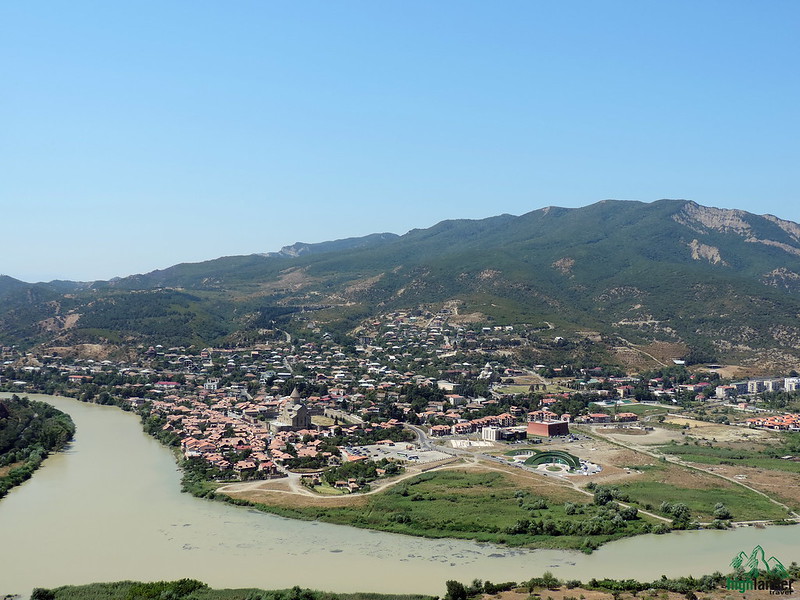
Two rivers meet at Mtskheta, the Aragvi and the Mtkvari, and the ancient Iberians who built their capital here between the 5th and 1st centuries BC chose this spot deliberately. The confluence gave them a strategic military position, reliable water, and a junction on the trade routes connecting Byzantium, Syria, and the Silk Road.
For centuries, Mtskheta was the political and commercial heart of the Kingdom of Iberia. But the event that defined its identity came in 337 AD, when King Mirian III and Queen Nana converted to Christianity, making Georgia one of the earliest nations to adopt the faith. A young missionary from Cappadocia named Saint Nino convinced them. The hilltop where she erected a wooden cross became the site of Jvari Monastery. The spot where she established the first church became Svetitskhoveli Cathedral.
The Georgian Orthodox Church designates Mtskheta a “Holy City.” When you see passengers on a marshrutka crossing themselves as Jvari appears through the window, you understand: this place still carries meaning that goes well beyond its historical significance.
Things to Do in Mtskheta: The Essential Three
Svetitskhoveli Cathedral
The 11th-century cathedral dominates central Mtskheta. Svetitskhoveli means “Cathedral of the Living Pillar,” a name rooted in one of Georgia’s oldest legends.
According to tradition, a Jewish rabbi from Mtskheta was present in Jerusalem during the crucifixion of Christ. He acquired the seamless robe and brought it home. His sister Sidonia touched it and died from the sheer force of its holiness. They buried her still clutching the garment. A sacred cedar grew from her grave.
When builders attempted to fell the tree for the first church, one stump rose into the air and would not descend until Saint Nino prayed over it for an entire night. The “Living Pillar” that floats, a miraculous stump, gave the cathedral its name.
Georgians have told this story for 1,700 years.
Inside, you walk over the tombs of Georgian kings, including Vakhtang Gorgasali, the founder of Tbilisi. The frescoes blend biblical scenes with unusual zodiac symbols — a reflection of the interesting syncretism in medieval Georgian Christianity. On the northern exterior wall, look for a carved hand. Legend holds that King Giorgi ordered the architect’s hand cut off so he could never create anything to rival this building.
The cathedral houses relics that believers consider fragments of the True Cross and Christ’s Mantle. During services, elderly Georgian women pray before them with a devotion that transforms the space entirely. This is not a museum experience.
Practical details: Open daily, free entry. Modest dress required — shoulders covered, long pants or skirts below the knee, headscarves for women (scarves are available at the entrance, but bringing your own is easier). Photography is permitted outside but restricted during services. Georgian Orthodox liturgy here features polyphonic chanting that UNESCO recognises as intangible cultural heritage — if you can time your visit to catch a service, particularly on Sundays, it is worth it.
Jvari Monastery
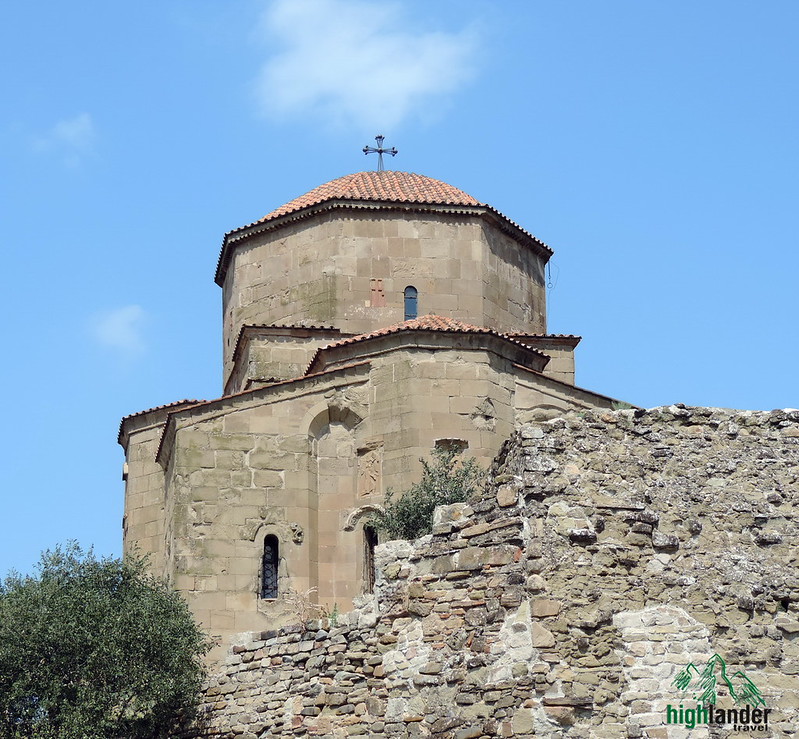
The 6th-century monastery perched on the cliff above the river confluence is Georgia’s most photographed building, and deservedly so.
The setting does most of the work. From the clifftop, you look straight down to where the Aragvi’s clear water flows into the muddier Mtkvari, the two colours remaining distinct for some distance before blending. On clear days, the Caucasus range fills the northern horizon. The Jvari monastery itself is architecturally restrained — an early Georgian church building favoured proportion and harmony with the landscape over ornament.
The history adds depth. This is where Saint Nino planted her original cross, reportedly bound together with her own hair, directly on top of a pagan temple. The deliberate placement — Christian symbol over pre-Christian sacred site — is a pattern you will see repeated across Georgia.
Practical details: Open daily, free entry. Same dress code as Svetitskhoveli. The monastery sits on a hill accessible by road — you will need a car, taxi, or tour vehicle to get there, as no public transport runs directly to Jvari. Allow 30–45 minutes for the visit. Early morning (before 10 AM) offers the best light and smallest crowds. Sunday mass at 9–10 AM is particularly atmospheric — polyphonic singing against stone walls with that panorama behind you.
Samtavro Monastery
A ten-minute walk from the main square, Samtavro operates as an active nunnery and has a markedly different atmosphere, quieter, greener, with gardens and a spring water fountain.
The current church dates to the 11th century, though the site goes back to the 4th century. Saint Nino spent her final years here in a small cell, now marked by a chapel you can enter. King Mirian III and Queen Nana – Georgia’s first Christian monarchs – rest in twin stone tombs beneath a delicate pavilion. Glass mosaics shimmer above their graves.
The monastery also holds the tomb of Saint Gabriel (Monk Gabriel Urgebadze), a modern saint who died in 1995 and was canonised in 2012. His story is striking: in 1965, during a Soviet May Day parade in Tbilisi, he publicly burned a banner of Lenin. The authorities committed him to a psychiatric facility. The Orthodox Church eventually declared him a saint. His pink marble sarcophagus draws a steady stream of pilgrims.
Local families fill bottles from the monastery’s spring, and you are welcome to do the same. The water is cold and clean — bring an empty bottle.
Practical details: Open daily, free entry. Dress code applies. Photography is generally permitted, but ask before photographing nuns or pilgrims.
Hidden Gems Near Mtskheta That Most Visitors Miss
Shio-Mgvime Monastery
Eleven kilometres west of Mtskheta, carved into a limestone canyon along the Mtkvari River, Shio-Mgvime receives a fraction of Jvari’s visitors. This is a shame, because the medieval frescoes here are among the best-preserved in Georgia.
The monastery was founded in the 6th century by Father Shio, one of the thirteen Assyrian missionaries who spread Christianity across Georgia. At its peak, the community housed 2,000 monks in caves cut into the cliff face — you can still see the dark openings dotting the rock wall above.
Two churches stand in the complex. The smaller one contains Shio’s cave-tomb, where he spent his final fifteen years in solitude — you walk directly into the rock. The larger church holds vivid frescoes of biblical scenes, remarkably intact after more than 800 years.
The monastery shop sells honey and beeswax candles made on-site. These are among the few genuinely local products you will find in the Mtskheta area.
Getting there: You need a car. It is a 20-minute drive from central Mtskheta, followed by a short uphill walk. No public transport. This is one of the sites that makes having a local driver or joining a guided tour genuinely useful — the monastery has no signage in English, and the historical context transforms what you see.
Antioch Church
Follow the residential lanes toward the Aragvi River, and you will find this small 4th–5th century chapel that tour groups rarely visit. Four frescoes painted in the 1990s by artist Irakli Tsintsadze depict key moments from Saint Nino’s life. The interior walls hold additional colourful frescoes.
The real draw is the riverside terrace. Jvari appears to float on its mountain across the valley. This is one of the most peaceful spots in Mtskheta — no vendors, no crowds, just the sound of the river.
Zedazeni Monastery
Perched at 1,170 metres in the Saguramo Range, roughly 35 kilometres from Mtskheta, Zedazeni offers a panoramic view that takes in both Mtskheta and Tbilisi with the Caucasus as a backdrop.
This is where the thirteen Assyrian Fathers gathered before dispersing across Georgia to establish their individual monasteries. The site replaced an ancient pagan temple dedicated to the fertility god Zaden — that same pattern of Christian sites built directly over pre-Christian ones.
The drive passes through Tbilisi National Park and is scenic in its own right. The final approach is a steep stone track (manageable in any car if you take it slowly), then a short walk to the gates.
Practical details: The monastery opens at 11 AM, but the outdoor viewing areas are accessible earlier for sunrise or better photographic light. At the base, local families have created a large outdoor shrine of religious icons arranged around a metal cross — grassroots, unpolished, and very Georgian. You can buy candles from their small shop.
Archaeological Sites
Mtskheta sits on millennia of continuous settlement, and excavations continue to turn up material.
Bagineti, near the river, has revealed Hellenistic and early medieval ruins. Armazi, the ancient lower town along the opposite bank of the Mtkvari, produced remains of a royal palace, public baths, wine cellars, and water systems. The Armazi Fortress ruins crown a nearby hilltop.
Bebristsikhe Fortress (9th century) lies just two kilometres from the town centre. The ruins are weathered, and footing can be uneven, but the walk is pleasant and gives you an hour away from the tourist areas.
These sites lack the immediate visual drama of the churches. But for anyone interested in how a major ancient trading city actually functioned, they provide valuable context.
Mtskheta Day Trip from Tbilisi: Getting There
Marshrutka (minibus): 2 GEL from Didube Station in Tbilisi. Vans depart every 20–30 minutes between roughly 8 AM and 8 PM. The journey takes 25–35 minutes. At Didube, exit the metro, pass through the underpass, cross the road, turn right through the market alley, then left — you will find the Mtskheta vans and ticket counter. Buy your ticket before boarding. Return vans can be flagged down on the main road.
Taxi or Bolt app: 20–25 GEL one way. Convenient for the town centre, but limits your ability to reach Jvari, Shio-Mgvime, or Zedazeni without hiring the driver for the full day (typically 80–120 GEL for 3–4 hours, depending on negotiation).
Guided tour: Small-group day tours from Tbilisi with English-speaking guides typically cost 40–55 USD per person and cover all the major sites with historical commentary. Private tours cost more but let you set the pace and itinerary. The practical advantage of a guided tour is access to sites like Jvari and Shio-Mgvime that have no public transport, combined with the context that makes the architecture meaningful rather than decorative. We run day tours to Mtskheta — details and schedules on our site.
Self-driving: A straightforward 25-kilometre drive on good roads. Any vehicle will manage. Parking in the old town fills quickly — arrive before 10 AM or use the paid lots outside the pedestrian zone.
Where to Eat in Mtskheta
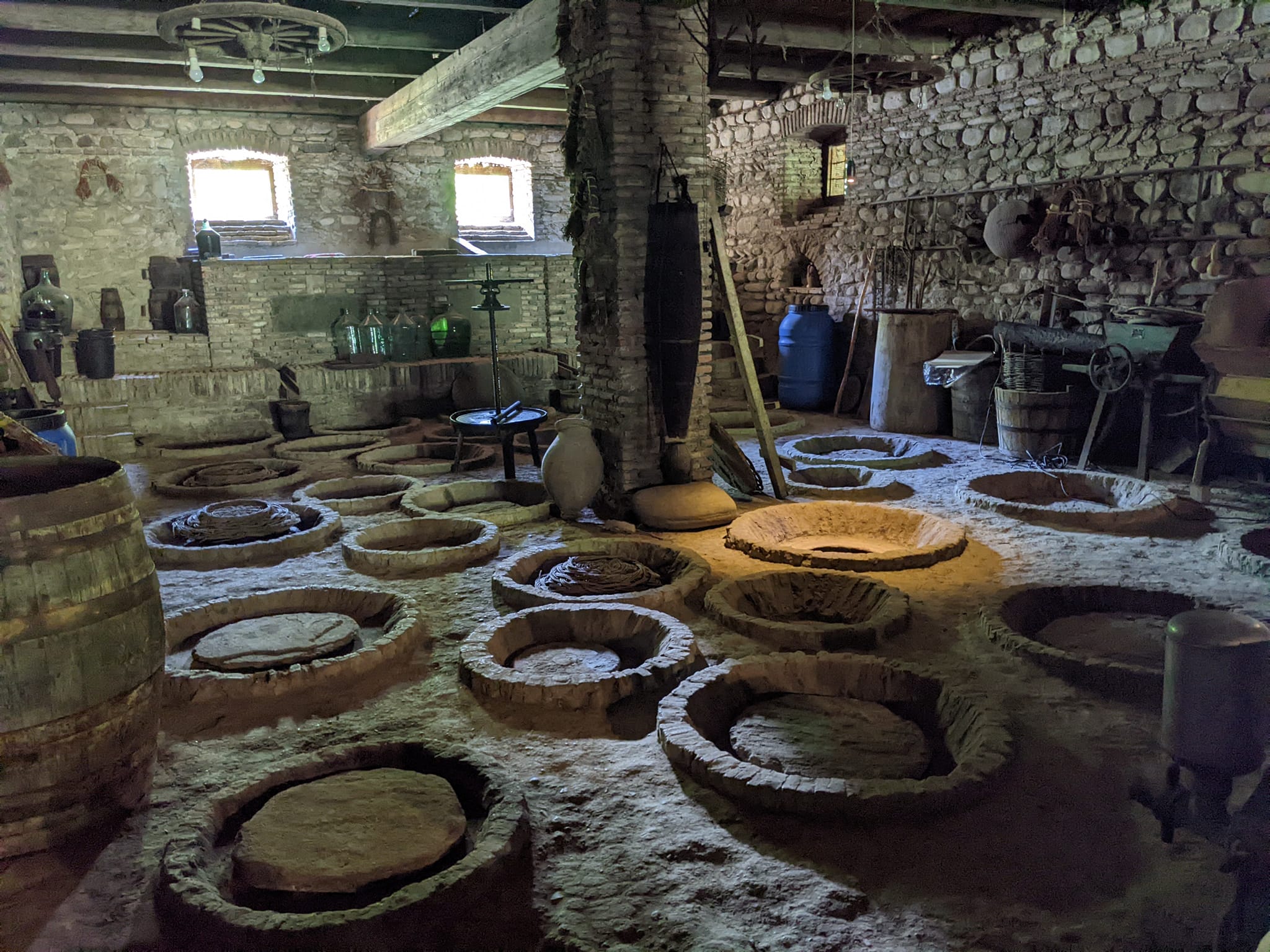
Salobie sits just outside town on the approach road and is where Tbilisi locals eat when they visit Mtskheta. The building is roughly 400 years old, with multiple dining rooms and outdoor terraces. Order at the counter upstairs, not from the waiters — this is how it works, though it confuses every visitor at first. The specialty is lobio (beans slow-cooked in clay pots) served with fresh bread. House wine arrives by the carafe. Prices remain surprisingly low for the quality.
Ornament Express, behind Svetitskhoveli, has a terrace overlooking the cathedral and serves well-executed Georgian food. The khachapuri comes straight from the oven. Their honey cake is worth saving room for.
Adacafe on the riverfront is a contemporary spot with good coffee, large windows, and a mixed Georgian-international menu. Popular with younger Georgians escaping Tbilisi for the day.
Restaurant Check-In Garden, also riverside, offers more traditional Georgian dining — generous portions, reliable quality, pleasant setting.
Shopping in Mtskheta
The pedestrian streets around Svetitskhoveli fill with vendors selling churchkhela (walnut-and-grape candy), spices, carpets, ceramics, chacha (grape brandy), wine, and assorted souvenirs.
Quality varies widely. For churchkhela, look for vendors who make it themselves rather than reselling commercial versions — the texture and flavour difference is obvious. There is a potter on the main road selling handmade ceramics from his own workshop — these are worth considering as genuine Georgian craft.
Winery Khareba, opposite the Svetitskhoveli entrance, offers tastings if you purchase a bottle. The staff explain Georgian grape varieties well, and it serves as a reasonable introduction to Georgian wine if you are not planning a separate trip to the Kakheti wine region.
Should You Stay Overnight in Mtskheta?
Most visitors treat Mtskheta as a day trip from Tbilisi, and three to four hours is enough to see the three main sites. But spending a night has genuine advantages.
After the tour buses leave in the late afternoon, the town becomes quiet. Svetitskhoveli and Jvari look entirely different in sunset or early morning light. You can eat dinner without rushing, explore at your own pace, and wake up to a town that feels like it belongs to you and the locals.
An overnight stay also makes sense logistically if you are heading north to Kazbegi the next day, avoiding the need to backtrack to Tbilisi.
Accommodation options: Guest House Ebralidze (simple, comfortable, behind Svetitskhoveli, garden setting). Hotel Bagineti (mid-range, old town location). Chateau Mukhrani (luxury historic winery, 30 minutes northwest — beautiful if you want to combine Mtskheta with wine country). Sevsamora Resort & Spa (Georgia’s first fully wheelchair-accessible hotel, near Zedazeni, with a pool).
What to Bring
- Clothing for religious sites: Shoulders must be covered. Trousers or skirts below the knee. Headscarves for women. Most monasteries lend scarves at entrances, but having your own is simpler.
- Comfortable shoes. Cobblestones and uneven surfaces everywhere, steep steps at Jvari, rough paths at the more remote monasteries.
- Water. Summer temperatures regularly exceed 35°C. Small shops exist, but a refillable bottle saves money and plastic.
- Small banknotes. Candles at churches cost 1–2 GEL. Market vendors rarely have change for 50 or 100 GEL notes.
- Sun protection. Hat, sunscreen, sunglasses — especially June through August.
Best Time to Visit Mtskheta
Mtskheta is a year-round destination, but conditions vary.
May, September, and October offer the best combination of comfortable temperatures, manageable crowds, and attractive light. October is particularly rewarding — the surrounding mountains turn to autumn colour, and the Svetitskhovloba Festival on October 14 brings religious ceremonies, cultural performances, and food markets to the town. Expect larger crowds during the festival, but it is a genuine cultural event rather than a staged one.
June through August is hot. Temperatures climb above 35°C, and the main sites are crowded between 10 AM and 4 PM. Start early, carry water, and visit on weekdays if possible.
December through February brings cold weather and occasional snow, which makes the churches and landscape look striking. Roads remain clear. Orthodox Christmas (January 7) and Easter bring special services worth attending.
April and May bring wildflowers, mild temperatures, and pleasant conditions throughout.
See also: Why Georgia is the best holiday destination from Dubai in 2026
Combining Mtskheta with Other Destinations
Only the Mtskheta tour normally takes up to half a day.
Mtskheta + Ananuri + Kazbegi. A popular route heading north along the Georgian Military Highway. Ananuri Fortress, 40 minutes from Mtskheta, is a dramatic fortified monastery on a reservoir. Continuing to Kazbegi and the Gergeti Trinity Church makes for one of Georgia’s most celebrated journeys. We offer a two-day Kazbegi tour that includes Mtskheta.
Mtskheta + Gori + Uplistsikhe. A full day of history. Gori is home to the Stalin Museum — its existence is controversial, but the museum itself is a fascinating artefact. Uplistsikhe, a rock-hewn city with cave dwellings dating to the 6th century BC, is one of Georgia’s most extraordinary ancient sites. Our Mtskheta-Gori-Uplistsikhe day tour covers the full circuit.
Both routes involve distances and logistics that are significantly easier with a driver or organised tour than by marshrutka, which requires multiple connections and tight scheduling.