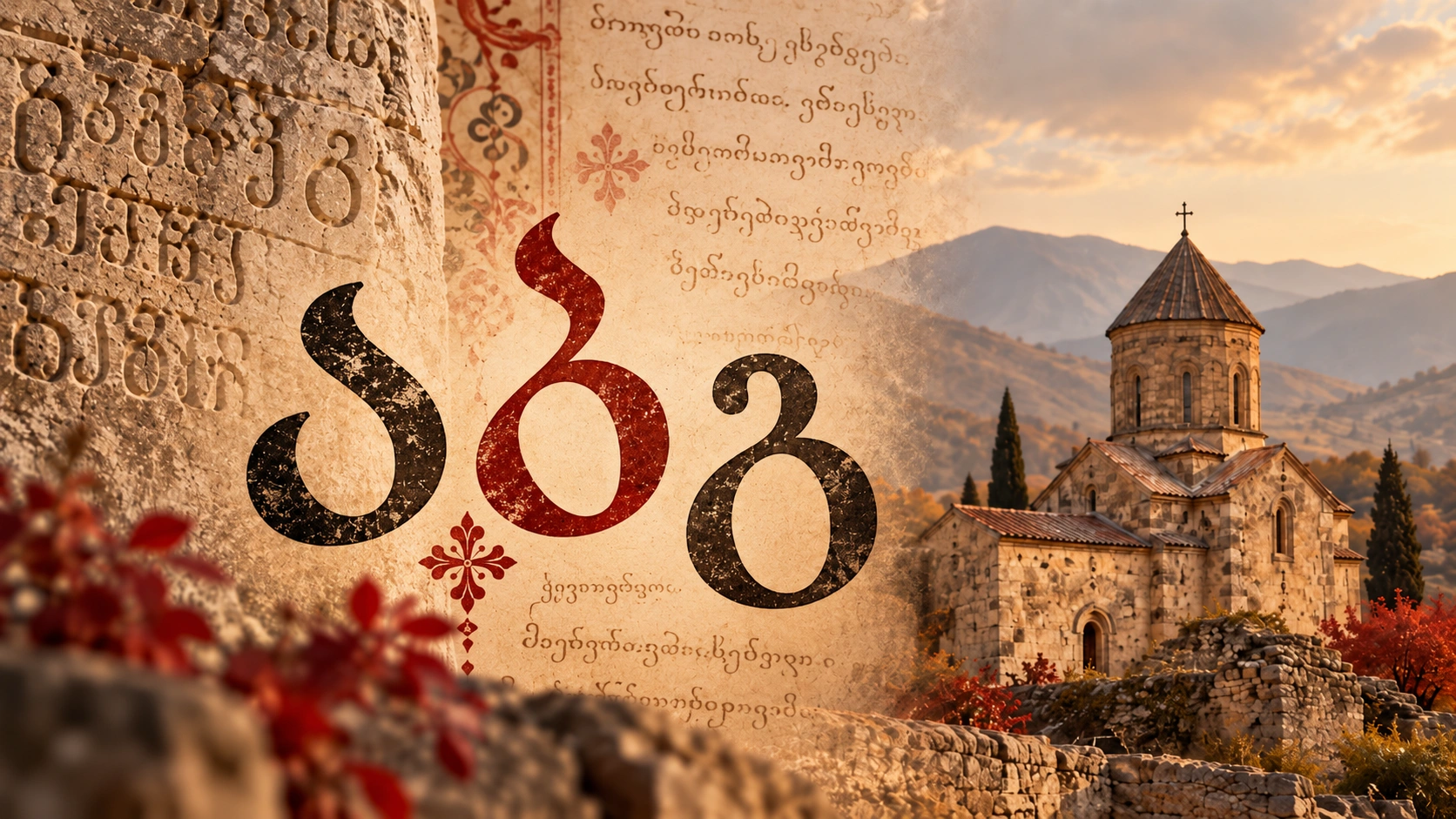
For most visitors, the first Georgian word they learn to recognise is the name of the capital: თბილისი. Then it is everywhere. On bakery windows, on bus fronts, on the menu where you are trying to work out which line means khachapuri. The letters loop and curl like something between handwriting and wrought iron, and for the first day or two they read as pure decoration.
They are not. Modern Georgian uses just 33 letters, and the link between letter and sound is close to one-to-one. Learn a handful and the city starts talking back to you.
There is a twist, too. Georgia has not one script but three, all descended from the same alphabet and all still in use. In 2016 UNESCO recognised that living tradition on its Representative List of the Intangible Cultural Heritage of Humanity. This guide explains what you are looking at, where it came from, and where in Georgia you can see its oldest surviving traces carved into stone.
The Georgian Alphabet at a Glance
The modern Georgian alphabet is called Mkhedruli. It has 33 letters, is written left to right, and has no separate upper- and lower-case letters in ordinary writing.
| Fact | Answer |
|---|---|
| Name of the modern script | Mkhedruli (მხედრული) |
| Number of letters | 33 |
| Vowels | 5 (ა a, ე e, ი i, ო o, უ u) |
| Consonants | 28 |
| Writing direction | Left to right |
| Capital letters | No case distinction in normal text; an all-caps style called Mtavruli is used for headings and signs |
| Related historical scripts | Asomtavruli (also called Mrgvlovani) and Nuskhuri |
| UNESCO recognition | 2016, as the living culture of three writing systems |
| Language | Georgian, a Kartvelian language, unrelated to Indo-European, Turkic or Semitic languages |
How many letters are in the Georgian alphabet?
The modern Georgian alphabet, Mkhedruli, has 33 letters: five vowels and 28 consonants. Older Georgian used several more letters, which were dropped in the late 19th century as pronunciation changed. That is why you will sometimes see higher totals quoted for historical forms of the alphabet.
The 33 Letters of the Modern Georgian Alphabet
English spellings are only approximations. Georgian has sounds English does not, above all the ejective consonants: k’, p’, t’, ts’, ch’ and q’ are pronounced with a short closed-throat pop and no puff of air. So ქ and კ are not the same “k”, and თ and ტ are not the same “t”. The apostrophe in the table marks the ejective; on road signs and maps it is usually left out.
| Letter | Name | Sound (approx.) | Example word |
|---|---|---|---|
| ა | ani | a as in “father” | ავტობუსი (avt’obusi) – bus |
| ბ | bani | b | ბანკი (bank’i) – bank |
| გ | gani | g as in “go” | გამარჯობა (gamarjoba) – hello |
| დ | doni | d | დიახ (diakh) – yes (polite) |
| ე | eni | e as in “bed” | ეკლესია (ek’lesia) – church |
| ვ | vini | v | ვაშლი (vashli) – apple |
| ზ | zeni | z | ზღვა (zghva) – sea |
| თ | tani | t, with a puff of air | თბილისი (Tbilisi) |
| ი | ini | i as in “machine” | ისტორია (ist’oria) – history |
| კ | k’ani | k’ (ejective) | კი (k’i) – yes (casual) |
| ლ | lasi | l | ლარი (lari) – the Georgian currency |
| მ | mani | m | მადლობა (madloba) – thank you |
| ნ | nari | n | ნახვამდის (nakhvamdis) – goodbye |
| ო | oni | o as in “or” | ოთახი (otakhi) – room |
| პ | p’ari | p’ (ejective) | პური (p’uri) – bread |
| ჟ | zhani | zh, like the s in “pleasure” | ჟურნალი (zhurnali) – magazine |
| რ | rae | r, lightly rolled | რესტორანი (rest’orani) – restaurant |
| ს | sani | s | სადგური (sadguri) – station |
| ტ | t’ari | t’ (ejective) | ტუალეტი (t’ualet’i) – toilet |
| უ | uni | u as in “rule” | უფასო (upaso) – free of charge |
| ფ | pari | p, with a puff of air | ფული (puli) – money |
| ქ | kani | k, with a puff of air | ქუჩა (kucha) – street |
| ღ | ghani | gh, a throaty sound close to French r | ღვინო (ghvino) – wine |
| ყ | q’ari | q’ (deep ejective, back of the throat) | ყავა (q’ava) – coffee |
| შ | shini | sh | შაბათი (shabati) – Saturday |
| ჩ | chini | ch, with a puff of air | ჩაი (chai) – tea |
| ც | tsani | ts, with a puff of air | ცხელი (tskheli) – hot |
| ძ | dzili | dz | ძმა (dzma) – brother |
| წ | ts’ili | ts’ (ejective) | წყალი (ts’q’ali) – water |
| ჭ | ch’ari | ch’ (ejective) | ჭაჭა (ch’ach’a) – chacha, grape spirit |
| ხ | khani | kh, as in Scottish “loch” | ხინკალი (khink’ali) – dumplings |
| ჯ | jani | j as in “jam” | ჯვარი (jvari) – cross |
| ჰ | hae | h | ჰაერი (haeri) – air |
You do not need to master the ejectives to travel. You do need to know they exist, because they explain why one place name can turn up in three different English spellings.
Why Does Georgian Writing Look So Different?
Mkhedruli looks unfamiliar because it shares almost no letter shapes with Latin, Greek or Cyrillic. Its alphabetical order follows the Greek model, but the forms themselves developed on their own.
A few features give it its character:
- Curves instead of corners. Almost every letter is built from loops and arcs. Straight vertical strokes are rare, which is why a page of Georgian looks soft even when the text is a parking regulation.
- Ascenders and descenders. Letters sit on a baseline, but many reach up (ბ, ლ) or drop below it (გ, ქ). A line of text has a rolling, uneven skyline, a little like a row of hills seen from a train window.
- No case. There is no capital letter at the start of a sentence or a name. Tbilisi and tbilisi are written the same way: თბილისი.
- Separate letters. Even in handwriting, letters are usually formed individually rather than joined into one continuous cursive line.
- Look-alikes. Several letters differ only by a small hook, a tail or an extra loop. Expect to confuse a few pairs for the first days; that is the eye calibrating, not failing.
One honest warning: Georgian street typography varies a lot. A hand-painted bakery sign can look quite different from the same word in a modern sans-serif. If a word refuses to make sense, try reading it in a different font before you give up on it.
One Language, Three Scripts – All Still in Use
Georgian has been written in three related scripts over roughly 1,500 years: Asomtavruli, Nuskhuri and Mkhedruli. They share the same alphabetical order and the same sound system, but the letter shapes are different enough that a reader of one cannot automatically read the others.
| Script | Also called | First appears | Where you see it today |
|---|---|---|---|
| Asomtavruli | Mrgvlovani (“rounded”) | 5th century inscriptions, possibly earlier | Stone inscriptions on early churches, icons, church decoration, monumental lettering |
| Nuskhuri | – | Around the 9th century | Church manuscripts and liturgical books, often combined with Asomtavruli |
| Mkhedruli | “Military” or secular script | Around the 10th century | Everything: signs, menus, books, phones, schoolbooks |
Asomtavruli (Mrgvlovani)
Asomtavruli is the oldest attested form of Georgian writing. Its letters are tall, rounded and built from circles and straight strokes, which made them well suited to carving in stone. UNESCO uses the name Mrgvlovani; most English-language sources say Asomtavruli. They are the same script.
Nuskhuri
Nuskhuri developed as a smaller, more angular hand for copying books. In church use it was often paired with Asomtavruli, which served as capital letters. That combination is called Khutsuri, the “priestly” script, and the Georgian Orthodox Church still uses it in liturgical texts.
Mkhedruli
Mkhedruli began as a secular hand used outside the church, in royal charters and everyday documents. Over the following centuries it took over almost every other role. It is the script of Georgian schools, newspapers and keyboards today, and the only one most travellers will ever need to read.
What about Mtavruli?
Mtavruli is not a fourth script. It is an all-capitals style of Mkhedruli: the same letters, redrawn at equal height. You will see it on shop fronts, book covers and headings, where it does the job that capital letters do in English. Since 2018 Mtavruli has had its own code points in Unicode, so it can now be typed as true capitals rather than as a special font.
Image suggestion: one word, for example საქართველო, shown in Asomtavruli, Nuskhuri, Mkhedruli and Mtavruli side by side.
How Old Is the Georgian Alphabet?
Nobody knows exactly when the Georgian alphabet was created. The oldest securely dated Georgian inscriptions come from the 5th century AD; everything earlier is tradition or debate.
Two old stories, neither proven
Medieval Georgian chronicles credit King Parnavaz of Kartli with creating Georgian writing in the 3rd century BC. Stories tell you more about how each tradition saw its own past than about what actually happened. No inscription or manuscript supports either one directly.
Many scholars connect the alphabet’s creation with the Christianisation of Kartli in the 4th century, when Georgian needed a script to translate scripture and liturgy. The Greek-style ordering of the letters fits that picture. Still, it remains a hypothesis.
What the evidence actually shows
| Site | Location | Approx. date | Why it matters |
|---|---|---|---|
| Bir el Qutt monastery | Near Bethlehem | 5th century (c. 430s) | Mosaic inscriptions among the oldest securely dated Georgian texts |
| Bolnisi Sioni | Kvemo Kartli, Georgia | 490s | Among the oldest dated Georgian inscriptions on Georgian soil |
| Nekresi | Kakheti, Georgia | Disputed | Some inscriptions have been proposed as earlier, but their dating is contested |
The chain of evidence is short but solid. A Georgian monastery stood in the Holy Land by the 430s, and its builders wrote in Asomtavruli. A few decades later, the same script was carved into the walls of Bolnisi Sioni, about 60 km southwest of Tbilisi.
By that point the script was clearly mature. Somebody had been writing Georgian for a while.
Letters that were also numbers
Old Georgian letters doubled as numerals, much like Greek ones did. Each letter carried a value, so a date in a medieval inscription is written as a short string of letters. If a guide reads a year off a church wall that you only see as decoration, this is how.
Is the Georgian Alphabet Difficult to Learn?
Learning to read the Georgian alphabet is much easier than learning Georgian. Most adults can sound out simple words within a few days of steady practice. Understanding them is another matter.
What makes the alphabet approachable:
- Only 33 letters, and no second set of capitals to memorise.
- Spelling follows pronunciation closely. Once you know a letter’s sound, it rarely surprises you.
- No silent letters of the kind that make English spelling a lottery.
What makes it harder:
- Ejective consonants. Hearing the difference between ქ and კ, or ჩ and ჭ, takes time. Producing it takes longer.
- Consonant clusters. Georgian happily strings consonants together. გვბრის (gvbris) and მცვრთნელი (mtsvrtneli) are real words, and they look the way a cat walking across a keyboard might type.
- The grammar. Georgian verbs are famously complex. The alphabet opens the door; it does not furnish the house.
For a trip, aim for recognition rather than fluency. Being able to spot თბილისი on a bus or ხინკალი on a menu is already a real gain.
Georgian Words You Will Actually Meet on Your Trip
The best practice material is already around you. These words appear on doors, shop fronts and menus across the country:
| Georgian | Transliteration | Meaning | Where you’ll see it |
|---|---|---|---|
| შესასვლელი | shesasvleli | Entrance | Doors of museums, metro stations, shops |
| გასასვლელი | gasasvleli | Exit | Same places, other door |
| ღიაა | ghiaa | Open | Shop doors and opening-hours signs |
| დახურულია | dakhurulia | Closed | The same sign, flipped |
| აფთიაქი | aptiaki | Pharmacy | Street signs; very common in Tbilisi |
| ღვინო | ghvino | Wine | Menus, cellar doors, wine bars |
| ხინკალი | khink’ali | Dumplings | Menus and restaurant signs |
| ხაჭაპური | khach’ap’uri | Cheese bread | Bakery windows and menus |
Two tips make these easier to spot. First, look at the start of the word: შესასვლელი and გასასვლელი share their whole ending and differ only in the first two letters. Second, read menus slowly the first time. Decoding ხაჭაპური letter by letter, then finding it on the table ten minutes later, is a small but genuine pleasure.
A Living Tradition: UNESCO and Georgian Script Today
In 2016 UNESCO inscribed the Living culture of three writing systems of the Georgian alphabet on its Representative List of the Intangible Cultural Heritage of Humanity. The wording matters. UNESCO did not list “the Georgian alphabet” as a monument, and it is not a World Heritage Site. What it recognised is a practice: three scripts that are still written, taught and passed on, each with its own role.
That role split is easy to see once you know to look for it:
- In churches, Asomtavruli and Nuskhuri appear on icons, frescoes and in liturgical books, where the old forms carry a sense of continuity.
- In schools and everyday life, Mkhedruli does all the work. Children learn it first, and it is the script of every keyboard and phone.
- In design and craft, calligraphers, jewellers and typographers borrow letter forms from all three. Asomtavruli letters turn up on silver pendants, posters and modern logos.
- In archives and libraries, manuscripts written over many centuries preserve all three systems side by side.
Georgians take this heritage personally. 14 April is celebrated as the Day of the Georgian Language, marking the 1978 demonstrations in Tbilisi that defended Georgian’s status as the official language of Soviet Georgia. For many families, the alphabet is less a school subject than a symbol of survival.
Where to See Historic Georgian Writing in Georgia
A chart shows you the letters. A church wall shows you what they meant to the people who carved them. These are the places where the history of the script becomes something you can stand in front of.
Bolnisi Sioni: the oldest dated inscriptions on Georgian soil
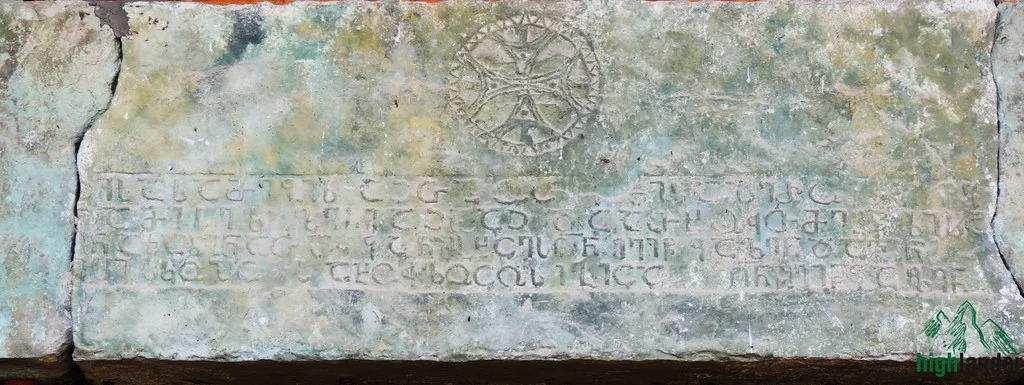
Bolnisi Sioni, in Kvemo Kartli about an hour’s drive from Tbilisi, is the single most important stop for anyone interested in the alphabet. The basilica was built between 478 and 493, and its Asomtavruli building inscriptions from the 490s are among the oldest dated Georgian texts preserved in Georgia itself.
The church is not large, and the inscriptions do not announce themselves. Many visitors walk past them assuming the carved bands are ornament. Then someone points out that the “ornament” has an alphabet, and that it is the ancestor of the letters on the bakery sign in the village outside. The fifteen centuries between the two suddenly feel very short.
For the full story of the church, its architecture and what to look for on the walls, read our guide to Bolnisi Sioni. Bolnisi pairs naturally with the early-human site at Dmanisi, and our Dmanisi and Bolnisi day tour combines both.
More places to look
- Jvari Monastery, Mtskheta. The 6th–7th century church above the confluence of two rivers carries Asomtavruli inscriptions on its exterior walls. Look up at the facade reliefs: the letters sit beside the carved figures they name.
- Ateni Sioni, near Gori. Best known for its frescoes, this 7th-century church also preserves inscriptions from several periods, including early examples of Mkhedruli.
- Svaneti Museum of History and Ethnography, Mestia. Its collection includes illuminated manuscripts and icons with inscriptions, kept for centuries in the region’s churches and towers.
- National Centre of Manuscripts, Tbilisi. Georgia’s main repository of historical manuscripts, holding texts in all three scripts. Check in advance whether an exhibition is open during your visit.
- Any Tbilisi street. The living end of the story. Spot Mtavruli on shop signs, Mkhedruli on the metro map and, in the occasional jewellery window, Asomtavruli letters worn as pendants.
Georgian Alphabet FAQ
How many letters are in the Georgian alphabet?
The modern Georgian alphabet, Mkhedruli, has 33 letters: 5 vowels and 28 consonants. Older forms of the alphabet included several additional letters that fell out of use and were removed in the late 19th century.
What is the Georgian alphabet called?
The modern script is called Mkhedruli. The two older Georgian scripts are Asomtavruli (also known as Mrgvlovani) and Nuskhuri.
Why does Georgian have three alphabets?
Georgian writing developed in stages. Asomtavruli came first, Nuskhuri grew out of book copying, and Mkhedruli developed as a secular hand that eventually became the everyday script. All three survive because each kept a role, mainly in church, scholarship and design.
Does Georgian have capital letters?
Not in the English sense. Sentences and names do not start with a capital. However, Mtavruli, an all-caps style of Mkhedruli, is used for headings, signs and emphasis, and has had its own Unicode characters since 2018.
Is Georgian written in Cyrillic?
No. Georgian has its own script and has never been written in Cyrillic for everyday use. Russian is still understood by many older Georgians, which is perhaps why the question comes up so often.
Is the Georgian alphabet protected by UNESCO?
UNESCO did not list the alphabet itself. In 2016 it inscribed the “living culture of three writing systems of the Georgian alphabet” as Intangible Cultural Heritage, recognising how the three scripts are still used and passed on.
Is Georgian hard to read?
Reading the letters is quite achievable; many visitors can sound out signs after a few days. Understanding the language is much harder, because of its sounds and its grammar.