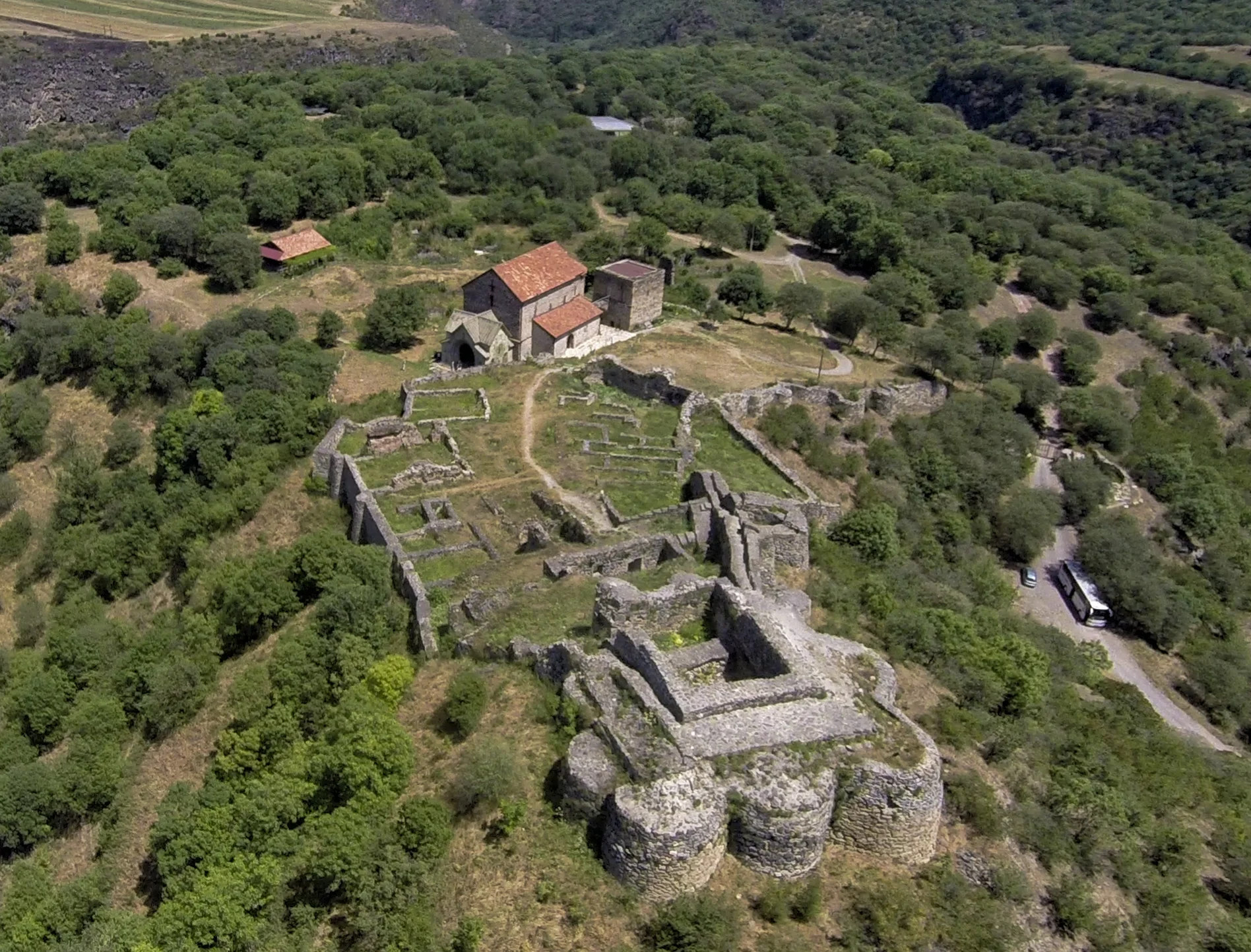
At the Dmanisi archaeological site in southern Georgia, Early Pleistocene deposits containing some of the oldest well-dated hominin fossils outside Africa lie beneath the remains of a medieval trading city. Few places bring such distant periods together so clearly: approximately 1.8-million-year-old fossils, simple stone tools, city walls, churches, bathhouses and cemeteries occupy the same promontory.
Dmanisi changed scientific discussion about the first dispersals of the genus Homo into Eurasia. The fossils showed that early hominins with relatively small bodies, small brains and Oldowan-type tools could travel far beyond Africa. The medieval ruins above them tell a separate story of trade and religious diversity at a strategic Caucasian crossroads.
Dmanisi at a Glance
| Location | Kvemo Kartli, approximately 90 km southwest of Tbilisi |
|---|---|
| Oldest deposits | Approximately 1.85–1.77 million years old |
| Key finds | Five skulls, mandibles, teeth, postcranial bones, stone tools and animal fossils |
| Common classification | Early Homo, often attributed to early Homo erectus; taxonomy remains debated |
| Medieval remains | Fortifications, Dmanisi Sioni, streets, dwellings, bathhouses, workshops and cemeteries |
| Visiting season | The museum operates seasonally; verify current dates and hours before travelling |
Why the Dmanisi Fossils Matter
Before the Dmanisi discoveries, many models associated the first successful movement out of Africa with larger bodies, larger brains and Acheulean handaxes. Dmanisi complicated that picture. Its hominins had cranial capacities from roughly 546 to 775 cubic centimetres and used comparatively simple core-and-flake tools.
The fossils and tools come from deposits dating to around 1.8 million years ago. This makes Dmanisi one of the most important sites for studying the early expansion of Homo into Eurasia. It does not answer every question about the route, behaviour or taxonomy of these hominins, but it establishes that dispersal occurred earlier and with different biological characteristics than many researchers once expected.
How the Prehistoric Site Was Discovered
Archaeologists initially investigated Dmanisi for its medieval remains. In the 1980s, animal fossils and stone tools began appearing in sediment exposed by medieval pits and cellars. A hominin mandible discovered in 1991 revealed that the lower deposits contained evidence far older than the city above.
Further work produced five famous skulls, additional jaws and teeth, more than one hundred postcranial remains, thousands of stone artefacts and a large collection of animal fossils. The unusual preservation and concentration of material allow researchers to compare individuals from one locality and a relatively narrow geological interval.
The Five Dmanisi Skulls
| Skull | Specimen | Approx. cranial capacity | Why it matters |
|---|---|---|---|
| Skull 1 | D2280 | 775 cc | Adult skullcap with features commonly compared with early Homo erectus |
| Skull 2 | D2282 | 650 cc | Gracile individual associated with the D211 mandible found in 1991 |
| Skull 3 | D2700 | 600 cc | Well-preserved subadult individual |
| Skull 4 | D3444 | 625 cc | Older, almost toothless individual who survived after extensive tooth loss |
| Skull 5 | D4500 | 546 cc | Complete adult cranium and face with an unusually small braincase and robust, projecting face |
The skulls differ substantially in size and shape. Their variation has become central to debates about how many early Homo species should be recognised. However, the fossils do not prove that the five individuals formed a family, lived together or died at exactly the same moment; the geological interval is narrow on an evolutionary scale but may still span many generations.
The Toothless Individual: Evidence of Care?
Skull 4 and its associated mandible belonged to an older individual who had lost all but one tooth before death. Remodelling of the empty sockets shows that survival continued after the teeth were lost. Researchers have proposed that other group members may have helped by sharing soft food or processing tougher food.
That is a plausible and important interpretation, but it is not the only possible explanation. Toothless primates can sometimes survive without direct assistance. Dmanisi therefore provides evidence consistent with social support, not definitive proof of the first act of compassion.
Why Skull 5 Changed the Debate
Skull 5 combines a complete, robust face with the smallest braincase in the Dmanisi sample. A 2013 study argued that the variation among the five skulls could fit within one evolving lineage and questioned whether several named African forms deserved separate species status.
The proposal remains debated. Skull 5 did not settle early human taxonomy, but it demonstrated how misleading fragmentary fossils can be when the face and braincase are not preserved together.
What Species Were the Dmanisi Hominins?
There is no single classification accepted by every researcher. The fossils are frequently described as early Homo erectus or an early Eurasian population related to African Homo ergaster. The name Homo georgicus was proposed for some of the material, while other authors prefer broader or more cautious terminology.
For visitors, the safest description is early Homo from Dmanisi. The uncertainty is not a weakness of the site; it is one reason Dmanisi remains so scientifically valuable.
Life at Dmanisi 1.8 Million Years Ago
The Early Pleistocene environment around Dmanisi combined woodland, open grassland and river or lakeside habitats. Fossil animals include large herbivores and predators, while the stone assemblage belongs to a simple core-and-flake tradition often compared with the African Oldowan.
Researchers continue to debate how the hominins acquired food, how often they occupied the site and which route brought their ancestors from Africa. Scavenging, hunting and plant gathering are all discussed, but the evidence does not justify a detailed reconstruction of daily behaviour. Claims that the group routinely drove predators from kills should be treated as hypotheses rather than established fact.
The Medieval City Above the Fossils
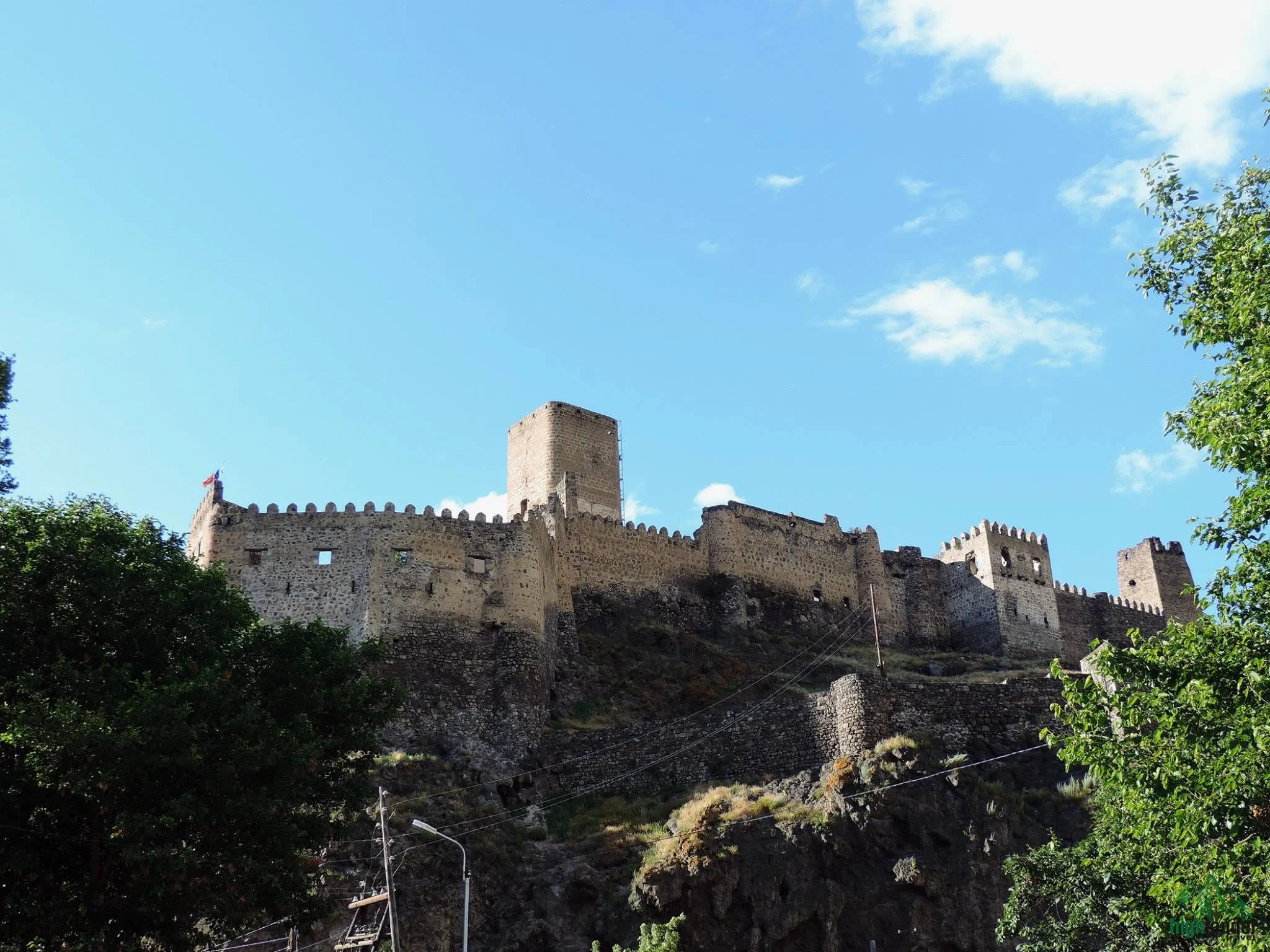
Dmanisi later developed into an important medieval town on routes connecting Tbilisi with Armenia, Iran and territories toward the Black and Caspian seas. It grew under changing political authorities and became a commercial centre known through written sources, coins and imported ceramics.
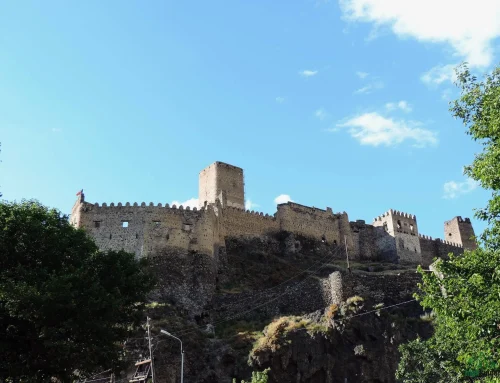
- A citadel and fortified town walls
- Paved streets, dwellings and craft workshops
- Bathhouses and water-management structures
- Christian churches and Georgian and Armenian inscriptions
- Muslim religious remains and an extensive cemetery with Arabic inscriptions
- Wine cellars, pottery, metalwork, glass and imported goods
- A long tunnel descending toward the Mashavera River
The size of the Muslim cemetery, together with Christian monuments and inscriptions, reflects a diverse urban population. Dmanisi suffered heavily during invasions at the end of the 14th century and declined further after later attacks, never regaining its earlier commercial importance.
Dmanisi Sioni
Dmanisi Sioni stands near the centre of the ruined town. Its earliest construction date is debated: traditional scholarship places the basilica in the 6th–7th century, while some specialists favour a 9th-century date. The richly carved narthex was added during the reign of Giorgi IV Lasha in the early 13th century.
Archaeological Research and Orozmani
Systematic work at Dmanisi has involved the Georgian National Museum and international research partners for decades. The Dmanisi Hominid Archaeological Site has been on Georgia’s UNESCO World Heritage Tentative List since 2007, but it is not currently an inscribed World Heritage Site.
Research on early hominin dispersal continues beyond Dmanisi. At nearby Orozmani, archaeologists found a hominin tooth in 2022 and announced a roughly 1.8-million-year-old mandible in 2025, together with stone artefacts and animal fossils. These discoveries indicate that Dmanisi was part of a wider Early Pleistocene landscape rather than an isolated point of occupation.
What You Can See at Dmanisi
Prehistoric Excavation Area
The protected excavation area reveals the sedimentary context in which hominin fossils, animal remains and stone tools were recovered. Interpretation at the site helps visitors understand the sequence beneath the medieval pits and buildings. Active excavation areas may be restricted for safety and research.
Museum Exhibition
The seasonal exhibition introduces the prehistoric and medieval discoveries through fossil casts, stone tools, animal remains and archaeological objects. The original hominin material is conserved by the Georgian National Museum. Before travelling specifically to see an original specimen in Tbilisi, confirm which fossils are currently on public display.
Citadel, Streets and Town Ruins
Visitors can walk through sections of the medieval town, see defensive structures and trace the outlines of houses, workshops and public buildings. The ground is uneven, and access to the river tunnel or excavation zones may be limited depending on conditions.
How to Visit Dmanisi
| Distance from Tbilisi | Approximately 90 km southwest |
|---|---|
| Driving time | Allow roughly 1.5–2 hours each way, depending on traffic and stops |
| Time at the site | Approximately 2–3 hours for the museum, excavation area and medieval ruins |
| Best transport | Private car, driver or organised day tour |
| Season | The museum is generally seasonal; check current opening dates before departure |
| Terrain | Uneven outdoor paths with limited shade |
A private vehicle is the most practical option. Public transport may reach the modern municipality, but it does not provide a simple visitor route to the archaeological complex and nearby monuments. Our Dmanisi and Bolnisi tour from Tbilisi combines the site with important monuments elsewhere in Kvemo Kartli.
What to Bring
- Sturdy, closed walking shoes
- Water, sun protection and a hat
- A light layer for wind or changing weather
- Modest clothing if entering the active church
- Cash for small local expenses
- Any medication or snacks you may need during a full-day journey
What to Combine with Dmanisi
Bolnisi Sioni
Bolnisi Sioni is one of Georgia’s oldest surviving churches, built in the late 5th century. Its early Georgian inscriptions are essential evidence for the history of the Georgian script. It is the most natural companion stop on a Dmanisi day trip.
Tsughrughasheni Church
Near Bolnisi, the 13th-century Tsughrughasheni Church offers a strong contrast to the austere early basilica. Its tall proportions and finely carved stonework represent the mature medieval Georgian architectural tradition.
The Georgian National Museum in Tbilisi
The Simon Janashia Museum of Georgia on Rustaveli Avenue provides valuable context for Dmanisi and Georgia’s wider archaeology. Exhibition displays can change, so check current information if a particular fossil is the main reason for your visit.
Why Dmanisi Deserves a Full Day
Dmanisi is not visually monumental in the way of Vardzia or a large medieval fortress. Its importance comes from context. The prehistoric deposits demonstrate how early hominins reached Eurasia, while the town above shows how the same strategic landscape later supported trade, religion and urban life.
Allowing time for both stories makes the visit worthwhile. Combine the site with Bolnisi and Tsughrughasheni, travel with someone who can explain the archaeology clearly, and confirm seasonal access before leaving Tbilisi.