In 1991 a team was digging up a medieval Georgian town — grain pits, house walls, the ordinary business of an eleventh-century trading city — when someone came up with a jaw that did not belong to anybody medieval. It was eventually dated to 1.8 million years.
That single find rearranged the field. Until then, the accepted story had early humans leaving Africa somewhere around a million years ago, with a large brain and sophisticated tools, essentially ready for the journey. The people at Dmanisi did it nearly twice as early, with brains around half the size of ours and a simple chipped-stone toolkit. They were not equipped for the trip by anybody’s model. They went anyway.
Five individuals have since been found on the promontory: an adolescent, a heavy-browed adult male, a small female, an old man, and — excavated in 2005 and published in 2013 — the most complete adult skull of its age ever recovered anywhere. That last one set off an argument that is still running, because it looks so different from the other four that its finders suggested all the early Homo species we have named might really be one variable species. Not every palaeoanthropologist agrees. That is rather the point: this is a live scientific question, not a settled display case.
The old man is the one people remember. He had lost all but one of his teeth years before he died, and the bone had reabsorbed where the sockets used to be — meaning he lived a long time in that state, in a landscape with sabre-toothed cats in it, unable to chew. Somebody was helping him. It is arguably the oldest evidence we have of one human looking after another.
Around the excavation stands the medieval town that was being dug when the jaw appeared, along with a sixth-century basilica and a fortress with a tunnel to the river. And on the way there, in the same valley, you stop at the oldest church still standing in Georgia — built in the 490s, carrying the earliest known inscriptions in the Georgian alphabet, and carved with the cross that eventually ended up on the national flag.
One honest thing. An excavation is not a spectacle. What you look at is a trench with markers where the skulls came out, and a small modern museum with casts. If you want scale and drama, take the Kazbegi tour. If the idea that the ground you are standing on was walked by someone 1.8 million years ago does something to you, this is the best day out in Georgia and nothing else is close.
What you’ll see
Tour highlights
- The oldest human presence outside Africa — 1.8 million years, on a promontory above the meeting of two rivers. Nothing else on the continent comes close, and the site is still being excavated every summer.
- The Dmanisi five — an adolescent, a robust male, a small female, the toothless elder, and the most complete adult skull of its antiquity ever found. Markers on the ground show where each came out.
- The toothless skull — an old man who survived years without the ability to chew, in a landscape with sabre-toothed cats. Widely read as the oldest evidence of one human caring for another.
- An argument that is still going — the 2013 publication of Skull 5 suggested the early Homo species might all be one. Plenty of specialists disagree. Your guide can lay out both sides.
- A medieval town on top of it — the eleventh-century trading city that was being excavated when the first jaw appeared, with a fortress and a tunnel cut down to the river.
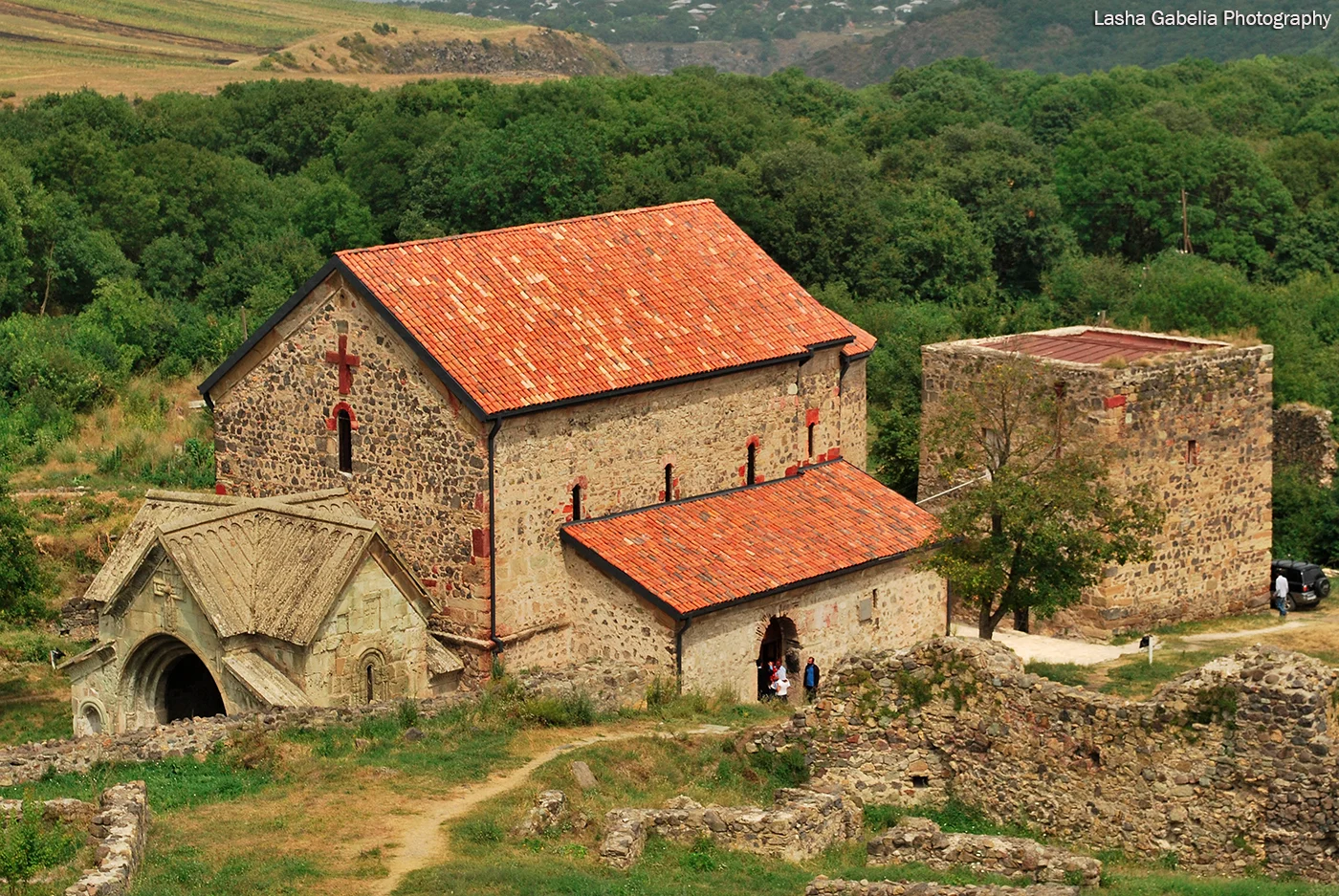
- Bolnisi Sioni, built 478–493 — the oldest church still standing in Georgia, carrying the earliest surviving inscriptions in the Georgian alphabet.
- The cross on the flag — the Bolnisi cross carved into that church is the ancestor of the cross Georgia flies today. It is on the wall, and you can put your hand on it.
- Tsugrugasheni and Kveshi — a thirteenth-century church covered in carved stone, and a fortress on a rock with the whole valley below it.
Step by step
Tour itinerary
Nine to ten hours door to door, about 170 kilometres. The tour runs from May to October, when the open-air site and museum are open.
08:30 — Pickup in Tbilisi
Collected from your hotel or apartment. The road runs southwest into Kvemo Kartli, a region most visitors drive past on the way to Armenia — mixed Georgian, Azerbaijani and Armenian villages, and a valley that has been a trade corridor for as long as there have been trade corridors.
10:00 — Bolnisi Sioni
Thirty to forty minutes. A three-nave basilica finished in 493, which makes it the oldest church building still standing in the country. The inscriptions on it are the earliest surviving writing in the Georgian alphabet, and the carved cross beside the entrance is the original of the one on the flag. It is a plain, heavy, early building and it does not look like anything else in Georgia — Georgian church architecture had not been invented yet when this went up.
10:45 — Tsugrugasheni
Twenty-five to thirty-five minutes, and a jump of seven hundred years. Built in the 1210s, it is covered in carved ornament — interlace, foliage, animals, crosses — cut with the confidence of masons at the top of their trade. Standing here after Bolnisi is the fastest way to understand what happened to Georgian architecture in between.
11:30 — Kveshi Fortress
Twenty to thirty minutes. A defensive site on a rock spur, with walls from roughly the seventh to ninth centuries and a view over the valley that explains exactly why somebody built here.
12:30 — Lunch
An hour at a local restaurant. Kvemo Kartli cooking borrows from all three of its communities, so expect things you will not have eaten in Tbilisi.
13:30 — Dmanisi
Two and a half to three hours, and the reason you came. You start in the museum, which is small, modern, and does its job well: casts of all five skulls, the fossil fauna they were found alongside — sabre-toothed cat, giraffe, ostrich, an assemblage that reads more African than Caucasian — and the stone tools, which are startlingly simple.
Then you walk out onto the site itself: the excavation trenches with markers where each skull came out, the medieval town built on top of it, the sixth-century Dmanisi Sioni basilica, and the fortress with its tunnel cut down to the river. If you visit during the summer dig you may see the team working. Give the museum the time it deserves before you go outside — the site makes far more sense afterwards.
16:30 — Return to Tbilisi
About ninety minutes, arriving between 18:00 and 18:30.
Starting from
€145
per person
Locally operated since 2011
We reply within 24 hours
What your price covers
What’s included
Included
- Private air-conditioned vehicle for your group only
- A guide with a background in archaeology or anthropology — this tour is not run by a general city guide
- Hotel or apartment pickup and drop-off in central Tbilisi
- All entrance fees — museum, archaeological site, churches and fortress
- Fuel, parking and road costs
- Bottled water in the car
- All taxes and booking fees
Not included
- Lunch — around 25–45 GEL per person
- Travel insurance
- Tips for your guide
- Personal expenses and souvenirs
Photographs
Gallery
Where you’ll go
Map & route
Tbilisi
Bolnisi Sioni Cathedral
Dmanisi Archaeological Site
Practical details
Good to know before you go
May to October only
Dmanisi is an open-air excavation with a museum attached, and it closes for the winter — roughly November to April — because of cold, snow and the need to protect the trenches. We do not sell this tour outside the open season. Confirm your date with us when you book at the very start or the very end of the season; opening depends on the weather that year, not the calendar.
What you will and will not see
- Casts, not the original skulls. The originals are curated by the Georgian National Museum in Tbilisi. The casts at Dmanisi are excellent and the site is where they were found, which is the part that matters — but if you want to stand in front of the actual fossils, add the National Museum on Rustaveli to your Tbilisi days. We are happy to arrange it.
- An excavation, not a reconstruction. No dioramas of hairy people around a fire. Trenches, markers, layers, and a guide who can read them for you.
- Archaeologists at work, if you come during the summer dig. Ask us when you book and we will tell you what is planned.
Who this tour is for
People who read about this sort of thing for pleasure. Anyone who followed the Skull 5 argument when it broke. Families with teenagers who are interested — this is a real scientific site, not a children’s attraction, and the ones who are into it get a great deal out of it. Also, quietly, a lot of doctors, biologists and teachers.
It is not for people who want landscape and photographs. Kvemo Kartli is pleasant rather than spectacular and the site is a trench in the ground. We would rather say that here than have you find out at 14:00.
Physical demands
Easy to moderate. Perhaps two kilometres of walking on uneven ground, with steps at the fortresses and an optional descent into the Dmanisi tunnel — steep, dark and skippable. Nothing here is strenuous. Wear shoes with grip.
Dress code
Bolnisi Sioni, Tsugrugasheni and Dmanisi Sioni are churches. Shoulders and knees covered; women need a skirt and a headscarf. Coverings are not reliably available at these smaller churches, so bring your own.
What to bring
- Sun protection. The site is exposed, and Kvemo Kartli is hot in July and August.
- Shoes with grip for the trenches and the fortress steps.
- A scarf or wrap for the churches.
- Cash in lari for lunch.
- Your curiosity, out loud. This is the one tour on our list where asking difficult questions improves the day for everybody, guide included.
Reading, if you want to arrive prepared
The 2013 paper describing Skull 5 was published in Science and the coverage of it at the time is easy to find and readable. Ten minutes with any decent summary of the “one species or several” debate will double what you get out of the museum. You do not need it — your guide will cover the ground — but people who do it always enjoy the day more.
Booking
Book at least 48 hours ahead so we can confirm a specialist guide — there are not many of them and they are not always free. Free cancellation up to 24 hours before departure.
From our travellers
Reviews
Before you book
Frequently asked questions
Why is Dmanisi important?
It holds the oldest evidence of humans anywhere outside Africa — around 1.8 million years — which is roughly twice as early as the accepted date before the site was excavated. The individuals found there had brains about half the size of ours and very simple stone tools, which forced a rethink of what a hominin needed in order to leave Africa at all.
Are the original fossils on display at Dmanisi?
No. The originals are curated by the Georgian National Museum in Tbilisi; what you see at Dmanisi are casts, alongside the excavation itself, the fossil animal remains and the stone tools. If seeing the actual skulls matters to you, visit the National Museum on Rustaveli while you are in Tbilisi — we can help you arrange it.
Do I need any scientific background?
None at all. Your guide has one, which is the point of running this tour with a specialist rather than a general guide. Come with questions; the more you ask, the better the day gets.
What is Homo erectus georgicus?
The name given to the Dmanisi hominins, treating them as a regional variety of Homo erectus. Some researchers prefer Homo georgicus as a separate species, and after the 2013 publication of the fifth skull others argued the opposite — that the early Homo species we have named may all be one variable species. The naming is genuinely unsettled, and your guide will explain why.
How complete are the skulls?
Unusually. Skull 5, excavated in 2005, is the most complete adult hominin cranium of that age recovered anywhere in the world — it has its face and its lower jaw, which almost never survive together. That completeness is what made it scientifically explosive.
Can I see archaeologists working?
Sometimes. Excavation runs during the summer. Ask us when you book and we will tell you what is planned for your dates, though fieldwork schedules move.
When is the tour available?
May to October. The open-air site and museum close for the winter to protect the excavation. Dates at the very start and end of the season depend on the weather, so confirm with us.
Is it suitable for children?
From around ten, and it depends entirely on the child. This is a working scientific site rather than an attraction — a teenager who likes this subject will have a memorable day, and one who does not will find it long. The tunnel at the fortress is usually the deciding factor.
How much walking is there?
Around two kilometres over the day, on uneven ground, with steps at the fortresses. Easy to moderate. The tunnel descent is optional.
Why do the churches matter?
Bolnisi Sioni, finished in 493, is the oldest church still standing in Georgia and carries the earliest surviving inscriptions in the Georgian alphabet — including the carved cross the national flag descends from. Tsugrugasheni, from the 1210s, shows what Georgian masons were doing seven centuries later. Seeing them in the same morning is the clearest architecture lesson in the country.
Ready when you are
Tell us your dates and how many of you are travelling. We’ll come back within 24 hours with availability, a confirmed price, and your guide’s name.