Ateni Sioni church
A 7th-century church that preserves some of the finest frescoes in Georgia—and the oldest known examples of two Georgian scripts still in use today.
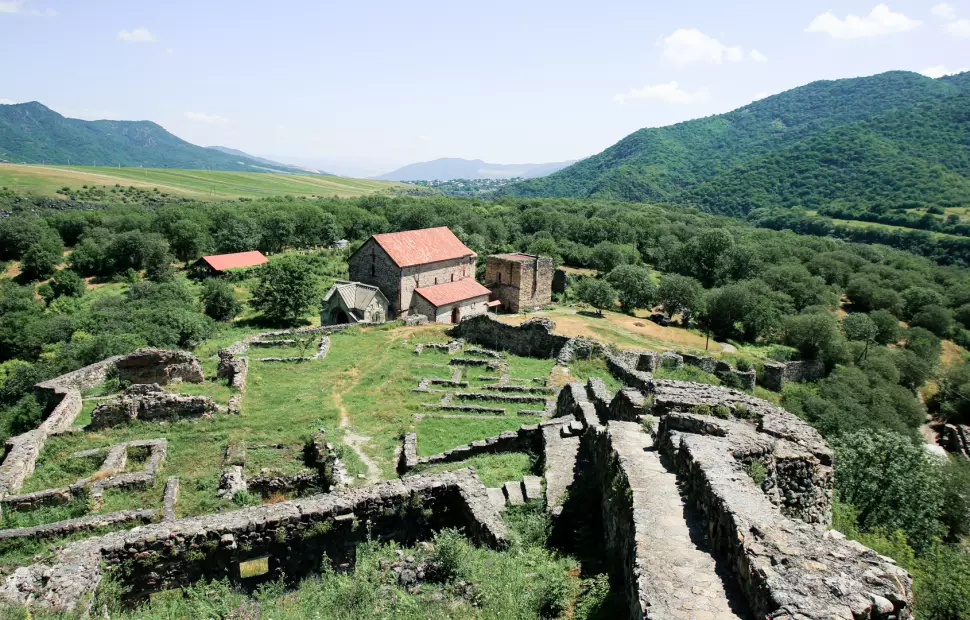
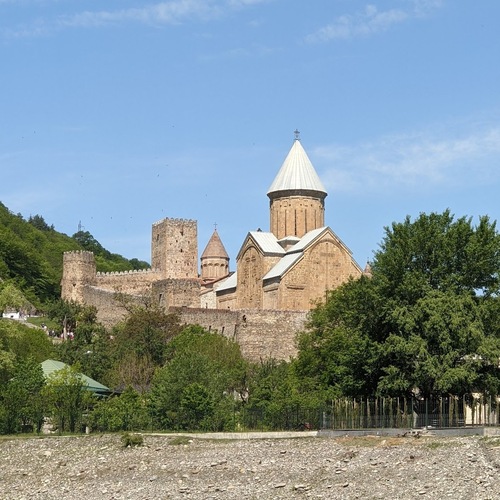
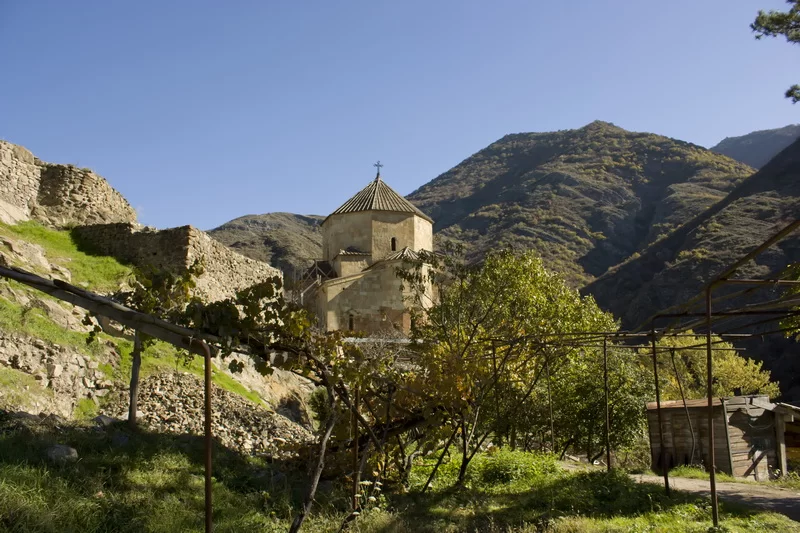
Twelve kilometers south of Gori, in a peaceful gorge carved by the Tana River, stands one of Georgia’s most important medieval monuments. Ateni Sioni Church doesn’t appear on most tourist itineraries, overshadowed by the famous sites of Mtskheta just 60 kilometers away. Yet for scholars of Georgian art and history, this early 7th-century church holds treasures that few other sites can match: magnificent 11th-century frescoes, a remarkable collection of historical inscriptions, and the earliest known examples of both Nuskhuri and Mkhedruli—the scripts that gave rise to modern Georgian writing.
The name “Sioni” comes from Mount Zion in Jerusalem, following a medieval Georgian tradition of naming churches after holy places in the Holy Land. The Ateni Sioni is one of several “Sioni” churches in Georgia, but it stands alone in the completeness of its artistic heritage.
The Architecture: A Jvari-Type Tetraconch
Ateni Sioni belongs to a distinctive group of churches that art historians call the “Jvari type,” after the famous Jvari Monastery overlooking Mtskheta. Built shortly after Jvari—which dates to the 580s–600s AD—Ateni Sioni follows the same architectural plan: a tetraconch design, meaning a church with four apses arranged in a cross pattern around a central domed space.
What makes the Jvari-type churches special is their addition of four niches between the four apses. These three-quarter cylindrical niches open into the central space, creating an interior that feels larger and more complex than the relatively compact exterior suggests. The result is a harmonious blend of Georgian and broader Caucasian architectural traditions.
Exterior Design
The church’s cruciform interior measures approximately 24 by 19 meters. The facades are faced with carved rectangular blocks of greenish-gray sandstone—a local stone that gradually takes on reddish tones as it ages. At the corners of the roof, small decorative elements depict sheep’s heads and miniature church domes.
The eastern facade is particularly rich in ornamental carving. Here you’ll find the famous relief of deer drinking from a spring—a Christian symbol representing souls thirsting for salvation, inspired by Psalm 42: “As the deer pants for streams of water, so my soul pants for you, my God.” This carving predates the other exterior reliefs and represents the earliest decorative phase of the church.
Other reliefs added during later renovations include hunting scenes, images of saints, and portrait reliefs of patrons. The beaded and decorated semi-columns framing the windows demonstrate the sophisticated stone-carving traditions of medieval Georgia.
The Dome
The dome rises on a complex system of tromps (squinches)—architectural elements that allow a circular dome to sit atop a square base. Ateni Sioni’s dome rests on three rows of tromps: the lowest is eight-faceted, the middle sixteen-faceted, and the upper thirty-two-faceted. This elegant transition from square to circle was a hallmark of Caucasian architecture during this period.
The Question of Todosak
An undated Armenian inscription on the southern facade reads: “I, Todosak, the builder of this holy church.” Who was Todosak? Scholars debate whether he was the original architect of the 7th-century church or a renovator who worked on the building during a documented reconstruction in the late 10th century.
Georgian academician Giorgi Chubinashvili believed Todosak was the original architect, working around 630 AD. Others argue the inscription refers to renovations. During the late 10th century, the local Bagvashi clan (also known as Liparitids) controlled the Ateni gorge. Around the 960s–970s, the eristavi (duke) Rati Bagvashi made alterations to the church, including replacing some Georgian reliefs with Armenian ones. Some historians attribute Todosak’s work to this period.
What is certain is that Ateni Sioni bears the marks of multiple construction phases, with the original 7th-century structure receiving significant additions and modifications in the centuries that followed.
The Frescoes: Masterpieces of the Georgian Golden Age
When the church was first built in the 7th century, the architects did not plan for frescoes—the interior walls were left bare stone. It wasn’t until the second half of the 11th century that the walls were painted, creating what are now considered among the finest examples of medieval Georgian monumental art.
Some sources date the frescoes more precisely to around 1093–1094, commissioned by King David IV (David the Builder) after he gained control of the Ateni gorge from the Liparitid family. This would place the frescoes at the very beginning of Georgia’s Golden Age—the period of cultural and political flowering that David initiated.
The Artists and Their Style
Art historians believe the frescoes were painted by a group of at least four artists working together to create a harmonious composition. Each apse contains its own iconographic cycle, yet the overall effect is unified and coherent.
The painting style reflects traditional Georgian iconography while incorporating Byzantine influences. The figures are dynamic and expressive, with careful attention to the folds of clothing that suggest movement. The color palette emphasizes light tones—blue, gray, purple—giving the frescoes an ethereal quality even in the dim interior light.
What the Frescoes Depict
The church is dedicated to the Dormition (Assumption) of the Virgin Mary, and the frescoes reflect this dedication. The Virgin Mary appears as a central figure throughout, with many scenes depicting events from her early life—a relatively unusual emphasis in Georgian church decoration.
The western apse contains particularly important images: portraits of the kings and nobility who supported the church’s decoration. These include an image of King David the Builder himself, as well as his father King George II depicted in monastic robes (George had abdicated in favor of his son). The Bishop of Chkondidi also appears. These are among the earliest known portraits of these historical figures, painted during their lifetimes or shortly after.
Damage and Preservation
The frescoes have suffered over the centuries. Most notably, when Shah Abbas I’s Persian army invaded Georgia in the spring of 1614, soldiers reportedly lit fires inside the church. The soot from these fires remains visible on some walls today, darkening portions of the painted surfaces.
Despite this damage, a remarkable amount of the original painting survives. Restoration work has been ongoing, and visitors can still see vivid scenes and portraits that have endured nearly a millennium.
The Inscriptions: A Living Archive of Georgian History
Beyond the frescoes, Ateni Sioni preserves something equally remarkable: an extraordinary collection of inscriptions in multiple languages and scripts, spanning from the 8th century to the 19th century. No other church in Georgia contains such a wealth of epigraphic material.
The inscriptions appear in Georgian, Armenian, Greek, Arabic, Syriac, Hebrew, and Slavic languages. Some Greek and Hebrew texts were even written using Georgian letters. They were created using different techniques: carved into stone, painted on walls, or scratched as graffiti by pilgrims.
The Oldest Georgian Scripts
For students of Georgian writing, Ateni Sioni holds special significance. The church walls contain:
- The oldest known Nuskhuri inscription, dating to 835 AD. Nuskhuri (also called Nuskha-Khutsuri) is the second of three Georgian scripts, characterized by angular letterforms. Before the Ateni inscription was dated, the oldest known Nuskhuri texts were manuscripts from 864 AD.
- The oldest known Mkhedruli inscription, dating to the 980s AD. Mkhedruli is the script used for modern Georgian today—the one you see on street signs, newspapers, and books throughout the country. The Ateni inscription predates all other known Mkhedruli examples.
These discoveries have transformed scholarly understanding of how Georgian writing evolved. The church essentially provides a timeline of script development frozen in stone.
Historical Records
Other inscriptions record events of major historical importance:
- One inscription commemorates Adarnase I of Tao-Klarjeti, the first documented Georgian Bagratid nobleman and father of Ashot I, who founded the new royal line that would eventually unite Georgia.
- An inscription on the southern apse describes the Arab attack on Tbilisi in 853 AD, when Bugha al-Kabir, sent by the caliph to punish the rebellious Tbilisi emir, captured and burned the city. This is a primary historical source for one of the most traumatic events in early Georgian history.
- A large inscription from the 1060s records King Bagrat IV’s control of the Ateni gorge after his conflict with the Liparitid family.
- In 1556, a Russian traveler scratched an inscription on the wall, marking the date in Cyrillic numerals—evidence of the church’s continued importance as a pilgrimage site.
The Ateni Gorge and Surrounding Sites
Ateni Sioni doesn’t stand alone. The Tana River valley was once home to a significant medieval settlement, and several other historical structures survive in the area.
Within the Complex
The church grounds include the remains of other buildings:
- Orbeliani Domed Church (8th–9th centuries): A smaller church from the medieval period
- Tsminda Giorgi Church (11th century): Dedicated to St. George
- Monastery buildings: Various structures from different periods
Nearby
- Atenis-tsikhe: A medieval fortress overlooking the village of Didi-Ateni (Big Ateni), the ruins of what was once a substantial fortified town
- Terraced vineyards: The gorge has been known for wine-making since ancient times, with traditional terraces carved into the hillsides
The landscape around the church is particularly beautiful—rocky cliffs, forested slopes, and the winding river create a setting that feels remote from the modern world despite being less than an hour from Gori.
How to Get There
Ateni Sioni is located in the village of Ateni (also called Patara Ateni/Small Ateni), about 10–12 km south of Gori in the Shida Kartli region.
From Gori
The easiest approach is from Gori. By taxi, the journey takes approximately 15–20 minutes and should cost around 20 GEL for a return trip with waiting time. If combining with Uplistsikhe, expect to pay 30–40 GEL total.
Marshrutkas (minibuses) also run from the Gori bus station to Ateni Sioni, departing once or twice per hour until approximately 6 PM. The fare is about 1 GEL, and the journey takes around 30 minutes. From the bus stop in Ateni, the church is less than 100 meters away.
From Tbilisi
The total distance from Tbilisi is approximately 90–100 km, taking about 1.5–2 hours by car. Most visitors combine Ateni Sioni with other Kartli sites—particularly Gori (Stalin Museum, fortress) and Uplistsikhe cave city—for a full day trip.
The Road
The final stretch of road to Ateni winds through the gorge, following the Tana River. The scenery is beautiful, with traditional stone houses, orchards, and the remnants of terraced vineyards.
Visiting the Church
The best option is to book our tour to Mtskheta and Uplistsikhe. We optionally are adding Ateni Sioni Church.
Practical Information
Ateni Sioni is an active church, so appropriate behavior and dress are expected. Women should cover their heads and shoulders; long skirts are preferred over pants. Men should wear long pants.
There is no formal entrance fee, though donations are welcome.
Photography: Generally permitted outside; inside, be respectful and avoid using flash, which can damage the frescoes. During services, photography may be restricted.
The church interior is quite dark, which makes appreciating the frescoes somewhat challenging. The dimness has actually helped preserve the paintings over the centuries, but visitors may need time for their eyes to adjust.
What to Look For
When visiting, pay particular attention to:
- The deer relief above the northern entrance—the oldest decoration on the church
- The frescoes in the dome and apses—look for the royal portraits in the western apse
- The inscriptions—even if you can’t read them, notice the different scripts and languages
- The construction details—the tromp system supporting the dome, the carved stone blocks of the exterior
The Monastery Shop
A small shop sells local products including monastery wine (the Ateni gorge is still wine-growing country), honey, and wooden souvenirs. Supporting these sales helps maintain the church and the small monastic community.
Combining with Other Sites
Ateni Sioni fits naturally into a day exploring the Shida Kartli region.
Suggested Itinerary: Kartli Heritage Day
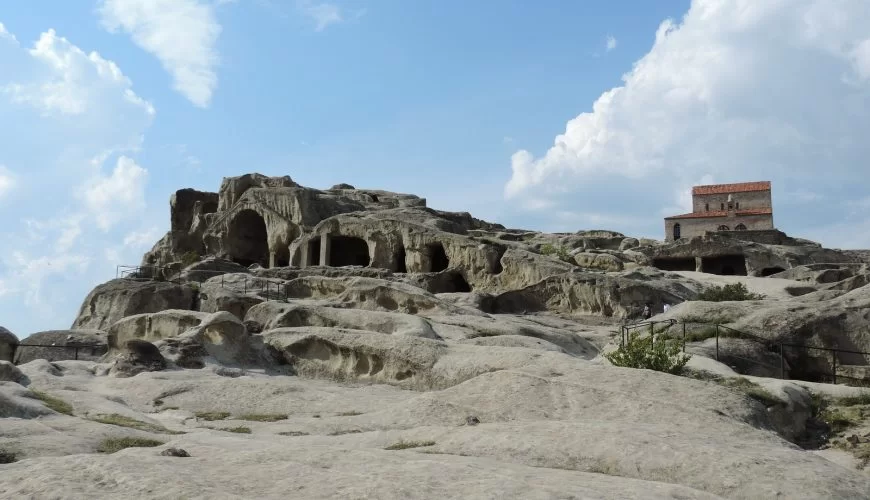
Morning: Start with Uplistsikhe, the ancient cave city 10 km east of Gori. This rock-hewn town dates back to the Iron Age and offers fascinating insights into pre-Christian Georgia.
Midday: Visit Gori, Georgia’s most famous small city as the birthplace of Joseph Stalin. The Stalin Museum remains a major attraction, though the city also has an impressive fortress and pleasant town center.
Afternoon: Drive south to Ateni Sioni. Spend an hour exploring the church, admiring the frescoes, and enjoying the peaceful gorge setting.
Return: Head back to Tbilisi via the main highway.
Other Nearby Sites
- Samtavisi Cathedral (about 30 km east): The 1030 cathedral that defined Georgian church architecture
- Ksani Fortress: Medieval castle not far from the main highway
- Mtskheta (60 km): The UNESCO World Heritage sites of Jvari, Svetitskhoveli, and Samtavro
Frequently Asked Questions
How old is Ateni Sioni Church? The church dates to the early 7th century, built shortly after the famous Jvari Monastery in Mtskheta. The frescoes were added in the second half of the 11th century.
What does “Sioni” mean? “Sioni” refers to Mount Zion in Jerusalem. Medieval Georgians often named their churches after holy places in the Holy Land.
Who painted the frescoes? The frescoes were painted by a group of at least four artists working together, likely commissioned by King David the Builder around 1093–1094. The individual artists’ names are not recorded.
Why are the inscriptions at Ateni Sioni so important? The church walls contain the oldest known examples of two Georgian scripts: Nuskhuri (835 AD) and Mkhedruli (980s AD). Mkhedruli is the script used for modern Georgian today, making Ateni Sioni crucial for understanding the history of Georgian writing.
Is the church still active? Yes. After being closed during the Soviet period, Ateni Sioni is once again an active Georgian Orthodox church.
Can I visit Ateni Sioni independently? Yes. The church is accessible by marshrutka from Gori or by taxi. There’s no need to book a tour, though having a guide can help you understand the frescoes and inscriptions.
How long should I spend at Ateni Sioni? Allow 45 minutes to an hour to explore the church, grounds, and take in the setting. The interior is quite dark, so give your eyes time to adjust.
Is there an entrance fee? No, but donations are welcome and help maintain the church.
What should I wear? Dress modestly as for any Georgian Orthodox church: covered shoulders, long skirts for women (or bring a wrap), headscarves for women, long pants for men.
Can I take photographs inside? Generally yes, but without flash and not during services. Be respectful of worshippers.
Why Ateni Sioni Deserves Your Time
Georgia overflows with ancient churches, and visitors can suffer from “church fatigue” after seeing too many similar sites. Ateni Sioni is different. Yes, it’s another medieval church with frescoes and carved stone—but it offers something most others cannot.
The frescoes here aren’t fragments or heavily restored reconstructions. They’re among the most complete and best-preserved medieval paintings in Georgia, created during the very dawn of the country’s Golden Age. The inscriptions aren’t just decorative—they’re a living archive of Georgian history and the birthplace of the modern Georgian alphabet.
And unlike the crowded UNESCO sites of Mtskheta, Ateni Sioni remains genuinely peaceful. You might find yourself alone in the dim interior, surrounded by thousand-year-old paintings, listening to nothing but birdsong from the gorge outside. That’s increasingly rare in Georgia’s popular destinations.
For travelers who want to go deeper into Georgian culture than the standard itinerary allows, Ateni Sioni rewards the small effort it takes to reach it.