Samtavisi Cathedral
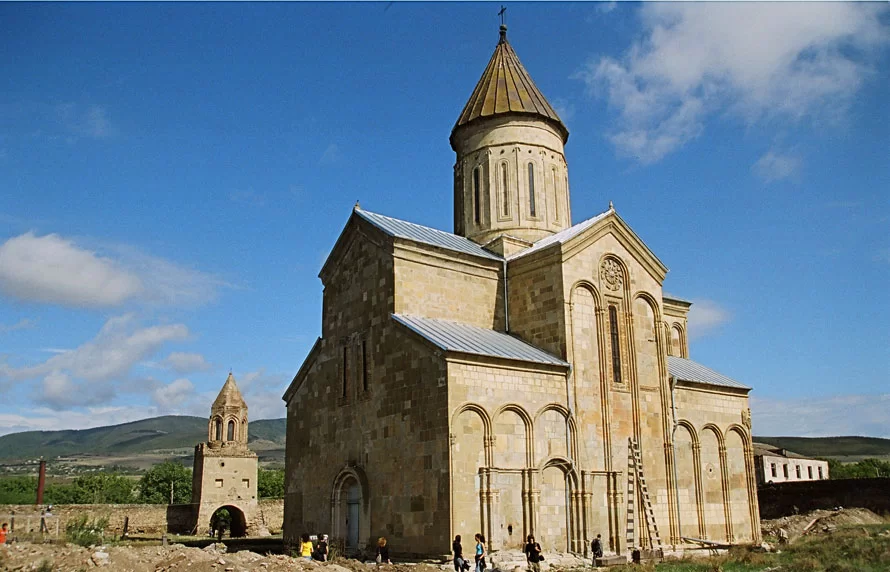
This 11th-century cathedral didn’t just set a standard—it created a template that defined Georgian church architecture for centuries, inspiring everything from medieval monasteries to Tbilisi’s iconic Kashveti Church.
Quick Facts
|
Location |
Samtavisi village, Shida Kartli Region |
|
Distance from Tbilisi |
45 km (~50 minutes) |
|
Distance from Gori |
30 km (~30 minutes) |
|
Distance from Kaspi |
11 km (~15 minutes) |
|
Built |
1030 AD |
|
Architect |
Hilarion Samtavneli (son of Vane Kanchaeli) |
|
First monastery |
572 AD (St. Isidore) |
|
Entrance Fee |
Free |
|
UNESCO Status |
Tentative List |
|
Dedication |
Ascension of Christ |
Why Samtavisi Matters
Drive along the highway from Tbilisi toward western Georgia, and about 45 kilometers from the capital, a distinctive dome rises above the fields near Igoeti village. This is Samtavisi Cathedral—and while it may not be as famous as Svetitskhoveli or Jvari, architecture historians consider it one of the most influential churches in the entire Caucasus.
Why? Because Samtavisi was the first. Built in 1030, it established the cross-in-square (or “inscribed cross”) design that became the defining template for Georgian ecclesiastical architecture. Every major domed church built in medieval Georgia’s golden age drew inspiration from what Bishop Hilarion created here. Walk into Kashveti Church on Tbilisi’s Rustaveli Avenue today, and you’re essentially walking into an exact replica of Samtavisi—built nine centuries later as a tribute to this revolutionary design.
Beyond its architectural significance, Samtavisi represents a remarkable moment in Georgian history: we know the name of its architect. In an age when most medieval builders remained anonymous, the construction inscription at Samtavisi identifies Hilarion, son of Vane Kanchaeli, as both the patron and designer. This makes Hilarion one of the earliest named architects in Georgian history—and based on his work here, one of the most talented.
The History of Samtavisi
The Assyrian Fathers (6th century)
Long before the current cathedral existed, this site held deep spiritual significance. According to Georgian tradition, St. Isidore of Samtavisi, one of the Thirteen Assyrian Fathers who brought organized monasticism to Georgia in the 6th century, founded a monastery here in 572 AD.
The Thirteen Assyrian Fathers were monks from Antioch (in present-day Turkey) who arrived in Georgia to strengthen Christianity and establish monastic communities across the country. Each father founded a monastery in a different region—David at Gareja, Shio near Mtskheta, and Isidore here in the Kartli heartland. St. Isidore’s grave lies inside the cathedral, near the altar, drawing pilgrims who honor his role in Georgia’s Christian heritage.
The original 6th-century church was a basilica—a rectangular hall design common in early Christian architecture. Fragments of this ancient structure were discovered during excavations and now lie beneath the floor of the current cathedral.
King Vakhtang Gorgasali’s Era (5th century)
Some traditions suggest an even earlier church on this site, possibly dating to the reign of King Vakhtang Gorgasali in the late 5th century—the same king who founded Tbilisi. While this remains uncertain, it speaks to Samtavisi’s importance as a spiritual center in the Georgian heartland.
Bishop Hilarion’s Masterpiece (1030)
In 1030, Bishop Hilarion Samtavneli transformed this ancient sacred site. The son of a local nobleman named Vane Kanchaeli, Hilarion was both a church leader and an architectural visionary. He demolished the older structures and built an entirely new cathedral—one that would revolutionize Georgian architecture.
A stone inscription, now lost but recorded by historians, documented the construction date and named Hilarion as the builder. He also constructed a wine cellar (marani) and wine press for the cathedral in 1050, showing his attention to the monastery’s practical needs as well as its spiritual ones.
Hilarion’s architectural innovations were so influential that he was commissioned to design at least one other church—Ashuriani, located nearby—proving his reputation extended beyond Samtavisi.
Earthquakes and Reconstruction (15th–16th centuries)
The medieval period brought catastrophe. A series of earthquakes in the 15th century caused the dome, western wall, and parts of the pillars to collapse. The destruction was severe enough that the cathedral required major rebuilding.
An inscription on the western facade records this reconstruction: “The secondary builder of the temple was the daughter of king of the kings and the wife of Amilakhor, Gayane.” This refers to Princess Gayane, who married into the powerful Amilakhvari family—the noble house that would dominate Samtavisi’s history for the next four centuries.
The reconstruction altered much of Hilarion’s original work. The northern, southern, and western walls were rebuilt, and the dome was restored (though in different proportions than the original). Only the eastern facade—the most decorated portion—survived intact from the 11th century.
The Amilakhvari Era (15th–19th centuries)
From the 15th century onward, the Amilakhvari princes controlled Samtavisi and the surrounding lands. The family used the cathedral as their ancestral burial ground and invested heavily in its maintenance.
In 1679, Prince Givi Amilakhvari and his wife commissioned new frescoes for the interior, painted by Bishop Meliton of Samtavisi. An inscription in the apse documents this patronage. These 17th-century paintings remain the primary decorative element of the interior today.
The bell tower, incorporated into the northern defensive wall, also dates to this period (16th–17th centuries), along with the bishop’s residence and the protective walls surrounding the complex.
Russian Period and Modern Times (19th century–present)
In the 19th century, during the Russian Imperial period, architect Ripardi undertook another restoration. Unfortunately, this work resulted in the loss of some original decorative elements—including one of the two griffin sculptures on the eastern facade.
Today, Samtavisi remains an active cathedral and serves as one of the centers of the Eparchy of Samtavisi and Gori of the Georgian Orthodox Church. The village surrounding it is quiet and somewhat worn, but the cathedral itself stands beautifully maintained, drawing visitors who appreciate its historical and architectural significance.
The Architecture: A Template for Georgian Churches
The Cross-in-Square Innovation
Before Samtavisi, Georgian churches typically followed either basilica (rectangular hall) or earlier domed designs. What Hilarion created in 1030 was something new: the cross-in-square (also called “inscribed cross”) plan.
In this design, a Greek cross is “inscribed” within a square exterior. From outside, the building appears roughly rectangular. Inside, the cross shape reveals itself through the arrangement of pillars and vaulting, with a dome rising at the intersection. The result is a church that combines the symbolic power of the cross with the practical efficiency of a compact footprint.
This layout became the standard template for Georgian domed churches throughout the medieval golden age (11th–13th centuries). When you visit Gelati, Bagrati, or dozens of other medieval Georgian churches, you’re seeing variations on what Hilarion pioneered at Samtavisi.
Exterior Design
The cathedral is built from finely hewn stone blocks in shades of bluish, greenish, yellowish, and gray—giving it a subtle, natural color palette that shifts with the light. Key exterior features include:
- Tall drum dome: Unlike earlier Georgian churches with lower domes, Samtavisi introduced a taller, more elongated drum topped with a conical roof. This creates the distinctive silhouette visible from the highway.
- Blind arcading: Decorative arches that don’t actually open anywhere, creating rhythm and visual interest across the facades.
- Square exterior: The outer walls form a nearly square shape, disguising the cross-shaped interior.
- Twelve-windowed dome: The reconstructed dome has twelve windows—seven real and five imitated—flooding the interior with light.
The Famous Eastern Facade
The eastern facade is Samtavisi’s masterpiece—and the only portion that survives essentially unchanged from 1030. This facade established a decorative template that influenced Georgian churches for centuries.
The Tri-Cross Composition: The centerpiece is a bold ornamental cross carved above the window, flanked by two smaller decorative panels below. This arrangement represents the scene of Calvary—Christ’s cross between those of the two thieves—a symbolic motif that became standard in Georgian church decoration after Samtavisi.
The three elements form a unified composition, with each piece designed to complement the others. The central cross is large and elaborate; the flanking panels feature intricate diamond (lozenge) patterns that echo its geometry.
The Stone Carving: The quality of carving at Samtavisi is exceptional, even by the high standards of 11th–12th century Georgia. The stonework features:
- Floral ornamentation: Vines, leaves, and botanical motifs flow organically across the surface
- Pomegranate patterns: The ancient symbol of abundance and fertility appears throughout
- Geometric interlace: Complex patterns that demonstrate remarkable precision
- Five-arched arcade: A row of decorative arches frames the lower portion of the facade
The Griffin: In the corner of the eastern facade, a small but expressive griffin sculpture guards the sanctuary. This mythical creature—part lion, part eagle—was a common symbol of divine protection in medieval Christian art. Originally, two griffins flanked the facade, but one was lost during 19th-century restorations.
Interior
The interior of Samtavisi is deliberately simple and austere, allowing the architectural proportions to speak for themselves. The space is defined by:
- Four pillars supporting the central dome
- Semicircular arches creating the cross-shaped plan
- Apse, prothesis, and sacristy in the eastern section
- Southern entrance (the original northern and western portals were removed during reconstruction)
The 17th-century frescoes by Bishop Meliton cover the dome and apse. The dome depicts Christ Pantocrator surrounded by six-winged seraphim and the four evangelists. Prophets appear between the dome’s supporting arches, with the Virgin Mary and Jesus among them; archangels fill the spaces below the windows. The apse shows the traditional Deesis (Christ flanked by Mary and John the Baptist) and a multi-figured Eucharist scene.
The color palette is subdued: dark brown, blue, yellow, and dark gray predominate.
Graves of Note:
- St. Isidore of Samtavisi: Near the altar—the 6th-century Assyrian Father who founded the original monastery
- Philemon Karbelashvili: Near the northern entrance—a 19th-century church leader who helped preserve Georgian sacred music
The Kashveti Connection
Walk down Rustaveli Avenue in Tbilisi and you’ll see a beautiful white church opposite the Parliament building. This is Kashveti Church of St. George, and it’s an intentional, detailed replica of Samtavisi Cathedral.
Built between 1904 and 1910 by architect Leopold Bilfeldt (with stonework by master carver Neophyte Agladze), Kashveti was designed to recreate Hilarion’s masterpiece in the heart of the capital. The architects studied Samtavisi carefully, reproducing its proportions, its eastern facade decoration, and its cross-in-square plan.
Visiting both churches offers a fascinating perspective: you can see how an 11th-century design translates to a 20th-century context, and how faithfully the later builders honored Hilarion’s original vision.
If you’ve already seen Kashveti in Tbilisi, a visit to Samtavisi shows you the authentic original. If you haven’t made it to Samtavisi yet, Kashveti offers a preview of what awaits.
What to See at the Complex
The Cathedral
The main church dominates the complex—its tall dome visible from the moment you enter the walled enclosure. Don’t miss:
- Eastern facade: The original 11th-century masterpiece with tri-cross decoration and griffin
- Interior frescoes: 17th-century paintings in dome and apse
- Graves: St. Isidore near the altar, Philemon Karbelashvili near the north wall
- Stone iconostasis fragments: Look for carved elements preserved from earlier periods
The Bell Tower
Enter the complex through the gate-bell tower built into the northern wall. This three-story structure dates to the 16th–17th centuries:
- Ground floor: Gate passage
- Middle floor: Guard quarters
- Upper floor: Belfry with bells
Bishop’s Residence (Ruins)
In the southeastern corner of the enclosure stand the remains of a two-story bishop’s palace. Though badly damaged, the ruins hint at the administrative importance Samtavisi once held as an episcopal center.
Small Church
A modest church (5.8 × 3.2 meters) stands within the complex, likely dating to the 17th–18th centuries.
Defensive Walls
The 3–5 meter high walls surrounding the complex reflect centuries of insecurity in the Georgian heartland. Made of stone and brick, they transformed the cathedral into a fortified compound.
Archaeological Remains
Beneath and around the current cathedral lie the foundations of earlier structures, including fragments of the 6th-century basilica. These are visible in some areas and documented by excavations that revealed two distinct historical layers.
How to Get There
Samtavisi is located in Shida Kartli region, on the left bank of the Lekhura River, near Igoeti village. It’s visible from the main Tbilisi-Batumi highway—look for the dome rising above the fields.
From Tbilisi
Distance: 45 km | Time: 50–60 minutes
By Car:
- Take the main highway west toward Gori
- Pass Mtskheta and continue toward Kaspi/Gori
- Near Igoeti village, turn off the highway toward Samtavisi village
- The cathedral is less than 1 km from the highway, in the village center
By Marshrutka:
- Take a marshrutka from Didube Bus Station toward Gori
- Ask the driver to stop at the police post before the Samtavisi turnoff
- Walk approximately 1 km to the cathedral
By Organized Tour:
- Some Gori/Uplistsikhe tours can add Samtavisi as a stop
- Request inclusion when booking a custom itinerary
From Gori
Distance: 30 km | Time: 30 minutes
Drive east on the main highway toward Tbilisi, turning off near Igoeti.
From Kaspi
Distance: 11 km | Time: 15 minutes
The cathedral is a short drive south from Kaspi town.
Combining with Other Sites
Samtavisi works well as part of a day trip exploring the Shida Kartli region.
Suggested Itinerary: Kartli Heritage Day
Morning:
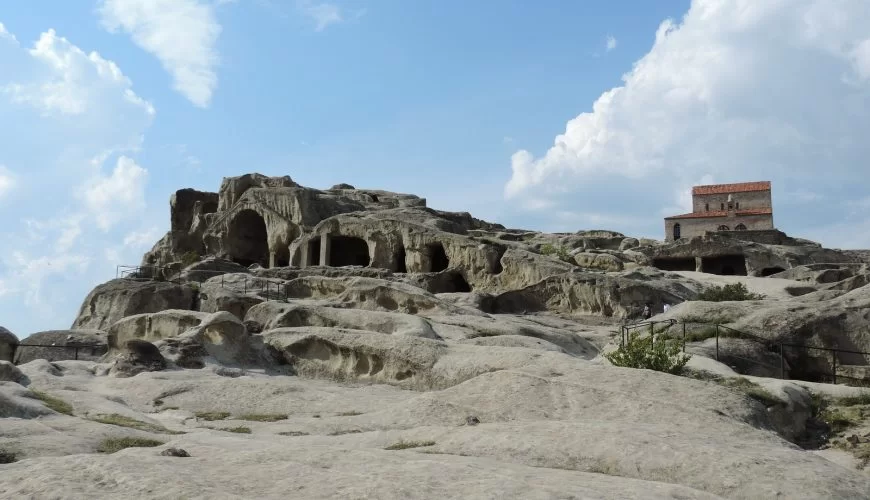
- Uplistsikhe Cave City – Ancient rock-hewn town dating to the Iron Age
- Gori – Stalin Museum (for those interested), fortress, old town
Lunch: Traditional restaurant in Gori
Afternoon: 3. Samtavisi Cathedral – The architectural masterpiece 4. Amilakhvari Castle or Skhvilo Fortress – Medieval castles of local princes (both nearby)
Return: Via highway to Tbilisi (or continue to Mtskheta)
We often add Samtavisi visit to our tour to Usplistsikhe.
Other Nearby Attractions
- Ksani Fortress: Medieval fortress not far from Samtavisi
- Chateau Mukhrani: Wine estate offering tastings and tours
- Mtskheta: Add the UNESCO World Heritage sites on your way back to Tbilisi
Practical Information
Visiting Hours
- Generally daylight hours
- As an active church, hours may vary for services
- Free admission
Dress Code
This is an active Orthodox church:
- Women: Cover shoulders, wear long skirt (not pants), headscarf
- Men: Long pants, covered shoulders
What to Bring
- Camera for the exceptional stonework
- Modest clothing (see dress code)
- Water (limited facilities in the village)
Time Needed
- 30–45 minutes for a thorough visit
- Allow extra time for photography of the eastern facade
Facilities
The village is small and services are limited. Plan to eat and buy supplies in Gori, Kaspi, or along the highway.
Frequently Asked Questions
What is special about Samtavisi Cathedral? Samtavisi is the first “cross-in-square” domed church in Georgia, built in 1030. Its design became the template for Georgian church architecture throughout the medieval period. The eastern facade’s decorative scheme influenced countless later churches.
Who built Samtavisi? Bishop Hilarion Samtavneli, son of nobleman Vane Kanchaeli, built the cathedral in 1030. He’s one of the earliest named architects in Georgian history.
What is the connection between Samtavisi and Kashveti Church in Tbilisi? Kashveti Church on Rustaveli Avenue (built 1904–1910) is an intentional replica of Samtavisi. Architects Leopold Bilfeldt and Neophyte Agladze studied the medieval cathedral and recreated its design for the capital.
Is Samtavisi a UNESCO World Heritage Site? Samtavisi is on Georgia’s UNESCO Tentative List but has not yet been inscribed as a full World Heritage Site.
Can I visit Samtavisi on a day trip from Tbilisi? Yes. At 45 km from Tbilisi, Samtavisi makes an easy day trip. It combines well with Gori and Uplistsikhe for a full Kartli heritage itinerary.
Is the cathedral still active? Yes. Samtavisi is an active church and one of the centers of the Eparchy of Samtavisi and Gori.
What happened to the original cathedral? Earthquakes in the 15th century destroyed the dome and parts of the walls. The church was rebuilt, but only the eastern facade survives from Hilarion’s original 1030 construction.
Who is buried at Samtavisi? Notable burials include St. Isidore of Samtavisi (one of the Thirteen Assyrian Fathers, 6th century) and Philemon Karbelashvili (19th-century preserver of Georgian church music).
What are the 17th-century frescoes? Bishop Meliton painted the interior in 1679 under patronage of Prince Givi Amilakhvari. The frescoes depict Christ Pantocrator, evangelists, prophets, angels, and the Eucharist.
How do I get to Samtavisi without a car? Take a marshrutka from Tbilisi’s Didube station toward Gori and ask to stop at the Samtavisi turnoff. Walk about 1 km to the village center.
Final Thoughts
Samtavisi Cathedral offers something rare: the chance to see where a great architectural tradition began. While more famous churches draw crowds, this quiet cathedral in a small Kartli village preserves the template that shaped Georgian sacred architecture for centuries.
Stand before the eastern facade and you’re looking at original 11th-century stonework—carved nearly a thousand years ago by craftsmen working under Bishop Hilarion’s direction. The floral patterns, the geometric precision, the guardian griffin—all survived earthquakes, invasions, and centuries of weather to reach us today.
When you next pass Kashveti Church in central Tbilisi, you’ll understand its lineage. The proportions, the decorative scheme, the cross-in-square plan—all began here, in a village by the highway, where a bishop and architect named Hilarion created something that would echo through Georgian culture forever.