Kazbegi Travel Guide: Mount Kazbek, Gergeti Church, and Georgia’s Wildest Day Trip
Updated March 2026 — by Georgia Tours, running trips to Kazbegi since 2011
The first time you see it, the scale doesn’t register. You’ve been driving for three hours, climbing steadily through gorges and past Soviet monuments, and then the road rounds a bend and there it is — a tiny stone church on a green ridge, and behind it, five thousand meters of ice and volcanic rock filling half the sky. Gergeti Trinity Church against Mount Kazbek. The picture that sells Georgia to the world.
But here’s what the pictures don’t tell you: that mountain attracts clouds like a magnet, and there’s a solid chance you’ll arrive to find the peak hidden behind a grey wall. That the church hike is steep enough to make your calves burn but short enough that almost anyone can do it. The region around Kazbegi holds a volcanic valley with orange mineral pools, a cluster of dolomite rock towers that rival anything in the Alps, and some of the emptiest hiking trails in Europe. And that the whole thing sits just three hours from Tbilisi on a road so scenic it’s an attraction in itself.
This guide covers everything we’ve learned in fifteen years of bringing travelers here — from the practical logistics to the trails most visitors miss.
[IMAGE: Gergeti Trinity Church with Mount Kazbek — early morning, clear conditions]Kazbegi, Stepantsminda, Mount Kazbek — Sorting Out the Names
The naming confuses everyone, so let’s clear it up front.
Mount Kazbek (5,047m) is the dormant stratovolcano that dominates the skyline. Georgians call it Mkinvartsveri — “ice peak.” It’s Georgia’s third-highest mountain and one of the major summits of the Caucasus range.
Stepantsminda is the main town at the base. It was renamed from “Kazbegi” in 2006, but everyone — locals, taxi drivers, travelers, and most maps — still call it Kazbegi. We’ll use both interchangeably here, as you’ll hear both on the ground.
Kazbegi District is the wider administrative area covering the valleys, gorges, and the Kazbegi National Park (8,707 hectares of protected alpine terrain).
The town sits at an elevation of 1,740 meters, 157 km north of Tbilisi. Everything in this guide — the hikes, restaurants, and guesthouses — centers on Stepantsminda unless noted otherwise.
Getting to Kazbegi: The Georgian Military Highway
Half the experience of Kazbegi is getting there. The Georgian Military Highway — the historic route connecting Tbilisi to the Russian border — is one of the great mountain drives in the world. Lermontov wrote about it. Pushkin crossed it. And even with modern tourism, the scenery still earns those literary comparisons.
The 157-km drive from Tbilisi takes 3–4 hours and climbs from the lowlands through increasingly dramatic terrain. You’ll want to stop several times.
Highway Highlights Worth Stopping For
Ananuri Fortress (65 km from Tbilisi) guards a ridge above the turquoise Zhinvali Reservoir. The 16th–17th century castle complex has two churches, defensive towers, and the kind of setting that looks computer-generated. Most tours stop for 20–30 minutes. If you’re passing through Mtskheta on the same day, Ananuri makes a natural second stop heading north.
Gudauri (120 km from Tbilisi) is Georgia’s main ski resort at 2,200m. In summer, the slopes become paragliding launch sites — tandem flights are available from several operators, and the views across the Greater Caucasus from altitude are worth the price.
Russia-Georgia Friendship Monument (125 km) is a massive curved wall of Soviet-era mosaics, built in 1983. Opinions on its aesthetics vary, but the viewpoint over the Aragvi gorge below is genuinely impressive.
Cross Pass (Jvari Pass, 2,379m) is the highest point on the highway, marking the watershed between rivers flowing to the Black Sea and the Caspian. Snow lingers here into June. In winter, this is where closures happen.
How to Get There — Compared
| Transport Option | Cost (approx.) | Time | Best For |
|---|---|---|---|
| Organized day tour | 80–150 GEL per person | Full day (10–12 hrs) | First-timers who want highway highlights + Gergeti in one day |
| Private transfer | 200–300 GEL round trip | Flexible | Families, groups who want their own pace and stops |
| Marshrutka (minibus) | 15–20 GEL one way | 3–4 hours | Budget travelers staying overnight (no highway stops) |
| Shared taxi | ~30 GEL per seat | 3 hours | Budget travelers who want some highway stops |
| Rental car | From 80 GEL/day | Self-paced | Experienced drivers are comfortable with narrow mountain roads and trucks |
Marshrutkas and shared taxis depart from Tbilisi’s Didube bus station (by the Didube metro). Marshrutkas go when full, departures from roughly 8 AM through late afternoon, 15 GEL. The ride is direct — no sightseeing stops — but gets you to Kazbegi, where you can stay for a night or more and explore properly.
We’d recommend against self-driving unless you’re confident with narrow mountain roads, heavy truck traffic, and occasional fog. The highway is paved throughout, but sections through the gorges require attention. Our day tours include all the highway stops plus Gergeti Church and Gveleti Waterfalls, with experienced local drivers who know every bend.
Important: The highway continues to the Russian border at Dariali/Lars. Foreign tourists cannot cross here without a valid Russian visa and advance registration with Russian border authorities.
[IMAGE: Georgian Military Highway — aerial or driving shot showing the scale of the road against mountains]Gergeti Trinity Church: The Hike Everyone Comes For
The 14th-century Gergeti Trinity Church (Tsminda Sameba) sits at 2,170m on a ridge above Stepantsminda, with Mount Kazbek rising directly behind it. It’s the most photographed spot in Georgia, and the hike up is the one activity every visitor does.
Which Trail to Take
This matters more than most guides let on. When you reach the T-junction in Gergeti village (across the river from Stepantsminda), you’ll see several paths heading uphill. Not all are equal.
The valley route via Bashi creek (turn left at the junction) is the one to take. It’s longer than the direct paths but significantly less steep, follows a stream with views the whole way, and keeps you off the rough vehicle road. Allow 1.5–2 hours up, about an hour down. Total elevation gain is roughly 500 meters.
The paths heading straight up the hill are murderously steep — short but punishing, with loose gravel that’s worse on the descent. If someone at your guesthouse says “just go straight up, it’s faster” — take the valley route anyway.
A sealed road now reaches the church, so regular vehicles (not just 4x4s) can drive up. 4×4 taxis wait in Stepantsminda’s main square and charge 60–80 GEL per car round trip with about 30 minutes’ wait time at the top. You can split this with other travelers.
Practical tip: Download Maps.me or Gaia GPS before you arrive. The trails are on both apps and work offline — useful if you’re extending beyond the church toward the glacier viewpoints.
At the Church
The building itself is a classic Georgian stone church — simple, solid, the kind of architecture that looks like it grew from the rock. The interior is open to visitors (modest dress required, women should cover their heads). The interior is dim and atmospheric, but photography is not permitted inside.
The real impact is the setting. On clear mornings, Kazbek fills the entire sky behind the church — glaciers catching light, snow cone improbably close. On cloudy days, the church stands alone against shifting mist, which has its own austere beauty.
Photography: When to Go
This is worth planning around. Mount Kazbek attracts clouds like nothing else in the region. By late morning, there’s a decent chance the peak will be hidden.
Best strategy: Go early. Before 10 AM, you have the highest odds of a clear summit and the best light on Kazbek (the sun is behind you, lighting the mountain). Sunrise visits are feasible if you’re staying in Stepantsminda — the trail is walkable in pre-dawn light. Evening golden hour illuminates the church beautifully but puts the mountain in shadow, so you’re choosing between two different photographs.
The classic composition is from below and south of the church, looking north toward Kazbek.
Beyond the Church: Gergeti Glacier
The church doesn’t have to be the endpoint. Trails continue upward toward Mount Kazbek’s glaciers — and this extension transforms a half-day outing into a serious mountain day.
The Gergeti Glacier viewpoint (approximately 3,300m) adds another 2–3 hours each way beyond the church. The trail is well-worn but relentless — about 1,100m more of elevation gain above the church. You’ll pass alpine meadows, cross rocky moraines, and arrive at the foot of the glacier where Kazbek’s ice descends toward you. The return to Stepantsminda via the church takes another 3 hours. Budget 8–10 hours for the full round trip from town.
The old Meteorological Station at 3,680m — a Soviet-era weather station now used as a mountaineering base camp — is reachable by strong hikers. This is a full-day commitment requiring early departure, proper gear, and mountain experience.
Best Hikes in Kazbegi (Beyond Gergeti)
Most visitors come for the church and leave. They’re missing some of the best walks in the Caucasus.
Truso Valley
Distance: ~21 km round trip | Duration: 6–8 hours | Difficulty: Easy to moderate (mostly flat)
If Gergeti is Kazbegi’s famous face, Truso is its secret personality. This volcanic valley looks nothing like anything else in the region — orange and white travertine terraces, bubbling mineral springs that stain the ground in surreal colors, and the ruins of the fortress village of Zakagori at the far end, set against border peaks.
The walk follows a dirt road along the valley floor from the village of Kvemo Okrokana. The terrain is mostly flat, making this one of the most accessible longer walks in the Kazbegi area — and one of the quietest. You’ll likely have stretches entirely to yourself.
Getting there: The turnoff is on the main highway south of Stepantsminda. A taxi costs 40–50 GEL round trip with waiting time, or you can arrange a transfer through Mountain Freaks, the logistics operator in town. Bring food and plenty of water — there are no services in the valley apart from a small seasonal camp.
Juta Village and the Chaukhi Massif
Distance: Variable | Duration: Half-day to multi-day | Difficulty: Moderate to challenging
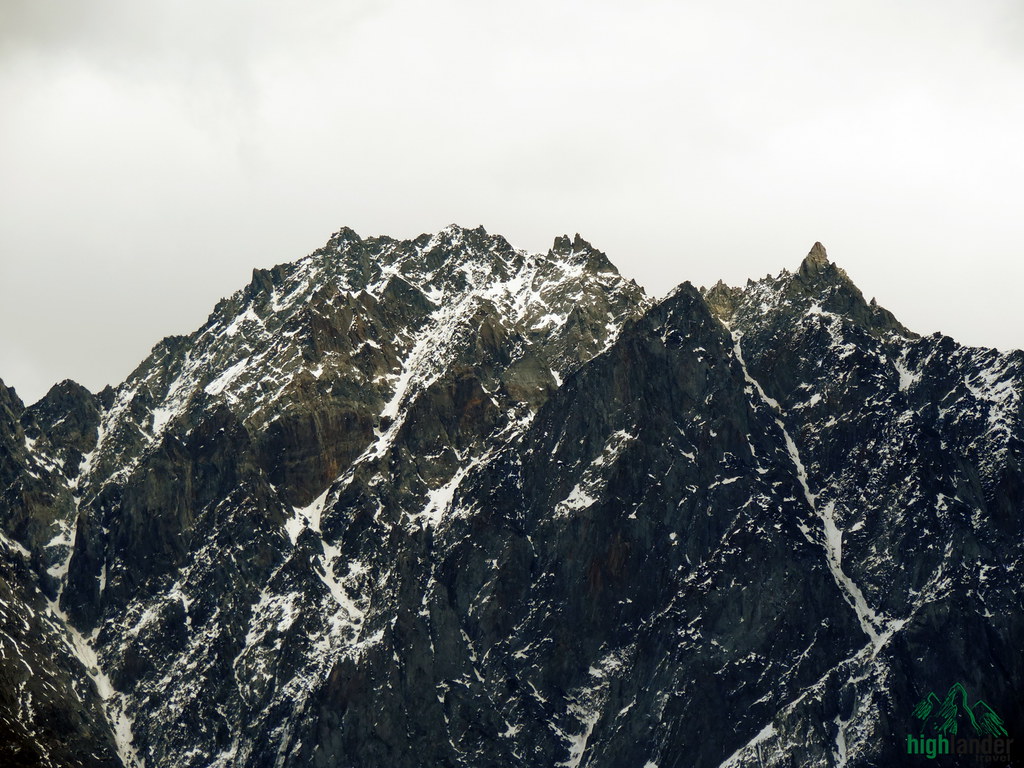
The village of Juta (2,200m) sits beneath a wall of jagged rock spires that look like the Dolomites after a geological argument. This is the Chaukhi massif — and it’s some of the most dramatic alpine scenery in Georgia.
Day hikes from Juta range from gentle valley walks (2–3 hours) to approaches toward Chaukhi Pass (4–6 hours, moderate to challenging). The full Chaukhi Pass crossing to the Abudelauri glacier lakes and Roshka is a 2-day trek that ranks among Georgia’s best — connecting Kazbegi with Khevsureti through a landscape of dolomite towers and three glacial lakes, each a different color (white, blue, and green).
Getting there: A rough road connects Stepantsminda to Juta (~10 km). 4×4 recommended. As of 2025, sections of the road were under renovation, sometimes requiring a ~1-hour walk from the road closure point. Mountain Freaks organizes shared transfers. Check conditions locally before heading out.
For the full Chaukhi experience, our Grand Trek in Eastern Caucasus crosses the pass as part of a 13-day expedition through three mountain regions.
Gveleti Waterfalls
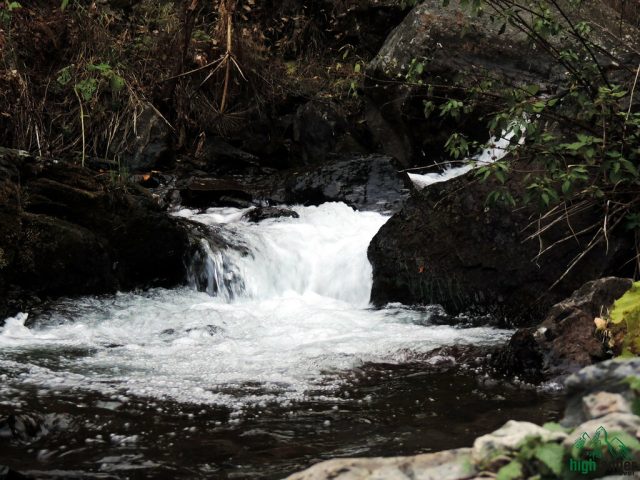
Distance: ~4 km round trip | Duration: 1–1.5 hours | Difficulty: Easy
A short, shady gorge hike just south of Stepantsminda, leading to twin waterfalls that cascade off the cliff walls. The spray is refreshing on hot days and the walk is family-friendly. It’s an easy addition to a Kazbegi day trip or a good leg-stretcher if you’ve been driving the highway.
Access: Turn off the main highway at the Gveleti sign, approximately 5 km south of town. Small parking area at the trailhead.
Sno Valley
A gentle side trip rather than a hike. The Sno Valley branches off the highway before Stepantsminda and features the stone head sculptures by Merab Piranishvili — large carved stone faces of Georgian writers lining the roadside. It’s an unexpected outdoor gallery in a mountain valley, and makes a quick, photogenic stop. The village of Sno itself has a medieval defensive tower and is the gateway to Juta.
Dariali Gorge and Monastery
North of Stepantsminda, toward the Russian border, the Dariali Gorge narrows dramatically — high rock walls channeling the Terek River through what was historically one of the most strategic passes in the Caucasus. The recently restored Dariali Monastery sits in the gorge, and the drive there passes through terrain that feels genuinely wild. Allow about an hour for the side trip.
Mount Kazbek: The Summit
For experienced mountaineers, Mount Kazbek (5,047m) is one of the more accessible 5,000-meter peaks in the world — which still means it is serious, technical, and potentially dangerous.
The standard route takes 3–4 days: Stepantsminda → Gergeti Church → Meteorological Station (3,680m, Day 1) → acclimatization day → summit attempt via the Gergeti Glacier and Kazbek Plateau → descent. The climbing season runs from late June through September, with July and August offering the most stable weather windows.
This is not a hike. Kazbek requires glacier travel skills, crevasse rescue knowledge, crampons, ice axe, harness, rope, and high-altitude experience. Several Georgian and international companies offer guided climbs. If you’re considering it, be honest about your experience level — Kazbek has serious objective hazards including crevasses, rockfall, and sudden weather deterioration.
Where to Eat in Kazbegi
Stepantsminda’s restaurant scene has grown quickly with tourism. You won’t go hungry, and a few places stand out.
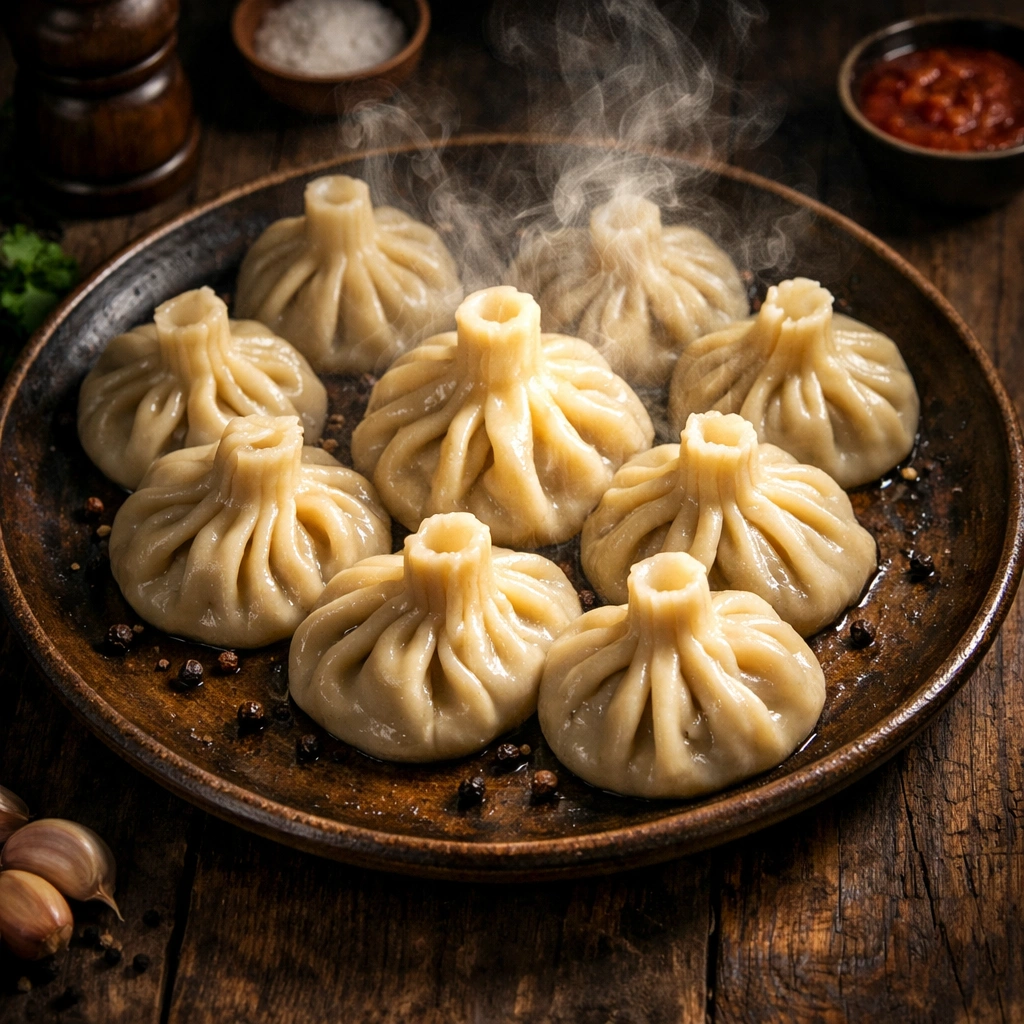
Tiba is the local go-to. Straightforward Georgian food — khinkali (dumplings), grilled meats, salads, fresh bread — at honest prices. It fills up, especially at dinner, so arrive early or be patient.
Rooms Hotel Kazbegi restaurant serves upscale Georgian-international dishes in a setting designed to show off the mountain views. Even if you’re not staying at the hotel, the terrace is worth a visit for a drink at sunset.
Panorama Restaurant does traditional Georgian dishes with a view — solid cooking, friendly service, reliable choice.
Several guesthouses serve home-cooked meals that are often the best food in town. Half-board (breakfast and dinner) is standard and usually excellent value. If your guesthouse host is cooking, eat there — Georgian home cooking is what the restaurants are trying to replicate.
There are also a handful of cafés and small shops for supplies. Bring cash — card acceptance is limited outside the hotels.
Where to Stay
Rooms Hotel Kazbegi is the flagship — a converted Soviet-era sanatorium turned stylish design hotel with panoramic mountain views, an excellent restaurant, and a spa. It’s the most expensive option in town and genuinely impressive.
Mid-range hotels like Hotel Stancia offer comfortable rooms with good views at lower prices.
Guesthouses are the heart of Kazbegi accommodation. Family-run, simple but comfortable rooms, home-cooked meals, and the kind of hospitality that has travelers extending their stays. Expect to pay 60–120 GEL per person including breakfast and dinner. Some are in Stepantsminda proper, others across the river in Gergeti village (closer to the trailhead).
Camping: Camp at Kuro, north of town, offers a budget option. In Juta, Zeta Camping and Fifth Season operate from June to September (book ahead — they’re popular).
Tips:
- Book ahead in July–August and on any weekend year-round.
- Confirm your room has mountain views if that matters — not all do.
- Verify heating availability in spring, autumn, and winter.
- Half-board at guesthouses is almost always worth it.
When to Visit Kazbegi — Season by Season
| Season | Weather | Trail Access | Crowds | Best For |
|---|---|---|---|---|
| May | Mild in valley, snow at passes | Gergeti Church, Gveleti, lower Truso | Moderate | Spring scenery, blooming lowlands transitioning to snow at altitude |
| June | Warm, occasional rain | Most trails open, some snow above 3,000m | Growing | Wildflowers, longer days, early access to higher routes |
| July–August | Warmest, afternoon clouds common | All trails open, Kazbek climbing season | Peak | Full access to all hikes including Chaukhi Pass and Juta |
| September | Cooling, clearer mornings | Most trails still accessible | Thinning | Autumn colors, fewer visitors, excellent photography light |
| October | Cold at altitude, unpredictable | Lower trails only, Juta road may close | Low | Dramatic autumn landscapes if weather cooperates |
| Nov–March | Cold, snow, occasional road closures | Gergeti Church (with gear), town walks | Minimal | Snow-covered scenery, solitude, combining with Gudauri skiing |
Weather reality check: Mount Kazbek attracts cloud cover. Mornings before 10 AM are typically the clearest. By early afternoon, clouds often build and hide the peak — sometimes for the rest of the day. This isn’t unusual; it’s normal mountain weather. If you’re staying overnight, you get two morning chances instead of one.
What to Do When the Weather Doesn’t Cooperate
Clouds hiding Kazbek is the most common disappointment in the region. It happens to locals too. But a cloudy day doesn’t have to be a lost day:
- Hike Truso Valley — the valley’s volcanic geology is interesting regardless of summit views.
- Drive to Sno Valley — the stone sculptures are a 10-minute detour, and the valley views are lower-altitude and often clearer.
- Visit Dariali Gorge and Monastery — the gorge itself is dramatic even in cloud.
- Stepantsminda History Museum — small but worthwhile for local context (check opening times locally).
- Eat — seriously, settle into a guesthouse meal with house wine and wait for the mountain to show itself. It often does by the next morning.
Practical Information
What to Bring
Mountain weather changes fast. Even in July, you can go from sunshine to cold rain in an hour. Pack accordingly: sturdy walking shoes (hiking boots for longer trails), a rain jacket, a warm layer (fleece or light down), sun protection, water, snacks, and cash — ATMs exist (Bank of Georgia on the main square) but card acceptance is limited.
Download Maps.me before you arrive for offline trail maps. If you’re doing the glacier hike, Gaia GPS with downloaded topo maps is more useful.
Mobile coverage: Signal is decent in Stepantsminda but drops quickly on trails. Buy a Georgian SIM card in Tbilisi before your trip (Magti or Geocell, available at the airport) — some travelers with eSIMs report losing signal outside town.
Services in Stepantsminda
The town has what you need but nothing extra: Bank of Georgia ATM, small grocery shops, restaurants and cafés, taxi and 4×4 services, a basic medical clinic, and limited outdoor gear shops. There’s no major outdoor equipment store — bring what you need from Tbilisi.
Logistics Operator: Mountain Freaks
Mountain Freaks runs shared transfers to Juta, Truso trailhead, and other points in the district. They also organize hikes, rent equipment, and serve as a general information point. Their office in Stepantsminda is the go-to for logistics if you’re traveling independently.
Wildlife and Nature
Kazbegi National Park protects 8,707 hectares of high-mountain terrain — and the biodiversity here is more substantial than the compact area suggests.
The East Caucasian tur (a wild mountain goat with dramatic curved horns) is the signature species — sightings are possible on longer hikes, particularly early morning above the treeline. Chamois, brown bear, lynx, and wolf also inhabit the protected areas, though sightings are rare.
The skies are the real show. Golden eagles, griffon vultures, and bearded vultures (lammergeiers) patrol the cliffs — the lammergeier, with its three-meter wingspan and habit of dropping bones from height to crack them open, is one of the more extraordinary birds in Europe.
The alpine meadows explode with wildflowers in June and July — over 1,300 plant species grow in the Kazbegi floristic zone, roughly a quarter of them endemic to the Caucasus.
Culture and History
The people of this region, the Mokheves (from “mokheve” — gorge dweller), have lived in these mountains for centuries, guarding the Dariali Pass — the strategic gateway into Georgia from the north. Their history is bound up with defense: towers, fortresses, and a culture that blends Orthodox Christianity with older mountain traditions.
Gergeti Trinity Church (14th century) is the most famous landmark, but the area holds other historical sites: the Dariali Monastery (recently restored, near the Russian border), Sno Fortress (a medieval defensive tower in the Sno Valley), and the contemporary stone head sculptures by artist Merab Piranishvili — large carved faces of Georgian literary figures placed in the mountain landscape.
Georgian highland hospitality is legendary and real. If a guesthouse host invites you to share chacha (grape brandy) and toast after dinner — accept. It’s not a performance; it’s how people here have treated guests for centuries.
Day Trip vs. Overnight: Which Makes Sense for You?
Most visitors see Kazbegi as a day trip from Tbilisi. It works — but you’re trading depth for efficiency.
| Day Trip | 2–3 Night Stay | |
|---|---|---|
| What you’ll see | Highway highlights + Gergeti Church + one extra stop | Multiple hikes, sunrise/sunset at church, Truso or Juta, local food |
| Pace | Structured, time-limited | Relaxed, weather-flexible |
| Kazbek visibility | One chance (afternoon, often cloudy) | Multiple morning chances |
| Cost | 80–300 GEL total | 200–500+ GEL (accommodation + meals + transfers) |
| Best for | Short Georgia trips, first-time visitors, limited mobility | Hikers, photographers, anyone wanting the full mountain experience |
Our recommendation: If you have just one day, a day tour covers the essentials well and lets you see the highway highlights. But if you can spare two or three nights, the region opens up completely — Truso, Juta, the glacier hike, and the chance to experience mountain mornings and evenings that make the day-trippers’ hurried lunch stops feel like a different trip entirely.
Frequently Asked Questions
How far is Kazbegi from Tbilisi?
Kazbegi (Stepantsminda) is 157 km from Tbilisi via the Georgian Military Highway. The drive takes 3–4 hours depending on traffic and stops.
Can I visit Kazbegi as a day trip from Tbilisi?
Yes — day trips are the most common way to visit. Organized tours depart Tbilisi around 8–9 AM and return by 7–8 PM, typically including Ananuri Fortress, the Friendship Monument, Gergeti Church (usually by 4×4), and one additional stop. Staying overnight is better for hikers and photographers who want more time and flexibility.
Is the Gergeti Trinity Church hike difficult?
The hike gains about 500 meters over 3–4 km. Most people with average fitness complete it in 1.5–2 hours up and an hour down. Take the gradual valley route via Bashi creek rather than the steep direct paths. A sealed road now reaches the church if you prefer to drive (60–80 GEL per car round trip).
What is the best time to visit Kazbegi?
June through September for hiking, with July–August offering full trail access and the warmest weather. September has fewer crowds and autumn color. May is pleasant in the valley but higher trails may have snow. Winter visits are possible but trails are limited.
Do I need a guide for hiking in Kazbegi?
Not for the Gergeti Church hike, Gveleti Waterfalls, or Truso Valley — trails are well-worn and navigation is straightforward. For the Chaukhi Pass crossing, glacier approaches, or anything above 3,000m, a guide is strongly recommended. Our trekking tours include experienced mountain guides for all remote routes.
Can I climb Mount Kazbek?
Yes, but it’s a technical mountaineering objective requiring glacier skills, proper equipment, and high-altitude experience. It takes 3–4 days. The season is late June through September. A professional guide is strongly recommended.
Where should I eat in Kazbegi?
Tiba for reliable traditional Georgian food, Rooms Hotel restaurant for upscale dining with views, Panorama for mountain views and solid cooking, and guesthouse home cooking for the most authentic meals.
Where should I stay in Kazbegi?
Rooms Hotel Kazbegi for luxury, mid-range hotels like Hotel Stancia for comfort, or family guesthouses (60–120 GEL per person with meals) for the best value and authentic hospitality. Book ahead in summer.
Is the road to Kazbegi safe?
The Georgian Military Highway is paved and driven daily by buses, trucks, and private vehicles. It’s generally well-maintained. Winter can bring temporary closures at the Cross Pass due to snow or avalanches. Hiring an experienced driver is recommended over self-driving.
What if Mount Kazbek is hidden by clouds?
This is common, especially in the afternoon. Go to the church early morning (before 10 AM) for the best odds. If the peak is hidden, hike Truso Valley, visit Sno Valley, explore Dariali Gorge, or wait — the mountain often reveals itself by the next morning.
Can I cross into Russia from Kazbegi?
The Dariali/Lars border crossing requires a valid Russian visa and advance registration. It is not a routine tourist crossing for foreign nationals.
Is there mobile phone coverage in Kazbegi?
Coverage is decent in Stepantsminda but drops quickly on trails. Buy a Georgian SIM card (Magti or Geocell) in Tbilisi before your trip. eSIM users should not rely on signal outside town.
Explore Kazbegi With Us
We’ve been bringing travelers to these mountains since 2011. We know which guesthouse serves the best khinkali, which trail gives you the best view with the least suffering, and what time of morning to be at Gergeti if you want the church and Kazbek together without twenty other photography groups.
Browse our full range of Georgia tour packages — or start with these:
- Kazbegi Day Tour from Tbilisi — the Georgian Military Highway highlights, Gergeti Church, and Gveleti Waterfalls in a single day.
- 2-Day Kazbegi Tour — stay overnight, hike at your own pace, experience mountain mornings.
- Trekking in Georgia — multi-day routes through Kazbegi, Khevsureti, Tusheti, and Svaneti.
- Grand Trek in Eastern Caucasus — 13 days from Kazbegi through three mountain regions to Kakheti’s vineyards.
Questions? Contact us — we answer personally, and we’ll tell you honestly whether a day trip or a longer stay makes sense for your trip.
Georgia Tours has been operating since 2011. We’re based in Tbilisi and run our own trips — no middlemen, no reselling. Our guides are locals who know these mountains year-round.
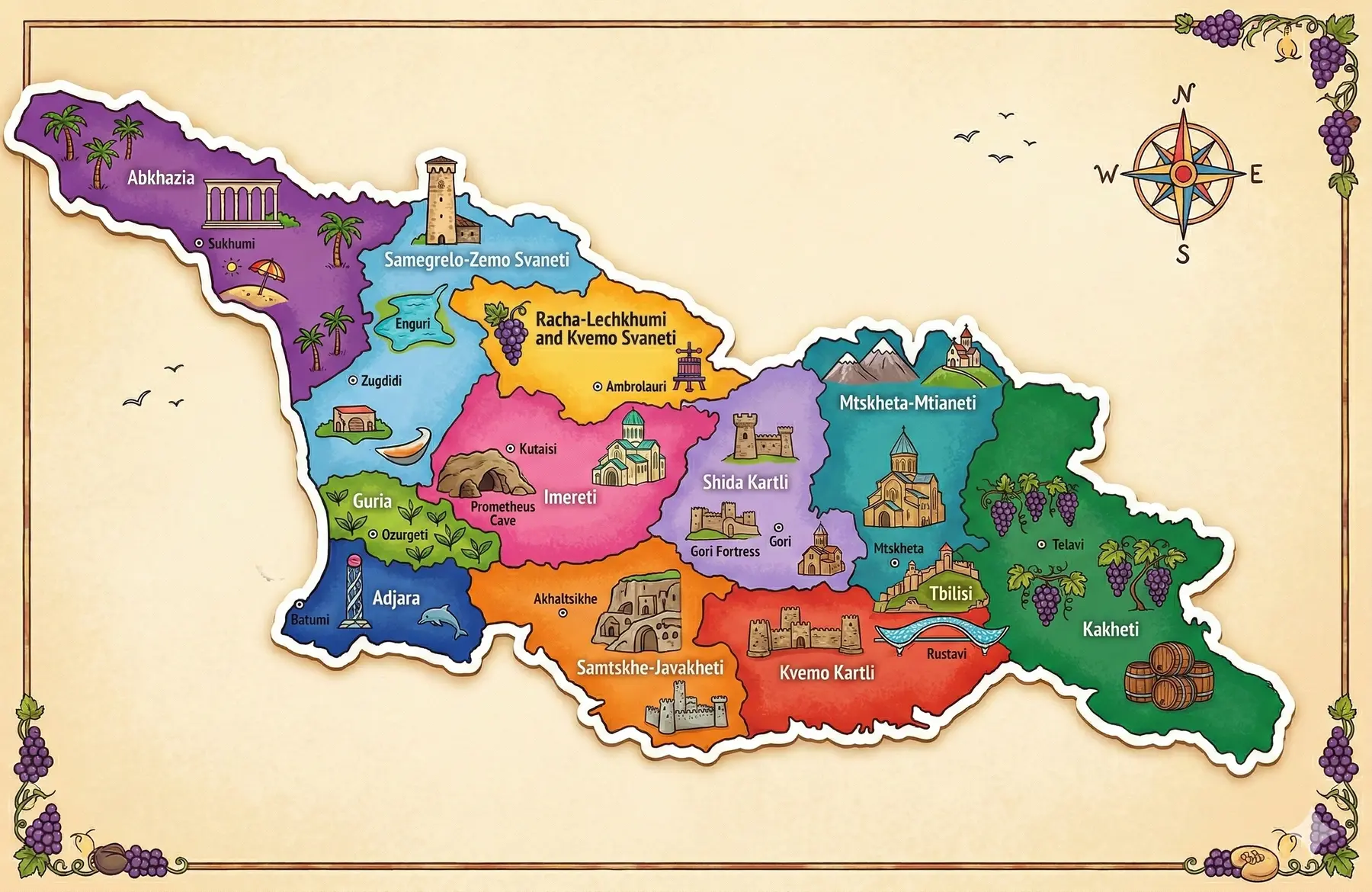
![Essential Travel Tips for Georgia: What First-Time Visitors Actually Need to Know in [current year]](https://www.georgia-tours.eu/wp-content/uploads/2026/03/map-of-georgia-1280x832.webp "Kazbegi Travel Guide: Mount Kazbek, Gergeti Church, and Georgia's Wildest Day Trip 8") Essential Travel Tips for Georgia: What First-Time Visitors Actually Need to Know in 2026
Essential Travel Tips for Georgia: What First-Time Visitors Actually Need to Know in 2026