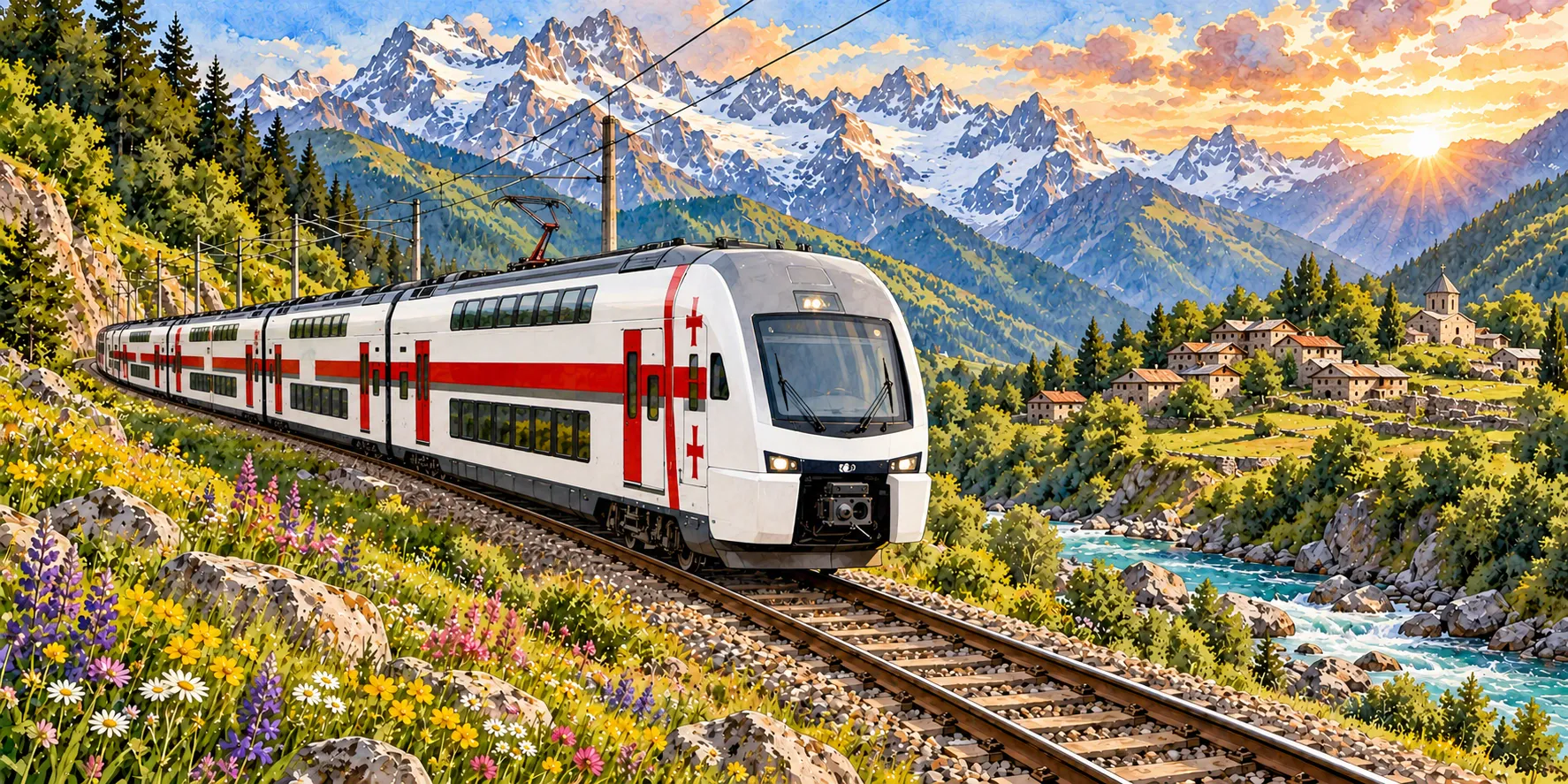
At 08:05 a white-and-red double-decker slides out of Tbilisi Central, and by lunchtime you are smelling salt air in Batumi. Four hours, coast to capital. A year ago the same trip took five and a half.
It has been a big year for Georgian trains. The main line west has been rebuilt, the sleeper to Baku is back after six years, the night train to Yerevan now sells tickets online in plain English, and the little narrow-gauge Kukushka is due to climb to Bakuriani again this winter. None of this makes Georgia a rail country in the way Switzerland is. The network is thin, some trains are museum-grade, and whole regions (Kakheti, Kazbegi, Svaneti) have no passenger service at all. But where the rails do go, the train is often the calmest way to travel.
This guide covers what actually runs in autumn and winter 2026–27, how to buy tickets, what the carriages feel like, and what you need to cross into Armenia or Azerbaijan by rail. Timetables here were checked in October 2026. Georgian Railway adjusts them often, so always confirm your date on the booking site before you build a day around a departure.
Which routes actually run: the network at a glance
Everything domestic is operated by one company, Georgian Railway (GR), and almost everything starts at Tbilisi Central in Tbilisi, the wave-roofed station above Station Square metro. The map is essentially one spine running west to the Black Sea, with branches to Zugdidi, Poti, Ozurgeti and Borjomi, plus two international sleepers heading south and east.
| Route | Train type | Frequency (winter 2026–27) | Time | Fare from |
|---|---|---|---|---|
| Tbilisi – Batumi | Stadler double-decker | 2 daily each way | ~4 h | 35 GEL (II class, online) |
| Tbilisi – Zugdidi | Day train, assigned seats | 1 daily each way | ~5 h | 11 GEL |
| Tbilisi – Poti | Day train, assigned seats | 1 daily each way | ~4.5–5 h | 11 GEL |
| Tbilisi – Ozurgeti | Day train | Every second day | ~6 h | 7 GEL |
| Tbilisi – Borjomi | Old electric commuter | 2 daily each way | ~4 h | 1–2 GEL |
| Kutaisi I – Batumi | Regional | 2 daily each way | ~4 h | 1–2 GEL |
| Tbilisi – Yerevan | International sleeper | Every second night | ~10.5 h | 115 GEL |
| Tbilisi – Baku | International sleeper (Stadler) | Daily; 2 a day from 1 Nov 2026 | ~9.5–10 h | 54 AZN |
| Borjomi – Bakuriani (Kukushka) | Narrow-gauge | Restart announced for December 2026 | ~2.5 h (historically) | Not yet published |
Times for the slower regional trains shift from season to season, so treat them as a guide and check the exact clock time for your date.
A few things you will not find: there is no passenger train to Kakheti (Telavi, Sighnaghi), to Kazbegi in Mtskheta-Mtianeti, to Mestia or to Vardzia. For those, you are on the road, whether by marshrutka, shared taxi or on one of our one-day tours from Tbilisi.
Tbilisi – Batumi: the train most travellers mean
When people say “the train in Georgia”, they mean this one. The Swiss-built Stadler double-deckers run the full width of the country, and since the main line was rehabilitated in summer 2026, the trip takes about four hours instead of five and a half. In August 2026 the railway’s director general confirmed the four-hour time, and the live booking system now sells it that way. For most travellers this is now the best way to reach Batumi and the Adjara coast: faster than a marshrutka, calmer than a day on the highway, and far cheaper than a private transfer.
Out of season the core timetable is just two pairs, every day:
| Train | From → To | Departs | Arrives |
|---|---|---|---|
| 802 | Tbilisi → Batumi | 08:05 | 12:06 |
| 804 | Tbilisi → Batumi | 17:10 | 21:11 |
| 803 | Batumi → Tbilisi | 08:00 | 12:00 |
| 801 | Batumi → Tbilisi | 16:50 | 20:50 |
In summer GR adds extra pairs, including early-morning and occasionally overnight runs, but these come and go during the season. The 2026 extras ended in September and early October. Plan around the four trains above and treat anything else as a bonus.
Fares. Online, a second-class seat costs 35 GEL and first class 75 GEL for the full run; business class (125 GEL) is on the tariff but does not appear on every date. At the counter it is 1 GEL less, because the website adds a small internet fee.
Useful stops. The Stadlers call at only a handful of stations, and one of them is Kopitnari, the station for Kutaisi International Airport. If you have landed on a low-cost flight, you can walk to the platform and be on the coast or in the capital without touching a marshrutka. Kutaisi city centre is about 20 km further, so you still need a taxi or shuttle for that last stretch, or start straight into Imereti with one of our tours from Kutaisi. Upper deck or lower? Upstairs gives you more window and the better view of the beech forests of the Surami Pass and the tea-green hills of Guria; downstairs is closer to the door if you are wrestling a big suitcase.
Book early in summer. From June to August, second-class seats on Friday and Sunday trains vanish within days of going on sale. In winter you can usually buy a day or two ahead.
Beyond Batumi: Zugdidi, Poti, Ozurgeti, Borjomi and Kutaisi
The other domestic routes are slower and less polished, but several solve real travel problems.
- Tbilisi – Zugdidi. The rail gateway to Svaneti, and the usual way independent travellers get to Mestia. A morning train gets you to Zugdidi, the capital of Samegrelo, in time to catch an afternoon marshrutka up to Mestia, and the evening train brings you back. Second class costs 11–15 GEL, first class 23–27 GEL.
- Tbilisi – Poti. A quieter way to reach the coast, and the closest station to Ureki’s black-sand beaches and the Kolkheti wetlands. Same fare band as Zugdidi.
- Tbilisi – Ozurgeti. The line into tea-growing Guria runs only every second day, so check the date as well as the time. Fares are 7–9 GEL.
- Tbilisi – Borjomi. Two old electric trains a day, around 06:35 and 18:35, back at about 06:00 and 16:30. They stop at every halt for roughly four hours and cost 1–2 GEL, which tells you everything. This is a train for people who want the ride itself; anyone in a hurry takes a marshrutka from Didube in about half the time. Tickets are not sold online, so buy them at the station.
- Kutaisi – Batumi. A twice-daily regional train along the Guria coast, handy if you are based in Kutaisi and fancy a day at the sea.
- Commuter lines. Tbilisi – Gardabani (via Rustavi, in Kvemo Kartli), Kutaisi – Sachkhere (via the cable-car town of Chiatura) and Khashuri – Zestafoni are local services. Chiatura is the one worth a detour.
The Kutaisi trap. Despite the name on the map, there is currently no direct Tbilisi – Kutaisi passenger train. Kutaisi’s central station sits on a dead-end branch that long-distance trains skip. You ride a westbound train and get off at Kopitnari (the airport station, on the Stadler) or Rioni (on the slower trains), then take a 20–30 minute taxi into town.
Coming soon, maybe. In April 2026 the government announced a direct Tbilisi – Kutaisi service and the return of Tbilisi – Akhaltsikhe trains, suspended since 2009, with the Akhaltsikhe journey cut to about three hours. Neither had appeared in the published timetable by mid-October 2026. If Akhaltsikhe trains do launch, they will be the first rail link into Samtskhe-Javakheti, toward Vardzia and Rabati Castle, in well over a decade. Until then, our Mystic South Georgia tour covers Borjomi, Rabati and Vardzia by road, so keep an eye on GR’s announcements.
What the trains are like: the comfortable and the less so
Riding Georgian Railway is a bit like walking through a family photo album: one page is glossy and new, the next is faded Soviet sepia. Which page you land on depends entirely on the route.
What works well
- Punctuality. Long-distance trains leave on the minute. If the board says 08:05, the doors close at 08:05, not 08:10.
- The Stadlers. Air conditioning that actually cools in August, power sockets, clean toilets and big windows. Second class is perfectly fine for four hours; first class buys you wider seats and more legroom rather than a different experience.
- Assigned seats. Every long-distance ticket has a carriage and seat number, so there is no scramble on the platform.
- Price. 35 GEL to cross the country is less than many city taxis charge to the airport in Western Europe.
- Safety. Trains are calm, families travel on them constantly, and solo travellers, including women, rarely report problems.
What is less comfortable
- Food. Do not count on a buffet. Bring water and something to eat, especially on the regional lines.
- Wi-Fi. It exists on the Stadler, but it drops out in the mountains. Do not schedule a video call between Khashuri and Zestafoni.
- The commuter trains. The Borjomi line and the other local electrics are old, hard-seated and slow, with no air conditioning in summer and patchy heating in winter. Charming for an hour, tiring for four.
- Luggage space. Racks on the double-deckers fill quickly in summer. A medium suitcase fits; a large one may end up at your feet.
- Language. Announcements are mainly in Georgian, with English on the Stadler. Station staff in Tbilisi and Batumi usually speak some English; at small halts, less so.
- No train where you want it. The biggest discomfort is simply coverage. For Kakheti wine country, the Georgian Military Road or the high Caucasus, the rails will not help you.
| Stadler (Tbilisi – Batumi) | Regional day trains (Zugdidi, Poti, Ozurgeti) | Commuter electrics (Borjomi and others) | |
|---|---|---|---|
| Air conditioning | Yes | Varies | No |
| Power sockets | Yes | Limited | No |
| Seats | Assigned | Assigned | Unreserved benches |
| Buy online | Yes | Yes | No, station only |
| Best for | Fast, comfortable coast trips | Budget trips west, Svaneti connection | Slow scenic ride, local life |
How to buy domestic train tickets
Buying a ticket is easier than it was even two years ago. You have four options:
- Online at gr.com.ge. The official site works in English and accepts foreign Visa and Mastercard. You register, search your route, pick a seat on the carriage plan and receive an e-ticket. Online tickets carry a 1 GEL fee.
- The Georgian Railway mobile app. Same system, same rules, handier on the move.
- Partner sites such as tkt.ge. Useful if gr.com.ge is misbehaving with your card.
- At the station. Ticket desks at Tbilisi Central are on the upper level; there are also self-service payment terminals. This is the only way to buy commuter tickets, such as Borjomi.
Rules worth knowing
- Sales open 20 days before departure, not earlier. If your date does not appear yet, it is simply outside the window.
- You need ID. Each ticket is issued to a named passenger with a passport or ID number, and you must show the same document when boarding.
- Online sales close 10 minutes before departure.
- Refunds: 100% if you return the ticket at least 15 hours before departure, 85% between 4 and 15 hours, and 70% under 4 hours. The commission is never refunded.
- Children under 5 travel free if they do not take their own seat; ages 5 to 10 pay roughly half.
- Lost tickets are not replaced, so keep the e-ticket PDF on your phone and, ideally, a screenshot offline.
Arrive 20–30 minutes early at Tbilisi Central. The platforms are reached by stairs and escalators from the upper concourse, and the station is a shopping mall as well, which can make the first visit confusing.
Prefer not to deal with the booking site? We can buy the tickets for you. For a small commission, our team books Georgian Railway domestic tickets on your behalf: the Batumi Stadler, the Zugdidi train for Mestia, Poti, Ozurgeti and the other domestic routes. Send us your route, date, class and the passport details of each traveller through our contact page, and we will send the e-tickets back. Please note that this service covers Georgian Railway domestic trains only; we do not book the international sleepers to Yerevan or Baku.
The Kukushka: Borjomi to Bakuriani is coming back
The Kukushka (Russian for “little cuckoo”, after the call of its old engines) is Georgia’s only true scenic railway, and after six silent years it is about to run again. On 9 October 2026 Deputy Prime Minister and Economy Minister Mariam Kvrivishvili said rehabilitation of the line was nearing completion and that trains should return in December 2026. The original plan, announced in April, had pointed to January 2027, so a December start is ahead of schedule rather than behind it.
What the line is. A 37 km narrow-gauge railway that climbs from Borjomi, at about 820 metres, to the ski resort of Bakuriani, at roughly 1,700 metres. It opened in January 1902 after four years of building through steep, forested terrain, and it threads through pine woods, over slender bridges and past villages such as Tsaghveri, Tsemi and Libani. In winter the snow turns the whole climb into a moving Christmas card.
What is new. The government’s project covers the track, the rolling stock and five stations along the route. The minister said the new carriages were chosen to suit Bakuriani’s landscape and history, and that the aim was to keep the atmosphere of the old train rather than replace it with something generic.
What we do not know yet. As of mid-October 2026, no timetable, fares or ticketing method has been published. Before the closure, the trip took about two and a half hours, there were two departures a day in each direction, and tickets cost a couple of lari paid on board. Expect the new service to be more organised, and probably pricier.
How to plan for it now
- Reach Borjomi first. Take the slow commuter train from Tbilisi (about four hours) or a marshrutka from Didube (about half that).
- Ride up, not down. Regular riders always recommended the train uphill and a taxi or marshrutka back. The climb is the show; the descent is the same view in reverse, more slowly.
- Arrive early. In the old days the best window seats went to whoever reached the platform first.
- Watch for the official launch. Georgian Railway and the Ministry of Economy will announce the start date and ticket sales. Until then, treat December as a target, not a promise, and keep a road option for Bakuriani in your plan.
Tbilisi – Yerevan: the night train to Armenia
Go to sleep in Georgia, wake up with Mount Ararat filling the window. The Tbilisi – Yerevan sleeper is run by South Caucasus Railway (the Armenian operator) and is the most reliable overland link between the two capitals.
Winter timetable, 2 October 2026 – 13 June 2027
| Train | Route | Runs | Departs | Arrives | Journey |
|---|---|---|---|---|---|
| 371 | Tbilisi → Yerevan | Odd dates (1st, 3rd, 5th…) | 20:00 | 06:35 | 10 h 35 min |
| 372 | Yerevan → Tbilisi | Even dates (2nd, 4th, 6th…) | 21:00 | 07:05 | 10 h 05 min |
On the way the train stops at Sadakhlo (Georgian border) and Ayrum (Armenian border) for about an hour each, then at Vanadzor, Gyumri and Armavir. In summer (mid-June to 1 October), the service becomes Batumi – Yerevan, still running every second night, and passes Tbilisi late in the evening. Months with two odd dates in a row (the 31st and the 1st) break the pattern, so always confirm your exact date.
Classes and fares (winter 2026–27, per person, either direction)
| Class | What you get | Fare |
|---|---|---|
| SV / Lux (1st) | Private 2-berth compartment, both lower berths, travel kit | 218 GEL / 30,300 AMD |
| Coupe Comfort | 4-berth compartment plus tea, coffee, snack and kit | 173 GEL / 23,800 AMD |
| Coupe (2nd) | 4-berth compartment with a lockable door | 147 GEL / 20,300 AMD |
| Platzkart (3rd) | Open sleeper carriage, no doors | 115 GEL / 15,700 AMD |
On board. The carriages date from 2021 and are clean and modern, if a little clinical: air conditioning, sockets and USB ports, a hot-water boiler for tea, and toilets that stay presentable until about the Armenian border. Bedding arrives in sealed packs; you make your own bunk. There is no dining car and nothing to buy, so pack dinner, breakfast and water. Travelling as a couple and want a 4-berth to yourselves? You can buy all four berths, provided each ticket is in a real passenger’s name.
The border is the price of the romance. Expect to be woken, to hand over passports, and sometimes to step off the train for Georgian passport control. Allow two hours in total.
Tbilisi – Baku: back after six years, with one big catch
On 26 May 2026 the first passenger train in six years rolled between Baku and Tbilisi. The old Soviet sleeper is gone; Azerbaijan Railways (ADY) now runs modern Swiss-built Stadler sets with a dining car, Wi-Fi and proper compartments. Demand has been strong enough that a second daily train each way is added from 1 November 2026.
The catch: not everyone can ride it yet. Azerbaijan’s land borders officially stay closed until at least 2 January 2027. The train runs under a special exemption, and ADY sells tickets only to Azerbaijani citizens and to foreigners whose passports allow visa-free entry to Azerbaijan. If you need an e-visa for Azerbaijan, which includes travellers from the US, the EU, the UK and Australia, you cannot currently board this train in either direction and will have to fly. Check the visa-free list on Azerbaijan’s Ministry of Foreign Affairs website before you get your hopes up.
Timetable from 1 November 2026 (Georgia and Azerbaijan share the same time zone)
| Direction | Day train | Overnight train |
|---|---|---|
| Tbilisi → Baku | 11:00 → 20:26 | 22:00 → 07:57 |
| Baku → Tbilisi | 09:10 → 19:11 | 23:00 → 08:41 |
The train calls at Gardabani on the Georgian side, then at Boyuk Kasik (the Azerbaijani border), Agstafa, Ganja, Yevlakh and Bilajari. About two hours are built in for border formalities, which take place on board.
Classes and fares
| Class | What you get | Fare from |
|---|---|---|
| Standard | The cheapest berths, available from 1 November 2026 | 54 AZN (~82 GEL) |
| Comfort | Berth in a shared sleeper compartment, shared bathroom | 85 AZN |
| Comfort Plus | As Comfort, with extra amenities | 123 AZN |
| Luxe | Private 2-berth compartment with its own bathroom | 189 AZN (~295 GEL) |
Fares are pegged to an international tariff in Swiss francs, so they wobble slightly day to day, and they climb as the travel date approaches. Children under 5 ride free.
International tickets and border requirements
The two international trains are sold by different railways through different websites, with different booking windows. Here is how each one works.
| Tbilisi – Yerevan | Tbilisi – Baku | |
|---|---|---|
| Sold by | South Caucasus Railway and Georgian Railway | Azerbaijan Railways (ADY) |
| Website | ticket.railway.am/en or gr.com.ge | ticket.ady.az/en |
| Sales open | 40 days before departure | 90 days before departure |
| Online sales close | 2 hours before departure | Check at booking |
| Who can travel | Anyone with valid entry rights for Armenia and Georgia | Azerbaijani citizens and visa-free nationalities only (until further notice) |
| At the station | Tbilisi Central, upper level, 08:00–20:00; Yerevan station 09:00–18:00 | Tbilisi Central and Baku station, but trains often sell out weeks ahead |
Booking the Yerevan train online
- Register on ticket.railway.am or gr.com.ge. A foreign phone number is fine; you can confirm the account by email.
- Search your date. If you get “route does not exist”, you have picked a day the train does not run (remember the odd/even pattern) or a date beyond the 40-day window.
- Choose your class. On gr.com.ge you can pick specific berths from a seat map for 1 GEL, which is the easiest way to keep a group together.
- Enter each passenger’s name, passport number and date of birth. You can buy up to four tickets per transaction with Visa or Mastercard.
- Download the PDF ticket, print it, and bring it with your passport. In summer, buy as soon as sales open.
Booking the Baku train online
- Create an account on ticket.ady.az with your passport details and confirm it with a one-time code. Some travellers outside the region need a VPN to load the site.
- Read the travel-rules pop-up carefully: it states who may cross the border by rail.
- Book as early as you can. Prices rise as the date approaches, and the train has been selling out weeks in advance.
Documents you need at the border
- Passport valid for your whole trip, with blank pages. Armenian visas, where needed, take a full page.
- Armenia: many nationalities, including EU, UK, US and Australian citizens, enter visa-free. Others can apply for an e-visa in advance or, in many cases, get a visa on arrival at the border.
- Azerbaijan: for the train, you must currently hold a passport that is visa-free for Azerbaijan. Stays over 15 days require registration with the State Migration Service, and drones need prior written permission.
- Georgia (on the way back in): most Western passports enter visa-free for up to a year. Since 1 January 2026, all foreign tourists must also hold health and accident insurance covering their entire stay, and border officers can ask to see it. Keep a copy on your phone and on paper.
- Medication: Georgian customs may ask about prescription drugs. Carry them in original packaging with a doctor’s letter in English or Russian.
- Have your hotel details handy. Armenian and Azerbaijani officers sometimes ask about a recent visit to the other country. There is no rule against visiting both, but answers go faster with addresses and dates written down.
One more thing: the Armenia–Azerbaijan border is closed. Georgia is the hinge of any Caucasus rail trip, so Tbilisi is where you change direction.
Frequently asked questions
Is the train faster than the bus from Tbilisi to Batumi? Yes, now. The Stadler takes about four hours. Marshrutkas from Didube are cheaper but noticeably slower, and driving the highway is a full day once you add stops.
How far ahead can I buy domestic tickets? Up to 20 days before departure, on gr.com.ge, in the Georgian Railway app or at a station.
Do I need to print my ticket? For domestic trains, you board with your ticket and your passport; an e-ticket on your phone generally works, but save a screenshot in case you lose signal. For the Yerevan train, print the PDF; staff on that route still prefer paper.
Can you buy Georgian Railway tickets for me? Yes. For a small commission we book domestic Georgian Railway tickets on your behalf. Contact us with your route, date, class and passport details. We do not sell tickets for the Yerevan or Baku trains.
Is there a train from Tbilisi to Kutaisi? Not a direct one at the moment. Take a westbound train to Kopitnari (the airport station) or Rioni, then a short taxi into the city. A direct service has been announced but was not running as of October 2026.
Is there a train to Kakheti, Kazbegi or Svaneti? No. For Svaneti, the train to Zugdidi plus a marshrutka to Mestia is the classic combination; if you would rather skip the transfers, see our Svaneti tours. Kakheti and Kazbegi are road trips, and Kakheti pairs best with one of our wine tours.
Can I take the train from Tbilisi to Baku on a US, EU or UK passport? Not yet. As of October 2026, only Azerbaijani citizens and visa-free nationalities can buy tickets. Everyone else flies, at least until Azerbaijan reopens its land borders.
Does the Yerevan train run every day? No. In winter it runs every second night: from Tbilisi on odd dates, from Yerevan on even dates.
When does the Kukushka start running again? The Economy Minister has named December 2026. Timetable and fares will be announced by Georgian Railway; until then, keep a road backup for Bakuriani.
Can I bring a bicycle or skis? On the Yerevan train, oversized items such as bicycles and skis need an extra ticket. On domestic routes, check GR’s luggage rules for your train before you travel.
Is it safe to travel by train in Georgia? Yes. Trains are orderly and widely used by families. On sleepers, lock your compartment at night and keep valuables in reach, as you would anywhere.
The view from the window
Somewhere past Khashuri the line starts to climb, the motorway peels away, and for a while there is nothing outside but beech trunks and a river the colour of weak tea. That stretch alone makes the case for the train. It will not take you everywhere, and on some routes it will take you slowly. But between the capital and the sea, and soon again between Borjomi and the snow, it gives you something the road rarely does: time to look. When you want to see the places the rails miss, tell us your dates and we will plan the rest of the route.