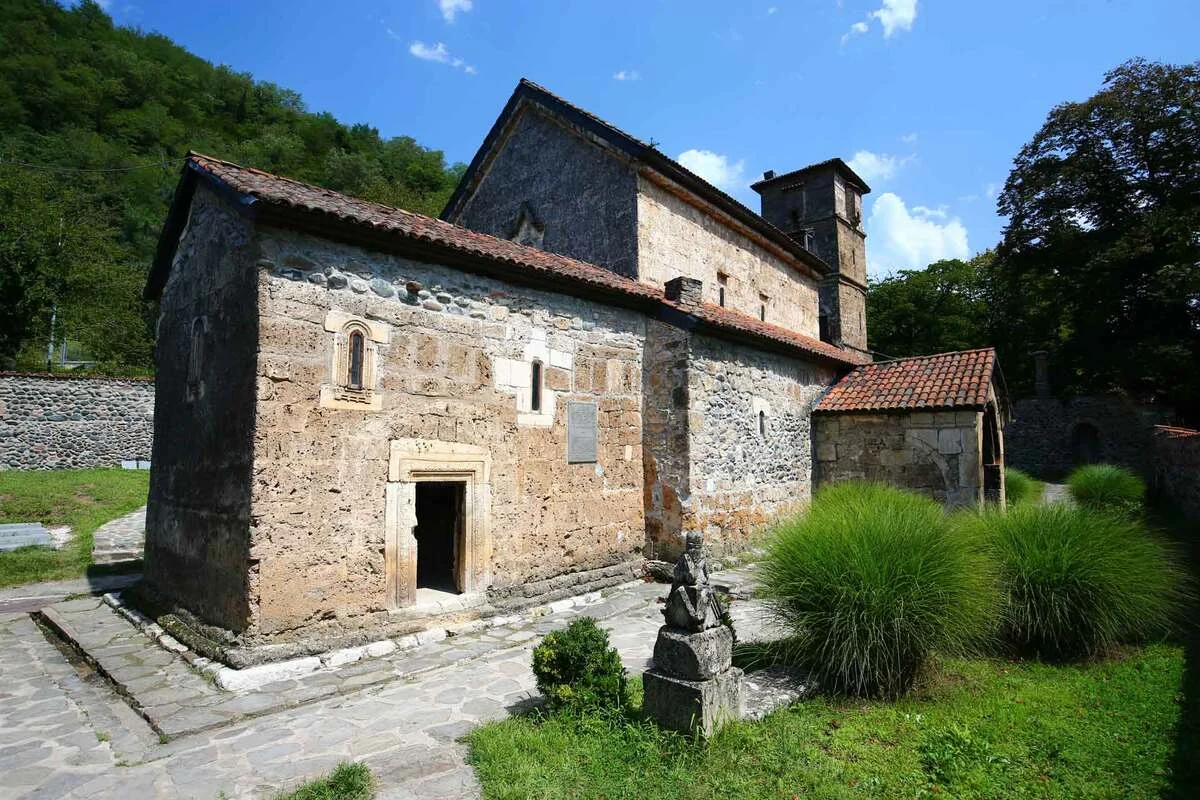
Beside the main road leading into western Georgia stands one of the most easily overlooked artistic treasures in Imereti.
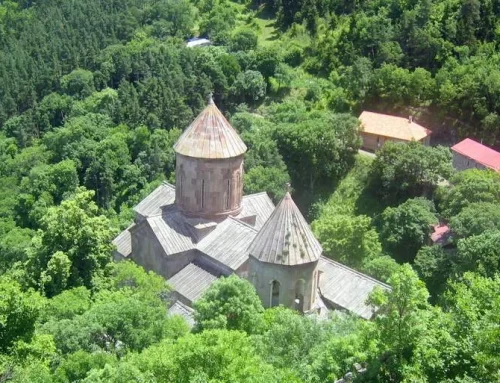
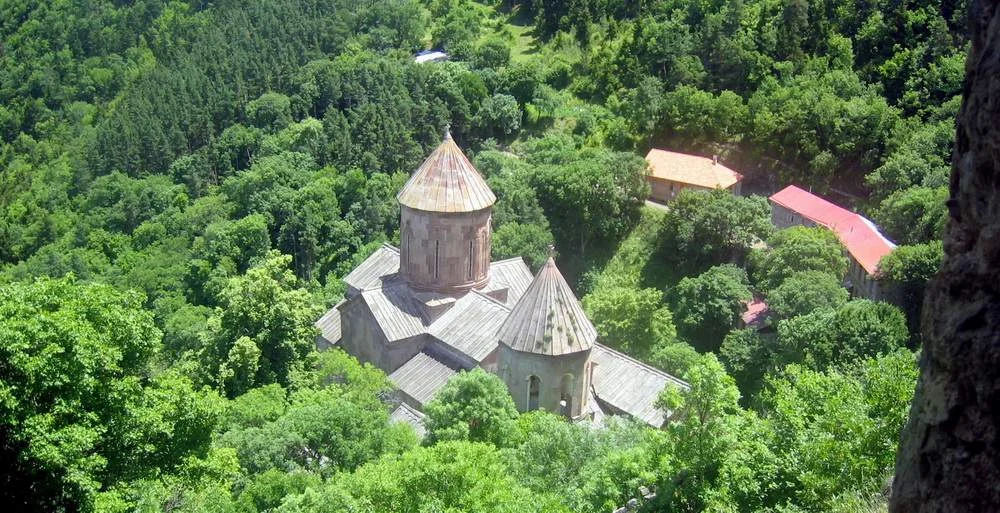
Ubisa Monastery, also written Ubisi Monastery, is a modest medieval complex centred on a 9th-century Church of St George. From the outside, there is little to suggest what waits inside.
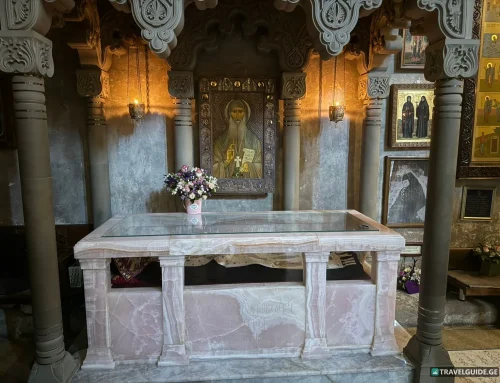
Step through the door, however, and almost every surface of the small church is covered with remarkable 14th-century frescoes associated with the Georgian master Damiane.
For travellers driving between Tbilisi and Kutaisi, Ubisa is one of the most rewarding cultural stops along the route.
It is also included in our 2-Day Western Georgia Cave Tour from Tbilisi, where the monastery provides a historical and artistic contrast to Uplistsikhe and the natural caves of Imereti.
Why Visit Ubisa Monastery?
Most travellers pass Ubisa without realising what is hidden behind its stone walls.
The monastery does not have the monumental scale of Gelati, the dramatic cliff setting of Motsameta, or the skyline presence of Bagrati Cathedral.
Its importance is inside.
The walls of the Church of St George preserve one of Georgia’s most important medieval fresco cycles, painted during the cultural revival of the 14th century.
The monastery also contains:
- a 9th-century church;
- frescoes associated with the master Damiane;
- a remarkably preserved four-storey tower dated to 1141;
- medieval monastic buildings;
- later chapels and family burial structures;
- an active Orthodox community.
For travellers interested in medieval painting rather than only monumental architecture, Ubisa deserves serious attention.
Where Is Ubisa Monastery?
Ubisa is located in the village of Ubisi in the Kharagauli Municipality of Imereti.
It lies close to the principal east–west route connecting Tbilisi with Kutaisi.
This makes it especially convenient as a stop rather than a standalone excursion.
Travellers crossing into western Georgia can combine Ubisa with nearby Shrosha, famous for traditional Georgian ceramics, before continuing toward Kutaisi and the major attractions of Imereti.
The Foundation of Ubisa
Ubisa’s history begins in the 9th century.
The monastery is traditionally associated with St Gregory of Khandzta, one of the most important figures in Georgian monastic history.
Gregory played a central role in the development of the great monastic centres of Tao-Klarjeti and in the broader religious and cultural revival of medieval Georgia.
According to Georgian tradition, the ruler Demetre of Abkhazia asked Gregory to establish a monastery in western Georgia.
Ubisa became part of that wider movement of Georgian monastic expansion.
Georgia Travel likewise identifies the monastery as a 9th-century foundation associated with Grigol Khandzteli, his disciples and King Demetre of the Abkhazians.
The Church of St George
The main church is dedicated to St George and dates from the 9th century.
Architecturally, it is much more restrained than later Georgian cathedrals.
The original building is a small hall church constructed from stone and mortar.
Its exterior is deliberately simple.
Rather than elaborate façade carving, the artistic focus is concentrated inside, where the medieval fresco cycle transforms the otherwise modest interior.
Later centuries brought several additions to the church, including chapels and structures associated with the Abashidze noble family.
Despite these changes, the original medieval core remains clearly visible.
Damiane’s Frescoes
The main reason to visit Ubisa is its extraordinary wall painting.
The frescoes date from the 14th century, during the reign of King George V, known as George the Brilliant.
Georgia Travel identifies the paintings with the artist Damiane and his artistic circle.
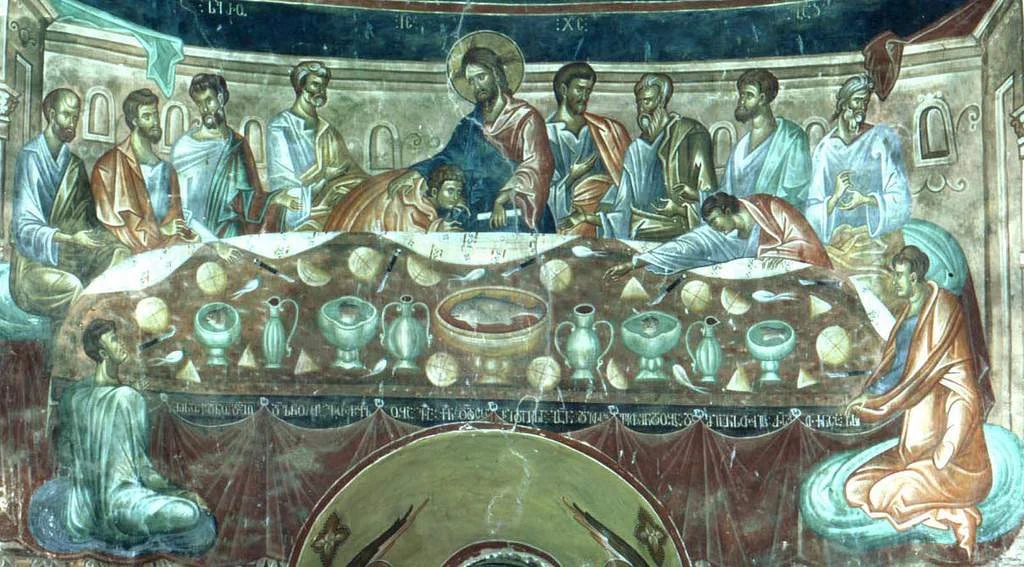
The walls depict major events from the Christian liturgical cycle as well as saints, biblical figures and scenes connected with St George.
Among the most important compositions is the Last Supper.
The paintings are remarkable not simply because of their age but because of their artistic quality.
The Palaeologan Style
Damiane’s frescoes belong to the wider artistic environment usually described as the Palaeologan Renaissance.
This was the final great flourishing of Byzantine artistic culture before the fall of Constantinople.
Compared with earlier, more rigid monumental painting, this style placed greater emphasis on:
- movement;
- emotional expression;
- architectural space;
- individualised faces;
- dynamic compositions;
- greater spatial depth.
At Ubisa, these tendencies were adapted to Georgian artistic traditions.
The result is one of the clearest examples of how medieval Georgian painting participated in broader developments across the Byzantine Christian world.
What to Look for Inside the Church
Do not rush through Ubisa.
The church is relatively small, which makes it possible to examine the fresco programme in considerable detail.
Important scenes include:
- the Last Supper;
- the Annunciation;
- the Nativity;
- the Baptism of Christ;
- the Transfiguration;
- the Raising of Lazarus;
- the Entry into Jerusalem;
- the Crucifixion;
- the Resurrection;
- the Ascension;
- Pentecost;
- the Dormition of the Virgin;
- episodes associated with St George.
Look particularly closely at faces, gestures and interactions between figures.
That expressive quality is one of the defining characteristics of the Ubisa paintings.
Damiane’s Inscriptions
Ubisa is also important because inscriptions preserve the name of the medieval artist.
This is unusual.
Many Georgian medieval painters remain anonymous, while at Ubisa the name Damiane survives within the painted programme.
The inscriptions connect the artwork with an identifiable artist and provide valuable evidence for the study of medieval Georgian monumental painting.
They are one reason Ubisa occupies such a significant position in Georgian art history.
The Medieval Iconostasis
Another unusual feature of the church is its altar screen.
Rather than the type of heavily carved stone iconostasis seen in some Georgian churches, Ubisa preserves a structure closer to the Byzantine templon tradition.
Stone supports carried a horizontal beam separating the sanctuary from the main body of the church.
This architectural feature adds another Byzantine connection to a monument already strongly associated with the broader artistic world of the eastern Mediterranean.
The Tower of 1141
A short distance from the church stands one of Ubisa’s most distinctive structures: a four-storey medieval tower.
An inscription dates it precisely to 1141, during the reign of King Demetrius I, son of David the Builder.
Georgia Travel likewise dates the tower to 1141 and notes its unusual internal arrangement.
Unlike a purely defensive tower, the structure combined several functions.
Its lower level was used for storage, while upper floors contained living and working spaces.
Features include:
- a fireplace;
- storage areas;
- living quarters;
- a primitive medieval toilet;
- spaces for prayer and work;
- an upper defensive level.
This makes the tower particularly valuable because it provides a rare glimpse into the practical side of medieval monastic life.
Svimon Chkondideli
The tower is connected with Svimon Chkondideli, an important ecclesiastical and political figure of 12th-century Georgia.
He held one of the most prestigious church offices in medieval western Georgia and was associated with the royal court.
The construction of such a substantial tower at Ubisa demonstrates that the monastery maintained considerable importance long after its initial 9th-century foundation.
It also connects Ubisa with Georgia’s 12th-century Golden Age.
Later History
Ubisa continued to develop across subsequent centuries.
The Abashidze princely family became important patrons of the monastery, and later chapels and burial spaces were incorporated into the complex.
This accumulation of architectural layers is typical of Georgian monasteries that remained active for centuries.
Rather than representing one moment in history, Ubisa preserves traces of several periods:
- 9th-century monastic foundation;
- 12th-century royal-era construction;
- 14th-century monumental painting;
- later aristocratic patronage;
- modern Orthodox monastic life.
Ubisa Today
Ubisa remains an active Orthodox monastery.
Visitors should therefore treat the church primarily as a living religious site rather than as a museum.
Dress modestly.
Women should generally cover shoulders and knees and may be asked to cover their hair. Men should wear long trousers and avoid sleeveless clothing.
Photography rules can vary.
Ask before photographing inside the church and never use flash on the frescoes.
How Long Do You Need?
A quick stop can be completed in around 30 minutes, but that is not enough if you are genuinely interested in the frescoes.
Allow 60–90 minutes to:
- examine the main fresco cycle;
- walk around the monastery;
- inspect the medieval tower;
- look at later architectural additions;
- appreciate the setting above the Dzirula valley.
The scale of the complex is modest, but the artistic detail rewards slow observation.
Ubisa on the Road from Tbilisi to Kutaisi
One of Ubisa’s greatest advantages is its location.
You do not need to make a major detour.
The monastery lies close to the road connecting eastern and western Georgia and makes an excellent cultural break when travelling toward Kutaisi.
Our 2-Day Western Georgia Cave Tour uses exactly this logic.
After visiting Uplistsikhe and crossing into western Georgia, the itinerary stops at Ubisa before continuing deeper into Imereti.
This gives travellers a chance to experience medieval art between Georgia’s rock-cut archaeology and its natural cave landscapes.
Combine Ubisa with Shrosha
Just west of Ubisa lies Shrosha, one of Georgia’s best-known traditional pottery villages.
Roadside stalls display:
- qvevri;
- clay cooking vessels;
- decorative ceramics;
- traditional household pottery.
Because Shrosha lies on the same route, it combines naturally with Ubisa.
The pairing also works thematically.
Ubisa represents medieval Georgian religious art, while Shrosha preserves a living craft tradition rooted in local clay and generations of pottery production.
Ubisa and Kutaisi
Travellers continuing west can use Kutaisi as a base for exploring the rest of Imereti.
Important historical sites around the city include:
- Gelati Monastery;
- Motsameta Monastery;
- Bagrati Cathedral;
- Sataplia;
- Prometheus Cave.
Your Imereti travel guide already identifies Ubisa alongside Gelati, Motsameta and Bagrati as one of the region’s important churches and monasteries.
Ubisa and Gelati Monastery
Ubisa and Gelati Monastery offer a particularly useful comparison.
Gelati was founded by David the Builder in the early 12th century and became a major royal, religious and intellectual centre.
Its scale and political importance were far greater than Ubisa’s.
Ubisa, however, offers something different.
Its compact Church of St George preserves an extraordinarily concentrated medieval fresco programme, making it especially valuable for visitors interested in painting and iconography.
Visiting both gives a much broader understanding of medieval Georgian religious art.
Explore Imereti from Kutaisi
Ubisa belongs naturally within a wider journey through Imereti.
Travellers staying in Kutaisi can combine monasteries with caves, canyons and natural attractions.
See our tours from Kutaisi for routes through western Georgia.
Ubisa works particularly well either:
- as a stop while travelling between Tbilisi and Kutaisi; or
- as part of a heritage-focused Imereti itinerary.
Visit Ubisa on the 2-Day Western Georgia Cave Tour
Ubisa is included in our 2-Day Western Georgia Cave Tour from Tbilisi.
The journey combines:
- Uplistsikhe;
- Ubisa Monastery;
- Navenakhevi Cave;
- Motsameta;
- Kutaisi;
- the cave landscapes around Tskaltubo.
The result is a route that combines archaeology, medieval art and natural history rather than concentrating on only one type of attraction.
For travellers who want to explore western Georgia beyond a simple transfer from Tbilisi to Kutaisi, it is one of the most relevant existing itineraries for visiting Ubisa.
Why Ubisa Matters
Ubisa deserves more attention than it receives.
Its architecture is modest.
Its location is not dramatic by Georgian standards.
It lacks the international recognition of Gelati or the spectacular setting of many mountain monasteries.
But inside its small church survives one of Georgia’s outstanding ensembles of medieval monumental painting.
The 14th-century frescoes associated with Damiane demonstrate that medieval Georgian artists were participating in—and contributing to—the broader artistic developments of the Byzantine world.
Add the 9th-century foundation, 12th-century tower and long continuity of monastic life, and Ubisa becomes much more than a roadside church.
It is one of the most rewarding cultural stops on the route into western Georgia.
Frequently Asked Questions
Where is Ubisa Monastery?
Ubisa is located in the village of Ubisi in the Kharagauli Municipality of Imereti.
Is it Ubisa or Ubisi Monastery?
Both spellings occur in English. Georgia’s official tourism site uses Ubisi, while Ubisa Monastery is also widely used and is the established form on Georgia-Tours.eu.
When was Ubisa Monastery founded?
The monastery dates to the 9th century and is associated with St Gregory of Khandzta and his disciples.
Who painted the Ubisa frescoes?
The 14th-century paintings are associated with the Georgian medieval master Damiane and his artistic circle.
What is Ubisa Monastery famous for?
It is best known for its exceptionally important 14th-century wall paintings and its well-preserved four-storey medieval tower.
How old is the Ubisa tower?
An inscription dates the tower to 1141.
Can I visit Ubisa while travelling from Tbilisi to Kutaisi?
Yes. Ubisa lies close to the main route into western Georgia and is one of the easiest historical stops to add to the journey.
Is Ubisa included in a Georgia tour?
Yes. It is included in the 2-Day Western Georgia Cave Tour from Tbilisi.
What else can I see near Ubisa?
Shrosha pottery village is nearby. Travellers continuing toward Kutaisi can also visit Gelati Monastery, Motsameta, Bagrati Cathedral, Sataplia and the caves around Tskaltubo.
How long should I spend at Ubisa?
Around 60–90 minutes is ideal if you want to study the frescoes and explore the medieval tower without rushing.