
Svetitskhoveli Cathedral dominates the centre of Mtskheta, Georgia’s ancient capital. The present cathedral was built between 1010 and 1029 on a site associated with the country’s conversion to Christianity, royal ceremonies and one of Georgian Orthodoxy’s most important traditions: the burial of Christ’s robe.
The cathedral is not simply a historic monument. It remains an active place of worship where services, pilgrimages, weddings and religious celebrations continue. This guide explains the documented history, the Living Pillar legend, what to see inside and how to plan a respectful visit from Tbilisi.
Svetitskhoveli Cathedral: quick facts
| Location | Central Mtskheta, approximately 20–25 km from Tbilisi |
|---|---|
| Present cathedral | Built from 1010 to 1029 |
| Architect | Arsukidze |
| Earlier churches | A 4th-century wooden church and a 5th-century stone basilica preceded the current building |
| UNESCO status | Part of the Historical Monuments of Mtskheta, inscribed in 1994 |
| Admission | Normally free; donations are voluntary |
| Time needed | Approximately 45–60 minutes for the cathedral and courtyard |
| Dress code | Covered shoulders and knees; women are generally expected to cover their hair and wear a skirt inside |
| Best combined with | Jvari Monastery, Samtavro Monastery and Mtskheta’s old centre |
Before you go: Svetitskhoveli is an active cathedral, so access, opening times and photography rules can change during services and religious holidays. Follow signs and the instructions of clergy or attendants on the day.
Why Svetitskhoveli matters
Mtskheta was the political and religious centre of the ancient Kingdom of Iberia, which covered much of present-day eastern Georgia. Christian tradition connects the cathedral site with Saint Nino and the royal conversion of King Mirian III and Queen Nana in the 4th century. Later Georgian rulers were crowned or buried at Svetitskhoveli, and the cathedral remains closely associated with the Georgian Orthodox Church. Together with Jvari and Samtavro, it forms the UNESCO-listed Historical Monuments of Mtskheta, recognised for their importance to medieval religious architecture in the Caucasus.The Robe of Christ and the Living Pillar tradition
The story behind Svetitskhoveli belongs to Georgian Orthodox tradition and should be understood as sacred tradition rather than independently verified history.The robe comes to Mtskheta
According to the tradition, a Jewish man from Mtskheta named Elioz was in Jerusalem at the time of the Crucifixion. He obtained Christ’s seamless robe and brought it home. When his sister Sidonia took the garment into her hands, she died and could not be separated from it, so she was buried with the robe.The cedar and the seventh pillar
A cedar was said to have grown over Sidonia’s grave. When Georgia’s first church was constructed on the site in the 4th century, the tree was cut down and used for seven wooden pillars. Six were set in place, but the seventh rose above the ground. After Saint Nino prayed, it descended and gave forth a healing liquid. The name Svetitskhoveli is commonly translated as “Living Pillar” or “Life-Giving Pillar.” Inside the present cathedral, a painted stone structure marks the place associated with the pillar and Sidonia’s grave. The robe itself is not displayed.History of Svetitskhoveli Cathedral
The first churches
A wooden church was established here in the 4th century, during the period traditionally associated with Georgia’s adoption of Christianity. In the 5th century, King Vakhtang Gorgasali replaced it with a larger stone basilica. Archaeological remains of earlier building phases survive beneath and around the current cathedral.Construction of the present cathedral
The building seen today was constructed from 1010 to 1029 under Catholicos Melchizedek I, during the reign of King Giorgi I. Its architect, Arsukidze, created one of the defining monuments of medieval Georgian architecture. A carved hand holding a mason’s tool appears on the exterior beside an inscription naming Arsukidze. A later legend claims that the architect’s hand was cut off after he completed the cathedral so that he could never surpass it. The carving and inscription are real; the punishment story is a legend and should not be presented as established fact.Damage, rebuilding and conservation
Invasions, earthquakes and repeated alterations changed the cathedral over many centuries. Major repairs were carried out at different periods, while much of the original interior painting was lost or covered. The frescoes visible today belong to several phases rather than one complete medieval programme. The fortified wall and towers around the complex are largely associated with reconstruction under King Erekle II in the late 18th century. Modern archaeological and conservation work has helped reveal earlier foundations and protect the surviving fabric.Architecture and exterior details
At about 50 metres high, Svetitskhoveli is one of Georgia’s largest surviving medieval churches. Its cross-domed plan, tall central space and carefully balanced façades demonstrate the technical and artistic confidence of 11th-century Georgian builders.- Stone carving: look for ornamental bands, geometric patterns, crosses, animals and grapevine motifs.
- The architect’s hand: the carved hand and inscription connected with Arsukidze appear high on the exterior.
- Western entrance: entering through the wall gives the clearest sense of the cathedral’s scale within the fortified precinct.
- Asymmetry: rebuilding and later additions mean the exterior is not perfectly uniform; this is part of the monument’s long history.
What to see inside Svetitskhoveli
The Living Pillar shrine
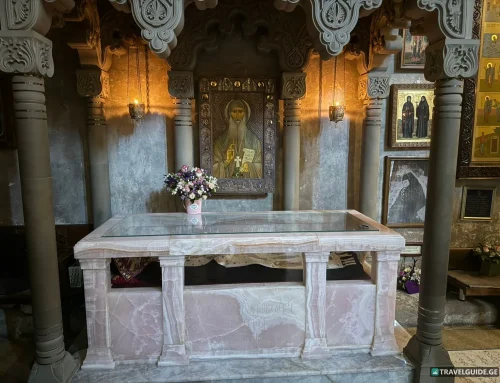
The painted stone canopy in the nave marks the place connected by tradition with Sidonia, Christ’s robe and the miraculous cedar pillar. Its wall paintings illustrate episodes from the story and Georgia’s Christianisation.The symbolic Holy Sepulchre
A small stone structure inside the cathedral symbolically evokes the Church of the Holy Sepulchre in Jerusalem. It expresses Svetitskhoveli’s spiritual connection with the Holy Land; it is not a full architectural replica.Royal tombs
Grave markers in the cathedral recall its role as a royal burial church. Among the rulers associated with the surviving tombs are King Erekle II and Giorgi XII, the last king of Kartli-Kakheti. Walk carefully and avoid standing on marked graves when the interior is crowded.Frescoes and liturgical space
Surviving paintings from different periods cover parts of the pillars, walls and dome. The cathedral can be dim, so pause after entering and allow your eyes to adjust. The iconostasis and sanctuary remain part of an active liturgical space and are not visitor exhibits.Practical visitor information
Opening hours and admission
Svetitskhoveli normally welcomes visitors daily and admission is generally free. Because it is a working cathedral, published hours and visitor access may change for liturgies, weddings, funerals, maintenance and major feast days. Check locally if your schedule depends on entering at a particular time.Dress code
Visitors should cover their shoulders and knees. Women are generally expected to cover their hair and wear a skirt rather than trousers inside the cathedral; men should wear long trousers. Shared scarves and wraps are often available near the entrance, but bringing your own is more comfortable and avoids depending on availability.Photography and behaviour
Photography is often allowed without flash, but temporary signs and instructions from clergy take priority. Do not photograph worshippers at close range, interrupt a service, use a tripod in busy areas or enter roped-off spaces. Keep conversations quiet and silence your phone.Accessibility
The cathedral stands close to central Mtskheta, but the approach includes cobbles and uneven stone. Step-free access may depend on which gate or doorway is open. Travellers with limited mobility should ask their driver or a local attendant about the nearest suitable drop-off point.How to get to Svetitskhoveli from Tbilisi
Mtskheta is approximately 20–25 kilometres from central Tbilisi. The journey commonly takes 30–45 minutes, but urban traffic can make it longer.By taxi or private car
A taxi or private car is the easiest independent option. If you also plan to visit Jvari, agree on the full route, waiting time and return arrangements before departure. App prices and local taxi fares vary by demand, so fixed figures become outdated quickly.By marshrutka
Shared minibuses travel from the Didube transport area towards Mtskheta. Departure points, frequencies and final stops can change, so confirm the correct vehicle and return point locally. Public transport reaches Mtskheta but does not normally climb to Jvari Monastery.By guided tour
A half-day Mtskheta tour from Tbilisi combines Svetitskhoveli with Jvari, Samtavro and the old town without arranging separate transfers. Travellers who want a broader historical route can choose the Mtskheta, Gori and Uplistsikhe tour.What to see near Svetitskhoveli
Jvari Monastery
The late 6th-century Jvari Monastery stands on a ridge above the confluence of the Aragvi and Mtkvari rivers. It is approximately 7 kilometres by road from central Mtskheta. There is no regular public transport to the summit, so most visitors use a taxi, private vehicle or organised tour.Samtavro Monastery
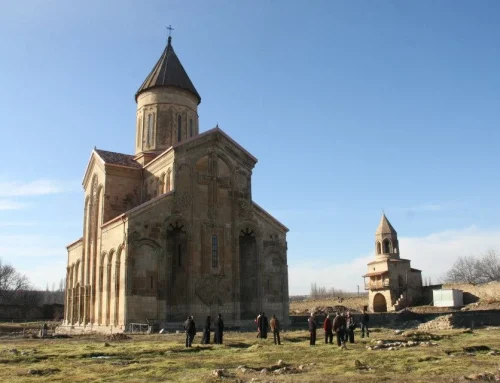
Samtavro is a working convent within walking distance of Svetitskhoveli. The complex is associated with Saint Nino and contains the tombs of King Mirian III and Queen Nana. Dress and behave as you would at the cathedral, and respect the privacy of the resident religious community.Mtskheta old town
The lanes around the cathedral contain cafés, bakeries, wine shops and stalls selling churchkhela and handicrafts. The central area is compact and easy to explore on foot, although cobbles can be uncomfortable in unsuitable shoes.Shio-Mgvime Monastery
Shio-Mgvime lies in a limestone gorge outside Mtskheta and requires a separate road journey. It suits travellers with a full day and a particular interest in monastic history. Arrange a return vehicle rather than expecting to find transport at the monastery.Suggested Mtskheta itineraries
Half-day itinerary
- Begin at Jvari Monastery for the panoramic view over Mtskheta.
- Continue to Svetitskhoveli and allow approximately one hour for the cathedral and courtyard.
- Walk through the old centre and visit Samtavro before returning to Tbilisi.
Full-day itinerary
Spend the morning at Jvari, Svetitskhoveli and Samtavro, then continue to Shio-Mgvime or travel west to Uplistsikhe and Gori. If you are driving north towards Kazbegi, Mtskheta also connects naturally with the Georgian Military Highway, although combining every stop in one day can feel rushed.Best time to visit Svetitskhoveli
The cathedral can be visited throughout the year. Weekday mornings are usually calmer than weekends, when weddings, worshippers and tour groups are more common. Spring and autumn are comfortable for walking around Mtskheta, while summer afternoons can be hot in the exposed streets. October 14 is Svetitskhovloba, the cathedral’s major feast day. It is an important time to experience the site as a living religious centre, but visitors should expect large crowds, traffic restrictions and limited sightseeing access during ceremonies.Frequently asked questions
Is there an entrance fee for Svetitskhoveli Cathedral?
Admission is normally free because Svetitskhoveli is an active Georgian Orthodox cathedral. Donations are voluntary, and paid guiding or transport services are separate.
What are Svetitskhoveli Cathedral’s opening hours?
The cathedral normally welcomes visitors daily, but hours and access can change around services, religious holidays, weddings and maintenance. Check locally if you must enter at a specific time.
What should I wear at Svetitskhoveli Cathedral?
Cover your shoulders and knees. Women are generally expected to cover their hair and wear a skirt inside, while men should wear long trousers. Shared wraps may be available, but bringing your own is preferable.
Is Christ’s robe displayed at Svetitskhoveli?
No. Georgian Orthodox tradition holds that Christ’s robe was buried with Sidonia beneath the cathedral site. The interior shrine marks the place associated with the robe and the Living Pillar story.
Is Svetitskhoveli Cathedral a UNESCO World Heritage Site?
Yes. It is one of the three principal components of the Historical Monuments of Mtskheta, inscribed on the UNESCO World Heritage List in 1994 with Jvari and Samtavro.
How much time do I need at Svetitskhoveli?
Allow approximately 45–60 minutes for the cathedral and courtyard. A half day is better if you also want to visit Jvari, Samtavro and Mtskheta’s old centre.
How do I get to Svetitskhoveli from Tbilisi?
Travel by taxi, private car, marshrutka from the Didube area or guided tour. The journey from central Tbilisi usually takes around 30–45 minutes, depending on traffic.
Can I take photographs inside Svetitskhoveli Cathedral?
Photography is often allowed without flash, but signs and instructions from clergy take priority. Do not photograph worshippers closely or take pictures during a service when asked not to.
Can I visit Svetitskhoveli and Jvari on the same trip?
Yes. They are normally combined because Jvari is about 7 kilometres by road from central Mtskheta. A taxi, private vehicle or guided tour is needed because regular public transport does not climb to Jvari.