
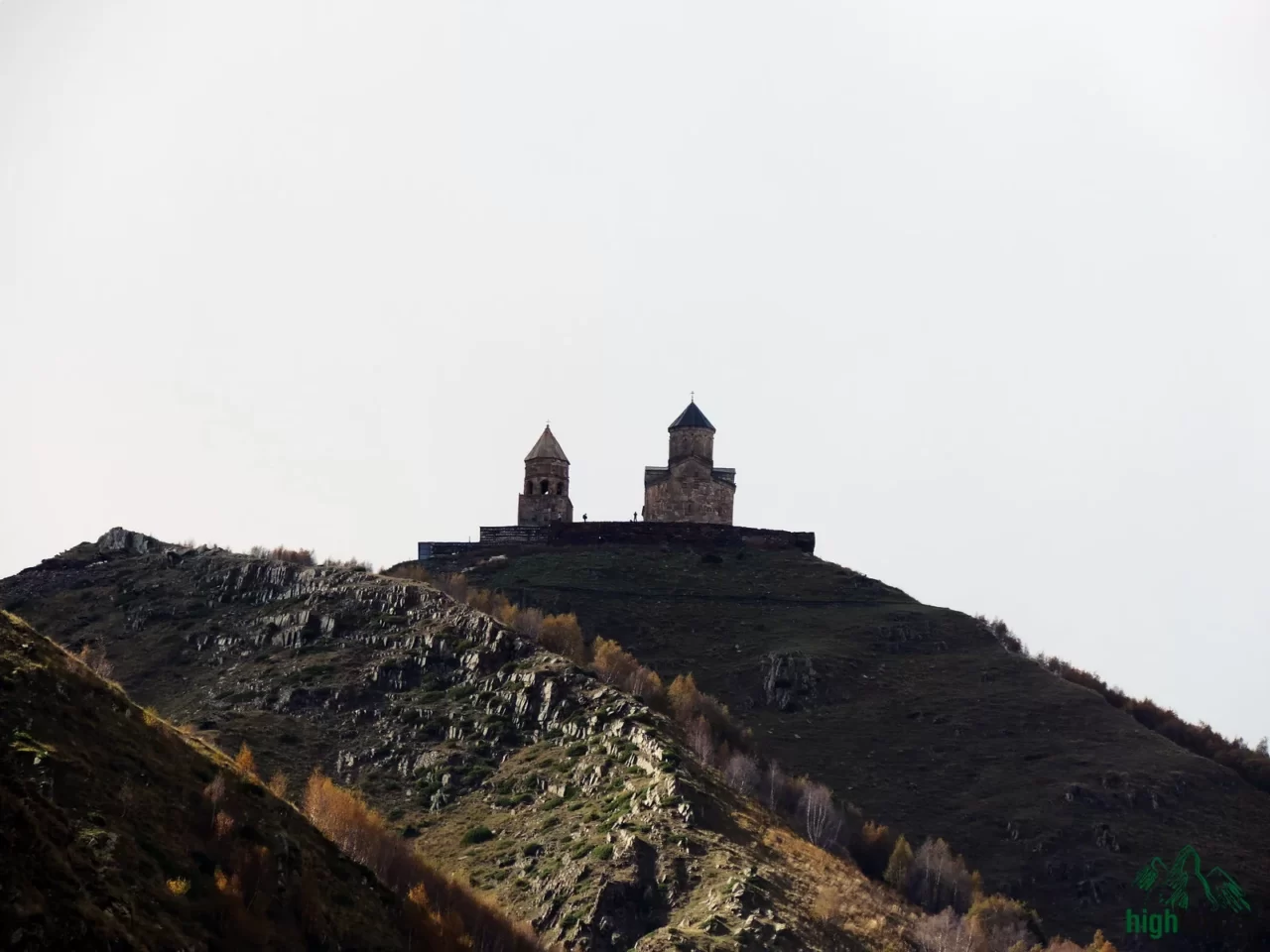
One of the defining images of Georgia is surprisingly simple: a small stone church, a broad sweep of green or snow-covered mountainside, and the enormous white bulk of Mount Kazbek rising behind it.
That church is Gergeti Trinity Church, known in Georgian as Gergetis Sameba. Standing high above Stepantsminda in the Mtskheta-Mtianeti region, it is one of the most recognizable landmarks in the Caucasus and an essential stop on almost any journey along the Georgian Military Highway.
Yet Gergeti is more than a famous photograph. It remains an active Georgian Orthodox church, a historic sanctuary for some of the country’s most treasured religious objects and a place closely tied to the identity of the mountain province of Khevi.
The setting does much of the drama. Gergeti stands at roughly 2,170m above sea level, several hundred metres above Stepantsminda. Across the valley rises Mount Kazbek, or Mkinvartsveri in Georgian, reaching 5,054m.
For travelers, this combination of history, landscape and relatively easy access makes Gergeti one of those rare attractions that largely lives up to the photographs.
Gergeti Trinity Church at a glance
| Location | Above Stepantsminda, Kazbegi Municipality |
| Region | Mtskheta-Mtianeti |
| Elevation | About 2,170–2,200m |
| Built | 14th century |
| Georgian name | Gergetis Sameba |
| Religion | Georgian Orthodox Christianity |
| Main complex | Trinity Church, bell tower and surrounding structures |
| Distance from Stepantsminda | Around 4km from the town area |
| Access | On foot, taxi or vehicle via the mountain road |
| Entrance | Free |
| Typical visit | 45 minutes to 1.5 hours, excluding the hike |
| Best season for easy access | Late spring to early autumn |
| Photography | Excellent outside; photography inside is restricted |
| Dress code | Modest clothing required inside |
The historic complex includes the cross-domed church, a bell tower and an enclosed precinct. The Georgian Encyclopedia dates it to the 14th century and describes Gergeti as the principal shrine of historical Khevi.
Why Gergeti Trinity Church is worth visiting
There are larger churches in Georgia. There are older churches, more richly decorated churches and monasteries containing considerably more elaborate frescoes.
Gergeti’s power comes from somewhere else.
The building seems inseparable from the landscape around it. Walk a few hundred metres away and the walls appear almost impossibly small against Kazbek and the surrounding Caucasus. Stand beside them, however, and the thick grey stone, narrow windows and weather-beaten carvings make perfect sense. This is architecture designed for a hard mountain environment rather than ceremonial grandeur.
The journey is part of the experience too. Walking uphill from Stepantsminda gradually opens views across the Tergi River valley, while arriving by road produces a rather more sudden reveal as the church appears on its high plateau.
Then there is the silence. Visit outside the busiest daytime hours and you may hear little beyond wind, bells and occasional chanting from inside the church.
That atmosphere is why Gergeti deserves more than a quick photo stop.
Historical overview
Gergeti Trinity Church was constructed during the 14th century, although the identity of its architect is unknown. It is particularly significant as the only cross-domed church of this type in historical Khevi, the mountainous district surrounding present-day Stepantsminda.
Its remote location was practical as well as spiritual.
For centuries, Georgia repeatedly faced invasion and political instability. Valuable religious objects from the country’s more exposed churches and cathedrals could be moved into mountain strongholds for safekeeping. Gergeti became one such refuge and was known as a hiding place for treasures associated with Mtskheta, Georgia’s ancient religious capital.
Most famously, the Cross of Saint Nino, one of the most important relics in Georgian Christianity, was kept at Gergeti during periods of danger. Today the relic is housed in Sioni Cathedral in Tbilisi.
Gergeti was not only a church. A meeting hall associated with the complex was used by the elders of Khevi to discuss important community matters, giving the site a civic role alongside its religious one.
Religious activity was suppressed during the Soviet period, when the church was closed as an active place of worship. Following the end of Soviet rule, religious life returned, and Gergeti is once again an active Georgian Orthodox site.
Today pilgrims arrive alongside hikers, photographers and travelers from around the world.
Architecture: simple, solid and unmistakably Georgian
Gergeti does not overwhelm visitors with decoration. In fact, its restraint is one of its strengths.
The church is a traditional Georgian cross-domed structure built from carefully dressed local stone. Its heavy proportions and broad dome give it a solidity that suits the exposed mountain setting.
Look closely at the exterior and you’ll find decorative stonework around entrances and windows, carved crosses and geometric details. Beside the main church stands a separate two-storey bell tower dating from roughly the same medieval period.
The interior feels very different from the panoramic world outside. It is small, dim and austere, with surviving traces of historic religious painting. Georgia’s official tourism portal notes 16th-century religious images associated with the interior.
Don’t expect the ornate interiors of the great cathedrals of Tbilisi or Mtskheta. Gergeti is quieter and more intimate.
That contrast is part of its character.
The view of Mount Kazbek
On a clear day, Mount Kazbek dominates the horizon behind Gergeti.
At 5,054m, it is one of Georgia’s great Caucasus peaks, permanently snow-covered around its upper reaches and surrounded by glaciers. The classic climbing route toward Kazbek also begins in the vicinity of Gergeti before continuing higher into the mountains.
The catch? Kazbek has a habit of disappearing.
Mountain cloud can form quickly, sometimes hiding a summit that was perfectly visible 20 minutes earlier. Travelers who stay overnight in Stepantsminda therefore have a considerable advantage over those rushing through on a day trip: they can wait for the weather to cooperate.
Early morning often brings calmer conditions, but there are no guarantees in the Caucasus.
Even without Kazbek, Gergeti is hardly a wasted journey. Low clouds can transform the church completely, wrapping the ridge in mist and giving it a much more mysterious atmosphere.
How to get to Gergeti Trinity Church
There are three realistic ways to reach the church: walk, take a local taxi or drive.
Hiking from Stepantsminda
For active travelers, walking is the most rewarding option.
Several variations of the route climb from Stepantsminda and the Gergeti side of town. The final ascent is steep enough to raise your pulse but does not require technical hiking skills in normal summer conditions.
Georgia’s tourism authority describes a roughly 30–40 minute uphill walk from the Gergeti side, while travelers beginning farther away in central Stepantsminda should generally allow more time. A relaxed ascent from town can take around one to 1.5 hours, depending on the route, starting point and fitness.
Wear shoes with reasonable grip. After rain, unpaved sections can become muddy and slippery.
The larger benefit of walking is that you see the landscape unfold gradually rather than simply arriving at the car park.
By taxi or 4WD
Local drivers in Stepantsminda make regular trips to Gergeti.
This is the easiest option if you’re short on time, traveling with children or don’t want to tackle the climb. Agree on the price before leaving and clarify whether the driver will wait or whether the fare covers a return journey.
The road from Stepantsminda has been paved, making access considerably easier than it once was. Mountain weather still matters, however, particularly in winter when snow and ice can affect conditions.
Driving yourself
Independent drivers can normally follow the mountain road toward the church when conditions permit.
Take extra care in poor visibility, ice or heavy snow. A road that feels straightforward on a dry summer afternoon can be a different proposition in January.
If you’re renting a vehicle, make sure your rental agreement allows you to use it on the roads you plan to drive.
Hiking up or driving: which is better?
If the weather is good and you are reasonably fit, walk up and take a taxi down.
It is a useful compromise. You get the best part of the hiking experience, enjoy steadily improving views and avoid putting unnecessary pressure on your knees during the descent.
Walk both ways if you have time and enjoy hiking. Drive both ways if Gergeti is one stop in a packed Kazbegi itinerary.
There is no prize for reaching a 2,000m mountain church exhausted.
Best time to visit Gergeti Trinity Church
Gergeti can be visited throughout the year, but each season produces a different experience.
Spring: April to May
Snow begins retreating from the lower slopes while the high Caucasus remain white.
May is particularly attractive as the landscape turns green, although rain, mud and sudden cold spells are still possible.
Summer: June to August
Summer offers the easiest hiking conditions and longest daylight hours.
It is also the busiest period. Tour groups commonly arrive between late morning and mid-afternoon, so an early start makes a noticeable difference.
Bring sun protection even when the air feels cool. At this elevation, strong mountain sunshine can catch visitors by surprise.
Autumn: September to October
Early autumn is arguably the sweet spot.
Days are often comfortable for walking, visitor numbers begin to fall and the valleys take on autumn color. By later October, however, winter conditions can arrive quickly.
Winter: November to March
Snow transforms Gergeti into something close to the postcard version many visitors imagine.
It also introduces real practical complications. Temperatures can be severe, wind is common, daylight is shorter and road or hiking conditions may change rapidly.
Winter visitors should treat suitable footwear and warm layers as essentials rather than optional extras.
What time of day should you go?
For photography and atmosphere, early morning is difficult to beat.
Fewer visitors are around, light can be softer and the mountain air often feels particularly clear. Late afternoon can also be beautiful as the changing sun adds texture to the surrounding slopes.
Midday works perfectly well if you’re primarily interested in sightseeing, but this is when you’re most likely to encounter tour groups.
If you are spending at least one night in Stepantsminda, avoid locking yourself into one precise visiting time. Check the mountain from town. If Kazbek suddenly emerges from cloud, that may be your cue to go.
Visiting the church: etiquette and dress code
Gergeti is an active religious site, not simply a historic monument.
Visitors should dress and behave accordingly. In practical terms:
- Women should bring a scarf to cover the head and wear clothing appropriate for an Orthodox church; wraps may sometimes be available at the entrance.
- Men should wear long trousers rather than shorts and remove hats before entering.
- Keep voices low, particularly while a service is taking place.
- Do not interrupt worshippers or stand directly in front of people praying.
- Photography inside the church is restricted; follow signs and instructions from clergy or attendants.
- Exterior photography around the church and surrounding landscape is normally fine.
Dress requirements at Gergeti have long been clearly signposted, and recent visitor information continues to note restrictions on indoor photography.
A lightweight scarf and an extra layer solve most clothing problems and take almost no room in a daypack.
Opening hours and entrance fee
Admission to Gergeti Trinity Church is free.
Current public listings generally show visitor hours of approximately 9am to 6pm daily, although Gergeti is an active place of worship rather than a conventional ticketed museum. Access can be affected by services, religious celebrations and local circumstances, so confirm locally if your plans depend on a very early or late visit.
The Stepantsminda Tourist Information Center is open daily and is a useful local source for current road, weather and sightseeing information.
Gergetoba: Gergeti’s major religious celebration
One particularly important date is 16 July, when Gergetoba is celebrated at the church.
The feast brings worshippers to Gergeti for religious services and celebrations. Georgia’s official tourism information describes the occasion as involving the arrival of an icon of the Mother of God and a service accompanied by traditional church hymns.
For culturally curious visitors, it can be a memorable day to witness the church functioning primarily as a sacred place rather than a tourist attraction.
The trade-off is obvious: expect many more people than usual and be especially sensitive about photography and personal space.
Photography tips
You do not need professional equipment to photograph Gergeti well. What matters more is where you stand and when you arrive.
The classic composition places the church below Kazbek, but don’t stop there. Walk around the plateau and you’ll find views looking back across Stepantsminda, down the Tergi valley and toward multiple surrounding ridges.
A few practical ideas:
- Arrive early. Softer light and fewer people make compositions easier.
- Give the church some space. Gergeti often looks more dramatic when photographed as a small element within the landscape.
- Wait for moving cloud. Kazbek can appear and disappear quickly.
- Use people for scale. A lone walker beside the church shows just how large the surrounding landscape really is.
- Don’t forget Stepantsminda. The view down into town is almost as impressive as the more famous mountain-facing angle.
If Kazbek is completely hidden, resist the temptation to consider the trip a failure. Fog and storm clouds can make far more atmospheric photographs than a cloudless sky.
What to bring
Gergeti is easy to reach compared with many Caucasus destinations, but it is still a mountain location at more than 2,000m.
For a comfortable visit, carry:
- Walking shoes or hiking footwear with decent grip
- A warm or windproof layer, even in summer
- Water
- Sun protection
- A scarf or suitable covering for entering the church
- A light rain jacket
- Camera or phone with enough battery for the climb
Do not judge conditions solely by the weather in Stepantsminda. The exposed plateau around the church can feel significantly colder and windier.
Can you continue hiking beyond Gergeti?
Yes, and this is where Gergeti changes from sightseeing destination to gateway into the high Caucasus.
Trails continue above the church toward Altihut and higher routes associated with the approach to Mount Kazbek. Altihut stands at around 3,014m, while serious mountaineering routes continue toward the glacier and Kazbek itself.
These should not be confused with the simple hike to the church.
Once you continue substantially above Gergeti, altitude, rapidly changing weather and mountain hazards become increasingly important. The climb of Kazbek is a genuine mountaineering objective involving snow, ice, crevasses and glacier travel; inexperienced climbers should use a qualified mountain guide. Browse our adventure and trekking tours in Georgia for guided mountain options.
For ordinary visitors who simply want a longer walk, even hiking a short distance above the church can provide excellent views before turning back.
What else to see around Stepantsminda
Gergeti may be the headline attraction, but it should not be the only reason you stop in Kazbegi.
Dariali Gorge
North of Stepantsminda, the Georgian Military Highway squeezes into the dramatic Dariali Gorge on its way toward the Georgian-Russian border.
Sheer mountain walls and the rushing Tergi River give this stretch of road an entirely different character from the open valley around Stepantsminda.
Gveleti Waterfalls
The Gveleti waterfalls are among the easiest nature excursions to combine with Gergeti.
The area lies in Dariali Valley north of Stepantsminda, with walking required for the final approach.
Sno
The village of Sno makes a worthwhile stop for its mountain scenery and defensive tower, and it sits on the route toward Juta.
Juta and the Chaukhi Mountains
Travel deeper into the side valleys and the scenery becomes wilder.
Juta is a favorite starting point for walks toward the jagged Chaukhi massif and deserves at least half a day if hiking is one of your reasons for coming to Kazbegi.
Truso Valley
West of the main highway, Truso combines a broad alpine valley with mineral springs, abandoned settlements, historic towers and sweeping walking country.
It is one of the best places in the region to spend a full day away from the busier Gergeti corridor. Mtskheta-Mtianeti’s mountain valleys, including Truso and Dariali, are among the region’s defining landscapes.
How long should you spend in Kazbegi?
Gergeti Trinity Church can technically be visited on a Kazbegi day trip from Tbilisi.
But Kazbegi is much better when you stay overnight.
Georgia’s tourism authority estimates the drive between Tbilisi and Stepantsminda at just under three hours in ordinary conditions. Add stops around Ananuri, Gudauri and the Georgian Military Highway, and a same-day return quickly becomes a long stretch of road travel.
With one night, you gain an evening and a morning to see Gergeti in better light and have another chance if Kazbek is hidden by cloud.
With two nights, you can add a proper trip into Juta, Truso or Dariali without rushing.
For travelers who enjoy hiking, three nights will not feel excessive.
A simple Gergeti and Kazbegi itinerary
If you have one day
Arrive in Stepantsminda in the morning, walk or drive to Gergeti Trinity Church and spend time exploring the plateau. Have lunch back in town, then continue toward Dariali Gorge and Gveleti before returning.
If you have two days
Day 1: Travel from Tbilisi via the Georgian Military Highway, stopping at Ananuri Fortress and viewpoints around Gudauri. Reach Stepantsminda in the afternoon and visit Gergeti near sunset.
Day 2: Visit Gergeti again early if Kazbek is clear, then choose either Juta and the Chaukhi area or the Truso Valley before spending another evening in Stepantsminda.
The second visit to Gergeti may sound repetitive. In changing mountain weather, it often feels like an entirely different place.
Is Gergeti Trinity Church suitable for children?
Yes, particularly if you drive to the church.
Families who choose to hike should remember that the route involves a sustained uphill climb and sections can become slippery after poor weather. How enjoyable it is will depend much more on the children’s experience with walking than their age.
The exposed plateau also means warm layers are useful for young travelers even if Stepantsminda feels pleasant.
Inside the church, children should follow the same respectful behavior expected of all visitors.
Accessibility
The historic complex was not designed with modern accessibility in mind.
Vehicle access makes Gergeti considerably more reachable than it once was, but surfaces around old religious sites can be uneven and steps or thresholds may present difficulties.
Travelers with reduced mobility should discuss current conditions with a local driver or the tourist information center before setting out.
Gergeti Trinity Church in winter
Winter deserves a special mention because this is when the church is at its most spectacular—and potentially its least predictable.
Fresh snow can turn the slopes completely white, while cloud occasionally gathers below the church itself. It is an extraordinary sight.
But winter is not simply summer with snow added.
Road conditions can change, the walking route may be icy and the temperature on the exposed ridge can fall rapidly. If you are not experienced with mountain winter driving, using a local driver is generally the more sensible choice.
Good boots, gloves, wind protection and warm layers matter.
And allow more time than you think you need.
Responsible travel at Gergeti
Gergeti’s popularity has grown enormously, yet the reason the site remains special is precisely because it is not an amusement park or purpose-built viewpoint.
Treat the church first as a religious site and second as a photography location.
Stay on established tracks where possible, take rubbish back to town, avoid blocking entrances for photographs and give worshippers space. If a religious service is underway, observing quietly from the back—or simply waiting outside—is often the most respectful approach.
The best souvenir from Gergeti is the view, not a footprint somewhere it shouldn’t be.
Final thoughts
Plenty of places become famous because a photograph flatters them. Gergeti Trinity Church is one of the exceptions.
The photographs capture only part of the experience.
They cannot quite convey the cold wind crossing the plateau, the sudden appearance of Kazbek through moving cloud, the darkness inside the medieval church after the brightness outdoors or the scale of Stepantsminda hundreds of metres below.
Come for the famous view, certainly. But give Gergeti enough time to become more than a viewpoint.
Walk up if the weather allows. Circle the church rather than taking the same photograph as everyone else. Step inside respectfully. Look down the valley. Wait a few minutes when Kazbek disappears behind cloud.
In the Caucasus, the scenery rarely works to a traveler’s schedule.
Gergeti is better for it.
Frequently Asked Questions
Where is Gergeti Trinity Church?
Gergeti Trinity Church stands on the mountainside above Stepantsminda in Kazbegi Municipality, in Georgia’s Mtskheta-Mtianeti region. It is approximately 2,170 metres above sea level.
How old is Gergeti Trinity Church?
The church dates from the 14th century. Its historic complex also includes a medieval bell tower and an enclosed precinct.
Is Gergeti Trinity Church free to visit?
Yes. There is normally no general admission charge. Because it is an active place of worship, access may occasionally be affected by services or religious celebrations.
How long does it take to walk to Gergeti Trinity Church?
The final climb from the Gergeti side can take around 30–40 minutes. Starting in central Stepantsminda, allow approximately one to 1.5 hours depending on your route, fitness and conditions.
Can you drive to Gergeti Trinity Church?
Yes. A paved mountain road connects Stepantsminda with the church, and local taxis regularly make the journey. Snow, ice or poor visibility can still affect access in winter.
What should I wear at Gergeti Trinity Church?
Wear modest clothing suitable for an active Georgian Orthodox church. Cover shoulders and knees; women may be asked to cover their hair, while men should remove hats before entering.
Can I take photographs inside the church?
Exterior photography is normally permitted, but photography inside the church is restricted. Follow all signs and instructions from clergy or attendants.
When is the best time to visit Gergeti?
Late spring to early autumn usually offers the easiest walking and driving conditions. Visit early in the morning for softer light and fewer people. Winter is beautiful but requires preparation for snow, ice, wind and cold.
Is Gergeti worth visiting when Mount Kazbek is cloudy?
Yes. The medieval church, plateau and views over Stepantsminda remain impressive without a clear view of Kazbek. Mist and low cloud can create an especially atmospheric landscape.
Ready to see Gergeti for yourself? Explore our Kazbegi tour from Tbilisi, with stops along the Georgian Military Highway, or browse all private tours in Georgia to create a longer mountain itinerary.





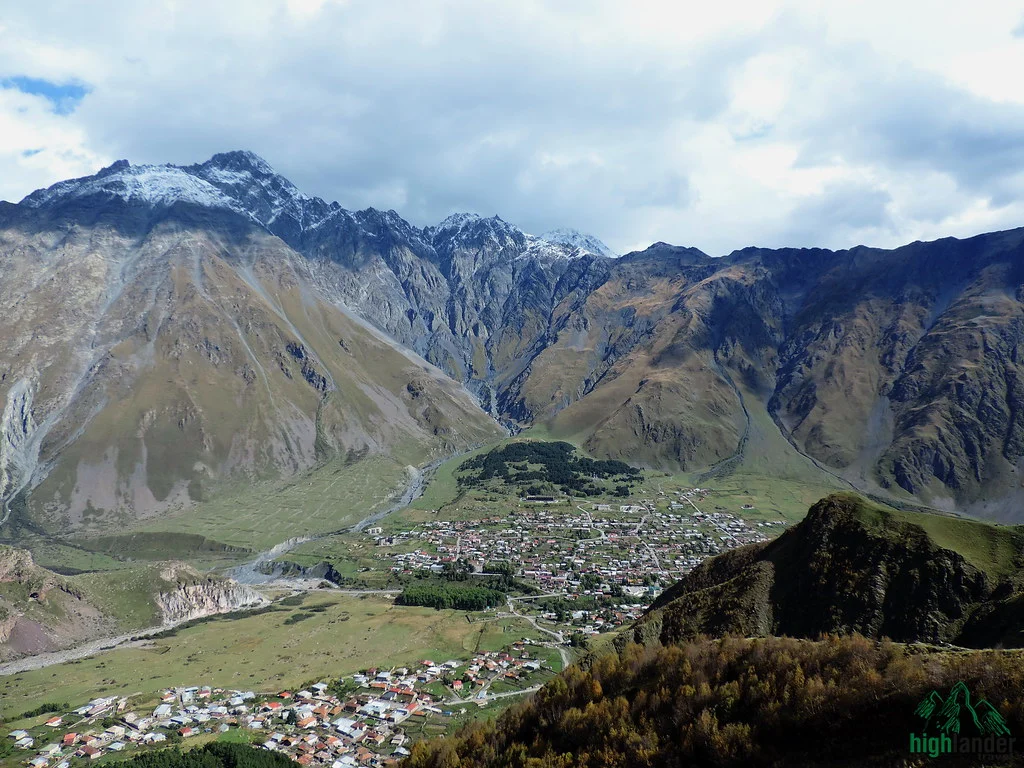
[…] in Georgia. Set in the Greater Caucasus beneath Mount Kazbek, it is the main base for visiting Gergeti Trinity Church, hiking near Juta, exploring Truso Valley and discovering the waterfalls and gorges of northern […]