
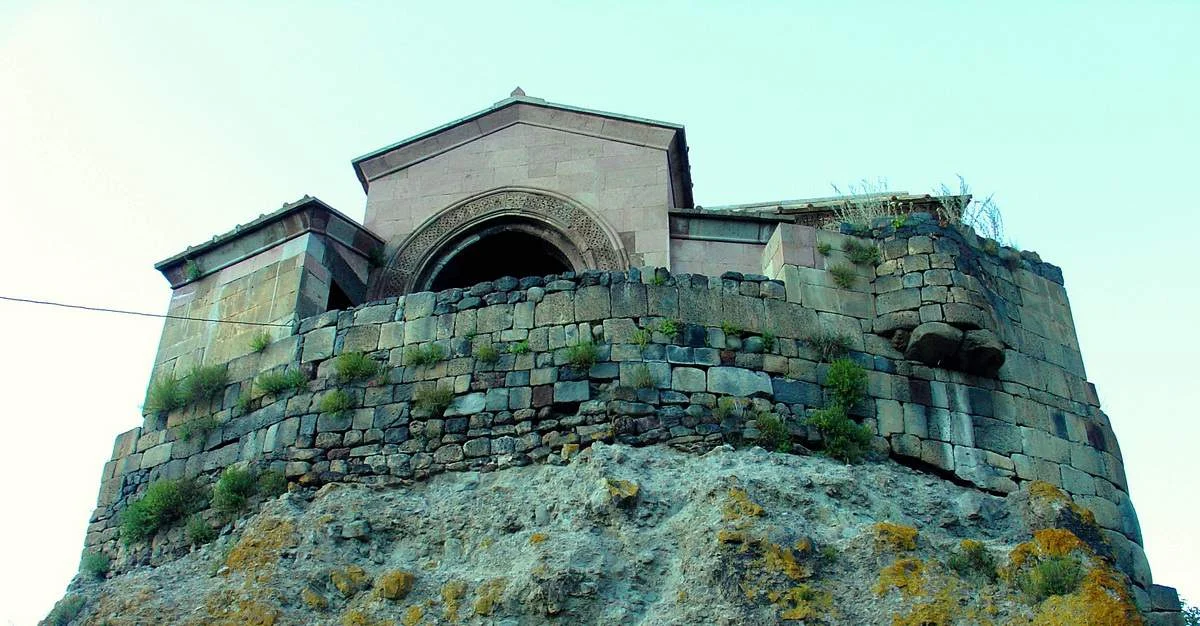
Only around 7 km from Vardzia, on a rocky terrace above the Mtkvari Valley, stands one of the quieter medieval monuments of Samtskhe-Javakheti.
Tsunda Church, dedicated to St John the Baptist, was built during Georgia’s medieval Golden Age on a site associated with the much older settlement of Tsunda.
Unlike Vardzia, with its vast network of rock-cut chambers and passages, Tsunda is intimate and understated: a small stone church surrounded by terraced fields, orchards, cliffs and the historical landscape of the upper Mtkvari Valley.
It is also included in our 2-Day Vardzia Tour from Tbilisi, where Tsunda is visited after exploring Vardzia itself.
Where Is Tsunda?
Tsunda is located in Aspindza Municipality, in the Samtskhe-Javakheti region.
The church stands approximately 7 km from Vardzia Cave Monastery, close to the village of Tmogvi and the Mtkvari River.
This section of the valley contains an extraordinary concentration of historical monuments.
Within a relatively short distance are:
- Vardzia
- Vanis Kvabebi
- Tmogvi Fortress
- Khertvisi Fortress
- Upper Vardzia
- medieval villages and cave sites
The current Samtskhe-Javakheti travel guide lists Tsunda among the region’s important churches and monasteries.
The Ancient Settlement of Tsunda
The history of Tsunda began long before the surviving medieval church was constructed.
Georgian historical tradition describes Tsunda as an important settlement and religious centre in the upper Mtkvari Valley.
The medieval church therefore stands within a much older cultural landscape.
Very little of the ancient city is immediately obvious to the casual visitor today, but the location itself helps explain why a settlement developed here.
The elevated position overlooks the river valley and stands close to routes connecting the Javakheti highlands with southern and central Georgia.
As Tsunda declined, nearby Tmogvi Fortress became increasingly important as a strategic centre controlling movement through the valley.
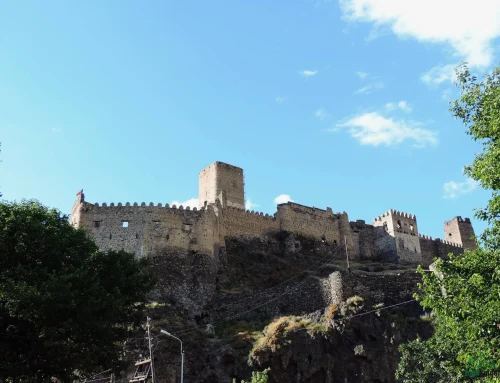
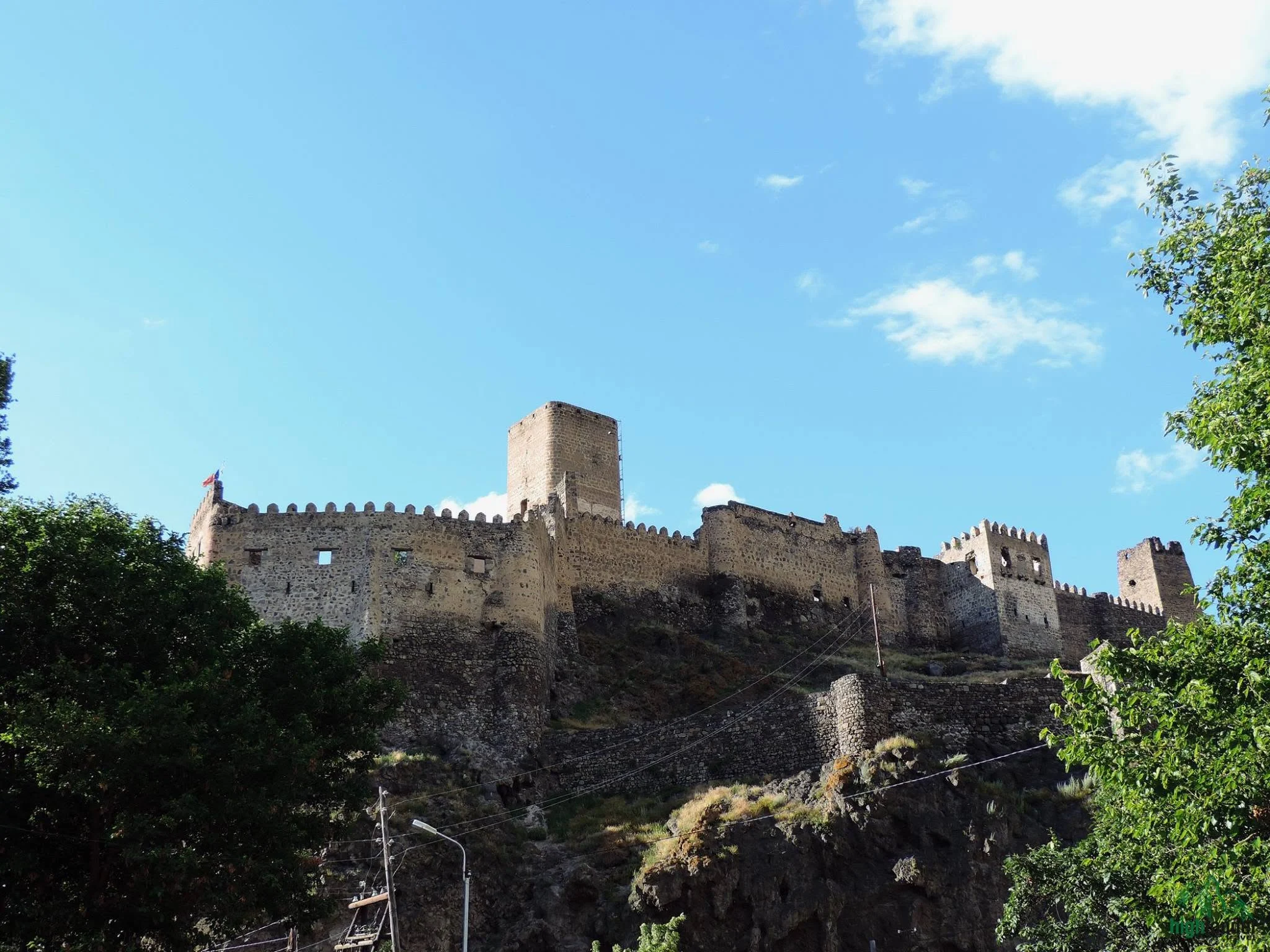
Today, the ruins of Tmogvi remain visible dramatically positioned above the Mtkvari.
Tsunda During Georgia’s Golden Age
The surviving Church of St John the Baptist belongs to the late 12th or early 13th century, the period associated with the reign of Queen Tamar.
This was one of the most important cultural periods in Georgian history.
The kingdom reached the height of its medieval political influence, while architecture, monumental painting, literature and monastic culture flourished.
Nearby Vardzia developed into one of the defining monuments of this period.
Tsunda belongs to the same broader historical landscape, but on a much smaller scale.
Instead of a royal monastery, it represents the patronage of Georgia’s medieval nobility.
Ichkit Gurgenisdze – Patron of Tsunda
The church is associated with Ichkit Gurgenisdze, also referred to in the surviving inscription as Ichkitman, son of Gurgen.
He belonged to a powerful local noble family active in Javakheti around the transition from the 12th to the 13th century.
His name is also connected with Vanis Kvabebi, another important cave monastery farther along the Mtkvari Valley.
That relationship makes Tsunda and Vanis Kvabebi especially interesting to visit together.
Both sites reflect aristocratic patronage during the same broad period, while their architecture could hardly be more different.
Vanis Kvabebi is carved dramatically into a cliff.
Tsunda is a compact masonry church integrated into an agricultural landscape.
The Foundation Inscription
One of the most important historical features of Tsunda is the inscription above the western entrance.
Written in Asomtavruli, the monumental form of the Georgian script used extensively in medieval inscriptions, it identifies the church’s patron and dedication.
The inscription states that Ichkit, son of Gurgen, built the church of St John the Baptist and associates the foundation with prayers for himself and his parents.
Because the exact construction year is not preserved, the lettering and architectural style are important evidence for dating the building to approximately the late 12th or early 13th century.
Architecture of Tsunda Church
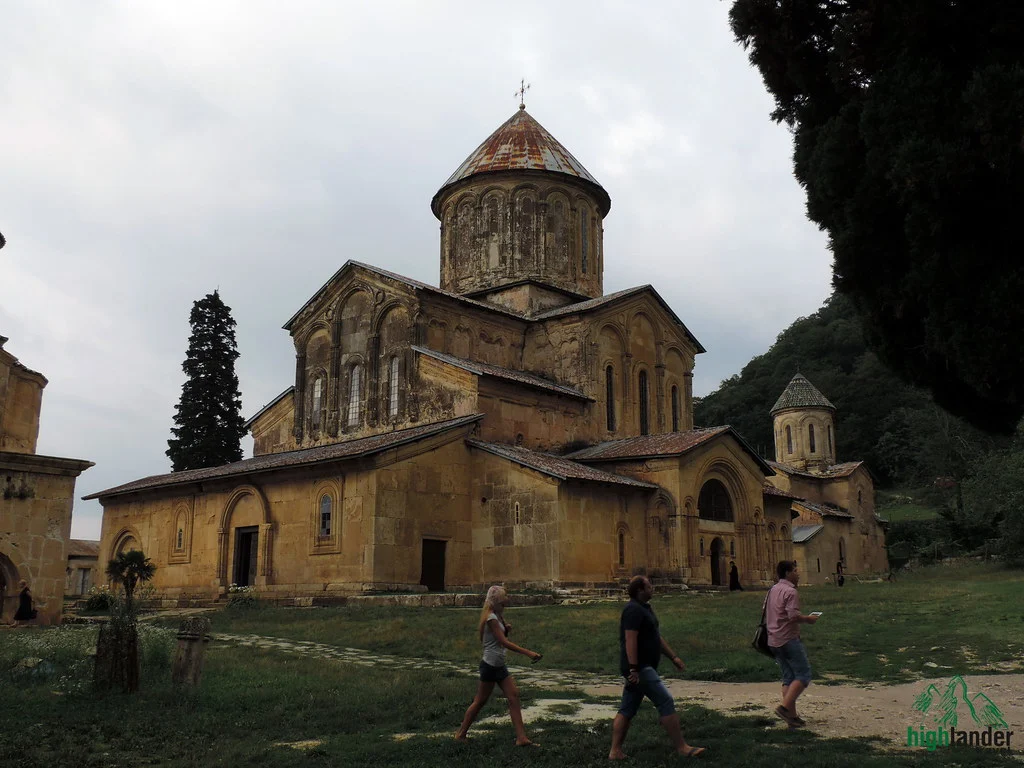
Tsunda is a hall church, one of the simplest and most widespread forms of Georgian medieval ecclesiastical architecture.
The building consists primarily of:
- a single nave;
- barrel vaulting;
- a semicircular sanctuary apse;
- carefully dressed masonry;
- carved door and window frames.
Its plan is considerably simpler than the sophisticated rock-cut architecture of Vardzia or the great domed cathedrals of medieval Georgia.
Yet simplicity is part of Tsunda’s strength.
The proportions are carefully controlled, while the precision of the stonework gives the church a sense of refinement despite its modest scale.
Stone Carving
Tsunda’s decoration is restrained rather than lavish.
Carved details appear mainly around doors, windows and architectural framing.
Among the decorative motifs are vegetal forms and bunches of grapes — imagery with strong associations in Georgian Christian art.
Grapes and vines carried obvious Eucharistic symbolism, but they were also deeply connected with Georgia’s long viticultural tradition.
Because the façades are relatively simple, these small carved elements are more noticeable when examined at close range.
The Crypt
One of Tsunda’s unusual features is a lower chamber or crypt beneath the church.
Its precise historical function is less certain than the main architectural elements.
It may have been associated with burial or memorial use, potentially reflecting the church’s character as a privately sponsored aristocratic foundation.
Visitors interested in Georgian medieval architecture will find this particularly interesting because such lower spaces are not universal in smaller Georgian churches.
Later Additions
Tsunda did not remain completely unchanged after its original construction.
The entrance portal and several elements of the surrounding complex appear to belong to later medieval building phases.
Structures including walls, gateways and auxiliary spaces gradually created a small enclosed ecclesiastical compound around the church.
These later additions show that Tsunda continued to function after its initial foundation.
The Landscape Around Tsunda
Architecture alone does not explain the appeal of Tsunda.
The setting is one of the reasons the place is memorable.
The church stands above the Mtkvari Valley, surrounded by rocky slopes, cultivated terraces and orchards.
Across the landscape rise the cliffs associated with Tmogvi, while Vardzia lies only a few kilometres away.
The church seems proportioned specifically for this landscape rather than designed to dominate it.
For travellers who enjoy photography, the relationship between medieval architecture, agricultural terraces and the volcanic landscape is often as interesting as the church itself.
Natural Hot Springs near Tsunda
The Tsunda area is also known for natural mineral springs.
These are not developed as a formal resort comparable with Borjomi.
Conditions can be rustic, and access can change.
Travellers interested specifically in the springs should therefore check locally rather than assuming there will be maintained pools or tourist infrastructure.
The springs nevertheless add another layer to a valley already rich in archaeology, medieval architecture and unusual geology.
Tsunda and Vardzia
The most natural combination is Tsunda with Vardzia.
Vardzia is one of Georgia’s great medieval monuments: a multi-level rock-cut monastery created mainly in the 12th century under King Giorgi III and Queen Tamar.
Tsunda offers the opposite experience.
Where Vardzia is monumental, complex and increasingly busy, Tsunda is compact and usually quiet.
Visiting the two on the same day helps show the range of architecture produced in medieval southern Georgia — from royal rock-cut complexes to privately sponsored village churches.
Visit Tsunda on Our 2-Day Vardzia Tour
Tsunda is now included as a standard stop on our 2-Day Vardzia Tour from Tbilisi.
The tour spends the night near Vardzia rather than attempting the exhausting 500-km-plus return journey in a single day.
On the second morning, travellers have two to three hours to explore Vardzia before continuing to Tsunda.
This is the most natural way to visit the church because it places Tsunda within its proper historical context rather than treating it as an isolated roadside monument.
Tsunda, Vanis Kvabebi and Tmogvi
Travellers with a deeper interest in medieval Georgia should also look beyond Vardzia.
Nearby Vanis Kvabebi is an older cave monastery whose history is connected with the same aristocratic environment associated with Tsunda.
Nearby Tmogvi represents another dimension of the region’s history.
Its ruined fortress dominates a dramatic section of the Mtkvari Gorge and controlled important routes across southern Georgia.
Together, these sites show that Vardzia was never isolated.
The entire valley functioned as a dense historical landscape of monasteries, fortresses, settlements and agricultural communities.
Khertvisi Fortress
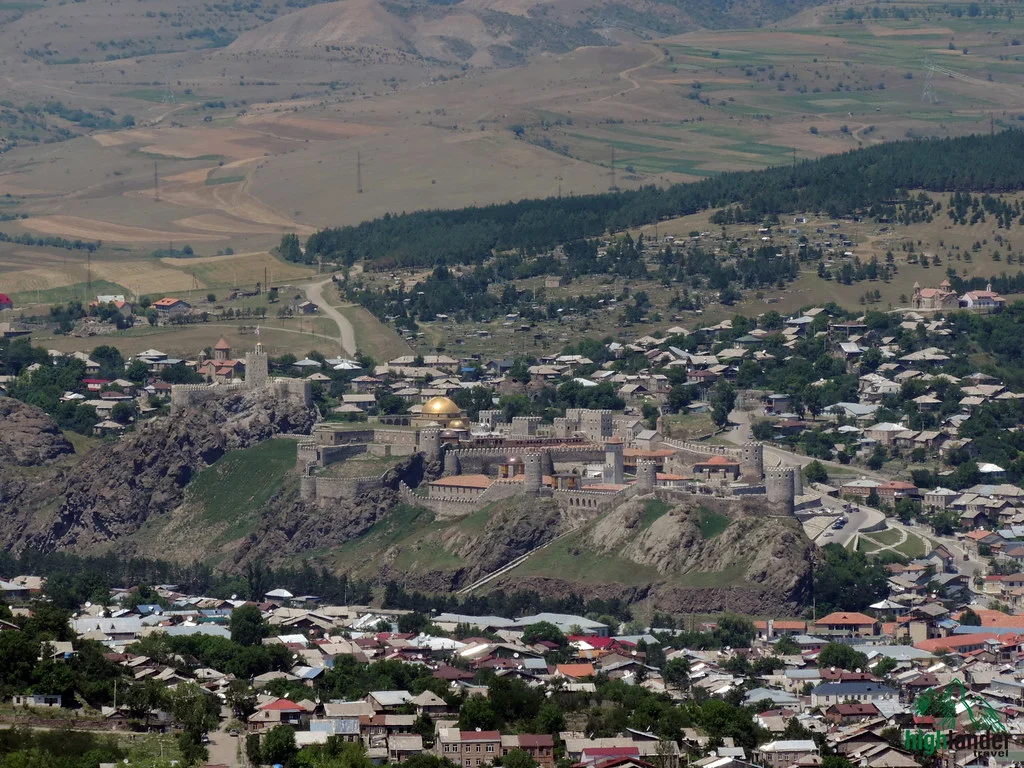
Farther down the valley stands Khertvisi Fortress, positioned above the confluence of the Mtkvari and Paravani rivers.
Khertvisi is also included in the 2-Day Vardzia Tour.
Its strategic setting helps explain why fortresses developed throughout this corridor.
Visitors travelling from Akhaltsikhe toward Vardzia therefore move through a sequence of historical environments:
Khertvisi → upper Mtkvari valley → Tsunda and Tmogvi → Vardzia.
This is one of the strongest history-focused routes in southern Georgia.
A Longer South Georgia Itinerary
Travellers who want more than the standard Vardzia route can consider our 4-Day Mystic South Georgia Tour.
The current itinerary explores Vardzia, Vanis Kvabebi, Upper Tmogvi, Khertvisi, the Javakheti Plateau, Sapara, Borjomi and other lesser-known sites.
Tsunda is not presently listed as a standard stop on that published itinerary, but because it lies within the same Vardzia–Tmogvi area, it is a logical site to discuss when planning a customized history-focused route.
When to Visit Tsunda
Spring
Late April through June is one of the most attractive periods.
The valley is greener, orchard trees may be flowering and temperatures are usually comfortable for exploring.
Summer
Summer offers reliable access but midday temperatures in the valley can become hot.
Morning or late afternoon is more pleasant.
Autumn
September and October are excellent.
The light is softer, temperatures are comfortable and the surrounding agricultural landscape becomes especially attractive.
Winter
The church may still be accessible, but conditions in southern Georgia can change quickly.
Snow and ice can affect regional roads, particularly if the journey continues onto the higher Javakheti Plateau.
Practical Information
Tsunda is a quiet historical monument without the extensive visitor infrastructure found at Vardzia.
Do not expect:
- a large visitor centre;
- cafés;
- organised guiding at the entrance;
- souvenir shops.
That is part of its appeal.
Allow around 30–45 minutes for the church and surrounding landscape.
Visitors should dress respectfully when entering the church.
Why Visit Tsunda?
Tsunda is not designed to compete with Vardzia.
That is exactly why it works so well as a complementary stop.
Vardzia shows medieval Georgia at royal scale.
Tsunda shows the same period through a much smaller aristocratic foundation.
Its carved inscription connects the building with a named patron. Its position links it to the older settlement of Tsunda and the fortress landscape of Tmogvi. Its architecture demonstrates the quality Georgian builders could achieve even in a relatively modest hall church.
And because relatively few travellers stop here, it remains possible to experience the site without the crowds found at Georgia’s most famous monuments.
For anyone travelling to Vardzia, Tsunda is one of the easiest ways to add historical depth to the journey.
Frequently Asked Questions
Where is Tsunda Church?
Tsunda is located in Aspindza Municipality in the Samtskhe-Javakheti region, close to Vardzia and Tmogvi.
How far is Tsunda from Vardzia?
Tsunda is approximately 7 km from Vardzia.
When was Tsunda Church built?
The surviving church is generally dated to the late 12th or early 13th century, during the period associated with Queen Tamar.
Who built Tsunda Church?
The foundation inscription identifies Ichkit, son of Gurgen, generally known as Ichkit Gurgenisdze, as the patron.
Who is the church dedicated to?
Tsunda Church is dedicated to St John the Baptist.
Was Tsunda once a city?
Georgian historical tradition describes Tsunda as an important older settlement in this part of the Mtkvari Valley. The surviving medieval church represents a later phase in the long history of the site.
Are there hot springs near Tsunda?
Yes, natural mineral springs occur in the area, although they should not be expected to have formal spa infrastructure.
Is Tsunda included in the Vardzia tour?
Yes. Tsunda is currently included in our 2-Day Vardzia Tour from Tbilisi and is visited after Vardzia on Day 2.
What else should I see near Tsunda?
The main nearby historical sites are Vardzia, Vanis Kvabebi, Tmogvi Fortress and Khertvisi Fortress.
Is Tsunda worth visiting if I am already visiting Vardzia?
Yes. Tsunda takes relatively little additional time and provides a much more intimate example of medieval Georgian architecture than Vardzia’s monumental cave complex.


[…] Tsunda Church […]