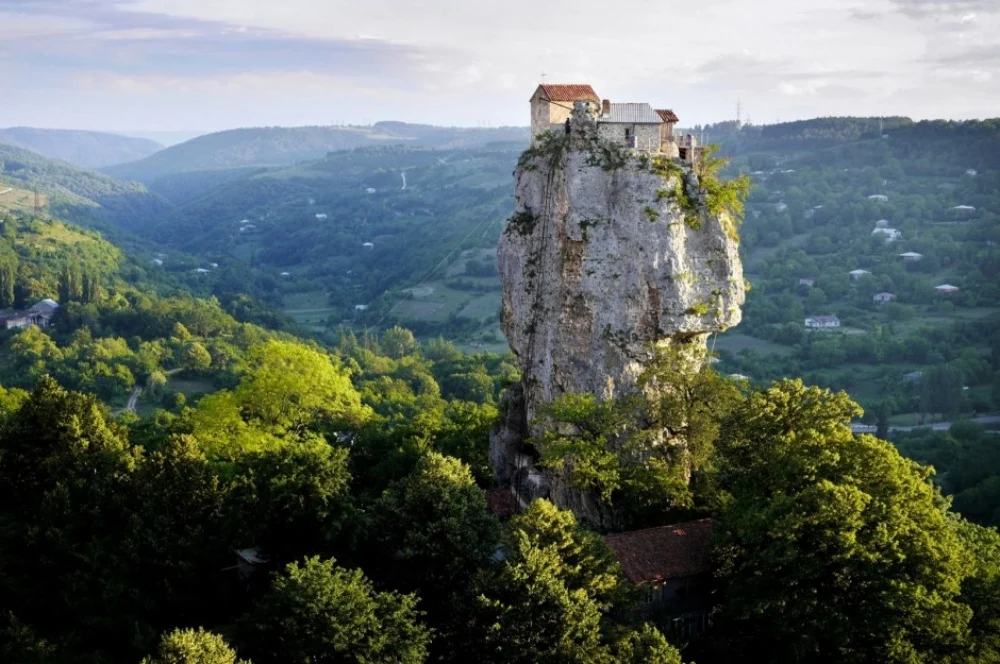
Katskhi Pillar is a natural limestone monolith near Chiatura, crowned by a restored church and hermit cells. Archaeological research dates the main medieval complex to the 9th or 10th century, while a 13th-century inscription shows that religious life continued on the summit for centuries.
The Church on the Pillar
Rising about 40 metres (130 feet) above the Katskhura River valley near Chiatura, Katskhi Pillar (კაცხის სვეტი) is a natural limestone monolith with a small monastic complex on its summit.
The rock has long been venerated locally as the “Pillar of Life” and as a symbol of the True Cross. One local legend claimed that an iron chain once connected its summit with Katskhi Monastery, around 1.5 kilometres away.
Researchers made the first documented modern ascent in 1944. Later archaeological work identified a medieval church, hermit cells, a burial vault, storage spaces and qvevri on a summit measuring roughly 150 square metres. Current scholarship generally dates the principal complex to the 9th or 10th century, rather than the earlier dates proposed after the first expedition.
Religious activity returned in the 1990s with Monk Maxime Qavtaradze. The summit buildings were restored with state heritage support between 2005 and 2009. The pillar remains an active religious site, but visitors are not permitted to climb to the summit.
Katskhi Pillar at a glance
| Detail | Information |
|---|---|
| Height | Approximately 40 metres |
| Summit area | Approximately 150 m² |
| Main medieval phase | 9th–10th century |
| First documented modern ascent | 1944 |
| Systematic research | 1999–2009 |
| Restoration | 2005–2009 |
| Location | Katskhi village, Imereti |
| Nearest town | Chiatura, approximately 5–10 km away |
| Public summit access | Not permitted |
| Recommended visit | Approximately 45–90 minutes |
The Stylite Tradition
Saint Simeon Stylites and the origins of the practice
The word stylite comes from the Greek stylos, meaning “pillar.” Stylites were Christian ascetics who lived on raised columns or towers as a radical form of withdrawal, prayer and public religious witness.
The best-known early example is Saint Simeon Stylites the Elder (c. 390–459), a Syrian monk whose life on successive columns inspired followers across the eastern Christian world. Although the practice was unusual, stylites became influential religious figures who preached and offered counsel from their elevated platforms.
Stylite monasticism at Katskhi
Katskhi offered a natural equivalent of a constructed column. Archaeology supports the existence of a hermitage on the summit in the 9th or 10th century, and a 13th-century inscription confirms continued activity. Surviving evidence does not establish an uninterrupted line of stylites or a precise abandonment date, so broader claims about continuous occupation should be treated cautiously.
History and Archaeology of Katskhi Pillar
Early traditions and the carved cross
The 18th-century historian and geographer Prince Vakhushti Bagrationi provided the earliest surviving written description of the pillar. Later accounts associated the rock with pre-Christian fertility beliefs, but this should be understood as local tradition rather than a firmly demonstrated archaeological phase.
A cross carved in relief near the base has stylistic parallels with early medieval Georgian crosses, including examples at Bolnisi. Scholars have connected it with the Christian veneration of the rock as the Pillar of Life, although assigning an exact date remains difficult.
The medieval hermitage
Archaeological research dates the main summit complex to the 9th or 10th century. It included:
- A small hall church dedicated today to Saint Maximus the Confessor
- Hermit cells
- A burial vault
- A curtain wall
- Storage spaces and a wine cellar area
- Eight qvevri, which may have held wine, water or other provisions
The church is very small, measuring approximately 4.5 by 3.5 metres. The limited summit area required the buildings to be fitted closely around the uneven rock surface.
The 13th-century inscription
In 2007, archaeologists found a limestone plate bearing an inscription in Asomtavruli, the oldest form of the Georgian script. Paleographic analysis dated it to the 13th century.
The inscription names a man called Giorgi in connection with the construction of three hermit cells and refers to the Pillar of Life. It provides important evidence that the hermitage remained active several centuries after its principal building phase.
When was Katskhi Pillar abandoned?
The exact date and cause of abandonment are not securely documented. By the 18th century, Prince Vakhushti reported that the church could be seen but that people no longer knew how to reach it. It is safer to connect the decline with the broader instability of late medieval and early modern western Georgia than to attribute it to one specific invasion without evidence.
The 1944 Ascent and Later Research
Prince Vakhushti’s unanswered question
Prince Vakhushti described a tall pillar with a small church on top and noted that nobody knew how to ascend it. His account preserved the mystery of the summit buildings at a time when access had apparently been lost.
The first documented modern ascent
On 29 July 1944, a team led by Georgian mountaineer Alexander Japaridze and including writer Levan Gotua made the first documented modern ascent of Katskhi Pillar.
The expedition recorded ruined religious buildings, living and storage areas, qvevri and human remains in the burial vault. The identity and exact date of those remains were not established, so they should not be presented as certainly belonging to the “last stylite.”
Architect Vakhtang Tsintsadze initially dated the ruins to the 5th–6th centuries. Systematic investigation from 1999 onwards, including archaeological work in 2006, led Giorgi Gagoshidze and other researchers to place the main complex in the 9th–10th centuries. The 13th-century inscription discovered in 2007 added evidence for the hermitage’s later use.
Monk Maxime and the Modern Revival
Religious life at Katskhi was revived in the mid-1990s by Monk Maxime Qavtaradze, a native of the Chiatura area. In published interviews, he described a troubled youth and presented monastic life as a decisive personal transformation.
With the support of local residents, mountaineers, the Georgian Orthodox Church and the National Agency for Cultural Heritage Preservation, the summit complex was gradually restored. A fixed metal ladder and a winch allowed authorised residents to reach the summit and move provisions.
Monk Maxime lived primarily on the pillar for around twenty years, descending periodically to participate in the religious community at its base. His life attracted international media and documentary attention, but Katskhi should not be treated as a performance site: it remains an active monastery where visitors are expected to respect privacy, services and access restrictions.
The summit is now closed to public climbing. Only authorised clergy or monastery personnel may use the ladder.
What Exists at Katskhi Today
On the summit
The restored complex includes the Church of Saint Maximus the Confessor, hermit cells, a burial vault, storage areas, a curtain wall and the excavated qvevri. These structures are visible from below but are not open to visitors.
At the base
The monastery area below the pillar includes the Church of Saint Simeon Stylites, living and service buildings, and remains of earlier structures. Public access is limited to the areas indicated on site. Conditions can change during services, maintenance or private monastic activity.
Visitors should not attempt to use the ladder, cross barriers or enter residential buildings. Follow the instructions of the monastery community and any signs posted at the site.
Katskhi Monastery: A Separate Historic Church
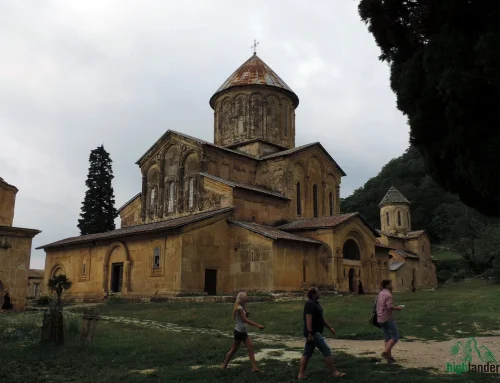
Do not confuse Katskhi Pillar with Katskhi Monastery, a separate medieval complex in the same village around 1.5 kilometres away.
The Monastery of the Nativity of the Savior was built for the Baguashi-Liparitid family between approximately 988 and 1014, during the reign of King Bagrat III. Its central church is notable for a rare multi-apsed, hexagonal design and rich stone carving. It also served as an important family monastery and burial place.
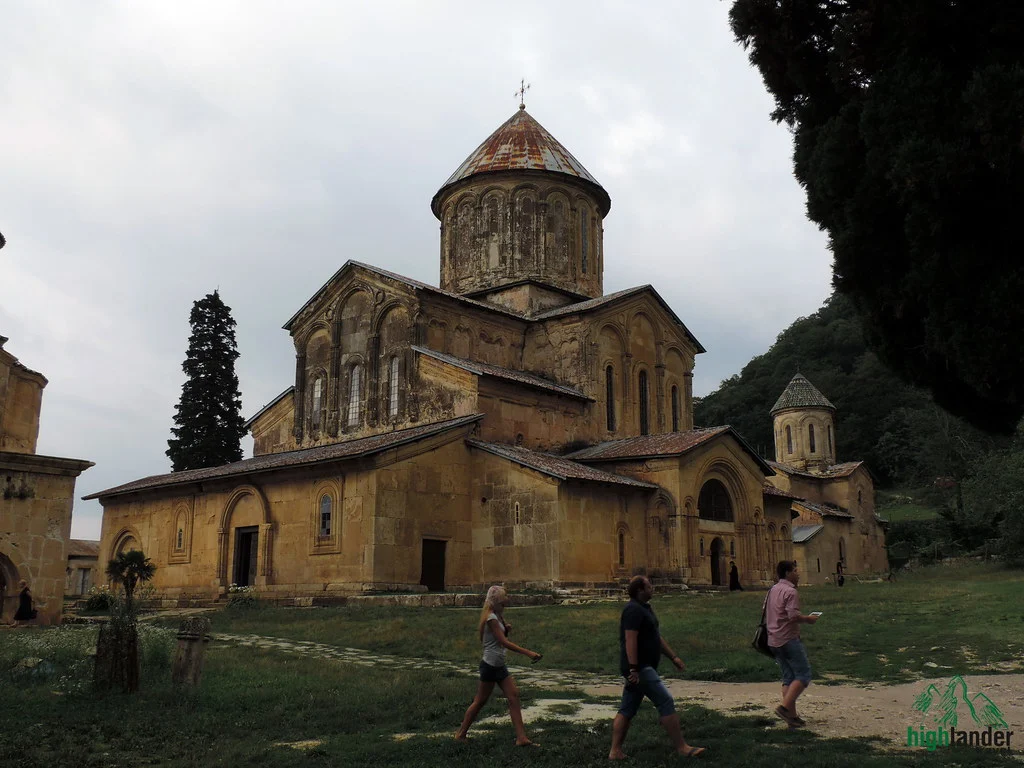
The monastery was closed by the Soviet authorities in 1924 and revived in 1990. It is now an active religious site and is worth visiting as a complement to the pillar. For another major Imereti monument, see our guide to Gelati Monastery.
Visiting Katskhi Pillar
Location and distances
Katskhi Pillar is in Katskhi village in the Imereti region of western Georgia, a short drive from Chiatura.
- From Tbilisi: approximately 190–220 km; allow at least 3.5–4 hours each way, depending on the route and traffic
- From Kutaisi: approximately 65–75 km; usually 1.5–2 hours by road
- From Chiatura: approximately 5–10 km; usually 15–25 minutes by road
Distances and journey times vary according to the chosen road, stops and current conditions.
Arriving by car
Road signs in Katskhi direct visitors towards the monastery area. Parking arrangements and the condition of the final approach can change, so follow local signs rather than relying on old descriptions of “first” and “second” car parks. Wear shoes with good grip for uneven or muddy paths.
Public transport
Marshrutkas connect Tbilisi and Kutaisi with Chiatura, but departure points and schedules can change. Confirm the service locally on the day of travel. From Chiatura, a taxi is normally the simplest way to reach Katskhi village; agree on the fare and waiting time in advance.
For a simpler day trip, browse our tours from Kutaisi or ask us to create a private Imereti route.
What visitors can access
Visitors may view and photograph the pillar from the ground and enter public areas at the base when open. The summit, ladder, monastic residences and restricted buildings are not open to general visitors. Do not climb barriers or attempt an unauthorised ascent.
Dress code and conduct
Katskhi is an active Georgian Orthodox monastery. Cover shoulders and knees, and wear clothing suitable for a religious site. Men should remove hats inside churches, while women may be asked to cover their hair. Keep voices low and avoid photographing clergy, residents or services without permission.
Best time to visit
Spring and autumn usually provide comfortable temperatures and attractive landscapes. Early morning and late afternoon offer softer light for photography. Rain can make the paths slippery, while summer afternoons can be hot.
How much time to allow
Allow around 45–90 minutes for the viewpoint, public monastery area and photographs. Set aside a full day if combining Katskhi with Chiatura, Mgvimevi Monastery or other Imereti attractions.
Combining Katskhi Pillar with Chiatura
Katskhi is commonly combined with Chiatura, a manganese-mining town built across a steep river valley. The city became an important industrial centre in the late 19th and early 20th centuries, and a passenger cable-car system began operating in 1954.
Four modern Poma ropeway lines now connect districts around Chiatura’s central station. Parts of the historic Soviet network survive as industrial heritage, while additional lines have undergone or continued reconstruction. A municipal update in March 2026 showed that work on the Chiatura–Perevisa line was still in progress, so old blog posts listing every line as operational are unreliable.
Do not publish a fixed fare or timetable without checking it immediately before publication. Operating hours, maintenance closures and available routes can change. The old suspended cars and derelict stations should be viewed only from safe public areas.
What to see in Chiatura
- The modern central cable-car station and whichever lines are operating
- Historic cable-car stations and Soviet-era mosaics visible from public areas
- Chiatura’s mining landscape and river-valley viewpoints
- The local history museum, subject to current opening hours
- Mgvimevi Monastery, a rock-cut religious complex near the town
Suggested route from Kutaisi
Allow a full day for Kutaisi → Katskhi Pillar → Katskhi Monastery → Chiatura → Mgvimevi Monastery → Kutaisi. Check cable-car operation and museum access before departure. Our Kutaisi travel guide and Imereti destination guide provide additional ideas for a longer stay.
Why Katskhi Pillar Matters
Religious history
Katskhi is a rare Georgian example of a natural rock formation adapted for stylite monasticism. Its medieval complex, later inscription and modern revival show how the same site acquired new religious meanings across different periods.
Archaeology and architecture
The summit demonstrates how medieval builders fitted a church, cells, storage areas and a burial vault into an irregular space of only about 150 square metres. Archaeological reinterpretation also shows why early expedition reports should not be repeated without considering later research.
The landscape
Even without summit access, the relationship between the narrow limestone pillar, the restored church and the surrounding Imereti valley makes Katskhi visually distinctive. The site is most rewarding when visited respectfully and combined with the region’s other religious and industrial heritage.
Conclusion
Katskhi Pillar brings together geology, medieval archaeology and an active monastic tradition in a remarkably compact site. Its story is strongest when established evidence—the 9th–10th-century complex, the 13th-century inscription, the 1944 ascent and the modern restoration—is kept separate from local legend and later speculation.
The summit is not a visitor attraction and cannot be climbed. From the public area below, however, travellers can appreciate the engineering challenge of the medieval hermitage and place it within a wider day trip through Katskhi village and Chiatura.
Frequently Asked Questions About Katskhi Pillar
Can visitors climb Katskhi Pillar?
No. The summit and its ladder are not open to general visitors. View the pillar from the public area below and follow all monastery signs and instructions.
How high is Katskhi Pillar?
Katskhi Pillar rises approximately 40 metres, or 130 feet, above the surrounding valley.
When was the church on Katskhi Pillar built?
Current archaeological interpretation dates the principal medieval church and hermitage to the 9th or 10th century. A 13th-century inscription confirms later religious activity on the summit.
Who lived on Katskhi Pillar in modern times?
Monk Maxime Qavtaradze revived religious life at Katskhi in the 1990s and lived primarily on the pillar for around twenty years while the summit complex was restored.
What was discovered during the 1944 ascent?
The expedition documented ruined religious buildings, cells, storage areas, qvevri and human remains in a burial vault. Later research revised the original dating of the complex.
Is Katskhi Pillar the same as Katskhi Monastery?
No. Katskhi Pillar is the limestone monolith with a church on its summit. Katskhi Monastery is a separate early 11th-century religious complex around 1.5 kilometres away.
How far is Katskhi Pillar from Kutaisi?
Katskhi Pillar is approximately 65–75 kilometres from Kutaisi. The drive usually takes around 1.5–2 hours, depending on the route and conditions.
Can Katskhi Pillar be combined with Chiatura?
Yes. Katskhi is a short drive from Chiatura and can be combined with the city’s cable cars, industrial heritage, local museum and Mgvimevi Monastery. Check current operating hours before travelling.
Is there an entrance fee at Katskhi Pillar?
The public monastery area has generally been accessible without a standard admission ticket, but access arrangements can change. Donations may be accepted, and private transport or guided services have separate costs.
How much time is needed at Katskhi Pillar?
Allow approximately 45–90 minutes for the viewpoint, public monastery grounds and photographs. Plan a full day when combining Katskhi with Chiatura and nearby monasteries.
Plan Your Imereti Day Trip
Combine Katskhi Pillar with Chiatura and Mgvimevi Monastery on a private day trip from Kutaisi. Browse our tours from Kutaisi, explore more places in the Imereti region, or contact Highlander Travel for a customised route.
If you are staying longer in western Georgia, combine this itinerary with the Imereti caves and protected areas or explore our private tours in Georgia.