Five days through Georgia’s hidden wine country—where €200 bottles grow on single mountain slopes, naturally semi-sweet reds predate European traditions by millennia, and family winemakers guard grape varieties that exist nowhere else on Earth
While the world discovers Kakheti’s Saperavi and Rkatsiteli, Western Georgia guards wine secrets that even many Georgians haven’t tasted. This is where Georgia’s most expensive wine grows on a single mountain slope, where semi-sweet reds preceded European dessert wines by millennia, and where family winemakers still cultivate grape varieties that exist nowhere else on earth.
This five-day journey takes you deep into the humid, mountainous regions of Racha, Lechkhumi, and Imereti—territories that produce wines as different from Eastern Georgia as Burgundy is from Rioja. You’ll cross mountain passes at 1,500 meters, drive rutted roads to remote vineyards, taste wines that cost €200 per bottle in Tbilisi restaurants, and meet winemakers whose families have cultivated the same slopes for centuries.
This isn’t a tour for those seeking comfort and predictability. It’s for wine lovers who want to taste something genuinely rare, travelers who appreciate that the best experiences require effort, and anyone curious about why Georgia’s western wines remain one of the country’s best-kept secrets.
This tour suits: Wine enthusiasts seeking rare varieties unavailable elsewhere, adventure travelers comfortable with mountain roads and rural accommodations, photographers chasing dramatic landscapes, cultural explorers interested in authentic traditions, and anyone who values depth over polish.
This tour doesn’t suit: Those seeking luxury hotel accommodations, travelers uncomfortable with winding mountain roads, visitors expecting Kakheti-style polished wine tourism, people with severe motion sickness, or those wanting a relaxed, predictable itinerary.
Tour highlights
15-20 rare wines • 4 nights at wineries • Mountain passes to 1,500m • UNESCO sites • Remote vineyards where buses can’t follow
Why Western Georgia Wines Are Different
Geography creates personality in wine, and Western Georgia’s geography couldn’t be more different from Kakheti’s sun-drenched valleys. Here, the Caucasus Mountains trap humid air from the Black Sea, creating a subtropical climate where vines grow lush and grapes develop differently. While Kakheti produces bold, tannic dry wines perfect for qvevri aging, Western Georgia naturally produces semi-sweet wines—not through added sugar, but from grapes so rich in natural sugars that they retain sweetness even after fermentation.
Khvanchkara: Stalin’s Favorite Wine
The Racha-Lechkhumi region specializes in naturally semi-sweet wines that earned international recognition in the 19th century when Russian aristocrats declared Khvanchkara their favorite. Stalin’s preference for Khvanchkara made it famous, but the wine’s quality keeps it relevant. Small production volumes mean these bottles rarely leave Georgia, and when they do, prices reflect their scarcity.
The Khvanchkara micro-zone exists in a specific location along the Rioni valley where soil composition, precise elevation, and microclimate influenced by surrounding peaks create conditions found nowhere else. Only here do Alexandrouli and Mujuretuli grapes develop the characteristics that produce authentic Khvanchkara—naturally semi-sweet, ruby-red, with notes of raspberry and pomegranate, balanced acidity preventing cloying sweetness.
Usakhelauri: Georgia’s Most Expensive Wine
Usakhelauri, grown only on the western slopes of Khvamli Mountain in microclimates so specific that attempts to cultivate it elsewhere have failed, produces Georgia’s most expensive wine. A single bottle can cost 300-500 GEL (€100-180) in Tbilisi. The grapes require intensive hand labor, yields are tiny, and the resulting wine is deep red, aromatic, and naturally sweet—tasting like nothing else. Its Georgian name means “nameless,” though whether this refers to its rarity or its indescribable character remains debated.
Production barely reaches a few thousand bottles annually. The variety demands intensive care: late ripening, susceptible to disease in a humid climate, and low yields even in good years. Attempts to cultivate Usakhelauri in other regions, even within Lechkhumi, have failed. These particular slopes, these specific soils, this microclimate—only here does the grape express its full potential.
Tvishi: The Wine That Converts Skeptics
Tvishi, another naturally semi-sweet white wine, comes from Tsolikauri grapes that thrive in Lechkhumi’s narrow gorges. Delicate, floral, balanced—it’s the wine that converts people who claim they don’t like sweet wines. Production stays small, quality remains high, and outside Lechkhumi itself, finding authentic Tvishi requires effort.
Imereti: Where Western Wine Begins
Imereti serves as the gateway to Western Georgian wine culture. Here you’ll encounter Tsitska (fresh dry white with minerality and citrus), Krakhuna (amber wine fermented with skins developing complex nutty, honeyed notes), and Otskhanuri Sapere (semi-sweet red that shows how Western Georgia’s climate creates natural sweetness without cloying). These wines provide context for understanding the rarer Racha and Lechkhumi varieties that follow.
Tour Itinerary
Start: Kutaisi | End: Terjola winery | Duration: Full day
Morning: UNESCO Heritage Sites
Your journey begins in Kutaisi, Georgia’s ancient capital and third-largest city. Morning light reveals Bagrati Cathedral dominating the skyline—built in the 11th century under King Bagrat III, the monarch who unified Georgia. The cathedral stands as both an architectural masterpiece and a symbol of national identity. The views over Kutaisi and the Rioni River are spectacular.
A short drive brings you to Gelati Monastery, another UNESCO site and perhaps the most important monastery in Georgian history. King David the Builder established Gelati as Georgia’s intellectual center in the 12th century, founding an academy that taught philosophy, theology, and sciences. The mosaics and frescoes inside represent Georgian medieval art at its finest. Your guide explains why David requested burial not inside the church, but under the gateway where every monk would walk over him—an act of humility from Georgia’s greatest king.
Afternoon: Nature and Wine
The day shifts from cultural immersion to natural beauty at Dzusa waterfall, where the Rioni River cascades through forested gorges. Then the character of the journey changes as you reach Terjola, entering a wine country that operates on different rhythms than famous Kakheti.
Your first winery welcomes you with the kind of hospitality that defines Western Georgia. Here you’ll taste wines that reveal the region’s personality: Tsitska (fresh dry white with minerality and citrus), Krakhuna (amber wine fermented with skins developing complex nutty, honeyed notes), and Otskhanuri Sapere (semi-sweet red showing how Western Georgia’s climate creates natural sweetness).
Evening: Dinner at the Winery
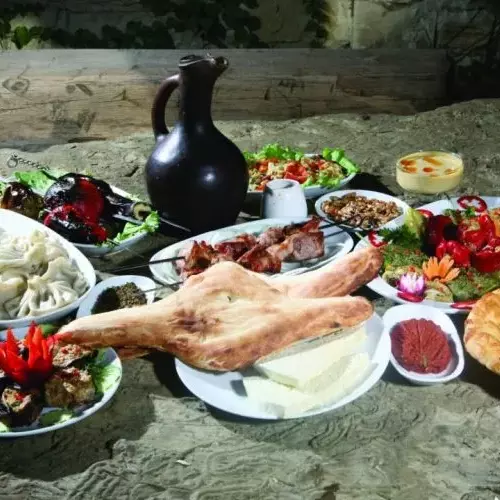
Dinner pairs these wines with Imeretian cuisine—khachapuri (the western version is flatter and less cheesy than Adjarian or Megrelian styles), lobio (bean stew), shkmeruli (chicken in garlic cream sauce), and seasonal vegetables. You’ll overnight here, falling asleep in wine country silence broken only by night birds and the occasional dog barking in distant villages.
Overnight: Terjola winery guesthouse (dinner included)
Route: Terjola → Nakerala Pass (1,500m) → Racha | Duration: Full day
Morning: Mountain Crossing
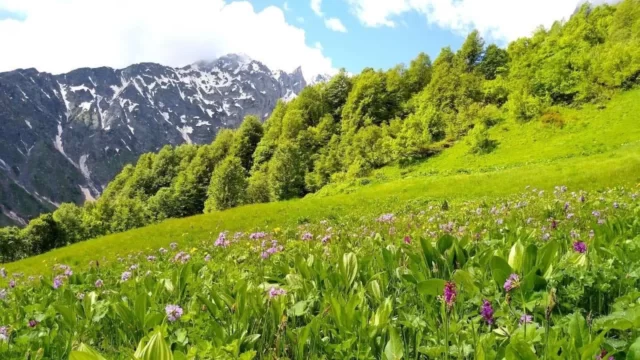
The drive to Racha ranks among Georgia’s most scenic journeys. Nakerala Pass climbs to 1,500 meters, revealing sweeping views over the Kolkheti valley toward the Black Sea coast. On clear days, the contrast between humid lowlands and alpine heights creates an atmospheric perspective that photographers dream about. The landscape shifts from subtropical to mountain forest as you climb, then opens dramatically as you descend toward Racha.
Shaori reservoir appears like a mountain jewel—an artificial lake created in Soviet times that now serves as both a hydroelectric resource and an accidental beauty spot. The surrounding peaks reflect in still water when the weather cooperates.
Midday: Medieval Masterpiece
Before reaching Racha’s wine heartland, a detour brings you to Nikortsminda Church, an 11th-century masterpiece whose exterior stone carving and interior frescoes represent Georgian ecclesiastical art at its pinnacle. The church sits in a village that time seems to have bypassed, where old women in headscarves tend gardens and cows graze near medieval walls.
Afternoon: Khvanchkara Micro-Zone
Ambrolauri, Racha’s modest capital, serves as a gateway to the Khvanchkara micro-zone. The Rioni valley here creates conditions found nowhere else: specific soil composition, precise elevation, and microclimate influenced by surrounding peaks. Only in this small zone do Alexandrouli and Mujuretuli grapes develop the characteristics that produce authentic Khvanchkara—naturally semi-sweet, ruby-red, with notes of raspberry and pomegranate.
Soviet-era mass production and post-independence fraud damaged Khvanchkara’s reputation (many bottles sold as Khvanchkara contain cheaper blends), but quality producers maintain standards that earned this wine imperial favor. The micro-zone’s limited size means annual production stays small, and real Khvanchkara commands prices reflecting its scarcity.
Evening: Chateau Dio
Chateau Dio represents the new generation of Georgian winemaking—young vintners applying technical knowledge while respecting tradition. The estate’s location offers views over Khvanchkara vineyards, and dinner here pairs the estate’s wines with Rachian cuisine, known for being richer and heartier than other Georgian regions. Rachian ham, aged cheese, lobiani (bean-filled bread), and kubdari (meat-filled bread) provide substance for wine appreciation that continues into the evening.
Overnight: Chateau Dio estate (dinner included)
Route: Chateau Dio → Lechkhumi → Tvishi → return | Duration: Full day adventure
Into Remote Lechkhumi
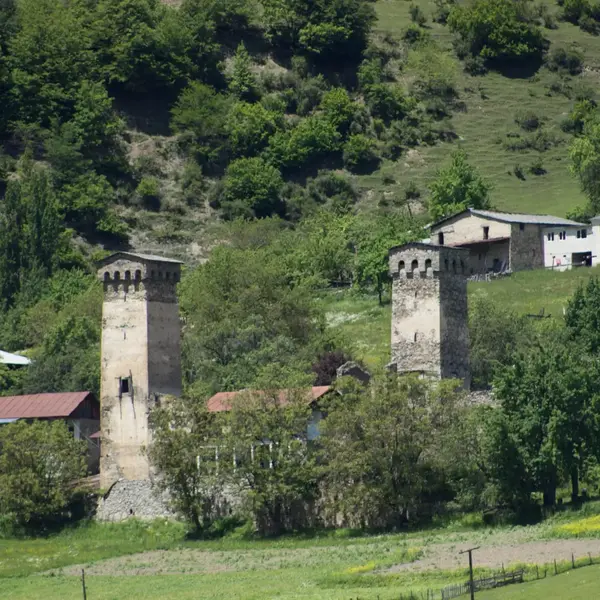
Today ventures into Lechkhumi, a region so remote that even most Georgians know it only by reputation. Sandwiched between Racha, Imereti, and Svaneti, Lechkhumi developed wine traditions in isolation. The Rioni River, which flowed broad and gentle in lower valleys, here cuts a narrow gorge through mountains. Roads cling to cliffsides, villages perch on slopes, and tourism infrastructure remains minimal.
Khvamli Mountain dominates the western horizon—a massive, mysterious presence that locals invest with spiritual significance. The mountain’s rocks and ridges create dramatic silhouettes, and its slopes shelter the vineyards you came to find.
Waterfalls and Mountain Churches
Waterfalls become a theme of the day. Gvirishi and Nikordziri waterfalls demonstrate Lechkhumi’s water abundance—this is some of Georgia’s wettest territory, where springs emerge from mountainsides and every ravine carries rushing water.
The off-road drive to Mount Orkhvi tests vehicle and driver, but the ruins of St. George Church at the summit, with 360-degree mountain panoramas, justify the rough kilometers.
Tvishi Village: Wine at Its Source
Tvishi village sits in a valley where Tsolikauri grapes have grown for centuries. The micro-zone’s specific conditions—elevation, humidity, mountain-protected climate—create grapes with natural sugar levels and acidity that produce Tvishi wine’s distinctive character. Your host winemaker walks you through vines, explaining cultivation challenges in this climate, showing how traditional Georgian viticulture adapts to steep slopes and heavy rain.
Barbecue in the Mountains
The barbecue prepared in your honor follows Georgian tradition: mtsvadi (grilled meat on vine branches), fresh vegetables, herbs picked that morning, and local cheese. Tvishi wine accompanies everything—its delicate sweetness and floral notes balancing smoky meat and sharp cheese. This is wine tourism at its most authentic: no tasting room, no merchandise, just a winemaker sharing his craft in the place where it happens.
You return to Chateau Dio for the night, the mountain drive at dusk offering different light and atmosphere than morning’s journey.
Overnight: Chateau Dio estate
Route: Racha → Orbeli Pass → Usakhelauri vineyards → Kinchkha | Duration: Full day
Morning: Another Mountain Crossing
Tskhenistskali valley requires crossing Orbeli Pass, another mountain route where dramatic scenery distracts from the road’s challenges. The western slopes of Khvamli Mountain—the same peak you admired yesterday from the east—hide Lechkhumi’s greatest wine secret.
The Usakhelauri Experience
Usakhelauri grapes grow in vineyards so small and conditions so specific that production barely reaches a few thousand bottles annually. The variety demands intensive care: late ripening, susceptible to disease in a humid climate, and low yields even in good years.
The resulting wine justifies its reputation and price. Deep garnet color, intense aromatics of dark berries and mountain herbs, natural sweetness balanced by surprising acidity, finish that lingers. Wine critics compare Usakhelauri to great Sauternes or vintage Port, but the comparison fails—this wine tastes like nowhere else. Scarcity keeps it largely within Georgia, where collectors pay premium prices and restaurants feature it as their crown jewel.
Visiting the vineyard, meeting the winemaker, understanding the viticulture challenges, and tasting Usakhelauri at its source creates the kind of wine experience that even seasoned enthusiasts rarely encounter. Lunch accompanies the tasting with simple food that doesn’t compete with the wine but provides necessary balance.
Afternoon: Kinchkha and Aladasturi
The afternoon brings you back to Imereti. Kinchkha village produces Aladasturi, another rare grape variety making semi-dry red wine with characteristics between Kakheti’s bold Saperavi and Racha’s sweet Khvanchkara.
Kinchkha waterfall, dropping 70 meters in multiple cascades through mossy forest, ranks among Georgia’s most impressive natural sights. The nearby Lomina waterfall offers different character—wider, more powerful, the sound audible from hundreds of meters away.
Overnight: Kinchkha winery (dinner included)
Route: Kinchkha → Okatse Canyon → Kutaisi | Duration: Half day
Morning: Canyon Finale
The final morning takes you back toward Kutaisi, but one last natural wonder awaits. Okatse Canyon cuts a dramatic gorge through limestone, creating walls up to 50 meters high. A suspended metal walkway allows you to walk above the canyon floor, the Okatse River rushing below, ferns and moss covering vertical walls, and waterfalls appearing around bends.
The canyon serves as an appropriate finale—a reminder that Western Georgia’s appeal extends beyond wine to encompass landscape diversity that ranges from subtropical lowlands to mountain peaks, humid gorges to limestone canyons.
Tour Conclusion: Kutaisi
Your wine tour concludes in Kutaisi, where the journey began five days earlier. The wines you’ve tasted, the winemakers you’ve met, the roads you’ve traveled, and the mountain landscapes you’ve crossed have revealed a side of Georgia that remains unknown even to many who’ve visited Kakheti’s famous wineries.
Arrival in Kutaisi: Late morning/early afternoon—with five days of rare wine memories, dozens of varieties tasted, and a deep appreciation for Western Georgia’s hidden treasures.
Price details
[wptb id=17403]
What’s Included
Tour map
Kutaisi (Start/End)
Bagrati Cathedral (UNESCO)
Gelati Monastery (UNESCO)
Dzusa Waterfall
Terjola Winery (Night 1)
Nakerala Pass (1,500m)
Shaori Reservoir
Nikortsminda Church
Ambrolauri
Chateau Dio - Khvanchkara (Nights 2-3)
Gvirishi & Nikordziri Waterfalls
Mount Orkhvi - St. George Church
Tvishi Village
Khvamli Mountain
Orbeli Pass
Usakhelauri Vineyards
Kinchkha Winery (Night 4)
Kinchkha Waterfall (70m)
Lomina Waterfall
Okatse Canyon
Tour gallery
Practical Information
Duration: 5 days / 4 nights
Start/End: Kutaisi
Group Size: Small groups (4-8 people) or private arrangements
Difficulty: Moderate—requires comfort with mountain roads and rural accommodations
Best Season: May-October (September-October for harvest season)
Language: English (Russian, German available on request)
What to Bring
Comfortable walking shoes: For walking on uneven ground at wineries and waterfalls.
Light rain jacket: Western Georgia is humid—sudden showers are common.
Layers: Temperature varies significantly between valley (warm) and mountain passes (cool).
Camera: Landscapes range from subtropical to alpine—you’ll want to capture them.
Sunscreen: Mountain sun is strong even on cloudy days.
Personal medications: Rural areas have limited pharmacy access.
Physical Requirements
No significant hiking required, but expect walking on uneven ground at wineries and waterfall viewpoints. Mountain driving involves winding roads and some unpaved sections—not suitable for those with severe motion sickness. Accommodations are comfortable but rural—clean rooms with private bathrooms, but not luxury hotels.
Wine Purchases
Most wineries sell bottles directly at significantly lower prices than Tbilisi. Expect to pay 25-80 GEL (€8-25) for most Western Georgian wines. Usakhelauri costs 250-400 GEL (€80-130) when available. Your guide can help arrange purchases and shipping if buying multiple bottles. Cash preferred at most wineries.
Best Time to Visit
May-June ⭐⭐⭐⭐: Spring brings wildflowers and green landscapes. Occasional rain possible. All mountain passes open.
July-August ⭐⭐⭐: Warmer temperatures in lower elevations but pleasant in mountains. Long days for exploration. Waterfalls at peak flow.
September-October ⭐⭐⭐⭐⭐: Ideal season—grape harvest (rtveli) means winemaking activity, autumn colors in mountains, golden light for photography.
November-April ⭐⭐: Unpredictable weather, potential road closures at higher passes. Some wineries reduce operations. Not recommended.
Tour FAQ
Why Book This Tour
Most Georgia wine tours follow well-worn paths through Kakheti’s Alazani valley, visiting the same wineries that accommodate buses daily. This tour goes where buses can’t follow—to regions producing wines that rarely leave their home valleys, meeting winemakers who work outside commercial tourism.
You’ll taste wines that cost €200 per bottle in fine restaurants, made in quantities so small that export remains impossible. You’ll understand why Western Georgia’s climate produces naturally sweet wines that predate European traditions by millennia. You’ll drive roads that test vehicles and drivers, cross passes that reveal Georgia’s mountain geography, and eat meals at family tables where hospitality remains genuine rather than performative.
The wines justify the effort. Khvanchkara’s raspberry-pomegranate notes and balanced sweetness explain why Russian aristocrats and Soviet leaders prized it. Usakhelauri’s complexity—dark berries, mountain herbs, surprising acidity—justifies its price and scarcity. Tvishi converts even skeptics who claim they don’t like sweet wines. These aren’t tourist wines; they’re the bottles Georgian winemakers keep for special occasions.
We’ve built relationships over years. The winemakers who host you aren’t performing for tourists—they’re sharing their craft with guests we’ve personally vouched for. Chateau Dio’s young vintners explain their technical approach. Tvishi’s family winemaker walks you through vines his grandfather planted. Usakhelauri’s producer shares bottles from his personal reserve. These relationships take years to build and can’t be replicated by booking online.
This is wine tourism for those who measure success not in number of wineries visited but in depth of understanding gained, who value authenticity over comfort, and who seek experiences that can’t be replicated anywhere else.